A Work Project presented as part of the requirements for the
Award of a Masters Degree in Management from NOVA –
School of Business and Economics
The Compliance Function in Banking: Perspective and Future in
the Age of Globalization
Artur Ferreira Conrado Torres Pereira
Student number 787
A Project carried out on the Management course, under the
supervision of: Professor Carlos Alves Marques
June 4
th, 2012
The Compliance function in banking: perspective and future in the age of
globalization
! !
! ! !
Abstract:
Ethically correct business decisions and the respect for applicable laws and regulations have become in demand for regulators and supervisors, but especially for the general public. For those behaviors to happen, compliance culture is an essential requirement. Through survey research, we prove the existence of a relationship between the workers’ level of compliance culture and their hierarchical position, which may indicate communication problems between hierarchies. This area is also given a comprehensive outlook, as the globalization process combined with financial regulatory reforms lead multinational corporations to a more challenging equilibrium between their compliance departments’ actions and budgets. !
! ! ! ! ! !
Index
Introduction __________________________________________________________ 5
Theoretical Framework _________________________________________________7
Compliance risk ___________________________________________7
Reputational risk ___________________________________________9
History __________________________________________________10
Compliance Culture ________________________________________13
Methodology _________________________________________________________16
Results ______________________________________________________________19
Discussion ___________________________________________________________ 24
Limitations _______________________________________________29
Recommendations _________________________________________29
Conclusions __________________________________________________________31
“It’s not hard to do the right thing; in fact it’s easy. What’s hard is
knowing what the right thing to do is. Once you know that, and
believe it, doing the right thing is easy.”
Introduction
In light of recent financial and accounting scandals1, that started in the turn of
the 21st century with Enron and WorldCom and carried on into its first decade with
AIG, Madoff Investment Securities and most notoriously, Lehman Brothers, financial
and political institutions alike have been forced to rethink and rebuild the way the
financial sector is supervised and controlled. As these changes take place, the amount of
guidelines and regulation banks have to comply to has increased substantially2, as has
the scrutiny that the general public subjects them to, with such values as transparency
and ethical behavior becoming a crucial requirement for bank sustainability3. This has
forced banks to substantially change the way they look at Compliance, from a strategic
point of view, as the line that distinguishes not only a compliant action from ethical
behavior but, most importantly, the one that distinguishes a non-compliant action from
unethical behavior has become increasingly blurry.
The growing importance of European and global guidelines, emphasized by an
ever smaller world (both technologically and politically) and the amplified strictness
from public opinion facing the financial sector, especially after recent developments and
its consequences, will make Compliance an increasingly important aspect of business
for any bank wanting to remain competitive and relevant.
As we will try to show, compliance is every worker’s responsibility and
therefore, the strength, uniqueness and coherence of the company’s compliance culture
(a concept we will study in further detail) will be paramount to conclude on what ethical
standards are most commonly used at that organization while making everyday business !!!!!!!!!!!!!!!!!!!!!!!!!!!!!!!!!!!!!!!!!!!!!!!!!!!!!!!!
1 CNN Money. 2012. money.cnn.com/2002/01/11/companies/acct_scandals/ (accessed January, 30th,
2012)
2
Thomson Reuters. 2012.The State of Regulatory Reform 2012
3 Malcolm Hayday. 2012. “Banks must put ethical principles at the heart of their operations”. The
decisions, given the role that emotions play in decision-making4. In this Work Project,
our goal will be to assess the compliance culture of the institution in which we carried
out our Internship. First, we will look to quantify it and, next, we will try to characterize
it. That is to say we wish to understand how the bank’s employees feel about
compliance, and how they position themselves relative to its requirements i.e., do they
feel that compliance gets in the way of their daily duties or, rather, they take pleasure in
feeling (and knowing) that what they are doing is in compliance to applicable
regulation, ethical standards and best practices? To characterize it, we wish to study the
main dimensions of a compliance culture – knowledge of theoretical concepts, attitude
towards compliance and the perception of its influence in the bank’s performance -
across the different groups that can be formed within the bank’s working force i.e. does
someone that has been with the bank for 20 years have a higher probability of knowing
more about compliance or having a different (more active) attitude towards compliance
than someone that has recently joined the institution? Or is someone that has a higher
hierarchical position more prone to being sensible to this subject than someone at the
bottom of the organizational pyramid?
These and other organizational variables will be analyzed during the course of
our study, as well as descriptive information that we will use in order to build on our
recommendations and conclusions about the current scenario at the banking institution
that received us.
!!!!!!!!!!!!!!!!!!!!!!!!!!!!!!!!!!!!!!!!!!!!!!!!!!!!!!!!
4 Mellers, B. A. and A. P. McGraw. 2001. ‘‘Anticipated Emotions as Guides to Choice.’’ Current
Theoretical Framework
The word compliance comes from the verb to comply, which in its turn comes
from the Latin phrase complere, meaning to fulfill or to meet specified standards. This
term is of common use in many different social and business settings: In mechanics, it is
used to describe how much certain materials respond to stimulus; In medical science, it
can be used to measure how well a patient is following the prescribed treatment but is
also used to describe a muscle’s ability to bend; In the corporate world, however, we
will mostly discuss regulatory compliance i.e. the act of being in accordance to legal
and regulatory guidelines5, as well as promoting and incentivizing ethical behavior at all
time6. So put, compliance translates the choice or need an organization has of respecting
the rules or regulations that govern its operations or its industry, both externally and
internally. Additionally, the term compliance is also associated to the overall attitude
assumed towards these responsibilities. A company that understands the importance of
spending its time and resources making an effort in order to become compliant is one
that embodies this feeling, in the sense that it will sometimes be doing more than the
strictly necessary.
Compliance risk
Simply put, it can be said that the compliance department’s main responsibility
is to manage (and report to the Board) matters, events, regulatory updates, supervisory
relations and controversial decisions related to compliance risk. Compliance risk was
first formally categorized and acknowledged by the Basel Committee on Banking
!!!!!!!!!!!!!!!!!!!!!!!!!!!!!!!!!!!!!!!!!!!!!!!!!!!!!!!!
5
Basel Commitee on Banking Supervision. 2005. Compliance and the compliance function in banks.
6 Weaver, Gary R. and Linda Treviño. 1999. “Compliance and values oriented ethics programs:
Supervision in 20057 and also appears in Portuguese regulation8 as one of the 10 risk
categories challenging businesses today9. It´s defined as “the probability of negative
impacts in earnings or capital that arises from violations or nonconformance with laws,
regulations, specific determinations, contracts, implemented practices, ethical standards
or codes of conduct or of customer relations.”10. These negative impacts can materialize
themselves in many different ways, spanning from financial to business and, of course,
legal sanctions. Any institution that disregards or neglects the compliance risk it is
subject to, be it directly through the organization´s characteristics or indirectly via the
industry or sector where it operates, may be subject to fines, civil money penalties
(financial sanctions), voiding11 of contracts or loss of business opportunities (business
sanctions). Competitive disadvantages may also arise from conditions imposed from
judicial decisions, urging changes or adaptations to be made with accrued pressure and
less strategic preparation or planning. In a sense, compliance risk is rather unique as,
unlike market risk or interest rate risk (that depend almost exclusively on factors
external to the company and that it cannot control), its effects on corporations will
depend almost exclusively on the company itself – i.e., how fast the company is at
detecting new standards and how culturally devoted it is in making everything in its
power to respect existing regulation. Additional criteria for successful compliance risk
mitigation could be how well legislation is interpreted – as poor interpretation alone
may lead to negative consequences12.
To fully convey the practical meaning of this risk, let us imagine a man driving a
!!!!!!!!!!!!!!!!!!!!!!!!!!!!!!!!!!!!!!!!!!!!!!!!!!!!!!!!
7 Basel Commitee on Banking Supervision. 2005. Compliance and the compliance function in banks.
8 Banco de Portugal. 2008. Aviso nº5/2008
9
See Appendix 1 for full list
10Basel Commitee on Banking Supervision. 2005. Compliance and the compliance function in banks
11 Loss of legal validity or binding power due to possible breeches in contractual duties
12 See Smiley v. Citybank for a case of regulatory interpretation related to the banking industry
car on a national highway, like the one connecting Lisbon and the Algarve, the A2. As
in almost every human activity, we have risk – operational risk. There is a risk that the
man has an accident and could eventually be injured. He knows that the maximum
speed allowed by law is 120 km/hour and he also knows that, if he respects that limit,
the traffic brigade cannot sanction him. If the man chooses to drive at a constant speed
of 150 km/hour in order to take less time, however, he knows that not only will his
operational risk increase, but we will also be breaking the law. The risk the man incurs
while driving at 150 km/hour on a highway of being caught by the police and paying a
fine is the man’s compliance risk. The amount of the fine and the man’s personality will
establish whether he will accept that risk or not – he may think it is endurable and
possibly worth it, according to its risk appetite. Maybe that was what happened with
many investment-banking corporations in the business world in recent years.
Reputational risk
Another consequence that looms over companies with compliance difficulties is
reputational issues, which are strongly associated with compliance risk. More than
financial and business sanctions, a negative impact on a firm’s reputation can
potentially create the most enduring, crippling and costly of hindrances that a company
can face13. The automobile industry has given us the latest and most forceful examples,
with the recall of thousands of cars due to technical or mechanical failures14,15 causing
more than significant losses, not just due to operational costs but also due to the
business lost in periods to come, as consumers and business partners alike perceive that
!!!!!!!!!!!!!!!!!!!!!!!!!!!!!!!!!!!!!!!!!!!!!!!!!!!!!!!!
13Perry, Jason and De Fontnouvelle, Patrick. 2005. “Measuring Reputational Risk: The Market Reaction
to Operational Loss Announcements”
14
Ohnsman, Alan and Makiko Kitamura. 2010. “Is Toyota’s Reputation Finished?”, Business Week.
http://www.businessweek.com/lifestyle/content/jan2010/bw20100128_413922.htm
15 Clifford Krauss. 2010. “Oil Spill’s Blow to BP’s Image May Eclipse Costs”, The New York Times.
specific brand as unsafe or unreliable. Naturally, media hype around these events is
usually not unrelated to this loss of trust but the consequences are, all the same,
extremely negative.
In the financial sector, this too has come to be a very sensitive issue, as is the
sensitivity of the decision of which bank to leave your money with. Individual clients
and corporations are increasingly willing to spear no efforts in making sure that their
money is safe and a bank´s reputation is crucial in this decision16. Switching costs,
apparently, pose no obstacle17. Unfortunately, good reputation is something that many
banks and financial institutions in general have been struggling to keep18, even when
they have had little to do with or fought to avoid the kind of credit policies that led the
financial industry to the dead end situation in which it is right now.
Historical Background
Compliance first began to reach some notoriety at the turn of the 20th century,
when the first public safety agencies started to appear in the USA, as there were
increasing concerns on the capability (or willingness) of private agents to provide a
product or service that would unselfishly serve the community as a whole, while still
making a profit for themselves and remaining sustainable. This was true for such
diverse industries as the food industry (quality of the products sold to consumers) and
the financial industry (honesty or interests of the person providing the service). The
creation of industry-specific enforcement agencies (e.g. pharmaceutical and
environmental, for instance) looked to build on this compliance momentum.
!!!!!!!!!!!!!!!!!!!!!!!!!!!!!!!!!!!!!!!!!!!!!!!!!!!!!!!!
16 Helm S.. 2007. “The role of Corporate Reputation in Determining Investor Satisfaction and Loyalty”
Corporate Reputation Review, Vol.10 #1
17 J.D. Power & Associates. 2011. “Shopping and Switching Rates Increase among Retail Bank
Customers as Competition in the Industry Intensifies”, U.S. Retail Bank New Account Study
18American Banker. 2010. “Bank Reputation Rankings Flash Red”.
However, it was the 1977 Foreign Corrupt Practices Law, which was signed
after a Securities and Exchange Commission (SEC) investigation that exposed the acts
of a considerable number of US companies in bribing foreign officials in exchange for
contract deals or a bidding upper hand19,20, that opened the floodgates on corporate
compliance mechanisms. This event, along with the Watergate scandal, was greatly
responsible for a new “private side” of compliance – private agents taking over
responsibility for compliance and oversight by public agencies taking a secondary role.
Companies started to realize that there was something to gain from allocating some of
their resources to monitoring and controlling their adherence to laws and regulations, as
these resources were substantially less impactful than the possible consequences of a
civil action by any regulatory authority.
It was the US Sentencing Commission that wrote the first formal compliance
and ethics program guidelines, as a response to an increase in corporate scandals and the
lack of coherence in corporate sentencing, when it created the first Federal Sentencing
Guidelines for Organizations (FSGO) in November 1991. Companies following these
recommendations were considered for lighter sentences and controls were implemented
to impose multiple obstacles on criminal behavior.
Despite all these efforts, and as a result of a considerable number of accounting
scandals in the beginning of the 20th century that included Xerox, Enron, WorldCom,
Merrill Lynch and other large corporations, a major overhaul of regulatory requirements
was enacted through the 2002 Sarbanes-Oxley Act (SOX), which revamped issues as
diversified as auditor independence, corporate governance, internal control assessment
!!!!!!!!!!!!!!!!!!!!!!!!!!!!!!!!!!!!!!!!!!!!!!!!!!!!!!!!
19 Time Magazine. 1975. “Lockeed’s defiance: a Right to Bribe?”.
http://www.time.com/time/magazine/article/0,9171,917751,00.html
20 Frantz D. 1998. “Chiquita Still Under Cloud After Newspaper’s Retreat”. The New York Times.
and better financial disclosure21. This Act also created the Public Company Accounting
Oversight Board (PCAOB), responsible for overseeing, regulating, inspecting and
disciplining audit firms and their action in detecting fraud and other illegal practices.
“SOX-type laws“ have been enacted in a number of other countries such as India,
Australia, Germany and France22.
Just a few years later, however, the gap between risk-taking regulation on
investment banking and depository banking had grown considerably, which allowed
investment banks such as Lehman Brothers to irresponsibly build on subprime loans,
but especially mortgages, as a way to leverage its investment business. That made them
extremely vulnerable to even small volatilities in the housing market. The subprime
mortgage crisis, which saw a rise in foreclosures and defaults, brought on more than just
a small volatility and exposed these institutions to the consequences of their doubtful
lending decisions.
The financial crisis that ensued Lehman Brothers’ bankruptcy in September
2008 posed yet another challenge for the financial industry and its supervisors, as both
these agents tried to regain trust from the markets23– the first, for irresponsible actions
and the latter, for its inability to prevent them. “Back to the drawing board”, they might
say, as financial regulation reforms took place and paradigms behind the action of
financial services were, once again, reformulated and improved.
!!!!!!!!!!!!!!!!!!!!!!!!!!!!!!!!!!!!!!!!!!!!!!!!!!!!!!!!
21 Securities and Exchange Comission. 2012. “The Laws that Govern the Securities Industry”
https://www.sec.gov/about/laws.shtml
22
The GRC Group. 2012. “Shining the light on the Sarbanes-Oxley Act: Widespread Ressonance and global echoes”. http://www.grcg.com/what-is-sox/ (accessed May 20th, 2012)
23 Anand, Kartik., Prasanna Gai and Matteo Marsili. 2011. “Financial crises and the evaporation of
Compliance culture
With such an instable regulatory backdrop to work with over the last few
decades, banks may have acquired the tendency to look at guidelines and regulation as a
competitive disadvantage24,25, but they are now trying to integrate it in its corporate
strategy26. Simultaneously, this subject is being taken out of a “back-office” perspective
and manipulated in order to have a positive and strong contribution on banks’
reputations. A bank ́s objective should be to make compliance to rules, guidelines and
ethical standards not just a simple whim but, on the contrary, a strategically planned and
laid out set of actions that will ultimately lead to competitive advantages, by having the
Compliance department serve as a protection against sanctions, fines, operating
inefficiencies and reputational damages that other banks may have yet to detect. This
should be an end in itself, transversal to the entire organization and leaving out no
worker, independent of their job or position. That is why the question remains: will
CECOs around the world be required to single-handedly make the organizations they
work for an example of outstanding ethical conduct and irreprehensible rule abiding,
while at the same time trying not to pull an oversized deal of resources towards this
activity, so as to allow its organization to earn profits and remain competitive? The
answer is simple, and should be one of no hesitation for anyone with any kind of
responsibility for governance in the business world: “It’s the people, stupid.”27 As we
had mentioned earlier, the concept of compliance culture is crucial. This is not a
!!!!!!!!!!!!!!!!!!!!!!!!!!!!!!!!!!!!!!!!!!!!!!!!!!!!!!!! 24
Glenn Alan Cheney. 2006. “Regulation: a help or hindrance to business growth?”, The Free Library.
http://www.thefreelibrary.com/Regulation%3A+a+help+or+hindrance+to+business+growth%3F-a0151653027 (accessed March, 13th, 2012)
25 McCreevy, Charlie. 2007. “Regulators: help or hindrance?”. Speech given at the 12th Annual
International Corporate Governance Network in Cape Town, South Africa.
26
Rothenberg, Stephen E., Michael N. Abrams and Rita Numerof. 2010. “The need for Compliance as a Business Strategy”. Medical Device and Diagnostic Industry. http://www.mddionline.com/article/need-compliance-business-strategy (accessed April 3rd, 2012)
fugacious requirement by regulatory authorities rather than it is a long-standing
distinction many supervisors impose between companies that successfully instill this
culture in their organization, and the ones that don’t. This concept has existed and been
enforced since the creation of the FSGO, where on top of lighter sentences for
compliant companies, the distinction was also made between companies that
implemented procedures and routines to detect criminal behavior and those that, in
addition, promoted a corporate culture that encouraged compliance to rules and
regulation and an ethical conduct at all times.
It is, as many other culture-related concepts, difficult to define, and the phrase
“you’ll know it when you see it” comes to mind. However, it would be impossible for
companies to try to implement something that could not be clearly defined or explained.
Therefore, the Securities and Exchange Commission provided what we feel is the best
definition for this culture: “(…) establishing, from the top of the organization down, an
overall environment that fosters ethical behavior and decision-making. Simply put, it
means instilling in every employee an obligation to do what's right. This culture will
underpin all that the firm does, and must be part of the essential ethos of the firm, so
that when employees make decisions, large and small, and regardless of who's in the
room when they make them, and whether or not lawyers or regulators or clients or
anyone else is looking, they are guided by a culture that reinforces doing what's right.
Importantly, a firm's Culture of Compliance exists outside the compliance department
— it exists throughout the firm”28. For such a culture to develop, we feel it is crucial for
the workers to be reasonably acquainted with the theoretical concepts of this area as
well as having interiorized the values underlying this positioning and feel actively about !!!!!!!!!!!!!!!!!!!!!!!!!!!!!!!!!!!!!!!!!!!!!!!!!!!!!!!!
28 Richards, L. 2007. “Working towards a culture of compliance: some obstacles in the path”. Speech
them. They should also possess a realistic grasp on what the compliance department
really does for the bank i.e. the impact compliance activities have on its results and
overall performance.
Notwithstanding this need, it is also true that many workers may have different
viewpoints, which can derive from a number of different factors such as academic
background, professional experience or even the position they hold inside the bank’s
structure.
One example for this are lawyers (or other workers with a legal background),
whose appetence for this kind of compliance positions has been questioned repeatedly
by many industry professionals and compliance experts29 (despite the growing number
of companies resorting to their legal professionals to carry out this function). They base
their case in the fact that a lawyer’s positioning as a CECO will more than often fall into
simple questions like “are we compliant?” in order to convey that message onto senior
management rather than business-driven questions such as “how do we become
compliant?”, “in what part of business is our compliance most pressing?” or “what are
the consequences of not being compliant?”. Another example may be the duration of the
professional relationship between the worker and the company. On average, we will
expect to see more unethical or incorrect behavior from someone that is yet to integrate
the company’s values or positioning and made them his own. Loyalty is key in this
process, and it may take several years to develop. Other examples can come from
hierarchical position, seeing as a team leader or department coordinator may feel he has
a greater responsibility or duty to be ethically correct (even if only for the higher
!!!!!!!!!!!!!!!!!!!!!!!!!!!!!!!!!!!!!!!!!!!!!!!!!!!!!!!!
notoriety) than someone who feels their actions go undetected or are given little
importance to.
We thus begin to understand that it will be truly relevant for us to analyze these
different groups separately, as well as the different dimensions of the concept of
compliance culture.
Methodology
In order to meet our goals and to properly assess what was being said and
thought about compliance at the bank, we chose to apply a survey to the bank’s
employees working at its main headquarters. Due to the bank’s organizational
characteristics, we restricted our sample size to 50 employees, from which we obtained
32 answers (64% answer rate). Additionally, the sample was built in such a way that it
would allow for sufficient diversity of positions and departments, so as to gather some
representativeness (which makes it an objective sample)30.
We first submitted a formal request to the bank’s Board in order to obtain
permission. The questionnaire itself was an Excel file, which was securely locked to
prevent editing and other kinds of misuse. It was composed of 20 questions, 5 of them
being information regarding the employees’ situation at the bank (no information on the
department was asked, so as to guarantee anonymity to survey respondents), namely:
Position (which was assumed to be an ordinal variable, seeing as there is an
hierarchical rank between them, as listed): administrative assistant, junior
manager, unit coordinator, area coordinator, department coordinator or central
director,
Business area: core, support or operational,
!!!!!!!!!!!!!!!!!!!!!!!!!!!!!!!!!!!!!!!!!!!!!!!!!!!!!!!!
30 Maroco, J. and Regina Bispo. 2005. “Estatística aplicada às ciências sociais e humanas.” 2nd ed. pp
Education: high school or college degree,
Education field: high school, management/economics or other areas and
Number of years of work at the bank.
These variables were treated as our independent variables. The remaining 15
questions looked to assess the worker’s level of compliance culture and its 3
sub-categories:
Total compliance score: the average of all 12 rated questions,
Knowledge of compliance concepts – 3 questions (“What can happen to the bank
in case of non-compliance with rules and regulations?”),
Attitude towards compliance and its action – 5 questions (“In the last 3 months,
have you witnessed any compliance incidence?”) and
Perception of the influence compliance has on the bank – 4 questions
(“Compliance plays an important role in the bank’s results and performance. Do
you agree?”).
The score on each of these 3 variables, as well as the total score, constituted our
dependent variables. We used the average answer to compute total scores i.e., instead of
summing all the answers given by the respondents on a scale from 1 to 5, we calculated
the average answer. The same procedure was adopted for calculating the score in the 3
variables. As mentioned before, only 12 questions had a quantitative scale ranging from
1 to 5. The remaining 3 questions were used to gather descriptive information that
helped us build on our recommendations and directed us towards some conclusions,
seeing as they would be challenging to classify and still obtain comparable results (due
occasion, the scale was inverted, meaning that a score of 5 could possibly be the worst
score e.g. “Rules and procedures at the bank are a formality and, in reality, things
happen differently. Do you agree?”31 If a worker were to agree completely, this would
pose serious impairments to his compliance culture, and this score would have to be
corrected in order to reflect its true meaning, which we did.
Our hypothesis for each independent variable is:
• H0: µ1 = µ2 = … = µn , the mean total survey score is the same across the
different groups
• H1: µ1 ≠ µ2≠ … ≠ µn, there are at least 2 mean total survey scores which
differ across groups,
where n stands for the number of different groups within each
independent variable.
The statistical treatment of the data was made in SPSS for Mac (version 20.0.0)
and statistical tests were applied to verify our hypothesis. We tested each dependent
variable for normality over each of the independent variables (position, years at the
bank, education level, education area and business area) and their categories with the
Shapiro-Wilk normality test (which is adequate for samples < 5032). For our hypothesis,
we used an ANOVA test for k independent samples (parametric) or Kruskal-Wallis test
(non-parametric). For the level of school attendance, and seeing as we had only 2
different levels (high school or college education), we used the Student’s t-test for 2
independent samples (parametric) or the Mann-Whitney test (non-parametric).
We also conducted correlation analysis in the variables we detected as having
!!!!!!!!!!!!!!!!!!!!!!!!!!!!!!!!!!!!!!!!!!!!!!!!!!!!!!!!
31
The Economist. 2008. “Governance, risk and compliance in financial services”. Economist Intelligence
Unit
32 Maroco, J. and Regina Bispo. 2005. “Estatística aplicada às ciências sociais e humanas”. 2nd ed.
some type of relationship in this first stage, for which we utilized the Spearman’s rank
correlation coefficient. Finally, in order to obtain a broader picture, we tried to include
all of our independent variables in an explanatory multiple regression model that would
help us best predict the expected level of compliance culture of a given worker
according to his or her characteristics.
Results
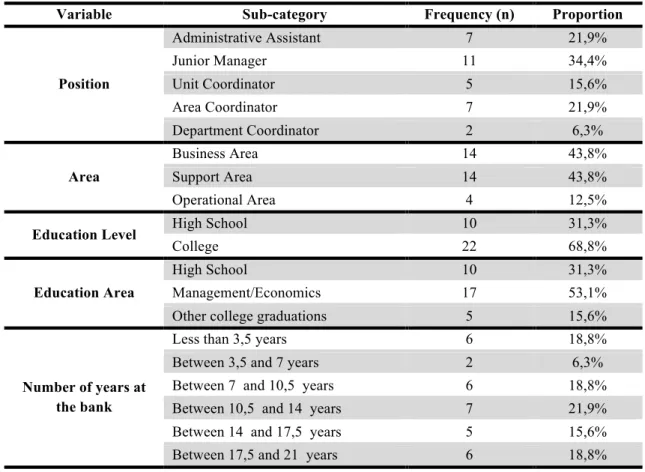
As we can see, our sample gathered reasonable representativeness, except
possibly for the cases of department coordinators (n = 2), other college graduates (n =
5) and workers from the operational area (n = 4).
Table 1 below represents the constitution of our sample, in all its 5 dimensions
(independent variables):
Table 1: Sample composition (n = 32)
Variable Sub-category Frequency (n) Proportion
Position
Administrative Assistant 7 21,9%
Junior Manager 11 34,4%
Unit Coordinator 5 15,6%
Area Coordinator 7 21,9%
Department Coordinator 2 6,3%
Area
Business Area 14 43,8%
Support Area 14 43,8%
Operational Area 4 12,5%
Education Level High School 10 31,3%
College 22 68,8%
Education Area
High School 10 31,3%
Management/Economics 17 53,1%
Other college graduations 5 15,6%
Number of years at the bank
Less than 3,5 years 6 18,8%
Between 3,5 and 7 years 2 6,3%
Between 7 and 10,5 years 6 18,8%
Between 10,5 and 14 years 7 21,9%
Between 14 and 17,5 years 5 15,6%
We obtained an average total score in the compliance culture survey of 3.66
points out of 5 (σ = 0.39). In the remaining 3 sub-scores, we obtained an average score
(by descending order) of 3.91 in the attitude sub-score (σ = 0.58), 3.48 in the
compliance concepts sub-score (σ = 0.49) and 3.47 in the perception of compliance’s
impact sub-score (σ = 0.42). The question with the highest average score across the
sample was “Is Compliance training useful for my work?”, with 4.28 (σ = 0.68) and the
question with the lowest score was “Does the Bank give too much importance to
Compliance?”, with 2.90 (σ = 0.54). This last question’s score is inverted, which means
that, on average, the bank’s workers considered that the bank was, in fact, giving too
much importance to this department.
Total Survey Score
On the total survey score variable, the Shapiro-Wilk normality test presented
p-values equal or greater than 0.05 when applied to the categories of area, education
level, education area and the number of years at the bank, which lets us assume
normality. The same did not occur for position, as there was one p-value smaller than
0.05 (unit coordinator, p = 0.045). In the course of studying the group’s different
means, we found no significant differences between them in the total survey score for
area (F = 1.022, p = 0.372), position (H (4) = 7.676; p =0.10), education level (t (30) =
0.686; p = 0.498), education area (F (2,29) = 0.24, p = 0.788) or years at the bank (F (5,26)
= 0.576, p = 0.718). With total survey score not presenting any relevant conclusions,
we broke this score down into its 3 categories in order to capture potential effects on
Concepts Sub-Score
In the concepts sub-score, the Shapiro-Wilk (SW) test allowed the assumption of
normality for area, position and number of years at the bank (p-values greater than
0.05). For education level and education area (high school, p = 0.031), however, that
assumption was not possible. We verified significant differences in position (F (4,27) =
4.172, p = 0.009) but none in area, education level, education area and number of years
at the bank.
Attitude Sub-Score
In the attitude sub-score, the normality test was not significant (p > 0.05) across
all categories of the independent variables, which allows us to assume normality.
Unfortunately, no significant differences were traced within any of our independent
variables.
Perception Sub-Score
Finally, in the perception sub-score, the SW test proved not significant (p >
0.05) both for area, education level and number of years at the bank. It failed to do so
for position (unit coordinator, p = .006; area coordinator, p = .016) and education area
(other fields, p = 0.006). However, significant differences were still achieved for
position (H (4) = 9.099; p = 0.05), education level (t (30) = 2.292; p = 0.029) and
education area, despite the high p-value (H (2) = 4.929, p =0.08).
Post-hoc tests
For differences traced within hierarchical position, and seeing as we had
rejected the null hypothesis that all 5 levels would have equal means in the concepts
sub-score, we applied the Tukey’s Honestly Significant Difference (HSD) post-hoc test
comparisons indicated that the mean concepts sub-score for the administrative assistant
(µ = 3.12; σ = 0.36) significantly differed from that obtained by area coordinator (µ =
3.74; σ = 0.50) at a 6% significance level and by department coordinator (µ = 4.25; σ =
0.59) with a significance of 0.02. Additionally, we concluded that results from unit
coordinators (µ = 3.27; σ = 0.45) were also different from those obtained by department
coordinators with a significance of 5%.
Correlation analysis
Following this analysis, from where we were able to understand which variables
were possibly interconnected by more than random chance, we applied a correlation
analysis, using the Spearman’s rank correlation coefficient. We found significant
Spearman correlations between position and the concepts sub-score (ρ = 0.49, p =
0.004), which reinforced our previous result. Position was also significantly correlated
with total survey score (ρ = 0.41, p = 0.021), despite mean difference test having
provided only a 10% significance level previously. We also found correlations between
the perception sub-score and education level (ρ = - 0.37, p = 0.037), which also
followed the significant mean difference detected earlier. Education area and
perception sub-scores were also significantly correlated (ρ = 0.40, p = 0.025), which we
could expect seeing as education level and education area are 2 variables that are
related by definition. Finally, we also detected a correlation between number of years at
the bank and total survey score, but its power was smaller (ρ = 0.30, p = 0.10).
Multiple Regression analysis
To complete our analysis, and to best capture the multi-sided influence of these
variables on a single worker’s total level of compliance culture (total survey score), we
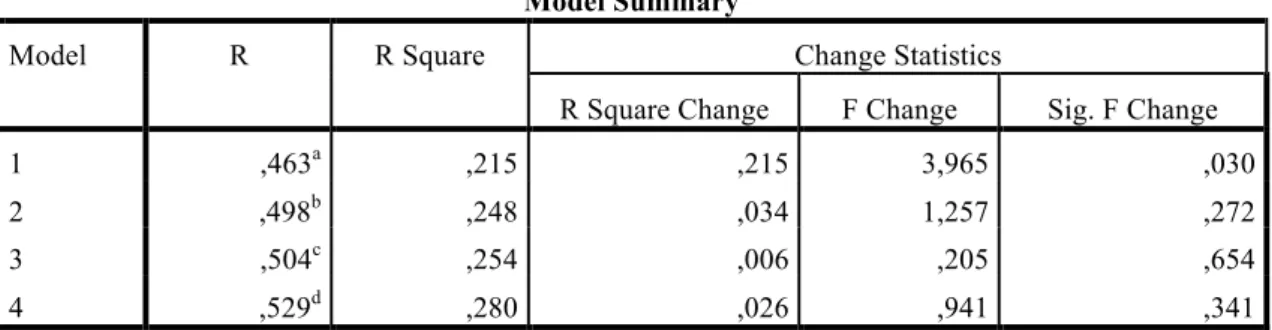
models. The first model contains only 2 variables, education level and position. The
remaining 3 models add more independent variables but with no significant increase in
the predictive power of the model (F (2,29) = 1.26, p = 0.27).
Table 2: Regression Models and their contribution in terms of R2
Table 2 shows us that the remaining variables we have studied with this survey
(business area, education area and number of years at the bank) do little to explain the
level of compliance culture, i.e., the total survey score for each employee. The other 2
variables (position and education level), however, reveal fairly accurate predictions
with a beta of 0.48 (p = 0.011) and -0.30 (p = 0.10), respectively.
That predictive power is maintained for the concepts variable, where the beta
for position is 0.63 (p < 0.01) and -0.31 (p = 0.066) for education level.
In both cases, and seeing that the remaining dependent variables have failed to
produce relevant results, it would seem that regressions with 2 variables (position and
education level) are the ones most suited to predict survey scores. All in all, the most
influential variable is position, as is shown in Appendix 5, which contains a table that
depicts the summary of the different models used and the influence each variable has on
the total survey score, as measured through its beta. The variable position did not have a
beta inferior to 0.42 in any model tested and was always significant at the 5% level.
Model Summary
Model R R Square Change Statistics
R Square Change F Change Sig. F Change
1 ,463a ,215 ,215 3,965 ,030
2 ,498b ,248 ,034 1,257 ,272
3 ,504c ,254 ,006 ,205 ,654
Discussion
It was thanks to many unprecedented events in the business and financial world
that compliance, and ethics in general, began receiving more than its 15 minutes of
fame. As the number of corporate scandals increased33, public opinion rallied around
what common sense tells us to be the most basic in a society: its values. Our objective
was to analyze whether the “compliance set of mind” had really permeated the
organization where we carried out our internship, being part of the banking industry as
it is.
Based on our sample, we consider the compliance culture at this bank as being at
moderate levels. 3.66 points out of 5 correspond to a 14.6 grade out of 20. However, we
ask ourselves, is that enough? In times where doing the right thing34 is again becoming
the norm in the business world, and where values such as social responsibility and
sustainability are conquering bigger slices of corporate budgets35, shouldn’t it be your
people the first thing to change? A considerable amount of respondents (n = 16; 50%)
attributed the compliance department the responsibility (or duty) of creating internal
norms or regulations. This notion is fairly off target and leads us to associate it to little
contact with this reality. At a compliance department, the mission of interpreting
external laws, regulations, best practices and ethical standards and to adjust internal
norms and procedures to best fit them must never be mistaken for the creation of said
internal regulations. That is the function of a truly operational area, where many other
!!!!!!!!!!!!!!!!!!!!!!!!!!!!!!!!!!!!!!!!!!!!!!!!!!!!!!!!
33
Ted Barrett. 2002. CNN Politics.
http://articles.cnn.com/2002-07- 24/politics/corporate.reform_1_corporate-scandals-house-republicans-corporate-wrongdoers?_s=PM:ALLPOLITICS (accessed March, 20th, 2012)
34 John Mariotti. 2011. “The struggle of doing the right thing”. American Express Open Forum.
http://www.openforum.com/articles/the-struggle-of-doing-the-right-thing (accessed May 15th, 2012)
35 Kielburger, Craig. and Marc Kielburger. 2008. “The rise of Corporate Social Responsibility”. The
Huffington Post.
http://www.huffingtonpost.com/craig-kielburger-and-marc-kielburger/the-rise-of-corporate-soc_b_85395.html (accessed February 18th, 2012)
variables and contributions must also be taken into account until the final output is
generated.
But where is this notion coming from? Is it sprouting from convictions held by
junior positions or is this in fact a problem of communication between hierarchies,
where top managers understand the compliance scenario and its minutiae but are simply
unable to communicate it onto their subordinates?
Our statistical analysis seems to point us towards this last hypothesis, seeing as
our results presented a positive relationship between the variable position and the
variable total survey score as well as the variable concepts. This is true as much
correlation-wise as it is regression-wise, as we have previously seen in the results
section. On the one hand, there exist positive aspects related to these results, such as the
fact that the people with the most responsibilities but also with the most power,
denoting a bigger sensibility towards these issues, which lets us believe that they will
look to upkeep this way of thinking throughout their organization with a bigger degree
of probability than your average worker. On the other hand, every correlation is 2-sided,
which in this case means that positions ranked lower in the organization will suffer from
significant shortcomings when dealing with these issues. This goes against some of the
fundamental same language principles, enacted by some risk experts36 and that call for
a common risk infrastructure, with no missing links between senior management and
the rest of the organization. “What you don’t know won’t hurt you” does not apply to
corporate compliance37, where the simple act of ignoring can bring severe consequences
to your organization.
!!!!!!!!!!!!!!!!!!!!!!!!!!!!!!!!!!!!!!!!!!!!!!!!!!!!!!!!
36
Mendes, Pedro M. 2011. “The Audit Role & Risk Management” Deloitte, lecture given at Nova School
of Business and Economic, Lisbon, Portugal
37 Peiser, Joseph C. 2012 “Ignorance is not Bliss: Using D&O Insurance Applications to get to Corporate
http://www.corporatecomplianceinsights.com/ignorance-is-not-bliss-using-do-insurance-It was also fairly immediate for us to see that nearly all 32 respondents placed
some kind of reason why they didn’t develop a higher interest for the compliance
department and its activities, while only 1 respondent posed no obstacle whatsoever to
his interest. A vast majority of those claimed the little time they had available as the
number one reason while others claimed the subject itself had little internal publicity.
To many of these workers, according to these results, compliance would appear to
present itself as an option: “If I were to invest more time in this activity, I would be able
to achieve full compliance. However, as the number of tasks I am responsible for is
excessive, I am not able to achieve task completion and task compliance requirements
at the same time.” We all know how fast-paced and demanding the business and the
financial world can be. We also know that managers today are being ever more
pressured to become versatile, adaptive and assume an array of different functions38 that
allows them to contribute in many different ways to a project or organization.
Nonetheless, we have learned during the course of our internship that compliance and
its influence on every activity, task and decision, is not an option. That is, it should be
opted for, but it really should be regarded as something that must underlie all that we do
and something that must come within our thought process: “It is unimaginable for me
not to consider compliance aspects in the midst of my daily activities”. From our
research, we obtained results from people from areas such as accountancy and IT
(which are 2 of the most compliance-sensible departments) clearly stating little time
available as one of the reasons for their small interest but also summing causes like little
importance to the bank or the fact that their job description did not require them to
!!!!!!!!!!!!!!!!!!!!!!!!!!!!!!!!!!!!!!!!!!!!!!!!!!!!!!!!!!!!!!!!!!!!!!!!!!!!!!!!!!!!!!!!!!!!!!!!!!!!!!!!!!!!!!!!!!!!!!!!!!!!!!!!!!!!!!!!!!!!!!!!!!!!!!!!!!!!!!!!!!
applications-to-get-to-corporate-compliance/ (accessed May, 14th, 2012)
38 Testa, Bridget. 2010. “Multiskilled employees sought as versatility becomes a workplace virtue”.
Workforce
worry themselves about it. This is related to what was discussed earlier – compliance is
every worker’s responsibility, independent of his or her job or area, and this is why
culture is such an important part in creating this environment, seeing as a considerable
amount of voluntary mind-changing is always necessary.
In what concerns other variables, such as school education, we were also
surprised by the findings, as were expecting for education to positively influence the
results on our survey. However, this variable presented significant negative correlations
(ρ = - 0.37, p = 0.037), to the variable perceptions i.e. the average result from workers
with college education was significantly lower than that of workers with only high
school education.
We were also surprised to see no relevant conclusion being made from the
relationship between our survey and the variable number of years at the bank.
Relationships have been found between organizational loyalty and ethical behavior
REF, which led us to believe, based on the assumption that a worker who has been with
the organization for many years has acquired a significant amount of loyalty towards it,
that this variable could influence its score on our survey and their overall posture
towards this department and its importance. In failing to do so, we present a possible
explanation, that bases itself in the possibility of this loyalty-building process having
been interrupted because of its acquisition by a foreign bank in the last decade. Having
changed image and strategy completely, many may have felt like they were working for
an entirely different bank. The fact that it was foreign may have also contributed to
some loss of loyalty.
Our objective in this Work Project was not only to discuss a topic that will
change, in light of almost continuous regulatory reforms and the growing impact
non-national regulation will have on organizations, especially those from the financial
industry. The most pressing challenges for compliance officers in the near future will be
essentially American pieces of regulation, some with a truly global reach, leaving no
small or medium sized company or individual indifferent. The soon-to-be-enforced
Foreign Account Tax Compliance Act (FATCA) posed serious logistical, legal and
operational issues and challenges for banking institutions worldwide, and efforts are
still being made in order to have government cooperation on this matter. Without it,
many banks, independent of country or size (provided they have US Person39 clients)
will have to give up those clients so as to escape income withholding taxes of 30%. The
Dodd-Frank Wall Street Reform and Consumer Protection Act also brought on stricter
registration requirements with the Securities and Exchange Commission (previously
there were some exemptions) and brought under that same regulatory body’s
supervisory a number of non-bank financial institutions, that are regarded as if they
were a bank.
Solution and challenge alike, many call for bigger Governance, Risk and
Compliance (GRC) integration within national and multinational corporations. Recent
studies40 have made a strong case for it, with many industry experts and professionals
providing insight into the substantial decrease in compliance risk they are subject too
when the move is made towards this integrated approach. The main advantage will be to
prevent organizations from having independent yet overlapping control functions that,
in extreme situations, may bring redundant reporting to senior management, which
!!!!!!!!!!!!!!!!!!!!!!!!!!!!!!!!!!!!!!!!!!!!!!!!!!!!!!!!
39
Citizens, residents in the United States, as well as a domestic partnership or corporation – IRS.gov:
http://www.irs.gov/businesses/small/international/article/0,,id=96395,00.html (accessed June 1st, 2012)
40 The Economist. 2008. “Governance, risk and compliance in financial services”. Economist Intelligence
impedes a comprehensive view of the risk affecting the company and creates silos that
can easily become a risk in itself. With such pressing and overwhelming regulatory
reform processes as the ones we are witnessing globally everyday, this kind of
redundancy might be enough for devastating consequences.
Limitations
In spite of the most favorable conditions we were given during the course of our
internship and to conduct our survey research, we feel obliged to say that there were
some limitations on the study we conducted. These limitations, had they not existed,
might have brought on significantly more reliable results as well as better information
for the institution.
The most hindering limitation was the modest sample size (n = 32) we were able
to collect. This was due to logistical requirements imposed by the organization as well
as a reduced time frame to answer the survey (approximately 2 weeks). The statistical
implications of a small sample, itself divided in several groups, makes it harder to
immediately assume this sample’s representativeness.
Another limitation was the lack of existing literature on this subject, specifically
one where this topic was approached in a quantitative way, as we have tried to do here.
This limitation makes our judgment of the results obtained subjective and lacking in
empirical demonstration. To fight this, we tried to benchmark our results always based
on how a compliance system should work, rather than evaluate it strictly for its
numbers.
Recommendations
During the completion of this Project, and based on the reflection we made on
Compliance department of this organization, in spite of the considerable experience of
its workers.
First, we believe the bank, as a whole, should look to move with the recent
developments in the sector and integrate its different risk-managing departments. At the
very least, it should look to provide these departments with the tools necessary for better
and more efficient communication and sharing of information between them. We are
aware of the obstacles that such an operation poses, if not for logistical and operational
reasons, for politics alone. The rearranging of hierarchical positions or even its
disappearance is always something to be considered thoroughly and, at first, the
existence of a return on these movements and this integration may not even be
perceived as relevant. However, we believe that, over time, and with the necessary
support from senior management, the more transparent and efficient reporting, as well
as the improved coordination of the different control functions will play a considerable
role in mitigating risk, in all its different categories and dimensions, for the bank.
Additionally, we feel that the importance of compliance and its inherent
mentality should deserve more publicity in order to reach all the organization’s levels
more efficiently. It is important to convey the message that the organization’s top
management is committed to this type of behavior and conduct (the tone at the top),
notwithstanding the increasing importance of the tone established by mid-level
managers, as we have stated earlier. It was following this rationale that the department,
with our collaboration, implemented a bi-monthly Compliance Newsletter, where the
most recent regulatory developments and updates were discussed and given awareness.
However, during our time at the institution, we felt that something more was needed
communication spaces usually reserved to HR (in elevators and in several different
locations within the bank) or possibly resort to more paper-based communication (such
as flyers) to avoid the possibility of being ignored by the bank’s workers. The simple
fact that the Board approves such measures will bring the topic to their attention but
also emphasize the management’s commitment to it.
We highly recommend the bank to maintain their bet on Compliance training,
allowing workers to maintain themselves informed on the concepts and problems of this
department, as well as possibly acquire a greater interest for it. We do recommend,
however, that these training sessions carry higher practical implications for the workers,
allowing them to expose past working experiences where they have had problems and
did not know how to react, or simulate and enact situations that make the
comprehension much easier and faster.
Finally, we also recommend the bank to positively stimulate the workers who
wish to report suspect or controversial situations, from a Compliance point of view. Not
only will they be motivated towards that goal, but they will also have an opportunity to
apply any knowledge they might have acquired.
Conclusions
Compliance, and its growing importance as a factor for the sustainability and
reputational dimensions of a bank, has gained some notoriety. That notoriety has led us
to write this paper, which intended to dissert over some of the most important aspects of
this subject, as well as seize the opportunity of practical experience (our internship) to
include several practical and professional world insights, which we hoped would
contribute to the understanding of Compliance by those not related to the industry. We
self-elaborated survey (multiple-choice questionnaire) that lacked benchmarking (due to
little quantitative information on this matter) but allowed us to perceive the general
positioning of the organization’s workforce towards it.
We found out that, while the overall results were not at all unpleasing, there
were still a lot of misconceptions in the employee’s view of Compliance, as well as its
role and functions. We also recognized that hierarchical position proved to be a strong
variable in predicting the general positioning towards Compliance and that maybe that
constituted a symptom for a bigger disease: the lack of conveyance by top and mid-level
managers of the importance of this positioning.
However, we feel there is still a lot of awareness to be raised towards
Compliance, as many still regard it, even within the banking industry, as “lawyer’s
work”. The strategic and ethical principles behind Compliance are, most probably, what
separate it from any legal profession and what makes it so important in fighting some
greed-driven and value-absent policies that caused substantial turmoil to the financial
industry in recent years.
We hope to have contributed to this discussion and to have put in place study
References
1 CNN Money. 2012. money.cnn.com/2002/01/11/companies/acct_scandals/ (accessed January, 30th,
2012)
2
Thomson Reuters. 2012. The State of Regulatory Reform 2012
3 Malcolm Hayday. 2012. “Banks must put ethical principles at the heart of their operations”. The
Guardian. www.guardian.co.uk/sustainable-business/banks-ethics-reform-services
4 Mellers, B. A. and A. P. McGraw. 2001. ‘‘Anticipated Emotions as Guides to Choice.’’ Current
Directions in Psychological Science 10: 210-214.
5 Basel Commitee on Banking Supervision. 2005. Compliance and the compliance function in banks.
6 Weaver, Gary R. and Linda Treviño. 1999. “Compliance and values oriented ethics programs:
influences on employees’ atitudes and behavior” Business Ethics Quarterly, Volume 9, Issue 2, pp 315-335
7 Basel Commitee on Banking Supervision. 2005. Compliance and the compliance function in banks.
8
Banco de Portugal. 2008. Aviso nº5/2008
10Basel Commitee on Banking Supervision. 2005. Compliance and the compliance function in banks
13Perry, Jason and De Fontnouvelle, Patrick. 2005. “Measuring Reputational Risk: The Market Reaction
to Operational Loss Announcements”
14Ohnsman, Alan and Makiko Kitamura. 2010. “Is Toyota’s Reputation Finished?”, Business Week.
http://www.businessweek.com/lifestyle/content/jan2010/bw20100128_413922.htm
15Clifford Krauss. 2010. “Oil Spill’s Blow to BP’s Image May Eclipse Costs”, The New York Times.
http://www.nytimes.com/2010/04/30/business/30bp.html?pagewanted=all
16 Helm S.. 2007. “The role of Corporate Reputation in Determining Investor Satisfaction and Loyalty”
Corporate Reputation Review, Vol.10 #1
17 J.D. Power & Associates. 2011. “Shopping and Switching Rates Increase among Retail Bank
Customers as Competition in the Industry Intensifies”, U.S. Retail Bank New Account Study
18American Banker. 2010. “Bank Reputation Rankings Flash Red”.
http://www.americanbanker.com/issues/175_93/reading-reputation-scorecard-1019174-1.html?zkPrintable=1&nopagination=1
19 Time Magazine. 1975. “Lockeed’s defiance: a Right to Bribe?”.
http://www.time.com/time/magazine/article/0,9171,917751,00.html
20 Frantz D. 1998. “Chiquita Still Under Cloud After Newspaper’s Retreat”. The New York Times.
http://www.nytimes.com/1998/07/17/us/chiquita-still-under-cloud-after-newspaper-s-retreat.html?pagewanted=all&src=pm
21 Securities and Exchange Comission. 2012. “The Laws that Govern the Securities Industry”
https://www.sec.gov/about/laws.shtml
22The GRC Group. 2012. “Shining the light on the Sarbanes-Oxley Act: Widespread Ressonance and
23
Anand, Kartik., Prasanna Gai and Matteo Marsili. 2011. “Financial crises and the evaporation of trust”
24 Glenn Alan Cheney. 2006. “Regulation: a help or hindrance to business growth?”, The Free Library.
http://www.thefreelibrary.com/Regulation%3A+a+help+or+hindrance+to+business+growth%3F-a0151653027 (accessed March, 13th, 2012)
25McCreevy, Charlie. 2007. “Regulators: help or hindrance?”. Speech given at the 12th Annual
International Corporate Governance Network in Cape Town, South Africa.
26Rothenberg, Stephen E., Michael N. Abrams and Rita Numerof. 2010. “The need for Compliance as a
Business Strategy”. Medical Device and Diagnostic Industry. http://www.mddionline.com/article/need-compliance-business-strategy (accessed April 3rd, 2012)
28Richards, L. 2007. “Working towards a culture of compliance: some obstacles in the path”. Speech
given by SEC staff at the National Society of Compliance Professionals 2007 National Membership Meeting in Washington, D.C., U.S.A.
29Tabuena, J. 2009. “Fitting a square peg in a round hole”. Corporate Secretary
30
Maroco, J. and Regina Bispo. 2005. “Estatística aplicada às ciências sociais e humanas.” 2nd ed. pp
83-84. Lisboa: Climepsi Editores
31 The Economist. 2008. “Governance, risk and compliance in financial services”. Economist Intelligence
Unit
32Maroco, J. and Regina Bispo. 2005. “Estatística aplicada às ciências sociais e humanas”. 2nd ed.
Lisboa: Climepsi Editores
33
Ted Barrett. 2002. CNN Politics.
http://articles.cnn.com/2002-07- 24/politics/corporate.reform_1_corporate-scandals-house-republicans-corporate-wrongdoers?_s=PM:ALLPOLITICS (accessed March, 20th, 2012)
34John Mariotti. 2011. “The struggle of doing the right thing”. American Express Open Forum.
http://www.openforum.com/articles/the-struggle-of-doing-the-right-thing (accessed May 15th, 2012)
35Kielburger, Craig. and Marc Kielburger. 2008. “The rise of Corporate Social Responsibility”. The
Huffington Post.
http://www.huffingtonpost.com/craig-kielburger-and-marc-kielburger/the-rise-of-corporate-soc_b_85395.html (accessed February 18th, 2012)
36
Mendes, Pedro M. 2011. “The Audit Role & Risk Management” Deloitte, lecture given at Nova School
of Business and Economic, Lisbon, Portugal
37Peiser, Joseph C. 2012 “Ignorance is not Bliss: Using D&O Insurance Applications to get to Corporate
Compliance”. http://www.corporatecomplianceinsights.com/ignorance-is-not-bliss-using-do-insurance-applications-to-get-to-corporate-compliance/ (accessed May, 14th, 2012)
38Testa, Bridget. 2010. “Multiskilled employees sought as versatility becomes a workplace virtue”.
Workforce
40
The Economist. 2008. “Governance, risk and compliance in financial services”. Economist Intelligence