Death and dying from the perspecive of
muliprofessional residents in a teaching hospital
Daniel Tietbohl Costa 1, Lucas França Garcia 2, José Roberto Goldim 3Abstract
This study aimed to analyze and describe the understanding of muli-professional residents of a teaching hospital regarding death and dying. A qualitaive study was performed using Bardin subject analysis. A semi-structured interview was used for the collecion of data, which was analyzed with QSR NVivo 11 sotware. It was noted that the interviewees believe that working with the theme of death and dying is enirely perinent, and that it is an indispensable subject in academic training for integral care. It was found that the interviewees did not feel they were prepared to deal with the process of death and dying.
Keywords: Death. Aitude to death. Palliaive care. Health educaion. Bioethics.
Resumo
Morrer e morte na perspeciva de residentes muliproissionais em hospital universitário
Este arigo tem como objeivo analisar e descrever o entendimento que residentes muliproissionais de hos -pital universitário têm sobre a morte e o morrer. Trata-se de estudo de abordagem qualitaiva, com emprego da técnica de análise de conteúdo de Bardin. A ferramenta uilizada para coleta de dados foi entrevista semies -truturada, analisada com auxílio do sotware QSR NVivo 11. Veriicou-se que na perspeciva dos entrevistados é totalmente perinente trabalhar o tema da morte e do morrer, temáica indispensável à formação acadêmica para assistência integral. Conclui-se que os entrevistados sinalizaram a sensação de não se senirem prepara -dos para lidar com o processo de morrer e a morte.
Palavras-chave: Morte. Aitude frente à morte. Cuidados paliaivos. Educação em saúde. Bioéica.
Resumen
Morir y muerte en la perspeciva de residentes muliprofesionales en un hospital universitario
Este arículo iene como objeivo analizar y describir el entendimiento que los residentes muliprofesionales de un hospital universitario ienen sobre la muerte y el morir. Se trata de un estudio de enfoque cualitaivo, con la uilización de la técnica de análisis de contenido de Bardin. La herramienta uilizada para la recolección de datos fue la entrevista semiestructurada, analizada con la ayuda del sotware QSR NVivo 11. Se veriicó que en la perspeciva de los entrevistados es totalmente perinente trabajar el tema de la muerte y del morir, te -máica indispensable en la formación académica para la asistencia integral. Se concluye que los entrevistados señalaron la sensación de no senirse preparados para lidiar con el proceso de morir y la muerte.
Palabras-clave: Muerte. Acitud frente a la muerte. Cuidados paliaivos. Educación en salud. Bioéica.
1. Mestrando [email protected] – Universidade Federal do Rio Grande do Sul (UFRGS) 2. Doutor [email protected] – Unicesumar 3. Doutor[email protected] – UFRGS, Porto Alegre/RS, Brasil.
Correspondência
Daniel Tietbohl Costa – Hospital de Clínicas de Porto Alegre. Laboratório de Pesquisa em Bioéica e Éica na Ciência. Centro de Pesquisa Experimental. Rua Ramiro Barcelos, 2.350, LAB12213 CEP 90035-903. Porto Alegre/RS, Brasil.
Declaram não haver conlito de interesse.
Aprovação CEP-HCPA CAAE 51253615.9.0000.5327
R
e
se
a
rc
The discussion of the meaning of death accompanies the history of mankind. Its irreversible character and the impossibility of formulaing it in symbolic terms terriies the human being, since we can not describe or name it 1-3, although it is the only great certainty 4. Several understandings, emphases and comprehensions have been given and are given to this process in diferent socieies and periods, and the conduct of the human being in the face of death has changed several imes in the course of ime.
What is now characterized as a lonely end of life in the hospital has, in the past, been faced as “tamed death”, in which the dying or terminal paient presided over his death ceremony. In the Middle Ages, with this perspecive of family death, the person acted calmly and in tranquility before death, acceping his/her desiny and the end of life. They waited serenely and organized their departure, including their funeral or funeral procession. Death was public and a farewell at home surrounded by relatives, friends and neighbors, with the paricipaion of children as well 5,6.
With the changes that society has undergone over time, people have become less receptive to death because, due to sanitary measures, the deceased and the paient in the process of terminaion began to be moved away from the others, in order to avoid risks and the spread of diseases. This displacement of death, which is no longer at home with the family, but in the hospital bed, may have accelerated its interdicion in discursive and psychological terms 7. This understanding that the hospital would be the most appropriate place to die, surrounded by invasive devices and heavy technology, was called by Menezes the “modern death” 8,9. Thus, dying became a lonely and feared act 10.
In addiion to these diferences, inherent to the historical process, during the development of the medical sciences new criteria were elaborated to deine death, which further intensiied the diversity of interpretaions. From a technical-scieniic point of view, death, which was previously classiied as an absence of cardiorespiratory funcion 11, started to also be characterized by the brain criterion. That is, death is atested when the irreversible cessaion of brain functions occurs as a result of severe aggression or severe organ injury, blocking blood low and causing the organ’s destrucion 12,13.
Technological advances and the view of the body as a producion machine refer to death as something to be feared, avoided, and stalled 4-6,13. Such advances allowed the prolongaion of life by
new ariicial methods, but they did not necessarily do enough for the human being to live with beter quality 4-6,14. In this way, therapies that prolong their existence are imposed without worrying about the consequences of living, without taking adverse efects into account 15. The goal became to save lives “at any cost”, prioriizing the years of life, that is, the quanity, regardless of the quality of the living 16,17. This culminated in detachment from death, which came to symbolize therapeuic failure 13,14, generaing a lack of empathy among the care team, withdrawal from the understanding of the paient’s sufering, and the interdicion of the subject itself.
The discussion of dying and death can be performed in all contexts, be them family, professional or educaional 4-6. Thus, the prospect of death is present at any stage of human life, from birth to extreme old age. Health professionals, from the stages of their academic and professional training, just as every living being, have death present in their daily lives. Muli-professional residents are exposed to situaions involving death and dying. However, there are few spaces for discussion and relecion on the theme.
This justifies the need to work the issue properly during the training of health professionals, as well as to provide them with permanent support. There is also an urgent need to open dialogic spaces to discuss the subject of death and dying, in order to improve their understanding and recogniion that death is a part of life, thus improving the integral care of the paient. The aim of this aricle is to describe the percepion of residents in the formation of the Integrated multi-professional Health Residency Program (Programa de Residência Integrada Muliproissional em Saúde - Rims) about death and the process of dying.
Methods
A qualitaive, descripive study was carried out using the content analysis of Bardin 18 for the construcion of themaic categories. The three stages of the content analysis were observed: pre-analysis, which consisted in the choice of the documents to be analyzed, systemaizaion of hypotheses and iniial ideas and creaion of categories of analysis; exploraion, in which classiicaion and categorizaion of the material occurred; and, inally, the treatment and interpretaion of the results obtained.
The sample consisted of ten residents of RIMS residents of the Hospital of Clinics of Porto Alegre (Hospital das Clinicas de Porto Alegre - HCPA), from
R
e
se
a
rc
the following concentraion areas: Criical Adult (n=1), Cardiovascular Atenion (n=1), Onco-Hematology (n=3) and Child Health (n=5). The inclusion criterion comprised students who began their paricipaion in RIMS between 2013 and 2015, and were paricipaing in the Residence Program during the interviews. The sample was selected for convenience.
Data were collected through semi-structured interviews (see annex) conducted from January to August 2016 by a researcher with experience in qualitaive research. Paricipants were invited to paricipate in the study via insituional e-mail and personally during the training period. Sixty invitaions were sent and the irst 15 respondents were selected to paricipate in the study. Ater ten interviews, the saturaion of senses was reached. The interviews were carried out at the Clinical Research Center of the HCPA, recorded and transcribed in their enirety with the authorizaion of the paricipants. All subjects paricipated in the informed consent process and, after communicating possible risks and benefits, decided to paricipate in the study.
In order to keep the privacy and conideniality of the paricipants, it was decided not to inform the training area of each subject, considering the small number of easily ideniiable residents at the study site. In the presentaion of the speeches, it was decided to use the leter “E” followed by the number corresponding to the interview - for example, the irst interview was designated code E1. The data obtained in the transcription of the interviews were analyzed using the sotware QSR NVivo 11, version Windows 19, using the Bardin content analysis technique. The program used allowed the crossing of informaion, to code data and to manage informaion, and helped in the assembly of themaic categories. In addition, it also enabled basic staisical analysis and grouping of the speeches in clusters, trees and word frequencies.
Results and discussion
The sample was composed of ten Rims residents of the HCPA, 80% (n=8) being females and 20% (n=2) being males. The average age was 28 years, ranging from 25 to 41 years. Health professionals from the areas of physical education, nursing, pharmacy, physiotherapy, nutriion and social services paricipated. In order to preserve the conideniality and privacy of the paricipants, their interviews were not ideniied by profession or area of acivity.
Four themaic categories emerged from the analysis of the interview transcripts: 1) relevance of the theme and preparaion of professionals to deal with death; 2) understanding of the muli-professional resident about death and its deiniion criteria; 3) feelings related to loss - subdivided into feelings related to family loss and loss of paients; and 4) symbolism of death for the muli-professional resident.
Relevance of the theme and preparaion of the professionals to deal with death
From the perspective of the residents interviewed, the theme of death and dying should be part of the preparaion for integral care, making its discussion relevant. In pracical training, many residents are young students with no prior experience in hospital care, and they had dealt few or very few imes with losses in the workplace. Given this, it is natural that they feel unprepared to deal with the subject. Thus, it is essenial that they receive adequate training on how to deal with death, as well as the support of other professionals through talk rounds, exchanges of experiences, and other support aciviies. The need to be prepared to deal with death is evidenced several imes in the interviews:
“I do not think I’m prepared to deal with death. Mainly because there are not as many deaths in the
hospitalizaion unit as in the ICU, for example”(E1);
“No, not at all [prepared to deal with death]. We are
prepared to deal with life and sickness in a sick human being, but not with this issue of death, of the end” (E4);
“No, I had no preparaion to deal with this subject
before I started at the hospital. During the period of the residence, I had the opportunity to atend lectures and paricipate in events on the subject, but I feel that the preparaion is sill inadequate, either in the undergraduate course or in RIMS. There are gaps on the subject that need to be worked and fulilled” (E10).
The health professionals interviewed reported not feeling fit to deal with patients’ deaths, demonstraing the lack of adequate preparaion regarding the subject studied. This unpreparedness is also identified by the participants in the undergraduate course, which does not address the subject. Professional training emphasizes life and does litle about death. Many professionals assume antagonism between life and death and do not
R
e
se
a
rc
idenify them as a whole process, which can lead to a sense of failure at the death of the paient.
Words like “no” (in Portuguese: “não”), in the sense of lack of preparaion; “worked” (“trabalhado”), in the sense addressed during training; “death” (“morte”); “coping” (“lidar”) in the sense of personal and emoional management; and “training” (“formação”), in the educaional and professional sense, were the most frequent in residents’ interviews. A brief analysis allows the observaion that all words converge to the feeling of unpreparedness, implying that death needs to be addressed in the training of the health professional with a broader approach.
Figure 1. Word cloud on the relevance of the theme and professional preparedness. (Original words in Portuguese.)
Working on the “death” theme is fundamental in all contexts. The phenomenon of death is inherent to living beings, and, sooner or later, the loss falls upon all. For the health professional, in addiion to the family environment, it is necessary to relect on this issue in the teaching environment or in the workplace 4-6. These professionals, and, here, speciically muli-professional residents, have death in their daily work, which makes it much more perinent to approach the theme throughout the training process.
According to the residents interviewed, discussing death is very important, especially in the health area and throughout the training. Understanding or dealing with it helps to deal with feelings and with families in a less painful way 20. The convenional hospital context generally does not encourage broad discussion on how to deal with the physical and mental sufering of criically ill paients and their caregivers 1-3.
“We have to be prepared to deal with the end, with
the palliaive paient, with the paient who is in a very sever condiion, that the team makes clear that in no way will return (...) I think we have to
get used to it, but at the same ime you can not lose sensiivity as a human being. I think that this is a part of it, it has to be touched in some way, it is important to also have this separaion from what we feel, from being sensiized.”(E8);
“When the husband [of the paient who died] came
to the hospital, he wanted to thank us, but he was lost. That was a situaion that could destabilize me. Those who enter a hospital environment should approach the issue in a mature way. I did not know what to say. Just like I did not have any training on how to behave in diicult situaions. This issue of empathy is very personal, being able to say the right things at the right ime is an exercise in very ‘human being’, you have to be too big to say something comforing at such a ime. The professional who allows himself to cry for a paient is extremely rare, even because our preceptors do not do it and they
are our models”(E9).
Thus, the analysis of the statements allowed us to conclude that we should invest in a more humane formaion of health professionals, teaching them to understand each other’s pain and how to behave in imes of loss and sadness. In order to do this, we must be aware that interacions occur in muliple ways and act in diferent ways in the processes of equilibrium of diferent people 20. Moreover, it is indispensable to observe that the professional-paient relaionship does not take place in a closed system - taking into account the interests and desires of those involved, paients and their families 21-24. This awareness highlights the importance of welcoming the person with afecion, giving him/her emoional support and respect.
The understanding of the muli-professional resident about death and its deiniion criteria
It can be said that understanding about the criteria of death tends to vary according to our beliefs and worldview. According to the data obtained in the interviews, death is defined as the decomposiion of the body, the end of the physical body, the end of life, that is, perceiving the appreciaion of the physical aspect in the deiniion of death in the discourse of the paricipants of the study. This way, for those interviewed, death is a physical state, when the body no longer supports
R
e
se
a
rc
life and can not maintain its biological funcionality. It is possible to say that this vision is strongly based on the biomedical view, in which we see the body as a machine. Death evokes feelings of frustraion and impotence, associated with grief, mourning, pain, despair, contradicing the technical and biomedical concept of life and development 12,14,16.
Dying is an irreversible process; once installed in the body, there is no way to prevent it, although it is possible to delay it with therapeuics, in many cases applied in an ariicial and fuile way. It also represents the end of a cycle, the life that ceases. It is to cease to live physically, which is seen as a natural phenomenon. However, understanding about death may vary according to the person’s religious orientaion. For those who believe in the perspecive of spiriism, as reported in the interviews, death refers to the closure of the body as physical terminality, in which the spirit leaves the physical state, but its soul or essence does not cease to exist. These consideraions are illustrated in the following statements:
“It depends a lot on your beliefs, anyway... For me,
death refers more to the physical body, because I believe in the spirit, in the soul, I am a Spiriist. (...)
The physical body dies and life ends there, but that refers to the physical body. This does not mean that the individual’s essence or soul has been lost. It is only the death of the physical body” (E1)
“Death is the end of life. I’m not religious, I do not
think there is much more than that. So, I think it’s when your body enters a state that no longer supports life, from there on you are already in a state of death” (E5).
When analyzing the following statements, we observed that the interviewed residents see diferent criteria to deine the death outcome, such as brain death and that caused by cardiorespiratory arrest (CRA):
“I think that in brain death, you, with some maintenance,
you will have your body funcioning, depending on technologies, but you no longer have your conscience, you will not revert your case, this is conirmed by several tests, brain death... And in the cardiothoracic death, the lung and the heart, progressively stop, the brain also loses functions... Both are deaths, yes, in my
understanding, both are deaths”(E3);
“Death is when the person really ceases all vital
signs, right?, the heart stops beaing and the person has no more reacion” (E6);
“I understand death as the end of life, like the closing
of a cycle, something irreversible. Death by the brain criterion is a diagnosis without reversion. I think it’s wrong to revive” (E9).
Residents perceive the relaionship between brain death and futile therapies. In this way, the artificial maintenance of life is considered undesirable, except in case of organ donation. In relaion to death by CRA, there is a diferent percepion, in which the body is sufering slowly, since the brain, understood as the main organ of the nervous system, is sill preserved. Although there may be an apparent dichotomy between death by CRA and brain death, both are criteria for the characterizaion of death.
Figure 2. Word cloud of the understanding about death and the criteria of its deiniion. (Original words in Portuguese.)
Feelings related to the loss
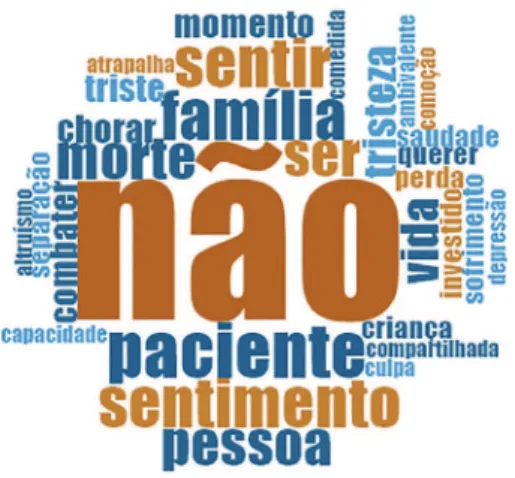
In this category, the word “no” (“não”) takes on a larger proporion in relaion to the frequency of words, making clear the strong sense of denial associated with death.
Other feelings related to loss are quite frequent, such as sadness and sufering. According to the professionals interviewed, the loss generates ambivalent emoions that manifest in diferent ways in each individual, because now we miss the lost loved one, or we hate them to have let us. This sense of ambivalence has also been veriied in correlated studies 25-27. In the view of the subjects, we can and should feel and cry the loss of paients,
R
e
se
a
rc
provided that in a controlled way, without leing it disrupt the care rouine and the relaionship between the professional and other paients.
Experienced by all human beings at some point in their lives, loss is a universal phenomenon. Regardless of the type of situaion to which the loss is circumscribed, all have in common the diiculty of the individuals involved in enduring the lack of the one who is gone 25. Ater an unexpected loss, there always seems to be a protest stage, in which the individual who lost the loved one strives to recover the lost person. Hope, despair and anger alternate. The mourner goes through the destabilizaion of the phase of despair and reorganizes oneself based on the person’s permanent absence 25. Anger and social isolaion are necessary feelings for the process of mourning to be healthy. The statements referring to these aspects are transcribed below:
Figure 3. Word cloud of feelings related to loss. (Original words in Portuguese.)
“I was very sad, because it was a paient in whom we
were invesing a lot, despite having no perspecive of life (...). But even so he was being invested a lot, in all
kinds of treatment, specialies were involved, so it was a pity, because the mother had hope about the life of the son and she was always there and so dedicated” (E1);
“Sadness, longing ater the person dies. Sadness for
the family, when we put ourselves in the place of the family. I think so, I am a person, I have feelings, and the moment I do not feel anything, I will need to review if I really want to coninue working in this area” (E4);
“Feeling is just sadness, right? Missing the person...” (E6).
According to these statements and other ones transcribed previously, it can be seen that residents
are bothered by fuile investment in paients with no prospect of cure or reversion of the condiion. However, although the discomfort that this generates is evidenced, they oten perform these therapies in an atempt to preserve the paient’s family members from this sufering.
According to Bowlby 25, mourning is composed of three stages: protest, despair and detachment. People of all ages who experience the loss of loved ones feel regret and go through the mourning period. The reorganizaion of the sufering individual varies according to the way one faces these stages. Denial is the irst reacion of the human being in the face of bad news and serves as a temporary defense mechanism 24. We interdict the subject of death and do not touch the subject by the false illusion that, by denying it, we would be protecing people from contact with pain and sufering 4-6. However, denying the fact of death makes it more diicult to elaborate the mourning 25.
• Feelings related to a family loss (of close
people)
Losing people is always painful, especially when they are our family or very close people. When asked about the feelings involved in family losses, the paricipants showed greater regret regarding paient losses, which was normally expected. We have stronger affective bonds with our family members. It was highlighted in this category that residents report being more prepared to deal with the death of relaives by talking about the diagnosis and talking openly with the patient about the possibiliies of living or dying.
Even though it is inherent in human beings, death often produces feelings of anguish and sufering, which make it diicult to cope with them and increase their dualism 16. This is because we react to the news someimes with relief that the sufering of the paient has ended, someimes with extreme sadness and regret, someimes even angry at the loss. The following are some statements associated with these feelings:
“The irst close loss I had, (...) I dealt very badly [with it], [it was] my grandfather, who was my paient. I
sufered a lot, I felt bad for a long ime and I did not want to go to my grandparents’ house, where he lived. And then my family worked on that with me” (E5);
“I lost my stepfather and my two maternal
grandparents, I also had my brother-in-law, who died
R
e
se
a
rc
very unexpectedly. Chronic diseases, like this, one even understands going through death more easily; now, I had an 18-year-old brother-in-law who died falling from a balcony, so it was very traumaic”(E6);
“The loss of my father was something unexpected, he
was not in the hospital, he died at home, sleeping. His death was very shocking, because I had talked to him just hours before, but despite all the pain of the loss, the sufering of the family, we always considered the fact that he did not sufer from terminal illnesses like cancer, nor did he have invasive procedures that caused cause pain. We believe it was a quiet death” (E10).
• Feelings related to the loss of paients
When asked about feelings related to the loss of paients, the answers diverged. In a way, some residents think it is a mistake to get involved and sufer the loss of a paient because they see this as lack of preparaion and professionalism. This is due to cultural, historical and hierarchical constructs within hospitals with biomedical structures 26,28,29. Death completes the life cycle 30. However, praciioners are emoionally unprepared to deal with the feelings it arises, thus presening diiculies in providing support and assistance to the terminally ill paient 31. Sentences that expose the thinking of the establishment and maintenance of links with criically ill paients:
“Yes, I will not feel [the death of a paient] as [if it were] a relaive of mine, but I will certainly feel it... I do not think there is any way to compare” (E1);
“It is very diicult for you to lose a child, such a
young being to lose one’s life. It afects one a lot, you cling... No mater how hard you try not to take work home, from the hospital to the personal life, just to protect yourself” (E3);
“There was a paient to whom I got a litle more atached.
I knew that he was already in palliaive care and that some ime it was going to happen [death] (...). I was
atached, and I do not think I should have been atached. We can not hold on, otherwise it becomes a negaive thing for us. Because criical paients die a lot”(E5).
Although it is not consensus, the feeling of commotion largely affects the participants. Professionals learn to bond with paients and their families to cope with the illnesses that alict them. Residents strongly bonded with paients who have died sufer their loss, which is predicted in a situaion
in which the bond is broken, either abruptly or not. However, neither these nor any other physicians can sufer a loss like this without having support from other professionals. It is necessary that the pain be shared and that the muli-professional resident receive adequate support.
Another notable feature of this category was the non-acceptance of the loss of pediatric paients. We more easily accept the loss of adults or the elderly because there is a certain naturalness in death in old age 16 - these are expected deaths and we managed to prepare the mourning in advance. When a child is lost, there is an early rupture of the bond, and there is the concepion that children “sill have their whole lives ahead of them.”
The symbolism of death for the muli-professional resident
Death represents sadness, loss, the end. It is something that is generally not thought of, precisely due to being associated with these negaive feelings. It is the absence of the physical body that leaves an empiness full of longing. To feel the loss is natural, provided that in a controlled way. Death can be considered a relief, a passage, the end of a cycle, whether or not coninued on another spiritual dimension. Death is a complex phenomenon with innumerable external and internal inluences that hinder its comprehension and its integraion into everyday life.
The vision of death is loaded with symbolism, socially constructed in a gradual way, impregnated with values and meanings that depend on the historical, cultural, economic, political and environmental context in which the subject is inserted, exering strong inluences in diferent generaions. Therefore, such concepions about death are extremely relevant to assist in understanding the social representaions of residents who work in health care. Their aitudes toward dying and death will be in accordance with their understanding. The following are some statements referring to the symbolism of death:
“The end of a cycle. The end of sufering. The end of
life”(E2);
“Loss. It depends on the point of view - it is a loss for
some, but it can be a relief for others” (E7);
“It represents sadness, sufering, change, closure and rest”(E10).
R
e
se
a
rc
Final consideraions
It can be said that the results obtained with the report of the paricipants of this study are corroborated by the indings in the literature, that is, the percepion of inadequate preparaion to deal with death. This gap in professional qualiicaion is atributed to several reasons, with emphasis on cultural issues. The interviewees perceive death as a process of separaion, passage and initude, indicaing the end of life, the closing of a cycle, and characterizing an irreversible phenomenon. The results also indicate that the percepion of death depends on the beliefs of each individual. In this perspecive, religious people understand death as just the end of the physical body, the soul and spirit being preserved in another dimension. Less religious people understand death as the end of the natural process, the act of ceasing to exist physically, the end of the cycle that begins at birth, the cessaion of life, the body that loses energy. One of the interviewees cites the fear of death that manifests in certain
people, which derives from their awareness of how they used the opportuniies they had in life, if they led his life in a way that was worth living.
Death is a stressor, and facing the loss alone without being adequately prepared can generate intense suffering even in more experienced professionals. There are signiicant gaps in health education, both undergraduate or graduate, on issues involving death and dying. Although health professionals have coninued educaion, they do not ind dialogic spaces that allow them to share their losses, alicions and suferings. Likewise, they are also not supported, in a structured way, in their emoional and social quesions concerning death.
Based on the informaion obtained, we suggest that greater atenion be given to the issues involved in death and dying during the training of health professionals, in undergraduate school and muli-professional residency, with spaces of dialogue that allow the exchange of experiences, facilitaing the overcoming of diicult and distressing situaions.
Referências
1. Kovács MJ. Educação para a morte: temas e relexões. São Paulo: Casa do Psicólogo; 2004. 2. Kovács MJ. Educação para a morte. [Internet]. Psicol Ciênc Prof. 2005 [acesso 15 jul
2016];25(3):484-97. Disponível: htp://bit.ly/2xezF9L
3. Kovács MJ. Educação para a morte: desaio na formação de proissionais de saúde e educação. 2ª ed. São Paulo: Casa do Psicólogo; 2012.
4. President’s Commission for the Study of Ethical Problems in Medicine and Biomedical and Behavioral Research. Deining death: a report on the medical, legal and ethical issues in the determinaion of death. [Internet]. Washington: U.S. Government Prining Oice; 1981 [acesso 10 jan 2017]. Disponível: htp://bit.ly/2gVkf0d
5. Arìs P. História da morte no Ocidente: da idade média aos nossos dias. Rio de Janeiro: Ediouro; 2003.
6. Arìs P. O homem diante da morte. São Paulo: Unesp; 2014.
7. Azeredo NSG, Rocha CF, Carvalho PRA. O enfrentamento da morte e do morrer na formação de acadêmicos de medicina. [Internet]. Rev Bras Educ Méd. 2011 [acesso 22 ago 2016];35(1):37-43. Disponível: htp://bit.ly/2vO96Vu
8. Menezes RA. Tecnologia e “morte natural”: o morrer na contemporaneidade. [Internet]. Physis. 2003 [acesso 6 jul 2017];13(2):129-47. Disponível: htp://bit.ly/2fcoJzC
9. Hermes HR, Lamarca ICA. Cuidados paliaivos: uma abordagem a parir das categorias proissionais de saúde. [Internet]. Ciênc Saúde Coleiva. 2013 [acesso 6 jul 2017];18(9):2577-88. Disponível: htp://bit.ly/2xUlRhP
10. Combinato DS, Queiroz MS. Morte: uma visão psicossocial. [Internet]. Estud Psicol. 2006 [acesso 14 out 2016];11(2):209-16. Disponível: htp://bit.ly/2vYtur0
11. Dantas Filho VP, Sardinha LAC, Falcão ALE, Araújo S, Terzi RGG, Damasceno BP. Dos conceitos de morte aos critérios para o diagnósico de morte encefálica. [Internet]. Arq Neuropsiquiatr. 1996 [acesso 10 jun 2016];54(4):705-10. Disponível: htp://bit.ly/2vYfZra
12. Beecher HK. Ater the deiniion of irreversible coma. [Internet]. N Engl J Med. 1969 [acesso 12 jan 2017];281:1070-1. Disponível: htp://bit.ly/2wTe0n2
13. Beecher HK. A deiniion of irreversible coma. [Internet]. Int Anesthesiol Clin. 2007 [acesso 7 jun 2016];45(4):113-9. Disponível: htp://bit.ly/2vOatU8
14. Maranhão JLS. O que é morte. 2ª ed. São Paulo: Brasiliense; 1986. 15. Bobbio M. O doente imaginado. São Paulo: Bamboo; 2014. p. 246.
16. Covolan NT, Corrêa CL, Hofmann-Horochovski MT, Murata MPF. Quando o vazio se instala no ser: relexões sobre o adoecer, o morrer e a morte. Rev. bioét. (Impr.). 2010;18(3):561-71.
17. Agamben G. Homo sacer, o poder soberano e a vida nua. Belo Horizonte: UFMG; 2007. 18. Bardin L. Análise de conteúdo. Lisboa: Edições 70; 2008.
R
e
se
a
rc
19. Lage MC. Uilização do sotware NVivo em pesquisa qualitaiva: uma experiência em EaD. [Internet]. Educ Tem Dig. 2011 [acesso 20 jul 2017];12(N. Esp.):198-226. Disponível: htp://bit.ly/2vOgfFg 20. Silva Júnior FJG, Santos LCS, Moura PVS, Melo BMS, Monteiro CFS. Processo de morte e morrer:
evidências da literatura cieníica de enfermagem. [Internet]. Rev Bras Enferm. 2011 [acesso 27 nov 2016];64(6):1122-6. Disponível: htp://bit.ly/2gVqzFh
21. Piaget J. Epistemologia genéica. São Paulo: Marins Fontes; 2002. 22. Goldim JR. Bioéica: origens e complexidade. Rev HCPA. 2006;26(2):86-92.
23. Goldim JR. Bioéica complexa: uma abordagem abrangente para o processo de tomada de decisão. Rev Amrigs. 2009;53(1):58-63.
24. Kübler-Ross E. Sobre a morte e o morrer. 9ª ed. São Paulo: Marins Fontes; 2008.
25. Bowlby J. Formação e rompimento dos laços afeivos. 4ª ed. São Paulo: Marins Fontes; 2006. 26. Borges MS, Mendes N. Representações de proissionais de saúde sobre a morte e o processo
de morrer. [Internet]. Rev Bras Enferm. 2012 [acesso 17 jul 2017];65(2):324-31. Disponível: htp://bit.ly/2gUP0Gl
27. Pereira CP, Lopes SRA. O processo do morrer inserido no coidiano de proissionais da saúde em unidades de terapia intensiva. [Internet]. Rev SBPH. 2014 [acesso 6 jul 2017];17(2):49-61. Disponível: htp://bit.ly/2xoCllQ
28. Botsaris A. Sem anestesia: o desabafo de um médico: os basidores de uma medicina cada vez mais distante e cruel. Rio de Janeiro: Objeiva; 2001.
29. Pita A. Hospital como campo de práica. In: Pita A. Hospital: dor e morte como oício. São Paulo: Hucitec; 1999. p. 39-59.
30. Epicuro. Carta sobre a felicidade (a Meneceu). São Paulo: Unesp; 2002.
31. Menin GE, Petenon MK. Terminalidade da vida infanil: percepções e senimentos de enfermeiros. [Internet]. Rev. bioét. (Impr.). 2015 [acesso 10 jun 2016];23(3):608-14. Disponível: htp://bit.ly/2wRxxoE
Paricipaion of the authors
Daniel Tietbohl Costa paricipated in the concepion of the study, in data collecion and elaboraion of the manuscript. José Roberto Goldim paricipated in the concepion of the study. All authors contributed to the data analysis and criical review of the manuscript.
Recebido: 15.2.2017
Revisado: 6.7.2017 Aprovado: 16.8.2017
R
e
se
a
rc
Annex
Script of the semistructured interview Paricipant’s data:
Paricipant’s code: _________ Date: ____/___/____ Sex: ( ) female ( ) male Age: _____ years
Religious pracice: No ( ) Yes( ) Which? _______________
Training: _________________ Field of acion in the Rims: _________________ Year of Residency: R1 ( ) R2 ( )
Previous experience (to the RIMS) in health assistance aciviies: ___ years
1. What do you understand by “death”?
2. Do you understand that death atested by the brain criterion is equal to death veriied by the cardiothoracic criteria?
3. What does death represent to you?
4. Do you think you were properly trained to deal with subjects that approach the themes of death and dying?
5. Do you ind it relevant to work on this theme throughout your academic training?
6. In undergraduate aciviies, did you have any discipline or acivity that addressed the issue of death and dying? 7. Have you ever had personal experience of the death of a family member or friend? (Specify)
8. If you answered “yes” to the previous quesion, what were your feelings in relaion to this loss?
9. Have you ever had personal experience of the death of a paient death accompanied as an acivity linked to RIMS? (Specify)
10. If you answered “yes” to the previous quesion, what were your feelings in relaion to this loss of a paient?
11. Would you have any comment or addiional suggesion to make about the theme of death and dying?