642
Artigo
ISSN 0102-695X Received 03/29/06. Accepted 09/17/06
* E-mail: [email protected], Tel/Fax + 55-83-32167026 Revista Brasileira de Farmacognosia
Brazilian Journal of Pharmacognosy 16(Supl.): 642-644, Dez. 2006
Antimicrobial activity of the essential oil of
Sida cordifolia
L.
Xirley Pereira Nunes
1, Gabriela Lemos de Azevedo Maia
1, Jackson Roberto Guedes da Silva
Almeida
2, Fillipe de Oliveira Pereira
3, Edeltrudes de Oliveira Lima
3*
1Universidade Federal da Paraíba, Laboratório de Tecnologia Farmacêutica, Caixa Postal 5009, 58051-970,
João Pessoa, Paraíba, Brasil,
2Universidade Federal do Vale do São Francisco, Cx. Postal 252, 56306-410, Petrolina,
Pernambuco, Brasil,
3Universidade Federal da Paraíba, Departamento de Ciências Farmacêuticas,
58051-900, João Pessoa, Paraíba, Brasil
RESUMO: “Atividade antimicrobiana do óleo essencial de Sida cordifolia L.”. A análise da
atividade antimicrobiana do óleo essencial de Sida cordifolia foi avaliada com quatro diferentes
cepas de bactérias e nove de fungos. O óleo essencial foi testado “in natura” 100 % e diluído de 32 até 2 %. Os microrganismos, bactérias e fungos, foram semeados em ágar Muller-Hinton
e Sabouraud dextrose, respectivamente. S. cordifolia mostrou atividade inibitória contra os
microrganismos testados com efi cácia de 80 %. Quando testado contra Staphyllococus aureus,
Staphyllococus epidermidis, Candida guilliermondii e Trichosporon inkin o óleo essencial mostrou um melhor desempenho.
Unitermos: Sida cordifolia, Malvaceae, atividade antimicrobiana, óleo essencial.
ABSTRACT:The analysis of the antimicrobial activity of the essential oil of Sida cordifolia was evaluated with four different strains of bacteria and nine fungi. The essential oil was tested “in natura” (100 %) and diluted from 32 until 2 %. The microorganisms, bacteria and fungi, were
spread in agar Muller-Hinton and Sabouraud dextrose, respectively. S. cordifolia showed inhibitory
activity against the microorganisms tested with effi cacy of 80 %. When tested against Staphylococcus
aureus, Staphyllococus epidermidis, Candida guilliermondii and Trichosporon inkin the essential oil showed the best performance.
Keywords: Sida cordifolia, Malvaceae, antimicrobial activity,essential oil.
INTRODUCTION
In the world of medicinal plants the aromatic plants constitute a prominent group mainly by the essential oils found in leaves, stems bark, resins, fl owers, fruit bark and other parts.
The resistance of the bacteria to the innumerous antimicrobial agents constitutes one of the great challenges in the treatment of infections, conditioning to the necessity of searching and fi nding new sources of substances with antimicrobial proprieties to be used in the combat of microorganisms (Recio et al., 1989).
The Malvaceae family comprises about 120 genera and 1700 to 2000 species. The genus Sida is the third most diversifi ed one of this complex family having 170 to 250 species around the world (Fuertes, 1993).
Sida cordifolia L. (Malvaceae) is a species with widespread distribution occurring in the tropical regions of the world mainly in America. In Brazil it is a common species found from north to south and is used as medicinal. In the Northeast region S. cordifolia is popularly known as “malva-branca” and is used in folk medicine for the
treatment of rheumatisms, infl ammations, asthma and in nasal congestions (Silveira et al., 2003).
The aqueous extract of the leaves of S. cordifolia showed anti-infl ammatory activity (Falcão et al., 2005) and the acetone extract of the roots inhibited the angiotensin converting enzymes (Barbosa-Filho et al., 2006). Phytochemical studies with this plant leaves have revealed the presence of quinolizidine alkaloids, such as vasicine, vasicinone and vasicinol (Ghosal et al., 1975). Pharmacological studies conducted in our laboratory identifi ed the cardiovascular activity of the alkaloid vasicine by Silveira et al. (2003). In this work the antimicrobial activity of the essential oil of S. cordifolia
against some bacteria and pathogenic fungi is reported.
MATERIAL AND METHODS
Botanical material
643 Antimicrobial activity of the essential oil of Sida cordifolia L.
Rev. Bras. Farmacogn. Braz J. Pharmacogn. 16(Supl.):dez. 2006
(Agra et Góis 6243) were deposited in the Herbarium Prof. Lauro Pires Xavier (JPB) and in the reference collection of the Laboratório de Tecnologia Farmacêutica of the Universidade Federal da Paraíba, Brazil.
Extraction of the essential oil
Fresh leaves of S. cordifolia (1000 g) were cut into pieces, and subjected to steam distillation in a Clevenger-type apparatus (Matos et al., 1999). The essential oil obtained (0.06 % w/w) had yellow color and characteristic odor and was dried over anhydrous sodium sulfate and fi ltered. The oil was kept in amber bottle fl ask and maintained in temperature lower then 4oC.
Microorganisms
For the bioassays 4 bacteria and 9 fungi were used:
Staphylococcus aureus (ATCC 25923), Staphylococcus epidermidis (ATCC 12228), Micrococcus luteus (ATCC 9341), Pseudomonas aeruginosa (ATCC 27853), Candida albicans (ATCC 90028), Candida guilliermondii (LM 28), Candida krusei (LM 07), Candida stellatoidea (LM 96), Candida tropicalis (LM 25), Trichosporon inkin
(LM 267), Trichophyton rubrum (LM 105), Trichophyton mentagrophytes (LM 103) and Penicilium (FCF 281).
Culture media
The assays for the antimicrobial activities were carried out in agar Muller-Hinton (Merck) and agar Sabouraud dextrose – ASD (Difco) for bacteria and fungi,
respectively.
Assays of antimicrobial activities
The essential oil was tested “in natura” (100 %) and in dilutions from 32 until 2 %, according to Allegrini et al. (1973). For this purpose, 1.2 mL of the oil, 0.04 mL of Tween 80 (Sigma Chemical) and sterile distilled water enough to complete 5 mL were placed in sterile glass tubes, 70 x 10 mm (32% dilution). The resultant emulsion was homogenized in agitator Vortex (FANEM) for fi ve minutes. The seriate dilutions were made in proportion of two. Beginning at the fi rst tube, 2.5 mL were transferred to a second one, which contained 2.5 mL of sterile distilled water following by agitation and homogenization. This process was successively repeated until the sixth dilution, corresponding to 2 %. The tests performed to evaluate the antibacterial and antifungal activity of the volatile oil were carried out by the method of diffusion in solid media (Bawer et al., 1996; Cleeland; Squires, 1991). 1 mL of suspension of each microorganism, previously prepared, was deposited in dischargeable and sterile Petri dishes (15 x 90 mm), to which were previously added 20 mL of ASD with slow homogenization. Cavities were made with sterile glass cannulas with 6 mm in diameter in the solid culture media and were inoculated with 50 μL of each dilution of the tested oil. The controls were made for each microorganism with the standard antimicrobial chloramphenicol at 30 μg/mL for bacteria, and ketoconazole at 50 μg/mL for fungi. The assay system was incubated at 37 °C, during 24 – 48 hours for bacteria and leveduriform fungi; and at room temperature Essential oil (%) Control
Microorganisms 100 32 16 8 4 2
M
ic
roor
ga
n
is
m
s
K
et
o
co
na
zol
e
50
µ
g/
m
L
Chl
or
am
p
he
n
ic
o
l
30
µ
g/
m
L
S. aureus ATCC 25923 17 13 12 8 0 0 + - 22
S. epidermidis ATCC 12228 16 12 10 7 0 0 + - 16
M. luteus ATCC 9341 12 10 7 0 0 0 + - 20
P. aeruginosa ATCC 27853 0 0 0 0 0 0 + - 10
C. albicans ATCC 90028 14 13 12 0 0 0 + 10 -
C. guilliermondii LM 28 20 15 12 10 7 0 + 12 -
C. krusei LM 07 12 10 8 0 0 0 + 0 -
C. stellatoidea LM 96 0 0 0 0 0 0 + 14 -
C. tropicalis LM 25 14 10 7 0 0 0 + 12 -
T. inkin LM 267 24 22 16 12 8 0 + 0 -
T. rubrum LM 105 0 0 0 0 0 0 + 10 -
T. mentagrophytes LM 103 12 10 0 0 0 0 + 12 -
Penicillium FCF 281 0 0 0 0 0 0 + 0 -
644
Xirley Pereira Nunes, Gabriela Lemos de Azevedo Maia, Jackson Roberto Guedes da Silva Almeida, et al.
Rev. Bras. Farmacogn. Braz J. Pharmacogn. 16(Supl.):dez. 2006
in a period of 10 – 14 days for the fi lamentous fungi. Each assay was carried out in duplicate and the results were expressed by arithmetic media of the halos of inhibition obtained. The biological activity of the oil was considered positive when the media of the inhibition of the halos were equal or superior to 10 mm in diameter.
RESULTS AND DISCUSSION
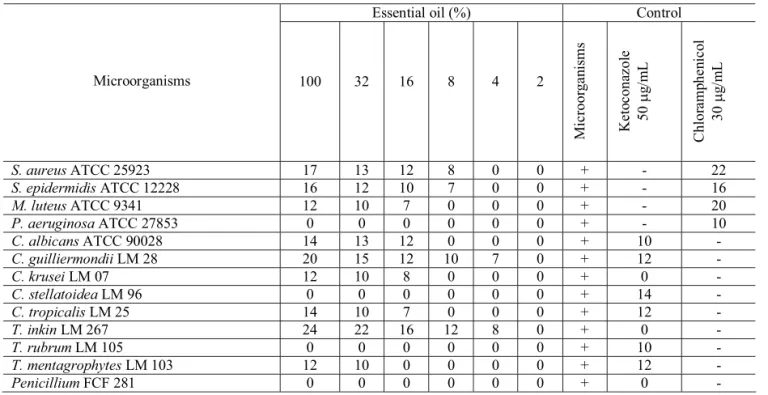
The antimicrobial activity results of the oil against the bacteria and fungi can be seen in Table 1.
The essential oil of S. cordifolia was able to inhibit the growth of three of the four strains of bacteria tested. However, it was more effective against
Staphylococcus aureus e S. epidermidis, up to the dilution of 8 % with inhibition halos of an average of 12 mm in diameter.
Among the fungi strains tested, seven were sensitive to the oil of S. cordifolia, representing 70 % of the tested strains. Concerning the leveduriform fungi,
C. guilliermondii and Trichosporon inkin were the most sensitive ones to the oil up to the dilution of 8 %, with inhibition halos of an average of 13 mm in diameter. Being only C. stellatoidea resistent to the essential oil. Regarding Candida albicans, C. krusei, C. tropicalis, they were sensitive to the oil at the concentration of 16%, with inhibition halos of an average of 10 mm in diameter.
Among the fi lamentous fungi tested, the oil at the concentration of 32 %, inhibited the growth of only
T. mentagrophytes, with inhibition halos of an average of 10 mm in diameter.
This study led to the conclusion that the antimicrobial activity of the essential oil of Sida cordifolia was satisfactory against the bacteria and fungi tested. These results are important as a preparation for further research with this same material. However, this essential oil needs to have adequate toxicological studies carried out in order to verify the possibility of its use in the fi ght against the microorganisms tested.
ACKHNOWLEDGEMENTS
The authors are grateful to CAPES and CNPq (Brazil) for grants and fellowships and express their thanks to the College of Pharmacy of the University of Illinois, Chicago, USA, for granting access to the NAPRALERT database.
REFERENCES
Allegrini J, Bouchberg MS, Maillols H 1973. Emulsions d’huiles esentielles fabrication et applications en
microbiologie. Societé de Pharmacie de Montpellier
33: 73-86.
Barbosa-Filho JM, Martins VKM, Rabelo LA, Moura MD, Silva MS, Cunha EVL, Souza MFV, Almeida RN, Medeiros IA 2006. Natural products inhibitors of
the angiotensin converting enzyme (ACE). A review
between 1980-2000. Rev Bras Farmacogn 16:
421-446.
Bawer AW, Kirby WM, Sherris SC, Turck M 1996. Antibiotic susceptibility testing by a standardezid single disc
method. Am J Clin Pathol45: 493-496.
Cleeland R, Squires E 1991. Evaluation of new antimicrobials “in vitro” and in experimental animal infections.
Antibiotics in Laboratory Medicine 3: 739-787. Falcão HS, Lima IO, Santos VL, Dantas HF, Diniz MFFM,
Barbosa-Filho JM, Batista LM 2005. Review of the
plants with anti-infl ammatory activity studied in
Brazil. Rev Bras Farmacogn 15: 381-391.
Fuertes FJ 1993. Revisión taxonômica del gênero Sida L.
(Malvaceae) em Colômbia. Salamanca: Universidad de Salamanca/Facultad de Biologia. Departamento de Biologia Vegetal.
Ghosal S, Chauhan RBPS, Mehta, R 1975. Chemical constituents
of Malvaceae. Part I. Alkaloids of Sida cordifolia.
Phytochemistry14: 830-832.
Matos FJA, Machado MIL, Craveiro AA, Barbosa-Filho JM
1999. Essential oil of Mentha x vilosa Huds. J Essent
Oil Res 11: 41-44.
Recio MC, Rios JL, Villar AA 1989. Review of some antimicrobial compounds isolated from medicinal
plants reported in the literature 1978-1988. Phytother
Res3: 117-125.
Silveira AL, Gomes MAS, Santos MRV, Medeiros IA, Barbosa-Filho JM 2003. Evaluation of the cardiovascular effects of vasicine, an alkaloid isolated from the
leaves of Sida cordifolia L. (Malvaceae). Rev Bras