Rev Bras
Cineantropom
Hum
DOI: http://dx.doi.org/10.5007/1980-0037.2017v19n1p1
original article
Development of an instrument in Portuguese to
identify barriers for physical activity in children
Desenvolvimento de um instrumento em Português
para identiicar as barreiras para a atividade física em
crianças
Patrícia Becker Engers1
Gabriel Gustavo Bergmann2
Marcelo Cozzensa da Silva1
Abstract – he aim of this study was to develop an instrument to identify barriers to PA in children. his is a validation study with observational and cross-sectional design. he population consisted of students aged 06-09 years from the city of Uruguaiana/ RS. he instrument content was obtained by theoretical matrix, constructed from the literature review and the assessment of barriers through open questions applied by proxy-report (n=100) and focus groups conducted with parents/guardians and children. It is a questionnaire consisting of 29 closed questions. After testing the instrument clarity, its implementation was carried out (n = 293) to verify the construct validity and internal consistency. After one week, parents/guardians were asked to answer the questionnaire retest reliability (n = 168) to verify the agreement. Exploratory factor analysis distributed the 29 questions in six factors, with total variance of 55.6%. All items that have deined the factors obtained load greater than 0.4 and eingenvalues above 1.0. In the internal consistency analysis, item-total correlations ranged from 0.23 to 0.64 and the total alpha value was 0.90. Reproducibility values ranged from 0.43 to 0.78. Twenty-four questions met all the criteria adopted for the study. It was concluded that the instrument developed has adequate validity and reliability for the identiication of barriers to PA in schoolchil-dren aged 06-09 years.
Key words: Child; Motor activity; Reproducibility of results; Surveys and questionnaires; Validity of tests.
Resumo – O objetivo do presente estudo foi desenvolver um instrumento para identiicar as barreiras para a prática de AF em crianças. Trata-se de um estudo de validação com caráter observacional e delineamento transversal. A população foi composta por escolares de 06 a 09 anos da cidade de Uruguaiana/RS. O conteúdo do instrumento foi obtido através da matriz teórica, construída a partir de revisão da literatura e do levantamento das barreiras através de questões abertas aplicadas por Proxy-report (n=100) e grupos focais conduzidos com pais/responsáveis e com crianças. Constitui-se um questionário composto por 29 questões fechadas. Após realizar o teste de clareza do instrumento, foi realizada a aplicação do mesmo (n=293) para veriicar a validade e a consistência interna. Depois de uma semana, os mesmos pais ou responsáveis foram convidados a responder o questionário em reteste (n=168) veriicando-se a concordância. A análise fatorial exploratória distribuiu as 29 questões em seis fatores, com variância total de 55,6%. Todos os itens que deiniram os fatores obtiveram carga maior que 0,4 e eingenvalues acima de 1,0. Na análise de consistência interna, as correlações item-total variaram de 0,23 a 0,64 e o valor total de alfa foi de 0,90. A reprodutibilidade variou entre 0,43 e 0,78. Vinte e quatro questões atenderam todos os critérios adotados para o estudo. Concluí-se que o instrumento desenvolvido apresenta validade e idedignidade adequadas para identiicação das barreiras para prática de AF em escolares de seis a nove anos.
1 Federal University of Pelotas. Gra-duate Program in Physical Education. Pelotas, RS. Brazil.
2 Federal University of Pampa. Uruguaiana, RS. Brazil.
Received: 26 September 2016
INTRODUCTION
he practice of Physical Activity (PA) is associated with numerous health beneits at all ages1. Physically active children are less likely to develop
chronic non-communicable diseases such as obesity, diabetes, hypertension and metabolic syndrome2. In addition, the practice of physical activities in
this period is positively associated with bone and muscle growth2.
Although evidence shows behaviors related to PA acquired and consolidated in childhood and adolescence inluence the active lifestyle in adulthood3,4, it has been veriied that the levels of PA decrease as age
increases, especially from adolescence5. A study conducted with preschool
children aged 4-6 years has shown that 65.3% are exposed to low level of PA6. Among adolescents, evidence points to a prevalence of physical
inactivity ranging from 39.0% to 93.5%7.
Biological, social and environmental aspects can inluence the involve-ment in physical activities8. he so-called barriers to the practice of PA are
among these aspects. he term “barrier” is conceptually deined as a set of personal and environmental obstacles that, based on individual perceptions, prevent or hamper adherence to the practice of PA9.
In recent years, several studies have addressed this item in scientiic literature10-14. However, in a search conducted in the main health databases
(PubMed, SciElo and Lilacs), no studies investigating the perceived bar-riers to the practice of PA in Brazilian children were found. Knowledge about the theme in this age group is afected by the inexistence of instru-ments validated for this purpose. Literature only reports instruinstru-ments exclusively developed to assess barriers among adolescents15,16, adults17,18
and the elderly19.
he development of reliable instruments to identify barriers to the practice of PA that consider, in addition to the psychometric characteris-tics particularities of the study population, is of extreme importance for the understanding of this phenomenon and, therefore, for the elaboration of efective interventions to promote the practice of PA in the age group under study. Based on this premise, the present study aimed to develop an instrument to identify barriers to the practice of PA in children aged 6-9 years. his age group was selected considering that children are of school age, which makes it possible to perform data collection.
METHODOLOGICAL PROCEDURES
Construction of the Theoretical Matrix
he construction of the theoretical matrix to support the elaboration of the instrument was performed through a literature review carried out in health databases (PubMed, SciElo and Lilacs). Collections were carried out be-tween August 2014 and August 2015. he year of publication of articles was not delimited, since publications on the subject in the age group of study are scarce. Combinations of the following Health Sciences Descriptors (HSDe) were used: “barriers”, “motor activity”, “physical activity”, “exercise” and “children” and their correspondents in the Portuguese language. Studies that met the following inclusion criteria were selected: a) those with outcomes of barriers to practice of PA, b) samples composed of children, without physical or mental disabilities c) published in Portuguese, English or Spanish. At the end of the search, only three studies met all criteria12-14, then composing the
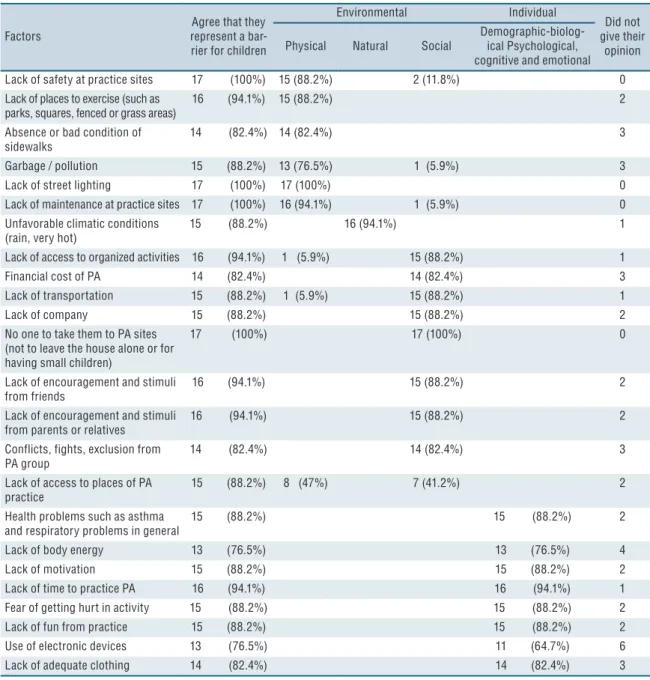
matrix. In these studies, 29 barriers were identiied, which were grouped according to determinant and dimension, which could be social, individual (psychological, cognitive and emotional) or environmental (physical and natural environment), according to classiication presented in the ecological model of determinants proposed by Sallis and Owen20.
Content validity
he content validity of the theoretical matrix was veriied through the judgment of Physical Education experts who had published at least one article on barriers to the practice of PA. In a nationwide survey, 23 names that met the criteria were found, with the exception of authors of this study who did not participate in this process to avoid any bias in the validation results. Experts were contacted via email and after three attempts to contact in diferent electronic addresses, 17 (73.9%) issued a response to the request sent. In the form sent to researchers, there was an item that represented or not a barrier to children and the classiication of barriers according to the ecological model. Of the 17 experts, all gave their opinion on whether or not to agree that the item represented a barrier to children, some agreed and others did not. However, some did not feel safe to give their opinion. For validation, the minimum agreement value of 70% among experts was adopted, according to recommendations of Serpa21.
Identiication of barriers
he identiication of factors that prevent or hamper the practice of PA in the study population, children aged 6-9 years, was performed through the application of a questionnaire with open questions, answered by parents and the formation of two focal groups, one with parents and the other with children.
For the application of the open questions, two schools from the urban area of Uruguaiana-RS were drawn, one from the public network and one from the private network. he sample was composed of students from one class of each school grade (1st to 4th year) of each of the schools (public and
private). A total of 109 children participated in the study, nine of which were not eligible, as they were children above the study age, totaling 100
Table 1. Theoretical matrix of factors that prevent or hinder the practice of Physical Activity (PA) by children after content validity.
Factors
Agree that they represent a bar-rier for children
Environmental Individual
Did not give their
opinion Physical Natural Social Demographic-biolog-ical Psychological,
cognitive and emotional Lack of safety at practice sites 17 (100%) 15 (88.2%) 2 (11.8%) 0 Lack of places to exercise (such as
parks, squares, fenced or grass areas)
16 (94.1%) 15 (88.2%) 2
Absence or bad condition of
sidewalks 14 (82.4%) 14 (82.4%) 3
Garbage / pollution 15 (88.2%) 13 (76.5%) 1 (5.9%) 3
Lack of street lighting 17 (100%) 17 (100%) 0
Lack of maintenance at practice sites 17 (100%) 16 (94.1%) 1 (5.9%) 0 Unfavorable climatic conditions
(rain, very hot)
15 (88.2%) 16 (94.1%) 1
Lack of access to organized activities 16 (94.1%) 1 (5.9%) 15 (88.2%) 1
Financial cost of PA 14 (82.4%) 14 (82.4%) 3
Lack of transportation 15 (88.2%) 1 (5.9%) 15 (88.2%) 1
Lack of company 15 (88.2%) 15 (88.2%) 2
No one to take them to PA sites (not to leave the house alone or for having small children)
17 (100%) 17 (100%) 0
Lack of encouragement and stimuli
from friends 16 (94.1%) 15 (88.2%) 2
Lack of encouragement and stimuli
from parents or relatives 16 (94.1%) 15 (88.2%) 2
Conflicts, fights, exclusion from PA group
14 (82.4%) 14 (82.4%) 3
Lack of access to places of PA
practice 15 (88.2%) 8 (47%) 7 (41.2%) 2
Health problems such as asthma
and respiratory problems in general 15 (88.2%) 15 (88.2%) 2
Lack of body energy 13 (76.5%) 13 (76.5%) 4
Lack of motivation 15 (88.2%) 15 (88.2%) 2
Lack of time to practice PA 16 (94.1%) 16 (94.1%) 1 Fear of getting hurt in activity 15 (88.2%) 15 (88.2%) 2
Lack of fun from practice 15 (88.2%) 15 (88.2%) 2
Use of electronic devices 13 (76.5%) 11 (64.7%) 6
participants (48 boys and 52 girls). For this stage, the free and informed consent form was sent to their parents / guardians, together with a question-naire composed of the following open questions: 1- Does your child practice PA? 2- If not, what are the main reasons for him/her not to practice PA? 3- If so, are there reasons that make it diicult to practice PA? Which are they? his questionnaire was answered by parents or guardians.
he Focus Group (FG) was developed in order to complement the instrument construction, which was especially based on studies and quali-tative researches of Dias22 and Placco23. For the formation of the focus
groups, a drawn was made between the two schools participating of the previous stage. he public school was drawn. For the FG performed with parents/guardians, three parents from each class, from the 1st to 4th school
grade, who had not previously participated, were invited. Of these, seven attended the day and time previously scheduled, agreeing to participate in the group. A 65-minute session was held, which encouraged discussions guided by ive indirectly structured questions (1- Do you consider that the place where you live stimulates your child to practice PA (what is missing or could be diferent) 2- Do the everyday tasks of your child make it dif-icult or impossible for him/her to practice PA? 3 - Do you think that the government carries out any program to stimulate the practice of PA for child? 4 – Do you think that the weather interferes with your child’s PA practice. In what way? 5- Do you think that there is any personal factor of your child that prevents him/her from practicing PA?).
he FG developed with children consisted of eight participants, two from each age group (six to nine years). For this, two children from each school grade (1st to 4th grades) were drawn, whose parents did not
partici-pate in the previous stages. FG was conducted in two sessions, the irst with duration of 30 minutes and the second with duration of 45 minutes. Discussions among participants were stimulated through the exposure of images of situations that represent obstacles to the practice of PA.
he sessions of both focus groups were conducted by the researcher in the school library. his place was chosen because it has little movement of people and because it is silent, thus allowing greater privacy and concentra-tion throughout the accomplishment of the work. Sessions were recorded and later transcribed in order to identify the main points that could help in the elaboration of questions.
From the content of parents’ answers to open questions and focus group discussions, barriers were identiied and grouped according to determinant and dimension and to the classiication presented in the ecological model of determinants proposed by Sallis and Owen20 (Figure 1). Five barriers
“My son is lazy about playing and moving”
“Laziness
practic-ing PA” Laziness Psychological, Cog-nitive and emotional
Response to open
question Barrier Determinant Dimension
Figure 1. Example of classification of barriers
Questionnaire elaboration
From the content of the theoretical matrix, of answers to open questions and from data obtained in focus groups, the closed questions that composed the inal questionnaire were formulated. he questionnaire consisted of 29 questions with response options that followed the summative or additive scale format with three levels: (0) never; (1) sometimes and (2) always. his three-point scale was adopted considering the evidence that individuals, when faced with many answer options, tend to mark extreme points and show diiculty in diferentiating intermediate evaluations 24.
Clarity test
To verify the clarity of the developed instrument, a new public school class participating in the previous stages was drawn. his group had not participated in the application of open questions or focus groups. Parents / guardians of students were invited to attend the school at previously scheduled date and time. On this occasion, the questions were applied, so that each one of them was read by the researcher, without generating any inluence on answers or explanation about it. Twelve mothers participated in this stage. After this test, only question “is the inancial cost of the activity a barrier?” needed to be rewritten, being reformulated to “Is the inancial cost involved in the PA practice a barrier?”
Validity and reliability test
To verify the instrument validity and reliability, the sample size was deined by the “humb Rules”, applied to factorial analysis techniques25.
he sample number was deined by the number of items in the closed questionnaire, establishing at least ten cases per variable (290 cases). We included 10% for possible losses and refusals, requiring a sample size of 319 children / parents.
he questionnaire was sent to parents or guardians of students in these three schools, being tested to verify their validity and internal consistency. After one week, parents or guardians were again invited to participate in the retest in order to verify the reproducibility of the questionnaire. he applications (test and retest) had at least three collection attempts.
Data analysis
he database was built in EpiData 3.1 software and data was double-typed for consistency checking. Statistical analysis was conducted in SPSS for Windows software version 20.0.
he questionnaire validity was tested through exploratory factorial analysis and applied to the direct Oblimin rotation, accepting eingenvalues above 1.0 and items with load greater than 0.4 to deine the factors26. his
procedure allowed verifying to what extent the sample response patterns adhere or distanced. he Kaiser-Meyer-Olkin (KMO) statistics was used to identify the sample adequacy.
Internal consistency analysis was performed using the Cronbach alpha coeicient of each factor, and alpha values ≥0.7027 were considered adequate.
he general analysis (all items) of Cronbach’s alpha and the identiication of the alpha value excluding each item was also tested. Corrected values of item-total correlations were also analyzed, considering values above 0.3 as appropriate.
Reproducibility was veriied by agreement analysis using the weighted Kappa index obtained after two applications in the same group with one week of interval. Minimum values of 0.4 (relative aggregation) were consid-ered for concordance28. In all analyses, signiicance level of 5% was adopted.
Ethical aspects
he study was approved by the Ethics Research Committee of the School of Physical Education, Federal University of Pelotas (protocol No. 1,109,092). Data collection began after formal authorization from the municipal and state Department of Education (10th CRE) and also from schools selected
for the study. Participants voluntarily signed the Free and Informed Con-sent Form.
RESULTS
In the validity and reliability testing phase, participants of the irst instru-ment application (test) was composed of the parents / guardians of 293 students, considering 31 losses. Of these, 164 (56%) were female, 35 aged six years, 63 aged seven years, 70 aged eight years and 125 aged nine years. In the second application (retest), 168 parents / guardians responded to the instrument. Regarding students, 111 were girls (66%), 17 aged six years, 36 aged 7 years, 37 aged 8 years and 78 aged 9 years.
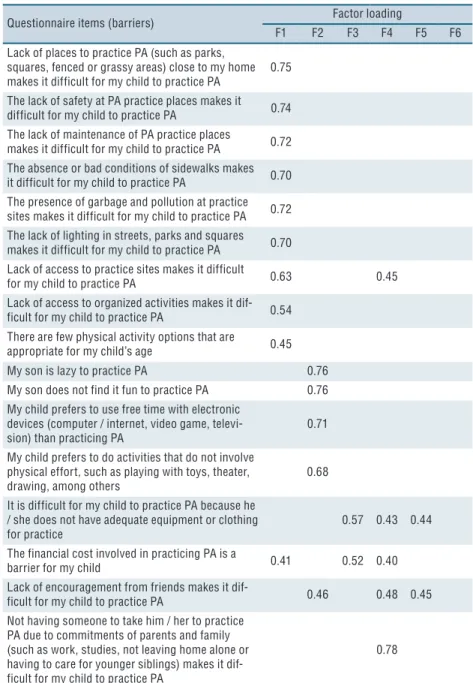
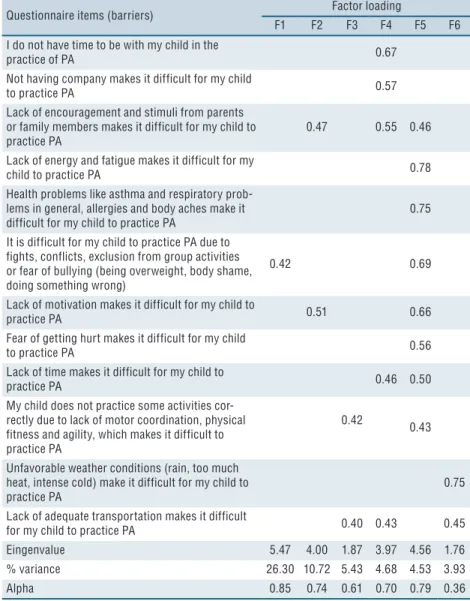
items that compose them. Factor one was named as “physical and social environment”, consisting of nine items. Factor two, consisting of four items, was deined as “personal motivation.” Factor three, with two items, was given the name “inancial contribution”. Factor four was named as “social support and encouragement”, composed of ive items. Factor ive, with seven items, was named as “individual factors” and factor six as “natural environment and transportation” (this one with only two items). All items that deined the factors obtained load higher than 0.4.
he total variance found was 55.6% and all factors obtained eingenval-ues above 1.0. Factors that presented the highest eingenvaleingenval-ues were factor one (5.47 and variance 26,30) and factor ive (4.56 and variance 4.53). Factor six was the one with the lowest value (1.76 and variance 3.93) (Table 2).
Table 2. Factorial analysis and validity indexes of barriers found for the practice of physical activity
(PA) in children.
Questionnaire items (barriers) Factor loading
F1 F2 F3 F4 F5 F6
Lack of places to practice PA (such as parks, squares, fenced or grassy areas) close to my home makes it difficult for my child to practice PA 0.75 The lack of safety at PA practice places makes it difficult for my child to practice PA 0.74 The lack of maintenance of PA practice places
makes it difficult for my child to practice PA 0.72 The absence or bad conditions of sidewalks makes it difficult for my child to practice PA 0.70 The presence of garbage and pollution at practice sites makes it difficult for my child to practice PA 0.72 The lack of lighting in streets, parks and squares makes it difficult for my child to practice PA 0.70 Lack of access to practice sites makes it difficult
for my child to practice PA 0.63 0.45
Lack of access to organized activities makes it dif-ficult for my child to practice PA 0.54 There are few physical activity options that are
appropriate for my child’s age 0.45 My son is lazy to practice PA 0.76 My son does not find it fun to practice PA 0.76 My child prefers to use free time with electronic
devices (computer / internet, video game,
televi-sion) than practicing PA 0.71
My child prefers to do activities that do not involve physical effort, such as playing with toys, theater,
drawing, among others 0.68
It is difficult for my child to practice PA because he / she does not have adequate equipment or clothing
for practice 0.57 0.43 0.44
The financial cost involved in practicing PA is a
barrier for my child 0.41 0.52 0.40
Lack of encouragement from friends makes it
dif-ficult for my child to practice PA 0.46 0.48 0.45 Not having someone to take him / her to practice
PA due to commitments of parents and family (such as work, studies, not leaving home alone or having to care for younger siblings) makes it dif-ficult for my child to practice PA
Questionnaire items (barriers) Factor loading
F1 F2 F3 F4 F5 F6
I do not have time to be with my child in the
practice of PA 0.67
Not having company makes it difficult for my child
to practice PA 0.57
Lack of encouragement and stimuli from parents or family members makes it difficult for my child to
practice PA 0.47 0.55 0.46
Lack of energy and fatigue makes it difficult for my
child to practice PA 0.78
Health problems like asthma and respiratory prob-lems in general, allergies and body aches make it
difficult for my child to practice PA 0.75
It is difficult for my child to practice PA due to fights, conflicts, exclusion from group activities or fear of bullying (being overweight, body shame, doing something wrong)
0.42 0.69
Lack of motivation makes it difficult for my child to
practice PA 0.51 0.66
Fear of getting hurt makes it difficult for my child
to practice PA 0.56
Lack of time makes it difficult for my child to
practice PA 0.46 0.50
My child does not practice some activities cor-rectly due to lack of motor coordination, physical fitness and agility, which makes it difficult to practice PA
0.42 0.43
Unfavorable weather conditions (rain, too much heat, intense cold) make it difficult for my child to practice PA
0.75
Lack of adequate transportation makes it difficult
for my child to practice PA 0.40 0.43 0.45
Eingenvalue 5.47 4.00 1.87 3.97 4.56 1.76
% variance 26.30 10.72 5.43 4.68 4.53 3.93
Alpha 0.85 0.74 0.61 0.70 0.79 0.36
Table 2 shows the alpha values for each extracted factor. Variations from 0.36 to 0.85 were found, and factors three and six did not obtain adequate values (alpha ≥0.70). Regarding the sample suitability, KMO value was 0.88.
he results of reliability analyses are presented in Table 3. In the inter-nal consistency ainter-nalysis, item-total correlations ranged from 0.23 to 0.64, showing that not all items contributed equally to the set of barriers and that items “Unfavorable weather conditions (rain, too much heat, intense cold) make it diicult to practice PA” and “My child prefers to do activi-ties that do not involve physical efort, such as playing with toys, theater, drawing, among others”, did not present adequate values (≥0.3) (values of 0.23 and 0.29, respectively). he total alpha value was 0.90. he alpha values, if items were deleted, ranged from 0.89 to 0.90, showing that no item, if removed, would increase the total alpha value.
Regarding reproducibility, all items had agreement above 0.4 between questionnaire applications (test and retest). Item “My child does not correctly
practice some activities due to lack of motor coordination, physical itness and agility, which makes it diicult to practice PA”, presented the highest reproducibility value (0.78). Item “Unfavorable climatic conditions (rain, too much heat, intense cold) prevent the practice of PA” showed the lowest value found (0.43). In general, 16 items presented reproducibility values with moderate classiication (0.40-0.59) and 13 optimal classiication (≥0.60).
Table 3. Results of the internal consistency and reproducibility (test-retest) of barriers.
Internal consistency retest
Test-Questionnaire Items Total
correlation
Alpha if deleted Kappa Lack of places to practice PA (such as parks, squares, fenced
or grassy areas) close to my home makes it difficult for my child to practice PA
0.48 0.89 0.70
The lack of safety at PA practice places makes it difficult for
my child to practice PA 0.47 0.89 0.67
The absence or bad conditions of sidewalks makes it difficult
for my child to practice PA 0.44 0.89 0.50
The presence of garbage and pollution at practice sites makes it difficult for my child to practice PA
0.50 0.89 0.64
The lack of lighting in streets, parks and squares makes it
difficult for my child to practice PA 0.45 0.89 0.58 The lack of maintenance of PA practice places makes it
dif-ficult for my child to practice PA 0.48 0.89 0.63 Unfavorable weather conditions (rain, too much heat, intense
cold) make it difficult for my child to practice PA
0.23 0.90 0.43
Lack of access to organized activities makes it difficult for
my child to practice PA 0.47 0.89 0.45
The financial cost involved in practicing PA is a barrier for my child
0.48 0.89 0.55
Lack of adequate transportation makes it difficult for my
child to practice PA 0.48 0.89 0.53
Not having company makes it difficult for my child to
prac-tice PA 0.45 0.89 0.56
Not having someone to take him / her to practice PA due to commitments of parents and family (such as work, studies, not leaving home alone or having to care for younger sib-lings) makes it difficult for my child to practice PA
0.44 0.89 0.58
Lack of encouragement and stimuli from friends makes it
difficult for my child to practice PA 0.52 0.89 0.51 Lack of encouragement and stimuli from parents or family
members makes it difficult for my child to practice PA
0.50 0.89 0.59
It is difficult for my child to practice PA due to fights, conflicts, exclusion from group activities or fear of bullying (being overweight, body shame, doing something wrong)
0.58 0.89 0.62
Lack of access to practice sites makes it difficult for my child to practice PA
0.64 0.89 0.61
Health problems like asthma and respiratory problems in general, allergies and body aches make it difficult for my child to practice PA
0.48 0.89 0.64
Lack of energy and fatigue makes it difficult for my child to
practice PA 0.55 0.89 0.63
Internal consistency retest
Test-Questionnaire Items correlation Total Alpha if deleted Kappa
My son does not find it fun to practice PA 0.42 0.89 0.59 My child prefers to use free time with electronic devices
(com-puter / internet, video game, television) than practicing PA 0.33 0.90 0.70 It is difficult for my child to practice PA because he / she
does not have adequate equipment or clothing for practice
0.53 0.89 0.64
There are few physical activity options that are appropriate
for my child’s age 0.45 0.89 0.49
My child prefers to do activities that do not involve physical effort, such as playing with toys, theater, drawing, among others
0.29 0.90 0.51
My child does not practice some activities correctly due to lack of motor coordination, physical fitness and agility, which makes it difficult to practice PA
0.33 0.90 0.78
Lack of time makes it difficult for my child to practice PA 0.31 0.90 0.53
My son is lazy to practice PA 0.30 0.90 0.69
Considering the validity analyses, internal consistency and reproduc-ibility, four factors (one, two, four and ive) met all the criteria adopted for the study. Among items belonging to these four factors, only one (“My child prefers to do activities that do not involve physical efort, such as playing with toys, theater, drawing, among others”) did not present value considered adequate for Item-total correlation (≥0.3). hus, the inal ques-tionnaire consisted of 24 questions (Annex I).
DISCUSSION
he present study is the irst to develop a speciic instrument for the iden-tiication of barriers to the practice of PA in children, a population group that has not yet been evaluated in scientiic literature. he elaboration of the instrument considered the speciic peculiarities of the age group when investigating the barriers that are relevant to the study population. For this, the participation of parents and children themselves and the inclusion of barriers identiied in the review of studies conducted in diferent countries were fundamental factors to achieve the study purposes12-14.
Some points of the research should be emphasized. he elaboration of the study followed all the steps for the process of development and testing regarding the instrument validity and reliability, following a psychometric model similar to that used in other studies15,16,29. his accomplishment
sought to guarantee the psychometric quality of the instrument developed to identify barriers for PA in children. he inclusion of items related to in-dividual, social and environmental factors identiied in the literature review and assessed in the study population such as to include in the instrument the maximum number of items that contemplated the diversity of factors that may represent barriers to children’s engagement in PA practice is another point that should be emphasized. Last but not least, it concerns
the content validation process, which relied on the opinion of experts with recognized knowledge in the ield.
he validity analysis of the study found values similar to studies that developed similar procedures and used the factorial analysis for its veriica-tion15,16. he internal consistency analysis showed that all items signiicantly
contributed to the construction of the questionnaire with alpha values ranging from 0.89 to 0.90. A study by Santos et al.15 aimed at developing
an instrument to analyze barriers to the practice of PA in adolescents, and by Kienteka et al.30, which analyzed the validity and reliability of an
instrument to evaluate the perception of barriers to bicycle use in adults, veriied similar internal consistency values (> 0.85 and> 0.72, respectively).
In the agreement analysis, the Kappa index was classiied from moder-ate (0.40-0.59) to optimal (≥0.60)28, similar to results found by Kienteka
et al.30 (k = 0.41 to k = 0.82) and Martins & Petroski17, who tested an
instrument to verify barriers to the practice of PA in adults (k = 0.55 to k = 0.88). In contrast, the present study presented higher concordance values compared to a study performed with a very similar population, but with another age group16. his diference may be related to the fact that in the
study by Engers et al.16, the questionnaire was answered by adolescents.
On the other hand, the application of the questionnaire was performed by Proxy-report with parents or guardians, that is, it was answered by adults. Proxy-report collections have been used in research with children because they are, in most cases, unable to answer complex questionnaires. hus, information about the child’s life is provided by someone of his or her life, such as parents, guardians, teachers or neighbors29,12,14.
Among studies investigating barriers to the practice of PA performed so far, no national studies investigating subjects under the age of ten were found. At international level, a study conducted in Mexico12 identiied
as the main barriers among children the presence of dogs on the street, intense heat, bad weather, heavy traic, inadequate public lighting and lack of places such as parks to exercise. A study conducted in the United States14 found that the most cited barriers are poor neighborhood safety,
followed by lack of sports and organized activities and the inancial cost of participating in PA. In Denmark, the most frequently identiied barriers were weather, conlicts, lack of space, lack of leisure facilities and prefer-ence for the use of electronic devices13. Most of these barriers remained in
the instrument proposed by the present study after validity and reliability analyses. Although the inluence of climatic conditions is reported as one of the main barriers in diferent parts of the world10,11,13, it was not considered
attenu-ated with the development of a FG with children who reported perceiv-ing practically the same barriers as those reported by parents. Another characteristic that must be considered is that even though methodological procedures recognized as adequate to develop instruments with psycho-metric quality have been applied, the fact that the theoretical matrix was not returned to experts after the changes suggested by them should be pointed out as a limitation. In addition, the fact that the research did not investigate the construct validity is another limitation. he procedure used to verify the construct validity was only exploratory and does not relect the construct validity, serving as a subsidy for future studies.
CONCLUSION
It was concluded that the proposed instrument has adequate validity and reliability to identify barriers to practice of PA in children aged 6-9 years. It should be noted that the socio-cultural characteristics of children should be considered in order to identify barriers in diferent locations. he use of this instrument in research to identify barriers to the practice of PA is important to increase the evidence on the subject. his information will provide support for better-planned and implemented PA programs for the health promotion of this population.
REFERENCES
1. Lee IM, Shiroma EJ, Lobelo F, Puska P, Blair SN, Katzmarzyk PT, et al. Efect of physical inactivity on major non-communicable diseases worldwide: an analysis of burden of disease and life expectancy. Lancet 2012;380(9838):219-29.
2. Janssen I. Physical activity guidelines for children and youth. Appl Physiol Nutr Metab 2007;32(2):109-21.
3. Telama R, Yang X, Viikari J, Välimäki I, Wanne O, Raitakari O. Physical ac-tivity from childhood to adulthood: a 21-year tracking study. Am J Prev Med 2005;28(1):267–73.
4. Azevedo MR, Menezes AM, Assunção MC, Gonçaves H, Arumi I, Horta BL, et al. Tracking of physical activity during adolescence: the 1993 Pelotas Birth Cohort, Brazil. Rev Saude Publica 2014;48(6):925-930.
5. Bacil EDA, Mazzardo Júnior O, Rech CR, Legnani FS, Campos W. Physi-cal activity and biologiPhysi-cal maturation: a systematic review. Rev Paul Pediatr 2015;33(1):114-21.
6. Barros SSH, Lopes AS, Barros MVG. Prevalência de baixo nível de atividade física em crianças pré-escolares. Rev Bras Cineantropom Desempenho Hum 2012;14(4):390-400.
7. Tassitano RM, Bezerra J, Tenório MCM, Colares V, Barros MVG, Hallal PC. Atividade física em adolescentes brasileiros: uma revisão sistemática. Rev Bras Cineantropom Desempenho Hum 2007;9(1):55-60.
8. Sallis JF. Age-related decline in physical activity: a synthesis of human and animal studies. Med Sci Sports Exerc 2000;32(9):1598-1600.
9. Baranowski T, Jago R. Understanding the mechanism of change in children’s physical activity programs. Exerc Sport Sci Rev 2005;33(4):163-168.
CORRESPONDING AUTHOR Patrícia Becker Engers Rua Quinze de Novembro, 2695, apto. 301, Bairro São Miguel, Uruguaiana-RS, Brasil CEP 97502-784.
E-mail: [email protected]
11. Ibrahim S, Karim N A, Oon NL, Ngah WZW. Perceived physical activity barriers related to body weight status and sociodemographic factors among Malaysian men in Klang Valley. BMC Public Health 2013;13(275):236-246.
12. Meyer MRU, Sharkey JR, Patterson MS, Dean WR. Understanding contextual barriers, supports, and opportunities for physical activity among Mexican-origin children in Texas border colonias: a descriptive study. BMC Public Health 2013;13(1):14-28.
13. Pawlowski CS, homsen TT, Schipperijn J, Troelsen J. Barriers for recess physical activity: a gender speciic qualitative focus group exploration. BMC Public Health 2014;14(1):639-648.
14. Kottyan G, Kottyan L, Edwards NM, Unaka NI. Assessment of active play, in-activity and perceived barriers in an inner city neighborhood. J Commun Health 2014;39(3):538-544.
15. Santos MS, Reis RS, Rodriguez-Anez CR, Fermino RC. Desenvolvimento de um instrumento para avaliar barreiras para a prática de atividade física em adolescentes. Rev Bras Ativ Fis Saúde 2009;14(2):76-85.
16. Engers PB, Bergmann MLA, Bergmann GG. Barreiras para a atividade física em adolescentes: validade e reprodutibilidade de um instrumento. Rev Bras Ativ Fis Saúde 2014;19(4):504-513.
17. Martins MO, Petroski EL. Mensuração da percepção de barreiras para a pratica de atividades físicas: uma proposta de instrumento. Rev Bras Cineantropom De-sempenho Hum 2000;2(1):58-65.
18. Reichert FF, Barros AJD, Domingues MR, Hallal PC. he role of perceived personal barriers to engagement in leisure-time physical activity. Am J Public Health 2007;97(3):515-19.
19. Nascimento CMC, Gobbi S, Hirayama MS, Brazão MC. Nível de atividade física e as principais barreiras percebidas por idosos de Rio Claro. Rev Educ Fis/UEM 2008; 19(1):109-118.
20. Sallis JF, Owen N. Physical Activity & Behavioral Medicine. Califórnia: SAGE Publications; 1999.
21. Souza GR, Avelar MCQ. Diagnósticos de enfermagem na assistência à pacientes com lesão renal aguda: Técnica Delphi. Online Braz J Nurs 2009;8(1):1-10.
22. Dias CA. Grupo focal: técnica de coleta de dados em pesquisas qualitativas. Inf Soc 2000;10(2):1-12.
23. Placco VMNS. Um estudo de representações sociais de professores do Ensino Médio quanto à AIDS, às drogas, à violência e à prevenção: o trabalho com grupos focais. In: Menin MSS, Shimizu AM, organizadores. Experiência e representação social: questões teóricas metodológicas. São Paulo: Ed. Casa do Psicólogo; 2005. p. 295-314.
24. Gaya A, Cardoso M. Os Fatores Motivacionais para Prática Desportiva e suas Relações com o Sexo, Idade, Níveis de Desempenho Desportivo. Rev Peril 1998;2(2):40-52.
25. Hill MM, Hill A. Investigação por Questionário. Lisboa: Sílabo; 2002.
26. Field A, Descobrindo a Estatística Usando o SPSS. Porto Alegre: Bookman; 2009.
27. Allison KR, Dwyer JJ, Goldenberg E, Fein A, Yoshida KK, Boutilier M. Male adolescents’ reasons for participating in physical activity, barriers to participation, and suggestions for increasing participation. Adolescence 2005;40(157):155-170.
28. Landis JR, Koch GG. he measurement of observer agreement for categorical data. Biometrics 1977;33(1):159-174.
29. McMinn AM, Van Sluijs EM, Harvey NC, Cooper C, Inskip HM, Godfrey KM, et al. Validation of a maternal questionnaire on correlates of physical activity in preschool children. Int J Behav Nutr Phys Act 2009;6(1):81-92.
Annex I. Questionnaire about barriers of physical activity – Portuguese version.
Gostaríamos de saber se as condições ou situações abaixo dificultam a prática de atividade física de seu filho(a). Marque o quanto (nunca, às vezes ou sempre) cada situação representa uma barreira para seu filho(a) praticar atividade física. Marque apenas uma opção de resposta em cada questão!
1- A falta de locais para praticar atividades físicas (como por exemplo, parques, praças, áreas cercadas ou de grama) perto de casa dificulta a prática do meu filho(a).
(0) Nunca (1) Às vezes (2) Sempre
2- A falta de segurança dos locais de prática dificulta para meu filho(a) fazer atividade física. (0) Nunca (1) Às vezes (2) Sempre
3- A ausência ou as más condições das calçadas dificultam a prática de atividade física do meu filho(a). (0) Nunca (1) Às vezes (2) Sempre
4- A presença de lixo e poluição nos locais de prática dificulta para meu filho(a) fazer atividade física. (0) Nunca (1) Às vezes (2) Sempre
5- A falta de iluminação pública das ruas, parques e praças dificulta a prática de atividade física do meu filho(a). (0) Nunca (1) Às vezes (2) Sempre
6- A falta de manutenção dos locais de prática dificulta para meu filho(a) fazer atividade física. (0) Nunca (1) Às vezes (2) Sempre
7- A falta de acesso a atividades organizadas dificulta a prática de atividade física do meu filho(a). (0) Nunca (1) Às vezes (2) Sempre
8- Não ter companhia dificulta a prática de AF do meu filho(a). (0) Nunca (1) Às vezes (2) Sempre
9- Não ter alguém para levar para praticar AF, devido aos compromissos dos pais e familiares (como trabalho, estudos, não deixar a casa sozinha ou por ter que cuidar de irmãos menores) dificulta a prática do meu filho(a).
(0) Nunca (1) Às vezes (2) Sempre
10- A falta de incentivo e estímulo dos amigos dificulta a prática de atividade física do meu filho(a). (0) Nunca (1) Às vezes (2) Sempre
11- A falta de incentivo e estímulo dos pais ou familiares dificulta a prática de atividade física do meu filho(a). (0) Nunca (1) Às vezes (2) Sempre
12- É difícil para meu filho(a) praticar atividade física devido as brigas, conflitos, exclusão de atividades em grupo ou medo de sofrer bullying (por estar acima do peso, vergonha do corpo, fazer alguma coisa errada).
(0) Nunca (1) Às vezes (2) Sempre
13- A falta de acesso a locais de prática dificulta para meu filho(a) fazer atividade física. (0) Nunca (1) Às vezes (2) Sempre
14- Os problemas de saúde como asma e problemas respiratórios em geral, alergias e dores no corpo dificultam a prática de atividade física do meu filho(a).
(0) Nunca (1) Às vezes (2) Sempre
15- A falta de energia e o cansaço dificultam a prática de atividade física do meu filho(a). (0) Nunca (1) Às vezes (2) Sempre
16- A falta de motivação dificulta a prática de atividade física do meu filho(a). (0) Nunca (1) Às vezes (2) Sempre
17- A falta de tempo do meu filho (a) dificulta a prática de atividade física. (0) Nunca (1) Às vezes (2) Sempre
18- O medo de se machucar dificulta a prática de AF do meu filho(a). (0) Nunca (1) Às vezes (2) Sempre
19- Meu filho(a) não acha divertido praticar atividade física. (0) Nunca (1) Às vezes (2) Sempre
20- Meu filho(a) prefere utilizar o tempo livre com aparelhos eletrônicos (computador/internet, vídeo game, televisão) do que praticar atividade física.
Gostaríamos de saber se as condições ou situações abaixo dificultam a prática de atividade física de seu filho(a). Marque o quanto (nunca, às vezes ou sempre) cada situação representa uma barreira para seu filho(a) praticar atividade física. Marque apenas uma opção de resposta em cada questão!
21- Existem poucas opções de atividades físicas adequadas para a idade do meu filho(a). (0) Nunca (1) Às vezes (2) Sempre
22- Meu filho(a) não pratica corretamente algumas atividades por falta de coordenação motora, aptidão física e agilidade, isso dificulta a prática de AF.
(0) Nunca (1) Às vezes (2) Sempre
23- Não tenho tempo para acompanhar os filhos na prática de AF. (0) Nunca (1) Às vezes (2) Sempre
24- Meu filho(a) tem preguiça de praticar atividade física. (0) Nunca (1) Às vezes (2) Sempre