Rev Bras
Cineantropom
Hum
DOI: http://dx.doi.org/10.5007/1980-0037.2017v19n1p17
original article
1 Pontifical Catholic University of Parana. Research Group on Physical Activity and Quality of Life. Curitiba--PR. Brazil.
2 Federal University of Parana. Gra-duate Program in Physical Education. Curitiba-PR. Brazil.
3 Washington University in St Louis. Brown School. Prevention Research Center. St Louis- MO, USA.
Received: 31 August 2016
Accepted: 11 January 2017
Validity and reliability of an instrument in
Portuguese to assess bicycle use patterns in
urban areas
Validade e idedignidade de um instrumento em
Português para avaliar o padrão de uso de bicicleta em
áreas urbanas
Marilson Kienteka1,2
Rodrigo S. Reis1,2,3
Abstract – he aim of this study was to analyze the validity and reliability of an
instru-ment to assess bicycle use patterns in urban areas through systematic observation. he instrument items were selected from a literature review. Content validity was established by consensus opinion of experts of the physical activity area. he temporal stability (reli-ability) was veriied by percentage of agreement and intraclass correlation coeicient (ICC). Observations were conducted using an adapted protocol based on the System for Observing Play and Recreation in Communities (SOPARC), consisting of systematic scans for counting cyclists in an urban area through video images provided by the public transport control system of Curitiba (URBS). Observers A and B recorded a total of 383 and 378 cyclists. Most of the observed subjects were men (87%), adults (84%), cycling on the BRT lane (54%), coming from downtown (54%), rode the bicycle on the wrong side of the street (58.2%), were not wearing a helmet (76.8) and bicycled alone (64%). Agreement percentiles ranged from 89.2 to 99.5% and ICC values from 0.922 to 0.999. According to criteria adopted, reliability was considered high in all categories included in the instrument. he instrument showed validity and reliability to be used in studies aiming to evaluate bicycle use patterns in Brazilian urban areas.
Key words: Bicycling; Evaluation; Leisure activities;Observation; Pendular migration;
Validity of tests.
Resumo – O objetivo deste estudo foi analisar a validade e idedignidade de um instrumento
INTRODUCTION
he interest in bicycle use as a means of transport and leisure has increased in the last decade1,2. Such interest is motivated, among other aspects, by
the potential positive impact of bicycle use on physical activity levels of individuals, with numerous health beneits3. In addition, such beneits
outweigh the risks of bicycle use related to safety and injuries related to traic4. However, this advantage has been observed in countries and cities
with higher levels of bicycle use as modality of transport, in which it was observed that bicycle accident rates fall when use levels increase. In these places, the greater number of cyclists makes them more visible to drivers and pedestrians and increases the chance of drivers being bicycle users, thus increasing their awareness to the safety rights of cyclists on urban roads5.
herefore, increasing the presence of cyclists on public roads is an im-portant aspect for the consolidation of the bicycle use in urban environments. To do so, investment in infrastructure for the use of bicycle4 is considered
a priority. However, an understanding of the efect of such changes on the presence and use of public bicycle lanes depends on reliable and accessible measures that provide information on the proile of public road users. In addition, there is still little evidence on the efect of changing urban struc-tures on the bicycle use pattern. Most studies available in literature have cross-sectional design, limiting the understanding of causal relations. In this sense, researchers have indicated the need for more follow-up stud-ies. However, follow-up surveys of urban interventions are operationally complex since they require comparisons before and after completion of environmental modiications that are not controlled by the researcher6. In
addition, the evaluation of bicycle use patterns has high operational cost, since it relies on sophisticated equipment to record the use of bicycle on the lane, such as inductive detectors, tubular pneumatic counters7 and web
cameras8. In addition, although these devices allow establishing the traic
volume, they do not provide information about the proile of road users. his limitation can be mitigated by using direct observation. Direct ob-servation has been used in studies on human behaviors in speciic contexts and scenarios9, as in physical activities performed in public spaces such as
parks and squares10, in school space11, and also during games and leisure
activities12. Direct observation Involves sampling techniques in which
sys-tematic and periodic scans are performed of people and contextual factors within target areas in predetermined community environments9. During
a scan, activities and characteristics of each individual are coded according to the study objectives using specialized counters13. herefore, its use can
METHODOLOGICAL PROCEDURES
he process of development, validity and reliability of the instrument was composed of sequential steps following recommendations and criteria for the development of instruments in the health area14. hese steps included:
a) construction of the instrument from the identiication of items in litera-ture and a conceptual framework; b) content validity, established by the clarity and adequacy of items analyzed by specialists in the area of physical activity and quality of life; and c) reliability, obtained by the analysis of the agreement among evaluators.
Construction of the instrument
Initially, a standardization of the term “pattern” was adopted, once the proposed instrument seeks to establish patterns of use of a public road related to bicycle use15. In the dictionary of the Portuguese language, the
word “pattern” presents, among others, two deinitions pertinent to the subject: 1) oicial model of weights and measures and 2) what is the basis or standard for evaluation; measure16. Based on these conceptual
deini-tions, the operational deinition for the present study was established, the term “bicycle use pattern” being the most repeated model regarding the use of bicycles on public roads objectively measured.
Once the operational deinition was established, it was sought to iden-tify the components of the instrument to analyze the bicycle use pattern on public roads. For this, individual and environmental factors associated with bicycle use, published in the peer-reviewed literature and synthesized in a systematic review on theme17, were used. he literature search and the
organization of identiied factors also considered an ecological model of correlates and determinants of physical activity, which considers that the interaction between the diferent, individual, social and environmental levels can explain the level of physical activity of a person18.
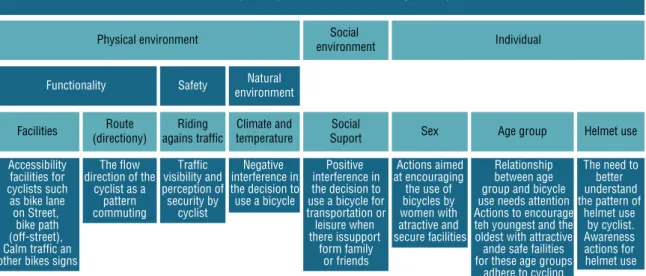
hen, the factors identiied in the literature review were organized in a theoretical framework that would allow the subsequent identiication of component items of the research instrument (Table 1)19. hese items were
listed and classiied according to their characteristics, namely:
a) Characteristics of the physical environment
• Functionality: a) traic routes for cyclist, the route that the cyclist chooses to travel, such as street, sidewalk or bicycle paths / bicycle lanes1,20; b) route direction, which seeks to identify the cyclist’s
direction low;
• Safety: a) use the bicycle against the traic low of motor vehicles, where cyclists may ind situations of conlict with pedestrians on the sidewalks and adverse situations with motor vehicles on the streets2; • Climate: a) climate and temperature, pointed in literature as an
important factor in the decision to use a bicycle21;
• Social support: positive encouragement is an important factor in the decision to use a bicycle for transportation or leisure22,23. Pedaling
accompanied by another cyclist is considered an approximation of the social support to use a bicycle.
c) Individual characteristics
• Sex: most studies indicate greater use of bicycles among men, which is certainly a target for the implementation of actions towards women as an incentive for bicycle use24,25;
• Age group: the use of the bicycle negatively related to younger in-dividuals and older adults, and therefore age group is an important aspect to be considered when promoting safe facilities for urban cycling26;
• Helmet use: Head injuries related to bicycle accidents are common and can be serious. hey can be avoided or reduced in terms of sever-ity with the use of the helmet; however, its use is still neglected27.
Understanding this relationship is vital for a set of safety awareness actions for cyclists.
Based on factors identiied in the conceptual model (Figure 1), a reg-istration form was developed with the respective categories and codes used during direct observation of behaviors at the study site. he form presents the possibility of the following records: 1) date of collection, 2) study phase, 3) hourly period fraction and 4) time spent in each observation fraction. For the climate factor, there are three options for recording: 1) presence of sun or sun among clouds; 2) cloudy and 3) predominance of drizzle or rainfall, also the recording of the maximum and minimum temperature of the observation period. For recording the pattern in which the cyclist uses the bicycle in the traic: a) Location identiication: (1) street, (2) bus corridor, (3) sidewalk and (4) bicycle path or bicycle lane; b) Route: (1) direction; neighborhood to downtown and 2) downtown to neighbor-hood, being able to be adapted for use according to the cardinal points;
c) wrong-way driving: it is recorded in a dichotomous way (yes or no); d) Sex: (1) male, (2) female; e) Age is categorized in age group: (1) child or adolescent, (2) adult and (3) older adult; f) Helmet use: (1) no, (2) yes and (3) the option of undeined or unidentiied; g) Social support: recorded if the cyclist is: (1) bicycling alone or (2) accompanied (two or more cyclists). All items are coded to facilitate the categorized typing of data (Annex 1).
For the form application, the System for Observing Play and Recre-ation in Communities (SOPARC)28 was used as reference. he SOPARC
protocol was adapted, the area scan originally proposed in the protocol was replaced by an imaginary line, which was established so that the observation amplitude is limited to the observer’s view ield (evaluator), which contemplates the passage of the cyclist in the transverse plane of the selected urban road. his observation can be carried out in ield or by recording traic images. In the case of ield observation, the evaluator’s position should be the one that allows the best ield of view and amplitude to establish an imaginary line of data tabulation. Image analysis will depend on the type of framing of the available urban route (area). For transversal framing of the urban route (area), which is the most appropriate, a line can be easily adapted on the video screen to facilitate data tabulation in the instrument. In the case of parallel ilming of the urban route (area), the ield of view of the video screen itself may set these limits. hese meth-odological procedures make it possible to tabulate information contained in the instrument at the moment that the cyclist is crossing this line of pre-established observation, systematically and periodically, for example, hourly or continuously, depending on the study design or proposal.
Content validity
he conceptual model (Figure 1) and the respective form registration possibilities were discussed by a group of experts composed of two senior researchers and two PhD candidates in Physical Education, all experienced in environment and physical activity research. his stage was developed with the purpose of adapting the aspects reported in international studies to the Brazilian context and assisted in the agreement and deinition of items selected to compose the instrument.
must present at least one of these characteristics for deinition of adolescent and adults were established, namely: bicycle size (small or lowered bicycle), clothing (wearing a cap, school uniform, hooded sweatshirt, long shorts) and behavior (indeinite direction and reckless maneuvers). hese criteria and procedure were recorded in a reference manual for instrument application.
Instrument reliability
he analysis of concordance among evaluators used data obtained through a partnership between the Graduate Program in Urban Management, School of Art and Design of the Pontiical Catholic University of Paraná and Urbanização de Curitiba S/A company (URBS)29, which Is a
mixed-economy company that controls the public transportation system of the city of Curitiba. After clarifying the study, URBS, owner of the operating system to monitor the collective transportation of the city, authorized the use of continuous images (Authorization No. 007/2014 - PPGTU).
After deining the standardization of measures, two volunteers (Evalu-ators A and B) received six-hour training for data tabulation, which was subdivided into two modules: 1) theoretical and practical using images for the knowledge of the instrument; 2) practical on public roads to solve questions related to the procedure. Next, a period of four hours of continu-ous images was used, subdivided into twelve fractions of 20 minutes for recording the codes on the form, according to the previously established protocol. Evaluators A and B recorded the information independently, but when necessary there was the possibility of reviewing images individually and without communication between them.
he frequency of observations among evaluators was tested in each category of variables using absolute and relative values and homogene-ity test using the chi-square test. Reliabilhomogene-ity was analyzed by the relative agreement percentage and by the intraclass correlation coeicient (ICC) among evaluators in each category of the instrument variables, and the unit of analysis for this correlation among evaluators is the 12 blocks of 20-minute fractions of the period analyzed; for example: correlation only to yes, then to no; among male cyclist and then among female cyclists, and so on. ICC values ≥ 0.70 and relative concordance ≥ 70.0% were considered as adequate reliability values14. Analyses were performed in SPSS 17.0
software and the signiicance level was 5%.
Ethical aspects
he study was submitted to and approved by the Ethics Research Commit-tee of the Pontiical Catholic University of Paraná under number 1.281.180.
RESULTS
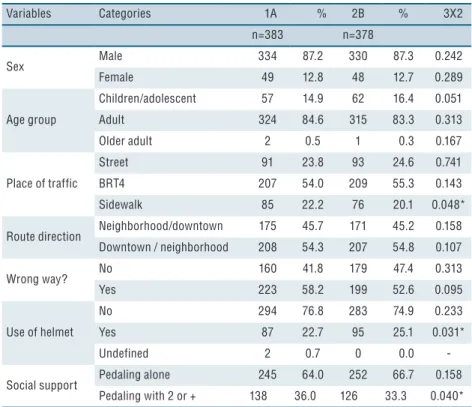
adults (A=84.6% and B=83.3%; p=0.313), were traveling through the BRT corridor (A=54.0% and B=55.3%; p=0.143), rode their bicycles in the downtown / neighborhood direction (A=54.3% and B=54.8%; p=0.107), in the wrong direction (A=58.2% and B=52.6%; p=0.95), used no helmet (A=76.8% and B=74.9%; p=0.233) and were riding alone (A=64.0% and B=66.7%; p=0.158).
here were some signiicant diferences among evaluators, within the categories of variables, for example, the place of traic in the category: sidewalk (A = 22.2% and B = 20.1%, p = 0.048), use of helmet category: yes (A = 22.7% and B = 25.1%, p = 0.031) and social support category: pedaling alone or not (A = 36.0% and B = 33.3%; p = 0.040), according to table 1.
Table 1. Absolute and relative frequencies of observations, according to instrument recording categories and evaluators
Variables Categories 1A % 2B % 3X2
n=383 n=378
Sex Male 334 87.2 330 87.3 0.242
Female 49 12.8 48 12.7 0.289
Age group
Children/adolescent 57 14.9 62 16.4 0.051
Adult 324 84.6 315 83.3 0.313
Older adult 2 0.5 1 0.3 0.167
Place of traffic
Street 91 23.8 93 24.6 0.741
BRT4 207 54.0 209 55.3 0.143
Sidewalk 85 22.2 76 20.1 0.048*
Route direction Neighborhood/downtown 175 45.7 171 45.2 0.158
Downtown / neighborhood 208 54.3 207 54.8 0.107
Wrong way? No 160 41.8 179 47.4 0.313
Yes 223 58.2 199 52.6 0.095
Use of helmet
No 294 76.8 283 74.9 0.233
Yes 87 22.7 95 25.1 0.031*
Undefined 2 0.7 0 0.0
-Social support Pedaling alone 245 64.0 252 66.7 0.158
Pedaling with 2 or + 138 36.0 126 33.3 0.040*
1A: evaluator A; 2B: evaluator B; 3X2: chi-square to verify if there is similarity among observations
between evaluator A and B; 4BRT - (bus rapid transit) (*) p=<0.05 presented significant differences
between evaluators.
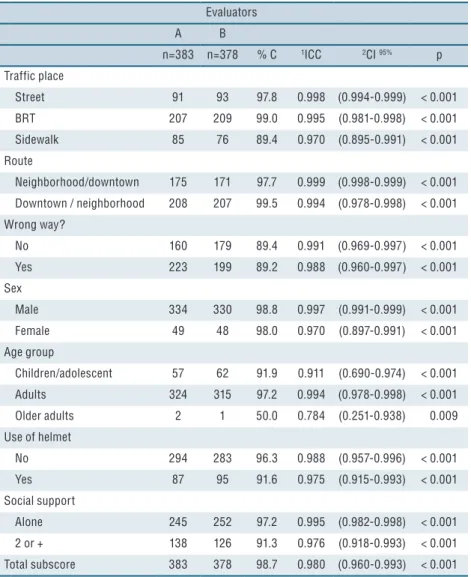
Table 2. Relative agreement values and intraclass correlation coefficient between evaluators according to the instrument recording categories
Evaluators
A B
n=383 n=378 % C 1ICC 2CI 95% p
Traffic place
Street 91 93 97.8 0.998 (0.994-0.999) < 0.001
BRT 207 209 99.0 0.995 (0.981-0.998) < 0.001
Sidewalk 85 76 89.4 0.970 (0.895-0.991) < 0.001
Route
Neighborhood/downtown 175 171 97.7 0.999 (0.998-0.999) < 0.001
Downtown / neighborhood 208 207 99.5 0.994 (0.978-0.998) < 0.001
Wrong way?
No 160 179 89.4 0.991 (0.969-0.997) < 0.001
Yes 223 199 89.2 0.988 (0.960-0.997) < 0.001
Sex
Male 334 330 98.8 0.997 (0.991-0.999) < 0.001
Female 49 48 98.0 0.970 (0.897-0.991) < 0.001
Age group
Children/adolescent 57 62 91.9 0.911 (0.690-0.974) < 0.001
Adults 324 315 97.2 0.994 (0.978-0.998) < 0.001
Older adults 2 1 50.0 0.784 (0.251-0.938) 0.009
Use of helmet
No 294 283 96.3 0.988 (0.957-0.996) < 0.001
Yes 87 95 91.6 0.975 (0.915-0.993) < 0.001
Social support
Alone 245 252 97.2 0.995 (0.982-0.998) < 0.001
2 or + 138 126 91.3 0.976 (0.918-0.993) < 0.001
Total subscore 383 378 98.7 0.980 (0.960-0.993) < 0.001
1ICC- Intraclass Correlation Coefficient; 2 95% confidence interval
Most of the items in the scale presented high agreement (89.2-99.5%). For the ICC values, similar to the agreement percentage, the results were high (ICC> 0.900) for all items of the instrument variables categorization, except for the “older adult” category (ICC = 0.784, p = 0.009), but still within values considered adequate for this type of analysis. he lower con-idence intervals of ICC values remained above 0.800 in all items, with the exception for “older adult” (0.251) and child / adolescent categories (0.690).
DISCUSSION
he present study aimed to analyze the validity and reliability of an instru-ment to evaluate the bicycle use patterns in urban roads through direct observation. Individual, social and environmental factors were analyzed, seeking the inclusion of information that can be identiied by scanning images of public roads.
of factors related to bicycle use and allowed the development of a theoretical matrix that supported the conceptual basis of the study. After consulting experts, some characteristics were re-adjusted and the instrument analysis categories were determined. However, some adaptations will be necessary when applying the instrument in diferent urban areas. For example, BRT is a structure of exclusive bus corridors only found in large urban centers, and may not be the case in some investigations. herefore, urban roads that do not contain similar corridors should include this structure whenever necessary (for example: railway axis, bicycle lanes shared in sidewalks, etc.).
Still in relation to content validity, consensus among specialists in-volved in the construction of the instrument and in the application of the observation protocol was veriied. However, evaluating bicycle use both on the site in real time and through ilming should be accompanied by some adaptations. For the real-time measurement, the type of road must be considered, since in cases of wide roads, with several lanes and with bicycle use structure, it may be necessary the presence of at least two evaluators in the same place. For image analysis, image quality should be investigated, as there is the possibility of distortions and lack of natural light at dawn and especially at nightfall, which may make it diicult to identify some study variables depending on the seasonality, winter time, rainfall and the region in which the instrument was applied.
A high percentage of agreement was observed in most categories of variables (89.2 - 99.5%) and similarly, intraclass correlation also showed high coeicients (0.922 - 0.999), conirming the instrument reliability. However, some categories presented low or nonexistent values, deserving attention in the study that proposed to use this instrument, for example: there may be a need to aggregate “older adult” with “adult” categories or subdivide the children / adolescent category if the study is aimed at evalu-ating school routes. Another variable that presented low or nonexistent observation was “undeined” helmet use category. his option was included due to the diiculty of observations in periods with little or no incidence of natural light.
his study presents an important contribution to studies seeking to evaluate the bicycle use pattern in urban areas. To date, an instrument that would allow this kind of evaluation in the Brazilian urban context has not yet been found in literature30. he combination of literature synthesis,
conceptual framework and expert opinion has allowed content validity to be established by diferent sources. In addition, reliability was evaluated separately for each component of the form, and allowed identifying in detail the quality of measurement for each item of the instrument. Finally, the use of a detailed protocol based on a well-established approach in the area of systematic observation combined with the use of images with good resolution and adequate training of observers, has reduced possible classiication biases.
Operations Control of the Curitiba Transportation System presented quality in image resolution, thus providing an excellent subsidy for the reproducibility of this instrument. Cyclists were observed in the morning of a single day of the week (Tuesday), with presence of sun and mild tem-perature (Min: 12.6oC and Max: 19.2oC), thus, the results of the bicycle
use pattern recorded in this study cannot be considered as a reference for other periods and days of the week, and for diferent climatic conditions. In addition, the morning period was intentionally chosen, not contemplat-ing the veriication of images made at other times with little or no natural light, which may make it diicult to identify some instrument variables such as: cyclists’ sex and helmet use.
Finally, the use of images can represent a facility in obtaining data, in which information can be later tabulated in laboratory. his situation may be diferent when it is proposed to obtain and tabulate data on the site, which may require testing the instrument on urban roads (in loco) by comparing it with the data simultaneously recorded by images. he lack of evidence on factors associated with bicycle use in the Brazilian population, especially bicycle use patterns, limits the comparison of indings with literature.
CONCLUSION
It was concluded that the instrument presents adequate content validity and reliability for the observation of bicycle use in urban roads through direct observation. In general, the information obtained with this instrument allows describing important characteristics about bicycle use patterns on public roads. Such information can be used in descriptive or comparative studies on sites of speciic interest, as well as in the assessment of the impact of modiications of urban structures on bicycle use. he development of this instrument can also contribute to the standardization of bicycle use in an observational way, facilitating the collection of data for city halls, agencies and fundraising organizations. Ideally, these groups can work with academic researchers in the design and implementation of evaluation studies, including data collection and analysis, and publication of results through the peer review process, for dissemination and better understand-ing of results, especially when applied before and after the implementation of bicycle use incentive structures. Additional studies should test the at-tributes of this instrument in diferent environments and urban contexts.
Acknowledgments
REFERENCES
1. Cervero R, Sarmiento OL, Jacoby E, Gomez LF, Neiman A. Inluences of Built Environments on Walking and Cycling: Lessons from Bogotá. Int J Sustain Transp 2009;3(4):203-26.
2. Titze S, Stronegger WJ, Janschitz S, Oja P. Association of built-environment, social-environment and personal factors with bicycling as a mode of transportation among Austrian city dwellers. Prev Med 2008;47(3):252-9.
3. Gordon-Larsen P, Boone-Heinonen J, Sidney S, Sternfeld B, Jacobs Jr DR, Lewis CE. Active commuting and cardiovascular disease risk: the CARDIA study. Arch Intern Med 2009;169(13):1216.
4. Pucher J, Dill J, Handy S. Infrastructure, programs, and policies to increase bicy-cling: An international review. Prev Med 2010;50:S106-S125.
5. Elvik R. An exploratory analysis of models for estimating the combined efects of road safety measures. Accid Anal Prev 2009;41(4):876-80.
6. Remler DK, Ryzin GG Van. Research Methods in Practice: Strategies for Descrip-tion and CausaDescrip-tion. Firt ediDescrip-tion. (Sage, ed.).; 2011.
7. Minge E, Falero C, Lindsey G, Petesch M. Bicycle and Pedestrian Data Collection Manual - Draft. Minnesota, US; 2015.
8. Hipp JA, Adlakha D, Eyler AA, Chang B, Pless R. Emerging technologies: Webcams and crowd-sourcing to identify active transportation. Am J Prev Med 2013;44(1):96-7.
9. McKenzie TL, Cohen DA, Sehgal A, Williamson S, Golinelli D. System for Observing Play and Recreation in Communities (SOPARC): Reliability and Feasibility Measures. J Phys Act Heal 2006;3 (Suppl 1):S208-S222.
10. Evenson KR, Jones SA, Holliday KM, Cohen DA, McKenzie TL. Park Charac-teristics, Use, and Physical Activity: A Review of Studies Using SOPARC (System for Observing Play and Recreation in Communities). Prev Med 2016;86:153-166.
11. Hino AAF, Reis RS, Romélio C, Añez R. Observação Dos Níveis De Atividade Física, Contexto Das Aulas e Comportamento Do Professor em Aulas De Educação Física Do Ensino Médio Da Rede Pública. Rev Bras Ativ Fis Saúde 2010;1(1):21-30.
12. Saint-Maurice PF, Welk G, Ihmels MA, Krapl JR. Validation of the SOPLAY Direct Observation Tool With an Accelerometry-Based Physical Activity Monitor. J Phys Act Health. 2011;8:1108-16.
13. Hino A A F, Reis RS, Ribeiro IC, Parra DC, Brownson RC, Fermino RC. Us-ing observational methods to evaluate public open spaces and physical activity in Brazil. J Phys Act Health 2010;7 (Suppl 2):S146-S154.
14. Terwee CB, Bot SDM, Boer MR, et al. Quality criteria were proposed for measure-ment properties of health status questionnaires. J Clin Epidemiol 2007;60(1):34-42.
15. Brito R De, Pinheiro C, Garganta R. Padrão de atividade física em crianças e jovens : Um breve resumo do estado do conhecimento. Rev Bras Cineantropom Desempenho Hum 2010;12(1):68-76.
16. Ferreira ABH. Aurélio Século XXI: O Dicionário Da Língua Portuguesa.; 1999.
17. Kienteka M, Fermino R, Reis R. Fatores individuais e ambientais associados com o uso de bicicleta por adultos: uma revisão sistemática. Rev Bras Ativ Fis Saúde 2014;19(1):12-24.
18. Sallis JF, Owen N, Fisher EB. Ecological models of health behavior. Heal Behav Heal Educ heory Res Pract. 2008;4(1):465-82.
19. Terwee CB, Mokkink LB, Van Poppel MNM, Chinapaw MJM, Van Mechelen W, De Vet HCW. Qualitative attributes and measurement properties of physical activity questionnaires: a checklist. Sport Med 2010;40(7):525-37.
20. Moudon AV, Lee C, Cheadle AD, Collier CW, Johnson D, Schmid TL, Weather RD. Cycling and the built environment, a US perspective. Transp Res Part D Transp Environ 2005;10(3):245-61.
22. Titze S, Stronegger WJ, Janschitz S, Oja P. Environmental, social, and personal correlates of cycling for transportation in a student population. J Phys Act Health 2007;4(1):66-79.
23. De Geus B, De Bourdeaudhuij I, Jannes C, Meeusen R. Psychosocial and environ-mental factors associated with cycling for transport among a working population. Heal Educ Res 2008;23(4):697.
24. Owen N, De Bourdeaudhuij I, Sugiyama T, Leslie E, Cerin E, Van Van Dyck D, Bauman A. Bicycle use for transport in an Australian and a Belgian city: as-sociations with built-environment attributes. J Urban Health 2010;87(2):189-8.
25. Garrard J, Rose G, Lo SK. Promoting transportation cycling for women: the role of bicycle infrastructure. Prev Med 2008;46(1):55-9.
26. Tin Tin S, Woodward A, hornley S, Langley J, Rodgers A, Ameratunga S. Cy-clists’ attitudes toward policies encouraging bicycle travel: indings from the Taupo Bicycle Study in New Zealand. Heal Promot Int 2009;25(1):54-62.
27. Karkhaneh M, Kalenga J-C, Hagel BE, Rowe BH. Efectiveness of bicycle helmet legislation to increase helmet use: a systematic review. Inj Prev 2006;12(2):76-82.
28. McKenzie TL, Cohen D, Sehgal A, Williamson S, Golinelli D. System for Observ-ing Play and Recreation in Communities (SOPARC): Reliability and Feasibility Measures. J Phys Act Health 2006;3 (Suppl 1):S208-S222.
29. Curitiba PM. Urbanização de Curitiba S/A; Available from: <http://www.urbs. curitiba.pr.gov.br> [2015 feb 25].
30. Gray JA, Zimmerman JL, Rimmer JH. Built environment instruments for walk-ability, bikewalk-ability, and recreation: Disability and universal design relevant? Disabil Health J 2012;5(2):87-101.
ANNEX I - DEFINITION AND INTERPRETATION OF
INSTRUMENT ITEMS
hese deinitions are intended to facilitate the interpretation of the instru-ment for better agreeinstru-ment among evaluators involved in data collection.
1) Place of traic: a) street, this is the lane for motor vehicles; b) BRT, is the acronym of the term “Bus Rapid Transit” for the exclusive corridors of buses when they are intended for public transport; c) sidewalk, this is the place for pedestrians located between the curb and the buildings of the street segment; d) bicycle lanes, places reserved at the same level of the street, but with distinct signaling, which may be continuous or intermittent bands, or even separated by relective and diferent paint-ings in their extension.
2) Route: a) BC, neighborhood / downtown direction; b) CB, downtown / neighborhood direction. In this item, since it is not possible to identify this direction by the urban coniguration of the city, one side should be chosen to quantify the number of cyclists who travel in both direc-tions, thus obtaining information on this bicycle route, for example: north / south, or east / west.
3) Wrong way: a) No; cyclists who travel in the traic direction, even when they travel on the sidewalk. b) Yes; cyclists who travel in the opposite direction, that is, against the normal traic low including on the sidewalk.
4) Sex: a) M, for male cyclist, b) F, for female cyclist.
CORRESPONDING AUTHOR Marilson Kienteka
Pontifícia Universidade Católica do Paraná – PUCPR
Grupo de Pesquisa em Atividade Física e Qualidade de Vida – GPAQ Rua Imaculada Conceição, 1155 – Prado Velho – CEP 80215-901 - Curitiba-PR, Brasil
5) Age group: a) Child / adolescent, for this item, those who are under the age of 18 years were considered adolescents. For the age threshold between 17 and ≥ 18 years, an interpretation criterion becomes neces-sary. To solve possible doubts in the interpretation of this age group transition, a predominant combination of characteristics in adolescents can be used, such as: bicycle size, random way of driving the bicycle, wearing school uniform or typical clothing (cap, hooded sweatshirt, etc.) b) Adult; likewise, adult observation may require identiication criteria at both ends, the younger part was already deined with examples, but for the transition from adult to older adult (18-65), the criterion may also need attention in the training of observers involved in data collection; c) Older adults; some characteristics of this age group were revealed in the validation study. In the same way that the adolescent can be iden-tiied by the bicycle size and model, older adults have a diferent style of pedaling and present diferent characteristics such as bicycle type (strong bar), hair, lighter pedaling cadence and conservative clothing.
6) Helmet use: a) No, tabulation of cyclists who do not use the helmet; b) Yes, tabulation of cyclists using the helmet; c) N / D, an acronym for “not deined”, in this case, when using images to analyze the bicycle use pattern, other variables may interfere with the correct observation of items that make up the instrument, but in this case, images with low resolution, zoomed distance or lack of lighting, may confuse with the use of cap, which is very typical among cyclists, as a helmet user.
7) Social support: a) Alone; cyclist who travels alone, without the com-pany of another cyclist. b) Two or more; cyclist who travels with other cyclists, next to or immediately behind. In some cases, the tracking of the cyclist’s trajectory rather than just the imaginary line previously determined for the collection of these data may be necessary.
ANNEX II - BICYCLE USE OBSERVATION
INSTRUMENT – PORTUGUESE VERSION
IOUB – INSTRUMENTO DE OBSERVAÇÃO DO USO DE BICICLETA
Data da observação: ___/___/___
Avaliador:
__________ ID local:
1[ ]______________ 2[ ]______________ 3[ ]
Fase do Estudo:
1[ ]Baseline 2[ ] 1ª fase 3[ ] 2ª fase 4[ ] 3ª fase 5[ ] 4ª fase
Dia da
semana: 1[ ] Segunda-feira 2[ ] Terça-feira 3[ ] Quarta-feira 4[ ] Quinta-feira 5[ ] Sexta-feira 6[ ] Sábado 7[ ] Domingo Fração do
período:
[ ]01 07:00:00-
07:59:59
[ ]02 08:00:00
08:59:59
[ ]03 09:00:00-
09:59:59
[ ]04 10:00:00-
10:59:59 [ ]05 11:00:00-
11:59:59
[ ]06 12:00:00
12:59:59
[ ]07 13:00:00-
13:59:59
[ ]08 14:00:00-
14:59:59 [ ]09 15:00:00-
15:59:59
[ ]10 16:00:00
16:59:59
[ ]11 17:00:00-
17:59:59
[ ]12 18:00:00
19:00:00 Clima
pre-dominante:
[ ]1 sol /entre
nuvens [ ]2 nublado
[ ]3 garoa ou
chuva Tempo aval: Iníc:______Fim:_______Total_____min. Direção da
filmagem:
[ ]1 BC:
Bairro-Centro
[ ]2 CB:
N - ID 1. Local do trânsito 2. Rota 3. Contramão 4. Sexo 5. Faixa etária pedalando 6. Uso de capacete?
7. Apoio social 01
1-5 Rua 3-5Calçada 2-5 BRT 4-5Ciclofaixa
1-5 BC 2-5 CB
0-5 Não 1-5 Sim
1-5 M 2-5 F
1-5 Criança/adolescente 2-5 Adulto 3-5 Idoso
0-5 Não 1-5 Sim 2-5 N/D
1-5 Sozinho 2-5 2 ou + _______
02
1-5 Rua 3-5Calçada 2-5 BRT 4-5Ciclofaixa
1-5 BC 2-5 CB
0-5 Não 1-5 Sim
1-5 M 2-5 F
1-5 Criança/adolescente 2-5 Adulto 3-5 Idoso
0-5 Não 1-5 Sim 2-5 N/D
1-5 Sozinho 2-5 2 ou + _______
03
1-5 Rua 3-5Calçada 2-5 BRT 4-5Ciclofaixa
1-5 BC 2-5 CB
0-5 Não 1-5 Sim
1-5 M 2-5 F
1-5 Criança/adolescente 2-5 Adulto 3-5 Idoso
0-5 Não 1-5 Sim 2-5 N/D
1-5 Sozinho 2-5 2 ou + _______
04
1-5 Rua 3-5Calçada 2-5 BRT 4-5Ciclofaixa
1-5 BC 2-5 CB
0-5 Não 1-5 Sim
1-5 M 2-5 F
1-5 Criança/adolescente 2-5 Adulto 3-5 Idoso
0-5 Não 1-5 Sim 2-5 N/D
1-5 Sozinho 2-5 2 ou + _______
05
1-5 Rua 3-5Calçada 2-5 BRT 4-5Ciclofaixa
1-5 BC 2-5 CB
0-5 Não 1-5 Sim
1-5 M 2-5 F
1-5 Criança/adolescente 2-5 Adulto 3-5 Idoso
0-5 Não 2-5 N/D 1-5 Sim
1-5 Sozinho 2-5 2 ou + _______
06
1-5 Rua 3-5Calçada 2-5 BRT 4-5Ciclofaixa
1-5 BC 2-5 CB
0-5 Não 1-5 Sim
1-5 M 2-5 F
1-5 Criança/adolescente 2-5 Adulto 3-5 Idoso
0-5 Não 2-5 N/D 1-5 Sim
1-5 Sozinho 2-5 2 ou + _______
07
1-5 Rua 3-5Calçada 2-5 BRT 4-5Ciclofaixa
1-5 BC 2-5 CB
0-5 Não 1-5 Sim
1-5 M 2-5 F
1-5 Criança/adolescente 2-5 Adulto 3-5 Idoso
0-5 Não 2-5 N/D 1-5 Sim
1-5 Sozinho 2-5 2 ou + _______
08
1-5 Rua 3-5Calçada 2-5 BRT 4-5Ciclofaixa
1-5 BC 2-5 CB
0-5 Não 1-5 Sim
1-5 M 2-5 F
1-5 Criança/adolescente 2-5 Adulto 3-5 Idoso
0-5 Não 2-5 N/D 1-5 Sim
1-5 Sozinho 2-5 2 ou + _______
09
1-5 Rua 3-5Calçada 2-5 BRT 4-5Ciclofaixa
1-5 BC 2-5 CB
0-5 Não 1-5 Sim
1-5 M 2-5 F
1-5 Criança/adolescente 2-5 Adulto 3-5 Idoso
0-5 Não 2-5 N/D 1-5 Sim
1-5 Sozinho 2-5 2 ou + _______
10
1-5 Rua 3-5Calçada 2-5 BRT 4-5Ciclofaixa
1-5 BC 2-5 CB
0-5 Não 1-5 Sim
1-5 M 2-5 F
1-5 Criança/adolescente 2-5 Adulto 3-5 Idoso
0-5 Não 2-5 N/D 1-5 Sim
1-5 Sozinho 2-5 2 ou + _______
11
1-5 Rua 3-5Calçada 2-5 BRT 4-5Ciclofaixa
1-5 BC 2-5 CB
0-5 Não 1-5 Sim
1-5 M 2-5 F
1-5 Criança/adolescente 2-5 Adulto 3-5 Idoso
0-5 Não 2-5 N/D 1-5 Sim
1-5 Sozinho 2-5 2 ou + _______
12
1-5 Rua 3-5Calçada 2-5 BRT 4-5Ciclofaixa
1-5 BC 2-5 CB
0-5 Não 1-5 Sim
1-5 M 2-5 F
1-5 Criança/adolescente 2-5 Adulto 3-5 Idoso
0-5 Não 2-5 N/D 1-5 Sim
1-5 Sozinho 2-5 2 ou + _______
13
1-5 Rua 3-5Calçada 2-5 BRT 4-5Ciclofaixa
1-5 BC 2-5 CB
0-5 Não 1-5 Sim
1-5 M 2-5 F
1-5 Criança/adolescente 2-5 Adulto 3-5 Idoso
0-5 Não 2-5 N/D 1-5 Sim
1-5 Sozinho 2-5 2 ou + _______
14
1-5 Rua 3-5Calçada 2-5 BRT 4-5Ciclofaixa
1-5 BC 2-5 CB
0-5 Não 1-5 Sim
1-5 M 2-5 F
1-5 Criança/adolescente 2-5 Adulto 3-5 Idoso
0-5 Não 1-5 Sim 2-5 N/D
1-5 Sozinho 2-5 2 ou + _______
15
1-5 Rua 3-5Calçada 2-5 BRT 4-5Ciclofaixa
1-5 BC 2-5 CB
0-5 Não 1-5 Sim
1-5 M 2-5 F
1-5 Criança/adolescente 2-5 Adulto 3-5 Idoso
0-5 Não 2-5 N/D 1-5 Sim
1-5 Sozinho 2-5 2 ou + _______
16
1-5 Rua 3-5Calçada 2-5 BRT 4-5Ciclofaixa
1-5 BC 2-5 CB
0-5 Não 1-5 Sim
1-5 M 2-5 F
1-5 Criança/adolescente 2-5 Adulto 3-5 Idoso
0-5 Não 2-5 N/D 1-5 Sim