Rev Bras
Cineantropom
Hum
DOI: http://dx.doi.org/10.5007/1980-0037.2017v19n1p108
original article
Is respiratory exchange ratio an alternative
to estimate anaerobic threshold in trained
runners?
A razão de troca respiratória é uma alternativa para
estimar o limiar anaeróbio em corredores treinados?
Fernando Diefenthaeler1
Raphael Luiz Sakugawa1
Rodolfo André Dellagrana1,2
Bruno Follmer1
Elisa Cristina Lemos1
Wagner de Campos2
Abstract – Several studies showed that respiratory exchange ratio (RER) have been used as an alternative to evaluate the aerobic capacity in a single incremental test. However, few studies have investigated trained runners. he aim of this study was to verify if the respiratory exchange ratio (RER) could be used as an alternative criterion for estimating anaerobic threshold (AT) in long-distance runners. Nineteen male long-distance run-ners volunteered to participate in the study. An incremental treadmill test was performed with initial speed of 10 km·h-1 with increments of 1 km·h-1 every 1 min until voluntary
exhaustion. he variables measured were oxygen uptake (VO2), irst and second ventila-tory thresholds (VT1 and VT2, respectively), intensity corresponding to RER level of 1.0 (iRER1.0), peak velocity (PV), heart rate (HR), and rate of perceived exertion (RPE). One-way repeated measure analysis variance was used, following Bonferroni post hoc test. Agreement between parameters was evaluated by Pearson correlation and disper-sion error. here were no signiicant diferences between iRER1.0 and VT2 parameters. he correlations were signiicant between iRER1.0 and VT2 parameters for absolute and relative VO2, speed, and HR (r=0.95; r=0.60; r=0.72; r=0.81, respectively). A small mean error (-0.2 km·h-1) was observed between iRER
1.0 and VT2. However, it was also
observed an overestimation trend for high speeds. In conclusion, iRER1.0 can be used as an alternative method to detect AT in long distance runners. However, its use is limited in runners with high aerobic capacity.
Key words: Athletic performance; Aerobic exercise; Oxygen consumption.
Resumo – Diversos estudos demonstram que a razão de troca respiratória (RER) tem sido utilizada como uma alternativa para estimar a capacidade aeróbia em único teste incremental. No entanto, poucos estudos foram realizados com corredores treinados. Sendo assim, o objetivo do estudo foi avaliar a utilização do RER como uma alternativa para estimar o limiar
ana-eróbio (AT) em corredores de longa distância.Dezenove corredores de longa distância do sexo
masculino participaram do estudo. Foi realizado um teste incremental com velocidade inicial de
10 km·h-1 com incrementos de 1 km·h-1 a cada minuto até a exaustão voluntária. As variáveis
mensuradas foram consumo de oxigênio (VO2), limiares ventilatórios (VT1 e VT2), intensidade
correspondente ao RER no valor igual a 1,0 (iRER1.0), pico de velocidade (PV), frequência
cardíaca (HR) e percepção subjetiva de esforço (RPE). Foi realizada a análise de variância de medidas repetidas do tipo one-way, seguido do teste post hoc de Bonferroni. A relação entre as variáveis foi veriicada pela correlação de Pearson e a concordância por meio da medida de
dispersão dos erros. Não houve diferença signiicativa entre as variáveis iRER1.0 e VT2. Foram
encontradas correlações signiicativas entre as variáveis iRER1.0 e VT2 para os valores absolutos
e relativos de VO2, velocidade e HR (r=0,95; r=0,60; r=0,72; r=0,81, respectivamente). Um
pequeno erro médio (-0,2 km·h-1) foi observado entre iRER
1.0 e VT2, bem como uma tendência
de superestimação em altas velocidade. Em conclusão, iRER1.0 pode ser utilizado como um método
alternativo para detectar o AT em corredores de longa distância, entretanto, seu uso é limitado
1 Federal University of Santa Catari-na. Florianópolis, SC. Brazil.
2 Federal University of Paraná. Curiti-ba, PR. Brazil.
In general, the anaerobic threshold (AT) is the highest sustained exercise intensity where oxygen uptake (VO2) can account for all of the energy requirement1. AT is also key predictor of discriminate aerobic endurance performance2 and represents the intensity at which the rate of removal of blood lactate equals the rate of blood lactate appearance. his concept is often considered the maximal lactate steady state (MLSS). MLSS is deined as the highest exercise intensity at which blood lactate concentration does not increase beyond the initial transient during constant load exercise3. MLSS has been considered the gold standard procedure4 since in most circumstances should represent the anaerobic threshold1. However, because MLSS is an invasive method and requires several constant load exercise trials to accurately determined, and may not be attractive for athletes and coaches5,6. As an alternative, many researchers have used diferent methods to estimate MLSS during a single protocol from ventilatory parameters [i.e., pulmonary ventilation (VE)]. hese estimates are non-invasive, without blood sample collection6, and include estimating MLSS from ventilatory equivalents (VE/VO2), or V-slope methods7.
Although some evidences show that ventilatory threshold (VT) can be related to lactate accumulation, it seems that both indices are not the same phenome8. VT presents two inlection points, in which irst (VT
1) represents the upper limit between moderate and heavy-intensity, while second (VT2) represents the upper limit between heavy and very heavy-intensity9. Some studies have been related VT
2 with respiratory exchange ratio (RER) equal to 1.00 (iRER1.0)10–12. It has long been known that beyond this point “extra” carbon dioxide (CO2) is released, as product of the bicarbonate bufering system, associated with lactate accumulation10,13. hus, iRER1.0 could be considerate a fast determination method since it has been related to MLSS during incremental cycle ergometer protocols10,11.
During an incremental cycle ergometer protocol, it is possible to obtain ingertip or ear lobe blood samples without interruption. However, during treadmill running, blood sampling requires at least 30 s pauses between incremental exercise stages that may compromise comparisons between ventilatory and blood lactate variables5. In a study involving 14 middle distance runners, Leti et al.5 observed that the intensity associated with iRER1.0 was similar to MLSS, but signiicantly diferent from intensity corresponding to VT2. However, these authors observed a disagreement between iRER1.0 and MLSS in ive subjects evaluated. According to the authors, blood sample collection interruption during the constant-load MLSS trials (2 min every 5 min) could allowed the subject to recover and overestimate MLSS speed.
Estimation of anaerobic threshold in runners Diefenthaeler et al.
iRER1.0 predicted by a continuous running protocol with high ecological validity for runners may lead to a better alternative than protocols with interruptions. In addition, several studies have suggested shorter protocols to identify individual athlete thresholds for better exercise prescription in runners4,5,9. hus, iRER
1.0 may allow a quick, objective determination of intensity associated with AT during a submaximal protocol and without blood collection11. Although gas analyzer provides respiratory outcomes to estimate both VT and RER, iRER1.0 is a more objective index to estimate AT than other methods since it does not require data itting or subjective examination of the results, as is often the case in determining VT2. Furthermore, iRER
1.0 is independent of evaluator’s experience in identify AT. In this way, the aim of this study was to verify if RER could be used as an alternative criterion for estimating anaerobic threshold in long-distance runners.
METHODOLOGICAL PROCEDURES
Nineteen male long-distance runners volunteered to participate in this study. he mean and standard deviation age, height, body mass, body mass index, and body fat were 17.89 ± 0.94 years, 1.73 ± 0.06 m; 65.66 ± 7.99 kg; 21.75 ± 1.70 kg/m², and 11.83 ± 3.09 %, respectively. Subjects were free of injuries or symptoms six months prior to the assessment. Average training patterns for the runners were six days per week and 70 km of training distance per week. Moreover, individual average time for the 5 km distance event was 18.47 ± 1.15 min. All volunteers signed an informed consent form in agreement with the local Human Research Eth-ics Committee (protocol: 0064.0.091.000-10) and performed according to the Declaration of Helsinki.
RPE were continuously monitored during the test.
To achieve the maximum oxygen uptake (VO2MAX) required, partici-pants had to meet at least two of the following criteria: (a) plateau in VO2 (change of <150 mL·min-1 in the last two stages); (b) RER ≥ 1.10; (c) peak HR at the end of the test ≥ 95% of age predicted maximum (220-age), and (d) RPE ≥ 9. herefore, VO2MAX was deined as the highest VO2 value attained after reaching the aforementioned criteria. Maximal heart rate (HRMAX) was deined as the highest value recorded during the test. he PV was deined as the last velocity maintained for a full minute.
he VT1 was determined by the excess CO2 method (ExCO2)2. VT 2 was determined by an increase in both ventilatory equivalents (VE/VO2 and VE/VCO2) and a decrease in partial pressure of end-tidal carbon dioxide (PETCO2)11. A visual inspection was carried out independently by two experienced investigators to determine the speed associated with VT1 and VT2. he speeds detected were then compared between inves-tigators. If both values were within 3%, then those values were averaged and accepted. If the diference was higher than 3%, a third investigator would independently analyze the ventilation test data to detect VT1 and VT2. his third value was then compared with those initial investigators, if this value was within 3% either of the initial investigators, then those two values were averaged.
iRER1.0 was determined using a previously described procedure11. If iRER1.0 occurred between the beginning and the 15th second of the stage, the chosen speed corresponded to the previous stage. When iRER1.0 oc-curred between 15th and 30th second of the stage, the chosen speed was the one corresponded to the previous stage + 0.25 km·h-1; between the 30th and 45th second of the stage, the chosen speed corresponded to the previous stage + 0.5 km·h-1, and between the 45th and 59th second of the stage, the chosen speed was the one corresponded to the previous stage + 0.75 km·h-1. Two experience investigators identiied these events. In case of disagreement, a third investigator would independently analyze those events.
Estimation of anaerobic threshold in runners Diefenthaeler et al.
RESULTS
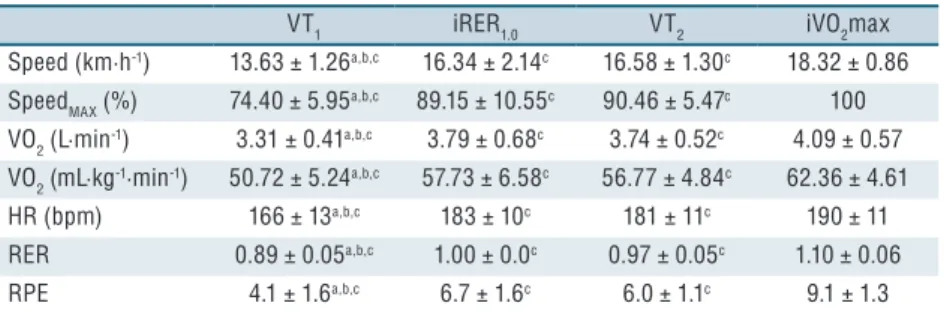
he small variation in VO2MAX (coeicient of variance – CV=7.4%) and PV (CV=4.7%) showed homogeneity among athletes. he parameters obtained during the incremental test are shown in Table 1. here was no signiicant diference between iRER1.0 and VT2 for any of the variables measured. Speed, percentage of the maximal speed, RER, and RPE difered statisti-cally from iRER1.0 and iVO2MAX. All variables showed signiicant difer-ences between iRER1.0 and VT1.
Table 1. Mean and standard deviation of speed, percentage of the maximal speed (SpeedMAX),
oxygen uptake (VO2), heart rate (HR), respiratory exchange ratio (RER), and rate of perceived exertion (RPE) at ventilatory thresholds (VT1 and VT2), intensity corresponding to RER level of 1.0 (iRER1.0), and intensity (speed) at which maximal oxygen uptake occurs (iVO2max).
VT1 iRER1.0 VT2 iVO2max
Speed (km·h-1) 13.63 ± 1.26a,b,c 16.34 ± 2.14c 16.58 ± 1.30c 18.32 ± 0.86
SpeedMAX (%) 74.40 ± 5.95a,b,c 89.15 ± 10.55c 90.46 ± 5.47c 100
VO2 (L·min-1) 3.31 ± 0.41a,b,c 3.79 ± 0.68c 3.74 ± 0.52c 4.09 ± 0.57
VO2 (mL·kg-1·min-1) 50.72 ± 5.24a,b,c 57.73 ± 6.58c 56.77 ± 4.84c 62.36 ± 4.61
HR (bpm) 166 ± 13a,b,c 183 ± 10c 181 ± 11c 190 ± 11
RER 0.89 ± 0.05a,b,c 1.00 ± 0.0c 0.97 ± 0.05c 1.10 ± 0.06
RPE 4.1 ± 1.6a,b,c 6.7 ± 1.6c 6.0 ± 1.1c 9.1 ± 1.3
asignificantly different from iRER 1.0,
bsignificantly different from VT 2,
csignificantly different from
iVO2max. p<.05.
Table 2 presents correlations between iRER1.0, VT1 and VT2 for absolute and relative VO2, speed, percentage of the maximal speed, HR, and RPE.
Table 2.Values of Pearson´s correlation between intensity corresponding to respiratory exchange
ratio level of 1.0 (iRER1.0), first ventilatory threshold (VT1), and second ventilatory threshold (VT2) for absolute and relative oxygen uptake (VO2), speed, percentage of the maximal speed (SpeedMAX), heart rate (HR), and rate of perceived exertion (RPE).
iRER1.0 VT1 Classification VT2 Classification
VO2 (L·min-1) 0.83* S 0.95* VS
VO2 (mL·kg-1·min-1) 0.57* M 0.60* M
Speed (km·h-1) 0.71* S 0.72* S
%SpeedMAX 0.65* M 0.67* M
HR (bpm) 0.79* S 0.81* S
RPE 0.30 W 0.44 M
Abbreviations are used for correlation coefficients classification (VW - very weak to negligible; W – weak; M – moderate; S – strong; VS - very strong). *p<.05
Scatter diagram conirms that iRER1.0 and VT1 showed no agreement, demonstrating mean error of 2.7 km·h-1 (95%IC, -0.3 to 5.7) (Figure 1).
Figure 2. Analysis of the residual scores between intensity corresponding to respiratory exchange ratio level of 1.0 (iRER1.0) and second ventilatory threshold (VT2). Solid line represents the mean error and dotted line represents the confidence interval (95%).
DISCUSSION
he aim of this study was to verify if RER could be used as an alterna-tive criterion for estimating AT in long-distance runners. Results show that iRER1.0 presents high correlation coeicient and no diference with intensity associated with VT2 (Tables 1 and 2), suggesting that iRER1.0 could predict AT. However, this result must be carefully interpreted, due to moderate correlation coeicients observed between diferences and mean in the scatter diagram (Figure 2). It was also observed an overestimation trend for VT2 at high speeds. Our results are partially in accordance with indings from previous studies5,10,11 that have compared iRER
1.0 with dif-ferent indices for estimate AT.
Estimation of anaerobic threshold in runners Diefenthaeler et al.
it is a more easy accessible and noninvasive technique. According previ-ous studies, VT2 measurement during incremental exercise may provide a good estimate of the AT22,23. However, to measure VT after the maximal efort is necessary two evaluators with wide analysis experience. herefore, a practical method and evaluator-independent to determine the optimal training intensity (considering aerobic-anaerobic transition as intensity pre-scription)5 in a submaximal protocol with individual ventilatory responses can be useful for coaches and athletes. Also, according to Carey et al23 the possibility of develop a portable respiratory rate monitor (similar to heart rate monitors) would be interesting to monitor training intensity.
In the present study, treadmill gradient used was 1% since it best repre-sents the energy cost in outdoor running15, improving intensity estimation precision for long distance runners. Additionally, assessment of ventilatory variables seems to be independent of exercise stages duration during an incremental maximal running test24. hus, no signiicant diference was observed between iRER1.0 and VT2. Furthermore, Bland and Altman17 method showed a better agreement between iRER1.0 and VT2 than VT1 (see Figure 1 and 2). his results are in agreement with previous studies involving cycle ergometer10,11 and treadmill protocols5. he agreement between iRER1.0 and VT2 (except for two subjects, see Figure 2) was expected since RER indirectly represents muscle oxidative capacity (CO2 production/O2 uptake). Additionally, RER increases according to exercise intensity, demonstrating increase in carbohydrate metabolism and decrease in lipids contribution10. Once RER values are superior to 1.0 it indicates bufering of H+ and consequently hyperventilation due to increment in CO2 production, corresponding to VT210.
However, despite the small mean error observed (-0.2 km·h-1) coni-dence interval (95%CI, -3.2 to 2.7) was large in comparison with other investigations5,11. Additionally, high CV (9.8%) between mean of iRER
1.0 and VT2 may indicate wide diferences between variables, compromising individual analysis. In igure 2, is possible to observe a trend indicating that in subjects with higher aerobic capacity the iRER1.0 may overestimate VT2. It partially corroborate with previous study conducted with long distance runners where a signiicant diference was observed in running speeds between iRER1.0 and VT25. Regarding that aerobic-anaerobic transition is related with endurance performance25, some studies showed that RER values above 1.0 were correlated with running pace (speed) dur-ing competition26. It could be a possible elucidation for aerobic capacity overestimation using iRER1.0.
iRER1.0 seems to be an easy way to assess aerobic capacity in cycle ergometer tests. Laplaud and Menier27 have demonstrated reproducibility of iRER1.0 in active men, which was similar to VT2. Additionally, Laplaud et al.11 proposed that iRER
without interruption, allowing comparison between ventilatory and blood lactate responses.
In runners, Leti et al.5 observed that iRER
1.0 was diferent from VT2, but similar to MLSS. he experiment was performed in a gymnasium with changes in running direction every 25 m. However, this exercise mode (i.e., constant changes of directions) cannot be compared with long-distance runner’s speciicity. Moreover, in a previous study comparing two running treadmill protocols (protocol 1 – increase in speed; protocol 2 – increase in speed and gradient), authors observed that RER presented lower reproduc-ibility between protocols than others ventilatory responses28, indicating that RER is protocol-dependent. In this way, it seems that terrain in the running (e.g., cross-country) could change ventilatory responses, increasing anaerobic contribution, and altering the relationship between performance and RER values26.
Among limitations of the present study, we can highlight the initial speed of the test (10 km·h-1) that might have overestimated VT
1 and VT2. However, subjects were trained endurance runners with average speed of 16.30 ± 1.06 km·h-1 in the 5 km event. hus, initial speed correspond to 61.35% of average speed during competitions and probably is lower than VT129. Additionally, the lack of an invasive method such as the assessment of lactate concentration, but interruptions for blood sampling collection could overestimate speed at AT as a consequence of athlete´s recovery4.
CONCLUSION
In conclusion, during an incremental treadmill test iRER1.0 can be used as an individual alternative method to detect the AT in long distance runners. However, its use is limited in runners with high aerobic capacity. here-fore, more studies should be conducted to develop speciic submaximal protocols with short duration to validate simpliied methods to estimate aerobic-anaerobic transition in long distance runners.
REFERENCES
1. Svedahl K, MacIntosh BR. Anaerobic threshold: the concept and methods of measurement. Can J Appl Physiol 2003;28(2):299–323.
2. Gaskill S, Ruby B, Walker A, Sanchez O, Serfass R, Leon A. Validity and reli-ability of combining three methods to determine ventilatory threshold. Med Sci Sports Exerc 2001;33(11):1841–8.
3. Tegtbur UWE, Busse MW, Braumann KM. Estimation of an individual equilib-rium between lactate production and catabolism during exercise. Med Sci Sports Exerc 1993;25(5):620–7.
4. Faude O, Kindermann W, Meyer T. Lactate threshold concepts: how valid are they? Sports Med 2009;39(6):469–90.
Estimation of anaerobic threshold in runners Diefenthaeler et al.
6. Van Schuylenbergh R, Vanden Eynde B, Hespel P. Correlations between lactate and ventilatory thresholds and the maximal lactate steady state in elite cyclists. Int J Sports Med 2004;25(6):403–8.
7. Wasserman K. he anaerobic threshold measurement to evaluate exercise perfor-mance. Am Rev Respir Dis 1984;129(2 Pt 2):S35-40.
8. Denadai B. Limiar anaeróbio: considerações isiológicas e metodológicas. Rev Bras Ativ Fís Saúde 2012;1(2):74–88.
9. Meyer T, Lucía A, Earnest CP, Kindermann W. A conceptual framework for performance diagnosis and training prescription from submaximal gas exchange parameters--theory and application. Int J Sports Med 2005;26 (Suppl 1):S38–48.
10. Zagatto A, Miyagi W, Sakugawa R, Kaminagakura E, Papoti M. Aerobic En-durance Measurement by Respiratory Exchange Ratio during a Cycle Ergometer Graded Exercise Test. J Exerc Physiol online 2012;15(5):49–56.
11. Laplaud D, Guinot M, Favre-Juvin A, Flore P. Maximal lactate steady state determination with a single incremental test exercise. Eur J Appl Physiol 2006;96(4):446–52.
12. Dickstein K, Aarsland T, Svanes H, Barvik S. A respiratory exchange ratio equal to 1 provides a reproducible index of submaximal cardiopulmonary exercise per-formance. Am J Cardiol 1993;71(15):1367–9.
13. Whipp BJ. Physiological mechanisms dissociating pulmonary CO2 and O2 exchange dynamics during exercise in humans. Exp Physiol 2007;92(2):347–55.
14. Slaughter, MH, Lohman, TG, Boilean, CA, Stillman, RJ, Vanvoan, ME, and Bemebn, DA. Skinfold equations for estimation of body fatness in children and youth. Hum Biol 1998;60(5):709–23.
15. Jones A, Doust J. A 1% treadmill grade most accurately relects the energetic cost of outdoor running. J Sports Sci 1996;14(4):321–7.
16. Utter AC, Robertson RJ, Green JM, Suminski RR, Mcanulty SR, Nieman and DC. Validation of the Adult OMNI Scale of Perceived Exertion for Walking/ Running Exercise. Med Sci Sport Exerc 2004;36(10):1776–80.
17. Bland JM, Altman D. Statistical methods for assessing agreement between two methods of clinical measurement. Lancet 1986;327(8476):307–10.
18. Rowntree D. Statistics Without Tears. London: Penguin; 1991.
19. Coyle EF, Martin WH, Ehsani AA, Hagberg JM, Bloomield SA, Sinacore DR, et al. Blood lactate threshold in some well-trained ischemic heart disease patients. J Appl Physiol 1983;54(1):18–23.
20. Heck H, Mader A, Hess G, Mucke S, Muller R, Hollmann W. Justiication of the 4 mmol. l- 1 lactate threshold. Int J Sport Med 1985;6(3):117–30.
21. Wasserman K, Whipp B, Koyal S, Beaver W. Anaerobic threshold and respiratory gas exchange during exercise. J Appl Physiol 1973;75(9 Suppl):S19–21.
22. Yamamoto Y, Miyashita M, Hughson R, Tamura S, Shinohara M, Mutoh Y. he ventilatory threshold gives maximal lactate steady state. Eur J Appl Physiol 1991;63(1):55–9.
23. Carey DG, Schwarz LA, Pliego GJ, Raymond RL. Respiratory Rate is a Valid and Reliable Marker for the Anaerobic hreshold: Implications for Measuring Change in Fitness. J Sports Sci Med 2005;4(4):482–8.
24. Kuipers H, Rietjens G, Verstappen F, Schoenmakers H, Hofman G. Efects of stage duration in incremental running tests on physiological variables. Int J Sports Med. 2003;24(7):486–91.
25. Dellagrana R, Guglielmo L, Santos B, Hernandez S, Silva S, Campos W. Physiological, Anthropometric, Strength, and Muscle Power Characteristics Correlates With Running Performance in Young Runners. J Strength Cond Res 2015;29(6):1584–91.
Catarina, Centro de Desportos – Laboratório de Biomecânica, Campus Universitário da Trindade, s/n, CEP: 88040-900 Florianópolis (SC), Brasil
E-mail: fernando.diefenthaeler@ ufsc.br
tion methods among two maximal treadmill exercise protocols in elite orienteers. Phys Educ Sport 2009;7(1):45–53.