Rev Bras
Cineantropom
Hum
DOI: http://dx.doi.org/10.5007/1980-0037.2017v19n1p96
original article
Fatigue and symptoms of eating disorders
in professional dancers
Fadiga e sintomas de transtornos alimentares
em bailarinos proissionais
Yasmin Cristina Feitosa Rodrigues1
Nycolle Martins Reis1
Melissa de Carvalho Souza Vieira1
Zenite Machado1
Adriana Coutinho de Azevedo Guimarães1
Abstract – he aim of this study was to make a comparison between fatigue and eating disorders in professional dancers in Brazil. Overall, 108 Classical Ballet or Contempo-rary Dance dancers (28.6 ± 7.7 years) (49 women and 59 men) of companies from São Paulo, Rio de Janeiro, Minas Gerais and Rio Grande do Sul participated in this study. he following validated instruments were used (Eating Attitudes Test; Bulimic Inventory Test Edinburgh; Yoshitake Fatigue Questionnaire, general Information). Results: 16% of dancers have symptoms of anorexia; 25% in the symptomatic bulimia scale and 30% in the bulimia scale. Signiicant data were identiied in the comparison of bulimia nervosa scales with fatigue domains; on the symptomatic scale with drowsiness and lack of at-tention at work domain (p = 0.015), on the severity scale with fatigue projections to the body domain (p = 0.014), and in both scales in the impaired concentration and attention domain (p = 0.003 and p = 0.047) and in the general fatigue score (p = 0.016). Dancers with higher scores for diiculty in concentration and attention are 1.558 (95% CI 1.113 to 2.179) times more likely to have symptoms of bulimia. his study showed that there is a relationship between fatigue and symptoms of bulimia.
Key words: Dancing; Eating disorders; Fatigue; Motor activity.
Resumo – Objetivou-se realizar uma comparação entre fadiga e transtornos alimentares em bailarinos proissionais do Brasil. Participaram 108 bailarinos (49 mulheres e 59 homens), de Ballet Clássico ou Dança Contemporânea (28,6±7,7 anos), de companhias de São Paulo, Rio de Janeiro, Minas Gerais e Rio Grande do Sul. Utilizaram-se instrumentos validados (Teste de Atitudes Alimentares; Bulimic Inventory Test Edinburgh; Questionário de Fadiga de Yoshi-take; Informações gerais). Notou-se que 16% dos bailarinos possuem sintomas de transtornos de anorexia; 25% na escala sintomática de bulimia e 30% na escala de gravidade da bulimia. Identiicou-se dados signiicativos na comparação das escalas da bulimia nervosa com os do-mínios da fadiga; na escala sintomática com domínio sonolência e falta de atenção no trabalho (p=0,015), na escala de gravidade com domínio projeções da fadiga ao corpo (p=0,014), e em ambas as escalas no domínio diiculdade de concentração e atenção (p=0,003 e p=0,047) e no escore de fadiga geral (p=0,016). Bailarinos com maiores escores para diiculdade de concentração e atenção possuem 1,558 (IC95%=1,113–2,179) vezes mais chances de apresentarem sintomas
1 State University of Santa Catarina. Florianópolis, SC. Brazil.
INTRODUCTION
Professional dancers can be found in all types of dance, with a greater ap-proach in Brazil in classical ballet and contemporary dance. Classical ballet has a rigid didactics, aiming at training with greater body requirement with emphasis on support, balance and ballet shoes1. In this modality, body
leanness and aesthetics are valued, inducing the search for the ideal body2,
even without scientiic records of the need to be skinny for the practice1.
In contemporary dance, dancers also sufer pressure on their bodies. his modality incorporates new unconventional ballet movements or modern dance techniques. It demands sensorial stimuli and propriocep-tion of dancers, but it also imposes high level of rehearsal and dedicapropriocep-tion as in classical ballet3.
In both modalities, dancers are submitted to a routine of rehears-als, tours, elaboration of new choreographies, physical preparation, daily training and presentations that are extremely exhaustive1,4. Due to the
high level of demand on their bodies, it is common to increase even more the training level, with the intention of burning more calories, harming their health by using inadequate and dangerous ways to achieve the body of dreams. Even with thin bodies, professional dancers tend to restrict their energy consumption2, leading to eating disorders such as anorexia
and bulimia nervosa5,6.
Anorexia nervosa is characterized by food restriction, leading to body weight below the minimum expected, morbid fear of getting fat, body im-age distortion and use of drugs for weight loss; bulimia nervosa presents symptoms such as: recurrent episodes of binge eating, use of compensatory behaviors in order to prevent weight gain such as inducing vomiting after an episode of overeating and / or excessive physical activity7.
Due to the intense training of classical ballet and contemporary dance, the appearance of trauma is frequent, with muscle fatigue being one of the main factors that lead to the onset of injuries4,8. Fatigue has been included
in studies because it impairs the performance of diferent types of popula-tions, such as athletes9 and workers10, causing impairment to quality of life11.
Due to the great amount of physical exercise performed by professional dancers especially when spectacles approach, fatigue can cause impairment in the performance of dancers4, for example decreased lexibility12. Eating
disorders are also associated with the performance of dancers, inappropriate eating behaviors have been used to optimize performance, since in these dance modalities, which favor leanness, thin body is associated with higher athletic performance5. However, despite the inluence that eating disorder
and fatigue have on performance, there is a gap in literature relating these two variables in the same study.
professional dancers in Brazil and will help to develop strategies that help choreographers, dancers and family members to avoid the development of fatigue and eating disorders.
METHODOLOGICAL PROCEDURES
his is a descriptive cross-sectional study based on secondary data from a research entitled of “Professional classical ballet and contemporary dance dancers: relationship between eating disorders and associated factors”. he non-probabilistic sample was composed of 108 professional dancers, 49 women (29.4 ± 7.8 years) and 59 men (27.9 ± 7.6 years), of these 37 of classi-cal ballet and 71 of contemporary dance, with mean age of 28.6 ± 7.7 years. As inclusion criteria, dancers should be of classical ballet or contem-porary dance modalities, of both sexes, over 18 years of age, paid to dance (being characterized in this research as professional dancers). In order to become a professional dancer, it is necessary to have an average profes-sionalization time of 6.8 ± 5.7 years4. Dancers should belong to dance
companies of the following states: Rio de Janeiro, São Paulo, Minas Gerais and Rio Grande do Sul. Exclusion criteria included illiterate dancers and those who were unable to complete the questionnaires adequately.
Dance companies were chosen for convenience, using the regions of Brazil with the greatest concentration of professional Companies, namely states of Rio de Janeiro, São Paulo, Minas Gerais and Rio Grande do Sul. Although there are no agencies that regulate dance companies In Brazil, pointing to numerical data, these states were selected because they are cur-rently the poles of professional dance in Brazil. hirty-six companies were invited, but only 12 (Sao Paulo - 4, Rio de Janeiro - 4, Minas Gerais - 2, Rio Grande do Sul - 2) accepted to participate, with percentage of 33.3%. hose who did not accept claimed lack of time.
For data collection, self-administered questionnaires about Eating Disorders Symptoms (Eating Attitudes Test; Bulimic Inventory Test Edinburgh); Yoshitake Fatigue Questionnaire; and general Information were used, described below:
Eating Disorders Symptoms: Two questionnaires, the Eating Attitude Test (EAT-26) and Bulimic Inventory Test Edinburgh (BITE) were used.
EAT-2613 was, created to detect symptoms of Anorexia Nervosa, is a
questionnaire composed of 26 questions proposed by Garner13, and has
validation for Brazilians14. Each question has a rating, with a score. For
ordinal-scale responses Never, Almost Never, and Few, score zero points, at times, often and always scored 1, 2 and 3 points, respectively. Only for question 25, this sum occurs inversely. After the sum of questions, the scores of individuals will vary from 0 to 78 points; the cutof point origi-nally set by the authors is 21 points13, in which individuals who scored 21
BITE15 is an instrument used to detect symptoms of Bulimia Nervosa.
It is composed of 33 questions subdivided into 2 scales, which was translated into Portuguese by Cordás and Hochgraf16. According to the classiication
of the authors16, in the irst scale of the questionnaire, the degree of the
bulimic symptoms is classiied, summing up 30 points. Score greater than or equal to 20 points means compulsion and high probability of bulimia diagnosis, 15 to 19 points corresponds to a subclinical group, 10 to 14 points represents unusual eating pattern and 0 to 9 points is equivalent to the absence of behavior typical of bulimia. he second scale aims to indicate severity through the frequency of compulsive and purgative behaviors. Score less than or equal to 4 indicates level of severity without signiicance, from 5 to 9 points clinically signiicant level and a score greater than 10 indicate signs of high severity. For statistical analysis, in this study, they were later grouped and classiied as: “symptomatic” in absence (“absence of typical behaviors of bulimia”) and presence (“unusual eating pattern” + “subclinical group” + “compulsion and high probability of bulimia di-agnosis); and “severity” in absence (“without signiicance”) and presence (“clinically signiicant” + “evidence of high severity”).
hese two questionnaires are cited as the instruments most widely used for the evaluation of eating disorders17, and have already been used
in studies conducted with dancers6,18.
Fatigue: evaluated by the Yoshitake Fatigue Questionnaire, validated for Portuguese by Metzner and Fischer10. he questionnaire consists of 30
multiple choice questions divided into three domains, with 10 questions each, according to the authors’ classiication10: he irst one evaluates
drowsiness and lack of disposition at work. he second is about the diiculty of concentration and attention. he third refers to fatigue projections to the body. he inal score is calculated by summing up the scores of the three domains, ranging from 30 (lower fatigue) to 150 points (higher fatigue)10.
his questionnaire was chosen because it evaluates fatigue in workers, as is the case of the study population.
General information: age, sex, schooling, marital status, functional occupation, presence of diseases, economic stratum, practice of physical activity in addition to dance and anthropometric variables (body mass and height to calculate body mass index kg / m2) for weight status. Since the
questionnaire was answered online, anthropometric variables were self referenced by participants themselves.
Body Mass Index (BMI) was calculated by means of body mass (in Kg) divided by height in meters elevated to the square using data self-referenced by dancers. he use of self-reported measures for the adult population is satisfactory and is considered a viable alternative in situations where it is not possible to directly obtain this information19. Dancers were classiied
by cutof points established by WHO - World Health Organization20, in
which 18.5 kg / m2 - low weight; between 18.5 and 24.9 kg / m2 - ideal
weight (eutrophic); between 25 and 29.9 kg / m2 - overweight and above
clas-siication remained the same and ideal and overweight clasclas-siications were grouped into ideal weight, since only one person was overweight and no one was obese.
Economic stratum was assessed using the questionnaire of the Brazilian Economic Classiication Criteria (CCEB), which is indicated by the Bra-zilian Association of Research Companies (ABEP)21. It has items related
to the amount of comfort items, access to public services, and schooling of the family head. Summing up the points of the questions, participants were divided into A, B1, B2, C1, C2, D and E; to then be classiied into: High (A), Medium (B1, B2, C1, C2), Low (D, E).
he study was approved by the Ethics Research Committee on Human Beings (CEPSH) of the State University of Santa Catarina (UDESC), protocol No. 1,152,774, on July 14, 2015, as prescribed in Resolution 466 of the National Health Council. Data collection began on August 2015 and ended on March 2016.
he contact with dance companies was initiated by phone calls, emails and social networks. he entire process was explained along with the referral of the questionnaire online link and with the free and informed consent, in which the dancer had the options “accept to participate” or “do not accept to participate”. In addition, there was a place to ill with personal data in case the dancer chose to receive the return of the research.
Questionnaires were applied online through the Google Docs platform, which is a free web 2.0 tool that is easy to access and has wide visibility22,
thus allowing simultaneous collection in the selected states. According to Gonçalves23, the application of online questionnaires has several
advan-tages, among them: easy tabulation and data analysis, reduction of errors in response completion, control in the order of questions and the option of mandatory illing of the questionnaire.
In some cases, face-to-face collection was necessary at the request of dance company managers in order to respect the company’s schedule, which was carried out at the company’s rehearsal site, using the printed question-naire. It is understood that the ideal would be just a form of collection, but it was decided to use both in order to reduce the loss of dance companies.
Binary Logistic Regression was used to associate the symptoms of eating disorders with the fatigue domains, controlling them for the inde-pendent variables of sample characterization (modality, sex, age, schooling, marital status, functional occupation, presence of diseases, state, practice of PA and economic stratum). he Enter method was used to select variables with 5% signiicance level.
In this study, subjects were divided into three groups according to the symptoms of anorexia, bulimia and bulimia severity.
RESULTS
Table 1 shows signiicant results between sex and symptoms of anorexia nervosa (p = 0.003) and the symptomatic bulimia scale (p = 0.022), espe-cially in females, which means that among dancers who had symptoms for eating disorders, the majority were female. Economic stratum was signii-cantly associated with the symptomatic bulimia scale (p = 0.002), in which the high level presented higher values, which means that dancers who had symptoms of bulimia, the majority belonged to the high economic stratum.
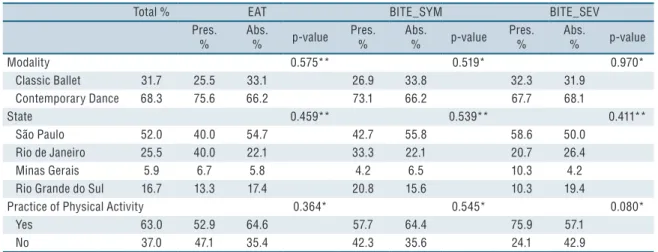
In Table 2, no signiicant results were found.
Table 1. Association of the general characteristics of dancers stratified by eating disorders. Brazil, 2016.
Total %
EAT (%)
BITE_SYM (%)
BITE_SEV (%)
Pres Abs p-value Pres Abs p-value Pres Abs p-value
Sex 0.003** 0.022* 0.485*
Male 44.9 11.8 51.1 25.9 51.2 50.0 42.7
Female 55.1 88.2 48.9 74.1 48.8 50.0 57.3
Schooling 0.871** 0.771** 0.849**
Elementary School 2.8 0.0 3.3 0.0 3.8 3.1 2.7
High School 63.0 70.6 61.1 66.7 61.2 59.4 64.0
Higher Education 34.3 29.4 35.6 33.3 35.0 37.5 33.3
Marital Status 0.792* 0.874* 0.584*
With partner 38.9 41.2 37.8 37.0 38.8 34.4 40.0
Without partner 61.1 58.8 62.2 63.0 61.2 65.6 60.0
Functional Occupation 0.052** 0.179** 0.582**
Student 12.0 29.4 8.4 22.2 8.2 6.7 14.3
Self employed 57.0 52.9 57.8 51.9 58.9 60.0 55.7
Government Employee 12.0 0.0 14.5 14.8 11.0 16.7 10.0
Private Company 19.0 17.6 19.3 11.1 21.9 16.7 20.0
Presence of Disease 0.359** 1.000** 0.580**
Yes 3.9 0.0 4.8 3.7 4.1 6.7 2.8
No 96.1 100 95.2 96.3 95.9 93.3 97.2
Economic Stratum 0.144** 0.002** 0.430**
High 9.3 23.5 6.7 25.9 3.8 84.4 89.3
Medium 88.0 76.5 90.0 70.4 93.8 9.4 9.3
Low 2.8 0.0 3.3 3.7 2.5 6.2 1.3
Dancers presented mean BMI of 21.17 ± 2.04. Most presented ideal weight. When associated with symptoms of anorexia nervosa, 17.6% of low-weight dancers presented symptoms and 9.0% presented no symptoms, while among ideal weight dancers, 82.4% had symptoms and 91.0% presented no symptoms (p-value 0.378). Associating BMI with the symptomatic bulimia severity scale among low-weight dancers, 7.4% had symptoms and 11.4% had no symptoms, among normal weight, 92.6% had symptoms and 88.6% had no symptoms (p-value 0.725). When associated with the bulimia severity scale among low-weight dancers, 9.4% presented symptoms and 10.8% presented no symptoms, while among normal weight, 90.6% had symptoms and 89.2% had no symptoms (p-value 1.000) (data not shown).
In this study, it was possible to observe that 15.8% of dancers have symp-toms of anorexia; 25.2% reported sympsymp-toms of disorders on the symptomatic bulimia scale and 29.9% on the bulimia severity scale (data not shown).
Regarding fatigue, 69.00 ± 13.61 dancers, on average, presented general fatigue, 25.73 ± 4.80 presented diiculty of concentration and attention, 20.63 ± 5.41 presented fatigue projections to the body and 22.64 ± 5.61 presented drowsiness and lack of disposition at work (data not shown).
Table 3 shows signiicant data for the comparison of fatigue level in the drowsiness and lack of attention in the work with the symptomatic bulimia scale (p = 0.015), and in the fatigue projections to the body compared to the bulimia severity scale domains (p = 0.014). Signiicant values were found comparing to the two bulimia scales, both for the diiculty of concentration and attention domain (p = 0.003 and p = 0.047), respectively, symptoms and severity, as for the general fatigue score (p = 0.016) for both scales, which means that fatigue may be related to symptoms of bulimia nervosa, but in this study, it was not possible to identify if fatigue is related to disorders or if disorders are related to fatigue. here were no signiicant results for anorexia.
In the simple model, drowsiness fatigue, diiculty fatigue and general fatigue were associated with the presence of symptoms of bulimia and fatigue projections and general fatigue to bulimia on the severity scale. When the model
Table 2. Association of variables related to professional dancers stratified by eating disorders. Brazil, 2016.
Total % EAT BITE_SYM BITE_SEV
Pres. %
Abs.
% p-value Pres.
%
Abs.
% p-value Pres.
%
Abs.
% p-value
Modality 0.575** 0.519* 0.970*
Classic Ballet 31.7 25.5 33.1 26.9 33.8 32.3 31.9
Contemporary Dance 68.3 75.6 66.2 73.1 66.2 67.7 68.1
State 0.459** 0.539** 0.411**
São Paulo 52.0 40.0 54.7 42.7 55.8 58.6 50.0
Rio de Janeiro 25.5 40.0 22.1 33.3 22.1 20.7 26.4
Minas Gerais 5.9 6.7 5.8 4.2 6.5 10.3 4.2
Rio Grande do Sul 16.7 13.3 17.4 20.8 15.6 10.3 19.4
Practice of Physical Activity 0.364* 0.545* 0.080*
Yes 63.0 52.9 64.6 57.7 64.4 75.9 57.1
No 37.0 47.1 35.4 42.3 35.6 24.1 42.9
was adjusted for all variables of the general sample characterization, only domain diiculty fatigue (diiculty of concentration and attention) remained associated. It was observed that dancers with higher scores in this domain were 1.558 (95% CI = 1.113-2.179) times more likely to present symptoms of bulimia regardless of dance modality, sex, age, schooling, marital status, functional occupation, presence of disease, state, practice of PA and economic stratum (Table 4).
Table 3. Comparison between fatigue and eating disorders in professional dancers. Brazil, 2016.
EAT BITE_SYM BITE_SEV
Fatigue Pres. Abs. p Pres. Abs. p Pres. Abs. p
Md(DIQ) Md(DIQ) Md(DIQ) Md(DIQ) Md(DIQ) Md(DIQ)
Drowsiness 0.286* 0.015* 0.114*
26.0(9) 22.0(6) 25.5(5) 22.0(7) 24.0(6) 22.0(8)
M (sd) M (sd)
Projections 0.727* 0.337* 0.014#
22.0(10) 20.0(7) 20.5(9) 20.0(8) 22.6(6) 19.8(5)
M (sd) M (sd) M (sd) M (sd) M (sd) M (sd)
Difficulty 0.883# 0.003# 0.047#
25.5(5) 25.7(5) 28.1(4) 24.9(5) 27.2(5) 25.1(4)
General 0.621# 0.016# 0.016#
70.5(16) 68.7(13) 74.5(12) 67.2(13) 73.9(14) 66.9(13)
EAT - Eating Attitudes Test, BITE_SYM - Bulimic Inventory Test Edinburgh symptomatic scale; BITE_SEV - Bulimic Inventory Test Edinburgh severity scale; Pres. - presence of symptoms; Abs. - absence of symptoms; Md - median; DIQ - interquartile range difference; M - mean; sd - standard deviation; P - p-value; Drowsiness fatigue - drowsiness and lack of disposition at work; Projection fatigue - projections of fatigue to the body; Difficulty fatigue - difficulty of concentration and attention; General fatigue - referring to total instrument fatigue (sum of the three scales).* U-Mann Whitney; # Test - t.
Table 4. Association of symptoms of eating disorders with fatigue domains.
EAT
OR CRUDE OR ADJUSTED
Fatigue (95% CI) p (95% CI) p
Drowsiness 1.037(0.945;1.138) 0.446 0.736(0.538;1.007) 0.055
Difficulty 0.992(0.887;1.108) 0.882 0.966(0.723;1.291) 0.815
Projections 1.030(0.936;1.133) 0.550 1.388(0.974;1.979) 0.070
General 1.010(0.972;1.050) 0.617 -
-BITE_SYM
OR CRUDE OR ADJUSTED
Fatigue (95% CI) p (95% CI) p
Drowsiness 1.096(1.011;1.189) 0.027 1.109(0.775;1.588) 0.570
Difficulty 1.170(1.048;1.307) 0.005 1.558(1.113;2.179) 0.010
Projections 1.046(0.966;1.134) 0.269 -
-General 1.042(1.007;1.078) 0.019 0.903(0.741;1.010) 0.313
BITE_SEV
OR CRUDE OR ADJUSTED
Fatigue (95% CI) p (95% CI) p
Drowsiness 1.070(0.991;1.154) 0.883 -
-Difficulty 1.099(0.999;1.208) 0.051 -
-Projections 1.100(1.016;1.191) 0.019 1.052(0.853;1.297) 0.638
General 1.039(1.006;1.074) 0.020 1.044(0.952;1.146) 0.361
DISCUSSION
he present study aimed to analyze the comparison between fatigue and eating disorders in professional dancers in Brazil. here were signiicant results in the comparison between fatigue and eating disorders symptoms in the following domains: drowsiness, lack of attention at work, fatigue projections to the body, diiculty of concentration and attention and gen-eral fatigue, indicating that eating disorders symptoms can lead to worse results in these variables.
It was veriied that 15.89% of dancers presented symptoms of anorexia, 25.23% symptoms of bulimia on the symptomatic scale and 29.91% symp-toms of bulimia on the severity scale. It is noteworthy that the occurrence of eating disorders among females was higher. Since the presence of eating disorders symptoms has been associated with body image dissatisfaction, the higher incidence of these symptoms in females is due to the women’s concern with the body, being more dissatisied18.
Likewise, there was a greater occurrence of eating disorders symptoms in dancers with higher economic stratum, conirming a study that identiied that eating disorders symptoms have been associated with higher strata of the society24. It was veriied that access to diferent information and media
vehicles (television; Internet) provided by higher economic level greatly inluences the standards of beauty and body25, in which the individual
is surrounded by such information, becoming susceptible to achieve the ideal body at any cost.
he results of this study are concerning, because eating disorders can damage the health of dancers2 and reduce their performance. However,
there are controversies, because reports have shown that even during the occurrence of fatigue, there is no reduction in the performance of dancers27.
Similar results are also found in high-performance athletes, showing that they present greater resistance to high-intensity exercises9. However, fatigue
is a valence diicult to evaluate and can be confused with tiredness. For this reason, the use of direct measures to evaluate fatigue is now known as the gold standard28. However, in this study, fatigue was evaluated through indirect
measurements, since making direct evaluations at national level is not feasible. Even so, dancers perform intermittent training that ends up requiring higher VO2 max, which can lead to fatigue27. When fatigue is related to training
in dance, it is hypothesized that it may be related to the training period, since there is intensiication in pre-performance periods and competitions, compromising the physical and mental preparation of dancers4,8.
Comparing eating disorders symptoms and fatigue, signiicant results in fatigue in the drowsiness and lack of disposition at work domains were found, showing that having problems with sleep can increase the level of fatigue10, which could be justiied by the fact that dancers with symptoms
of eating disorders exercise beyond the intense hours of training29, because
reduction in sleep time because they spend more hours of their day on training than on rest, thus increasing levels of fatigue and possibly physical discomfort in their professional activities4,30.
In addition, it was possible to identify that dancers with higher fatigue levels in diiculty of concentration and attention domains are more likely to present symptoms of eating disorders, speciically bulimia. It is known that bulimia is characterized by episodes of high food intake and exces-sive concern with body, and individuals make use of extreme means to stop weight gain, such as excessive exercise7. It is possible that individuals
with higher levels of fatigue due to the excessive training characteristic of professional dancers are more likely to present the disorder, since they end up having this greater concern with body and feel more need to practice physical exercises.
With a tired, aching, and malnourished body, the dancer’s health becomes impaired2, making it diicult to focus attention on rehearsals,
impairing his or her performance26. hus, it seems that dancers are a
category with a greater tendency to have symptoms of eating disorders and a daily fatigue routine. However, this study did not conclude whether fatigue leads to the development of eating disorders or the inverse, sug-gesting the performance of new studies to verify the relationship between these two variables.
his study has some limitations: the reduced number of dance compa-nies due to lack of interest in participating in the study, the study design, which does not allow establishing a cause-efect relationship among the variables investigated and data collection in two ways (online and in person).
However, it is necessary to highlight the advantages of the present study, such as the fact that it investigated only professional dancers and addressed a topic still not widely investigated in literature. he results obtained by this study can help in the knowledge and awareness of danc-ers, choreographers and / or directors of dance companies, regarding the importance of maintaining healthy body both to minimize factors detri-mental to the performance of dancers, such as fatigue, and to maintain their general health.
CONCLUSION
REFERENCES
1. Simas JPN, Guimarães ACDA. Ballet clássico e Transtornos Alimentares. Rev Educ Fís/UEM 2002; 13(2):119-26.
2. Moura UISD, Mendes LR, Silva IPDO, Ângelo RDCDO, Schwingel PA.
Con-sumo alimentar, peril antropométrico e imagem corporal de bailarinas clássicas do Vale do São Francisco. Rev Bras Nutr Esportiva 2015; 9(51):237-46.
3. Dantas M. De que são feitos os dançarinos de “aquilo...” criação coreográica e formação de intérpretes em dança contemporânea. Mov 2005; 11(2):31-57. 4. Dore BF, Guerra RO. Sintomatologia dolorosa e fatores associados em bailarinos
proissionais. Rev Bras Med Esporte 2007;13(2):77-80.
5. Perini TA, Vieira RS, Vigário OS, Oliveira GL, Ornellas JS, Oliveira FP. Tran-storno do comportamento alimentar em atletas de elite de nado sincronizado. Rev Bras Med Esporte 2009; 15(1):54-7.
6. Ribeiro LG, Da Veiga GV. Imagem Corporal e Comportamentos de Risco para Transtornos Alimentares em Bailarinos Proissionais. Rev Bras Med Esporte 2010; 16(2):99-102.
7. Manual Diagnótico e Estátistico de Transtornos Mentais/DSM – 5. American Psy-chiatric Association. Artmed, 2014; Disponível em: <http://c026204.cdn.sapo.io/1/ c026204/cld-ile/1426522730/6d77c9965e17b15/b37dfc58aad8cd477904b9bb-2ba8a75b/obaudoeducador/2015/DSM%20V.pdf> [2016 ago 25].
8. Guimarães ACA, Simas JPN. Lesões no ballet clássico. Rev Educ Fís/UEM 2001; 12(2):89-96.
9. Spigolon LMP, Borin JP, Leite GDS, Padovani RP, Padovani CR. Potencia An-aeróbia em atletas de futebol de campo: diferenças entre categorias. Colec Pesqui Educ Fís 2007; 6(1):421-8.
10. Metzner RJ, Fischer FM. Fadiga e capacidade para o trabalho em turnos ixos de doze horas. Rev Saúde Publica 2001; 35(6):548-53.
11. Mota DDCF, Cruz DALM, Pimenta CAM. Fadiga: uma análise do conceito. Acta Paul Enferm 2005; 8(3):285-93.
12. Ali LR, Navarro F. A relação da hipermobilidade músculo-articular de bailarinos e o risco de lesões. Rev Bras Ciên Saúde 2004; 2(4):29-33.
13. Garner DM, Olmsted MP, Bohr Y, Garinkel PE. he eating attitudes test: Psychometric features and clinical correlates. Psychol Med 1982; 12(4):871-8. 14. Nunes MA, Camey S, Olinto MTA, Mari JJ. he validity and 4-year test-retest
reliability of the Brazilian version of the Eating Attitudes Test-26. Braz J Med Biol Res 2005; 38(11):1655-62.
15. Cooper PJ, Taylor MJ, Cooper Z, Fairburn CG. he development and validation of Body Shape Questionnarie. Int J Eat Disord 1987; 6(4):485-94.
16. Cordás TA, Hochgraf BP. O “BITE”: instrumento para avaliação da bulimia nervosa-versão para o português. J Bras Psiquiatr 1993; 3(42):141-4.
17. Freitas S, Gorenstein C, Appolinario JC. Instrumentos para a avaliação dos tran-stornos alimentares. Rev Bras Psiquiatr 2002; 24(Suppl 3):34-8.
18. Reis NMR, Machado Z, Pelegrini A, Boing L, Monte FCSG, Simas JPN, Guima-rães A. Imagem corporal, estado nutricional e sintomas de transtornos alimentares em bailarinos. Rev Bras Ativ Fís Saúde 2013;18(6):763-81.
19. Coqueiro RDS, Borges LJ, Araújo VC, Pelegrini A, Barbosa AR. Medidas auto-referidas são válidas para avaliação do estado nutricional. Rev Bras de Cineantropom Desempenho Hum 2009;11(1):113-9.
20. World Health Organization/WHO. he International Classiication of adult un-derweight, overweight and obesity according to BMI. 2004; Disponível em: <http:// apps.who.int/bmi/index.jsp?introPage=intro_3.html> [2015 jun 1].
CORRESPONDING AUTHOR Nycolle Martins Reis
Endereço: Rua Tereza Lopes, 734. Campeche. Florianópolis-SC – Brasil
CEP: 88066-065.
E-mail: [email protected]
22. Klemann MN, Rapkiewicz CE. Pesquisa-ação para inclusão digital de professores e alunos: um projeto piloto usando Google Docs. Renote 2011; 9(2):1-10. 23. Gonçalves DIF. Pesquisas de marketing pela internet: as percepções sob a ótica
dos entrevistados. Rev Adm Mackenzie 2009; 9(7):70-88.
24. Borges NJBG, Sicchieri JMF, Ribeiro RPP, Marchini JS, Dos Santos JE. Tran-stornos Alimentares – Quadro Clínico. Med (Ribeirão Preto) 2006; 39(3): 340-8. 25. Dieling S, Martin Van Der Esch M, Janssen TWJ. Knee Joint Proprioception in
Ballet Dancers and Non-dancers. J Dance Med Sci 2014; 18(4):143-8.
26. Fortes LS, Paes ST, Amaral ACS, Ferreira MEC. Comportamento Alimentar Inadequado e insatisfação corporal em jovens nadadores em função de variáveis sociodemográicas. Psicol teor prat 2012; 14(3):123-33.
27. Rodrigues-Krause J, Krause M, Cunha GDS, Perin D, Martins JB, Alberton CL, Schaun MI, De Bittencourt Junior PVH, Reischak-Oliveira A. Ballet dancers cardiorespiratory, oxidative and muscle damage responses to classes and rehearsals. Eur J Sport Sci 2014; 14(3):199-208.
28. Amaducci CDM, Mota DDFDC, Pimenta CADM. Fatigue among nursing
undergraduate students. Rev Esc Eferm USP 2010; 44(4):1047-53.
29. Fração VB, Vaz MA, Ragasson CAP, Müller JP. Efeito de treinamento na aptidão física da bailarina clássica. Mov 1999; 5(11):3-15.