DOI: http://dx.doi.org/10.5007/1980-0037.2015v17n1p82
original article
Licence Creative Commom CC
RBCDH
1 Universidade Federal do Rio Grande do Sul. Escola de Educação Física. Porto Alegre, RS. Brasil.
Received: 15 January 2014 Accepted: 11 June 2014
Inluence of diferent breathing patterns
on front crawl kinematics
Inluência de diferentes padrões respiratórios na
cinemática do nado
crawl
José Guilherme Machado do Couto1
Marcos Franken1
Flávio Antônio de Souza Castro1
Abstract – he aim of this study was to investigate the efects of diferent breathing pat-terns on the kinematics of front crawl. Eleven college swimmers (10 men and one woman) performed seven 25-m front crawl trials at maximum intensity, with 2-min intervals between trials. One trial was performed in the breath-holding condition and six trials were performed using variable breathing frequencies (every two, four and six strokes) and sides (preferred and opposite side). Twenty-ive meter time (T25) and average stroke rate (SR), stroke length (SL) and swimming velocity (SV) were obtained by video analysis and compared between conditions. he results showed that breathing side had no efect on T25, SR, SL, or SV. he breathing frequency was unable to change SV, but T25 and SR were higher for the two-stroke breathing pattern. Stroke length was greater when the swimmer breathed every two strokes compared to six strokes. he breath-holding condi-tion produced lower T25 values and higher SV and SR compared to the other breathing patterns. In conclusion, the breathing side does not seem to interfere with the kinematic variables and breath-holding resulted in shorter swim times.
Key words: Breathing frequency; Performance; Swimming.
Coaches and researchers have particular interest in the factors that de-termine swimming performance, which include biomechanical (related
to the swimming technique), anthropometric and physiological factors1.
Important biomechanical factors are those related to the kinetics (drag and propulsion forces) and kinematics of swimming. he latter includes the average stroke rate (SR), deined as the number of arm stroke cycles per unit of time, and the average stroke length (SL) in meter2, in addition to characteristics related to swimming coordination and to the trajectories
of the center of mass and segments in the water3. he product of SR and
SL during pure swimming determines the average swimming velocity (SV), excluding propulsive contributions of starts and/or turns against the border of the pool.
Factors that can modify the relationship between SL and SR in front crawl are the breathing pattern used by the swimmers, which is expressed as the number of arm stroke cycles per breath, with one arm stroke cycle
corresponding to two complete strokes4. he most common breathing
pattern in front crawl is one breath every two strokes. Although almost all coaches5 agree that this is the best pattern for distances longer than 200 m, many coaches recommend restricted breathing patterns for distances up to 100 m. he dilemma faced by swimmers is that excessive restriction in their breathing (a decrease in breathing frequency) may reduce the sup-ply of oxygen, increase CO2 concentrations and contribute to the onset of fatigue, whereas an excessive breathing frequency can reduce velocity. It is therefore important to determine the most efective breathing pattern for each trial distance6,7.
According to Seifert et al.6, a swimmer can swim faster if no breathing movement is performed. here are two reasons for this: (1) the opposite stroke would be more propulsive when no force is used to increase the body roll angle related to breathing, and (2) the increase in body roll angle for
breathing could increase the resistance to forward progress. Counsilman8
suggested breathing every two strokes in longer competitive events, whereas in sprint races the best strategy should be determined for each swimmer in relation to his performance. However, it is common for sprint swimmers to hold their breath in 50-meter races.
With respect to the breathing pattern in front crawl, studies have aimed to (1) determine the existence of diferences in kinematics of the trunk and upper extremities between preferred-side breathing and breath-holding
swimming9-11; (2) to measure and compare the percentage of time spent
in expiration, inspiration and apnea during front crawl in swimmers of intermediate level12; (3) to analyze the efect of breathing and breath-holding on SR, SL, SV, stroke index, swimming coordination and symmetries
or asymmetries in competitive swimmers6,13, and (4) to examine how
Breathing patterns and front crawl kinematics Couto et al.
consideration: body position7, efects of energy metabolism7,12, technical and performance level4, specialty of the swimmer9, and training10.
In contrast to other studies in this area, the present study investigating the efects of diferent breathing patterns on SR, SL and SV used parameters that can be easily measured by coaches and that do not require sophisticated instruments or tests which demand time-consuming treatments, so that coaches and swimmers can rapidly obtain responses for training applica-tion16. Considering the lack of consensus regarding the efects of breathing patterns on front crawl kinematics, the overall objective of this study was to determine the efects of diferent breathing patterns on the kinematics and performance of competitive college swimmers in 25-m races, a distance widely used in sprint training14,15. he hypothesis was that lower breathing frequencies and preferred-side breathing permit a higher average veloc-ity during pure swimming by altering the relationship between SR and SL, since both parameters5-9 represent the mechanical adjustments to the energy requirements of each swimming event, especially when performed at maximum intensity.
METHODOLOGICAL PROCEDURES
he sample consisted of 11 college swimmers, 10 men and one woman (height: 1.75 ± 0.04 m; arm span: 1.82 ± 0.03 m; body weight: 73.6 ± 7.5 kg; age: 23.3 ± 1.8 years), who participated in state and/or national and international competitions. he participants had 7.9 ± 2.9 years of experi-ence (training and competition) and the mean best 50-m time in a 25-m pool was 28.0 ± 2.4 s (25.1 s for male swimmers and 32.4 s for the female swimmer). he participants underwent three to ive training sessions per week, swimming 2,000 to 4,000 m per session.
All procedures of this study were approved by the Ethics Committee of the Federal University of Rio Grande do Sul (Universidade Federal do Rio Grande do Sul) and were conducted in accordance with Resolution 466/2012 of the National Health Council. he participants received detailed information about the study procedures and signed the free informed consent form.
Experimental procedures
Ater a warm-up of 600 m freestyle at low intensity, each subject performed seven repetitions of 25 m front crawl at maximum intensity in a 25-m pool. he water temperature ranged from 28º to 30ºC. here was a minimum
interval of 2 min between repetitions14. One trial was performed in the
the times recorded by the two examiners difered in the tenths, the higher value was considered. he beginning of each trial was indicated by voice command and the end by the touch of the swimmer’s hand at the oppo-site border. All trials were performed inside the pool, without the use of a starting block, in order to prevent the efect of starts on kinematics and to obtain a suicient swimming distance for data collection.
he kinematic data of each 25-m trial were obtained using the Dvideo Videogrammetry System in two dimensions, with the front crawl being performed by the swimmer in the sagittal plane. Relective markers (adhe-sive tape) were placed around the right wrist of each swimmer (radial and ulnar styloid processes used as references) and on the silicone swimming cap (above the right ear). he images were collected at a non-interlaced frequency of 50 Hz. Lane 5 of a 25-m pool with six lanes was used for this protocol. A digital camera (JVC) was positioned at the lateral border of the pool, with the center of the lane in a parallel plane to the plane of the camera at a distance of approximately 11.7 m. he camera was at a height of approximately 2.35 m from the water surface. hese distances permit-ted a ield of view of approximately 7.5 m from the plane of the swimmer’s displacement in relation to the mark-up of the bottom of the pool corre-sponding to lane 5. Stroke rate, SL and SV could thus be obtained. Prior to recording of the trials, the image of a 2-m calibration ruler was recorded at the center and at the two ends of the ield of view. A mean variation of 4.2% from the 2 m between the ends and the center of the image was observed. For each 25-m trial, the SR was recorded from the entry of the right hand in the water until the next entry (corresponding to one cycle). he SR was calculated as the ratio between the number of cycles performed and the time necessary to perform them within the 7.5 m. Swimming velocity was obtained as the ratio between the distance covered in the horizontal plane from the swimmer’s head and the time necessary for displacement within the 7.5 m. he SL was calculated as the ratio between SV and SR for each trial. Swimming performance was deined as the time necessary to swim the 25 m.
Statistical analysis
Breathing patterns and front crawl kinematics Couto et al.
RESULTS
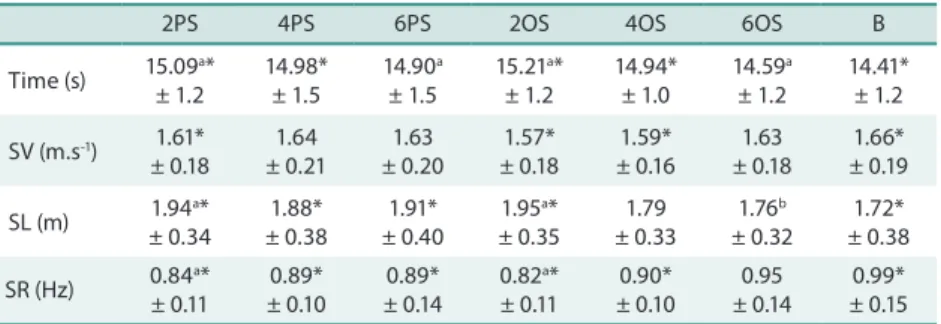
he mean and standard errors of time (s), SR (Hz), SV (m.s-1) and SL (m)
are shown in Table 1.
Table 1.Mean ± standard error of time (s), swimming velocity (SV, m.s-1), stroke length (SL, m) and stroke rate (SR, Hz) obtained for the diferent breathing patterns and breathing sides (n = 11).
2PS 4PS 6PS 2OS 4OS 6OS B
Time (s) 15.09a* ± 1.2
14.98* ± 1.5
14.90a
± 1.5
15.21a*
± 1.2 14.94* ± 1.0 14.59a ± 1.2 14.41* ± 1.2
SV (m.s-1) 1.61*
± 0.18 1.64 ± 0.21 1.63 ± 0.20 1.57* ± 0.18 1.59* ± 0.16 1.63 ± 0.18 1.66* ± 0.19
SL (m) 1.94a* ± 0.34
1.88* ± 0.38
1.91* ± 0.40
1.95a*
± 0.35 1.79 ± 0.33 1.76b ± 0.32 1.72* ± 0.38 SR (Hz) 0.84
a* ± 0.11 0.89* ± 0.10 0.89* ± 0.14
0.82a*
± 0.11 0.90* ± 0.10 0.95 ± 0.14 0.99* ± 0.15
2PS: breathing every two strokes to the preferred side; 4PS: breathing every four strokes to the preferred side; 6PS: breathing every six strokes to the preferred side; 2OS: breathing every two strokes to the opposite side; 4OS: breathing every four strokes to the opposite side; 6OS: breathing every four strokes to the opposite side; B: breath-holding. Superscript letters and asterisks indicate diferences for p < 0.05. Time: * = diferences between B and 2PS, 2OS, 4OS; a = diferences between 2x1 (irrespective of side) and 6x1 (irrespective of side); SV: * = diferences between B and 2PS, 2OS, 4OS; SL: * = diferences between B and 2PS, 4PS, 6PS, 2OS, 4OS; a = diferences between 2x1 (irrespective of side) and 6x1 (only on the opposite side); SR: * = diferences between B and 2PS, 4PS, 6PS, 2OS, 4OS; a = diferences between 2x1 (irrespective of side) and all other frequencies.
here was no signiicant interaction efect between breathing side and breathing frequency on the variables analyzed. he breathing side (PS or OS) exerted no efect on 25-m time (F(1, 9) = 3.304; p = 0.102; eta2 = 0.074). On the other hand, breathing frequency was able to change the 25-m time (F(2, 18) = 4.763; p = 0.022; eta2 = 0.191), but the efect size was small. he 25-m time at maximum intensity was shorter when breathing every six strokes compared to two-stroke breathing. No diference was observed between four- and six-stroke breathing or between four- and two-stroke breathing. he breath-holding condition resulted in better times when compared to the 2PS, 2OS and 4OS trials (p < 0.05; efect size ranging from 0.10 to 0.27).
Swimming velocity (excluding the impulse from the wall) was not afected by breathing side (F(1,7) = 0.064; p = 0.8; eta2 = 0.074) or breath-ing frequency (F(2,14) = 2.05; p = 0.165; eta2 = 0.097). Comparison of SV between each trial and the breath-holding trial showed higher values for the latter compared to 2PS, 4PS, 6PS and 2OS (p < 0.05; efect size ranging from 0.07 to 0.23).
he breathing side did not interfere with SL (F(1,7) = 2.984; p = 0.128; eta2 = 0.121). With respect to breathing pattern, higher SL values were only obtained for the two-stroke pattern compared to the six-stroke pattern (F(2,14) = 12.969; p = 0.009; eta2 = 0.159). Stroke length was always shorter in the breath-holding condition (p < 0.05; efect size ranging from 0.29 to 0.65), except when compared to 4OS and 6OS, but the diference was not signiicant.
he SR was not afected by breathing side (F(1,8) = 2.169; p = 0.179;
compared to the other breathing patterns. No diference was observed be-tween the two-stroke and four-stroke conditions. When SR was compared between each trial and the breath-holding trial, higher values were observed for the latter compared to 2PS, 4PS, 6PS, 2OS and 4OS (p < 0.05; efect size ranging from 0.32 to 0.54).
DISCUSSION
he objective of the present study was to determine the efects of diferent breathing patterns (frequency and breathing side) on front crawl kinematics and 25-m performance in competitive college swimmers. Diferences were evaluated between breathing to the preferred or opposite side every two, four or six strokes, in addition to comparisons with breath-holding swimming. Performance, which was evaluated based on 25-m time in the present study, was not afected by breathing side (preferred or opposite), whereas breathing frequency exerted an efect, but the efect size was small. he breath-holding condition resulted in better 25-m times compared to trials performed at higher breathing frequencies. Performance at maxi-mum intensity was better (shorter time) when breathing every four and six strokes compared to breathing every two strokes. No diference was observed between breathing every four and six strokes. hese data agree with the indings of Castro et al.9, who observed an increase in SR and SV in breath-holding front crawl swimming. In contrast, Payton et al.4 found no signiicant inluence of breathing action on performance. Furthermore, Seifert et al.17 showed that breathing to the preferred side rather than to the opposite side was more related to asymmetric arm coordination during a 100-m front crawl race. In the study of Dos Santos et al.18, coordination asymmetry remained unchanged in all force and impulse parameters analyzed, irrespective of the swimmer’s breathing preference (preferred or opposite side), indicating that the preferential breathing side does not prevent the occurrence of asymmetries in front crawl. In the present study, the variables analyzed only permitted inference of front crawl kinematics, but not of possible asymmetries.
According to Craig and Pendergast2, the ability to achieve a high SV is directly related to an increase in SL. In the present study involving college athletes, this strategy was used when the swimmers breathed every two strokes; however, to maintain the same velocity breathing every four or six strokes, the swimmers increased SR and decreased SL. his inding may be due to the increased time necessary to perform two complete strokes when breathing is performed.
Toussaint and Beek19 suggested SL to be an important indicator of
Breathing patterns and front crawl kinematics Couto et al.
for SR, i.e., this parameter was not afected by breathing side. However, breathing less oten, the participants were able to increase SL, indicating a better technique in these situations. hese data agree with the indings of
Pedersen and Kjendlie10 who observed an increase in SL when the
swim-mers took no breath.
According to Vilas-Boas and Fernandes1, for a swimmer to
continu-ously move in water, he/she needs to be able to produce, at every moment, a propulsive force (p) that is at least equal to the hydrodynamic drag force (D) acting opposite to the direction of movement. hus, the mass of the swimmer is subject, during the interval of time that this happens, to a negative impulse which will induce negative movement acceleration and, ultimately, implies the immobilization of the subject. he fact that the drag is directly proportional to the projected body area would explain the bet-ter kinematic values in the breath-holding and lower breathing frequency conditions due to the smaller number of body (breathing) movements that tend to increase drag.
Breathing plays a dual role during swimming: a physiological role related to body activity and the need for gas exchanges, and a mechanical role by directly inluencing the buoyancy of the subject7,20. his further in-dicates that not breathing, holding the air inside the lungs, would increase the athlete’s buoyancy by temporarily reducing body density, increasing the athlete’s performance in low-frequency breathing patterns and in the breath-holding condition. However, the higher the subject’s SV, the greater the need for oxygen consumption of the organism and production of CO27,12,20. Since the swimming distances were short (25 m) in the present study, this was not a determining factor; however, in oicial competitions, even sprint races (50 and 100 m), the swimmer will perform constant res-piratory exchanges. On the other hand, the distance used in the present study (25 m) restricts extrapolation of the results obtained to competitive distances, which is a known limitation of the methods used. However, even in these cases would it be interesting to breathe at a lower frequency.
According to unpublished observations of Pedersen and Kjendlie10, in a
Norwegian 50-m freestyle competition, all eight male swimmers breathed one, two or three times during the last three stroke cycles in the race. However, no signiicant diference in velocity was observed, which was 0.01 m.s-1, corresponding to a loss of time of 0.03 s in the last 10 m of the race. his loss in performance meant the diference between the irst and second place in the race. hese indings suggest that swimmers beneit from learning a better breathing technique and breath control. he present results regarding the breath-holding condition agree with the indings of Seifert et al.6 who demonstrated the need of restricting the breathing frequency at distances of 25 and 50 m, since the increase in velocity thus obtained would be greater than the harmful physiological efects of the lack of breathing. In front crawl swimming, to assume the best body position and to mini-mize drag, the swimmer is instructed to maintain the head aligned with
face and the athlete performing an inspiration. Regardless of the distance of the competition, the breathing action is directly related to metabolic demands, either supplying oxygen to active muscles or to eliminate
meta-bolic waste products (CO2) derived directly from the energy metabolism
or blood lactate bufering12. Furthermore, Cardelli et al.7 showed that the increase in breathing frequency during a race is associated with greater requirement of anaerobic metabolism, which leads to a compensatory increase in SR, rendering the swim less eicient. Payton et al.4 concluded that swimmers perform the breathing action during front crawl without altering SR or the timing of the underwater phases. In that study, the swim-mers also performed the breathing action without any decrease in SL and maintained similar mediolateral amplitudes and stroke width, although rolling further when breathing than when not. In contrast, with respect to rolling, a characteristic of swimming with alternating arms such as front and back crawl, Psycharakis and Sanders21 observed greater shoulder roll to the let side than to the right side in swimmers who preferred breathing to the right side, suggesting that factors related to laterality (breathing side) can inluence shoulder roll symmetry.
Castro et al.9 identiied an increase in SV in sprint swimmers during breath-holding swimming. his inding is probably related to the speciic tactics of 50-m freestyle races when the swimmer does not perform breathing movements or performs few movements. his strategy may inluence the swimming technique and inal performance. Furthermore, Pedersen and Kjendlie10 reported a signiicant decrease in SV when breathing every two strokes, i.e., SV was higher when fewer respiratory cycles were used. Accord-ing to these authors, swimmers should breathe as little as possible in 50-m freestyle sprints and no more than every six strokes in 100-m freestyle races.
CONCLUSIONS
he breathing side does not interfere with kinematic variables in the case of athletes with an already established technique. Breath-holding results in better times when compared to swimming at increased breathing fre-quencies, in addition to increasing average SV. he lower the breathing frequency, the higher the SR and the shorter the SL.
Coaches should emphasize breath control during both training sessions and competitions. he use of a given breathing pattern in a trial or training series should take into consideration individual diferences in technique and physiological responses. A more detailed analysis of this topic, combining biomechanical and physiological responses, is necessary for future studies.
Acknowledgements
Breathing patterns and front crawl kinematics Couto et al.
Corresponding author
Marcos Franken
UFRGS, Escola de Educação Física Rua Felizardo, 750, Jardim Botânico 90690-200. Porto Alegre, RS, Brasil E-mail: marcos_franken@yahoo. com.br
REFERENCES
1. Vilas-Boas JP, Fernandes R. Arrasto hidrodinâmico activo e potência mecânica máxima em nadadores pré-juniores de Portugal. Rev Port Ciên Esp 2001;1(3):14-21. 2. Craig AB, Pendergast DR. Relationships of stroke rate, distance per stroke and
velocity in competitive swimming. Med Sci Sports 1979;11(3):278-83.
3. Figueiredo P, Pendergast DR, Vilas-Boas JP, Fernandes RJ. Interplay of biomechani-cal, energetic, coordinative, and muscular factors in a 200-m front crawl swim. Bio Med Res Int 2013;1(1):1-12.
4. Payton CJ, Bartlett RM, Baltzopoulos V, Coombs R. Upper extremity kinematics and body roll during preferred-side breathing and breath-holding front crawl swimming. J Sports Sci 1999;17(9):689-96.
5. Maglischo EW. Swimming Fastest. he essential reference on technique, training, and program design. Champaign: Human Kinetics. 2003.
6. Seifert L, Chehensse A, Chollet CT, Lemaitre F, Chollet D. Efect of breathing pattern on arm coordination symmetry in front crawl. J Streng and Cond Res 2008;22(5):1670-6.
7. Cardelli C, Lerda R, Chollet D. Analysis of breathing in the crawl as a function of skill and stroke characteristics. Perc Mot Skills 2000;90(3):979-87.
8. Counsilman JE. La Natacion. Ciencia y Técnica para la Preparación de Campeones. Barcelona: Editorial Hispano Europea SA. 7th ed. 1995.
9. Castro FAS, Guimarães ACS, Moré FC, Lammerhirt HM, Marques AC. Cinemática do nado “crawl” sob diferentes intensidades e condições de respiração de nadadores e triatletas. Rev Bras Educ Fís Esporte 2005;19(3):223-32.
10. Pedersen T, Kjendlie P. he efect of the breathing action on velocity in front crawl sprinting. Rev Port Ciên Esp 2006;6(2):75-77.
11. Castro FAS, Vilas-Boas JP, Guimarães ACS. Efects of swimming intensity and breathing in front crawl body roll angles for swimmers and triathletes. Rev Bras Biomecânica 2006;7(13):85-90.
12. Costill DL, Kovaleski J, Porter D, Kirwan J, Fielding R, King D. Energy expenditure during front crawl swimming: predicting success in middle-distance events. Int J Sports Med 1985;6(5):266-70.
13. Matos CC, Castro FAS. Variabilidade do lactato sanguíneo em resposta a nados de aquecimento e de máxima intensidade. Rev Bras Ciênc Mov 2013;21(1):98-106. 14. Toubekis AG, Adam GV, Douda HT, Antoniou PD, Douroundos II, Tokmakidis
SP. Repeated sprint swimming performance ater low- or high-intensity active and passive recoveries. J Strength Cond Res 2011;25(1):109-16.
15. Toubekis AG, Douda HT, Tokmakidis SP. Influence of diferent rest intervals during active or passive recovery on repeated sprint swimming performance. Eur J Appl Physiol 2005; 93(5):694-700.
16. Franken M, Carpes FP, Diefenthaeler F, Castro FAS. Relação entre cinemática e an-tropometria de nadadores recreacionais e universitários. Motriz 2008; 14(3):329-36. 17. Seifert L, Chollet D, Allard P. Arm coordination symmetry and breathing efect in
front crawl. Hum Mov Sci 2005;24(2):234-5.
18. Dos Santos KB, Pereira G, Papoti M, Bento PCB, Rodacki A. Propulsive force asym-metry during tethered-swimming. Int J Sports Med 2013;34(7):606-11.
19. Toussaint HM, Beek PJ. Biomechanics of competitive front crawl swimming. Sports Med 1992;13(1):8-24.
20. Lomax M, Castle S. Inspiratory muscle fatigue signiicantly afects breathing frequency, stroke rate, and stroke length during 200-M front-crawl swimming. J Strength Cond Res 2011;25(10):2691-5.