Cristiane Aparecida de Assis Claro(a)
Jorge Abrão(b)
Silvia Augusta Braga Reis(b)
(a)Department of Orthodontics, School of
Dentistry, University of Taubaté, Taubaté, SP, Brazil.
(b)Departamento de Ortodontia e
Odontopediatria, Universidade de São Paulo (USP), São Paulo, SP, Brazil.
Corresponding author: Cristiane Aparecida de Assis Claro Av Tiradentes, 477, apto. 34, Centro Taubaté - SP - Brazil
CEP: 12030-180 E-mail: [email protected]
Received for publication on Mar 31, 2010 Accepted for publication on Jun 04, 2010
Association between overbite and
craniofacial growth pattern
Abstract: The purpose of the present study was to assess the association between overbite and craniofacial growth pattern. The sample comprised eighty-six cephalograms obtained during the orthodontic pretreatment phase and analyzed using the Radiocef program to identify the cranio-facial landmarks and perform orthodontic measurements. The variables utilized were overbite, the Jarabak percentage and the Vert index, as well as classiications resulting from the interpretation of these measurements. In all the statistical tests, a signiicance level of 5% was considered. Mea-surement reliability was checked by calculating method error. Weighted Kappa analysis showed that agreement between the facial types deined by the Vert index and the direction of growth trend established by the Jarabak percentage was not satisfactory. Owing to this lack of equiva-lency, a potential association between overbite and craniofacial growth pattern was evaluated using the chi-square test, considering the two methods separately. No relationship of dependence between overbite and craniofacial growth pattern was revealed by the results obtained. There-fore, it can be concluded that the classiication of facial growth pattern will not be the same when considering the Jarabak and the Ricketts anal-yses, and that increased overbite cannot be associated with a braquifa-cial growth pattern, nor can openbite be associated with a dolichofabraquifa-cial growth pattern.
Descriptors: Orthodontics; Cephalometry; Growth and Development; Diagnostic Errors.
Introduction
Changes in overbite (vertical incisor overlap) can be related to some functional alterations, such as phonoarticulatory problems.1
The terms “deep skeletal overbite” and “skeletal open bite” have been put forward to refer to vertical discrepancies.2 Other authors have used the terms “long face syndrome”3 and “short face syndrome”4 to collec-tively describe characteristics occurring in patients with excessive verti-cal alterations.
An essential step in orthodontic diagnosis and planning is determin-ing the craniofacial growth pattern. The cephalometric references used to identify the facial biotype can be different, as well as the terminology utilized by different authors.
pat-terns by means of the Vert index, which takes into account ive cephalometric measurements (facial axis, facial depth, mandibular plane, anteroinferior facial height and mandibular arch) and classiies the face into six types (severe brachyfacial, brachyfacial, mesofacial, light dolichofacial, dolichofacial and se-vere dolichofacial) (Figure 1). The Siriwat & Jarabak analysis was performed by determining the Jarabak coeficient [(posterior facial height/anterior facial height) x 100], and classiies growth tendency into hyperdivergent (54 to 58%), neutral (59 to 63%) and hypodivergent (64 to 80%)7 (Figure 2).
If vertical condylar growth exceeds dentoalveo-lar growth, anti-clockwise mandibudentoalveo-lar rotation oc-curs.8 Among the three anti-clockwise rotational types, type I (rotational center on the condyle) and type III (rotational center on the premolars) produce compression of inferior incisors against superior in-cisors, giving rise to deepening of bite.9
Although certain craniofacial morphological characteristics present signiicant differences when groups with increased overbite and open bite are
evaluated10 – thus indicating that vertical skeletal al-terations may justify the presence of abnormal over-bite (open over-bite in dolichofacial patients and deep bite in brachyfacial patients) – it is possible that fa-cial pattern differences may not be followed by cor-responding dentoalveolar discrepancies.
The present study evaluated concordance be-tween facial types deined by the Vert index and those indicated by the Jarabak percentage, and in-vestigated whether an association was observed be-tween overbite and the craniofacial growth pattern determined by these methods.
Material and Methods
This study was approved by the Institutional Ethics Committee. The sample comprised 86 pa-tients (42 male and 44 female, with ages ranging from 11 to 37 years). Fifty-nine patients (31 female and 28 male) had ages up to 18 years, 15 patients (11 female and 4 male) had ages ranging from 18 to 26 years, and 12 patients (2 female and 10 male) had ages ranging from 26 to 37 years.
where:
nv = normal value for the age; FA = facial axis;
FD = facial depth; MP = mandibular plane; AIFH = anteroinferior facial height; MA = mandibular arch.
Vert < or = −2 Severe dolichofacial
Vert > or = +1 Severe brachyfacial Vert = −1.9 to −1.0 Dolichofacial
Vert = −0.9 to −0.5 Light dolichofacial
Vert = −0.4 to +0.4 Mesofacial
Vert = +0.5 to +0.9 Brachyfacial
(FA − nv/3) + (FD − nv/3) + (nv − MP/4) + (nv − AIFH/4) + (MA − nv/4) Vert =
5
Figure 1 - Five cephalometric measurements used in the Vert index. 1: facial axis; 2: facial depth; 3: mandibular plane; 4: anteroinferior facial height; 5: mandibular arch.
1
5
3
2
The eighty-six lateral X-rays of patients’ heads were obtained at the same radiological institute and using the same apparatus. These patients, all in the pre-treatment orthodontic phase, presented perma-nent dentition with the second molars present.
The X-rays were scanned and the images were standardized using the Radiocef Studio version 4.0 computer program (Radio Memory Ltda, Belo Hor-izonte, MG, Brazil).
Following identiication of the craniofacial land-marks, a database was composed of overbite vari-ables, the Vert index (Figure 1) and the Jarabak per-centage (Figure 2).
Overbite groups were divided fundamental-ly based on a criterion used by Beckmann et al.11 (1998), and classiied as deep bite (> +4 mm), nor-mal overbite (> +1 mm and ≤ +4 mm), edge-to-edge overbite (> −1 mm and ≤ +1 mm) and open bite (≤ −1 mm). However, in the present study both edge-to-edge overbite and open bite were grouped togeth-er.
Method error
Twenty X-rays were re-evaluated after a period of time, and the irst measurement was compared to the second by means of the t test for identiication of systematic error. For evaluation of random error, the Dahlberg formula was employed. The weighted kappa statistic was used for categorical data.
Statistical method
Since the chi-square test required that the sam-ple size be set at twenty or higher, our samsam-ple size was considered suficient. However, if the sample size is less than forty, expected frequencies should be higher than ive.12 No expected frequency may be lower than one. A signiicance level of 5% was ad-opted for all statistical tests utilized.
The chi-square test was used to study
associa-tions between overbite and craniofacial growth pat-terns.
Results
Measurement reliability was conirmed by meth-od error, which did not identify systematic error by means of the t test for paired samples. Random er-ror assessed by the Dahlberg formula was consid-ered acceptable since error variance did not exceed 10% of total variance. As such, the lowest coefi-cient of reliability was 90.29%, and the highest, 97.51% (table 1).
Assessment of the method error for categori-cal data of facial type interpretation resulted in a
Variables Error variance (Se2)
Total variance (St2)
Coefficient of reliability [1 − (Se
2/S t
2)] × 100
t test paired samples
t p-value s/ns
Vert index 0.01 0.68 97.51 −1.28 0.216 ns
Jarabak % 1.45 14.95 90.29 1.24 0.230 ns
Overbite 0.20 6.08 96.63 1.53 0.141 ns
Table 1 - Results of the Dahlberg method and t test.
Figure 2 - Cephalometric measurements used in the Jara-bak Coefficient. 1: posterior facial height; 2: anterior facial height.
Posterior facial height Anterior facial height × 100 Jarabak coefficient =
weighted kappa coeficient of 0.68 (substantial) for the interpretation of the Jarabak analysis; for the Ricketts analysis, the weighted kappa coeficient was 0.85 (almost perfect).
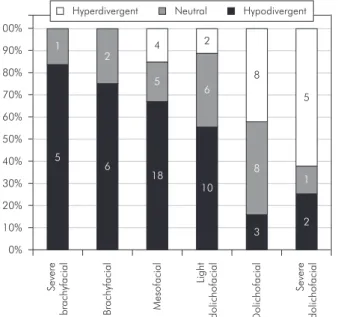
The data on the concordance between Vert index results and those deined by the Jarabak percentage
are shown in Graph 1. To carry out the statistical analysis, the degrees (light, severe) of the Ricketts analysis were grouped together according to growth type. The weighted Kappa analysis showed that agreement between facial types deined by the Vert index and direction of the growth trend established by the Jarabak percentage was light (weighted Kap-pa = 0.20). The interpretation of kappa scores, ac-cording to Landis and Kock,13 is shown in chart 1.
Because the concordance between interpreta-tions of growth types was not strong, we chose to conduct an association assessment considering sepa-rate analyses.
The data shown in tables 2 and 3 reveal a lack of
Chart 1 - Interpretation of kappa scores according to Lan-dis and Kock (1977).13
kappa value Interpretation
< 0 Poor
0 to 0.20 Light
0.21 to 0.40 Fair
0.41 to 0.60 Moderate
0.61 to 0.80 Substantial
0.81 to 1.00 Almost Perfect
Table 2 - Test results (chi-square) for the association between overbite and growth pattern defined by the Vert index.
Pattern Open Frequency observed (frequency expected) Normal Frequency observed (frequency expected) Deep Frequency observed (frequency expected)
X2 p s/ns
Severe Dolichofacial 2 (1.58) 5 (3.63) 1 (2.79)
8.473 0.583 ns
Dolichofacial 7 (3.76) 6 (8.62) 6 (6.63)
Light Dolichofacial 2 (3.56) 9 (8.16) 7 (6.28)
Mesofacial 4 (5.34) 11 (12.24) 12 (9.42)
Brachyfacial 1 (1.58) 5 (3.63) 2 (2.79)
Severe Brachyfacial 1 (1.19) 3 (2.72) 2 (2.09)
Table 3 - Test results (chi-square) for the association between overbite and growth pattern defined by the Vert index (grouped).
Pattern Open Frequency observed (frequency expected) Normal Frequency observed (frequency expected) Deep Frequency observed (frequency expected)
X2 p s/ns
Dolichofacial 11 (8.90) 20 (20.41) 14 (15.70)
2.661 0.616 ns
Mesofacial 4 (5.34) 11 (12.24) 12 (9.42)
Brachyfacial 2 (2.77) 8 (6.35) 4 (4.88)
100% 90% 80% 70% 60% 50% 40% 30% 20% 10% 0% Sev ere brachy facial 5 1 B rachy facial 6 2 Mes o facial 18 5 4 Light do licho facial 10 6 2 D o licho facial 3 8 8 Sev ere do licho facial 2 1 5
Hyperdivergent Neutral Hypodivergent
association between the patterns established by the Vert index and overbite regardless of whether or not the degrees of facial type are considered.
With the objective of certifying that the values referring both to patients with normal overbite and to those who were mesofacial did not interfere with the results, chi-square was utilized excluding these groups. The results shown in tables 4 and 5 do not reveal any relationship of dependence between over-bite and facial pattern.
The lack of association between overbite and fa-cial growth pattern deined according to the Jara-bak percentage was conirmed (table 6), even when maintaining only hyperdivergent and hypodivergent extremes (table 7). Although an association was ob-served when excluding the normal bite group (table 8), one of the expected frequencies was less than ive and the sample size was reduced to less than forty, therefore the result of this association is not reliable.
Discussion
Our sample was representative of the patient population in the orthodontic pre-treatment phase, given that it was obtained randomly and had a size suitable for the statistical tests. The inclusion crite-ria were not excessively speciic, in order to be co-herent with the study purpose, which was to assess whether an association generically assumed between overbite types and facial pattern could be supported
scientiically.
It is generally expected that malocclusion in patients with an elongated face includes open bite, while malocclusion in patients with a short face includes deep bite. However, although the combi-nation of certain occlusion characteristics may be associated with speciic facial types, this concept should not be generalized.14
Vertical malocclusion may be divided into those of predominantly skeletal origin, when related to mandibular and maxillary growth patterns, and those of predominantly dentoalveolar origin.8,15 However, both factors may be jointly present or manifest separately.
Occurrence of normal or even deep overbite in patients with an elongated face may be justiied by compensatory mechanisms in mandibular/maxillary and alveolar growth.16,17,18
The type II anti-clockwise mandibular rotation presents its center at the incisor contact area,9 and is not normally related to overbite. However, if oc-clusion of the incisors is unstable, the fulcrum point will be located more posteriorly, and the bite will deepen with time.8
It is not uncommon to ind incoherencies be-tween the results obtained from applying the cepha-lometric analyses of different authors to the same individual. This situation may create diagnostic doubt, especially amongst recently graduated
pro-Table 4 - Test results (chi-square) for the association between overbite and growth pattern defined by the Vert index (grouped), excluding the normal overbite group.
Pattern Open
Frequency observed (frequency expected)
Deep
Frequency observed (frequency expected) X2 p s/ns
Dolichofacial 11 (9.04) 14 (15.96)
1.549 0.461 ns
Mesofacial 4 (5.79) 12 (10.21)
Brachyfacial 2 (2.17) 4 (3.83)
Table 5 - Test results (chi-square) for the association between overbite and growth pattern defined by the Vert index (grouped), excluding the normal overbite and mesofacial individual groups.
Pattern Open
Frequency observed (frequency expected)
Deep
Frequency observed (frequency expected) X
2 p s/ns
Dolichofacial 11 (10.48) 14 (14.52)
0.22 0.634 ns
fessionals.
Utilization of the Vert index minimizes possible distortions stemming from regional morphological variations. These distortions may occur when dein-ing facial pattern based on individual cephalomet-ric measurements. However, the Vert index pres-ents some shortcomings related to the adjustment between average values, which would permit a true correspondence between factors.19
The lack of satisfactory concordance between the interpretation derived from the Jarabak percent-age and that deined by the Vert index is coherent with the results obtained in other studies.20-22
Since concordance between the facial types es-tablished by the different analyses was unsatisfac-tory, we chose to conduct an assessment of the as-sociation between overbite and the different facial types, initially as deined by the Vert index, and af-terwards as deined by the Jarabak percentage.
Because differences between observed and ex-pected frequencies were smaller in both mesofacial
and normal overbite groups, and these factors may have interfered in the chi-square results, the asso-ciation between overbite and facial growth patterns was tested. Nevertheless, this association was not identiied when the facial type was deined by the Vert index. An association was identiied when the facial type was deined according to the Jarabak percentage. This result, however, may not be com-pletely relied upon, since the sample number was be-low forty and, in this case, the expected frequency could not be lower than ive, as occurred in the hy-perdivergent open bite group.
The lack of a relationship of dependence between facial type and overbite is coherent with the results of other studies where facial type did not inluence the extent of the observed incisor intrusion.23
The main determining factor of overbite in pa-tients with an elongated face is inferior facial height, whereas, in short-faced patients, the major inluence on overbite is inferior dentoalveolar morphology. Normal overbite in individuals with an elongated
Table 6 - Test results (chi-square) for the association between overbite and growth pattern defined by the Jarabak percentage.
Open Frequency observed (frequency expected)
Normal Frequency observed (frequency expected)
Deep Frequency observed (frequency expected)
X2 p s/ns
Hypodivergent 7 (8.70) 18 (19.95) 19 (15.35)
5.037 0.284 ns
Neutral 4 (4.55) 11 (10.43) 8 (8.02)
Hyperdivergent 6 (3.76) 10 (8.62) 3 (6.63)
Table 7 - Test results (chi-square) for the association between overbite and growth pattern defined by the Jarabak percentage, considering only hypodivergent and hyperdivergent patterns.
Open Frequency observed (frequency expected)
Normal Frequency observed (frequency expected)
Deep Frequency observed (frequency expected)
X2 p s/ns
Hypodivergent 7 (9.08) 18 (19.56) 19 (15.37)
4.841 0.089 ns
Hyperdivergent 6 (3.92) 10 (8.44) 3 (6.63)
Table 8 - Test results (chi-square) for the association between overbite and growth pattern defined by the Jarabak percentage, considering only hypodivergent and hyperdivergent patterns, open bite and deep bite.
Open
Frequency observed (frequency expected)
Deep
Frequency observed (frequency expected) X2 p s/ns
Hypodivergent 7 (9.66) 19 (16.34)
4.523 0.033 s
face may be maintained by limited inferior dentoal-veolar compensation.17
Some factors may inluence the occurrence of compensatory mechanisms. Compensation requires that the eruptive system be normal and that the forces exercised by soft tissue be in balance. The po-sition of adjacent teeth during eruption, much like the plane inclination effect of opposing teeth during occlusion and mastication, also inluences the mech-anisms of compensation.18
In the present study the lack of association be-tween overbite and facial pattern suggests that com-pensatory mechanisms should be fairly frequent. However, in clinical practice the probable perception of the effects of these compensatory mechanisms oc-curs with higher frequency only in extreme cases.
Conclusions
In agreement with the analyses of the present study, and considering the characteristics of the study sample, the following may be concluded:
1. The degree of concordance between the inter-pretation of facial type deined by the Vert index and that deined by the Jarabak percentage was not satisfactory.
2. There was no association between overbite and craniofacial growth pattern.
Acknowledgments
The authors wish to thank Radio Memory Ltda. for having generously provided the Radiocef Studio version 4.0 computer program for this study.
References
1. Sahad MG, Nahás ACR, Scavone-Junior H, Jabur LB, Guedes-Pinto E. Vertical interincisal trespass assessment in children with speech disorders. Braz Oral Res. 2008 Jul-Sep;22(3):247-51.
2. Sassouni V. A classification of skeletal facial types. Am J Or-thod. 1969 Feb;55(2):109-23.
3. Schendel SA, Eisenfeld J, Bell WH, Epker BN, Mishelevich DJ. The long face syndrome: vertical maxillary excess. Am J Orthod. 1976 Oct;70(4):398-408.
4. Opdebeeck H, Bell WH. The short face syndrome. Am J Or-thod. 1978 May;73(5):499-511.
5. Ricketts RM, Roth RH, Chaconas SJ, Schulhof RJ, Engel GA. Orthodontic diagnosis and planning: their roles in preventive and rehabilitative dentistry. Pacific Palisades: Rock Mountain Data Systems; 1982. 269 p.
6. Siriwat PP, Jarabak JR. Malocclusion and facial morphology. Is there a relationship? An epidemiologic study. Angle Orthod. 1985 Apr;55(2):127-38.
7. Jarabak JR, Fizzel JA. Technique and treatment with light wire edgewise appliances. 2nd ed. Saint Louis: Mosby; 1972. 612 p.
8. Nielsen IL. Vertical malocclusions: etiology, development, diagnosis and some aspects of treatment. Angle Orthod. 1991 Dec;61(4):247-60.
9. Bjork A. Prediction of mandibular growth rotation. Am J Orthod. 1969 Jun;55(6):585-99.
10. Trouten J, Enlow D, Rabini M, Phelps A, Swedlow D. Mor-phologic factors in open bite and deep bite. Angle Orthod. 1983 Jul;53(3):192-211.
11. Beckmann SH, Kuitert RB, Prahl-Andersen B, Segner D, The RPS, Tuinzing DB. Alveolar and skeletal dimensions
associ-ated with overbite. Am J Orthod Dentofacial Orthop. 1998 Apr;113(4):443-52.
12. Cochran WG. Some methods for strengthening the common X2 tests. Biometrics. 1954 Dec;10(4):417-51.
13. Landis JR, Koch GG. The measurement of observer agreement for categorical data. Biometrics. 1977 Mar;33(1):159-74. 14. Keeling SD, Riolo ML, Martin RE, Ten Have TR. A
multivari-ate approach to analyzing the relation between occlusion and craniofacial morphology. Am J Orthod Dentofacial Orthop. 1989 Apr;95(4):297-305.
15. Van der Linden FPGM. The vertical dimension. In: McNa-mara Jr JA, Brudon WL. Orthodontics and dentofacial ortho-pedics. Needham: Ann Arbor; 2001. p. 111-48.
16. Beckmann SH, Kuitert RB, Prahl-Andersen B, Segner D, The RPS, Tuinzing DB. Alveolar and skeletal dimensions associ-ated with lower face height. Am J Orthod Dentofacial Orthop. 1998 May;113(5):498-506.
17. Kuitert R, Beckmann S, Loenen M, Tuinzing B, Zentner A. Dentoalveolar compensation in subjects with vertical skeletal dysplasia. Am J Orthod Dentofacial Orthop. 2006 May;129(5):649-57.
18. Solow B. The dentoalveolar compensatory mechanism: background and clinical implications. Br J Orthod. 1980 Jul;7(3):145-61.
19. Rino Neto J, Paiva JB, Queiroz GV. Variabilidade entre os fa-tores componentes do índice Vert na determinação do padrão facial. Ortodontia. 2004 Sep-Dec;37(3):32-6.
cefalométricas de Ricketts e Siriwat & Jarabak. J Bras Ortodon Ortop Facial. 2002 Nov-Dec;7(42):520-5.
21. Scanavini C, Vigorito JW. Estudo cefalométrico-radiográfico das possíveis correlaçöes existentes entre as análises de Vigorito, Ri-cketts e Siriwat & Jarabak na definiçäo dos tipos faciais, em in-divíduos leucodermas. Ortodontia. 2001 Sep-Dec;34(3):27-41. 22. Poubel D. Estudo comparativo da determinação do tipo facial
por meio de análise facial e cefalométrica em indivíduos com
oclusão normal [dissertação]. São Bernardo do Campo: Facul-dade de Odontologia da UniversiFacul-dade Metodista de São Paulo; 2003.180 p.