ANA MARIA DA COSTA FERREIRA, MARIA LÚCIA PIRES DOS SANTOS,
ELEONICE MARIA PEREIRA, MARCOS OLIVEIRA DAMASCENO and WENDEL ANDRADE ALVES
Departamento de Química Fundamental, Instituto de Química, Universidade de São Paulo, Cx. Postal 26077 – 05513-970 São Paulo, SP, Brasil
Manuscript received on September 8, 1999; accepted for publication on September 15, 1999; presented byJosé M. Riveros
ABSTRACT
The importance of copper as an essential element can be estimated by the wide range of copper proteins and enzymes playing different roles in biological systems. In the last decades many bioinorganic studies were developed on mimetic complexes of copper-dependent proteins, in order to verify the interrelations between structural and functional properties of active copper centers. Among the most studied copper ion ligand, diimine compounds have deserved special attention due their flexibility, facility of preparation, and ability to stabilize both oxidation states of this metal. In our laboratory, we have been investigating some Schiff base copper complexes as mimics of different proteins, with emphasis on functional aspects, trying to elucidate mechanisms of reaction, based on proposed intermediary species, in addition to molecular shapes. Particularly, mimics of the copper-zinc superoxide dismutase, and of monooxigenases and oxidases exhibiting dicopper sites are discussed in this work.
Key words: copper protein mimics, copper diimine complexes, EPR measurements, characterization and reactivity studies.
INTRODUCTION
The importance of copper as an essential element can be estimated by the wide range of copper proteins and enzymes playing different roles in biological systems (Kaim & Rall 1996). Very recently, an up-per limit of 10−18mol/L has been estimated for the
concentration of free copper ions in the cell, which means that cellular pools of free copper are virtu-ally nonexistent, and that copper ions are always inserted on suitable biomolecules (Lippard 1999). A wide range of different structures are exhibited by copper proteins and enzymes, depending on their
Correspondence to: Ana Maria da Costa Ferreira E-mail: [email protected]
occurrence, and activity.
In the last decades many bioinorganic studies were developed on mimetic complexes of copper-dependent proteins. The characteristic structural features of the active sites in these proteins account for their particularly interesting spectroscopic properties that originated a prior useful classifica-tion (Adman 1991, Ferreira 1998). Based on these results, further studies were then carried out in order to verify the correlation between structural and func-tional properties of active copper centers, mainly through the preparation, and investigation of model compounds (Karlin & Tyeklár 1993).
at-tention (Guerrieroet al.1995), due their flexibility, facility of preparation, and ability on stabilizing both oxidation states of this metal. These ligands can pro-vide macroacyclic and macrocyclic structures, tripo-dal, compartmental, or dinucleating species (Fenton 1999). Most of the studies deal with structural pa-rameters, such as binding distances and angles, in order to mimic activated states of enzymes, oxy-genated intermediates, or special moieties in multi-metallated proteins. In this case, model compounds are designed and isolated, having then their spectral and magnetic properties determined. On the other hand, some of the studies emphasize functional as-pects, trying to elucidate mechanisms of reaction, based on proposed intermediary species, in addition to molecular shapes.
Particularly, dinuclear copper complexes have biological relevance, since they can give valuable information about the binding mode of dioxygen to the dicopper sites of proteins involved in its transport and activation, as for example: hemocyanin, tyrosi-nase, and laccase (Solomonet al. 1996). Since the pioneering studies on model systems for the action of copper monooxygenases (Karlinet al.1984), and on oxygenated species of those proteins (Kitajimaet al. 1989), investigations of this type of complexes have contributed to the better understanding of the oxygenation reactionsin vivo.
Another protein extensively studied is the copper-zinc superoxide dismutase, mainly due their protective role in conditions of oxidative stress. This enzyme had its structure determined by X-ray crys-tallography, and its mechanism of action investi-gated by pulse radiolysis, showing a rate constant (k∼=2×10⁹M−1s−1) close to the diffusion limit
(Fielden & Rotilio 1984). Since its functional role has been described, many copper complexes with different ligands were prepared as mimics of this enzyme, specially macroacyclic polyimines (Gärt-ner & Weser 1986). These studies indicated that the catalytic cycle requires a particular conformation of the active site, between a square planar arrangement adequate for copper(II) ions, and a distorted
tetra-hedral form preferred by copper(I) ions.
In our laboratory, we have been investigating some Schiff base copper complexes as mimics of different proteins, involved in the metabolism of molecular oxygen and its reduced derivatives. A few examples are shown in Scheme 1. Complexes of tetradentate diimines seem to be more efficient on mimicking the SOD activity, while the tridentate lig-ands permit to obtain dinuclear species, which can act as monooxygenase or oxidase models.
SOD MIMETIC COMPLEXES
The cytosolic superoxide dismutase, Cu2Zn2SOD, is an antioxidant protein that dismutates superox-ide radicals into hydrogen peroxsuperox-ide and dioxygen (McCord & Fridovich 1969). In its active center a monomeric copper ion is surrounded by four imida-zole groups, one of them bridged to a zinc ion, with structural function.
SCHEME 1
were shown to be good mimics of this enzyme, es-pecially the compound [Cu(apz-pn)]2+
(Santoset al. 1998). The calculated EPR parameters indicated an axial symmetry for all the complexes, similar to that of the native Cu2Zn2SOD, which have a planar square configuration distorted toward tetrahedron. The extension of this tetrahedral distortion is usu-ally estimated by the g/A ratio (Mülleret al.1995). In addition, the studied models showed also some pro-oxidant properties, forming reactive radi-cal species in the presence of biologiradi-cal oxidants, capable of damaging biomolecules (Santos et al. 1998). Further kinetic and mechanistic
investiga-tions are currently being developed in our laboratory, in reactions of hydrogen peroxide and peroxynitrite, another biological oxidant (Santoset al.1999).
MIMICS OF PROTEINS WITH DICOPPER SITES
TABLE I
Spectroscopic Parameters and SOD Activity of Some Diimine-Copper(II) Complexes, compared to that of native Cu2Zn2SOD.
Compounds d-d Band EPR Parameters# SOD activity (as perchlorate salts) λmax, nm gÅgngn/An IC50
(ε, M−1cm−1) (cm) (µM)
[Cu(dac-ambi)]2+ 710 2.070 2.235 124 1.44
(101) 2.247 150
[Cu(PuPy)]2+ ∗ 710 2.050 2.225 149 0.603
(116)
[Cu(pyal-en)]2+ ∗∗ 630 2.058 2.218 117 0.446
(106) [Cu(dac-apbi)]2+
640 2.056 2.248 132 0.431 (210)
[Cu(PuPhePy)]2+ ∗ 690 2.048 2.217 152 0.270
(136)
[Cu(dac-aepy)]2+ 575 2.060 2.218 126 0.216
(104)
[Cu(apz-pn)]2+ ∗∗ 646 2.063 2.229 113 0.0902
(60)
Cu2Zn2SOD∗,∗∗ 680 2.083 2.271 162 0.00589;
(150) 0.0143
∗Mülleret al.1995,Inorg. Chim. Acta,233:11-19. ∗∗Santoset al.1998,J. Inorg. Biochem.,71:71-78.
# EPR spectra were recorded in a Bruker EMX spectrometer, using frozen
methanolic solutions. Diimine ligands: dac-apbi, derived from diacetyl and 2-(2-aminophenyl)benzimidazole; dac-aepy, derived from diacetyl and 2-aminoethylpyridine; PuPy, derived from 2-pyridine carboxaldehyde and 1,4-diaminobutane;PuPhePy, derived from 2-benzoylpyridine and 1,4-diaminobutane.
spin-exchange mechanism (Hodgson 1975, Kahn 1987), that could explain catalytic electron trans-fers in biological systems. Dioxygen molecule can bind at these dinuclear copper active centers, and the structure elucidation of both the deoxygenated and the resulting oxygenated protein has been de-termined by spectral and EPR properties (Solomon et al. 1996). Several groups studied model com-pounds mimicking the most relevant aspects of those species, specially insertion of oxygen atoms in sub-strates (Sorrell 1989, Monzaniet al. 1998), binding and activation of dioxygen in copper centers
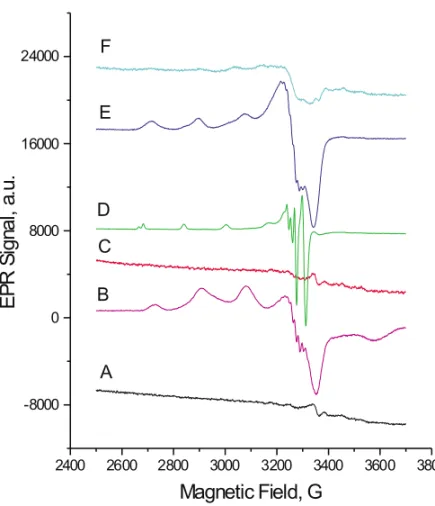
Fig. 1 – EPR spectra of some dinuclear diimine copper(II) complexes, in frozen methanol-water solution (4:1 v/v), at 77K. A- solvent ; B-[Cu2(apy-epy)2im]3+; C- [Cu2(sal-pol)2]2+; D- [Cu(aca-pol)Ac] ; E-[Cu(apy-pol)]+, monomer ; F- [Cu
2(apy-pol)2]2+.
[Cu2(apy-epy)2im]3+and the corresponding mono-mers (see Scheme 1), they usually occur in solution as a monomer/dimer equilibrium, monitored by spectrophotometric changes, very dependent on the pH of solution. The monomers seem to be the pre-dominant catalytic active species in reactions of hy-drogen peroxide, since the rates of reaction showed an inverse dependence on the complex concentra-tion for the studied systems. Probably, an available coordinating site for the oxidant is required.
All these compounds were found to be param-agnetic, similarly to their corresponding monomers, exhibiting characteristic EPR spectra (Figure 1). However, some other prepared dinuclear diimine complexes, as [Cu2(apy-pol)2]2+, and [Cu2(sal-pol)2]2+ compounds (see Scheme 1), showed a pronounced antiferromagnetic coupling in
the solid state, or even a partial interaction in frozen solutions, as verified by EPR spectra (Figure 1, lines C and F). These results were corroborated by mag-netic susceptibility measurements.
CONCLUSIONS
with that of the oxyhemocyanin. Additionally, din-uclear compounds can be interesting catalysts for reactions of hydrogen peroxide, occurring via two-electron transfer, under investigation in our labora-tory.
REFERENCES
Adman ET 1991. Copper Protein Structures. Adv Pro-tein Chem42:145-197.
Beauchamp C & Fridovich I 1971. Superoxide dis-mutase: improved assays and an assay applicable to acrylamide gels.Anal Chem 44:276-287.
Fenton DE 1999. Metallobiosites and their synthetic analogues - a belief in synergism.Chem Soc Rev28:
159-168.
Fenton DE & Vigato PA 1988. Macrocyclic Schiff base complexes of lanthanides and actinides. Chem Soc Rev17:69-90.
Fielden EM & Rotilio G 1984. The structure and mechanism of Cu/Zn superoxide dismutase. In:
Copper Proteins and Copper Enzymes, Lontie R, ed., CRC Press, Boca Raton, vol. II, Cap. 2, pp. 27-61.
Ferreira AMDC 1998. Sítios Ativos em Proteínas de Cobre: Estrutura e Reatividade. Revista Universi-dade de Guarulhos - Ciências Exatas e Tecnológicas,
III:5-12.
Gärtner A & Weser U1986. Molecular and functional aspects of superoxide dismutases. Top Curr Chem
132:1-61.
Guerriero P, Tamburini S & Vigato P A 1995. From mononuclear to polynuclear macrocyclic or macroa-cyclic complexes.Coord Chem Rev139:17-243.
Hodgson DJ 1975. The structural and magnetic prop-erties of first-row transition-metal dimers containing hydroxo, substituted hydroxo, and halogen bridges.
Progr Inorg Chem19:173-241.
Kahn O 1987. Magnetism of the heteropolymetallic systems.Struct Bonding (Berlin)68:89-167.
Kaim W & Rall J 1996. Copper, a “modern bioele-ment”.Angew Chem Int Ed Engl35:43-60.
Karlin KD & Tyeklár Z1993.Bioinorganic Chemistry of Copper, Chapman and Hall, New York.
Karlin KD, Tolman WB, Kaderli S & Zuberbühler AD 1997. Kinetic and thermodynamic parameters of copper-dioxygen interaction with different oxygen binding modes. J Mol Catalysis A: Chemical117:
215-222.
Karlin KD, Hayes JC, Gultneh Y, Cruse RW, McKown JWW, Hutchinson JP& Zubieta J 1984. Copper-Mediated Hydroxylation of an Arene: Model System for the Action of Copper Monooxy-genases.J Am Chem Soc,106:2121-2128.
Kitajima N 1992. Synthetic approach to the structure and function of copper proteins.Adv Inorg Chem39:
1-77.
Kitajima N, Fujisawa K, Morooka Y & Toriumi K 1989. µ−η2:η2-Peroxo Binuclear Copper Com-plex, [Cu(HB(3,5-iPr2pz)3)]2(O2). J Am Chem Soc
111:8975-8976.
Lippard SJ1999. Free Copper Ions in the Cell?Science
284:748-749.
McCord JM & Fridovich I 1969. Superoxide dismu-tase, an enzymic function for erythrocuprein. J Biol Chem244:6049-6055.
Monzani E, Quinti L, Perotti A, Casella L, Gul-lotti M, Randaccio L, Geremia S, Nardin G, Faleschini P& Tabbi G 1998. Tyrosinase Mod-els. Synthesis, structure, catechol oxidase activity, and phenol monooxygenase activity of a dinuclear copper complex derived from a triamino pentabenz-imidazole ligand.Inorg Chem37:553-562.
Müller J, Felix K, Maichle C, Lengfelder E, Strahle J & Weser U 1995. Phenyl-substituted copper di-Schiff base, a potent Cu2Zn2SOD mimic surviving competitive biochelation.Inorg Chim Acta
233:11-19.
Santos MLP, Faljoni-Alario A, Mangrich AS & Ferreira AMDC 1998. Antioxidant and Pro-oxidant Properties of Some Diimine-Copper(II) Complexes. J Inorg Biochem71:71-78.
lipid peroxidation induced by peroxynitrite. In:22a. Reunião Anual da SBQ, Poços de Caldas, MG.
Re-sumo QI-157.
Solomon EI, Sundaram UM & Machonkin TE 1996. Multicopper oxidases and oxygenases. Chem Rev
96:2563-2605.
Sorrell TN 1989. Synthetic models for binuclear cop-per proteins.Tetrahedron45:3-68.
Strothkamp KG & Lippard SJ 1982. Chemistry of the imidazole-bridge bimetallic center in the Cu-Zn SOD and its model compounds. Acc Chem Res15:
318-326.