BJRS
RADIATION SCIENCES
07-2A (2019) 01-12INSS: 2319-0612
Accepted: 2018-12-16
Elementary characterization of samples of Portland
cement, natural gypsum and phosphogypsum mortars from
Brazil
D. C. Narloch
a; S. A. Paschuk
a; J. N. Corrêa
b; C. A. P. Torres
a; A. L. Lara
c; J. M.
Ca-sali
d; W. Mazer
b; G. Macioski
b; A. F. N. Perna
e.
aGraduate Course in Electrical Engineering and Industrial Informatics/Federal Technological University of Paraná,
80230-901 Curitiba, Paraná, Brazil
bCivil Construction Academic Department/Federal Technological University of Paraná,
81280-340 Curitiba, Paraná, Brazil
cPhysics Institute of University of São Paulo/ University of São Paulo,
05508-090 Cidade Universitária, São Paulo, Brazil
dFederal Institute of Santa Catarina,
88020-380 - Florianópolis, Santa Catarina, Brazil
ePhysics Department / Federal Institute of Paraná, 80230-150 - Curitiba, Paraná, Brazil
ABSTRACT
Portland cement, the basic ingredient of concrete and is manufactured by crushing, milling and proportioning limestone, sand, clay, iron ore and secondary materials such as shells, chalk or marl combined with shale slate or blast furnace slag, fly ash, gypsum, phosphogypsum, and some others. Evaluating the physical and mineralogical characteristics of the cement and its chemical composition is essential to establish the quality of the product. Therefore, the objective of this work is to characterize and quantify the most common chemical elements in the samples of Brazilian Portland ce-ment, natural gypsum, and phosphogypsum mortars by means of Energy Dispersive X-ray Fluorescence Spectroscopy (EDXRF), as well as to evaluate the compressive strength of these mortars. For analysis of the compressive strength, initially prepared samples were submitted to a destructive mechanical test. Subsequently samples were milled and com-pacted to form thin tablets, which were submitted to the EDXRF analysis. The qualitative and semi-quantitative analyz-es showed that for phosphogypsum mortar the larganalyz-est mass fractions were found of 49.8±2.5% (Si), 24.66±0.96% (S) and 22.10±0.42% (Ca). For gypsum mortar those values were found of 43.41±0.45% (Ca), 33.8 ± 0.8% (S) and 18.9±1.2% (Si), respectively; and for Portland cement mortar, the predominant elements in those samples have the mass
fractions of 64.20±0.52% (Ca) and 27.3±1.5% (Si). The results showed that obtained values of mass fraction of the elements Si, S, K, Ca, Ti, Fe are in rather good agreement with quantities indicated for manufacture. Besides, gypsum and phosphogypsum presented almost the same composition and compressive strength.
Keywords: X-ray fluorescence, construction materials, gypsum, phosphogypsum, Portland cement.
1. INTRODUCTION
Portland cement is defined by ASTM C 150 as hydraulic cement produced by clinker pulverization. In this way, cement composition mainly hydrated calcium silicates, normally content one or more forms of calcium sulfate (CaSO4). Clinker is produced by heating ground limestone and clay [1].
Portland cement is composed of primary and secondary materials, primary include calcium silicates, which must be in appropriate forms and proportions. To obtain calcium in industry, materials from calcium carbonate that occur naturally are used, such as limestone, chalk, marl, and seashells. How-ever, clay and dolomite (CaCO3 . MgCO3) are present as main impurities. Furthermore, sources of
silica are clays and shales, since they react easier than silica and sandstone [1].
Clay is composed of alumina (Al2O3), and often iron oxide (Fe2O3) and alkalis. The function of
these elements and of the magnesium oxide (MgO) in the raw mix is contribute to mineralization that occur during the process of formation of calcium silicate under relatively lower temperatures than normally used. When the mixture has small quantity of Al2O3 and Fe2O3, is performed an
addi-tion of secondary materials, such as bauxite and iron ore. The compounds are crushed, grounded, and blended so that all the mixture is homogenized before heating 1450 ºC. The final process con-sists in the clinker pulverization and, consequently, the particles become smaller than 75μm diame-ter [1, 2]. Furthermore, addition of about 5% of gypsum is performed in these compounds to control the early reactions and hardening of the cement [1].
Various cement industries around the world and particularly in Brazil partially replace gypsum by phosphogypsum since both have similar properties. This procedure is economically important be-cause large quantities of phosphogypsum are available elsewhere at low price [3].
Phosphogypsum is by-product from fertilizer industry. More specifically, phosphogypsum is resi-due from production of phosphoric acid (H3PO4) during processing of phosphate ore into phosphate
fertilizer using the sulfuric acid [4]. The production of phosphogypsum occur in proportion of 4 to 6 times bigger than phosphoric acid and usually it is stored in open pit or ground piles nearby fertiliz-er industries. These piles of phosphogypsum are cause of concfertiliz-ern considfertiliz-ering the impurities present in its composition, such as heavy metals, fluorides, and radioactive elements (238U, 226Ra, 210Pb,
232Th, and 40K). These impurities can contaminate the soil and groundwater, as well as cause an
individual internal and external exposure [5]. For this reason, phosphogypsum is responsible for an expressive environmental contamination and risky impact [6].
There are many types of Portland cement, each one has specific characteristics for necessities and applications. However, in general, addition of gypsum (and possibility of gypsum replacement by phosphogypsum) is common to all types of Portland cement. Particularly, in this work the sample of high early strength Portland cement CPV-ARI were used. One of the important characteristics of this cement is the low amount of C3A (3CaO.SiO2), which is limited to 3.5%, which is inhibited by
the addition of FeO [1].
The Energy Dispersive X-ray Fluorescence Spectroscopy (EDXRF) technique is usually used with the purpose to perform qualitative and quantitative analysis of samples that can be solid or liquid, metallic or non-metallic [7 - 9].
In this context, the experimental setup was used to analyze four main points of this work. The first is to evaluate the chemical elemental composition of cement samples to determine the presence of gypsum and phosphogypsum. The second is to compare the chemical composition of different type of mortar samples and to characterize their quality as well as to correlate the compressive strength of studied samples considering the parameters of chemical composition established by the norm NBR 7215: 1996 [10]. The third is to answer the question concerning the possibility to substitute one material by another without significant decrease of the cement strength.
The levels of activity concentration of 222Rn and 226Ra present in Portland cement mortar, including the samples of the main compounds of Portland cement such as phosphogypsum and natural gyp-sum mortars were reported previously [11]. These values were found over 300 Bqm−3 of 222Rn ac-tivity concentration in the air in Portland cement mortar. However, phosphogypsum and gypsum mortars presented concentration levels of released 222Rn within the limits established by the national and international norms and regulation [12-15].
In present research, these building materials were submitted to other tests to evaluate the strength, their chemical composition as well as to study the correlation of these characteristics.
The experimental analysis was splitted in two parts: settlement of the compressive strength and EDXRF qualitative and quantitative elemental analysis of analyzed materials.
2.1 Experimental Setup 2.1.1. Compressive strength
Samples were prepared at the UTFPR, Campus Ecoville, at the Laboratory of Aggregates of the Academic Department of Civil Construction (DACOC). The materials used were the high early strength Portland cement CPV-ARI, phosphogypsum and natural gypsum, both provided by a ce-ment industry located at Paraná State (Brazil).
The Portland cement mortar was prepared according to NBR 7215 (1996) producing 6 samples with dimensions of 5 cm in diameter and 10 cm in height. The sand used in the samples preparation was provided by IPT (Institute for Technological Research, SP) and characterized using four different diameter grain sizes, such as 0.15mm (fine sand), 0.30mm (average fine sand), 0.60mm (average coarse sand), and 1.20mm (coarse sand). The water/cement ratio was 0.48 and a mass ratio of 1:3 (cement:sand) was used for all tested mortars. A grinding machine with 5L tank capacity (EMIC - model AG5) was used to produce the mortar. After 24 hours from mortar preparation, the samples of Portland cement were demolded [10].
To reduce the humidity of natural gypsum stones, the material was dried inside a kiln at 60° C be-fore milling, to prevent the gypsum adherence inside the ball mill (Solotest inc.). The
phosphogyp-sum also was dried in a kiln following the same procedure before it was used for sample preparation [16].
It must to be noted that in the case of all samples of Portland cement, phosphogypsum and natural gypsum, the procedures of thermal curing and drying were used with some small adaptations due to different characteristics of this material. The followed steps were similar to those recommended in the Technical Standards, with some difference in proportion of materials and addition of MC-PowerFlow 1102 synthetic superplasticizer, in order to decrease the amount of water and increasing the initial strength of phosphogypsum and gypsum mortars. This procedure allows to perform the demolding of samples after 24 hours, but it was necessary to leave the samples in the open-air to be dehydrated for two weeks [16]. After of samples manufacturing and preparation, they were submit-ted to compressive strength test.
After more than 60 days from preparation, nine samples were submitted to compressive strength tests, among them there were three samples of each type of material (Portland cement, natural gyp-sum and phosphogypgyp-sum mortars). The tests were done at the UTFPR laboratories, with the EMIC DL 30.000 testing machine (Figure 1). Obtained compressive strength data were transferred to the computer with TESC acquisition software.
Figure 1: A view of compressive strength test
Before test, samples were centralized according to the hydraulic press loading axis. Neoprene pel-lets were used to ensure the uniform distribution of compressive stress on the samples.
2.1.2 Qualitative and semi-quantitative analysis
For characterization of elements present in the samples of Portland cement, natural gypsum and phosphogypsum two sets of EDXRF equipment were used: one located at Laboratory of Applied Nuclear Physics of UTFPR and other at the Institute of Physics of the State University of Rio de Janeiro (UERJ). EDXRF analysis was performed using ground and compacted thin pellets from material samples residues of material samples previously submitted to compressive strength tests. Energy Dispersive X-ray Fluorescence (EDXRF) analysis was performed using the AMPTEK Ex-perimenter’s XRF Kit, which consists of the X-123 spectrometer (silicon drift detector (SDD) and the DP5 digital signal processor), the Mini-X X-ray tubes with Au and Ag targets, which were in-stalled at mounting plate, and obtained data were analyzed with XRS-FP2 X-ray analysis software. The calibration of EDXRF was performed by using a steel standard sample with the X-ray tube op-eration parameters recommended by the manufacturer (30 kV, current of 30 μA, and acquisition time of 200 s) [16].
One part of EDXRF analysis was performed using the ARTAX model 200, from BRUKER ADVANCED X-RAY SOLUTIONS, with X-ray tube with a molybdenum (Mo) target (6º angle), and SDD detector. In this case the calibration and spectra acquisition were performed operating the X-ray tube at 18 kV and current of 300 μA [16].
The semi-quantitative analysis was carried considering the values of National Institute of Standards and Technology (NIST) [17], as well as previously published results of similar research of other authors [6, 18], and the information provided by the manufacturers.
Table 1 shows the composition of Portland cement according to NIST [17] together with data pro-vided by the manufacture company, which supplied the Portland cement used in this work.
Compound Mass fraction (%) (NIST) Concentration (%) (Manufacture Company) CaO 64.0 60.36 SiO2 20.7 19.05 Al2O3 4.7 4.37 Fe2O3 3.2 2.77 SO3 2.4 2.75 MgO 2.2 4.93 K2O 0.7 - TiO2 0.3 - P2O5 0.1 - NaO 0.1 - CaO free - 1.47
Calculations of the average of the two measurements of the elemental concentration from obtained values in semi-quantitative analyses by AMPTEK equipment. Equation (1) show how to calculate average.
(1)
Where y indicates the weight average of the measurements results , with statistical weight . Sta-tistical weight is demonstrated by equation (2), where is uncertainty in the best approximation of i:
(2)
After to calculate average concentration, error was calculated by equation (3):
(3)
3.1.1. Compressive strength
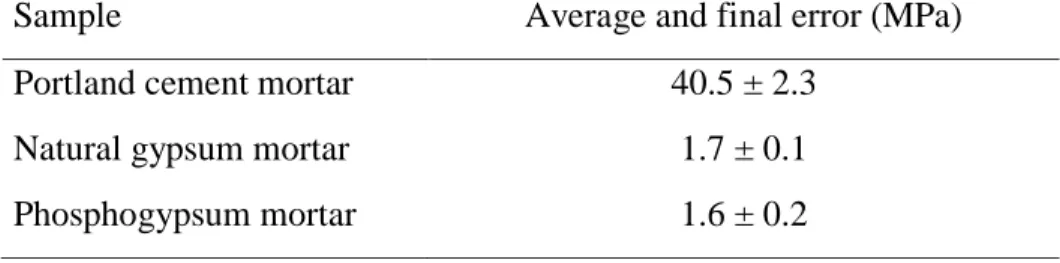
The results of average compressive strength for the samples of Portland cement, natural gypsum and phosphogypsum and the associated errors were calculated according the statistical limits estab-lished by NBR 7215 [10] and are shown in Table 2.
Table 2: Average and error for compressive strength tests of samples
Sample Average and final error (MPa)
Portland cement mortar 40.5 ± 2.3
Natural gypsum mortar 1.7 ± 0.1
Phosphogypsum mortar 1.6 ± 0.2
As it was expected, the Portland cement mortar samples had higher strength than the phosphogyp-sum mortar and natural gypphosphogyp-sum mortar [2].
3.1.2. Results of qualitative and semi-quantitative analysis
Elemental qualitative analysis of Portland cement, natural gypsum and phosphogypsum mortar samples was performed using collected EDXRF spectra using X-Ray tubes with Ag, Au, and Mo targets. Obtained results of the quantitative analysis are shown in Table 3. In the case of Portland cement mortar samples, Ca and Si are predominant elements. A large amount of Ca was found due to the presence of limestone (CaCO3) used as raw material during production of Portland cement,
and elevated concentration of Si comes from the sand present in the mortar.
Table 3: The results of semi-quantitative analysis of Portland cement, natural gypsum and
Element Portland Cement, [mg/cm2] Gypsum, [mg/cm 2] Phosphogypsum, [mg/cm2] Ca 64.20±0.52 43.41±0.45 22.10±0.42 S 0.91±0.17 33.8±0.8 24.66±0.96 Si 27.3±1.5 18.9±1.2 49.8±2.3 Fe 3.337±0.075 3.327±0.067 0.756±0.039 K 3.11±0.14 0.85±0.11 2.83±0.22 Ti 0.313±0.052 0.251±0.040 0.401±0.057 Sr 0.491±0.029 0.235±0.020 0.294±0.025 Mn 0.101±0.023 0.096±0.022 0.050±0.025 Zn - 0.015±0.009 0.066±0.012 Cl 0.38±0.15 - - Cu 0.028±0.012 - - Ni 0.025±0.014 - -
It was possible to compare the values given by the EDXRF equipment used in this work with the values established by NIST and the cement manufacturer (Table 1) [17]. Both showed similar con-centrations of chemical elements.
The predominant elements in gypsum and phosphogypsum mortars are Ca, S and Si. The results listed in Table 3 showed that both types of materials are composed of the same elements. Probably, due to their elemental similarity, both materials have almost equal compressive strength, as it was mentioned previously. The large amount of Si detected can be due to the presence of sand in the mortar. Natural gypsum consists of S, Ca, Si, Zn, Mn, Fe, K and Sr [6], which were detected in the present study too. The presence of some different elemental composition probably could be ex-plained by the particularities of the origin of studied materials.
According to El-Afifi (2009), phosphogypsum as well as natural gypsum also consists of Ca, S and Si. Moreover, the phosphorus (P), which was found in phosphogypsum in a small concentration, probably is related to the type of phosphogypsum production [18].
Among other elements it is necessary to mention vanadium (V) and phosphorus (P) detected in the samples of natural gypsum and Portland cement mortar as well as germanium (Ge), which was de-tected only in the samples of natural gypsum mortar.
4. CONCLUSION
Performed EDXRF analysis with Ag, Au and Mo X-Ray targets allowed satisfactory elementary characterization of Portland cement, natural gypsum and phosphogypsum mortar samples. Almost all basic components indicated by NIST were found and successfully identified by this method in all three types of materials.
The results of quantitative EDXRF analysis and compressive strength tests allowed to explain the similarities of mechanical properties of natural gypsum and phosphogypsum.
Moreover, it is possible to ascertain that gypsum could be replaced by phosphogypsum, which con-sequently can contribute to the reduction of phosphogypsum piles stored around fertilizer industries. The analysis of more samples of cement, gypsum, and phosphogypsum mortars from different backgrounds is suitable for further work. The increase in exposure time as setting parameter of EDXRF technique can be used to check whether more elements are identified in the material com-position.
5. ACKNOWLEDGMENT
The authors are very thankful to Coordenação de Aperfeiçoamento de Pessoal de Nível Superior (CAPES) and the Graduate Course in Electrical Engineering and Industrial Informatics (CPGEI) for financial support as well as to colleagues from the Institute of Physics of the State University of Rio de Janeiro (UERJ) for help to carry out EDXRF measurements and analysis of mortar samples.
REFERENCES
[1] METHA, P. K.; MONTEIRO, P. J. M. CONCRETE microstructure, properties and
materi-als. California, United States of America, 2001.
[2] NEVILLE, A.M.; BROOKS, J. J. Concrete Technology. Pearson: England, 2010. [3] British Cement Association. Concrete Practice, 3ª ed. 2002.
[4] MATOS, T. H. C. Caracterização hidro-mecânica do fosfogesso e das misturas
solo-fosfogesso. MSc dissertation. Universidade de Brasília Departamento de Energia Civil e Ambiental,
Brasília, 2011.
[5] COTA, S.D.S.; JACOMINO, V.M.F.; Taddei, M.H.T.; NASCIMENTO, M.R. Modelagem nu-mérica do impacto ambiental associado à aplicação de fosfogesso como cobertura de aterros sanitá-rios. Associação Brasileira de Águas Subterrâneas – ABAS. Águas Subterrâneas. v. 26.p. 27-42, 2012.
[6] CANUT, M. M. C. Estudo da viabilidade do uso do resíduo fosfogesso como material de
construção. (MSc dissertation). Programa de Pós-Graduação em Construção Civil – Universidade
Federal de Minas Gerais, Belo Horizonte, 2006.
[7] BRIENZA, S. M. B.; FILHO, V. F. N.; MOREIRA, S.; VIVES, A. E. S. Emprego da
fluores-cência de raios X dispersiva para avaliação da poluição por metais pesados em amostras de água e sedimentos de lagos. São Paulo, Brazil, 2002.
[8] BUENO, M. I. M. J.; NAGATA, N; PERALTA-ZAMORA P. G. Métodos matemáticos para correção de interferências espectrais e efeitos interelementos na análise quantitativa por fluorescên-cia de raios X. Química Nova. V 24, nº 4, 531-539, 2001.
[9] SILVA, R. M. C. E. Utilização da técnica de fluorescência de raios X com microssonda (µ -
XRF) aplicada a amostras de interesse arqueológico. Doctor Thesis, São Paulo, 2002.
[10] Associação Brasileira de Normas Técnicas. NBR 7215: Cimento Portland – Determinação
da resistência à compressão. Rio de Janeiro, 1996.
[11] NARLOCH, D.C.; PASCHUK, S.A.; CORRÊA, J. N.; ROCHA, Z., MAZER, W., TORRES, C. A. P., DEL CLARO, F.; DENYAK, V., SCHELIN, H. Characterization of radionuclides present
in portland cement, gypsum and phosphogypsum mortars. Radiation Physics and Chemistry. El-sevier. 2018. DOI: https://doi.org/10.1016/j.radphyschem.2018.07.011
[12] CNEN NE 3.01 - Comissão Nacional de Energia Nuclear. Posição Regulatória 3.01/007 – Ní-veis de Intervenção e de Ação para Exposição Crônica. Rio de Janeiro, 2005. http://appasp.cnen.gov.br/seguranca/normas/pdf/pr301_07.pdf
[13] European Commission, 1999. Radiological Protection Principles concerning the Natural Radi-oactivity of Building Materials, Directorate General Environment, Nuclear Safety and Civil Protec-tion Report 112, Geneva, EC.
[14] ICRP – International Commission on Radiological Protection, 2014. Radiological Protection against Radon Exposure. ICRP Publication 126. Ann. ICRP 43.
[15] UNSCEAR - United Nations Scientific Committee on the Effects of Atomic Radiation. Sources and Effects of Ionizing Radiation. UNSCEAR Report I. B. (2000).
[16] NARLOCH, D.C.; PASCHUK, S.A.; CASALI, J. M.; CORRÊA, J. N.; DEL CLARO, F.; MACIOSKI, G. Medidas da concentração de radônio-222 em cimento, fosfogesso e gesso. X
Con-greso Regional Latinoamericano IRPA de Protección y Seguridad Radiológica “Radioprotec-ción: Nuevos Desafíos para un Mundo en Evolución”, Buenos Aires, Argentina, 2015.
[17] FERRARIS, C. F.; GUTHRIE, W.; AVILÉS, A. I.; HAUPT, R.; MACDONALD, B. S. NIST
Special Publication. Certification of SRM 114q: Part I. NIST – National Institute of Stand-ards and Technology. Available at: <http://www.nist.gov/srm/upload/SP260-161.pdf>. Last
ac-cessed: 20 dec 2016.
[18] EL-AFIFI, E. M.; HILAL, M. A.; ATTALLAH, M. F.; EL-REEFY, S. A. Characterization of Phosphogypsum Wastes Associated with Phosphoric Acid and Fertilizers Production. Journal of