Studying Torsional Vibration of a Micro-shaft in a Micro-scale Fluid
Media based on Non-classical Theories
Mina Ghanbaria*
Siamak Hossainpourb
Ghader Rezazadehc
aMechanical Engineering Department., Engineering Faculty of Khoy., Urmia University, Urmia, Iran. E-mail: [email protected] bMechanical Engineering Department., Sahand University of Technology, Tabriz, Iran. E-mail: [email protected]
cMechanical Engineering Department., Faculty of Engineering., Urmia University, Urmia, Iran. E-mail: [email protected] * Corresponding author
http://dx.doi.org/10.1590/1679-78254569 Abstract
In this paper, torsional vibration of a micro-shaft in interacting with a micro-scale fluid media has been investigated. The presented mathematical model for this study is made up of a micro-shaft with one end fixed and a micro-cylinder at its free end which is immersed in a micro-scale fluid media. The micro-shaft can be actuated torsionally via applying an AC voltage to the capacitive plates around the micro-shaft and the outer fixed cylinder. As fluids and solids behave differently in micro scale than macro, the surrounding fluid field in the gap and also the micro-shaft have been modeled based on non-classical theories. Equation of motion governing angular displacement of the micro- shaft and also equations of motion of the fluid field have been derived based on non-local elasticity and micro-polar theories. The coupled differential equations have been transformed to an enhanced form with homogenous boundary conditions. The enhanced equations have been discretized over the beam and fluid domain using Galerkin method. Effects of non-local parameter of the micro-shaft and also micro-polar parameters of the fluid field on the response of the micro-shaft have been studied. We have shown that micropolar parameters of fluid due to having damping and inertial effects, changes resonance frequency and resonance amplitude of the shaft.
Keywords
MEMS, Micro-polar theory, Micro-scale fluid
1 INTRODUCTION
with the available experimental and numerical results. The added mass on a membrane with fixed ends was calculated by Minami (1998) by applying airfoil theory. He showed that added mass depends on the fluid density and the membrane dimensions. Also he showed that the added mass is not affected by the frequency and the amplitude of the oscillations. A formula was suggested by Sinha et al. (2003) for added mass of vibrating of perforated plate type structures immersed in fluids that designers could evaluate the structural dynamic of these structures without conducting a model test. Dynamic characteristic and forced response of a piezoelectrically actuated micro-beam subjected to fluid loading was investigated by Rezazadeh et al. (2009). They showed that fluid loading decreases the natural frequency of the micro-beam and because of higher dielectric coefficient and increasing electrical stiffness and decreasing total stiffness, causes maximum amplitude of the micro-beam to decrease. Rezazadeh and Ghanbari (2018) by investigating the effects of the surrounding fluid on the vibration of a micro-beam, proposed a novel model for measurement of fluids viscosity and density. In adition to inertial effect, fluid has damping and stiffness effect on the behavior of the microstructure. Many researches have been done to investigate damping effect of the fluid on the transversally vibrating micro-beams. This phenomena that is called squeezed film damping ocures in most of MEMS devices as micro-resonators and is a dominant source of dissipating energy in these devices (Zook et al.1992; Legtenberg and Tilmans, 1994; Starr 1994). Damping characteristics for the first three flexural modes of vibration of the resonator were obtained by Pandey and Pratap (2007) in which static deflection due to DC load was neglected. Younis and Nayfeh (2007) obtained bias deflection of the plate under different ambient pressures by using perturbation method. Squeeze film characteristics of cantilever micro-resonators for higher modes of vibration under large DC load were obtained operating in different ambient pressure conditions by Chaterjee and Pohit (2009, 2010).
Although several studies have been done on the dynamic behavior of the micro-structures under surrounding fluid, but in most of the researches the micro-beam has been modeled based on classisal theory which is not capable of predicting size-dependant behavior of the micro-beam. Todays, non-classical theories as couple stress, strain gradient and non-local elasticity theories are applied in modelling micro-structures (Arbind et al. 2014., Sedighi et al. 2014). In most of mentioned works, the surrounding fluid has been modeled by using linearized Reynolds equation that is obtained based on classical theory. In the study of micro and nano-scale fluid mechanics, the Navier-Stokes equations become incapable of explaining the micro scale fluid transport phenomena (Kucaba, 2004). A novel approach was developed by Eringen (1966) which includes the effect of local rotary inertia and couple stresses and presents a mathematical foundation to capture motions of the micro-scale fluids. Todays, researches show that in the field of micro-scale fluids, applying micro-polar fluid theory can be a useful tool in modeling of the micro scale flows (Kucaba, 2008; Chen et al 2011).
Recently, many works have been done in applying non-classical theories in modeling micro and nano structures. Ghanbari et al. (2014) studied squeeze film damping in a micro-beam resonator in which the fluid media was modelled based on micropolar theory. In an other work, Ghanbari et al. (2015a) by modeling the behavior of the micro fluid base on micropolar theory, presented a microsensor for measurement of a micro-scale fluid physical properties. Ghanbari et al. (2015b) investigated thin film damping in a microbeam resonator in which the beam was modelled base on non-local elasticity theory. Nonlinear vibration analysis of fractional viscoelastic Euler-Bernoulli nanobeams based on Surface stress theory was studied by Oskouie et al. (2017). Mohammadi et al. (2017) investigated Stochastic analysis of pull-in instability of geometrically nonlinear size-dependant FGM microbeams with random material properties. In another work, nonlinear frequency analysis of buckled nanobeams was studied by Sun et al. (2017), in the presence of longitudinal magnetic field. Ebrahimi and Haghi (2017) presented wave propagation analysis of rotating thermoelastically-actuated nanobeams based on nonlocal strain gradient theory.
In this paper a mathematical model has been presented for investigation the effect of a micro-scale fluid media on the force torsional vibration of the micro-shaft. Governing equations of motion of the fluid field have been derived based on micro-polar theory and equation of motion of the micro-shaft governing angular displacement of the shaft has been derived based on non-local elasticity theory. The obtained coupled differential equations have been solved simultaneously to calculate the force response of the micro-shaft. Effects of micro-polar parameters of the fluid media and non-local parameter of the micro-shaft on dynamic response of the micro-shaft have been studied.
2 MODEL DESCRIPTION AND ASSUMPTIONS
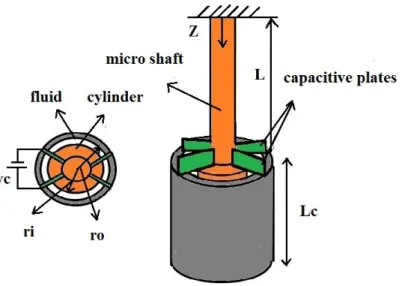
that can be created by applying an AC voltage to the capacitive plates situated around the micro-shaft. The surrounding fluid is bounded by an external cylinder in order to control the magnitude of the shear force. It is assumed that the surfaces of both cylinders are ideally smooth. It should be noted that as the amplitude of the vibration is so small, the geometric nonlinearity in this model is neglected.
Figure 1 Schematic of the proposed model for investigation the effect of fluid on dynamic behavior of the micro-shaft.
Refering to Eringen nonlocal theory of elasticity, strain of a point in a media depend on the stress of the whole points of the media as (Eringen, 1972):
2 2
2 zr
zr
l
zrz
(1)Where r is the distance to the center of the micro-shaft, z is the axial coordinate and
zr and
zr are the non-local and classical shear stresses, respectively. In torsional vibration, the classical shear stress and strain are related by:zr G rs
z
(2)
Where
G
s is the shear modulus of the shaft and is the angular displacement along the micro-shaft. The non-local twisting moment is defined as:zr A
T
r
dA
; s 2A
I
r dA
(3)Where
I
s is the polar moment of inertia and A is the cross section area of the shaft. Considering equations (1), (2) and (3) yields:2 2
2 s s
T
T l
G I
z
z
(4)
2
2
,
s s
T
I
T z t
t
Z
(5)Where
s is mass density of the shaft and T z t
, is the external torque acting per unit length of the micro-shaft . On the other hand, derivation of equation (4) with respect to z yields:3
3
2 2
2 s s
T
T
l
G I
z
z
z
(6)Combining equations (5) and (6) forms equation of motion governing angular displacement of the micro-shaft based on non-local elasticity theory:
2 4 2 2
2
2 2 2 2 2 ,
s s s s s s
T
I l I G I T z t
t z t Z z
(7)
For simplicity, the inertial force owing to the mass of the cylinder and the shear force due to physical properties of the surrounding fluid are assumed to be singular distributed loads with zero load intensity through the whole length of the beam and infinite intensity at its end as:
22
24 2 22
2
( ) (
)
s s
I
J
cz L
s s sI
J
cz L
sG I
s sT t
z L
t
l
z t
z
(8)
0 0
( ) ; ( ) ( );
L
c L
i c
T t
t Ar
zL
T t
zL dzT t
J
zL dzJ (9)Where
J
c is the mass moment of inertia of the cylinder, L is the length of the shaft, Ais the surface area,r
i is the radius of the cylinder and T is the momentum of shear force of the surrounding fluid acting on the surface of the cylinder.Boundary conditions of equation (8) are as:
0,
t
0
(10)
,
, 0
L t ex
ex s s
T t
T L t T t
z I G
(11)
Where
T t
ex( )
is an external exciting momentum acting on the shaft.Governing equations of the fluid field in the vector form based on micro-polar theory are as following (Eringen, 1966):
. V 0
t
(12)
.G
G
kf V 2k Gf l I G (14)Equation (12) represents conservation of mass; Equation (13) represents conservation of linear momentum; and Equation (14) represents conservation of angular momentum. In the equations above ,V and G are the fluid velocity and micro-rotation vectors, f and l are body forces and body couples. is density and I(Lf)2 is micro-inertia density of the fluid, and
k
f are dynamic and vortex viscosity coefficients. , , are spin gradient viscositycoefficients and is second order viscosity coefficient which produces a viscous effect associated with volume change.
f
L
is length scale of the fluid and is defined as:4 2
f
f
L
k
.Parameter 2 : 0 1
f
f
k
N N
k
characterizes
coupling between the vortex viscosity coefficient
k
f and the shear viscosity coefficient. In other words, it showsdependency of micro-rotations to macro-rotation (classical rotation) in the fluid field. If the limitin case N0, then the equations of the linear and angular momentums become independent of each other and the linear momentum transforms into the classical Navier-Stocks equations for Newtonian fluids.
By considering the following assumptions: 1. The fluid is assumed to be incompressible.
2. There are no body forces and body couples acting along z direction.
3. r dimension is very small in comparison to and z directions, so all derivatives with respect to and z are negligible compared to r dimension.
4. By supposing I Gs sI Gc c in which I Gc c is torsional stiffness of the cylinder, the fluid field is considered one-dimensional.
5. Pressure gradient in direction is neglected.
The equations (13) and (14) in the cylindrical coordinate can be rewritten as:
1
z
221
2f f f f
z f
v
g
v
v
v
k
rv
k
k
t
r r r
r
r
r
r
r
g
k
r
(15)
2
2
1
1
2
2
z z z z
f f z f f z
f
v
g
g
g
g
k g
r
k
k g
t
r r
r
r
r
r
r
v
k
r
(16)
Where
v
andg
z are the fluid velocity and micro-rotation components in and z directions, respectively. Boundary conditions of equations (15) and (16) are:
,
,
L t i
v
r t
t
t
;v r t
o,
0
(17)
,
0
z i
g r t
;g r t
z
o,
0
(18)
, ( , )
,
i i
i f f z r t
r t
v
v
r t
k
k g
r
r
(19)By introducing new functions:
z t
,
z t
,
zT t
p
(20)
,
w
,
t
o
;
o iv r t
r t
r
r h
r
r
h
(21)Equations (8), (15) and (16) can be Rewritten as:
2
2 4
2
2 2 2 2
2
2
,
w
w
2
i
i i
p
s s c s s s c s
o
s s f f zr s
r r r r i
T
z t
I
J
z
L
z
l
I
J
z
L
t
t
z t
t
t r
G I
k
k g
A
z
L
z
r
r
h
r h
(22)
2 2
2
2
w
,
w
,
w
,
w
1
z f f o
o z
f f
t
w r t
r
r
t
h
r t
r t
r
g
k
t
k
r
r
r
r
hr
r
(23)
2 2
w 1
( , z 2 z z
z f f z f
t
g g g
g r t k g k
t r r r r h
(24)
With homogenous Boundary conditions:
0,
t
0
; ,
0
L tz
(25)
o,
0
w r t
;w r t
i,
0
(26)
,
0
z i
g r t
;g r t
z
o,
0
(27)3 NUMERICAL SOLUTIONS
1
,
,
p
p k k
k
z t
z t
q t
z
(28)
1
w
,
(w )
,
m
m i i
i
r t
r t
a t
r
(29)
1
g
,
(g )
,
n
z z n j j
j
r t
r t
b t
r
(30)Substituting equations (29), (30) and (31) into equations (22), (23) and (24) yields:
2 1 1 1 1 1 1 1,
(
)
2
(t)
p p peq c s k k k k
k k
p
s s k
k
p M
o
s f j j i k k S s
j i k
M
s f j j i
k
j
z t
I
J
z
L
q
t
z
z T
t
l
q
t
z
G I
q t
z
r
A
z
L
k
a t
r
q t
L
L T
h
r h
A
z
L k
a t
r
(31)
1 1 2 21 1 1
2 1
w
,
(t)
1
(t)
p M
f o
f j j k k S s
j k
p
M M
o
f j j j j k k S s
j j k
p
f j j
j
r
r
r t
a t
r
q t
L
L T
h
r
k
a t
a t
r
q t
L
L T
r
hr
r
k
b t
r
(32)
1 1 1
3 1 1
1
,
1
(t)
p p p
z f f j j j j j j
j j j
p M
f j j k k S s
j k
r t
J
b t
r
b t
r
b t
r
r
k
a t
r
q
t
L
L T
h
(33)By applying Galerkin- based reduced order model, following ordinary differential equations are obtained:
(1) (1) (1)
1 1 1 1
p p p m
fk k fk k fk k fi i f
k k k i
M q
C q
K q
F a
P
; f 1,....p (34)(2) (2) (1) (2) (1)
1 1 1 1 1
p p m m n
sk k sk k si i si i sj j s
k k i i j
M
q
C q
E a
F
a
H b
P
(3) (3) (1) (2)
1 1 1 1
p m n n
uk k ui i uj j uj j u
k i j j
C q
F a
G b
H b
P
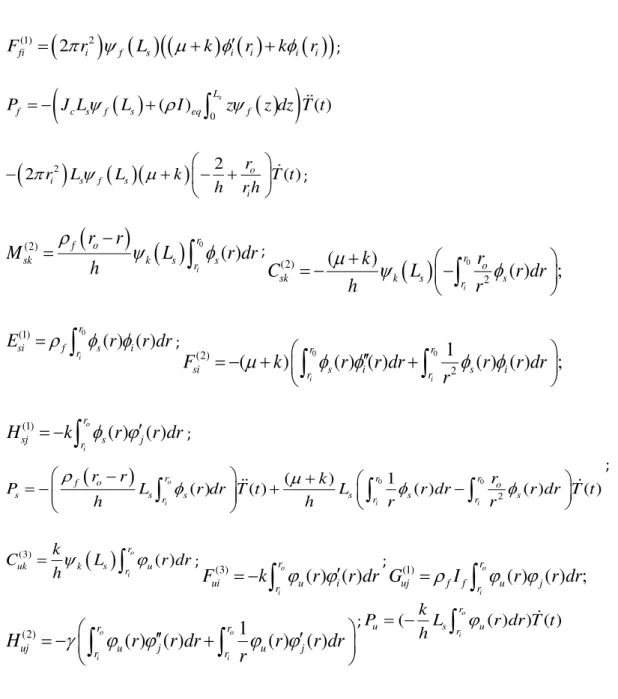
;u1,....n (36)With the following coefficients:
(1) 2
0 0
(
)
Ls Lsf k eq f k f k
fk c s s
M
J
L
L
I
z
z
dz l
z
z
dz
;
) 2
(1 2
2 o
i k
f f s s
i k
r
r L
h
C k L
r h
;
0(
)
Ls f kfk eq
K
GI
z
z
dz
;
1) 2
(
2
fi
r
i fL
sk
ir
ik
ir
iF
;
(
)
0
( )
s
L
f e
f c s s q f
P
J L
L
I
z
z
dz T t
2
22 o ( )
i s f s
i
r
r L L k T t
h r h
;
0(2)
( )
i r f o ksk s r s
r
r
L
r dr
h
M
;
02
(2)
(
)
( )
;
i r o k rsk s s
r
L
r dr
r
k
C
h
0 (1)( ) ( )
i r s i si rf
r
r d
E
r
;0 0 2 (2)
1
( ) ( )
( )
(
)
(
)
;
i i r rs i r s
i r i
s
F
r
r dr
r
r dr
r
k
(1)( )
( )
oi s j
r
sj r
H
k
r
r dr
;
0 02
1
( ) ( ) ( ) ( ) ( ) ( )
o
i i i
r r r
f o o
s r s r s r s
s s
k
P T t L
h
r r r
L r dr r dr r dr T t
h r r
(3) o ( )
i
uk s
r k r u
k C
h
L
r dr
; (3)( ) ( )
o i r u iui
k
rr
F
r
r d
; (1) o( )
( ) ;
i r
f u
f r
uj
I
r
jr
dr
G
(2)
1
( ) ( )
( ) ( )
o o
i i
r r
u j u j
r r
uj
r
r dr
r
r dr
H
r
; ( ) )( o ( )
i
u s
r u r r d
k
P L
h
r T t
(37)
(1) 2
0 0
(
)
Ls Lsf k eq f k f k
fk c s s
M
J
L
L
I
z
z
dz l
z
z
dz
;
) 2
(1 2 2 o
i k
f f s s
i k
r
r L
h
C k L
r h
;
0(
)
Ls f kfk eq
1) 2
(
2
fi
r
i fL
sk
ir
ik
ir
iF
;
(
)
0
( )
s
L
f e
f c s s q f
P
J L
L
I
z
z
dz T t
2
22 o ( )
i s f s
i
r
r L L k T t
h r h
;
0(2)
( )
i r f o ksk s r s
r
r
L
r dr
h
M
;
02
(2)
(
)
( )
;
i
r o
k r
sk s s
r
L
r dr
r
k
C
h
0 (1)( ) ( )
i r s i si rf
r
r d
E
r
;0 0 2 (2)
1
( ) ( )
( )
(
)
(
)
;
i i r rs i r s
i r i
s
F
r
r dr
r
r dr
r
k
(1)( )
( )
o i s j r sj rH
k
r
r dr
;
0 02
1
( ) ( ) ( ) ( ) ( ) ( )
o
i i i
r r r
f o o
s r s r s r s
s s
k
P T t L
h
r r r
L r dr r dr r dr T t
h r r
;
(3) ( ) o i uk s r k r uk C
h
L
r dr
; (3)( ) ( )
o i r u iui
k
rr
F
r
r d
; (1) o( )
( ) ;
i r
f u
f r
uj
I
r
jr
dr
G
(2)
1
( ) ( )
( ) ( )
o o
i i
r r
u j u j
r r
uj
r
r dr
r
r dr
H
r
; ( o ( ) ) ( )
i
u s
r u r r d
k
P L
h
r T t
4 NUMERICAL RESULTS
Geometric and material properties of the proposed model in this study are listed in Table1. Table 1 Geometrical and material properties of the proposed model
Properties Micro-shaft cylinder
Length(μm)
100
100
Diameter(μm)
20
50Young's modulus(GPa)
169
169
Poisson’s modulus
0.27
0.27
Mass density(Kg.m-3)
2331
2331
(2
1)
sin
2
k
k
z
L
z
; i
s n
i
(
i)
i
r
r
r
h
; j
s n
i
(
i)
j
r
r
r
h
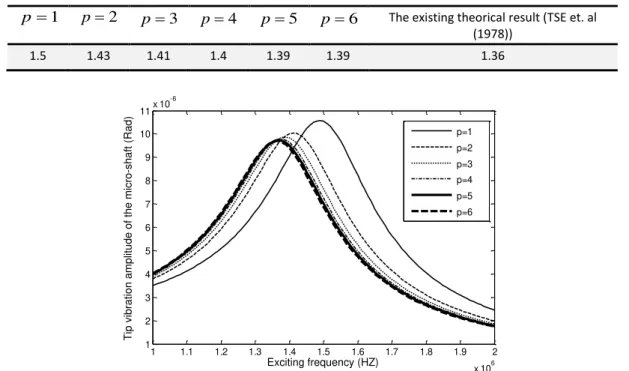
(38)Frequency response of the micro-shaft immersed in a micro-scale fluid for different number of the used shape functions is shown in figure 2. As illustrated, by increasing number of the used shape functions (
p
), the obtained results converge together, and for p6 the obtained result is considered acceptable. As shown in table 2, for the case whenthe effect of the shear force is not considered, the first calculated natural frequency of the system forp6 is the same
as the first natural frequency of the shaft having a concentrated mass at the free end with 2.2% error. Table 2 Values of the first calculated natural frequency of the system(MHZ) 1
p p2 p3 p4 p5 p6 The existing theorical result (TSE et. al (1978))
1.5 1.43 1.41 1.4 1.39 1.39 1.36
1 1.1 1.2 1.3 1.4 1.5 1.6 1.7 1.8 1.9 2
x 106 1
2 3 4 5 6 7 8 9 10 11x 10
-6
Exciting frequency (HZ)
Tip
vib
rat
ion
am
plit
ud
e o
f th
e m
icro
-sh
aft
(Ra
d)
p=1 p=2 p=3 p=4 p=5 p=6
Figure 2 Tip vibration amplitude of the micro-shaft versus exciting frequency for different number of shape functions.
Figure 3 presents effect of coupling parameter of the micro-scale fluid on tip vibration amplitude of the micro-shaft. Results show that lower values of resonance frequency and resonance amplitude are observed in fluids with higher values of coupling parameter. In fluids with higher value of coupling parameter due to having higher values of vortex viscosity coefficient, micro-rotations are more dependant to macro-rotation, consequently in fluids with higher values of coupling parameter, damping and inertial effects of fluid on vibration of the shaft are more considerable than in fluids with lower values of coupling parameter
1 1.1 1.2 1.3 1.4 1.5 1.6 1.7 1.8 1.9 2 x 10⁶ 1
2 3 4 5 6 7 8 9 10 11x 10
-6
Exciting frequency (HZ)
Tip
vib
rat
ion
am
plit
ud
e o
f th
e m
icro
-sh
aft
(Ra
d)
N=0 N=0.2 N=0.4 N=0.6
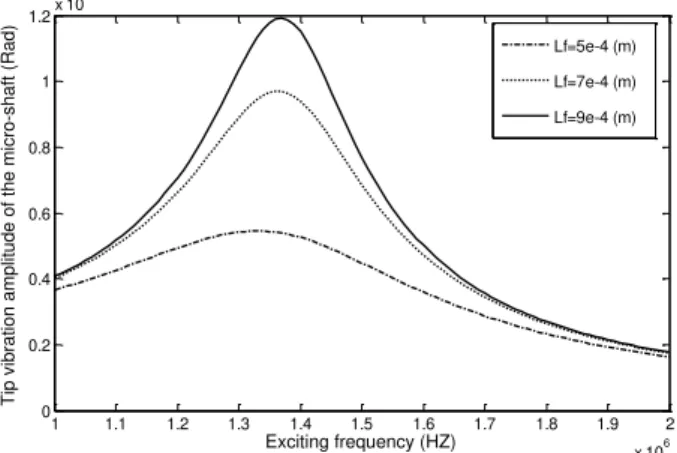
Dynamic response of the micro-shaft for different values of the characteristic length scale of the fluid is shown in figure 4. The results show that decreasing characteristic length scale due to increasing dependance of micro-rotations to macro-rotation of the fluid field, causes inertial and damping effects of fluid to increase. Consequently, lower value of resonance frequency and resonance amplitude are observed in fluids with lower values of length scale.
1 1.1 1.2 1.3 1.4 1.5 1.6 1.7 1.8 1.9 2 x 10⁶ 0
0.2 0.4 0.6 0.8 1 1.2x 10
-5
Exciting frequency (HZ)
Tip
vib
rat
ion
am
plit
ud
e o
f th
e m
icro
-sh
aft
(Ra
d)
Lf=5e-4 (m) Lf=7e-4 (m) Lf=9e-4 (m)
Figure 4 Tip vibration amplitude of the micro-shaft versus exciting frequency for different values of length scale of the fluid
(
L
f)
Figure 5 presents the effect of non-local parameter of the micro-shaft on the force response of it. Results show that increasing nonlocal parameter of the shaft due to increasing inertia of the micro-shaft and decreasing amplitude of the exciting momentum, causes resonance frequency and resonance amplitude of the shaft to decrease.
Figure 5 Tip vibration amplitude of the micro-shaft versus exciting frequency for different values of non-local parameter of the shaft ( )l
4 CONCLUSIONS
In this paper effect of micro-scale fluid media on torsional vibration of a micro-shaft was investigated. A mathematical model was proposed and the coupled governing equations of motion for fluid field based on micro-polar theory and torsional vibration of the micro-shaft based on non-local elasticity theory were derived. By transforming the governing equations to an enhanced form, they were discretized using a Galerkin-based reduced order model. It was shown that physical properties of a micro-scale fluid media have dissipative and inertial effects on the dynamic response of the micro-shaft. The effect of coupling parameter of the fluid media on force response of the micro-shaft was studied and the results showed that in fluids with higher value of coupling parameter, micro-rotations are more dependant to macro-rotation, that leads to higher inertia and damping effect of fluid on micro-shaft vibration. Dynamic response of the micro-beam in fluids with different characteristic length scale was investigated. We showed that fluids with higher values of length scale, have less damping and inertial effects on the shaft vibration. At the end, effect of non-local parameter of the shaft on the force vibrational response of it was investigated and lower values of resonance frequency
1 1.2 1.4 1.6 1.8 2
x 106 0
0.2 0.4 0.6 0.8
1x 10
-5
Exciting frequency (HZ)
T
ip
vi
b
ra
tio
n
a
m
p
lit
u
d
e
o
f
th
e
m
icr
o
-sh
a
ft
(
ra
d
)
and amplitude were observed in the case of micro-shafts having higher values of non-local parameter. It should be noted that, results obtained in this paper can be used for measurement of physical properties of micro-scale fluids.
References
Rezazadeh, G., Khatami, F., Tahmasebi, A. (2007). Investigation of the torsion and bending effects on static stability of electrostatictorsional micromirrors, Microsystem Technologies 13:715–722
Saif, MTA., Alaca, BE., Sehitoglu, H. (1999). Analytical modeling of electrostatic membrane actuator micro pumps, J. Microelectro-mechanical Systems 8:335–345
Nabian, A., Rezazadeh, GH., Haddad derafshi, M., Tahmasebi, A. (2008). Mechanical behavior of a circular micro plate subjected to uniform hydrostatic and non-uniform electrostatic pressure, Microsystem Technologies 14:235–240
Bao, M., Wang, W. (1996). Future of microelectromechanical systems (MEMS), Sensors and Actuators A 56:135–141
Sallese, JM., Grabinski, W., Meyer, V., Bassin, C., Fazan, P. (2001). Electrical modeling of a pressure sensor MOSFET. Sensors and Actuators A 94:53–58
Rezazadeh, GH., Ghanbari, M., Mirzaee, I. (2010). On the modeling of piezoelectrically actuated microsensor for Simultaneous measurement of fluids viscosity and density, Measurement 43:1516-1524
Minami, H. (1998) Added mass of a membrane vibrating at finite amplitude, J. Fluids and Structures 12: 919-932.
Kornecki, A., Dowell, EH., O’brien, J. (1976). On the aeroelastic instability of two-dimensional panels in uniform incompressible flow, J. Sound and Vibration 47:163–178
Lucey, AD., Carpenter, PW. (1993). The hydroelastic stability of three-dimensional disturbances of a finite compliant wall, J. Sound and Vibration 165:527–552
Jones, RT. (1946). Properties of low-aspect ratio pointed wings at speeds below and above the speed of sound. Technical Report 835, NASA
Liang, CC., Liao, CC., Tai, YS., Lai, WH. (2001). The free vibration analysis of submerged cantilever plates, Ocean Engineering 28:225–1245
Sinha, JK., Sandeep, S. Rama Rao. A. (2003). Added mass and damping of submerged perforated plates, Journal of sound and vibration 260:549–564
Rezazadeh, GH, Fathalilou, M., Shabani, R., Tarverdilou, S. (2009). Dynamic characteristics and forced response of an electristatically- actuated micro-beam subjected to fluid loading, Microsystem Technologies 15 (2009) 1355-1363.
Rezazadeh, G., Ghanbari, M. (2018). On the Mathematical Modeling of a MEMS-based sensor for simultaneous measurement of fluids viscosity and density, Sensing and Imaging, 19-27
Zook, J. D., Burns, D. W., Guckel, H., Sniegowski, J. J., Engelstad, R. L and Feng. Z. (1992). Characteristics of polysilicon resonant microbeams, Sensors and Actuators 35: 290–294.
Legtenberg, R., Tilmans, H. A. (1994). Electrostatically driven vacuum-encapsulated polysilicon resonators. Part I. Design and fabrication, Sensors and Actuators 45: 57–66.
Starr, J. B. (1994). Squeeze-film damping in solid-state accelerometers, in Proceeding. IEEE Solid-State Sensors and Actuators, Workshop: 44–47.
Pandey, A. K., and Pratap, R. (2007). Effect of flexural modes on squeeze film damping in MEMS cantilever resonators, J. Micromechanics and Microengineering 17: 2475-2484.
Younis, M. I., Nayfeh, A. H. (2007). Simulation of squeeze-film damping of microplates actuated by large electrostatic load, ASME Journal of Computational and Nonlinear Dynamics 2: 101-112
Chaterjee, S., Pohit, G. (2009). A large deflection model for the pull-in analysis of electrostatically actuated micro cantilever beams, J. Sound and Vibration 322: 969-986.
Arbind, A., Reddy, J. N and Srinivasa, A. R. (2014). Modified couple stress-based third-order theory for nonlinear analysis of functionally grades beams, Latin American Journal of Solids and Structures 11: 459-487.
Sedighi, H. M., Changizian, M and Noghrehabadi, A. (2014). Dynamic pull-in instability of geometrically nonlinear actuated micro-beams based on the modified couple stress theory, Latin American Journal of Solids and Structures 11: 810-825.
Kucaba, A. (2004). Microchannels flow modelling with the micropolar fluid theory, Bulletin of the Polish Academy of Sciences: Technical sciences 52: 209-214
Eringen, A.C. (1966). Theory of micro-polar fluids, J. Applied Mathematics and Mechanics 16: 1-18.
Kucaba, A. (2008). Applicability of the micropolar fluid theory in solving microfluidics problems, in Proceeding 1st European Conference on Microfluidics, Bologna.
Chen, J., Liang, C Lee, JD. (2011). Theory and simulation of micropolar fluid dynamic, J. Nanoengineering and Nanosystems 224: 31-39
Ghanbari, M., Hossainpour, S., Rezazadeh, G. (2014) Squeeze film damping in a microbeam resonator based on micropolar theory, Latin American Journal of Solids and Structures, 12:77-91
Ghanbari, M., Hossainpour, S., Rezazadeh, G. (2015a) On the modelling of a piezoelectrically actuated microsensor for measurement of microscale fluid physical properties, Applied Physics A: Materials science and processing 121:651-663
Ghanbari, M., Hossainpour, S., Rezazadeh, G. (2015b) Studying thin film damping in a microbeam resonator based on non-classical theories, Acta Mechanica Sinica 32: 369-379
Oskouie, MF., Ansari, R., Sadeghi, F. (2017). Nonlinear vibration analysis pf fractional viscoelastic Euler-Bernoulli nanobeams based on Surface stress theory, Acta Mechanica Solida Sinica 30: 416-424
Mohammadi, M., Eghtesad, M., Mohammadi, H. (2017). Stochastic analysis of pull-in instability of geometrically nonlinear size-dependent FGM micro beams with random material properties, Composite Structures 200: 466-479.
Sun, XP., Hong, YZ., Dai, HL., Wang, L. (2017). Nonlinear frequency analysis of buckled nanobeams in the presence of longitudinal magnetic field, Acta Mechanica Solida Sinica 30: 465-473
Ebrahimi, F., Haghi, P. (2017). Wave propagation analysis of rotating thermoelastically- actuated nanobeams based on nonlocal strain gradient theory, Acta Mechanica Solida Sinica 30:647-657
Eringen, A. C. (1972). Linear theory of nonlocal elasticity and dispersion of plane waves, International Journal of Engineering Science, 10:425-435.