Evaluation of ionic degradation and slot corrosion of metallic
brackets by the action of different dentifrices
Gustavo Antônio Martins Brandão1, Rafael Menezes Simas2, Leandro Moreira de Almeida2, Juliana Melo da Silva3, Marcelo de Castro Meneghim4, Antonio Carlos Pereira4, Haroldo Amorim de Almeida5, Ana Maria Martins Brandão5
How to cite this article: Brandão GAM, Simas RM, Almeida LM, Silva JM, Meneghim MC, Pereira AC, Almeida HA, Brandão AMM. Evaluation of ionic degradation and slot corrosion of metallic brackets by the action of different den-tifrices. Dental Press J Orthod. 2013 Jan-Feb;18(1):86-93.
Submitted: February 25, 2010 - Revised and accepted: October 28, 2010
» The authors report no commercial, proprietary or financial interest in the prod-ucts or companies described in this article.
1 Adjunct Professor – Federal University of Pará (UFPA). 2 DDS, UFPA.
3 PhD Student of Dental Clinic Program, Endodontics – Campinas State
University (FOP-Unicamp).
4 Professor on the Post-graduation in Dentistry Program FOP-Unicamp. 5 Professor of Orthodontics – UFPA.
Contact address: Gustavo Antônio Martins Brandão E-mail: [email protected]
Objective:To evaluate the in vitro ionic degradation and slot base corrosion of metallic brackets subjected to brushing with dentifrices, through analysis of chemical composition by Energy Dispersive Spectroscopy (EDS) and qualitative analysis by Scanning Electron Microscopy (SEM).
Methods: Thirty eight brackets were selected and randomly divided into four experimental groups (n = 7). Two groups (n = 5) worked as posi-tive and negaposi-tive controls. Simulated orthodontic braces were assembled using 0.019 x 0.025-in stainless steel wires and elastomeric rings. The groups were divided according to surface treatment: G1 (Máxima Proteção Anticáries®); G2 (Total 12®); G3 (Sensitive®); G4 (Branqueador®);
Positive control (artificial saliva) and Negative control (no treatment). Twenty eight brushing cycles were performed and evaluations were made before (T0) and after (T1) experiment. Results: The Wilcoxon test showed no difference in ionic concentrations of titanium (Ti), chromium (Cr), iron (Fe) and nickel (Ni) between groups. G2 presented significant reduction (p < 0.05) in the concentration of aluminium ion (Al). Groups G3 and G4 presented significant increase (p < 0.05) in the concentration of aluminium ion. The SEM analysis showed increased characteristics indicative of corrosion on groups G2, G3 and G4. Conclusion: The EDS analysis revealed that control groups and G1 did not suffer alterations on the chemical composition. G2 presented degradation in the amount of Al ion. G3 and G4 suffered increase in the concentration of Al. The immersion in artificial saliva and the dentifrice Máxima Proteção Anticáries® did not alter the surface polishing. The dentifrices Total 12®,
Sensi-tive® and Branqueador® altered the surface polishing.
Keywords:Orthodontic brackets. Corrosion. Scanning Electron Microscopy.
Objetivo:avaliar in vitro a degradação iônica e corrosão do fundo do slot de braquetes metálicos submetidos à escovação com dentifrícios, realizando análises da composição química por Espectroscopia de Energia Dispersiva (EDS) e qualitativa por Microscopia Eletrônica de Varredura (MEV). Métodos:foram selecionados 38 braquetes divididos aleatoriamente em quatro grupos experimentais (n = 7). Dois grupos (n = 5) funcionaram como controles positivo e negativo. Aparelhos ortodônticos simulados foram confeccionados com fios de aço inoxidável 0,019” x 0,025” e anéis elastoméricos. Os grupos foram divididos de acordo com o tratamento de superfície: G1 (Máxima Proteção Anticáries®); G2 (Total 12®); G3 (Sensitive®); G4 (Branqueador®); Controle Positivo (saliva artificial) e Controle Negativo (sem
tratamento). Foram realizados 28 ciclos de escovação e avaliações antes (T0) e após (T1) o experimento. Resultados:o teste de Wilcoxon indicou não existir diferença nas concentrações iônicas de titânio (Ti), cromo (Cr), ferro (Fe) e níquel (Ni) entre os grupos. O grupo G2 apresentou redução significativa (p < 0,05) na concentração do íon alumínio (Al) e os grupos G3 e G4 apresentaram aumento significativo (p < 0,05) nas concentrações do íon alumínio. A análise em MEV mostrou aumento nas características indicativas de corrosão dos grupos G2, G3 e G4.Conclusão:a análise por EDS revelou que os grupos controle e G1 não sofreram alterações na composição química. O grupo G2 apresentou degradação na quantidade de íons Al, e G3 e G4 sofreram aumento na concentração de Al. A imersão em saliva artificial e o dentifrício Máxima Proteção Anticáries® não alteraram o polimento de superfície. Os dentifrícios Total 12®, Sensitive® e
Branqueador® alteraram o polimento de superfície.
INTRODUCTION
Deterioration and corrosion of orthodontic appli-ances is a concern for orthodontists in their clinical prac-tice. This attention is focused in two main questions: If the corrosion by products, whether they are produced, are absorbed by the organism and can cause local or systematic effects; and which effects the corrosion has on the physical properties and clinical performance of orthodontic appliances. There are evidences that sup-port the deleterious effects of the buccal environment on structural alterations of metallic biomaterials.23
Elia-des et al6,7 tested orthodontic materials and did not find
ion release by nickel-titanium alloys, but observed levels of nickel and chromium released by stainless steel alloys. No material was mentioned as cytotoxic, probably due low quantity of released ions or for the way they link.
The several appliances (brackets, arch wires, etc.) used during orthodontic treatment to obtain the dental move-ment are composed of materials with distinct physical in-tegrity, structural compositions and mechanical proper-ties. Their requirements are complex for they are put un-der many stresses in the oral environment. This includes immersion in saliva and ingested liquids, temperature variation, mastication efforts and the loading submitted to the appliances. The combination of these materials and hostile conditions provided by the environment can result in corrosion, ion release and deterioration of these appliances. The interactions that these corrosion by prod-ucts can have on the manifestation of local or systematic problems in the individual’s health is not well corrobo-rated and comprehended in literature,3,4,11 despite
nu-merous case reports of hypersensitivity to nickel13,21 and
alterations on the ionic concentration of body fluids.1,16
House et al11 through wide literature review concluded,
based on the best available evidences, that the corrosion does not seem to be a process that should cause concern. However, he suggests that further studies, in clinically relevant situations, can lead to a better comprehension of corrosion clinical effects.
It is known that a physical characteristic of great in-terest for orthodontic mechanics is the contact surface rugosity of the wire and the slot, once this can interfere on the superficial friction and, therefore, on the slid-ing mechanics.15,19 Variation on chemical composition
and superficial aspect of metallic brackets2 and their
biodegradation before different stimulus5,10 have been
described in literature. Studies have shown that, in an
acid environment and in presence of fluoride ions the resistance to corrosion of certain materials may deterio-rate.24,30 There are findings that show that fluoridated
mouthwashes may influence on the resistance to corro-sion27 and galvanic corrosion26 of orthodontic brackets
as well as on the corrosion and modification of mechan-ical properties of orthodontic wires.12,14,17,29,30
Few previous studies were performed to evaluate the influence and clinical implications of fluoridated dentifrices on orthodontic brackets, although there are clinical evidences25 and in vitro studies8,9,18,20,22 of
the deleterious effects produced by the challenges that these appliances are submitted to in the oral cavity. Knowing that innumerous dentifrices commonly used by orthodontic patients are commercially available, with the most varied compositions and concentrations of substances that in contact with metal can induce al-terations and that these changes on the surface proper-ties of orthodontic brackets may jeopardize the orth-odontic mechanics, the objective of this study was to evaluate in vitro the ionic degradation and the slot base
corrosion of metallic brackets when subjected to me-chanical brushing with different dentifrices, through analysis of chemical composition by Energy Dispersive Spectroscopy (EDS) and qualitative analysis through Scanning Electron Microscopy (SEM).
MATERIAL AND METHODS
Selection of accessories and construction of specimens
For the development of this study, 38 orthodon-tic metallic brackets (austeniorthodon-tic stainless steel linked to Cr-Ni) of premolars, Edgewise prescription, slot 0.22 x 0.28-in, (Morelli Ortodontia®), were selected
determining a number of specimens compatible to the factors in study originated from pilot study and calcula-tion of sampling error. The accessories were randomly divided into four experimental groups of 7 brackets each. Two groups of 5 brackets worked as positive and negative controls. For each experimental group speci-mens were made characterizing a simulated orthodon-tic appliance constituted of 0.019 x 0.025-in stainless steel wires (Morelli Ortodontia®) and elastomeric rings
The positive control groups G1, G2, G3 and G4 were kept during experimental design in test tubes con-taining 10 ml of artificial saliva (Fig 2).
Evaluation of the ionic composition of orthodontic metallic brackets before surface treatment. (T0)
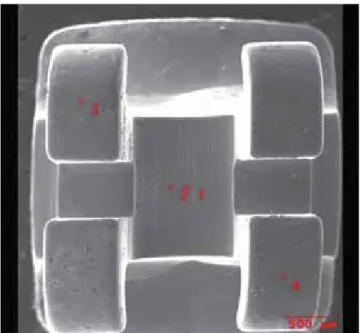
The 38 orthodontic brackets used in study, divid-ed in their respective groups, were subjectdivid-ed to ini-tial quantitative analysis (T0) aiming to determine the chemical composition by Energy Dispersive Spec-troscopy (EDS) in magnification of 70x with 20KV and 500 µm of distance. Four points on the brack-ets surface were selected to obtain concentrations of Aluminium (Al), Titanium (Ti), Chromium (Cr), Iron (Fe) and Nickel (Ni), originating a total of 28 points of analysis per experimental group (Fig 3). The percentage of ionic composition were obtained and classified for posterior achievement of the representa-tive composition mean of each group. After classifi-cation, the data were submitted to statistical analysis using Bioestat 5.0 software.
Qualitative analysis through Scanning Electron Mi-croscopy (SEM) of the metallic brackets’ slot surface
The topographic analysis of slot base surface charac-teristics was evaluated in magnification of 500x through Scanning Electron Microscope Leo Zeiss 1450VP (Fig 4). Each one of the 38 microphotographs obtained from the 4 experimental groups and from the 2 control groups were evaluated according to 8 characteristics determined by established criteria2 for surface characterization and
possible verification of corrosion indications (Table 2). An evaluator previously calibrated in relation to pos-sible characteristics to be observed on the surface of the slot base, examined the microphotographs in two dis-tinct moments, without knowing their group, aiming to eliminate possible intraevaluator errors. When discrep-ancy was found between the two evaluations, a third evaluation was performed and this became definitive, rejecting the prior ones. Each characteristic represented 1 score. This way, it can be obtained a value from 0 to 8 for each microphotograph depending on the number of characteristics present on the slot surfaces.
Group Treatment Composition Trade name
Negative
control No treatment -
-Positive
control
Immersion in
artificial saliva
NaH2PO4, NaCl, KCl, CaCl2, Na2S, (NH4)2SO4, C6H8O7,
NaHCO3, Urea
-Group 1 (G1) Mechanic brushing with dentifrice for
15s - 28 days
Fluoride, calcium carbonate, sodium lauryl sulphate,
sodium saccharin, tetrasodium pyrophosphate, sodium silicate, polyethylene glycol, sorbitol, carboxymethyl
cellulose, Methylparaben, Propylparaben, Flavor and Water, Sodium monofluorophosphate
Colgate Máxima
Proteção Anticáries®
Group 2
(G2)
Mechanic
brushing with dentifrice for
15s - 28 days
Sodium Fluoride, Triclosan, Water, Glycerin, Sorbitol,
hydrated silica, sodium lauryl sulphate, PVM / MA copolymer, aroma, Carrageen, sodium saccharin,
sodium hydroxide, Titanium dioxide
Colgate Total 12
Clean Mint®
Group 3 (G3)
Mechanic
brushing with dentifrice for
15s - 28 days
Potassium citrate, sodium monofluorophosphate,
zinc citrate, sorbitol, water, glycerin, hydrated silica, PEG-12, Tetrapotassium pyrophosphate, PVM / MA
copolymer, sodium lauryl sulfate, flavor, potassium hydroxide, Cellulose Gum, Saccharin sodium,
xanthan gum, Titanium Dioxide, Polyethylene, Calcium Carbonate, acid Rojo 18, Amarillo # 5
aluminum Lacquer, Rojo 28.
Colgate Sensitive
Multi Proteção®
Group 4 (G4)
Mechanic
brushing with dentifrice for
15s - 28 days
Calcium carbonate, sorbitol, alumina, sodium lauryl sulphate, aroma, sodium monofluorophosphate,
cellulose gum, sodium silicate, sodium bicarbonate, xanthan gum, sodium saccharin, Methylparaben,
Propylparaben.
Colgate Ultra
Branqueador®
Table 1 - Division according to treatment, chemical composition of the substance used and trade name.
Figure 1 - Standardized specimen for the
experi-ment.
Figure 2 - Specimen in test tube containing
The obtained data were inserted into forms pre-viously elaborated aiming to classify the results. The most frequent value between the 7 brackets from each group, i.e., mode (measure used for qualitative data) was taken as the group’s representative value. The groups that presented the highest value were considered the least polished, while the ones that presented lower value, the most polished.
Experimental design
The specimens correspondent to each group were subjected to surface treatment, which consisted in putting a similar amount of the standardized den-tifrice per group on the brush using the transversal technique, mechanic brushing for 15 seconds, always performed by the same operator,22 using the
Col-gate Motion® electric toothbrush. After mechanic
brushing the specimens were rinsed with 20 ml of distilled water during 20 seconds with assistance of a disposable syringe.
Finished the surface treatment the specimens were returned into test tubes containing artificial saliva, being changed at every cycle to avoid bacte-rial proliferation, and they were kept in room tem-perature (Fig 5). At every 24 hours it was performed a new cycle of surface treatment. On the positive control groups the appliances were only rinsed in distilled water and the saliva was changed. On the negative control group it was not applied any kind of treatment.
Twenty-eight cycles of surface treatment were performed. By the end of the 28th cycle the speci-mens were removed from the test tubes containing artificial saliva and rinsed in 20 ml of distilled water for 20 seconds. The orthodontic brackets were care-fully removed from the simulated orthodontic brac-es, removing the elastomeric rings, and submitted to new analysis of chemical composition by Energy Dispersive Spectroscopy (EDS) and qualitative anal-ysis in SEM, after the utilization of dentifrices (T1). The descriptive statistical analysis of data was per-formed to obtain the percentage means and standard deviations of each ionic component on the different groups evaluated. The Wilcoxon test (α = 5%) was used to compare variables before (T0) and after (T1) the experiment and verify the statistical difference on ionic concentrations.
Table 2 - Criteria for qualitative evaluation of metallic bracket slot surface.
Classification Characteristic
A Presence of furrow
B Mottled or spotted aspect
C Presence of depressions, pores, furrows or grains in less
than 1/3 of the surface
D Presence of depressions, pores, furrows or grains in 1/3 of
the surface
E Presence of depressions, pores, furrows or circumferential
grains in 2/3 of the surface
F Presence of depressions or pores in the entire surface extent
G Honeycomb aspect
H Presence of indentations
Figure 3 - Points selection and analysis by EDS.
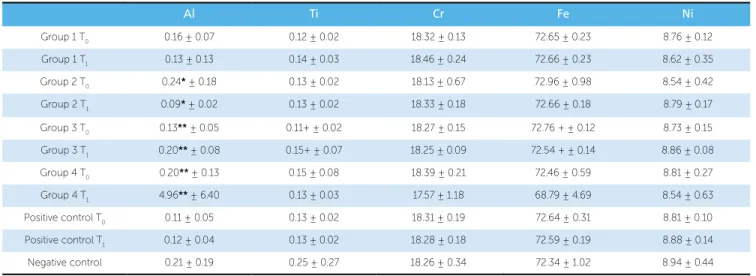
through Wilcoxon test presented statistically signifi-cant reduction (p < 0.05) for the mean concentra-tion of Aluminium ion (Al) on group G2. Groups G3 and G4 presented statistically significant increase (p < 0.05) on the mean concentrations of aluminium considering the comparison between T0 and T1.
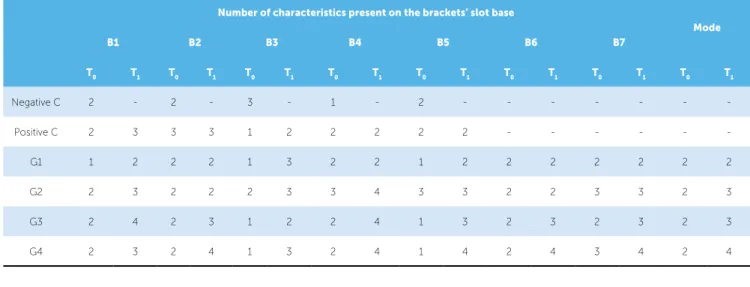
Table 4 represents the qualitative analysis of the number of characteristics present on the slot base of each one of the brackets and the mode value (higher frequency) for each experimental group, in T0 and T1. It is observed an alteration on the number of characteristics present, shown by the alteration of modal value, for groups G2, G3 and G4.
The microphotographs representative of each ex-perimental group confirm the surface characteristics determined by the scores (Fig 6). Group G1 according to number of most frequent characteristics, remained equally polished in T0 and T1. Groups G2, G3 and G4 as it can be noticed through representative images and assigned scores (Table 4) presented an increase on the number of surface characteristics, becoming therefore less polished after use of dentifrices.
DISCUSSION
There are evidences of degradation and oxidation of orthodontic metallic appliances in the oral environ-ment.1,3,4,8,13,25 The ionic release from the point of view
of health’s integrity at local and systematic level does not present significant clinical implications according to most publications.1,6,11,16 Therefore, studies that point
al-RESULTS
Table 3 represents the descriptive analysis per-formed in which the means and standard deviations of ionic concentrations were obtained for the ex-perimental groups and positive control group before (T0) and after (T1) experimental design. The evalu-ation of total ionic concentrevalu-ation showed that there is alteration for groups G2, G3 and G4 after surface treatment (T1). The comparison through Wilcoxon test showed that there is no statistically significant difference on ionic concentrations of titanium (Ti), chromium (Cr), iron (Fe) and nickel (Ni) between the evaluations T0 and T1. The comparative analysis
Table 3 - Mean value (%) and standard deviation of the different groups evaluated before and after surface treatment.
*Indicates significant difference between ions in different times for group 2 (p < 0.05). ** Indicates significant difference between ions in different times for group 3 (p < 0.05). *** Indicates significant difference between ions in different times for group 4 (p < 0.05).
Al Ti Cr Fe Ni
Group 1 T0 0.16 ± 0.07 0.12 ± 0.02 18.32 ± 0.13 72.65 ± 0.23 8.76 ± 0.12
Group 1 T1 0.13 ± 0.13 0.14 ± 0.03 18.46 ± 0.24 72.66 ± 0.23 8.62 ± 0.35
Group 2 T0 0.24* ± 0.18 0.13 ± 0.02 18.13 ± 0.67 72.96 ± 0.98 8.54 ± 0.42
Group 2 T1 0.09* ± 0.02 0.13 ± 0.02 18.33 ± 0.18 72.66 ± 0.18 8.79 ± 0.17
Group 3 T0 0.13** ± 0.05 0.11+ ± 0.02 18.27 ± 0.15 72.76 + ± 0.12 8.73 ± 0.15
Group 3 T1 0.20** ± 0.08 0.15+ ± 0.07 18.25 ± 0.09 72.54 + ± 0.14 8.86 ± 0.08
Group 4 T0 0.20** ± 0.13 0.15 ± 0.08 18.39 ± 0.21 72.46 ± 0.59 8.81 ± 0.27
Group 4 T1 4.96** ± 6.40 0.13 ± 0.03 17.57 ± 1.18 68.79 ± 4.69 8.54 ± 0.63
Positive control T0 0.11 ± 0.05 0.13 ± 0.02 18.31 ± 0.19 72.64 ± 0.31 8.81 ± 0.10
Positive control T1 0.12 ± 0.04 0.13 ± 0.02 18.28 ± 0.18 72.59 ± 0.19 8.88 ± 0.14
Negative control 0.21 ± 0.19 0.25 ± 0.27 18.26 ± 0.34 72.34 ± 1.02 8.94 ± 0.44
D
B A
C
Figure 5 - A) Standardized amount of dentifrice; B) Mechanic brushing;
lergic reactions, hypersensitivity and possible damages that can be caused by ionic release and corrosion jus-tify the performance of studies that help to better un-derstand the impact of these alterations on the patient’s health and on orthodontic treatment.
The results of the present study did not indicate differences on the ionic composition, evaluated by EDS, for the positive control group and G1 (con-ventional fluoridated dentifrice). G2, which was submitted to brushing with dentifrice containing antimicrobial (Total 12®) presented degradation
on the mean concentration of Al ions. G3 (Sensi-tive® dentifrice) and G4 (Branqueador® dentifrice)
presented an increase on the concentration of these ions, probably due the presence of Aluminium Lac-quer on the composition of dentifrice standardized for G3 and Alumina on the composition of denti-frice standardized for G4. These results indicate that elements present on the dentifrices composition can induce unpredictable alterations on the superficial ionic composition of orthodontic metallic brackets. The lack of studies hinders comparison with the obtained results, however, it indicates that new re-searches must be performed for better identification of structural alterations to which the orthodontic brackets are subjected inside the oral cavity.
Table 4 - Number of characteristics present on the brackets’ slot base surface for each group and mode (most frequent value) obtained for each group.
Figure 6 - Microphotographs of brackets’ slot base surface representing G1, G2, G3 and G4 in T0 and T1 (500x magnification).
Number of characteristics present on the brackets’ slot base
Mode
B1 B2 B3 B4 B5 B6 B7
T0 T1 T0 T1 T0 T1 T0 T1 T0 T1 T0 T1 T0 T1 T0 T1
Negative C 2 - 2 - 3 - 1 - 2 - - -
-Positive C 2 3 3 3 1 2 2 2 2 2 - - -
-G1 1 2 2 2 1 3 2 2 1 2 2 2 2 2 2 2
G2 2 3 2 2 2 3 3 4 3 3 2 2 3 3 2 3
G3 2 4 2 3 1 2 2 4 1 3 2 3 2 3 2 3
G4 2 3 2 4 1 3 2 4 1 4 2 4 3 4 2 4
G1
G3
G1
G3
G2
G4
G2
These alterations can be of great damage for the orthodontic mechanics, since they can interfere negatively on the friction during sliding mechan-ics. Groups G2, G3 and G4 presented increase on qualitative characteristics indicative of corrosion, which deserves attention since the lower the sur-face polishing, more difficult the sliding
mechan-ics,15,19 maybe bringing prejudice to the
orthodon-tic treatment.
Schiff et al26 suggests that mouthwashes must
be prescribed according to orthodontic materials used, due to the structural alterations that may be induced. This fact agrees with the present work, due to alterations on the superficial composition and on surface characteristics of metallic brackets evaluated both quantitatively and qualitatively.
Based on the results from this study it can be sug-gested that new studies are performed, in clinically relevant situations, for better comprehension of the factors that can induce alterations on the chemical composition and corrosion of orthodontic applianc-es and identify how thapplianc-ese factors can cause impair to orthodontic mechanics.
CONCLUSION
According to factors evaluated in this research and the methodology applied, the obtained results allow to conclude that:
a) Analysis of chemical composition by Energy Dis-persive Spectroscopy (EDS) revealed that the control group (immersed in artificial saliva) and G1 (Máxi-ma Proteção Anticáries®) did not presented
altera-tions on the chemical composition of brackets after experimental design. G2 (Colgate Total 12 Clean Mint®) presented degradation on the amount of Al
ions, while G3 (Sensitive Multi Proteção®) and G4
(Colgate Ultra Branqueador®) presented increase on
the concentration of Al ions on the brackets surface. b) The qualitative analysis through Scanning Electron
Microscopy (SEM) reveled that immersion in artifi-cial saliva and brushing using the dentifrice Máxima Proteção Anticáries® did not affect the surface
pol-ishing of metallic brackets, while the same procedure performed with dentifrices Total 12 Clean Mint®,
Sensitive Multi Proteção® and Ultra Branqueador®
1. Ağaoğlu G, Arun T, Izgi B, Yarat A. Nickel and chromium levels in the saliva and serum of patients with fixed orthodontic appliances. Angle Orthod. 2001;71(5):375-9.
2. Assad-Loss T, Neves R, Mucha J. Composição química e aspecto superficial do slot de braquetes metálicos. Rev Dental Press Ortod Ortop Facial. 2008;13(3):85-96.
3. Barrett RD, Bishara SE, Quinn JK. Biodegradation of orthodontic appliances. Part I. Biodegradation of nickel and chromium in vitro. Am J Orthod Dentofacial Orthop. 1993;103(1):8-14.
4. Bishara S, Barret R, Selim M. Biodegradation of orthodontic appliances. Part II. Changes in the blood level of nickel. Am J Orthod Dentofacial Orthop. 1993;103(2):115-8.
5. Dolci G, Menezes L, Souza R, Dedavid B. Biodegradação de braquetes ortodônticos: avaliação da liberação iônica in vitro. Rev Dental Press Ortod Ortop Facial. 2008;13(3):77-84.
6. Eliades T, Athanasiou AE. In vivo aging of orthodontic alloys: Implications for corrosion potential, nickel release, and biocompatibility. Angle Orthod. 2002;72(3):222-37.
7. Eliades T, Pratsinis H, Kletsas D, Eliades G, Makou M. Characterization and cytotoxicity of ions released from stainless steel and nickel-titanium orthodontic alloys. Am J Orthod Dentofacial Orthop. 2004;125(1):24-9. 8. Ferreira J. Avaliação da resistência à corrosão de materiais metálicos
utilizados em aparelhos ortodônticos fixos [tese]. Rio de Janeiro (RJ): Universidade Federal do Rio de Janeiro; 2005.
9. Grimsdottir MR, Gjerdet NR, Hensten-Pettersen A. Composition and in vitro corrosion of orthodontic appliances. Am J Orthod Dentofacial Orthop. 1992;101(6):525-32.
10. Harzer W, Schröter A, Gedrange T, Muschter F. Sensitivity of titanium brackets to the corrosive influence of fluoride-containing toothpaste and tea. Angle Orthod. 2001;71(4):318-23.
11. House K, Sernetz F, Dymock D, Sandy JR, Ireland AJ. Corrosion of orthodontic appliances-should we care? Am J Orthod Dentofacial Orthop. 2008;133(4):584-92.
12. Iijima M, Endo K, Ohno H, Yonekura Y, Mizoguchi I. Corrosion behavior and surface structure of orthodontic Ni-Ti alloy wires. Dent Mater J. 2001;20(1):103-13.
13. Jensen CS, Lisby S, Baadsgaard O, Byrialsen K, Menné T. Release of nickel ions from stainless steel alloys used in dental braces and their patch test reactivity in nickel-sensitive individuals. Contact Dermatitis. 2003;48(6):300-4.
14. Kaneko K, Yokoyama K, Moriyama K, Asaoka K, Sakai J, Nagumo M. Delayed fracture of beta titanium orthodontic wire in fluoride aqueous solutions. Biomaterials. 2003;24(12):2113-20.
15. Kapur R, Sinha PK, Nanda RS. Frictional resistance in orthodontic brackets with repeated use. Am J Orthod Dentofacial Orthop. 1999;116(4):400-4. REFEREnCES
16. Kerosuo H, Moe G, Hensten-Pettersen A. Salivary nickel and chromium in subjects with different types of fixed orthodontic appliances. Am J Orthod Dentofacial Orthop. 1997;111(6):595-8.
17. Kim H, Johnson JW. Corrosion of stainless steel, nickel-titanium, coated nickel-titanium, and titanium orthodontic wires. Angle Orthod. 1999;69(1):39-44.
18. Kuhta M, Pavlin D, Slaj M, Varga S, Lapter-Varga M, Slaj M. Type of archwire and level of acidity: Effects on the release of metal ions from orthodontic appliances. Angle Orthod. 2009;79(1):102-10.
19. Kusy RP, Whitley JQ, Mayhew MJ, Buckthal JE. Surface roughness of orthodontic archwires via laser spectroscopy. Angle Orthod. 1988;58(1):33-45.
20. Machado G, Ramos F, Terra A, Santos S, Cunha T, Avoglio J, et al. Avaliação da corrosão dos braquetes ortodônticos. Rev Virtual Odontol. 2007;1(4):15-27.
21. Menezes LM, Campos LC, Quintão CC, Bolognese AM. Hypersensitivity to metals in Orthodontics. Am J Orthod Dentofacial Orthop. 2004;126(1):58-64.
22. Menezes LM, Lima SEM, Rizzatto SMD, Thiesen G, Rego MVNN, Cumerlato ML, et al. Avaliação da superfície de braquetes de titânio após a aplicação de fluoreto de sódio. Rev Dental Press Ortod Ortop Facial. 2006;11(3):93-103.
23. Morais L, Guimarães G, Elias C. Liberação de íons por biomateriais metálicos. Rev Dental Press Ortod Ortop Facial. 2007;12(6):48-53. 24. Probster L, Lin W, Hutteman H. Effects of fluoride prophylactic agents on
titanium surfaces. Int J Oral Maxillofac Implants. 1992;7:390-4. 25. Romano FL, Correr Sobrinho L, Consani S, Magnani MBBA, Nouer DF.
Oxidação de braquetes metálicos. Rev Dental Press Ortod Ortop Facial. 2005;10(6):24-5.
26. Schiff N, Boinet M, Morgon L, Lissac M, Dalard F, Grosgogeat B. Galvanic corrosion between orthodontic wires and brackets in fluoride mouthwashes. Eur J Orthod. 2006;28(3):298-304.
27. Schiff N, Dalard F, Lissac M, Morgon L, Grosgogeat B. Corrosion resistance on three orthodontic brackets: a comparative study of three fluoride mouthwashes. Eur J Orthod. 2005;27(6):541-9.
28. Toumelin-Chemla F, Rouelle F, Burdairon G. Corrosive properties of fluoride-containing odontologic gels against titanium. J Dent. 1996;24:109-15.
29. Walker MP, White RJ, Kula KS. Effect of fluoride prophylactic agents on the mechanical properties of nickel-titanium-based orthodontic wires. Am J Orthod Dentofacial Orthop. 2005;127(6):662-9.