A computational framework for predicting onset and crack
propagation in composite structures via eXtended Finite
Element Method XFEM
Abstract
The eXtended Finite Element Method XFEM has been reliably used for an-alyzing crack growth in 3D structural elements over last years. In fact, many researchers have worked in this field, but it is scarce to find scientific con-tributions about 3D XFEM models applied to the failure of non-standard composite parts, such as tapered structures and thick laminated composites. Thus, a new computational framework is developed, which is based on a new enhanced golden section search algorithm and 3D Puck’s action plane principle in order to define the crack initiation direction. This in-formation is integrated into a XFEM and used to enrich elements, which have failed during analysis. Compared to the traditional algorithm, the new methodol-ogy has convergence one order higher than the traditional one; and it is 20 times more efficient computationally. Therefore, if more precision is needed, then higher gains are achieved combined to lower computational cost by us-ing the proposed framework. Moreover, thick laminated composites with layers mainly oriented to 90o were simulated under tension and compres-sion via the computational framework, displaying results as reported in the literature. Also, compact tension tests with 0°, 90° and 45° specimens were evaluated, and numerical results were qualitatively coherent with experi-mental data.
Keywords
3D XFEM, Crack propagation, Puck’s theory, composite joints, tapered struc-tures.
1 INTRODUCTION
There was undoubtedly a huge advance on the analysis of failure on composite structures in later years, nev-ertheless the concept of damage tolerance in such structures is still a field wide open for researches and poses many issues already unsolved. Even with modern approaches involving Fracture Mechanics and Representative Volume Elements, the intrinsic structural behavior is too complex and, therefore, micro-scale level approaches bring chal-lenges to be applied widely in an industry environment such as aeronautics damage tolerance MOU et al. 2016 . Thus, one alternative consists on using meso-scale phenomenological damage models based, for example, on the Puck’s theory. In fact, this theory is widely used and found in the literature due to easy implementation and good predictions. To corroborate this affirmation, it is enough to see that Puck’s theory was one of the best evaluated in the first World Wide Failure Exercise WWFE I and showed good results in WWFE II, as well, “Exhibiting good predictive capability, none or one fundamental weakness and many relatively minor weaknesses” as stated by Hin-ton, Kaddour and Soden 2002 and Kaddour, Hinton and Soden 2004 . WWFE II was the second edition of this benchmark, which tried to evaluate and compare the response of composite mechanics models.
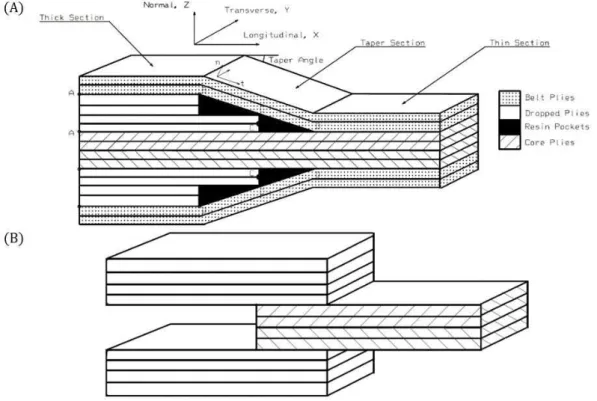
Many researchers have evaluated and proposed modified and enhanced versions of the Puck’s model for spe-cific applications as Dong et al. 2016 , who applied a modified version to analyze fatigue under uniaxial loading. Brunbauer, Gaier and Pinter 2015 who, in a similar way, have studied multiaxial loadings. In opposition to World Wide Failure Exercises, which focused on plane stress problems, Puck’s theory was used with successful for pre-dicting translaminar failure, but in rare situations. In fact, translaminar failure mechanism involves a 3D stress state and can be found in parts like tapered structures and joints as shown by Figure 1, as well as thick laminated
com-Angelo, Marcus Viníciusa*
Ribeiro, Marcelo Leiteb
Tita, Volneib
a Helicópteros do Brasil S/A, Helibras,
Itajubá-MG, Brasil. E-mail:
b Grupo de Estruturas Aeronáuticas, Escola de
engenharia de São Carlos, Universidade de São Paulo – USP, São Carlos-SP, Brasil. E-mail: [email protected], [email protected]. *Corresponding author
http://dx.doi.org/10.1590/1679-78254301
efficient reproduction of mechanical behavior of this type of composite structures is relevant not only for academy, but also for industry.
Figure 1: A Tapered structure and B typical double lap joint evident similarity
Regarding XFEM approach, it has been widely used on numeric simulation, with a huge diversity of enrichment functions, due to its intrinsic capability to model complex geometries independently of the mesh. It gets even more powerful when a previous knowledge of solution is available since it allows for specific enrichment functions to be used FREITAS et al. 2015 . Taking profit from the fact that the approach can map crack evolution on complex structures, many authors have tried to couple XFEM routines to non- or commercial programs. Sukumar et al. 2003 managed to integrate routines to DynELA for dynamic elastic XFEM. Later, following the same research line, Giner et al. 2009 included a model in a User Element subroutine UEL via AbaqusTM solver. Nevertheless, only 2D structures could be evaluated and the algorithm was based on plane stress assumption to be used for isotropic materials. Also, by using AbaqusTM, Shi et al. 2008 implemented a library, easily accessed from the software that allowed user to predict onset and propagation of cracks with-out further intervention from the user, but for only 2D application. From an aeronautical industry point of view, this integration to commercial programs is important, because it usually implies robustness and computational efficiency. Considering only proprietary routines, an ex-tension to 3D space was presented by Shi et al. 2010 , where the authors used level-set and fast-marching methods to track the crack developed in isotropic materials. In addition, there were researchers, who used Puck’s criterion along with or as basis for other approaches. Deveci, Aydin and Artem 2016 coupled the theory as constraint for buckling analysis in a hybrid approach. Lee et al. 2015 tried to make a damage-coupled FEM. However, an appli-cation of the action plane theory combining XFEM enrichment initiation as well as crack direction calculator has not been found in the literature by the present authors.
XFEM and used to enrich elements that have failed during analysis. The combination of Puck’s theory, enhanced golden section search algorithm and XFEM applied to fiber reinforced composite materials is new and makes the numerical solution extremely efficient computational-wise, which is very important to solve academy and industry problems. In terms of the computational aspects, the proposed framework is composed by two main modules: 1 onset/initialization and 2 propagation of failure, which will be discussed in present manuscript.
2 METHODS
To correctly reproduce the behavior of a composite structure, it is necessary to model with good accuracy polymer matrix behavior as well as out-of-plane stresses. In order to proper model it, the present work invokes Mohr’s assumption, where the collapse of the matrix is dependent on the stress state acting on the plane in which failure occurs. On the other hand, since the fibers are the main responsible for providing stiffness in a composite structure, their failure strongly modifies the stress/strain field and quickly reduces its strength, which implies stress concentration and convergence problems on FEA Finite Element Analysis due to the fact that fiber failure mechanisms are assumed to be very brittle and abrupt.
In order to overcome singularities and computational issues that appear near the failure crack , solution via eXtended Finite Element Method XFEM was applied. Matzenmiller’s theory, which is based on a Weibull distribu-tion of fiber failures was used to simulate mechanisms in the longitudinal direcdistribu-tion aligned to fibers , and Puck’s theory was used to simulate failure caused by normal stresses in transverse directions normal to fibers and shear stresses DEUSCHLE 2010 . In addition, a non-local approach was adopted to avoid premature stops in calculus due to convergence problems when fiber fails as proposed by Miot, Hochard, and Lahellec 2010 . The material model was previously implemented as a User Material subroutine UMAT into AbaqusTM, and full details can be seen in Angelo, Galucio, and Tita 2012a and Angelo, Galucio, and Tita 2012b .
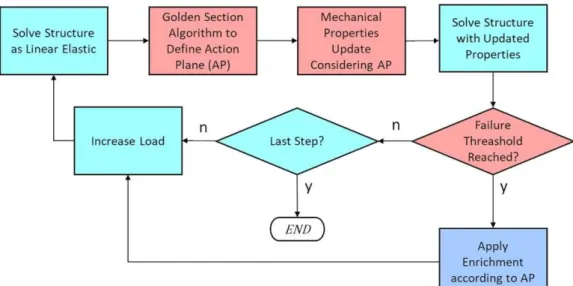
Initiation and propagation routines are organized as shown by the analysis flowchart in Figure 2, where dif-ferent colors represent the sub-modules, which were implemented. First of all, state variables are initialized and load is applied. A linear elastic calculation is performed according to generalized Hooke’s law applied to the com-posite structure. The user subroutine feeds the constitutive matrix to native XFEM solver from AbaqusTM, which performs the solution of the equilibrium equation. The UMAT routine for golden section algorithm is applied to define the action plane AP of failure in order to calculate the failure indexes according to Puck’s theory and to update state variables. To enhance convergence performance, these calculations are carried out over space aver-aged mechanical properties obtained by Angelo, Galucio and Tita 2012a . A new linear elastic analysis is per-formed with the new set of properties updated properties . If failure indexes exceed failure threshold index, sub-routine UDMGINI is called to determine fracture angle inclination and enrichment application. The UDMGINI is a subroutine implemented in FORTRAN, which runs at each end of step during AbaqusTM analysis. It must be coded so that it provides as output a boolean parameter for applying enrichment and the angle according to the element that will be enriched. This procedure is repeated until load is fully applied.
2.1 Crack Initiation
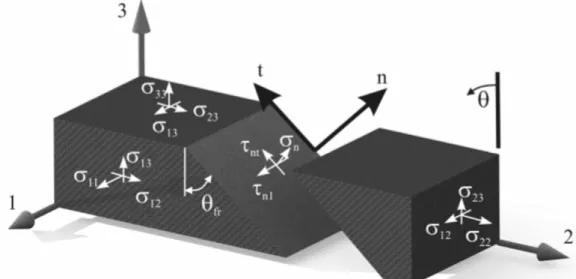
The main difficult for implementing Puck’s theory is the proper determination of the action plane, the basis of this theory, and it is defined as the plane in which the Puck’s indexes are maximum DEUSCHLE 2010 . Works have been done on optimizing this search such as Szlosarek et al. 2016 , but a definitive method is still an open problem. An example of this plane is shown in Figure 3.
Figure 3: Puck’s theory: Action plane WIEGAND, PETRINIC, and ELLIOTT 2008
The action plane inclination in 2D problems can be defined analytically PUCK, KOPP and KNOPS 2002 , but for 3D problems, due to transcendental equations, no analytical solution is possible making it necessary to use nu-merical methods in order to determine the angle. As previously stated, in the present work, User Defined Damage Initiation UDMGINI subroutine is implemented into AbaqusTM. According to this subroutine, the user must pro-vide the angle and threshold for crack onset DASSAULT SYSTÈMES SIMULIA CORP. 2011 .
The default XFEM from AbaqusTM is able to proper monitor cracks intrinsically, but it cannot be used directly since it supports only Linear Elastic Fracture Mechanics LEFM for isotropic materials. To overcome this limita-tion, user defined subroutines were employed. For these subroutines, even if the elements are homogeneous, the effect of fibers are taken into account by the material model and, the fracture plane considers the presence of fibers even if they are not explicitly modeled. Considering some regions of the tapered structures or joints, this feature would also allow to model resin pockets and regions without fibers, but an isotropic criterion should be used in these regions
2.1.1 Action plane inclination: Puck’s approach
According to Puck’s theory, in order to proper describe the mechanisms of failure related to the polymer matrix inter-fiber failure , a new coordinate system is defined at each finite element mesh integration point regarding the Puck’s “inclination” of the “action plane” in which the stresses are acting. Three modes of failures are defined con-cerning the sign and ratio between components of the stress tensor. Each mode has its own governing law and set of parameters that require tests and assumptions to be determined.
By averaging the stress tensor in the new orientation system, a failure index, which is called “stress exposure”, is calculated according to Eq. 1 and used to quantify the amount of damage in the matrix at each integration point. This index will be argument for the determination of the damage variable for inter-fiber mechanism as shown by Eq. 2 . This will be the variable by which elastic moduli will be reduced following Eq. 3 . It is important to notice that it was used the same notation of Puck’s works.
𝐼𝐹𝐹 ∥∗ 𝜎 ∥∗𝜎 1
𝜂 /
/ ∗
∗ / ∗/ 𝜂
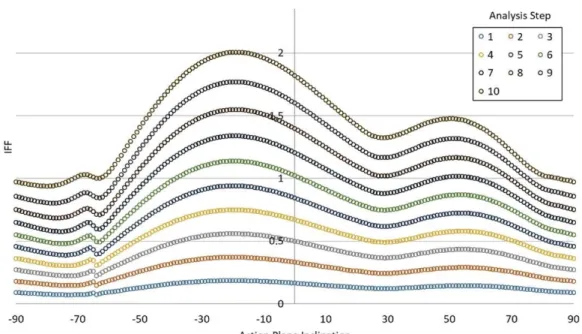
𝐸 𝜂 𝐸 𝐺 𝜂 𝐺 3 The action plane angle may be determined through “brute force”, i.e. a sweep made through all possible angles and the index of Inter-Fiber Failure IFF is calculated for each one. The highest value is used to determine the critical angle and the inclination angle, considering the respective failure index. This method is extremely compu-tationally inefficient; even though it is assured that the right angle will be reached. Figure 4 illustrates how the failure index behaves when calculated for each inclination.
Figure 4: Example of calculation of action plane inclination as proposed by Puck’s algorithm.
To increase precision, it is strategic to choose smaller steps for sweeping the angles, always taking it implies on higher number of steps and amount of calculations required. Figure 4 displays failure index plotted against fail-ure angle. A sweep from -90° to 90° is performed at each step. As analysis evolves, failfail-ure indexes assume higher values. In this example analysis, there is no crack and results are shown up to 90% of complete analysis.
The calculation of action angle is performed through the subroutine UDMGINI from Abaqus. This is used spe-cifically to set a user defined damage initiation criterion for enriched elements. As shown in Figure 2, the routine is called at the end of each increment and during its execution. Thus, the user-defined code will check threshold failure index according to the failure function Equation 1 and predict the crack initiation direction.
2.1.2 Action plane inclination: Proposed approach
As shown by Figure 4, there are multiple points of maxima and minima locally. Therefore, a robust approach was proposed in order to increase efficiency and avoid this problem.
Following the works of Wiegand, Petrinic and Elliott 2008 , it was implemented the approach based on the so called “golden section algorithm”. Thus, the interval of interest, in this case -90°, 90° , was subdivided as per the golden ratio shown in Eq. 4 :
1 5
2 j= +
4
Figure 5: Flowchart for implementing Golden Section search.
The Golden Section method is efficient, but it shows some limitation. According to the distribution of maxima and minima, the method may be unable to find the real global maximum, returning a local extreme value.
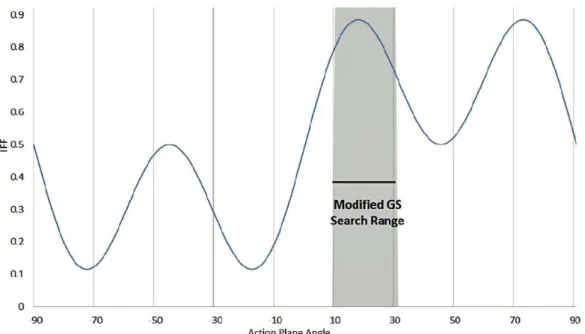
In order to improve efficiency, in the present work, the Golden Section method was expanded taking into ac-count the hypothesis from Schirmaier et al. 2014 , which states that no extreme value appears closer than 25° from each other. Under this hypothesis, a new approach is proposed that consists in a portion-wise application of Golden Section method. According to this new methodology, the whole interest interval is divided in 9 x 20° and, for each sub-interval, the Golden Section method is applied, and this new approach is defined as enhanced Golden Section method. Nine potential maximum values are obtained and compared. Hence, the maximum among them is considered the global maximum as shown by Figure 6.
Figure 6: Schematic representation of enhanced Golden Section method, highlighted one subinterval IFF vs Action Plane Inclination
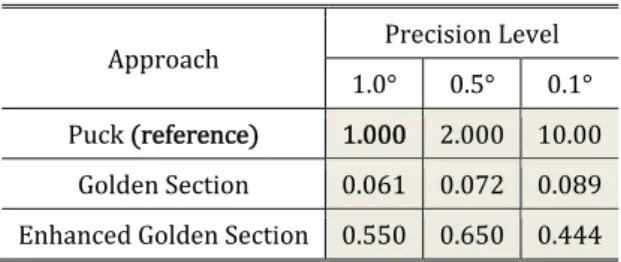
Table 1: Performance comparison.
Approach Precision Level 1.0° 0.5° 0.1° Puck reference 1.000 2.000 10.00
Golden Section 0.061 0.072 0.089 Enhanced Golden Section 0.550 0.650 0.444
The gains of applying the enhanced golden section method are not as high when in comparison to original golden section algorithm in terms of computational cost. Nevertheless, the balance between robustness and per-formance makes of it the best choice that could be further extended to other works that made use of this algorithm such as meshless colocation TSAI, KOLIBAL, and LI 2010 , medical appliance LU and HARGREAVES 2008 and even aircraft control PATRON, BOTEZ, and LABOUR 2012 .
3 RESULTS AND DISCUSSION
As commented previously, there were preliminary studies performed by industry classified results and acad-emy HOCHARD, MIOT and THOLLON, 2014 , which indicated that tapered composite structures show translami-nar failure mechanism. Furthermore, onset/initialization and propagation of failure in thick laminated composites represents the same behavior of translaminar failure mechanism. Based on these aspects, in the present work, it is proposed to investigate two different case studies: 1 thick laminates with layers mainly oriented to 90o under tension and compression and 2 0°, 90° and 45° specimens of compact tension test. For both case studies, material properties can be found in Table 2, where the composite material T700/M21 consists on epoxy res-in reinforced by carbon fibers, and sub-index 1, 2 and 3 corresponds to the orthotropic directions.
Table 2: Material properties for case studies.
Material Property MPa
T700/M21 𝐸 𝐸 𝐸 𝐺 𝐺 𝐺 𝜈 𝜈
116408 9544 5017 3642 0.31 0.31
3.1 Case Study 1: 90° layers under tension and compression
When transversal compression load is applied on unidirectional composite, considering experimental results presented by Puck and Schürmann 1998 , it is expected that the angle for failure occur around 54° DEUSCHLE 2010 . Experimental data was obtained from Puck’s original work where a fiber reinforced torsional spring was employed to isolate compressive stresses PUCK and SCHÜRMANN 2002 . On the other hand, when the same struc-ture is loaded under tension transversal loading, it is expected that the angle for failure occurs at 0°, i.e. parallel to the fibers aligned to 90o according to laminate coordinate system.
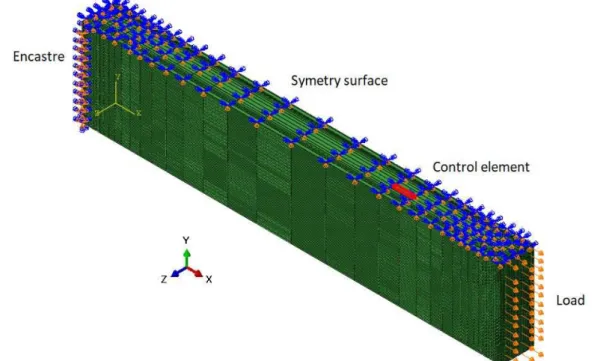
Figure 7: Model under tension transversal loading: Boundary conditions and control element.
The control element works as a virtual strain-gage and its numerical results are acquired for comparison with experiments. For compression simulations, the applied loading was kept below buck-ling critical load, then a linear analysis was performed. It is important to remark that the model aimed to prove the effectivity of the proposed approach
Figure 8: Failure index for each angle: Compression analyses.
path symmetrical behaviors . It is important to highlight that loading was simulated by using an imposed displace-ment up to the first failure i.e. IFF 1 , which happened at 3.7mm for this case.
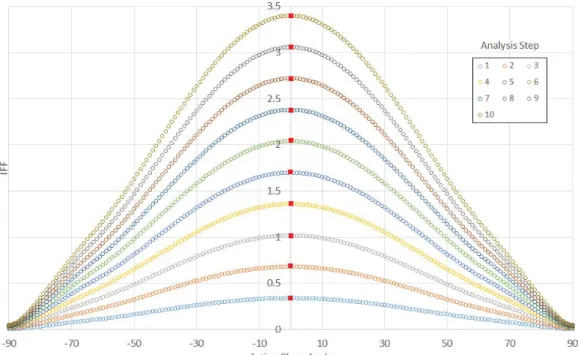
In a similar manner, Figure 9 shows the results for the tension analyses. Again, the results are exactly as ex-pected. Failure occurs at 0° i.e. in a plane parallel to the fibers and perpendicular to the loading. Filled dots show the results obtained by the proposed approach in opposition to the curve, which is again obtained through Puck’s approach. Again, the imposed displacement was adopted to be 3.7mm, but as it can be noticed, for tension analyses, the total failure index IFF reached much higher values.
Figure 9: Failure index for each angle: Tension analyses.
Table 3 shows comparison the current method to Puck’s method for the Case Study 1.
Table 3: Case Study 1 – Comparison the current method to traditional Puck’s method. Stacking Sequence
XY plane, X as reference Loading Puck’s Method Current Method
0°2, 90°6s Tension 0° 0°
0°2, 90°6s Compression 54° 53.4°
3.2 Case Study 2: Compact tension specimen
In order to verify the implementation of the initiation routine in the XFEM via material model, com-pact ten-sion tests under imposed displacement were simulated as shown by the Figure 10. Dis-placement was increased up to final failure of the structure. Results are reported at the last step before complete failure, since there is not solution for the model when the structure is completely separated.
The model was developed using 8805 C3D8 elements to simulate 16 composite layers. Con-strained and im-posed displacements are applied in reference points RPs . One of the RPs is con-strained while the other one has displacement steps, which are gradually applied as shown by the Figure 10 A .
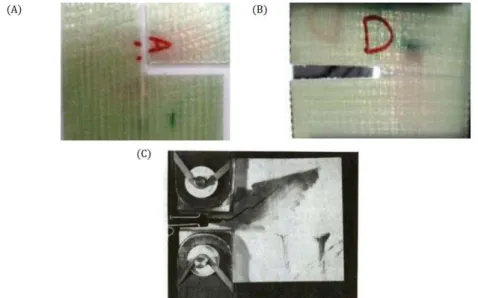
Both phenomena, translaminar failure and crack propagation are expected to be found in tapered composite struc-tures, mainly according to the stacking sequence of the laminate. Thus, three different layups were evaluated as shown in Table 4, and respective results for experiments shown in Figure 11 are displayed in Figure 12.
Figure 10: Compact tension model: A 3D iso-view B Detailed sketch with dimensions units: mm .
Final displacement for each analysis is also presented in Table 4.
Table 4: Details of computational analyses for Case Study 2 Stacking XY plane, Y as
reference Loading Expected Behavior Ultimate Displacement Ob-tained 0°16 Tension Failure along the fibers direction at 0° 2.7 mm
90°16 Tension Failure along the fibers direction at 90° 2.3 mm
45°16 Tension Failure along the fibers direction at 45° 4.7mm
Since the strength in fiber direction is much higher than in transversal, it is expected the failure represented by trespassing cracks in the structure following the alignment of fibers.
The consistency of the numerical results can be evaluated qualitatively by using experimental data found in the literature as shown by Figure 11, which were obtained from Jamali 2014 and Slepetz and Carlson 1976 . In these experiments compact tension specimens, made of unidirectional composite materials were stressed mono-tonically up to failure.
Figure 11: Compact tension experimental results: A 0° JAMALI 2014 , B 90° JAMALI 2014 and C 45° specimen SLEPETZ and CARLSON 1976 .
4 CONCLUSIONS
The present work showed a new computational framework, combining XFEM and 3D Puck’s failure theory, for evaluating onset and propagation of failure evolution of cracks in composite structures. Besides, the proposed approach for determining crack inclination angle uses an enhanced golden section method, which has proven to be robust and precise, filling a gap on the available researches in the field. Compared to the algorithm proposed by Puck, the new methodology has convergence one order higher than the first method developed by Puck; and it is 20 times more efficient computationally for a 0.1° precision. Therefore, if more precision is needed, then higher gains are achieved combined to lower computational cost by using the proposed method.
Moreover, proposed framework performance for translaminar failure was evaluated through thick laminated composites with layers mainly oriented to 90o simulated under tension and compression, displaying results as re-ported in the literature. In addition, compact tension tests with 0°, 90° and 45° specimens were evaluated, and numerical results were qualitatively coherent with experimental data. Therefore the computational framework can be used to predict onset and crack propagation in composite structures with translaminar failure
5 ACKNOWLEDGEMENTS
The authors acknowledge the Consulat Général de France à São Paulo for supporting this Research. Volnei Tita acknowledges the financial support of the National Council for Scientific and Technological Development CNPq process number: 401170/2014-4 and 310094/2015-1 and Air Force Office of Scientific Research – AFOSR Grant FA9550-16-1-0222 . Marcelo L. Ribeiro acknowledges the financial support of the São Paulo Research Foundation
FAPESP 2015/13844-8 .
6 REFERENCES
AMERICAN SOCIETY FOR TESTING AND MATERIALS. 2015. E1922-04 2015 . In Standard Test Method for Trans-laminar Fracture Toughness of Laminated and Pultruded Polymer Matrix Composite Materials. Philadelphia: Amer-ican Society for Testing Materials.
ANGELO, M. V., A. C. GALUCIO, and V. TITA. 2012a. “Development and Validation of a PFA Model for Composite Aeronautical Structures with Stress Concentrators.” X World Conference on Computational Mechanics, São Paulo - Brasil.
ANGELO, M. V., A. C. GALUCIO, and V. TITA. 2012b. “Parametric Analysis of Puck-Matzenmiller Theory based Dam-age Model for Composite Structures.” International Journal of Vehicle Structures & Systems 4 4 :152-157. doi: 10.4273/ijvss.4.4.07.
BRUNBAUER, J., C. GAIER, and G. PINTER. 2015. “Computational fatigue life prediction of continuously fibre rein-forced multiaxial composites.” Composites Part B: Engineering 80:269-277. doi: 10.1016/j.compo-sitesb.2015.06.002.
DASSAULT SYSTÈMES SIMULIA CORP. 2011. Abaqus Version 6.11 Documentation. Dassault Systems.
DEUSCHLE, M. H. 2010. “3d Failure Analysis of UD Fibre Reinforced Composites: Puck's Theory Within FEA.” Doctor in Engineering, Institute for Statics and Dynamics of Aerospace Structures - University of Stuttgart, Universitat Stuttgart 3-930683-99-7 .
DEVECI, H. A., L. AYDIN, and H. S. ARTEM. 2016. “Buckling Optimization of Composite Laminates Using a Hybrid Algorithm Under Puck Failure Criterion Constraint.” Journal of Reinforced Plastics and Composites 35 16 :1233-1247. doi: 10.1177/0731684416646860.
FERNANDES, M. F. da C. 2014. “Translaminar Fracture of Thin-Ply Composite Laminates.” Masters in Science, Fac-uldade de Engenharia da Universidade do Porto, Universidade do Porto.
FREITAS, A., D. A. F. TORRES, P. T. R. MENDONÇA, and C. S. BARCELLOS. 2015. “Comparative analysis of Ck-and C0-GFEM applied to two-dimensional problems of confined plasticity.” Latin American Journal of Solids and Structures
12 5 :861-882.
GINER, E., N. SUKUMAR, J. E. TARANCON, and F. J. FUENMAYOR. 2009. “An Abaqus Implementation of the Extended Finite Element Method.” Engineering Fracture Mechanics 76 3 :347-368. doi: 10.1016/j.engfrac-mech.2008.10.015.
HINTON, M. J., A. S. KADDOUR, and P. D. SODEN. 2002. “A Comparison of the Predictive Capabilities of Current Fail-ure Theories for Composite Laminates, Judged Against Experimental Evidence.” Composites Science and Technol-ogy 62 12 :1725-1797. doi: 10.1016/S0266-3538 02 00125-2.
HOCHARD, C., S. MIOT, and Y. THOLLON. 2014. “Fatigue of laminated composite structures with stress concentra-tions.” Composites Part B: Engineering 65:11-16. doi: https://doi.org/10.1016/j.compositesb.2013.10.020.
JAMALI, J. 2014. “Mechanistic Failure Criterion for Unidirectional and Random Fibre Polymer Composites.” The University of Western Ontario.
KADDOUR, A. S., M. J. HINTON, and P. D. SODEN. 2004. “A Comparison of the Predictive Capabilities of Current Fail-ure Theories for Composite Laminates: Additional Contributions.” Composites Science and Technology 64 3 :449-476. doi: 10.1016/S0266-3538 03 00226-4.
LAFFAN, M. J., S. T. PINHO, P. ROBINSON, and L. IANNUCCI. 2010. “Measurement of the in situ Ply Fracture Tough-ness Associated with mode I fibre Tensile Failure in FRP. Part II: Size and lay-up effects.” Composites Science and Technology 70 4 :614-621. doi: 10.1016/j.compscitech.2009.12.011.
LAFFAN, M. J., S. T. PINHO, P. ROBINSON, and A. J. MCMILLAN. 2012. “Translaminar Fracture Toughness Testing of Composites: A review.” Polymer Testing 31 3 :481-489. doi: 10.1016/j.polymertesting.2012.01.002.
LEE, C-S, J-H KIM, S-K KIM, D-M RYU, and J-M LEE. 2015. “Initial and Progressive Failure Analyses for Composite Laminates Using Puck failure criterion and Damage-Coupled Finite Element Method.” Composite Structures
121:406-419. doi: 10.1016/j.compstruct.2014.11.011.
LU, W., and B. A. HARGREAVES. 2008. “Multiresolution field map estimation using golden section search for water-fat separation.” Magnetic Resonance in Medicine 60 1 :236-244. doi: 10.1002/mrm.21544.
MIOT, S., C. HOCHARD, and N. LAHELLEC. 2010. “A Non-Local Criterion for Modelling Unbalanced Woven Ply Lam-inates with Stress Concentrations.” Composite Structures 92 7 :1574-1580. doi: 10.1016/j.comp-struct.2009.11.019.
MOU, H. L., T. C. ZOU, Z. Y. FENG, and J. XIE. 2016. “Crashworthiness Analysis and Evaluation of Fuselage Section with Sub-floor Composite Sinusoidal Specimens.” Latin American Journal of Solids and Structures 13 6 :1186-1202.
PATRON, R. F., R. BOTEZ, and D. LABOUR. 2012. “Vertical profile optimization for the Flight Management System CMA-9000 using the golden section search method.” IECON 2012 - 38th Annual Conference, Montreal - Canada.
PUCK, A., and H. SCHÜRMANN. 1998. “Failure Analysis of FRP Laminates by Means of Physically Based Phenome-nological Models.” Composites Science and Technology 58 7 :1045-1067. doi: 10.1016/S0266-3538 96 00140-6.
PUCK, A., and H. SCHÜRMANN. 2002. “Failure Analysis of FRP Laminates by Means of Physically Based Phenome-nological Models.” Composites Science and Technology 62 12 :1633-1662. doi: 10.1016/S0266-3538 01 00208-1.
SCHIRMAIER, F. J., J. WEILAND, L. KÄRGER, and F. HENNING. 2014. “A New Efficient and Reliable Algorithm to De-termine the Fracture Angle for Puck’s 3D Matrix Failure Criterion for UD Composites.” Composites Science and Technology 100:19-25. doi: 10.1016/j.compscitech.2014.05.033.
SHI, J., D. CHOPP, J. LUA, N. SUKUMAR, and T. BELYTSCHKO. 2010. “Abaqus Implementation of Extended Finite Element Method Using a Level Set Representation for Three-Dimensional Fatigue Crack Growth and Life Predic-tions.” Engineering Fracture Mechanics 77 14 :2840-2863. doi: 10.1016/j.engfracmech.2010.06.009.
SHI, J., J. LUA, H. WAISMAN, P. LIU, T. BELYTSCHKO, N. SUKUMAR, and Y. LIANG. 2008. “X-FEM Toolkit for Auto-mated Crack Onset and Growth Prediction.” In 49th AIAA/ASME/ASCE/AHS/ASC Structures, Structural Dynamics, and Materials Conference. American Institute of Aeronautics and Astronautics.
SLEPETZ, J. M., and L. CARLSON. 1976. Fracture of composite compact tension specimens. Massachusets: Army Ma-terials and Mechanics Research Center.
SUKUMAR, N., D. J. SROLOVITZ, T. J. BAKER, and J. H. PREVOST. 2003. “Brittle Fracture in Polycrystalline Micro-structures with the Extended Finite Element Method.” International Journal for Numerical Methods in Engineering
56 14 :2015-2037. doi: 10.1002/nme.653
SZLOSAREK, R., T. KARALL, C. HAHNE, A. BERGER, and N. ENZINGER. 2016. “Fracture Angle Search with Puck's 3D Interfiber Fracture Criterion Using the Damped Newton's Method.” Composites: Mechanics, Computations, Appli-cations: An International Journal 7 4 :319-339. doi: 10.1615/CompMechComputApplIntJ.v7.i4.40.
TEIXEIRA, R. F., S. T. PINHO, and P. ROBINSON. 2011. “Translaminar Ply Fracture Toughness of Advanced Compo-sites.” International Conference on Composite Materials, Jeju, 2011.
TSAI, C. H., J. KOLIBAL, and M. LI. 2010. “The golden section search algorithm for finding a good shape parameter for meshless collocation methods.” Engineering Analysis with Boundary Elements 34 8 :738-746. doi: 10.1016/j.enganabound.2010.03.003.
WIEGAND, J., N PETRINIC, and B. ELLIOTT. 2008. “An Algorithm for Determination of the Fracture Angle for the Three-Dimensional Puck Matrix Failure Criterion for UD Composites.” Composites Science and Technology 68