52 Artículo recibido el 11 de junio de 2009; Aceptado para publicación el 28 de julio de 2009
Symmetrical freedom quilts: the ethnomathematics of ways of
communication, liberation, and art
Os quilts simétricos da liberdade: os modos etnomatemáticos de
comunicação, libertação e arte
Milton Rosa1 Daniel C. Orey2
Abstract
Symmetrical Freedom Quilts may be considered as links between mathematics, history, ethnomathematics,
and the art of quilting. A quilt theme is a pedagogical way to integrate mathematics, art, and history in an interdisciplinary approach. This article combines an ethnomathematical-historical perspective by elaborating a history project related to the Underground Railroad. This work will allow teachers to develop classroom
projects that help students to better understand geometry, especially concepts of symmetry and transformations. One of the objectives of this project is to stimulate student’s creativity and interest, because quilts may be considered as cultural and mathematical expressions of student’s daily life.
Keywords: Freedom Quilts - Underground Railroad - Mathematics - Ethnomathematics - Geometry –
Symmetry
Resumo
Os Quilts Simétricos da Liberdade podem ser considerados como um elo entre a matemática, a história, a
etnomatemática e a arte de quilting. O tema quilt é um modo pedagógico que integra a matemática, a arte e a
história numa abordagem interdisciplinar. Este artigo combina uma perspectiva histórica-etnomatemática ao elaborar um projeto de história relacionado com o Underground Railroad. Este trabalho permite que os
professores desenvolvam projetos em sala de aula que auxiliam os alunos ao melhor entendimento da geometria, especialmente, os conceitos de simetria e transformações. Um dos objetivos deste projeto é estimular a criatividade e o interesse dos alunos, pois os quilts podem ser considerados como expressões culturais e matemáticas do cotidiano dos alunos.
Palavras-chave: Quilts da Liberdade – Underground Railroad – Matemática – Etnomatemática – Geometria -
Simetria
1 Mathematics Teacher. Encina Preparatory High School. Sacramento. California. USA.
2 Professor of Multicultural Education and Mathematics Education. California State University, Sacramento.
53
Introduction
Increased attention to multiculturalism in school settings can be done by incorporating diverse experiences into a variety of activities in all subject areas of the school curriculum. One of the subject areas that teachers are not very comfortable in teaching and applying multiculturalism in is often mathematics.
Explorations of symmetry can provide a unique opportunity to teach students to look at the world around them and find commonalities through the lenses of symmetry. Symmetry is culturally rooted because it is found in a diversity of cultural expressions such as painting, basket weaving, clothing, pottery, religion, art, carpet and rugs, and architecture.
It is important to share numerous examples of symmetry occurring in multicultural settings with students, teaching them a mathematical concept while simultaneously teaching them to develop an appreciation for the many cultures present in the world. Studying the patterns found in a diversity of objects also allows students to increase their understanding of the many aspects of symmetry such as the identification of patterns that slide, rotate, tessellate, or create reflections. For example, they can explore:
a) the mirror patterns found on the palace walls of a Persian king many centuries ago, b) the tessellating patterns that occur in the decorating of many Islamic mosques, c) the symmetry of oriental rugs, which provide an intricate reflected centers and
borders that translate mathematical patterns,
d) the famous ancient architectural structures such as the Egyptian Pyramids, the Greek Parthenon, and Cambodia's Angkor Wat complex.
e) the symmetrical patterns found in many temples and pyramids of ancient Pre-Columbian civilizations such as Tikal, Chichén Itzá, Teotihuacán, or Palenque. f) the symmetry found in many religious symbols, which make a significant statement
about the the religious groups who use them.
g) the symmetrical patterns found in pottery in ancient cultures and in indigenous and native cultures in the Americas, Africa, Asia, and Oceania.
54 students to explore different cultures and mathematical conventions would bring diversity into the classrooms.
Purpose
The purpose of this study is to explore the symmetrical patterns found in quilts as well as the connections between mathematics, ethnomathematics, and the tactile craft and art of quilting. In order to stimulate student creativity and interest, quilts may be considered as cultural and mathematical expressions of a student’s daily life.
Quilts
Throughout time, quilts have been created as a vehicle for sharing family history, a moral message, or as a reflection of historical and cultural events. The focus of this paper is on one important form of communication as used on the Underground Railroad by
African-Americans escaping slavery before the United States Civil War. The term “Underground Railroad” has come to us from a story of a farmer chasing a runaway who testified that the slave vanished on some kind of “Underground Railroad” (Burns &
Bouchard, 2003). Underground Railroad “was used to describe the network of abolitionists and safe houses that helped slaves escape to Ohio and Canada. Safe houses along the way were known as “stations”, those who guided the escapees were called “conductors” and the runaways themselves were called “passengers” (Burns & Bouchard, 2003, pp. 32).
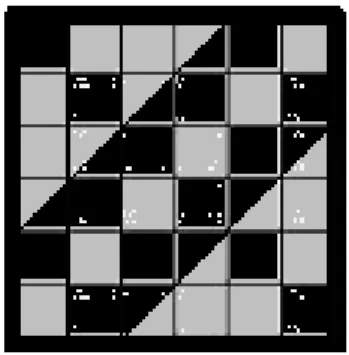
Figure 1: The Underground Railroad Quilt
The Underground Railroad was organized by former slaves, freed blacks, and
55 and safe paths to follow as they moved to the free states of the north and Canada. The quilts are referred to as Freedom Quilts and they were often hung over a clothes line, porch,
or balcony to symbolize what to do or where to go by using different designs that indicate safety, danger, clues, and landmarks to guide the slaves to freedom. The quilts were sewn to serve as a coded map for runaway slaves to memorize. Slaves followed symbols on
Freedom Quilts that were hung out during the day to give guidance, directions or dangers
that lay ahead. This method of communication was very effective, because bounty hunters apparently never caught onto the quilts and their messages.
Quilt definition
According to The Random House Dictionary of the English Language (1973), a
quilt is defined as "a coverlet for a bed, made of two layers of fabric with some soft substance, as wool or down, between them and stitched in patterns or tufted through all thicknesses in order to prevent the filling from shifting”(pp.1180). The word quilt probably originates from the Latin culcita or culcitra, which means a stuffed sack or cushion.
However, quilt word only came into the English language from the old French word cuilte
that was developed around the 13th century, which means mattress (The Random House Dictionary of the English Language, 1973).
A short quilt history
The earliest known quilted garment is on the carved ivory figure of a Pharaoh of the Egyptian First Dynasty about 3400 B.C. that features the king wearing a mantle that appears to be quilted (Colby, 1971). Crusaders brought quilting to Europe from the Middle East in the late 11th century and in accordance to Colby (1971), in medieval Europe, around 13th century, quilted cloth was part of a soldier's armor. Quilted garments were also very popular in the Middle Ages and at that time knights wore quilted garments under their armor for comfort and to protect the metal armor from the rain, snow, and the sun.
56 grown to the point that a wide variety of quality fabrics were readily available to the quiltmaker.
Currently, quilting has evolved to become a form of self-expression that provides occasion for socializing because quiltmakers often get together to work on a quilt projects. Seen in this context, quilting is and most probably has always been a social event. Currently, there is a renewed interest in quilts and quilt-making with a combination of traditional methods design and innovative ways of quilts.
Quilts and ethnomathematics
Studies involving quilts provide concrete links for students between contemporary life and history because they serve as artifacts acting as tools that help to retell family stories and past events. Quilts are often passed down from one generation to another. The original material often comes from scraps of clothing and articles from the home. There is a sense of personal heritage and history evident in the quilt that comes through when they are shared by the owner.
Quilt geometry definitely reflects the history and mathematics of the people, many of whom who are not traditionally thought of as worthy of study. From an ethnomathematical perspective, this study has allowed these researchers to better understand quilting as an art form done primarily by many women, in many countries. Women in both the United States and Brasil, for example, have also used quilts in order to have a voice; to express political, social, and religious beliefs. Though it is primarily an art form now, the Afro-American connection to quilting in both countries was entwined with the struggle for freedom. In so doing, since most quilters (women) lacked the opportunity to adequately express themselves through writing, they initially used skills they had to express themselves through elaborate quilts, and related work. It was in this way that quilting became an outlet for the expression of women’s thoughts, dreams, feelings, life experiences, and as became a commentary on social, political and community events.
57 and loved ones who had died of AIDS. The AIDS quilt is now so large that it can no longer be shown together in one piece, so parts of the quilt are displayed in schools, libraries, and public places around the world in honor of World AIDS Day. This is a very important aspect of an ethnomathematics program because the validation of the mathematical practices of this cultural group that is often deemphasized or left out of history of people (D’Ambrosio, 1990).
The focus on the origin of the fabric, that is, where it comes from, is also another important ethnomathematical perspective. For example, during the colonial period, in the United States, fabric stores were not well established and most definitely not accessible to people from all socio-economic levels. Fabrics were very expensive because fibers from plants and animals used in quilting had to be gathered, cleaned, spun, and woven by hand. A look at these processes allows for a deeper understanding and comprehension about the roles people had in colonial times, also it allows for an appreciation for the ease with which people obtain manufactured fabric products today. Besides their use as warm blankets, quilts reminded immigrants as well, of their family, friends for those who remained behind.
Another ethnomathematical perspective to be considered is that the secret codes in quilts are part of a longstanding tradition that goes back to Africa and the encoding of textiles there. The African precedent is that in these textiles, all of the designs have a meaning. According to Eglash (2002), geometrical African textile designs may have traveled to the Americas with the slaves.
During the time of slavery in the United States and Brasil, most everything that was “African” was forbidden. In so doing, “enslaved Africans were prohibited from drumming, speaking in their native languages, or learning to read and write in English” (Wilson, 2002, pp. 5). They were also prohibited from placing any “African” design on a quilt. What was shrewdly, indeed very creatively done by those who wanted to communicate was to take American quilt patterns and give these patterns meaning.
58 enslaved. Quilt patterns, and especially those that are called improvisational, are composed of fragments, remnants of cloth; so fractured cloth comes together and creates something new. This is really a metaphor, which addresses what happened during the time of slavery because in spite of the difficulty, in spite of families being torn apart, there was always a coming together with the hope of liberation, and emancipation.
The ethnomathematics of the symmetrical freedom quilts
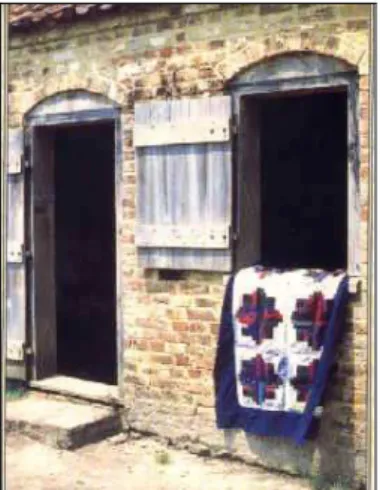
Quilts were used both as a means of signaling and providing travel instructions on the Underground Railroad. Quilts were made by enslaved women who used different symbols or pictures to communicate with runaway slaves. They were often displayed in window-sills to convey messages.
Figure 1: Freedom Quilt Displayed on Window-sill
One may picture a slave hanging a quilt on the fence on a farm of 18th century Southern plantation. The quilt was hung with other items to be aired out so most people believed that quilts were just a kind of bed-covering that needed to be aired. However, to those people who knew how to identify the secret codes in the quilt pattern, this meant the difference between life and death. Since slaves were not taught to read or write in English, they developed an intricate system of secret codes, signs, and signals to communicate with one another along the routes of the Underground Railroad. In so doing, in order to
59 one plantation to another to teach to other slaves the translation of the codes of the sampler quilt patterns (Wilson, 2002).
Symmetrical Freedom Quilts contained ties with knots that were often used to
indicate the date the slaves were ran away from their working plantation. For example, five knots in the cord meant that they should escape on the 5th day of the 5th month (Wilson,
2002). The ethnomathematical perspective of this context is to study the mathematical practices of this specific cultural group in the course of dealing with their environmental problems (D’Ambrosio, 1990).
For example, if a quilt showed a house with smoke coming out of the chimney, it meant that the house was safe. According to Orey & Rosa (2006), the quilt codes may be considered as mathematical techniques (tics) used by the slaves (ethno) who were trying to
manage problems and activities that arose in their own social-political environments (mathema).
In this regard, quilts present us with an ingenious, indeed highly creative and complex way in which to communicate between slaves and safe houses because they did not show any overt connection to slavery. The Freedom Quilt codes of the Underground
Railroad were transmitted to the members of the slave’s families, by their ancestors,
through generations.
It is necessary to emphasize the importance of the work done by Ozella McDaniel Williams, an African-American woman who made and sold quilts in South Carolina. She told about the quilt codes to tourists who visited Charleston. She had identified at least ten patterns used in the quilt code which signaled a specific action for slaves to take at a particular time. She also mentioned a number of secondary patterns (Burns & Bouchard, (2003). Usually, the code had two meanings:
1. Signal to slaves to prepare to escape, and to
2. Give clues to indicate safe directions on the journey.
In other words Symmetrical Freedom Quilts are presented as a link between
60
Ozella's Underground Railroad quilt
In the early 1990´s, Ozella revealed most of the Symmetrical Freedom Quilt codes
to the authors Tobin and Dobard who wrote part of Ozella’s story in the book Hidden in
Plain View, in 1999. Unfortunately, Ozella died in 1998, before the publication of the book
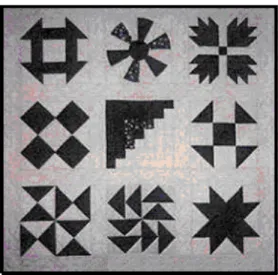
(Wilson, 2002). The message in the Ozella’s Underground Railroad Quilt (Tobin & Dobard, 1999) below may be interpreted as:
Figure 2 - Ozella's Underground Railroad Quilt
The monkey wrench…
Slaves knew it was time to gather and pack away whatever tools they needed for the long journey to freedom. They also had to be prepared and hone their mental and spiritual tools, because they needed to be deceptive.
…turns the wagon wheel…
Slaves knew that they should pack enough provisions to fit in a wagon and to be used in their long journeys. It was time to move on because the situation was getting dangerous.
…towards Canada on a bears paw…
Slaves knew that they had to follow the bear tracks through the woods, in order to remain safe, which would also lead them to water and food.
61 Slaves knew that they had to meet at the crossroads of Cleveland, Ohio because it was a destination that offered several routes to freedom. They also knew that they had to wait there to receive further instructions.
Once you get to the crossroads, dig a log cabin on the ground.
Slaves knew that this symbol drawn on the ground indicated that a person was safe for them to get instructions. It also advised that slaves were seeking for shelter. According to Brackman (2006), this symbol also indicated that slaves should “establish a permanent residency in a “free” area” (pp.84).
Shoofly told them to dress up in cotton…
Slaves knew that Shoofly was someone to be trusted or was someone among friends or a friendly guide who is nearby and could help them.
…and satin bow tie.
Slaves knew that they had to dress up in different clothing to resemble free blacks.
Flying geese stay…
Slaves knew that gluing geese were cardinal directional code because they had to follow the geese northward in the spring or the directions in which pattern indicated.
…on the drunkard's path…
Slaves knew that they had to walk in an unusual manner. They should follow a zigzag trail in order to make their tracks difficult for slave hunters to follow.
…and follow the stars.
62
The Tumbling Blocks was the tenth quilt pattern. It was the code for Niagara
Falls, the final landmark before crossing into Canada and freedom. This code was also associated with “packing up and moving on”.
The freedom quilt project
A quilt theme is a great way to begin one’s work by integrating mathematics, art, history, and reading in an interdisciplinary approach. As a result of this, the authors have prepared lesson plans that combine an ethnomathematical-historical perspective that elaborates a history project related to the Underground Railroad which allows teachers to
develop classroom activities and projects that help students to better understand history and geometry, especially concepts of symmetry and transformations.
Learning Objectives
In this project the students will:
1. Learn about the history of the Underground Railroad.
2. Identify and be able to construct basic Freedom Quilt patterns.
3. Learn the art of communication as expressed through Freedom Quilt patterns.
4. Learn the concepts of transformations: reflection (flips), translation (slides), rotation (turns), and symmetry.
5. Explore how shapes reflect, translate, and rotate by using pattern blocks.
6. Write a description of the mathematics, art, and design elements used to create the Freedom Quilt patterns.
7. Design a class Freedom Quilt.
8. Perceive the interdisciplinary connections between mathematics, geometry, and history.
Mathematical Quilts
63
Symmetrical Quilts
Making quilt blocks are an excellent way to explore symmetry. As quilts are made from square blocks, usually 9, 16, or 25 pieces to a block, with each smaller piece usually consisting of fabric triangles, the craft lends itself readily to the application of symmetry.
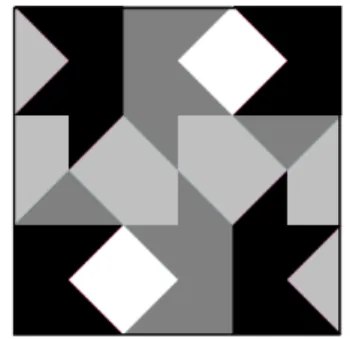
The figure below is an example of a quilt made with 9 blocks and it shows how its blocks are symmetrical.
Figure 3: Quilt made with 9 blocks
There are four kinds of quilt symmetry (The Annenberg/CPB Projects, 2008). They are described below.
1) The Letter H Symmetry
In a figure with H symmetry, the right side is a mirror of the left side and the top part is also a mirror of the bottom part. The left and the right sides of the vertical line of symmetry are congruent as well as the top and the bottom parts of the horizontal line of the figure.
64 In a figure with M symmetry, the right side of the figure is a mirror image of the left side, but the top part of the figure is not a mirror image of the bottom one. The right and the left sides of the vertical line of symmetry are congruent but the top part is not congruent to the bottom part of the figure. Isosceles and equilateral triangles share this kind of
symmetry.
3) The Letter S Symmetry
If figures have the letter S symmetry, then they do not have lines of mirror symmetry. However, they are the same appearance if they are rotated 180°. Parallelograms have this kind of symmetry.
4) The Letter B Symmetry
65 It is important to notice that the letters M and B kinds of quilt symmetries are mathematically symmetrical because they have only a single line of mirror symmetry. In mathematics, it makes no difference whether the line of symmetry is vertical (M) or horizontal (B). In the quilting making process, it is necessary to highlight that the quilt blocks do no look like the letters even though they have the same kind of symmetry.
Geometrical Quilts
The possibilities for the composition of a quilt design are limitless because they may rely upon personal choices. But the possibilities for the repetition of the symmetrical designs are limited by the laws of pattern formation and are subject to the constraints of that symmetry rules. In this context, for any kind of pattern that is used in a quilt design, there are four basic symmetry operations that may be performed upon a fundamental region or plane. Mathematicians call these rigid motions because they suggest movements without distortion of size or shape around a point, along or across a line, or to cover a plane.
In this context, imagine that a quilt as a plane. In geometry, when a shape is moved in a plane it is called a transformation. Some special types of transformations are called
isometries or rigid motions because they are transformations that preserve distances. The
following are the descriptions of the four common isometries:
1. Translation: It "slides" an object a fixed distance in a given direction. The original
object and its translation have the same shape and size, and they face in the same direction. The word "translate" in Latin means "carried across". Translations are
66 2. Reflection: It can be seen in water, in a mirror, in glass, or in a shiny surface. An
object and its reflection have the same shape and size, but the figures face in opposite directions. In a mirror, for example, right and left are switched. A reflection can be thought of as a "flipping" of an object over the line of reflection or line of symmetry.
• Line symmetry: It occurs when two halves of a figure mirrors each other across
a line. The line of symmetry is the line that divides the figure into two mirror images. Another name for the concept of line symmetry is line of reflection.
3. Rotation: It is a transformation that turns a figure about a fixed point called the
67 4. Glide Reflection: It combines a reflection with a translation along the direction of
the mirror line. In a glide reflection, the translation is always a translation along the mirror line of the reflection.
Methodology
Students should have some prior knowledge about the history of the Underground
Railroad. If they are not aware about this historical fact, teachers must give them some
in-depth background information. Since many slaves could not read, they used songs and symbols to guide them to freedom. In so doing, they found another method of communicating safely by using the coding of quilts.
Activity 1
Brainstorm with the students:
• Do people still develop and use secretive symbols or signs?
• How could shapes, patterns, and symmetries on a quilt communicate information?
Activity 2
There were ten patterns that gave messages to the runaway slaves. Students will work with or make these patterns. Throughout the project they will learn stories that describe the patterns, their meanings and messages they conveyed.
Activity 3
Display a Symmetrical Freedom Quilt design Shoo Fly
• Can students find evidence of translations, reflections, and rotations in the design?
68
• Where is the line of symmetry? How many lines of symmetry does this design have?
• What geometric figures are visible in the design?
Activity 4
Modeling the Shoo Fly Symmetrical Quilt Block
Shoo Fly is one the simplest traditional Symmetrical Freedom Quilts. Although Shoo Fly is a basic pattern, its versatility provides quilters with some wonderful
opportunities for creative use of colors, fabrics and stitching. Shoo Fly may be adapted
to a variety of sizes. Blocks often measure 9 x 9, but variations such as 10 x 10 and 12 x 12 may also be used. Below is an example of the Shoo Fly 10 x 10 symmetrical quilt
block.
Point of Reflection
A point of reflection exists when a figure is built around a single point called the center of the figure. For every point in the figure, there is another point that is found directly opposite on the other side of the figure. While any point in the x-y coordinate system may be used as a point of reflection, the most commonly point used is the origin. In the Shoo Fly quilt block, the point of reflection is the origin of the x-y coordinate
system.
By applying the general mappingP(x,y)→P'(−x,−y)on the three points of
69 images:A(9,3)→A'(−9,−3),B(3,9)→B(−3,−9), and C(3,3)→C'(−3,−3). In this case,
triangle A’B’C’ is the image of triangle ABC after a reflection on the origin of the
Cartesian coordinate system.
The point of reflection is also called point of symmetry. In a point of symmetry, the center point is a midpoint to every segment formed by joining a point to its image. The three straight dashed lines that connect A to A’, B to B’, and C to C’ pass through the
origin, which is the midpoint of each line segment. A figure that has point symmetry is unchanged in appearance after a 180 rotation. °
Line of Reflection or Line of Symmetry
The Shoo Fly has four lines of reflection or symmetry, which are lines that act as a
mirror in the form of a perpendicular bisector so that corresponding points are the same distance from the mirror. The distance from a point to the line of reflection is the same as the distance from the point's image to the line of reflection.
1) Reflection over the x-axis
When a point is reflected over the x-axis, the x-coordinate remains the same, but the y-coordinate is transformed in to its opposite. The mapping for this reflection isP(x,y)→P'(x,−y). In this case, the coordinates of the image of the three points in
70 In this example, the triangle ABC has been reflected over the horizontal segment
(x-axis), which serves at the line of reflection or symmetry to form the image A'B'C’. If point
A for is connected to its image A', then point P is the point of intersection of the reflection
line (x-axis) and line segment AA', that is, point P is the midpoint of line segment AA'. In
this case, the reflection line is perpendicular to the segment AA'. Thus, the reflection line is
the perpendicular bisector of segment AA'.
2) Reflection over the y-axis
When a point is reflected over the y-axis, the y-coordinate remains the same, but the x-coordinate is transformed in to its opposite. The mapping for this reflection isP(x,y)→ P'(−x,y). In this case, the coordinates of the image of the three points
71
3) Reflection over the line y = x
When a point is reflected over the line y = x, the x and the y coordinates of the point change place. The mapping for this reflection isP(x,y)→P'(y,x). In this case, the
coordinates of the image of the three points in triangle ABC below
areA(9,3)→ A'(3,9),B(3,9), B(3,9)→B(9,3), and C(3,3)→C'(3,3).
4) Reflection over the line y = -x
When a point is reflected over the line y = -x, the x the y coordinates change place and they are negated. The mapping for this reflection isP(x,y)→P'(−y,−x). In so
doing the coordinates of the image of the three points areA(9,3)→A'(3,9),
) 3 , 9 ( ' ) 9 , 3
(− − →B − −
72 A line of reflection or symmetry creates a figure that is congruent to the original figure and it is a transformation that is an isometry because it preserves the distance between two points. However, since when naming the figure in a reflection requires changing the order of the coordinates of the point, it is an indirect isometry or opposite isometry.
Rotation
A rotation turns the figure through an angle about a fixed point called center. The center of rotation is assumed to be the origin of the x-y coordinate system. A positive angle of rotation turns the figure counterclockwise, and a negative angle of rotation turns the figure in a clockwise direction.
Rotation is a transformation that is present in the Shoo Fly quilt block because it
moves every point 90 counterclockwise around the origin of the x-y coordinate system. °
The mapping of this rotation isR90°(x,y)=(−y,x). In so doing, the coordinates of point A
in its rotation around the x-y coordinate system are:
) 3 , 9 ( ) 9 , 3 ( '' ' ) 9 , 3 ( '' ' ) 3 , 9 ( '' ) 3 , 9 ( '' ) 9 , 3 ( ' ) 9 , 3 ( ' ) 3 , 9 ( 90 90 90 90 = − − = − − − − = − − = ° ° ° ° A R A A R A A R A A R
The figure below shows the rotation of point A around the x-y coordinate system.
73 a) Rotation of180°, that is,R180°(x,y)=(−x,−y). This is the same as the reflection in the
origin of the x-y coordinate system.
b) Rotation of 270 , that is,° R270°(x,y)=(y,−x).
A rotation creates a figure that is congruent to the original figure and preserves distance (isometry) and orientation (direct isometry).
Translation
A translation is a transformation,Ta,b(x,y)=(x+a,y+b), that slides every point
of a figure the same distance in the same direction. Since the Shoo Fly quilt block is not
formed by figures that slide in a fixed distance in a given direction, the translation is not present in this quilt block.
Glide Reflection
A glide reflection combines a reflection with a translation along the direction of the mirror line. In so doing, according the definition of glide reflection, if the figures in the Shoo Fly quilt block are not translated, then they are not a glided reflection.
Activity 5
Display all ten quilt patterns. Create a chart on the board and distribute the Quilt Chart handout. The students work independently to identify what kind of transformation was used in each pattern to create each design.
Students work in groups. Each student on the team completes one pattern. Have students label the quilt design in a short paragraph. The label should have information to describe the name of the pattern, what was done to create them, and includes mathematical, geometrical, historical, and design terms. Place the card on the back of the finished piece. Then connect all of the pieces for a class quilt.
Activity 6
74 the significance and meaning of the design of the piece that must include any mathematical, geometrical and design elements they used to create them.
Final considerations
Slaves followed symbols on the quilts that were put out during the day to give guidance on the directions or dangers that lay ahead of them. Both mathematics and design elements were used in creating these directional quilts. In the light of these facts,
Symmetrical Freedom Quilts do not only teach students about people and places of the past,
but also provide a positive link between school, academic mathematics, ethnomathematics, modeling, and history. By sharing these quilts teachers and students are also recognizing and appreciating the diversity of the backgrounds within the class. In general, quilts also provide "real world" examples of geometry concepts because they often use translations, reflections, rotations, symmetry. In order to study and make a quilt students have to measure, plan of the layout by using spatial relation, and recognize shapes, patterns, and symmetries. Through this investigation, students will design patterns, manipulate polygons, and work with transformations, and tessellations. Geometry concepts, when standing alone, can be seen as abstract concepts for students, but by analyzing actual
SymmetricalFreedom Quilt patterns and symmetries and by being surrounded by examples,
they are able to see their relevance to the study of history and geometry. They will also be focusing on the content areas of mathematics (especially geometry), language arts, science, and design by connecting history, modeling, and ethnomathematics perspective into the mathematics curriculum in order to value this very important aspect of this specific cultural group.
References
Brackman, B. (2006). Facts & Fabrications: Unraveling the History of Quilts & Slavery.
Lafayette: C & T Publishing.
Burns, E. & Bouchard, S. (2003). Underground Railroad: Sampler. San Marcos: Quilt in a
Day, Inc.
75 D’Ambrosio, U. (1990). Etnomatemática [Ethnomathematics]. São Paulo: Editora Ática.
Eglash, R. (2002). African Fractals: Modern Computing and Indigenous Design. New
Brunswick, NJ: Rutgers University Press
Rosa, M. & Orey, D. C. (2006). Abordagens Atuais do Programa Etnomatemática:
Delineando-se um Caminho para a Ação Pedagógica [Current Approaches in the
Ethnomathematics as a Program: Delineating a Path toward Pedagogical Action]. BOLEMA, 19(26): pp. 19 – 48.
Stein, J. (1973). The Random House Dictionary of the English Language: The Unabridged
Edition. New York: Random House, Inc.
The Annenberg/CPB Projects (2008). Shape and Space in Geometry. Teachers Lab.
Retrieved March 17, 2008, from http://www.learner.org/teacherslab/math/geometry/
Tobin, J. L. & Dobard, R.G. (1999). Hidden in Plain View: The Secret Story of Quilts and
the Underground Railroad. Doubleday: New York.