O
RIGINALA
RTICLE Revista Brasileira de FisioterapiaEffect of continuous positive airway pressure
on fluid absorption among patients with
pleural effusion due to tuberculosis
Efeito da pressão positiva nas vias aéreas sobre a absorção do derrame pleural
em pacientes devido à tuberculose
Juliana F. Oliveira1, Fernanda C. Q. Mello2, Rosana S. Rodrigues2, Ana L. Boechat2,Marcus B. Conde2, Sara L. S. Menezes1,2
Abstract
Background: Tuberculosis (TB) remains as an important public health problem worldwide. The most common type is pulmonary TB, and the most prevalent form of extra-pulmonary disease among HIV-negative patients is pleural disease. Objective: The objective of the present study was to determine the effect of continuous positive airway pressure (CPAP) on fluid absorption among patients with pleural effusion due to TB. Methods: Twenty patients were randomized into two groups. The interventional group (n=10) received CPAP three times a week during the initial four weeks of anti-TB treatment, and the control group (n=10) received anti-TB drugs only. The primary endpoint was the volume of pleural fluid after four weeks of treatment. Both groups were submitted to thoracic computed tomography using three-dimensional image reconstruction. The Mann-Whitney test for independent samples and the Wilcoxon paired samples test were used for statistical analysis. The normal distribution samples were analyzed using the unpaired t test. Results: The reduction of pleural effusion volume was significantly greater in the intervention group (83.5%±SD 3.6) than in the control group (36.9%±SD 2.9; p<0.001), and the final dyspnea index was lower in the Intervention group than in the control group (p=0.002). Conclusion: Our findings indicate that CPAP during the first month of TB treatment accelerates the absorption of pleural effusion, however, additional studies are needed to confirm these findings and evaluate the impact of CPAP on pleural sequelae after the end of anti-TB treatment.
Article registered in the Clinical Trials under the number NCT00560521.
Key words: physical therapy; pleural effusion; continuous positive airway pressure; pleural tuberculosis.
Resumo
Contextualização: A tuberculose (TB) permanece como um importante problema de saúde pública no mundo. A forma mais comum de apresentação é a pulmonar e, em pacientes soronegativos, a forma de doença extrapulmonar mais prevalente é a pleural. Objetivo:
O objetivo deste estudo foi determinar o efeito da pressão positiva contínua em vias aéreas (CPAP) na absorção do derrame pleural em pacientes com tuberculose. Métodos: Vinte pacientes foram randomizados em dois grupos. O grupo intervenção (n=10) recebeu CPAP três vezes por semana durante as quatro primeiras semanas do tratamento anti-TB, e o grupo controle (n=10) recebeu somente droga anti-TB. O ponto final de avaliação foi o volume de líquido pleural após quatro semanas de tratamento. Ambos os grupos foram submetidos à tomografia computadorizada, usando a reconstrução tridimensional (3D) da imagem. A análise estatística foi realizada por meio do teste de Mann-Whitney para amostras independentes e Wilcoxon para amostras pareadas, e as que apresentaram distribuição normal foram analisadas por meio do teste t de Student não pareado. Resultados: A redução do volume de derrame pleural foi significativamente maior no grupo intervenção (83,5%±DP 3,6) que no grupo controle (36,9%±DP 2,9) (p<0,001), e o índice de dispnéia final foi menor no grupo CPAP que no grupo controle (p=0,002). Conclusão: Tais achados indicam que a CPAP, durante o primeiro mês de tratamento anti-TB, acelera a absorção do derrame pleural, no entanto estudos adicionais são necessários para confirmar estes achados e avaliar o impacto da CPAP na sequela pleural após o término do tratamento anti-TB.
Artigo registrado no Clinical Trials sob o número NCT00560521.
Palavras-chave: fisioterapia; derrame pleural; pressão positiva contínua em vias aéreas; tuberculose pleural.
Received: 10/11/2008 – Revised: 06/03/2009 – Accepted: 15/04/2009
1 Centro Universitário Augusto Motta (UNISUAM), Rio de Janeiro (RJ), Brazil 2 Universidade Federal do Rio de Janeiro (UFRJ), Rio de Janeiro (RJ), Brazil
Correspondence to: Sara L. S. de Menezes, Hospital Clementino Fraga Filho (HUCFF), Rua Professor Rodolpho Paulo Rocco, 255 – 8º andar, CEP 21941-913, Rio de Janeiro (RJ), Brazil, e-mail: [email protected]
128
Introduction
For over a decade the World Health Organization (WHO) has declared tuberculosis (TB) a global emergency. According to the 2004 WHO estimate, two billion people are infected by
Mycobacterium tuberculosis worldwide. Among these, eight
mil-lion will develop the disease and 2 milmil-lion will die each year1.
In the city of Rio de Janeiro (Brazil), there were 9789 new cases of TB reported in 2004, with 15% of cases exhibiting ex-tra-pulmonary disease, 46% of which were pleural TB2.
Pleu-ral TB is the consequence of a delayed-type hypersensitivity reaction in response to the rupture of a subpleural focus of
Mycobacterium tuberculosis infection3. hemain clinical
ind-ing is pleural efusion and its diagnosisshould be considered in any patient with an exudative efusion4. Although small/
moderate in size in most cases, among those patients with larger volume, a restrictive ventilatory functional disturbance can occur with moderate reduction in pulmonary volume and compliance, as well as variations in gas exchange, reduc-tion in oxygen partial pressure (PaO2) and increase in carbon dioxide partial pressure (PaCO2)5,6. A clinically relevant factor
in the treatment of patients with TB-related pleural efusion is the degree of respiratory discomfort7.
Brazil’s national TB program recommends standard treatment with rifampin and isoniazid for six months, in addition to pyrazinamide during the first two months of treatment for all cases of pleural TB with the following aims: (1) to prevent the subsequent development of active pulmo-nary TB, (2) to relieve symptoms and (3) to prevent pleural sequelae (pleural fibrosis)8. Despite the lack of published
evidence regarding the effectiveness of continuous positive airway pressure (CPAP) on pleural effusion absorption dur-ing pleural TB treatment, it has been used as an adjuvant treatment9,10. The aim of the present study was to determine
the efficacy of CPAP on fluid absorption among patients with pleural effusion due to TB.
Methods
he present study prospectively recruited patients age 18 years or older with a conirmed diagnosis of pleural TB efusion between December 1, 2005 and March 31, 2007. All patients were initially evaluated at two hospitals (Hospital Cardoso Fontes and Hospital Universitário Antonio Pedro in Rio de Janeiro, Brazil). At both hospitals, patients underwent a chest radiograph with posterior, anterior and lateral decu-bitus views, thoracocentesis and pleural biopsy with a Cope needle. Pleural luid and two pleural fragments were stained with Ziehl-Neelsen stain and cultured in Lowenstein-Jensen
medium. hree other fragments were stained with hematoxylin and eosin. he volume of pleural luid withdrawn ranged from 50 to 80 mL. Diagnosis of pleural TB was based on the growth of Mycobacterium tuberculosis in pleural luid and/or pleural fragment or the presence of granulomas in the histopathology study of the pleural fragment.
Patients with confirmed diagnosis of pleural TB were in-vited to take part in the study. Before initiating anti-TB treat-ment, subjects who signed the informed consent form were randomized to an intervention group or to a control group using computer generated blocks in groups of two. The mean age of the control group was 39.5±17.63 while the interven-tion group was 42.5±13.53. Subjects from both groups were submitted to a thoracic Computed Tomography (CT) scan at Hospital Universitário Clementino Fraga Filho (HUCFF) of Universidade Federal do Rio de Janeiro, Brazil (UFRJ) be-fore starting treatment and after four weeks of treatment. Patients assigned to the intervention group received CPAP in addition to standard anti-TB treatment. CPAP was car-ried out by a single physical therapist, three times a week, using positive end-expiratory pressure (PEEP) of 10 cmH2O for 30 minutes through a flow generator (CriticalMed®, Rio
de Janeiro, Brazil) and a silicone face mask (Dinatech®),
in a sitting position for four weeks, respiratory rate, arte-rial blood pressure, oxygen saturation and heart rate were measured at minute 15 and immediately after application. Dyspnea was evaluated before and after treatment through a Modified Borg Scale11. Both groups received standard TB
treatment with rifampin and isoniazid for six months, with the addition of pyrazinamide during the first two months of treatment3. Anti-TB drug ingestion was monitored in both
groups through daily phone contact. Furthermore, a pill count was carried out by the nurse technician who supplied the patients with the tablets weekly.
Two radiologists specifically trained for the present study were blinded to group allocation and used a technique validated for this purpose12. The radiologists analyzed the
129 Table 1. Baseline characteristics.
Control group (n=10)
Intervention group (n=10)
p valor
Sex 0.31
Male 7 8
Female 3 2
Age (mean ± standard deviation)
39.5±17.63 42.5±13.53 0.34
Location of pleural effusion
0.5
Right 6 5
Left 3 5
Bilateral 1 0
TB diagnosis Positive culture for M tb (pleural fragment)
2 3
0.31
Histopathologic finding of granuloma (pleural fragment)
8 7
Sites of disease 0.33
Pleura 4 5
Lung + Pleura 6 5
Control group (n=10)
Intervention group (n=10)
p value
Volume (mL)
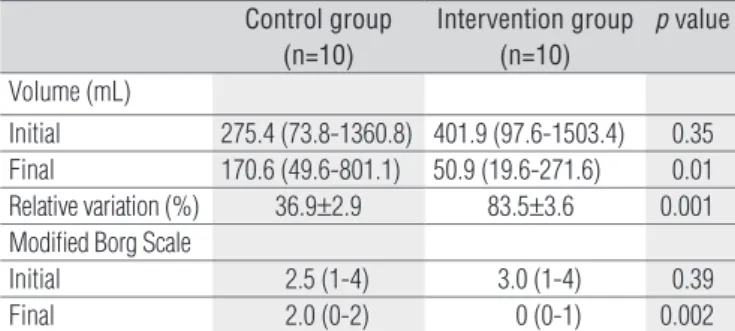
Initial 275.4 (73.8-1360.8) 401.9 (97.6-1503.4) 0.35 Final 170.6 (49.6-801.1) 50.9 (19.6-271.6) 0.01 Relative variation (%) 36.9±2.9 83.5±3.6 0.001 Modified Borg Scale
Initial 2.5 (1-4) 3.0 (1-4) 0.39
Final 2.0 (0-2) 0 (0-1) 0.002
Table 2. Pleural effusion volume and Modified Borg Scale rating before and after four weeks of treatment in the control group and in the intervention group.
*Data presented as mean±standard deviation (SD) or median.
following parameters: 450 HU (Hounsfield units; window) and 20 HU (level). Patients were excluded from the study if they did not take the standard anti-TB medications for 2 days or if they did not come to one of the CPAP sessions or radiological evaluations.
he variables that did not present normal distribu-tion and/or homogeneity of variances were analyzed with the Mann-Whitney test for independent samples and the Wilcoxon test for paired samples. hose presenting normal distribution were analyzed with the unpaired t test. Difer-ences were considered signiicant if p≤0.05. he sample size was based on type I error with alpha 5%, power 80% and esti-mate diference of 30%. It was calculated through the follow-ing equation n=[Zα√ P0 (1 – P0) + Zβ √ Pa (1 – Pa) ]2 / (P
0 - Pa) 2.
Informed written consent was obtained from all par-ticipants, and the study was approved by the Institutional Regulatory Board (IRB) of Hospital Universitário Clementino Fraga Filho of Universidade Federal do Rio de Janeiro under number 033/04.
Results
Twenty patients were screened and invited to take part in the study. Twenty patients were included and had endpoints evaluated. All strains were tested and were non-resistant to rifampin and isoniazid. Our laboratory does not perform sensi-tivity testing for pyrazinamide. No patients were excluded from the study. he baseline characteristics of the study sample are shown in Table 1. he mean age and sex were nearly identical in the two groups. here was no signiicant diference in the location of the pleural efusion and size. here were no adverse efects associated with the use of CPAP.
Table 2 shows that the relative variation between the initial and inal (after 4 weeks of treatment) pleural luid volume was signiicantly greater in the intervention group (83.5%±3.6) than in the control group (36.9%±2.9; p<0.001) suggesting that CPAP accelerated the speed of luid absorption. At the beginning of the study, the dyspnea index did not difer between groups (Table 1), but after 4 weeks of treatment it was signiicantly lower in the intervention group, with a median of 0 (0-1), than in the control group, with a median of 2.0 (0-2; p=0.002). here was no signiicant diference between the groups regarding cardiac and respiratory frequency values, arterial pressure and peripheral oxygen saturation (SpO2).
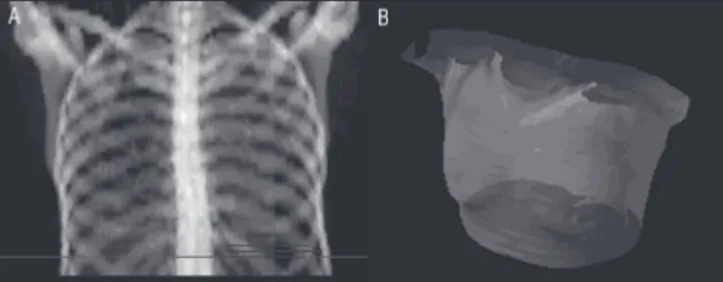
Figure 2 shows the reconstruction of the initial pleural efu-sion volume in 3D. Figure 3, shows the inal volume of a patient from the CPAP group. Figure 4 is a reconstruction of the initial pleural efusion volume in 3D, and Figure 5, the inal volume of a patient from the control group.
Discussion
Our study showed a signiicant reduction in pleural efu-sion size in the intervention group (83.5%) after 4 weeks of treatment compared with the control group (36.9%±SD 2.9; p<0.001). Fifty percent of patients with pleural TB develop pleural thickening one year after treatment with anti-TB drugs, and the prevention of pleural ibrosis is one of the goals of TB treatment13. he faster reduction in pleural efusion volume
might be associated with a lower rate of pleural ibrosis14. In
fact, a recent randomized controlled study with 52 patients showed that the intrapleural administration of a hyaluronate-based gel (HAbg) resulted in signiicantly faster luid absorp-tion and signiicantly less pleural thickening at three months15.
130
Figure 1. Reconstruction in three-dimensional (3D) imaging. A) Manual marking of pleural effusion. B) Evaluation of pleural effusion volume through volumetric analysis. C) Reconstruction in 3D imaging.
Figure 2. 3D reconstruction of the initial pleural effusion volume of an intervention group patient. A) Evaluation of pleural effusion volume through volumetric analysis. B) Reconstruction in 3D imaging.
Figure 3. 3D reconstruction of the final pleural effusion volume of an intervention group patient. A) Evaluation of pleural effusion volume through volumetric analysis. B) Reconstruction in 3D imaging.
Figure 4. 3D reconstruction of the initial pleural effusion volume of a control group patient. A) Evaluation of pleural effusion volume through volumetric analysis. B) Reconstruction in 3D imaging.
Figure 5. 3D reconstruction of the final pleural effusion volume of a control group patient. A) Evaluation of pleural effusion volume through volumetric analysis. B) Reconstruction in 3D imaging.
efusion due to TB is not part of the standard treatment, it has been reported by some authors that increasing the speed of luid absorption decreased pleural thickening9,10,16. Vandevenne
et al.17 associated respiratory physical therapy as an adjuvant
in the treatment of residual pleural TB efusion after thoraco-centesis. hirteen patients did diaphragm exercises in addition to pharmacological treatment twice a day, for two weeks. his considerably improved the ventilation on the side with pleural efusion as well as respiratory volume, measured by 133 xenon (Xe133) inhalation-perfusion scintigraphy.
As anti-TB drug therapy is the appropriate approach for treating pleural TB18, the inclusion of CPAP at the beginning
of treatment might be helpful, mainly to those patients in which pleural efusion is causing respiratory discomfort. Al-though CPAP is normally considered a hospital-based, high technology intervention, its use requires low-cost equipment. Moreover, CPAP is broadly available in outpatient health care
units and in home care environments, as well as in hospitals19.
Additional evaluation is necessary in order to demonstrate its cost-efectiveness. Furthermore, complications associated with the use of non-invasive positive pressure are uncommon. Clinically signiicant gastric inlation is rare at a pressure of less than 30 cmH2O, and aspiration of gastric contents has a very low incidence (5% or less). Local complications such as skin abrasions - due to the contact with the mask - and con-junctivitis are more common (incidence of 15%), yet poten-tially avoidable and easily treatable20-23. In the present study
no adverse efects of CPAP were observed, however this may be due to the small sample size.
We used thoracic CT with 3D reconstruction to address sev-eral questions regarding the accuracy and precision of thoracic radiography24,25 and ultrasonography26 in the measurement of
pleural efusion volume. For this reason, a workstation was utilized, as it is necessary for the transformation of the axial image into a volumetric image. his has been considered the gold standard for the evaluation of pleural efusion volume27-30.
A possible study limitation is the fact that TB treatment was not administered under Direct Observed Treatment Short Course (DOTS) strategy31,32. However, as both groups
131 results. Moreover, an exclusion criterion was the interruption
of anti-TB medication for more than 2 days.
Despite the small sample size, it was possible to demon-strate a significant effect of CPAP on the reduction of TB-re-lated pleural effusion volume in the first four weeks of anti-TB treatment. However, further studies with larger sample sizes are necessary to further investigate a few issues, such as the patient’s tolerance to the procedure, adverse effects of CPAP
and implications of rapid involution of pleural effusion on quality of life. Thoracic image evaluation is also needed at the end of the six months of treatment and twelve months after the diagnosis in order to evaluate the impact of CPAP on reducing pleural sequelae. In conclusion, our findings suggest that the addition of CPAP to standard TB therapy during the initial phase of treatment is associated with ac-celerated fluid absorption in patients with pleural TB.
References
1. World Health Organization [homepage na internet]. Global tuberculosis control: surveillance, planning, financing. Geneva: World Health Organization (WHO); [atualizada em 2004; acesso em 13 Mar 2006]. Disponível em: http://www.who.int/tb/publications/globalreport/2004.
2. Ministerio da Saúde [homepage na internet]. Secretaria de Vigilância em Saúde.Brasília: Ministério da Saúde; [atualizada em 2004; acesso em Jun 2006]. Disponível em: http://portal.saude.gov.br/portal/saude/Gestor/ area.cfm?id_area=1498.
3. Seiscento M, Conde MB, Dalcolmo MMP. Tuberculose pleural. J Bras Pneumol. 2006;32(4):174-81.
4. Conde MB, Loivos AC, Rezende VM, Soares SL, Mello FC, Reingold AL, et al. Yield of sputum induction in the diagnosis of pleural tuberculosis. Am J Respir Crit Care Med. 2003;167(5):723-5.
5. Epstein DM, Kline LR, Albelda SM, Miller WT. Tuberculous pleural effusions. Chest. 1997;91(1):106-9.
6. Pérez JMP, CabaleeroMR. Secuelas del derrame pleural tuberculoso. Med Clin. 2005;124(13):494-6.
7. Candela A, Andujar J, Hernandez L, Martin C, Barroso E, Arriero JM, et al. Functional sequelae of tuberculous pleurisy in patients correctly treated. Chest. 2003;123(6):1996-2000.
8. Light RW. Pleural effusion. N Engl J Med. 2002;346(25):1971-7.
9. Ferrer J. Pleural tuberculosis. Eur Respir J. 1997;10(4):942-7.
10. Valdes L, Pose A, San José E, Martinez Vázquez JM. Tuberculous pleural effusions. Eur J Intern Med. 2003;14:77-88.
11. Borg GA. Psychophysical bases of perceived exertion. Med Sci Sports Exerc. 1982;14(5):377-81.
12. Breiman RS, Beck JW, Korobkin M, Glenny R, Akwari OE, Heaston DK, et al. Volume determinations using tomography. AJR Am J Roentgenol. 1982;138:329-33.
13. Barbas CS, Cukier A, de Varvalho CR, Barbas Filho JV, Light RW. The relationship between pleural fluid findings and the development of pleural thickening in patients with pleural tuberculosis. Chest. 1991;100(5):1264-7.
14. Chung CL, Chen CH, Yeh CY, Sheu JR, Chang SC. Early effective drainage in the treatment of loculated tuberculous pleurisy. Eur Respir J. 2008;31(6):1261-7.
15. Zhou A, Guo L, Tang L. Effect of an intrathoracic injection of sodium hyaluronic acid on the prevention of pleural thickening in excess fluid of tuberculous thoracic cavity. Clin Exp Pharmacol Physiol. 2003;30(3):203-5.
16. Valdes L, Alvarez D, San Jose E, Penela P, Valle JM, Garcia-Pazos JM. Tuberculous pleurisy: a study of 254 cases. Arch Intern Med. 1998;158:2017-21.
17. Vandevenne A, Moyses B, Weitzenblum E, Carloz I, Methlin G. Regional pulmonary function in unilateral sero-fibrinous pleural effusions and changes under the influence of treatment. Poumon Coeur. 1981;37(3):223-8.
18. Sociedade Brasileira de Pneumologia e Tisiologia. II Consenso Brasileiro de Tuberculose: Diretrizes Brasileiras para Tuberculose 2004. J Bras Pneumol. 2004;30(Suppl 1):S24-38.
19. Leger P, Jennequin J, Gerard M, Robert D. Home positive pressure ventilation via nasal masks in patients with neuromuscular weakness and restrictive lung ou chest wall disease. Respir Care. 1989;34:73-9.
20. Hill NS. Complications of noninvasive positive pressure ventilation. Respir Care. 1997;42:432-42.
21. Richards GN, Cistulli PA, Ungar RG, Berthon-Jones M, Sullivan CE. Mouth leak with nasal continuous positive airway pressure increases nasal airway resistance. Am J Respir Crit Care Med. 1996;154(1): 182-6.
22. Janssens JP, Kehrer P, Chevrolet JC, Rocha T. Ventilation non-invasive (VNI) à domicile: suivi à long terme de 32 cases. Rev Mal Respir. 1999;16(4):511-20.
23. Mehta S, Hill NS. Noinvasive ventilation. Am J Respir Crit Care Med. 2001;163(2):540-77.
24. Eibenberger KL, Dock WI, Ammann ME, Dorffner R, Hörmann MF, Grabenwoger F. Quantification of pleural effusion sonography versus radiograph. Radiology. 1994;191(3):681-4.
25. Roch A, Bojan M, Michelet P, Romain F, Bregeon F, Papazian L, et al. Usefulness of ultrasonografhy in predicting pleural effusion > 500 ml in patients receiving mechanical ventilation. Chest. 2005;127(9):224-32.
132
27. Hulnick DH, Naidich DP, Mccauley DI. Pleural tuberculosis evaluated by computed tomography. Radiology. 1983;149(3):759-65.
28. Choi JA, Hong KT, Chung YM, Seol HY, Kang EY. CT manifestations of late sequelae in patients with tuberculous pleuritis. AJR AM J Roentgenol. 2001;176(2):441-5.
29. Gebrin EMMS. Incorporação de novas tecnologias em tomografia computadorizada. Radiol Bras. 2004;37(1):III-IV.
30. Diaz-Guzman E, Budey MM. Accuracy of the physical examination in evaluating pleural effusion. Cleve Clin J Med. 2008;75(4):297-303.
31. World Health Organization. An expanded DOTS framework for effective tuberculosis control: stop TB comunicable disease. Geneva: World Health Organization; 2002.