O
RIGINALA
RTICLE Revista Brasileira de FisioterapiaRelationship between quality of life and the
CEAP clinical classification in chronic venous
disease
Correlação entre classificação clínica CEAP e qualidade de vida na doença
venosa crônica
Regina M. F. Moura1, Gabriela S. Gonçalves2, Túlio P. Navarro3, Raquel R. Britto4, Rosangela C. Dias4
Abstract
Objectives: To evaluate the quality of life (QOL) of patients with chronic venous disease (CVD) and to analyze the relationship between QOL and disease severity. Methods: This was a cross-sectional study with a convenience sample of 50 participants with a diagnosis of CVD. The participants were classified according to disease severity using the CEAP clinical classification (Clinical manifestations, Etiological factors, Anatomical distribution of disease, Pathophysiological findings). They were then divided into two groups: CEAP 1, 2 and 3 (less clinically compromised) and CEAP 4, 5 and 6 (more clinically compromised). QOL was evaluated using the SF-36 questionnaire. The Mann-Whitney U test was used to compare the SF-36 scores between the groups. The Spearman correlation was used to evaluate the association between QOL and the CEAP. Differences were considered statistically significant with p < 0.05. The SPSS statistical software version 16.0 was used for the analyses. Results: Seventy-four percent of the sample was female. The mean age was significantly higher (p<0.001) among participants classified as CEAP 4, 5 and 6 (56.6±10.3) than among those classified as CEAP 1, 2 and 3 (40.6±10.7). All the domains of the physical component of the SF-36 presented significantly lower scores in the CEAP 4, 5 and 6 group (p<0.05), thus showing greater physical and functional impairment. Only the domains of the physical component presented statistically significant negative correlations with the CEAP. Conclusions: The physical and functional characteristics were more impaired, especially in the more severe forms of CVD. These findings may contribute to a better understanding of the effects of CVD on QOL and better management of therapeutic interventions in this population.
Key words: quality of life; venous insufficiency; physical therapy. Resumo
Objetivos: Avaliar a qualidade de vida (QV) na doença venosa crônica (DVC) e analisar a relação entre QV e severidade da doença. Métodos: Trata-se de um estudo transversal com uma amostra de conveniência de 50 pacientes com DVC diagnosticada. Os pacientes foram classificados quanto à severidade da DVC pela classificação clínica da Clinical manifestations, Etiologic factors, Anatomic distribuition of disease, Pathophysiologic findings (CEAP) e agrupados em: CEAP 1, 2, 3 (menos comprometidos clinicamente) e CEAP 4, 5, 6 (mais comprometidos clinicamente). A QV foi avaliada pelo questionário SF-36. Para comparação dos escores do SF-36 entre os grupos foi utilizado o teste Mann-Whitney U e para verificar associação entre QV e CEAP, o coeficiente de correlação de Spearman. Foi considerada diferença estatisticamente significativa p<0,05. O programa estatístico SPSS, versão 16.0 foi utilizado para as análises. Resultados: 74% da amostra eram mulheres e a média de idade foi significativamente maior (p<0,001) entre os indivíduos CEAP 4, 5, 6 (56,6±10,3) do que entre os CEAP 1, 2, 3 (40,6±10,7). Todos os domínios do Componente Saúde Física (CSF) do SF-36 apresentaram escores significativamente menores no grupo CEAP 4, 5, 6 (p<0,05), representando maior comprometimento físico e funcional. Apenas os domínios do CSF apresentaram correlação negativa e estatisticamente significativa com a CEAP. Conclusões: Os aspectos físicos e funcionais foram mais comprometidos, sobretudo nas formas mais graves da DVC. Estes achados podem contribuir para melhor compreensão dos efeitos da DVC na QV e melhor direcionamento das intervenções terapêuticas nessa população.
Palavras-chave: qualidade de vida; insuficiência venosa; fisioterapia.
Received: 23/06/2008 – Revised: 08/12/2008 – Accepted: 09/06/2009
1 Centro Universitário Newton Paiva, Belo Horizonte (MG), Brazil 2 Physical Therapist
3 Odilon Behrens Municipal Hospital (OBH), Belo Horizonte (MG), Brazil
4 Department of Physical Therapy, Universidade Federal de Minas Gerais (UFMG), Belo Horizonte (MG), Brazil
Introduction
Quality of life (QOL) is a subjective construct that involves self-perception, composed of multiple positive, negative and bi-directional dimensions such as physical function, emotional and social well-being1. Assessment of
QOL has been considered to be an important criterion for evaluating the impact of chronic diseases on people’s daily lives and the effectiveness of treatments and interventions within the field of healthcare2, 3.
Chronic venous disease (CVD) of the lower limbs is de-fined as a dysfunction in the venous system due to venous hypertension that is caused by valve incompetence and/or obstruction of venous flow. This venous anomaly may be congenital or acquired and can affect both the superficial and deep venous systems4-6.
The clinical manifestations due to CVD can be classi-fied based on the Clinical manifestations, Etiological factors, Anatomical distribution of disease, Pathophysiological find-ings (CEAP) system. According to this classification, clinical signs are categorized into seven classes, as follows: Class C0
- signs of venous disease are not visible and not palpable; Class C1 - telangiectasia or reticular veins; Class C2 -
vari-cose veins; Class C3 - edema; Class C4 - changes in skin and
in subcutaneous tissue resulting from venous disease (4a- pigmentation or eczema and 4b – lipodermatosclerosis or white atrophy); Class C5 - skin changes with healed ulcer;
and Class C6 - changes in skin with active ulcer 6.
Signs such as varicose veins, edema, trophic skin changes and ulcers and symptoms such as pain, cramps, itching, heavy legs, burning and throbbing are often as-sociated with limitations in activities of daily living and functional performance, along with psychological changes and changes to the perception of the health condition5,7-11.
CVD is a disease with high prevalence, morbidity and chronicity5,12-15. Brazilian epidemiological studies have
produced data showing that the prevalence of CVD among the population is 35.5%, and that 1.5% of such cases con-sisted of open or healed varicose ulcers 16. Moreover, the
incidence of CVD among women is 50%17. It has also been
observed that aging, number of pregnancies and female gender are important risk factors for the development of this disease and its complications16, 17.
It has been reported by some authors that CVD has a negative impact on QOL9,12- 14, particularly in relation to the
domains of pain, physical function and mobility. Depres-sion and social isolation have also been reported as mani-festations due to CVD, especially in more advanced stage of the disease, characterized by the presence of unhealed varicose ulcers7, 18.
Assessment of QOL is a way of examining issues that deserve to be considered, such as physical health, psy-chological state, independence level, social relationships, personal beliefs, relationship to environmental character-istics, cognitive function, sexual function, work productiv-ity, perception of illness, pain, self-esteem, body image and sleep. Information on QOL has been included both as an indicator for assessing the effectiveness, efficiency and impact of certain treatments and as a comparison stan-dard between procedures to control for health problems. Assessment of QOL in clinical practice is therefore an im-portant tool, particularly as an outcome variable capable of ascertaining the impact of the disease and its treatment on individuals’ lives2,19-22.
In most cases, the effects of therapeutic interventions and of the disease itself on patients with CVD have been ascertained based only on clinical results (laboratory tests, signs and symptoms and imaging tests). Such measure-ments are unable to assess individuals’ own perceptions of their illness and its impact on QOL, thus making it neces-sary to use other instruments to perform a more integral evaluation5, 20,22.
The etiology, diagnosis and treatment of CVD have been extensively studied. However, the magnitude of the impact of the clinical manifestations of this disease on QOL and functional characteristics still needs further analysis, since a more comprehensive view of how the disease influences individuals’ lives will enable a better-focused therapeu-tic approach that will consequently be more efficient4,5. Therefore, the aim of this study was to evaluate QOL in CVD and to analyze the correlation between QOL and dis-ease severity.
Methods
This was a cross-sectional study carried out at the cardiology and vascular surgery clinic at Hospital Odilon Behrens, in Belo Horizonte, Minas Gerais, Brazil, between August 2006 and April 2007. This study was approved by the Research Ethics Committee of Hospital Odilon Behrens (protocol nº. 83/2006). All participants signed the informed consent form after receiving information about the study.
Patients aged 18 years and over of both genders who had been diagnosed with CVD were evaluated. Individuals with chronic renal failure, congestive heart failure, chronic obstructive pulmonary disease, impairment of the lumbar nerve root, peripheral arterial disease (ankle-brachial in-dex > 0.9), knee, hip or ankle osteoarthritis or lower limb lymphedema were excluded from the study.
Initially, demographic data were collected. Next, the lower limbs were examined in the standing position. The lower limbs were always evaluated by the same trained and qualified examiner who, by visual inspection, classi-fied the lower limbs according to the severity of CVD, using the CEAP clinical classification23, 24. In the event that both
limbs were affected by CVD, the highest score according to the CEAP clinical classification was used. In the present study, the participants were divided into two groups ac-cording to the CEAP: one group was composed of patients who were less clinically compromised by CVD (classes 1, 2 and 3) and the other group was composed of patients who were more clinically compromised (classes 4, which included individuals classified as 4a and 4b, 5 and 6).
After collection of demographic and clinical data, the patients completed the Medical Outcomes Study Short-Form 36 (SF-36), Portuguese version25. This is a generic
questionnaire for which validity has been tested among the CVD population, showing good results5. It consists of
36 questions grouped into eight domains: four relating to physical health ( functional capacity, physical aspect, pain and general health) and four relating to mental health (vi-tality, social aspect, emotional aspect and mental health). The final score of the questionnaire can range from zero to 100 and the higher the score is, the better the perception that individuals have in relation to their QOL25. The mean
scores from the domains relating to physical health repre-sent the score for the physical component (PC), while the mean scores from the mental health domains represent the score for the mental component (MC).
The questionnaire was administered as an interview by two trained interviewers who were familiar with the CEAP clinical classification of patients. The inter-examiner reli-ability of the SF-36 was evaluated by applying the ques-tionnaire to 12 patients, on two different occasions with an interval of seven days between the first and second inter-view (administered by two examiners). Intraclass correla-tion coefficients (ICC) were used to assess the associacorrela-tions between the measurements made by the two examiners. The observed ICC was 0.80 for the MC and 0.88 for the PC of the SF-36, indicating adequate concordance26.
Statistical analysis
The data were expressed as mean ± standard deviation, median, minimum and maximum values. The Shapiro-Wilk normality test was used to verify the data distribution. To compare the mean ages between patients CEAP 1, 2 and 3 and CEAP 4, 5 and 6, Student’s t test for independent samples was used. The Mann-Whitney U test was used to
compare the SF-36 scores. Spearman’s correlation coeffi-cient was used to assess the association between the PC and the MC of the SF-36 and the CEAP clinical classifica-tion. Differences were considered statistically significant when p<0.0526. The Statistical Package for the Social
Sci-ences (SPSS) statistical program, version 16.0, was used for the analyses.
Results
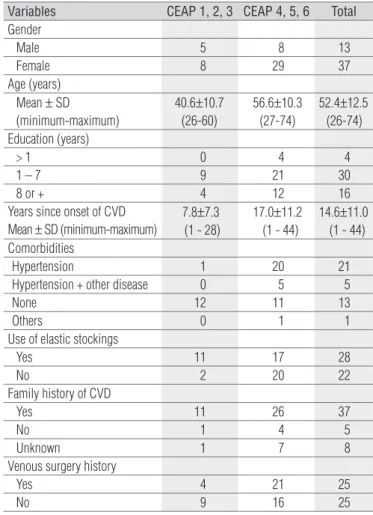
Fifty patients, comprising 37 women (74%) and 13 men (26%) aged between 26 and 74 years (52.4±12.5 years) were selected. All participants lived in the metropolitan area of Belo Horizonte and were attending the vascular surgery service of a general hospital in the capital city for treat-ment of venous disease. None of the participants was ex-cluded from the study. The clinical and demographic data are shown in Table 1.
With regard to age and the CEAP classification, it was observed that the mean age was significantly higher (p<0.001) among the individuals classified as CEAP 4, 5
Variables CEAP 1, 2, 3 CEAP 4, 5, 6 Total
Gender
Male 5 8 13
Female 8 29 37
Age (years) Mean ± SD (minimum-maximum)
40.6±10.7 (26-60)
56.6±10.3 (27-74)
52.4±12.5 (26-74) Education (years)
> 1 0 4 4
1 – 7 9 21 30
8 or + 4 12 16
Years since onset of CVD Mean ± SD (minimum-maximum)
7.8±7.3 (1 - 28)
17.0±11.2 (1 - 44)
14.6±11.0 (1 - 44)
Comorbidities
Hypertension 1 20 21
Hypertension + other disease 0 5 5
None 12 11 13
Others 0 1 1
Use of elastic stockings
Yes 11 17 28
No 2 20 22
Family history of CVD
Yes 11 26 37
No 1 4 5
Unknown 1 7 8
Venous surgery history
Yes 4 21 25
No 9 16 25
Table 1. Descriptive information on the sample.
47
56,87
90
43
87,15 86
0 10 20 30 40 50 60 70 80 90 100
CEAP4 CEAP5 CEAP6
PC score MC score
Values represent median.
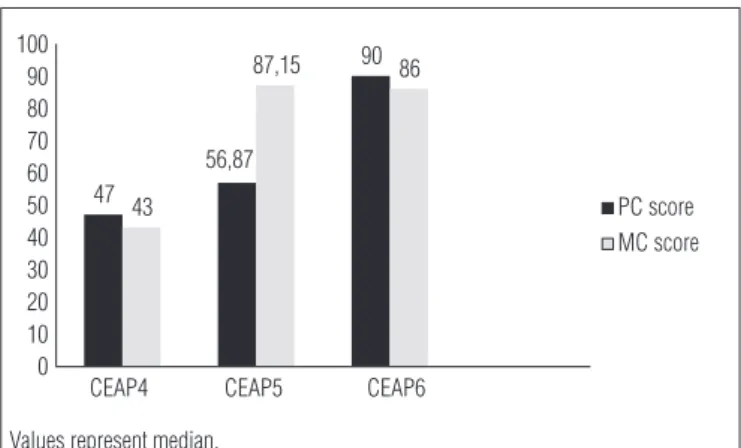
Figure 1. PC and MC scores of SF-36 in the different CEAP 4, 5 and 6 patients.
and 6 (56.6±10.3 yrs old) than among the individuals clas-sified as CEAP 1, 2 and 3 (40.6±10.7 yrs old). Most indi-viduals (68%) had had a maximum of seven years of school education, and the most prevalent associated disease was hypertension (42%). With regard to family history, 74% of the subjects reported cases of CVD in the family, and 50% reported previous venous surgery. Among the individuals classified as CEAP 4, 5 and 6, the mean duration of disease evolution (17.0 yrs) was greater than the duration among the individuals classified as CEAP 1, 2 and 3 (7.8 yrs).
A statistically signiicant diference between the PC scores (p=0.001) of the SF-36 among individuals classiied as CEAP 1, 2 and 3 and those classiied as CEAP 4, 5 and 6 was observed. In relation to the MC, no such diference was ob-served (p=0.56). When the comparison was made by domain, there were signiicant diferences between the groups for all the PC domains and for only one MC domain (Table 2).
Considering the PC of the SF-36 and the CEAP classifica-tion, there was a negative and statistically significant corre-lation (p>0.001, r=-0.479). No such correcorre-lation was observed with the MC (p=0.055, r=-0.273). Among the PC domains, all domains demonstrated significant negative correlations
with CEAP: physical role (p=0.015, r=-0.342), pain (p=0.038, r=-0.294), functional capacity (p<0.001; r=-0.479) and general health (p=0.047, r=-0.282). Among the MC domains, only the mental health domain showed a significant correlation with CEAP (P=0.031, r=-0.306).
When only the group of patients who were more clini-cally compromised (CEAP 4, 5 and 6) were evaluated in relation to the PC and MC scores of the SF-36, higher scores were observed, especially for the PC, as the disease worsened (Figure 1).
Discussion
The results from this study showed a significant negative association between QOL and CEAP. The patients who had the worst scores in the SF-36, both in the domains relating to physical health and in those regarding mental health, were those classified as CEAP 4, 5 and 6. It should be noted that the results from most authors who have investigated the relationship between QOL and CVD9, 13,14,27,28 have also
indicated worsening of QOL as the disease worsens. The population that was more severely compromised by CVD had a mean age that was significantly higher than the mean observed among the patients who were less compromised. Although CVD is not a disease restricted to the elderly, several studies have shown that its prevalence, especially in severe forms, increases with age7, 29.30. In the
present study, the patients who were more severely com-promised by CVD were those with more advanced age. In a population study carried out in the city of Omsted (USA), Heit et al.29 observed a higher incidence of varicose ulcers
among the elderly than among the nonelderly population, and another population study carried out in a region of southern Italy showed a 30% prevalence of CVD among the elderly30. In Brazil, there is little epidemiological
SF-36 questionnaire CEAP classification P value
Classes 1, 2 and 3 Classes 4, 5 and 6
Physical role 100.0 (0–100) 50.0 (0-100) 0.017*
Pain 72.0 (24-100) 42.0 (0-100) 0.001*
Physical functioning 80.0 (60-95) 40.0 (0-100) 0.001*
General health perceptions 87.0 (30-100) 57.0 (0-92) 0.048*
Social function 75.0 (50-100) 62.5 (12.5-100) 0.147
Vitality 75.0 (20-100) 45.0 (5-92) 0.159
Mental health 84.0 (32-100) 68.0 (16-100) 0.032*
Emotional role 100 (0-100) 66.6 (0-100) 0.157
Mental component 76.7 (28.6-100) 48.3 (8.6-96.5) 0.056
Physical component 83.2 (31-93) 47.0 (6.2-97.5) 0.001*
Table 2. CEAP classification and SF-36 scores.
Values represent median (minimum– maximum). * Statistical significance (p<0.05).
information relating to CVD. In a study carried out in the city of Botucatu, State of São Paulo, Maffei et al.16 observed
higher prevalence of CVD, especially the more severe forms of the disease, in groups of individuals over the age of 50 years16.
Out of the whole sample of the present study, 74% were female. Most epidemiological studies on the CVD popula-tion show higher prevalence of the disease among female subjects than among male subjects16,17. The factor of female
gender has also been identified as an important risk factor for CVD7, 21.
The domains relating to physical and mental health in the SF-36 are associated, respectively, with physical/func-tional and social/emophysical/func-tional characteristics25. Although
there have been reports of social isolation and psychologi-cal changes4, the results from the present study showed an
inverse correlation between all PC domains of the SF-36 and CEAP clinical classification and between only one MC domain and the CEAP classification. Although such asso-ciations have been of low magnitude, which means that the
r values observed were lower than 0.50, they were signifi-cant (p<0.05), thus indicating that there was indeed greater impairment of physical/functional characteristics than of social/mental characteristics in the study population, but the strength of this association was not so intense.
Population-based studies have investigated the influence of CVD on QOL12-14,28, and the results corroborate the findings
from the present study. In a multicenter study, Kurz et al.12
assessed QOL among 1135 patients with venous disease, and SF-36 was one of the instruments used. The authors ob-served that the scores for the domains relating to physical health were lower among subjects with greater severity of venous involvement (CEAP 4, 5 and 6), while there were no significant differences in scores for mental health between groups of individuals who were compromised to differing extents12, which also occurred in the present study.
Corroborating these results, Kaplan et al.13 also
ob-served an association between QOL and severity of CVD in an evaluation on 2404 individuals aged 40 to 79 years, by using the SF-36 and a classification of venous involvement similar to CEAP. The results from their study also showed a significant negative association between the PC domains of SF-36 and venous disease, but not between the MC do-mains and venous disease. However, those authors believed that the influence of CVD on the MC domains should not be ruled out, and they discuss the possibility that the is-sues that comprised the domain of mental health in SF-36 were not sensitive enough to detect changes in the CVD population13. In another population-based study, Kahn et
al.28 investigated the association between QOL and CVD in
1531 patients and demonstrated similar results, because the scores for the PC were significantly lower in individu-als with higher CEAP. However, this was not observed in the domains of mental health.
It should be noted that the assessment of QOL depends on the emotional interpretation that each individual makes regarding the facts and events and is closely related to the subjective perception of events and living conditions. The presence of a disease such as CVD with the same clinical classification in two individuals, for example, may not mean the same for these two different individuals, and the func-tional losses resulting from this disease may have different emotional and social importance for each individual2.
Andreozzi et al.14 observed significant impairment of
QOL in the population with CVD, especially in the PC do-mains of the SF-36, in patients in classes 4, 5 and 6. The group of patients with CEAP 4 showed greater involvement of the domains relating to mental health than of those re-lating to physical health, and also showed worse scores in SF-36 than did patients with clinical classifications of CEAP 5 and 6. These authors believed that patients with open ulcers (class 6) or healed ulcers (class 5) who were already at an advanced stage of the disease had gradually adapted to the conditions imposed by CVD14. In the present
study, when the results from the SF-36 scores in patients classified as CEAP 4, 5 and 6 were observed separately, it could be seen that there were higher scores as the disease worsened, which means that there was a trend for patients with more advanced forms of the disease to have a poorer perception of their QOL, especially in relation to the PC domains of the SF-36.
Although generic instruments such as the SF-36 reflect the impact of disease on general aspects of health and have the advantage of allowing comparisons between individu-als with different diseases, they are less sensitive for ex-ploring the effects of illness on QOL among individuals or populations with a specific disease13,20. It is possible that
inclusion of specific instruments for assessment might be more sensitive for identifying the real impact of disease on the QOL of the population with CVD20.
he symptoms caused by CVD can also directly inluence QOL5, but their presence, intensity and duration were not
evaluated in the present study. he presence of symptoms such as throbbing, itching, pain and cramps is associated with limi-tations to activities of daily living and functional performance, along with psychological changes and changes to perceptions of health condition5 ,7-11. In addition to symptoms, other points
1. Ebrahim S. Clinical and public health perspectives and applications of health-related quality of life measurement. Soc Sci Med. 1995;41(10): 1383-94.
2. Higginson IJ, Carr AJ. Measuring quality of life: using quality of life measures in the clinical setting. BMJ. 2001;322(7297):1297-300.
3. Seidl EMF, Zannon CMLC. Qualidade de vida e saúde: aspectos conceituais e metodológicos. Cad Saúde Pública. 2004;20(2):580-8.
4. van Korlaar I, Vossen C, Rosendaal F, Cameron L, Bovil E, Kaptein A. Quality of life in venous disease. Thromb Haemost. 2003;90(1):27-35.
5. Lamping DL. Measuring health-related quality of life in venous disease: practical and scientific considerations. Angiology. 1997;48(1):51-7.
6. Porter JM, Moneta GL. Reporting standards in venous disease: an update. International consensus committee on chronic venous disease. J Vasc Surg. 1995;21(4):635-45.
7. Bergan JJ, Schmid-Schonbein GW, Smith PD, Nicolaides AN, Boisseau MR, Eklof B. Chronic venous disease. N Eng J Med. 2006;355(5):488-98.
8. Lamping DL, Schroter S, Kurz X, Kahn SR, Abenhaim L. Evaluation of outcomes in chronic venous disorders of leg: development of a scientifically rigorous, patient-reported measure of symptoms and quality of life. J Vasc Surg. 2003;37(2):410-9.
9. Duque MI, Yosipovitch G, Chan YH, Smith R, Levy P. Itch, pain, and burning sensation are common symptoms in mild to moderate chronic venous insufficiency with an impact on quality of life. J Am Acad Dermatol. 2005;53(3):504-8.
10. Chiesa R, Marone EM, Limoni C, Volontè M, Petrini O. Chronic venous disorders: correlation between visible signs, symptoms, and presence of functional disease. J Vasc Surg. 2007;46(2):322-30.
11. Chiesa R, Marone EM, Limoni C, Volonté M, Schaefer E, Petrini O. Effect of chronic venous insufficiency on activities of daily living and quality of life: correlation of demographic factors with duplex ultrasonography findings. Angiology. 2007;58(4):440-9.
12. Kurz X, Lamping DL, Kahn SR, Baccaglini U, Zuccarelli F, Spreafico G, et al.Do varicose veins affect quality of life? Results of an international population-based study. J Vasc Surg. 2001;34(4):641-8.
13. Kaplan RM, Criqui M, Denenberg JO, Bergan J, Fronek A. Quality of life in patients with chronic venous disease San Diego population study.J Vasc Surg. 2003;37(5):1047-53.
14. Andreozzi GM, Cordova R, Scomparin A, Martini R, D’Eri A, Andreozzi F, et al. Quality of life in chronic venous insufficiency. An Italian pilot study of the Trivineto region. Int Angiol. 2005;24(3):272-7.
15. Silva MdeC. Chronic venous insufficiency of the lower limbs and its socio-economic significance. Int Angiol. 1991;10(3):152-7.
16. Maffei FH, Magaldi C, Pinho SZ, Lastoria S, Pinho W, Yoshida WB, et al. Varicose veins and chronic venous insufficiency in Brazil: prevalence among 1755 inhabitants of a country town. Int J Epidemiol. 1986;15(2): 210-7.
17. Scuderi A, Raskin B, Al Assal F, Scuderi P, Scuderi MA, Rivas CE, et al. The incidence of venous disease in Brazil based on the CEAP classification. Int Angiol. 2002;21(4):316-21.
18. Franks PJ, Moffatt CJ. Health related quality of life in patients with venous ulceration: use of the Nottingham health profile. Qual Life Res. 2001;10(8):693-700.
19. Ciconelli RM. Medidas de avaliação de qualidade de vida. Rev Bras Reumatol. 2003;43(2):9-13.
20. Carr AJ, Thompson PW, Kirwan JR. Quality of life measures. Br J Rheumatol. 1996;35(3):275-81.
21. Roaldsen KS, Rollman O, Torebjörk E, Olsson E, Stanghele JK. Functional ability in female leg ulcer patients-a challenge for physiotherapy. Physiother Res Int. 2006;11(4):191-203.
22. Guyatt GH, Feeny DH, Patrick DL. Measuring health-related quality of life. Ann Intern Med. 1993;118(8):622-9.
23. Eklöf B, Rutherford RB, Bergan JJ, Carpentier PH, Gloviczki P, Kistner RL, et al. Revision of the CEAP classification for chronic venous disorders: consensus statement. J Vasc Surg. 2004;40(6):1248-52.
24. Carpentier PH, Cornu-Thénard A, Uhl JF, et al. Appraisal of the information content of the C classes of CEAP clinical classification of chronic venous disorders: a multicenter evaluation of 872 patients. J Vasc Surg. 2003;37(4):837-3.
Conclusion
Individuals with CVD present impaired QOL, especially those with more severe venous involvement (CEAP 4, 5 and 6). Physical and functional characteristics were compro-mised more severely in this population, but the possibility that emotional characteristics might also be compromised cannot be ruled out.
Assessment of QOL among patients with CVD is often neglected by professionals dealing with this population. It is important to emphasize that such assessments can provide important information on limitations imposed by the disease on individuals’ lives that often cannot be obtained in traditional evaluations, and that such assess-ments can direct professionals towards the best therapeu-tic approach.
104
25. Ciconelli RM, Ferraz MB, Santos W, Meinão I, Quaresma MR. Tradução para a língua portuguesa e validação do questionário genérico de avaliação de qualidade de vida SF-36 (Brasil SF-36). Rev Bras Reumatol. 1999;39(3):143-50.
26. Gadotti IC, Vieira ER, Magee DJ. Importance and clarification of measurement properties in rehabilitation. Rev Bras Fisioter. 2006;10(2): 137-46.
27. Portney LG, Watkins MP. Foundations of clinical research applications to practice. 3ª ed. New Jersey: Pearson Education; 2008.
28. Kahn SR, M’lan CE, Lamping DL, Kurz X, Bérard A, Abenhaim LA, et al. Relationship between clinical classification of chronic venous disease and patient-reported quality of life: results from an international cohort study. J Vasc Surg. 2004;39(4):823-8.
29. Heit JA, Rooke TW, Silverstein MD, Mohr DN, Lohse CM, Petterson TM, et al. Trends in the incidence of venous stasis syndrome and venous ulcer: a 25-year population-based study. J Vasc Surg. 2001;33(5):1022-7.