M
ETHODOLOGICALA
RTICLE Revista Brasileira de FisioterapiaCross-cultural adaptation of the Gross Motor
Function Classification System into
Brazilian-Portuguese (GMFCS)
Adaptação transcultural para o Brasil do sistema de classificação da função
motora grossa (GMFCS)
Erika Hiratuka¹, Thelma S. Matsukura², Luzia I. Pfeifer³
Abstract
Background: Due to the complexity of clinical symptoms of cerebral palsy and the difficulties in classifying it based upon the motor types and the topography of the body distribution only, Canadian researchers have proposed the Gross Motor Function Classification System (GMFCS). Although this classification system has been largely used in Brazil, it has not been cross culturally adapted yet. Objectives: To perform the cross adaptation of the Gross Motor Function Classification System for the Cerebral Palsy (GMFCS) into Brazilian-Portuguese and to verify the reliability among observers of the adapted instrument in Brazilian children. Methods: This study was performed in two stages; the first stage was related to the process of cross-cultural adaptation and the second stage tested the instrument. Translation, back-translation, semantic and content analysis, back-translation of the final version and the approval of the authors were used for the cross-cultural adaptation. The test of the instrument was performed in 40 children with cerebral palsy, who were evaluated by two raters to verify the reliability among the observers. Results: The results showed that the stages of translation and back-translation did not present any difficulties and the semantic and conceptual equivalence was achieved. The reliability among the observers showed that the evaluations do not differ and that there is an excellent correlation and internal consistency of the construct with an ICC of 0.945 (95% CI 0.861 to 0.979) and a Cronbach α of 0.972. Conclusions: The final version of the GMFCS showed good potential of applicability for undergraduate students and professionals of the neuropediatric area.
Keywords: translation; cerebral palsy; classification.
Resumo
Contextualização: Em função da complexidade das manifestações clínicas da paralisia cerebral (PC) e das dificuldades na sua classificação baseada apenas nos tipos motores e topografia de distribuição corporal, estudiosos canadenses propuseram o Gross Motor Function Classification System (GMFCS). Apesar de esse sistema de classificação estar sendo bastante utilizado no Brasil, ele ainda não havia sido adapatado transculturalmente para tal. Objetivos: Realizar a adaptação transcultural para o Brasil do Sistema de Classificação da Função Motora Grossa (GMFCS) para a PC e verificar a confiabilidade entre observadores do instrumento adaptado com crianças brasileiras. Métodos: Este estudo consistiu em duas etapas, sendo a primeira relacionada com o processo de adaptação transcultural, e a segunda referente à testagem do instrumento. A adaptação transcultural do instrumento foi feita por meio da tradução, retrotradução, análise semântica, análise de conteúdo, retrotradução da versão final e aprovação dos autores do instrumento. A testagem do instrumento ocorreu junto a 40 crianças com PC, as quais foram avaliadas por dois examinadores para verificar a confiabilidade entre observadores. Resultados: Os resultados demonstram que as etapas de tradução e retrotradução não apresentaram dificuldades, e a equivalência semântica e a conceitual foram obtidas. A confiabilidade entre examinadores demonstrou que as avaliações quase não diferiam e que havia excelente correlação e consistência interna do constructo, com coeficiente de correlação intraclasse (ICC) de 0,945 (com intervalo de 0,861 a 0,979) e α de Cronbach de 0,972. Conclusões: A versão final do GMFCS mostrou bom potencial de aplicabilidade por graduandos e profissionais da área de neuropediatria.
Palavras-chave: tradução (produto); paralisia cerebral; classificação.
Received: 03/12/2009 – Revised: 29/06/2010 – Accepted: 03/09/2010
¹ Occupational Therapist
² Department of Occupational Therapy, Universidade Federal de São Carlos (UFSCar), São Carlos, SP, Brazil ³ Department of Neurosciences and Behavioral Sciences, Universidade de São Paulo (USP), Ribeirão Preto, SP, Brazil
Correspondence to: Thelma Simões Matsukura, Departamento de Terapia Ocupacional, UFSCar, Rodovia Washington Luis, Km 235, CEP 13565-905, São Carlos, SP, Brasil, e-mail: [email protected]
Introduction
Cerebral palsy (CP) is described as a series of motor and postural development disorders that cause functional limita-tions attributed by non-progressive disorders occurring in the Central Nervous System (CNS) during fetal development or during the irst two years of life1-3. he prevalence of CP ranges from 1.5 to 2.5 per 1,000 live births, with little or no diference among Western nations, despite the lack of data referent to Latin-American countries4. In Brazil, there are no speciic data in relation to the number of CP cases, however, the 2000 census registered 24.5 million people with some sort of impairment (14.5% of the Brazilian population), among which 23% had mo-tor impairments, including CP patients5.
he CP has traditionally been described based on the type of clinical manifestation (motor type) as well as on the body location (topography). With regards to the motor type, it can be classiied as spastic, athetoid, ataxic, hypotonic and mixed and; as for the topography, it can be classiied as hemiplegic, diplegic and quadriplegic1,6,7. Because it is distributed in a wide spectrum, there are many diferences related to the mo-tor impairment and functional limitations, which cannot be discriminated within these two classiications. herefore, the clinical and scientiic community often used inconsistent ter-minologies to describe the disability of children with CP such as “mild”, “moderate” or “severe”8,9.
Due to the complexity of the clinical manifestations of the CP and the diiculties in its classiication, researchers linked to the Canchild Centre for Childhood Disability Research de-veloped the Gross Motor Function Classiication System (GMFCS)10 as an attempt to standardize the evaluations with regards to the degree of motor impairment of individuals with CP from infant to 12-year old. he GMFCS has been widely accepted and used in research and in clinical practice, since it provides a simple, valid, and reliable way of classifying a complex phenomenon, besides being an instrument which has been validated for the English language and having an excellent levels of reliability11.
he goal of the GMFCS is to classify the child’s gross mo-tor function emphasizing in the “sitting” and “walking” move-ments through ive motor levels presented in each of the four age groups (0-2, 2-4, 4-6, and 6-12 years old), characterizing the child’s motor performance by taking into account diferent contexts such as home, school, and community spaces11.
he GMFCS is an extremely important instrument for pro-fessionals who work with children with CP, since it allows the establishment of appropriate therapeutic goals according to the patient’s age and motor level, and thus ensure an appropri-ate care for each subject7.
he GMFCS is able to predict the prognosis of the gross motor function of children with CP, since there is a tendency for children with lower motor development potential to reach their limits more quickly than children with higher potentials12. he classiication of the child in relation to the motor GMFCS levels remains stable over time, certifying that, not only ensure a greater uniformity in the classiication of the gross motor function but also this instrument predict the prognosis for children with CP12,13.
In the last years, GMFCS has been widely used both in clinical practice as well as in research in Brazil7,14-17. Until very recently, the adaptation of instruments developed in another culture and often in another language, were only simply translated into the language of the country where it will going to be used or, at most, a literal comparison of it with the back-translation18. Nowadays several authors suggest that the process of cross-cultural adaptation of an instrument must follow more stringent steps, including se-mantic evaluation, and also considering aspects of the cul-tural background and lifestyle of the target population19-22. Thus, it is important that the GMFCS undergoes a process of cross-cultural adaptation, which will bring benefits for the target population, in this case, undergraduate students, health professionals and researchers involved in the health-care of children with CP.
herefore, the objectives of this study were to perform a cross-cultural adaptation of the GMFCS for the Brazilian population and to assess the reliability of the observers of the translated version.
Methods
his study was divided into two phases, the irst related to the cross-cultural adaptation procedure, and the second phase concerning the testing of the instrument.
Cross-cultural adaptation
he objective of this phase was to translate and adapt the instrument for the Brazilian population, with the follow-ing steps: translation, semantic analysis of the items, content analysis or judging and back-translation of the instrument.
Participants
with luency in English (P2); and an university professor with experience in pediatric neurology ield (P3).
Back-translation phase of the version 1 of the instru-ment: one participant (P4), a linguist with a undergradu-ate degree in Languages, with fluency in English and translation experience in the field of pediatric neurology, although not familiar with the original version of the GM-FCS in English.
he stage of semantic analysis of the items: sixteen partici-pants divided into two groups of potential users of the instru-ment, one group composed by less skilled participants (lower stratum) represented here by seven 3rd and 4th-year undergrad-uate students of Occupational herapy and Physical herapy courses, and another group formed by higher skilled par-ticipants (highest stratum), represented here by ive university professors (with a doctoral or masters degree), working in the pediatric neurology ield and four pediatric neurology profes-sionals (physical therapists and occupational therapists), who have been working for more than two years and with clinical experience in this area.
he phase of content analysis or judging: nine participants, the same ones that composed the highest stratum group in the semantic analysis.
Back translation of the inal version of the instrument: two participants, a linguist (who also participated in the back translation phase of the version 1 of the instrument –P4), and an occupational therapist (who also participated in the initial phase of the translation – P1).
Procedures
he procedures used in the process of cross-cultural adap-tation of the GMFCS followed the proposals for translation and adaptation of instruments developed in other linguistic and sociocultural contexts, based on studies carried out by Beaton et al.19 and Herdman, Fox-Rushby and Badia20. he procedures used to perform the semantic analysis and content analysis, with also comprise the steps of cross-cultural adaptation, were based on the studies by Pasquali22-24, in a way that the whole process of cross-cultural adaptation of the GMFCS followed six phases, which are described below:
Phase 1 – Authorization from the instrument’s
authors
A request to authorize the translation of the instrument was submitted to the authors of the GMFCS10for CP, and the translation procedures were only initiated after this permis-sion was granted.
Phase 2 – Initial translation
Firstly, the translation from the original English version into Portuguese was performed by P1. his translation was checked and discussed with P2, who received the original English version, read it aloud, and translated it from English to Portuguese. During this reading, P1 followed the already translated version into Portu-guese, writing down the diferences found between both versions.
hen, P3 conducted a review of the two translations, giving suggestions to the preliminary version (version 1) to be back-translated. he version 1 of the instrument was produced after this phase.
Phase 3 – Back-translation of the version 1
After inishing the translation of the version 1, P4 carried out the back-translation of this version into the mother tongue of the instrument (English), according to the procedures de-scribed by Beaton et al.19 and Herdman, Fox-Rushby and Ba-dia20. hen, a comparison between the back-translated version 1 and the original version of the instrument was performed by P1 and P4, resulting after this analysis the version number 2.
Phase 4 – Semantic analysis of the items
Version 2 was subjected to a semantic analysis, which con-sists in verifying whether the terms used in the items and para-graphs of the instrument were clear. According to Pasquali22, this phase must be carried out by two diferent groups: the lower stratum group, represented by people with less skills who will use the instrument, and the highest stratum group, represented by higher skilled people in this area in question.
Participants in this phase received a semantic analysis form, as well as the version 2 of the GMFCS, followed by instructions on how to illing in the items contained in the form. After com-pleted, it was then handed over to one of the researchers.
Phase 5 – Content analysis or judging analysis
he version 3 of the instrument was elaborated after the se-mantic analysis performed by the two stratum groups, and also after comparing the highest stratum participants’ suggestions to the literature of pediatric neurology ield. his version was handed back to the participants of the highest stratum group (called here the judges) in order for them to analyze the content of the instrument and to indicate whether they agreed or dis-agreed with the item/paragraph being evaluated. A qualitative empirical analysis was conducted as proposed by Pasquali22
,in which veriies the agreement index. he proposed formula for
this analysis is C + D X C 100, being C the total agreement number
and D the total disagreement number.
Phase 6 – Back-translation of the final version and
submission to the authors
After the content analysis, a new version of the translation was elaborated, called as the inal version, which was translated again into English by P1 and P4, being this back-translated version sent to the authors of the instrument for veriication and approval.
Instruments used in the semantic analysis of the
items and content analysis (or judging analysis)
phases
Semantic analysis form: it was developed by the researchers based on the study carried out by Pasquali22-24 with the objective to verify whether the terms used in the paragraphs and the items of the version 2 of the GMFCS were clear to be used by the target population (undergraduate students and professionals in the pe-diatric neurology ield). Being an analysis that veriies the clarity of the words, the technical terminology and the understanding of the phrases, the participants were given two response alterna-tives: understandable and non-understandable. By checking the non-understandable option, the participants were requested to justify their choice and make suggestions for improvement.
Content analysis form: it was developed by the researchers based on the study carried out by Pasquali22, in order to verify whether the paragraphs and items of the version 3 of the GMFCS referred to the attribute in question, in this instrument, is actu-ally gross motor function of children with CP. By analyzing the contents of the instrument, the participants of this phase had the options to respond agree or disagree. By checking the dis-agree option, the participant should justify their reasons.
Application of the instrument and inter-rater
reliability test
After the approval of the inal version by the authors, the in-strument was used in order to verify its applicability among the Brazilian population. Moreover, the inter-rater reliability test was carried out in order to demonstrate the reproducibility of the assessment.
Participants
he participants were 40 children diagnosed with CP, with age varying from 8 months old to 11 years and four months
old, who were receiving outpatient care in a tertiary university hospital. here were 10 children in each age group, according to the GMFCS distribution (children under 2 years of age, 2 to 4 years old, 4 to 6 years old and 6 to 12 years old). hese children were evaluated by a professor with doctoral degree and with an occupational therapy background, with more than 20 years of experience (both clinically and educational) in the pediatric neurology ield.
In order to perform a comparison between the raters, 45% sample were randomly selected, in such a way that at least 30% of each age group were contemplated, resulting in a total of 18 pairs of observations to be compared. hese 18 children were classiied using the inal version of the GMFCS by another rater (an occupational therapist with more than 5 years of experience in the pediatric neurology ield) in order to verify the reliability inter-observers of the instrument. he statistical analyses were performed using the Statistical Package for Social Sciences (SPSS) program, version 17.0. To verify the level of correlation between two measurements, the intraclass correlation coef-icient (ICC)25 was used, with a 95% conidence interval, and in order to evaluate the internal consistency of the construct, Cronbach’s α26 was used.
Ethic procedures
Since it is a research involved human subjects, the pres-ent study was submitted to and approved by the Human Ethics Committee of the Universidade Federal de São Carlos (UFSCar), São Carlos, SP, Brazil, under the protocol nº CAAE: 149/2006, following the terms of decree 196/96, and all partici-pants or guardians were informed about the objectives of the study, and after conirming their interest in participating in the experiment, they signed a informed consent form.
Results
After authorization by the authors of the original version of the GMFCS, the process of cross-cultural adaptation was initi-ated. he diferences identiied in the translations of the origi-nal instrument into Portuguese, performed by the participants P1, P2 and P3 were related to the terminology or to contents that were speciic to the pediatric neurology ield; which we decided to keep the terms that appeared in at least two of the translations. hese results are shown in Table 1.
group. he terms that were considered more suitable for most of them were adopted, conirmed by a bibliographic review in the pediatric neurology ield. Table 2 shows the terms that were questioned by the participants of the phase 4 of this study, as well as the number of disagreements in each stratum and the suggestions given by the components of the highest stratum group.
After this phase, a new version (version 3) was given to the participants of the highest stratum group, which they indicated whether they agreed or not with each paragraph or item of this version hen, the number of agreements and disagreements for each item and paragraph was calculated and to considered them relevant, the calculation method for percentage of agree-ment as proposed by Pasquali22 was applied, where an item should be considered relevant if it present of percentage of agreement of at least 80% among the judges.
he results of this phase showed that, from the six para-graphs and 24 items analyzed, only two parapara-graphs and ive items had minor questioning from some of the participants. However, as the percentage of agreement was 88.8%, which does not characterize a signiicant number of disagreements and remaining below the percentage of agreement used as a criterion, no content changes were performed to version 3.
herefore, the back-translation that was sent to the authors of the original version of the instrument was performed from the version 3, called inal version, which was approved by the authors without any change requested.
he inal version was tested in a random sample of children with CP who were receiving outpatient care in a tertiary uni-versity hospital. A previous selection was performed aiming to obtain 10 children in each age group.
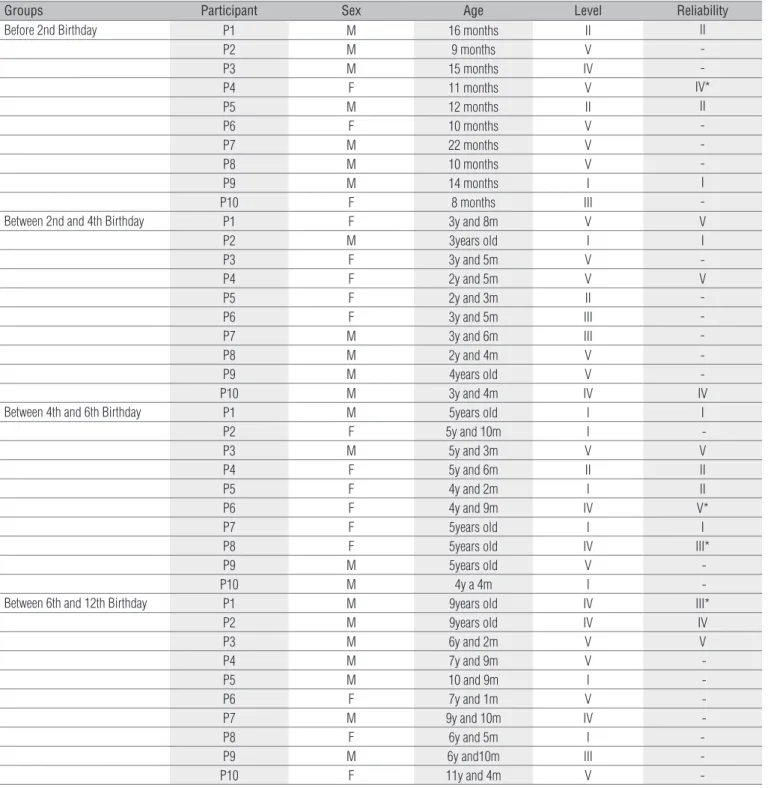
he results of this phase showed that the instrument was able to classify the children’s motor levels. All levels were iden-tiied during the evaluation, in all groups, with the largest num-ber of children being classiied into level V (n=16), followed by level I (n=9), and then level IV (n=7), as shown in Table 3.
he inter-rater reliability showed that there were virtually no diferences between the examiners and there was a strong and signiicant correlation, with an ICC of 0.945, with a 95% conidence interval ranging from 0.861 to 0.979. With regards to internal consistency of the instrument, the Cronbach α
value obtained was 0.972.
Discussion
he World Health Organization (WHO) recommends the translation and cultural adaptation of the existing assessment tools, since it facilitates the communication between diferent researchers and the comparison of data obtained on an inter-national level27. However, in order to be used in a new country or culture (even within the same country) the adaptation of an instrument requires a method that guarantees the equivalence between the original and adapted versions of the instrument.
Term P1 P2 P3 Versão 1
1 Parte inferior do tronco Base da coluna Parte inferior do tronco Parte inferior do tronco 2 Limitações físicas Dificuldades físicas Prejuízos físicos Prejuízos físicos 3 Engatinham com reciprocação Engatinham em padrão recíproco Engatinham em padrão alternado Engatinham em padrão alternado 4 Carregadas Transportadas Carregadas Carregadas 5 Membros superiores Braços Membros superiores Membros superiores 6 Impulsionam a cadeira de rodas Manejam a cadeira de rodas Manejam a cadeira de rodas Manejam a cadeira de rodas
7 Lactentes Bebês Bebês Bebês
Table 1. Differences among the three translators and suggestions presented for Version 1.
Questioned Terms Number of disagreements from
High Level Participants
Number of Disagreements of Low
Level Participants Selected Terms
Entrar e sair da posição (sentada, em pé) 4 2 Sentar-se e levantar-se
Tracionar-se 3 1 Puxar-se
Aparelhos assistivos de locomoção 2 0 Aparelhos auxiliares de locomoção
Rastejar em prono 1 0 Arrastar-se
Prejuízos físicos 4 0 Deficiências físicas
Mobilidade 3 1 Locomoção
Habilidades emergentes 2 2 Inicia habilidades Habilidades motoras grossas 1 0 Habilidades motoras globais Extensas adaptações 2 1 Muitas adaptações
Cruzar 1 0 Andar de lado
Table 2. Terms that were questioned, the number of disagreements by two levels of participants and the selected term.
Not only a well-performed linguistic translation of its items is needed, but also a cultural adaptation is necessary, with the goal of maintaining the content validity of the instrument19,28.
he GMFCS was submitted to a procedure of cross-cultural adaptation following a strict criteria proposed by Beaton et al.19, Herdman, Fox-Rushby and Badia20 and Pasquali22. he participa-tion of diferent professionals during the phase of translaparticipa-tion into Portuguese endorsed that the version 1 of the GMFCS presented a language suitable not only with regards to the structure of the
Portuguese language, but also relevant to the area of knowledge of pediatric neurology. he process of back-translation into the original language is quite important, as it aims to ensure that the contents of the original version are preserved in the translated version19. he results showed that the translation and back-translation phases presented no diiculties, and the semantic and conceptual equivalence being obtained.
he semantic analysis phase tried to adjust the language, in order to make the instrument easy to understand. he
Table 3. Participants Children Characteristics from Step 7 – applicability and inter-rater reliability.
* Disagreement between observers.
Groups Participant Sex Age Level Reliability
Before 2nd Birthday P1 M 16 months II II
P2 M 9 months V
-P3 M 15 months IV
-P4 F 11 months V IV*
P5 M 12 months II II
P6 F 10 months V
-P7 M 22 months V
-P8 M 10 months V
-P9 M 14 months I I
P10 F 8 months III
-Between 2nd and 4th Birthday P1 F 3y and 8m V V
P2 M 3years old I I
P3 F 3y and 5m V
-P4 F 2y and 5m V V
P5 F 2y and 3m II
-P6 F 3y and 5m III
-P7 M 3y and 6m III
-P8 M 2y and 4m V
-P9 M 4years old V
-P10 M 3y and 4m IV IV
Between 4th and 6th Birthday P1 M 5years old I I
P2 F 5y and 10m I
-P3 M 5y and 3m V V
P4 F 5y and 6m II II
P5 F 4y and 2m I II
P6 F 4y and 9m IV V*
P7 F 5years old I I
P8 F 5years old IV III*
P9 M 5years old V
-P10 M 4y a 4m I
-Between 6th and 12th Birthday P1 M 9years old IV III*
P2 M 9years old IV IV
P3 M 6y and 2m V V
P4 M 7y and 9m V
-P5 M 10 and 9m I
-P6 F 7y and 1m V
-P7 M 9y and 10m IV
-P8 F 6y and 5m I
-P9 M 6y and10m III
-* This version is available on the Can Child website in the following address: http://canchild-mgm.icreate3.esolutionsgroup.ca/en/GMFCS/resources/GMFCS_portuguese.pdf
participation of two diferent groups in this phase ensured the appropriateness of the language and the applicability of the GMFCS for a target-public with varied degrees of knowledge and skills in the area. hat is what Pasquali22,23 called knowledge stratum, being the lower stratum represented in this study by undergraduate students of physical therapy and occupational therapy, and the highest stratum represented by professors and professionals with vast experience in the pediatric neurology ield.
According to Pasquali22, the participation of individu-als from the lower stratum aims to determine whether the items and the paragraphs contained in the instrument are understandable to the target population with lower academic skills (i.e. people who will use the instrument in their clinical practice); while the participation of highest stratus aims to not only at the better understanding and clarity of the items and paragraphs, but also to avoid to awkwardness of the language used in the translated version of the instrument.
he content analysis aims to determine whether the items and paragraphs of the instrument refer, in fact, to the latent attribute, i.e. if they referred to the gross motor function of the children with CP22,23. From the suggestions about the changes presented by the participants in the highest stratum group (called expert judges), it was possible to adjust the terminolo-gies used in the translated version of the GMFCS, producing the inal version*.
he Portuguese version contributes to comparative stud-ies with other countrstud-ies, since GMFCS versions are available in at least 10 languages and it has been highly cited in the lit-erature, which reinforces such a classiication in the scientiic community8.
he application of the inal version of the GMFCS in chil-dren with CP showed a distribution that spread across all levels of classiication, despite inding a majority of cases classiied as level V, which may be justiied by the fact that the participants of this phase were undergoing a therapeutic process in a tertiary level care service. According to the study conducted by Pfeifer
et al.7, 100 children in that service, there is a predominance of quadriplegic CP cases, which are usually classiied as level V.
Although the sample of the present study is smaller than the study conducted by Pfeifer et al.7, the distribution of the motor levels was similar to their study, since in three age groups pro-posed by the instrument (under 2 years of age, from 2 to 4 years old, and from 6 to 12 years old) there was a predominance of level V, and in the 4-6 age group there was a predominance of level I.
In relation to the agreement between the two raters, it was found through statistical tests that the evaluations did not dif-fer and that there is a strong correlation between the scores. he closer the coeicient is to 1, the stronger the correlation, being the agreement between the raters classiied as poor (<0.4), moderate (0.4 to 0.75) or excellent (>0.75)29. According to this criterion, it was veriied that the result of the application of this instrument in children with CP showed that there was an excellent correlation between the examiners, which ensures the adequacy of the inal translated version of the GMFCS.
It is considered that an instrument has a good internal consistency when the alpha values are greater than 0.7030 and, according to this criterion, the inal translated version of the GMFCS respects the original version of the instrument.
Some of the limitations found cannot be ignored, because, being a preliminary study, the inal version of the GMFCS, translated and adapted for the Brazilian population, was ap-plied to a small sample of children with CP and within the same healthcare service, and the reliability was carried out by two professionals belonging to the group that had a higher level of expertise in the area. herefore, further studies are needed.
Ackowledgements
To the Professionals and children who participated in this study. Jair Lício dos Santos, for his contribution in the statisti-cal analysis.
References
Schwarztman JS. Paralisia cerebral. Arquivos Brasileiros de Paralisia Cerebral. 2004;1(1): 1.
4-17.
Krigger KW. Cerebral Palsy: an overview. Am Fam Physician. 2006;73(1):91-100. 2.
Bax M, Goldstein M, Rosenbaum P, Leviton A, Paneth N, Dan B, et al. Proposed 3.
definition and classification of cerebral palsy, April 2005. Dev Med Child Neurol. 2005;47(8):571-6.
Paneth N, Hong T, Korzeniewski S. The descriptive epidemiology of cerebral palsy. Clin 4.
Perinatol. 2006;33(2):251-67.
Brasil, Ministério da Saúde. Política nacional da pessoa portadora de deficiência. Brasília; 2009. 5.
Hagberg B, Hagberg G. The origins of cerebral palsy. In: David TJ, editor. Recent advances in 6.
paediatrics XI. Edinburgh: Churchill Livingstone; 1993. p. 67-83.
Pfeifer LI, Silva DBR, Funayama CAR, Santos JL. Classification of cerebral palsy: association 7.
between gender, age, motor type, topography and gross motor function. Arq Neuropsiquiatr. 2009;67(4):1057-61.
Morris C. Development of the gross motor function classification system (1997). Dev Med 8.
Child Neurol. 2008;50(1):5.
Rosenbaum PL, Palisano RJ, Bartlett DJ, Galuppi BE, Russell DJ. Development of the 9.
Gross Motor Function Classification System for cerebral palsy. Dev Med Child Neurol. 2008;50(4):249-53.
Palisano RJ, Rosenbaum P, Russell D, Wood E, Galuppi B. Development and reliability of a 10.
system to classify gross motor function in children of cerebral palsy. Dev Med Child Neurol. 1997;39(4):214-23.
Morris C, Bartlett D. Gross Motor Function Classification System: impact and utility. Dev Med 11.
Child Neurol. 2004;46(1):60-5.
Rosenbaum P, Walter SD, Hanna SE, Palisano RJ, Russell DJ, Raina P, et al. Prognosis 12.
for gross motor function in cerebral palsy: creation of motor development curves. JAMA. 2002;288(11):1357-63.
Wood E, Rosenbaum P. The gross motor function classification system for cerebral palsy: a 13.
study of reliability and stability over time. Dev Med Child Neurol. 2000;42(5):292-6.
Mancini MC, Alves ACM, Schaper C, Figueiredo EM, Sampaio RF, Coelho ZA, et al. Gravidade 14.
da paralisia cerebral e desempenho funcional. Rev Bras Fisioter. 2004;8(3):253-60.
Cury VCR, Mancini MC, Melo AP, Fonseca ST, Sampaio RF, Tirado MGA. Efeitos do uso 15.
de órtese na mobilidade funcional de crianças com paralisia cerebral. Rev Bras Fisioter. 2006;10(1):67-74.
Vasconcelos RLM, Moura TL, Campos TF, Lindquist ARR, Guerra RO. Avaliação do desempenho 16.
funcional de crianças com paralisia cerebral de acordo com níveis de comprometimento motor. Rev Bras Fisioter. 2009;13(5):390-7.
Chagas PSC, Defilipo EC, Lemos RA, Mancini MC, Frônio JS, Carvalho RM. Classificação 17.
da função motora e do desempenho funcional de crianças com paralisia cerebral. Rev Bras Fisioter. 2008;12(5):409-16.
Reichenhein ME, Moraes CL. Operacionalização de adaptação transcultural de instrumentos de 18.
aferição usados em epidemiologia. Rev Saúde Pública. 2007;41(4):665-73.
Beaton DE, Bombardier C, Guillemin F, Ferraz MB. Guidelines for the process of Cross-19.
cultural adaptation of self-report measures. Spine (Phila Pa 1976). 2000;25(24): 3186-91.
Herdman M, Fox-Rushby F, Badia X. A model of equivalence in the cultural adaptation of 20.
HRQoL instruments: the universalist approach. Qual Life Res. 1998;7(4):323-35.
Behling O, Law KS. Translating questionnaires and other research instruments: problems and 21.
solutions. Thousand Oaks: Sage; 2000.
Pasquali L. Princípios de elaboração de escalas psicológicas. Rev Psiquiatr Clínica. 22.
1998;25(5):206-13.
Pasquali L. Técnicas de exame psicológico – TEP: manual. São Paulo: Casa do Psicólogo; 2001. 23.
Pasquali L. Psicometria: teoria dos testes na psicologia e na educação. Petrópolis: Editora 24.
Vozes; 2003.
Siegel S, Castellan NJ. Estatística não paramétrica para ciências do comportamento. 2ª ed. 25.
Porto Alegre: Artmed; 2006.
Mengarda CV, Passos EP, Picon P, Costa AF, Picon PD. Validação de versão para o português 26.
de questionário sobre qualidade de vida para mulher com endometriose. Rev Bras Ginecol Obstet. 2008;30(8):384-92.
World Health Organization. The World Health Organization Quality of Life Assessment (WHOQOL): 27.
position paper from the World Health Organization. Soc Sci Med. 1995;41(10):1403-9.
Sant`Anna MMM, Blascovi-Assis SM, Magalhães LC. Adapatação transcultural dos protocolos 28.
de avaliação do modelo lúdico. Rev Ter Ocup. 2008;19(1):34-47.
Fleiss JL, Levin B, Paik MC. Statistical methods for rates and proportions. New Jersey: John 29.
Wiley & Sons; 2003.
Streiner DL, Norman GR. Health measurement scales: a practical guide to their development 30.