AR
TICLE
1 Departamento de Saúde Coletiva, Universidade de Brasília. Campus Universitário Darcy Ribeiro, Asa Norte. 70910-900 Brasília DF Brasil. joaopaulo.aoliveira@ gmail.com
The
Mais Médicos
(More Doctors) Program:
the placement of physicians in priority municipalities
in Brazil from 2013 to 2014
Abstract The inadequate placement and distri-bution of health professionals are problems that occur in various countries. The scope of the “Pro-grama Mais Médicos” (More Doctors Program) was to reduce the shortfall of physicians and di-minish regional inequalities in health. A descrip-tive study on the placement of physicians between 2013 and 2014 using the Ministry of Health da-tabase is presented. There was an allocation of 14,168 physicians to the 3,785 municipalities that signed up to the program: 2,377 met the priority and/or vulnerability criteria and received 77.7% of the physicians; 1,408 received 22.3% of the phy-sicians, but did not meet the established priorities. This study reveals the reduction in the lack of phy-sicians, mainly in the North and Northeast. These regions account for 36% of the Brazilian popula-tion and 46.3% of the physicians were allocated there. However, the introduction of an eligibility profile, which allocated 3,166 physicians in 1,408 non-priority municipalities is questionable. The conclusion drawn is that this may have hindered
the ability of the Mais Médicos Program to fully
achieve its objectives as a public policy aimed at reducing regional inequalities of access to primary healthcare. Further studies are necessary to
evalu-ate the impact of the Mais Médicos Program.
Key words Mais Médicos Program, Human Re-sources in health, Health evaluation
João Paulo Alves Oliveira 1
Mauro Niskier Sanchez 1
O
liv
eir
Introduction
The inadequate supply and distribution of health professionals and services are problems that oc-cur in various countries worldwide. When it comes to remote, poor and peripheral regions the situation is even more serious. Poor geographi-cal distribution of health professionals, especial-ly physicians, is a difficult situation to resolve. Countries with different economic and political systems and levels of wealth have developed dif-ferent strategies to tackle the problem1,2.
Venezuela launched the Mission Barrio
Ad-entro program in 2003, bringing over 20,000
physicians from Cuba to work in primary health care. In addition to this, it promoted the return of 3,328 Venezuelan students trained in general medical practice in Cuba during the course of the program3.
In Australia, for many decades past, Austra-lian physicians trained abroad and foreign grad-uates trained in Australia have been sent to re-mote regions. They are hired for up to ten years with incremental remuneration according to the distance between the geographical area of activi-ty and the nearest urban center.
Mexico, like other Latin American countries, instituted mandatory social service for health professionals. Before receiving their diplomas, professionals must spend a compulsory service period in healthcare facilities located in areas where access is difficult and there is low socio-economic development4.
The inequality generated by the lack of pro-fessionals and the difficulty of access to health services enhances a situation of underdevelop-ment in remote and isolated regions, inhabited mostly by low-income population. Some authors point out that these situations occur in synergy with other socioeconomic character of vulnera-bilities such as food insecurity and illiteracy5.
In Brazil, health is a universal right guaran-teed in the Federal Constitution of 1988. Since then, the State guarantees this right with the implementation of the Unified Health System (SUS), which as in other healthcare systems, suf-fers from problems of scarcity and poor distribu-tion of physicians in its territory.
In 2009, it was estimated that 42% of the population lived in municipalities with a density lower than 0.25 physicians per thousand inhab-itants. In the North and Northeast regions, the situation was even more serious. The North with 8% of the total population had 4.3% of the to-tal of physicians. The Northeast with 28% of the population had 18.2% of the total of physicians1.
Meanwhile, the Southeast, with 42% of the pop-ulation, concentrated 60% of all physicians in the country5.
The creation of the SUS and the country’s ur-ban expansion process contributed, among other things, to the increase of jobs in health. Howev-er, the strategies implemented until recently, had not been sufficient to address the constant short-age and maldistribution of physicians across the country.
In 2013, two episodes were striking: the launch of the “Where’s the doctor?” campaign by the National Mayors’ Alliance, which requested the hiring of physicians, including foreigners, to work in primary healthcare6. The other was the
wave of protests in the country’s streets, where thousands of people dissatisfied with public ser-vices in the country demanded more investments in health, education and security7. The Mais
Médicos program (PMM) was established in this
institutional political context.
It is a program scheduled to last three years, with the possibility of extension, consisting of three action fronts: improving the physical struc-ture of the primary healthcare network; educa-tional reforms of schools of medicine and med-ical residency; and the supply of physicians in priority regions for the SUS8.
In section I of the first article of Law No. 12,871, of October 22, 2013 establishing the
Mais Médicos Program8,reads “Art. 1. The Mais
Médicos Program is hereby established, [...]with
the following objectives: I - reduce the shortfall of physicians in priority regions for the SUS in order to reduce regional inequalities in health.” It should be stressed that this law was the result of the conversion of Provisional Measure No. 621, of July 8, 2013.
In this respect, aiming to attain the propo-sed objectives bapropo-sed on the emergency supply of physicians, the “Projeto Mais Médicos para o Brasil” (More Doctors for Brazil Project)9was
es-tablished by Interministerial Ordinance No. 1369 of July 8, 2013. Among other provisions, the or-dinance defined the priority regions for the SUS and the profile of physicians eligible for partici-pation. It is important to note that the adherence of municipalities and physicians was not manda-tory. Between 2013 and 2014, the Ministry of He-alth held five summons cycles of municipalities and physicians, through public call notices for adherence to the Mais Médicos program.
e C
ole
tiv
a,
21(9):2719-2727,
2016
evaluate its implementation are of great impor-tance. The modernization of public administra-tion and the adopadministra-tion of entrepreneurial public management principles foment the practice of assessment, which is already widespread in de-veloped countries10. For Akerman and Furtado11
evaluation involves the systematization of given practices in conjunction with pre-established criteria in order to reach a consensus, a value judgment on the measures implemented, whi-ch provides input for decision-making. In this perspective of analysis, the technical aspects of policy operationalization and development are appraised12. The implementation of public
poli-cies as a field of study is linked to the possibility of in-depth understanding of the political and administrative processes and problems to be cor-rected13.
The scope of this study was to evaluate the implementation of the Mais Médicos program, based on the objectives and criteria defined in its regulatory framework, namely, reduce the shortage of physiciansin remote areas to which access is difficult and reduce regional inequalities in health.
Methods
This is a descriptive study of the deployment of the placement of physicians by the Mais Médi-cos Program, from 2013 to 2014, based on the normative goals of the program. Official data provided by the Secretary of Labor Management and Health Education – SGTES, the Ministry of Health (MOH), the coordination of the “Analysis of the effectiveness of the Mais Médicos Program in achieving the universal right to health and the consolidation of health Services Networks” research project, funded through Public Call MCTI/CNPq/CT-Saúde/MS/SCTIE/DECIT No. 41/2013 were used as a data source for the anal-ysis. In the preparation of the charts the ArcGIS software (Free Trial version) was used with the municipal grid.
The data analyzed identified how many mu-nicipalities participated, had their registration cancelled, pulled out and did not sign up. The cancellation was considered as the withdrawal of registration and the withdrawal of approval to participate on the program.
For purposes of this research, the 294 physi-cians allocated in 34 Indigenous Health Districts – DSEIs were not considered because their geo-graphical boundaries overlap the boundaries of municipalities, which in this case was the
geo-graphic unit of analysis. In addition to this, one of the advantages of using the municipality as the unit of analysis is the fact that these are areas with a degree of self-sufficiency in the production and use of health services. Thus, the population per se, based on its socioeconomic, demographic, ep-idemiological and cultural characteristics is what dictates the municipal health services14.
The analysis checked the regional distribu-tion of the participating municipalities and was conducted on the basis of the priority and vul-nerability criteria defined in the normative acts that regulated the implementation of the pro-gram, prevailing during the period under review. To achieve this, Interministerial Ordinance No. 1369 of July 8, 2013 and Call Notice No. 40 of SGTES/MS of July 18, 201314 and Call Notice
No. 22 of SGTES/MS of March 31, 201415, as
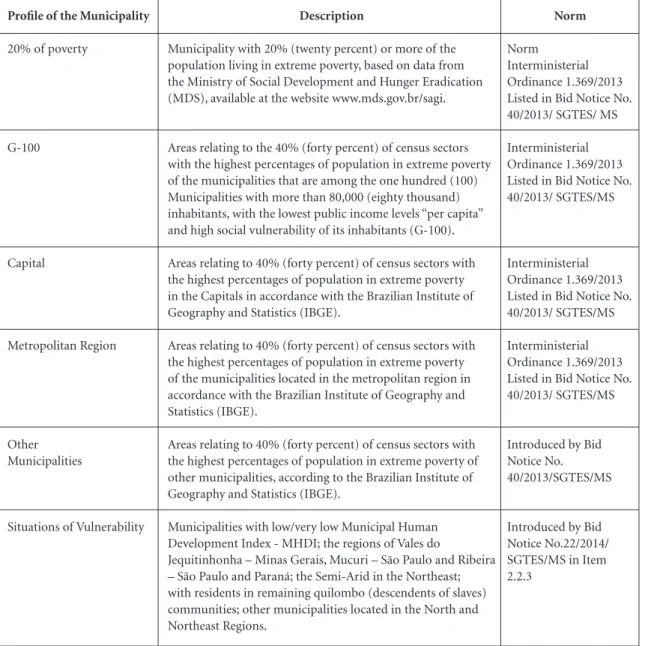
de-scribed in Chart 1, were considered.
Another aspect studied was the placement of physicians based on the following characteristics of the professionals: a) Physician registered with the Regional Council of Medicine (CRM); b) In-dividual Exchange Physician - physicians trained abroad, entitled to exercise their profession with-out the CRM; and, c) Medical aid workers – phy-sicians contracted for the program via the coop-eration agreement with Cuba brokered by the Pan American Health Organization (PAHO) 9.
Results
In the period analyzed, 3,785 municipalities in all regions of the country received 14,168 physicians contracted by the Mais Médicos program. A fur-ther 44 municipalities had their application re-jected, 376 suspended their application and 1365 did not sign up. Thus, of the 5,570 municipalities in Brazil, 68% joined the Mais Médicos program.
In accordance with Table 1, it can be seen that among the municipalities that signed up to the program, 2,377 (62.8%) complied with one of the priority or vulnerability criteria, according to Chart 1, and 1,408 (37.2%) did not comply with any criteria and were considered “other munici-palities” of the program.
O
liv
eir
Chart 1. Profile of municipalities eligible for the Mais Médicos Program in the chronological order of establishment of
priorities and vulnerabilities. Brazil, 2013-2014.
Profile of the Municipality
20% of poverty
G-100
Capital
Metropolitan Region
Other Municipalities
Situations of Vulnerability
Description
Municipality with 20% (twenty percent) or more of the population living in extreme poverty, based on data from the Ministry of Social Development and Hunger Eradication (MDS), available at the website www.mds.gov.br/sagi.
Areas relating to the 40% (forty percent) of census sectors with the highest percentages of population in extreme poverty of the municipalities that are among the one hundred (100) Municipalities with more than 80,000 (eighty thousand) inhabitants, with the lowest public income levels “per capita” and high social vulnerability of its inhabitants (G-100).
Areas relating to 40% (forty percent) of census sectors with the highest percentages of population in extreme poverty in the Capitals in accordance with the Brazilian Institute of Geography and Statistics (IBGE).
Areas relating to 40% (forty percent) of census sectors with the highest percentages of population in extreme poverty of the municipalities located in the metropolitan region in accordance with the Brazilian Institute of Geography and Statistics (IBGE).
Areas relating to 40% (forty percent) of census sectors with the highest percentages of population in extreme poverty of other municipalities, according to the Brazilian Institute of Geography and Statistics (IBGE).
Municipalities with low/very low Municipal Human Development Index - MHDI; the regions of Vales do
Jequitinhonha – Minas Gerais, Mucuri – São Paulo and Ribeira – São Paulo and Paraná; the Semi-Arid in the Northeast; with residents in remaining quilombo (descendents of slaves) communities; other municipalities located in the North and Northeast Regions.
Norm
Norm
Interministerial Ordinance 1.369/2013 Listed in Bid Notice No. 40/2013/ SGTES/ MS
Interministerial Ordinance 1.369/2013 Listed in Bid Notice No. 40/2013/ SGTES/MS
Interministerial Ordinance 1.369/2013 Listed in Bid Notice No. 40/2013/ SGTES/MS
Interministerial Ordinance 1.369/2013 Listed in Bid Notice No. 40/2013/ SGTES/MS
Introduced by Bid Notice No. 40/2013/SGTES/MS
Introduced by Bid Notice No.22/2014/ SGTES/MS in Item 2.2.3
Sout
48 5.5% 12 1.4% 3 0.3% 198 22.6% 45 5.1% 306 34.9%
570 65.1% 876 100% Profile of the Municipality
20% of poverty G-100 Capital
Metropolitan Region Vulnerability
Total of priority and/or vulnerable municipalities Other municipalities Overall Total of municipalities
Mid-West
32 10.8% 9 3.1% 3 1.0% 21 7.1% 27 9.2% 92 31.2%
203 688% 295 100%
Northeast
978 74.2% 36 2.7% 9 0.7% 39 3.0% 222 16.8% 1.284 97.4%
34 2.6% 1.318 100%
North
221 60.9% 14 3.9% 7 1.9% 5 1.4% 107 29.5% 354 97.5%
9 2.5% 363 100%
Southeast
55 5.9% 22 2.4% 4 0.4% 113 12.1% 147 15.8% 341 36.5%
592 63.5% 933 100%
Table 1. Profile of the municipalities participating in the Mais Médicos Program, per geographic region. Brazil, 2013-2014.
Total
1,334 35.2% 93 2.5% 26 0.7% 376 9.9% 548 14.5% 2,377 62.8%
e C
ole
tiv
a,
21(9):2719-2727,
2016
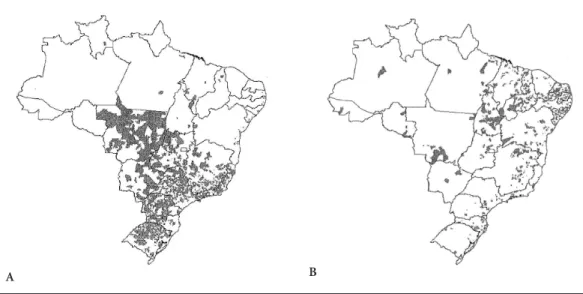
The Southeast and South regions were the re-gions with the highest number of municipalities categorized as “Other locations” that joined the program, with 592 and 570, respectively. Howev-er, non-priority municipalities in all geographic regions of the country received physicians under the program (Figure 1B).
The analysis also revealed that 699 eligible municipalities, i.e. 22.7% of priority municipali-ties, did not register or canceled their registration with the Mais Médicos program, namely 450 in the Northeast region, 52 in the North, 101 in the Southeast, 75 in the South and 21 in the Mid-west (Figure 1B). Also, with regard to the profile of these municipalities, it is emphasized that 374 were mu-nicipalities with 20% or more of the population living in extreme poverty, one capital (Cuiaba), five municipalities of the G-100, 133 ties in metropolitan regions and 186 municipali-ties with some of the vulnerability situations.
Between 2013 and 2014 the Mais Médi-cos program arranged for the supply of 14,168 physicians to the municipalities that joined the program. From the call notices for the selection of physicians an order of priority in hiring and placing in the vacancies offered was established. Thus, a physician registered with the CRM took precedence over the individual exchange student physician, who in turn had priority over the medical aid worker.
It should be stressed that the medical aid workers could not choose the municipality
where they could work, since it was the MOH that defined the placement of physicians from the agreement with Cuba, unlike the others, who could state their preference as to the municipality of activity.
Another aspect regulated in the call notices was the ban on hiring exchange program phy-sicians or conducting cooperative agreements within the scope of the Mais Médicos program if the rate of physicians per thousand inhabitants was less than 1.8 in the country of origin of pro-fessional practice16.
Among all the physicians hired by the Mais
Médicos program, 11,150 were medical aid
work-ers, resulting from the agreement signed between the Brazilian government and Cuba, which ac-counted for approximately 80% of the total. The Northeast region was the one that received the most medical aid workers, followed by the Southeast and South. In addition, the Mais Médi-cos program had the participation of physicians of 47 different nationalities.
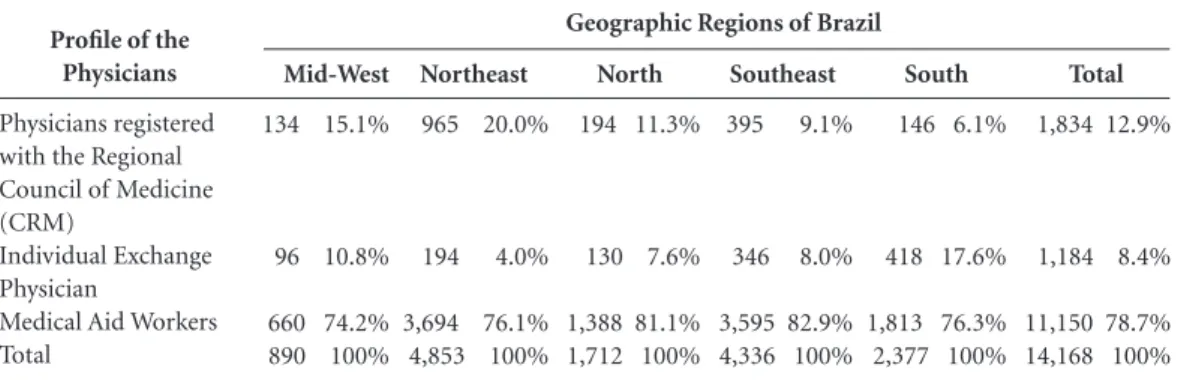
However, in all regions of the country it was found that most of the physicians allocated were medical aid workers. In addition, the Northeast was the region that received the highest number of physicians registered with the CRM (965). As for the individual exchange program physicians, the South and Southeast regions were the ones that received the highest number, namely 418 and 346 respectively. It is noteworthy that the Northeast was the region that received the
major-Figure 1. A - Distribution of the municipalities that received physicians from the Mais Médicos Program without
priority or vulnerability criteria. B - Distribution of municipalities eligible to participate in the Mais Médicos
Program that did not sign up. (2013-2014).
O
liv
eir
ity of the physicians from the program (4,853), followed by the Southeast (4336). The data reveal a reduction in the shortfall of physicians in the North and Northeast. In these areas about 36% of the Brazilian population live and there was some positive discrimination, with the allocation of 6,565 physicians, which corresponds to 46.3% of the total (Table 2).
According to Table 3, the physicians reg-istered with the CRM, i.e. those who chose the workplace, were allocated mainly in municipali-ties with 20% or more of the population living in extreme poverty (31.3%). One third of medical aid workers also went to municipalities with this profile (31.7%). Individual exchange program physicians opted mainly for metropolitan re-gions and capitals and, as a last option, for mu-nicipalities with some vulnerability situation.
The 2377 priority and vulnerable munici-palities that signed up to the Mais Médicos pro-gram received 11,002 physicians (77.7%). The “other municipalities” received 3,166 physicians (22.3%), and 2,825 medical aid workers, who were allocated by the MOH itself. Physicians registered with the CRM and individual ex-change program physicians were also allocated to non-priority or non-vulnerable municipalities.
Discussion
The starting point of this study was item I of the first article of the law that created the Mais Médi-cos program, which set the objective of diminish-ing the shortfall of physicians in priority regions and reducing regional inequalities in health. The profiling to determine whether the municipality
South
146 6.1%
418 17.6%
1,813 76.3% 2,377 100% Profile of the
Physicians
Physicians registered with the Regional Council of Medicine (CRM)
Individual Exchange Physician
Medical Aid Workers Total
Mid-West
134 15.1%
96 10.8%
660 74.2% 890 100%
Northeast
965 20.0%
194 4.0%
3,694 76.1% 4,853 100%
North
194 11.3%
130 7.6%
1,388 81.1% 1,712 100%
Southeast
395 9.1%
346 8.0%
3,595 82.9% 4,336 100%
Table 2. Distribution of the physicians participating on the Mais Médicos Program, per geographic region.
Brazil, 2013-2014.
Total
1,834 12.9%
1,184 8.4%
11,150 78.7% 14,168 100% Geographic Regions of Brazil
Profile of the Municipalities
20% of poverty G-100 Capital
Metropolitan Region Vulnerability Total of physicians allocated to priority and/or vulnerable municipalities Physicians allocated in other municipalities
Overall Total of Physicians
Table 3. Physicians participating on the Mais Médicos Program per priority and vulnerability profile of the
municipalities. Brazil, 2013-2014.
Medical Aid Worker
3,538 31.7% 780 7.0% 858 7.7% 1,603 14.4% 1,546 13.9% 8,325 74.7%
2,825 25.3%
11,150 100% Physicians registered
with the Regional Council of Medicine (CRM)
574 31.3% 264 14.4% 324 17.7% 351 19.1% 152 8.3% 1,665 85.5%
169 9.2%
1,834 100%
Individual Exchange Program
Physician
149 12.6% 149 12.6% 301 25.4% 326 27.5% 87 7.3% 1,012 85.5%
172 14.5%
1,184 100%
Total
4,261 30.1% 1,193 8.4% 1,483 10.5% 2,280 16.1% 1,785 12.6% 11,002 77.7%
3,166 22.3%
e C
ole
tiv
a,
21(9):2719-2727,
2016
was eligible or not to participate in the program was an arrangement to guide the implementa-tion of the emergency supply of physicians.
Following the line of thinking of Menicucci17,
the contention is that the implementation pro-motes retro-feedback effects on the formulation process. Furthermore, it is acknowledged that the formation of policy occurs when there is integra-tion between the processes of formulaintegra-tion, im-plementation and evaluation of policy18. Greater
adherence of priority municipalities in the North and Northeast regions, where the shortfall of physicians reflects the serious socio-economic conditions experienced, is emphasized6. There
is evidence that the Mais Médicos program pro-moted the reduction of the shortfall of physi-cians in priority and vulnerable regions, with the allocation of 11,002 physicians, and this was only possible due to the fact that the Mais Médicos
program innovated by making international calls for the recruitment of physicians and the cooper-ation agreement with Cuba mediated by PAHO: an innovation on other strategies implemented prior to that time in Brazil.
The acknowledgement of municipalities in vulnerable situations contributed to specify other areas that should be prioritized due to the short-fall of physicians and the difficulty of retaining them, especially those who are members of the Family Health Strategy (ESF) teams.
Nevertheless, the results draw attention to possible shortcomings in the implementation of
the Mais Médicos program. The first deals with
the subsequent creation of a profile that enabled the inclusion of 1,408 non-priority municipali-ties when the program corresponding to “Other municipalities” was formulated.
The National Council of Health Secretar-ies (CONASS), by means of Technical Note No. 23/2013, confirms the decision that only the Cap-itals, Metropolitan Regions, G-100s, municipali-ties with 20% or more of the population living in extreme poverty and those with any of the vulnerabilities described were priorities for the purposes of the Mais Médicos program19.
O’Brien and Lianjiang20, considers that a
de-gree of discretion on the part of those in charge of the implementation may be desirable as they have more local knowledge and can innovate and adapt the plan. However, it is important to keep the focus regarding the objectives of the policy, which was formulated to act on a previously de-fined situation. The creation of the “other mu-nicipalities” profile leads to prejudice in the pri-oritization of vulnerable regions.
At the time of the formulation of the Mais
Médicos program, it was common knowledge
that regional inequalities in health in Brazil are enormous. For example, the Southeast with 2.6 physicians per thousand inhabitants has a con-centration of 2.6 times more physicians com-pared to the North (0.98)21. Paim22, considers that
some evidence indicates that over the years there has been a reduction in inequalities in the distri-bution of SUS resources in Brazil. However, the North and Northeast regions still need a better redistribution of resources in their favor.
The second shortcoming of the implemen-tation was that 22.7% of priority municipalities for the SUS were left out of the initiative, due to the fact that inclusion of the municipalities is not mandatory. Among these municipalities, 72% are located in the North and Northeast regions. The needs of 100% of the municipalities that joined were met, however, it must be recognized that in practice the demand was greater.
The results of this study clearly reveal the con-trast in the distribution of non-priority munici-palities and those that were eligible but did not sign up to the Mais Médicos program, as shown in Figure 1. Furthermore, regarding the required number of physicians, a recent study indicat-ed that, in practice, the neindicat-ed for physicians was greater. The municipalities that joined between August 2013 and July 2014 requested 15,460 phy-sicians and the program attended 93.5% of this demand23.
In areas of the country and the outskirts of large cities where access is difficult, the popula-tion cannot avail itself of health services. In order to change this reality what was needed was for physicians to work together with the other pro-fessionals of the ESF teams. Without the presence of physicians, catering to the health needs of the population is prejudiced and comprehensive ac-tions in healthcare are limited due to the shortfall in the team.
In its Audit Report No. 005391/2014-8, the Federal Audit Court (TCU) also pointed out that the process of supply of physicians for the PMM featured some problems. In the document, the TCU pointed out that as of May 2014 the Minis-try of Health had left 592 priority municipalities for SUS out of the Mais Médicos program24. The
O
liv
eir
the autonomy of the federal entities, those mu-nicipalities with more aptitude in planning and management benefitted to the detriment of less well-structured municipalities24.
Lima and Luciano13, argues that many
fac-tors influence the results of the implementation process. Among these he highlights the variables related to regulations and the clarity with which the plan explains the implementation process. Others are variables of political and economic context and derive support, resistance to or boy-cott of the policy, on the part of the social actors that influence the availability of resources essen-tial for successful implementation.
In fact, to legitimize a policy it is necessary to consider that the information is never perfect, as a consensus is reached progressively and re-sources are limited. Since its announcement, the creation of the Mais Médicos program generated intense dispute in the country. There was fierce confrontation between the different social actors, especially government officials, medical corpora-tions, political parties and the National Congress. Some medical organizations even filed two law-suits alleging unconstitutionality in the Supreme Court in an attempt to prove that the program contravened constitutional provisions25.
For its part, the media promoted a stir around
the Mais Médicos program, expounding theses
and discussions, which were not always accurately portrayed. Nevertheless, it contributed to the stag-ing of surveys and polls that gradually garnered favorable results for the Mais Médicos program.
In August 2013, a Datafolha survey reported that 54% of the people interviewed approved of
the Mais Médicos Program26. Research of the
Na-tional Transport Confederation (CNT) showed 49.7% approval in July 2013, followed by 73.9% in September and 84.3% in November of the same year27.
Although several initiatives implemented in recent decades sought to reduce health inequi-ties, sometimes combining technical criteria for resource allocation, at other times promoting the staging of analyses that could assist in health policy formulation oriented towards equity, ev-idence shows that the quality of life, leisure, the distance to the central areas of large cities and the average income are more significant to explain the presence of the physician in municipalities28.
Therefore, it would seem that when the pri-ority municipalities were defined, they were the ones that offered the least conditions to the pop-ulation to exercise the right to health in terms of the lack of physicians. In this sense, it is import-ant that all priority municipalities for the SUS
should be attended by the Mais Médicos program in order to reduce the shortfall of physicians and guarantee access to health services for the pop-ulation. Among other aspects, the lack of physi-cians is a characteristic that impedes the ability of the population to use health services.
Final considerations
The primary objectives behind the creation of
the Mais Médicos program were to guarantee
access to and reduce inequalities in health. Rec-tifying the unequal distribution of physicians is not an easy task, nor even feasible in the short term. The solutions are not simple, though the development in tandem of different strategies may achieve promising results.
For the operation of public policies as a tool of social inclusion, it is necessary to ensure the implementation of mechanisms to increase their effectiveness, efficacy and efficiency, including: the formation of social capital; the effective eval-uation of public policies, with the ensuing use of the results thereof.
The Mais Médicos program has enabled
in-creased access to primary care services in thou-sands of Brazilian municipalities. However, the introduction of the “other municipalities” pro-file that enabled the participation of so many non-priority municipalities may have had reper-cussions on results of the program other than those expected in terms of reducing regional in-equalities in health, when one takes the increased number of physicians into consideration.
It is also important to stress that even in non-priority municipalities there are vulnerable population groups with limited access to physi-cians and medical services. However, the conclu-sion drawn is that the allocation of physicians in non-priority or vulnerable municipalities impact-ed the ability of the Mais Médicos program to re-duce regional inequalities in access to health care even more significantly, which calls for studies to check the possible effects in the medium term.
Collaborations
e C
ole
tiv
a,
21(9):2719-2727,
2016
Menicucci T. A implementação da Reforma Sanitária: a formação de uma política. In: Hochman G, Arretche M, Marques E, organizadores. Políticas públicas no Brasil. Rio de Janeiro: Editora Fiocruz; 2007. p. 303-325. Raeder S. Ciclo de Políticas: uma abordagem integra-dora dos modelos para análise de políticas públicas.
Perspectivas em Políticas Públicas 2014; II(13):121-146. Conselho Nacional de Secretários de Saúde (Conass). Programa Mais Médicos – Nota Técnica 23/2013. [acessado 2016 mar 1]. Disponível em: http://www. conass.org.br/Notas%20t%C3%A9cnicas%202013/ NT%2023-2013%20-%20Programa%20Mais%20 Me%CC%81dicos.pdf
O’brien KJ, Lianjiang L. 1999. Selective Policy Imple-mentation in Rural China. Comparative Politics 1999; 31(2):167-186.
Scheffer M, Biancarelli A, Cassenote A, organizadores. Demografia Médica no Brasil: dados gerais e descrições de desigualdades. São Paulo: Conselho Regional de Medicina do Estado de São Paulo, Conselho Federal de Medicina; 2011.
Paim JS. Desafios para a saúde coletiva no século XXI. Salvador: EDUFBA; 2006.
Pereira LL, Santos LMP, Santos W, Oliveira A, Rat-tner D. Mais Médicos program: provision of medical doctors in rural, remote and socially vulnerable ar-eas of Brazil, 2013-2014. Rural Remote Health 2016; 16(1):3616.
Brasil. Tribunal de Contas da União. Relatório de audi-toria. TC n.005.391/2014-8. Relator: Benjamin Zymler. 4 mar. 2015. [acessado 2016 mar 1]. Disponível em: http://portal3.tcu.gov.br/portal/page/portal/TCU/im-prensa/noticias/noticias_arquivos/005.391-2014-8%20 Mais%20M%C3%A9dicos.pdf
Silva S, Santos LMP. Estudo das Ações Diretas de In-constitucionalidade do Programa Mais Médicos. Cad. Ibero-Amer. Dir. Sanit. 2015; 4(2):68-82.
Morais I, Alkmin D, Lopes J, Santos M, Leonel M, San-tos R, Rosa W, Mendonça A, Sousa M. Jornais Folha de São Paulo e Correio Braziliense: o que dizem sobre o Programa Mais Médicos? Rev. esc. enferm. USP 2014; 48(Spec. 2):107-115.
Brasil. Agência Brasil de Comunicação. Apoio da po-pulação ao programa Mais Médicos alcança 84,3% na pesquisa CNT. 2013. [acessado 2016 mar 1]. Dispo-nível em: http://memoria.ebc.com.br/agenciabrasil/ noticia/2013-11-07/apoio-da-populacao-ao-programa -mais-medicos-alcanca-843-na-pesquisa-cnt
Scheffer M, Biancarelli A, Cassenote A. Demografia Médica no Brasil 2015. São Paulo: DMPUSP, Cremesp, CFM; 2015.
Article submitted 03/03/2016 Approved 24/06/2016
Final version submitted 26/06/2016 17.
18.
19.
20.
21.
22. 23.
24.
25.
26.
27.
28. References
Campos FE, Machado MH, Girardi SN. A fixação de profissionais de saúde em regiões de necessidade. Revis-ta Divulgação em Saúde para Debate 2009; (44):13-34. Oliveira FP, Vanni T, Pinto HA, Santos JTR, Figueiredo AM, Araújo SQ, Matos MFM, Cyrino EG. Mais Médi-cos: um programa brasileiro em uma perspectiva in-ternacional. Interface (Botucatu) 2015; 19(54):623-634. Backer LC, Molina A. Cuba and the Construction of Al-ternative Global Trade Systems: ALBA and Free Trade in the Americas. Journal of International Economic Law
2010; 31(3):37-38.
Maciel Filho R. Estratégias para a distribuição e fixação de médicos em Sistemas Nacionais de Saúde: o caso bra-sileiro [tese]. Rio de Janeiro: Universidade do Estado do Rio de Janeiro; 2007.
Girardi SN, Carvalho CL, Araújo JF, Farah JM, Wan der Maas L, Campos LAB. Índice de escassez de médicos no Brasil: estudo exploratório no âmbito da Atenção Pri-mária. In: Pierantoni CR, Dal Poz MR, França T, orga-nizadores. O trabalho em Saúde: abordagens quantita-tivas e qualitativas. Rio de Janeiro: Cepesc/IMS/UERJ, ObservaRH; 2011. p. 171-186.
Santos LMP, Costa AM, Girardi SN. Programa Mais Médicos: uma ação efetiva para reduzir iniquidades em saúde.Cien Saude Colet 2015; 20(11):3547-3552. Antunes R, Braga R. Os dias que abalaram o Brasil: as rebeliões de junho, julho de 2013. R. Pol. Públ. 2014; N Esp:41-47.
Brasil. Lei nº 12.871, de 22 de outubro de 2013. Institui o Programa Mais Médicos, altera as Leis nº 8.745, de 9 de dezembro de 1993, e no 6.932, de 7 de julho de 1981, e dá outras providências. Diário Oficial da União
2013; 23 out.
Brasil. Portaria Interministerial nº 1.369, de 8 de julho de 2013. Dispõe sobre a implementação do Programa Mais Médicos para o Brasil. Diário Oficial da União
2013; 9 jun.
Cunha CGS. Avaliação de Políticas Públicas e Progra-mas Governamentais: tendências recentes e experiências no Brasil. 2006. [acessado 2016 mar 1]. Disponível em: http://www.ufpa.br/epdir/images/docs/paper29.pdf Akerman M, Furtado JP, organizadores. Práticas de avaliação em saúde no Brasil: diálogos. Porto Alegre: Rede Unida; 2015.
Cavalcanti Vaz Mendes GS, Lemes de Sordi MR. Meto-dologia de avaliação de implementação de programas e políticas públicas. EccoS – Rev. Cient. 2013; 30:93-111. Lima LL, Luciano DA. Implementação de Políticas Pú-blicas: perspectivas analíticas. Rev de Sociologia e Políti-ca 2013; 21(48):101-110.
Brasil. Edital nº 40, de 18 de julho de 2013. Alteração do edital de adesão do Distrito Federal e dos municípios no Programa Mais Médicos para o Brasil. Diário Oficial da União 2013; 19 jul.
Brasil. Edital nº 22, de 31 de março de 2014. Adesão de municípios no Programa Mais Médicos para o Brasil.
Diário Oficial da União 2014; 01 abr.
Brasil. Edital nº 39, de 8 de julho de 2013. Adesão de Médicos ao Programa Mais Médicos para o Brasil. Diá-rio Oficial da União 2013; 9 jul.
1.
2.
3.
4.
5.
6.
7.
8.
9.
10.
11.
12.
13.
14.
15.