Bibliometric analysis of scientific articles published in Brazilian
and international orthodontic journals over a 10-year period
Neudí Antonio Primo1, Vivian Bertoglio Gazzola2, Bruno Tochetto Primo3, Maximiano Ferreira Tovo4, Italo Medeiros Faraco Junior4
How to cite this article: Primo NA, Gazzola VB, Primo BT, Tovo MF, Faraco Junior IM. Bibliometric analysis of scientific articles published in Brazilian and in-ternational orthodontic journals over a 10-year period. Dental Press J Orthod. 2014 Mar-Apr;19(2):56-65. doi: http://dx.doi.org/10.1590/2176-9451.19.2.056-065.oar
Submitted: May 19, 2012 - Revised and accepted: August 17, 2012
Contact address: Neudí Antonio Primo
Rua Barão do Rio Branco, 430 - E - Sala 18 – Chapecó/SC - Brazil CEP: 89.802-100 E-mail: [email protected]
1 Professor, Specialization course in Orthodontics, FUNORTE.
2 Doctorate student in Orthodontics, Lutheran University of Brazil (ULBRA). 3 MSc in Oral and Maxillofacial Surgery and Traumatology, ULBRA. 4 Professor, Doctorate and Master’s program in Dentistry, ULBRA.
» The authors report no commercial, proprietary or financial interest in the prod-ucts or companies described in this article.
Objective: This study aimed at describing the profiles of Brazilian and international studies published in orthodontic journals. Methods: The sample comprised 635 articles selected from two scientific journals, i.e., Den-tal Press Journal of Orthodontics and American Journal of Orthodontics and Dentofacial Orthopedics, which were analyzed at three different intervals over a 10-year period (1999 – 2004 – 2009). Articles were described in terms of knowledge domain, study design, and country of origin (or state of origin for Brazilian papers). Results: The most frequent study designs adopted in international studies were cohort (23.9%) and cross-sectional (21.7%) designs. Among Brazilian papers, cross-sectional studies (28.9%) and literature reviews (24.6%) showed greater frequency. The topics most often investigated were dental materials (17%) and treatment devices (12.4%) in international articles, with the latter topic being addressed by 16% of the Brazilian publications, followed by malocclusion, with 12.6%. In all cases, the most frequent countries of origin coincided with the countries of origin of each journal. Conclusions: The majority of the studies analyzed featured a low level of scientific evidence. Moreover, the findings showed that journals tend to publish studies produced in their own country of origin, and that there are marked discrepancies in the number of papers published by different Brazilian states.
Keywords:Bibliometrics. Dental research. Orthodontics. Study characteristics.
Objetivo:determinar o perfil das publicações nacionais e internacionais nos periódicos de Ortodontia. Métodos: fo-ram avaliados 635 artigos da Revista Dental Press de Ortodontia e Ortopedia Facial e American Journal of Orthodontics and Dentofacial Orthopedics, em três tempos distintos, dentro de um intervalo de 10 anos (1999, 2004 e 2009), caracterizando as áreas de conhecimento, os delineamentos utilizados e identificando países e estados brasileiros com maior produção científica. Resultados: os delineamentos dos estudos internacionais mais utilizados foram estudos de coorte (23,9%) e transversal (21,7%). Em estudos nacionais, destacam-se os delineamentos transversais (28,9%) e revisão de literatura (24,6%). Nas publicações internacionais, as categorias temáticas mais pesquisadas foram materiais dentários (17%), além de dispositivos de tratamento (12,4%); essa mesma categoria esteve presente em 16% das publicações nacionais, e a má oclusão dentária em 12,6%. A nacionalidade das publicações mais observada foi a do próprio país de origem do periódico. Conclusões: a maioria dos artigos publicados refere-se a estudos de menor potencial para estabelecer evidências científicas. Além disso, a situação detectada ilustra a propensão das revistas publicarem os artigos produzidos dentro de seu país de origem, bem como as disparidades entre os estados do Brasil quanto ao número de publicações.
INTRODUCTION
The growing demand for structuring and organizing information gleaned from the scientiic and academic domains has allowed healthcare scientists to analyze scientiic output in unprecedented detail. Bibliometrics emerges as an important tool that enables one to map and generate diferent indicators of information
man-agement and knowledge.1-5
By implementing a bibliometric approach in Or-thodontics one can evaluate publications that facilitate information retrieval and stratiication. In view of the above, ater reviewing, stratifying and electronically storing a catalog comprising the information identiied, one can build an accessible database. This database can aid patients and professionals in making decisions about
clinical procedures, as well as raise new research topics.6
Ater careful review of the orthodontic literature,
Sun et al6 found clinically relevant information on
which to base clinical decisions that struck a balance between etiology, diagnosis, treatment and prognosis.
Mavropoulos and Kiliaridis7 found that articles
pub-lished in orthodontic journals increasingly focused on treatment evaluation and diagnosis. They further found that the number of investigations into new treatment methods dwindled signiicantly over the past 20 years, which led them to conclude that there is absolute need for high-quality studies capable of generating reliable scientiic evidence.
Nevertheless, few studies in Orthodontics make use of bibliometric analysis, evincing the need for further research carried out on the basis of this
methodology.7,8 Therefore, the aim of this study is
to describe the profiles of Brazilian and interna-tional publications in two journals of Orthodontics at three different intervals over a period of 10 years (1999 - 2004 - 2009), assessing the knowledge do-mains and article designs used, while identifying the country of origin of the published studies.
MATERIAL AND METHODS
The journals used in this research were select-ed from the Brazilian National Council for Scien-tiic and Technologic Development (CAPES) da-tabase. Only those Brazilian and international pe-riodicals which ranked among the best in the area of Orthodontics according to CAPES-QUALIS rat-ing in 2010 were selected. The selected journals were
Dental Press Journal of Orthodontics (Dental Press Publishers, Maringá-PR, Brazil) and American Journal of Orthodontics and Dentofacial Orthopedics (Elsevier Publishers, Amsterdam, The Netherlands).
With the 1999, 2004 and 2009 issues of the se-lected journals in hand, copies of the abstracts of all articles were analyzed and divided by year and ater-wards divided by volume and number. Subsequently,
the titles and abstracts were reviewed.9 The
follow-ing three variables were assessed: Knowledge domain, study design and countries where the article(s) were published. When it was not possible to characterize these research variables using only the title and the ab-stract, the full article was obtained and analyzed in the same manner. Two examiners were trained and cali-brated to collect information. Their performance was measured by means of the Kappa test, of which result was k = 0.9654 (nearly perfect agreement). Categori-zation of data was carried out independently by physi-cal, manual and direct review of the abstract of each reference. Preface, editorial, readers’ letters and other data pertaining to journal organization were excluded.
Six knowledge domains and 18 speciic subdomains were established in order to detect and assess trends in the themes and subjects being addressed. Study designs
were ranked as advocated by Fletcher and Fletcher.10
The countries in the study were identiied and named according to the country of origin of each author whose mailing address was disclosed, with the purpose of reaching the total number of publications in each country, thereby detailing their scientiic contribution. When the author was Brazilian, their state of origin was also recorded according to their mailing address.
The instrument used to record the data included a speciic form containing questions about each knowl-edge domain, study design and country of publication. The data were then organized and analyzed using Sta-tistical Package for the Social Sciences (SPSS) sot-ware, version 10.0, presented by means of descriptive and analytical statistics.
RESULTS
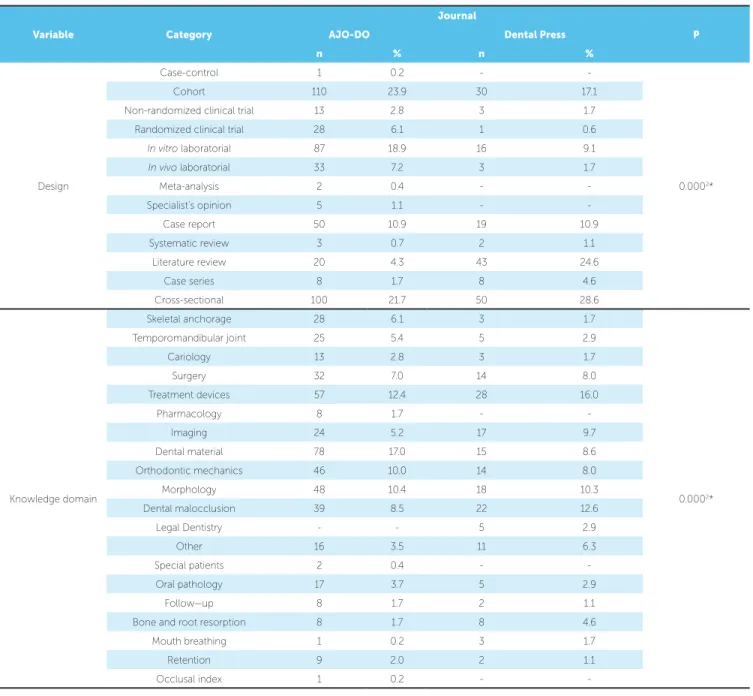
The chi-square and Fisher’s exact tests demonstrat-ed that all variables (knowldemonstrat-edge domain, study design and year) were signiicantly correlated with the jour-nals analyzed. In terms of number of publications, there was a substantial diference between journals, indicat-ing that such diference was maintained throughout the study period. This association proved statistically signii-cant (p = 0.008) (Table 1).
The cohort, cross-sectional and in vitro
labo-ratory studies proved the most frequent publica-tions in the AJO-DO, whereas cross-sectional de-sign, literature review and cohort studies were more
Table 2 - Distribution of articles according to the variables evaluated.
Table 1 - Distribution of articles for each journal evaluated..
Year
Journal
AJO-DO Dental Press p
n % n %
1999 164 35.7 40 22.9
0.0081*
2004 134 29.1 63 36.0
2009 162 35.2 72 41.1
Total 460 100 175 100
1 Chi-square test; * significant p ≤ 0.01.
Variable Category
Journal
AJO-DO Dental Press P
n % n %
Design
Case-control 1 0.2 -
-0.0002*
Cohort 110 23.9 30 17.1
Non-randomized clinical trial 13 2.8 3 1.7
Randomized clinical trial 28 6.1 1 0.6
In vitro laboratorial 87 18.9 16 9.1
In vivo laboratorial 33 7.2 3 1.7
Meta-analysis 2 0.4 -
-Specialist’s opinion 5 1.1 -
-Case report 50 10.9 19 10.9
Systematic review 3 0.7 2 1.1
Literature review 20 4.3 43 24.6
Case series 8 1.7 8 4.6
Cross-sectional 100 21.7 50 28.6
Knowledge domain
Skeletal anchorage 28 6.1 3 1.7
0.0002*
Temporomandibular joint 25 5.4 5 2.9
Cariology 13 2.8 3 1.7
Surgery 32 7.0 14 8.0
Treatment devices 57 12.4 28 16.0
Pharmacology 8 1.7 -
-Imaging 24 5.2 17 9.7
Dental material 78 17.0 15 8.6
Orthodontic mechanics 46 10.0 14 8.0
Morphology 48 10.4 18 10.3
Dental malocclusion 39 8.5 22 12.6
Legal Dentistry - - 5 2.9
Other 16 3.5 11 6.3
Special patients 2 0.4 -
-Oral pathology 17 3.7 5 2.9
Follow—up 8 1.7 2 1.1
Bone and root resorption 8 1.7 8 4.6
Mouth breathing 1 0.2 3 1.7
Retention 9 2.0 2 1.1
Occlusal index 1 0.2 -
-frequently observed in the Dental Press Journal. The design variable was signiicantly associated with the journals (p = 0.000) (Table 2). The areas of Dental Ma-terial and Treatment Devices were the most frequently
Table 3 - Countries of origin of published articles.
Country
Journal
AJO-DO Dental Press
n % n %
Brazil 42 9.1 174 99.4
USA 162 35.2 -
-Japan 37 8.0 -
-Turkey 24 5.2 -
-England 19 4.1 -
-Canada 18 3.9 -
-Korea 18 3.9 -
-Italy 17 3.7 -
-Germany 14 3.0 -
-Holland 10 2.2 -
-Greece 8 1.7 -
-Israel 8 1.7 -
-India 8 1.7 -
-China 7 1.5 -
-Sweden 7 1.5 -
-Switzerland 5 1.1 -
-Taiwan 5 1.1 -
-Austria 4 0.9 -
-Australia 4 0.9 -
-Belgium 3 0.7 -
-Egypt 3 0.7 -
-Kuwait 3 0.7 -
-Mexico 3 0.7 -
-Norway 3 0.7 -
-Thailand 3 0.7 -
-Spain 2 0.4 -
-Finland 2 0.4 -
-Ireland 2 0.4 -
-Iceland 2 0.4 -
-Others 17 3.7 1 0.6
Total 460 100 175 100
found in the AJO-DO. In the Dental Press Journal, on the other hand, Treatment Devices and Dental Mal-occlusion appeared to be the most frequent domains. Knowledge domain was also signiicantly associated with the Dental Press Journal (p = 0.000) (Table 2).
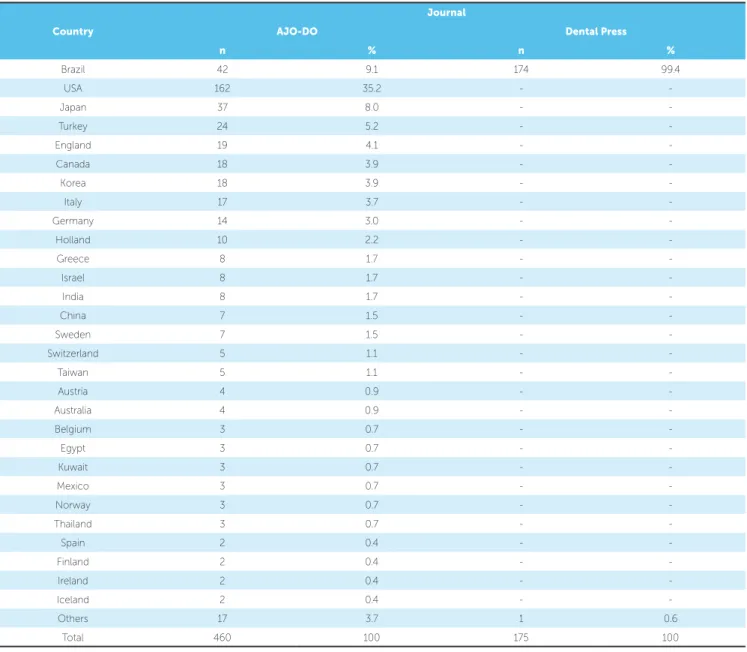
There were publications from 47 diferent countries. Both Brazilian and international journals predominant-ly published texts written by authors of their respective countries of origin. The United States was the coun-try with the greatest number of published studies in the American Journal (162 articles, 35.2%), followed by Brazil (9.1%). Brazilian-authored studies prevailed in the Dental Press Journal, with 174 articles (99.4%) (Table 3).
Brazilian publications comprised cross-sectional studies involving the study of malocclusion, imaging
and morphology. Laboratory studies were generally correlated with research on dental material. Research on surgery and treatment devices are carried out by co-hort studies (Table 4).
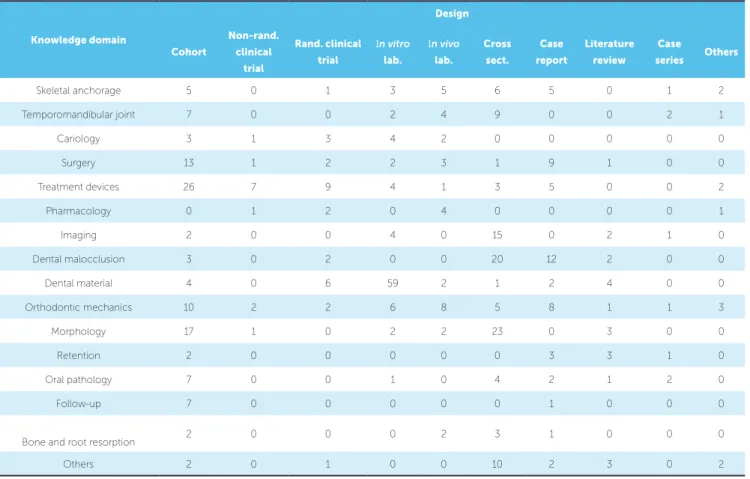
In international publications, cohort research was most oten associated with studies on treatment devices
and morphology. In vitro laboratory studies, in turn,
were found to be signiicantly linked to research on dental material. Research on morphology, dental mal-occlusion and imaging occurred most oten in cross-sectional studies. In case reports, studies on dental mal-occlusion prevailed (Table 5).
Table 4 - Study design in relation to knowledge domain for the Brazilian journal.
Table 5 - Study design in relation to knowledge domain for the international journal.
Knowledge domain
Design
Cohort
Non-rand.
clinical trial
Rand. clinical trial
In vitro
lab.
In vivo
lab.
Cross sect.
Case report
Literature review
Case
series Others
Skeletal anchorage 0 0 0 0 0 0 2 0 1 0
Temporomandibular joint 0 0 0 0 0 3 0 2 0 0
Cariology 1 1 1 0 0 0 0 0 0 0
Surgery 8 1 0 0 0 0 0 5 0 0
Treatment devices 9 1 0 1 0 2 7 6 2 0
Imaging 2 0 0 1 0 11 0 2 1 0
Dental malocclusion 1 0 0 0 0 11 5 2 2 1
Dental material 0 0 0 10 0 2 0 3 0 0
Orthodontic mechanics 3 0 0 1 2 1 2 5 0 0
Morphology 4 0 0 1 0 12 0 1 0 0
Retention 0 0 0 0 0 0 1 1 0 0
Oral pathology 1 0 0 0 1 0 0 1 1 1
Follow-up 1 0 0 0 0 0 0 1 0 0
Bone and root resorption 0 0 0 0 0 1 2 5 0 0
Others 0 0 0 2 0 7 0 9 1 0
Knowledge domain
Design
Cohort
Non-rand. clinical
trial
Rand. clinical
trial
In vitro
lab.
In vivo
lab.
Cross
sect.
Case
report
Literature
review
Case
series Others
Skeletal anchorage 5 0 1 3 5 6 5 0 1 2
Temporomandibular joint 7 0 0 2 4 9 0 0 2 1
Cariology 3 1 3 4 2 0 0 0 0 0
Surgery 13 1 2 2 3 1 9 1 0 0
Treatment devices 26 7 9 4 1 3 5 0 0 2
Pharmacology 0 1 2 0 4 0 0 0 0 1
Imaging 2 0 0 4 0 15 0 2 1 0
Dental malocclusion 3 0 2 0 0 20 12 2 0 0
Dental material 4 0 6 59 2 1 2 4 0 0
Orthodontic mechanics 10 2 2 6 8 5 8 1 1 3
Morphology 17 1 0 2 2 23 0 3 0 0
Retention 2 0 0 0 0 0 3 3 1 0
Oral pathology 7 0 0 1 0 4 2 1 2 0
Follow-up 7 0 0 0 0 0 1 0 0 0
Bone and root resorption 2 0 0 0 2 3 1 0 0 0
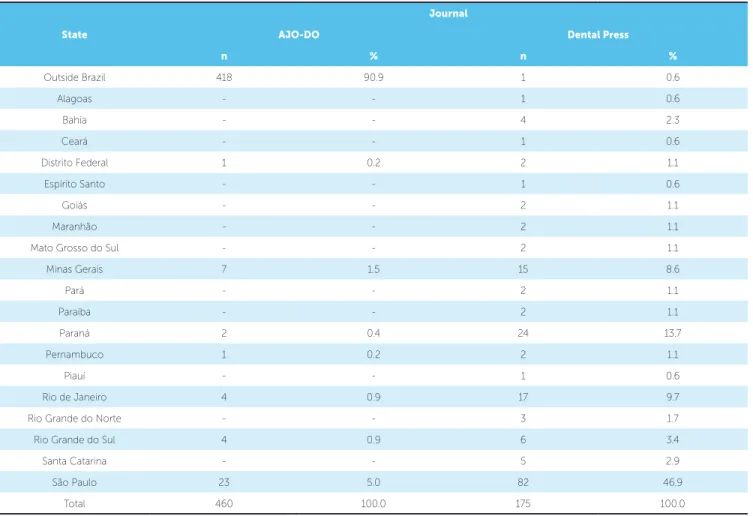
ranked second in frequency of publications in the Brazilian journal. Minas Gerais state achieved the sec-ond highest frequency in the international journal and stood out, along with Rio de Janeiro state, in the Bra-zilian journal (Table 6).
DISCUSSION
Contemporary Orthodontics has shown a consid-erable interest in themes that contribute to strength-ening the interaction between scientiic evidence and clinical decisions. As a result, the quality of stud-ies available in the literature is an important factor which requires investigation. This study performed a bibliometric analysis of orthodontic literature with the purpose of characterizing scientiic output in this
Table 6 - State of origin of Brazilian published articles.
State
Journal
AJO-DO Dental Press
n % n %
Outside Brazil 418 90.9 1 0.6
Alagoas - - 1 0.6
Bahia - - 4 2.3
Ceará - - 1 0.6
Distrito Federal 1 0.2 2 1.1
Espírito Santo - - 1 0.6
Goiás - - 2 1.1
Maranhão - - 2 1.1
Mato Grosso do Sul - - 2 1.1
Minas Gerais 7 1.5 15 8.6
Pará - - 2 1.1
Paraíba - - 2 1.1
Paraná 2 0.4 24 13.7
Pernambuco 1 0.2 2 1.1
Piauí - - 1 0.6
Rio de Janeiro 4 0.9 17 9.7
Rio Grande do Norte - - 3 1.7
Rio Grande do Sul 4 0.9 6 3.4
Santa Catarina - - 5 2.9
São Paulo 23 5.0 82 46.9
Total 460 100.0 175 100.0
research area. Brazilian and international abstracts of high-ranking scientiic journals were used. Journals constitute not only an important communication channel for science, but also the most extremely dy-namic method employed to disseminate knowledge developed in this dental specialty domain. These pe-riodicals also convey the scientiic output of a speciic area. Furthermore, they boast utmost credibility and widespread dissemination among dental professionals.
Setting criteria to assess the inluence of each scien-tiic journal has aroused fruitful debates. The inluence of a given journal can be determined in various ways such as by citation index, measured by impact factor (IF) or through its wide acceptance as indicated by how
factor index as an inclusion criterion in their orthodontic bibliometric investigation. This analysis used CAPES-QUALIS as its frame of reference, since no Brazilian orthodontic journal currently has an impact factor.
In this study, as in the study conducted by
Poletto and Faraco Júnior,11 all data were collected by
exploratory reading of the title and abstract carried out by two specialists in Orthodontics, who worked sepa-rately and concurrently ater training and calibration in order to impart reliability to the assessment and avoid
measurement bias, as described in Nainar’s study.12
Analysis of the articles comprised the years 1999, 2004 and 2009, spanning a period of 10 years, total-ing 635 articles. Throughout the study period, the Brazilian journal published an increasing number of ar-ticles while the international journal remained superior and constant in the number of publications. It is worth noting that the Brazilian journal is a bimonthly publica-tion of which inceppublica-tion occurred 16 years ago. The in-ternational journal, in turn, is a monthly publication launched 97 years ago. In the study carried out by
Gib-son et al,13 all articles published between 1999 and 2008
were collected, 425 of which were randomly analyzed so as to determine the publishing proile of four inter-national orthodontic journals. With a view to assessing the methodology and quality of systematic reviews in
Orthodontics, Papageorgiou et al14 resorted to
elec-tronic searches. In this research, however, collecting all articles published at 3 diferent intervals made it possible to compare trends in these publications over the years.
Harrison et al.15 found signiicant diferences in
the content of international journals of Orthodontics, suggesting that journals can depict diferent aspects of the specialty. An insight into the publishing trends of various journals can help clinicians to identify journals that are best suited to meet their needs.
Out of all research conducted by Gibson and
Harrison,13 articles on growth and development,
di-agnosis and treatment accounted for 72.2% of the articles analyzed. This research showed similarity be-tween the Brazilian and the international journal in terms of the domains studied, since the results indicate a trend towards the performance of studies on treatment devices and morphology in both journals. When classi-fying the knowledge domains in this investigation, un-der the “treatment devices” variable, for example, stud-ies which aimed at assessing the eicacy and therapeutic
characteristics of various appliances used in orthodontic treatment were included. In addition, studies on facial and bone analysis, as well as growth characteristics, among others, were included under morphology, in the respective knowledge domain. Thus, it was noted a trend towards interventional studies, suggesting inter-est in therapeutic clinical resolutions and their respec-tive responses in the maxillofacial complex. The inter-national journal published studies on dental material (17%) with a higher frequency. These studies evaluated, for example, mechanical and adhesive properties, or rate of poisoning of the material involved in the treatment. A plausible explanation for this percentage is the mod-ernization of material, development of new products and methods of evaluation.
Epidemiological studies on malocclusion — dental abnormalities — were classiied in the knowledge do-main under “dental malocclusion,” and had the second highest frequency rate (12.6%) in the Brazilian journal. These studies enable the implementation of preven-tive measures based on epidemiological surveys on the prevalence of malocclusion, which also provide an im-portant foundation to assess the current condition and future oral healthcare needs of a population.
The cohort (23.9%) and cross-sectional (21.7%) study designs were the most frequent in the interna-tional journal. In the Brazilian journal, however, cross-sectional studies showed a 28.6% frequency, with lit-erature reviews ranking second with 24.6%.
Laboratory studies are usually an important step that allow new treatment devices or material to be tested in animals to detect potential complications and un-expected results. These studies were highlighted in the international journals, showing a frequency rate of
26.1% when incorporated to in vitro and in vivo
labo-ratory studies. Although they are necessary to establish basic quality parameters prior to application of material
and techniques in humans, in vitro studies do not set
guidelines for clinical conduct, nor do they aford
criti-cal information for clinicriti-cal decision-making.16
Cross-sectional studies are a useful tool for describ-ing characteristics of a population, identifydescrib-ing at-risk groups, for healthcare measures and planning, in ad-dition to enabling research on the potential causal re-lationships between factors suspected of entailing risk
or disease.17 In the present study, cross-sectional studies
the international journal). In Brazilian and international publications, cross-sectional studies were most fre-quently performed in research conducted on imaging, dental malocclusion and morphology.
Cohort studies are designed to investigate changes
over time, i.e., to monitor a sequence of events.18 In the
publications analyzed in this study, cohort research was oten related to studies on treatment devices and mor-phology in the international journal, whereas it was re-lated to surgery in the Brazilian publication.
Case reports and case series play a signiicant part in the scientiic literature, as noted in this study. In their
study, Kanavakis et al8 reviewed three international
jour-nals and found that case reports accounted for 8.89% of the designs evaluated (AJO-DO only: 11.06%). These results resemble those found in this study, if case reports and case series are grouped together (12.6% in AJO-DO, and 15.5% in the Dental Press Journal).
Randomized clinical trials provide the best evi-dence quality available, and, therefore, it is extremely important to assess how they are conducted and re-ported. The results of randomized clinical trials inlu-ence decision-making in clinical practice and
consti-tute the backbone of systematic reviews.14,19 A study
conducted by Shimada et al20 identiied 161
random-ized clinical trials in orthodontic journals issued be-tween 2003 and 2007. This study showed that in both journals there were only a few clinical trials. Addition-ally, one can expect the number of well conducted tri-als to be even lower, considering design criteria such as actual randomization of the trial groups, presence of a control group, blinding and standardization of criteria. Thus, the data are in line with research by
Pandis et al19 who found that the quality of
random-ized clinical trials in the main Dentistry journals can be considered low, and warned that study design is of paramount importance to improve dental treatment.
Gibson and Harrison,13 however, estimate that the
number of randomized clinical trials in orthodontic journals has risen dramatically in recent years.
In this study, systematic reviews and meta-analyses accounted for less than 1% of all reviewed articles, under-scoring the need for expanding knowledge of evidence-based methods among researchers of Orthodontics as well as in the general area of Dentistry. Deined by the literature as of moderate quality, no signiicant improvement was
observed in these designs over the last decade.14
Literature reviews (24.6%) ranked second in the studies published in the Brazilian journal. This type of article can provide summaries of a particular subject, including relevant, updated information. Authors, how-ever, usually employ informal and subjective methods when collecting and interpreting the studies, which could lead them to expose their own biases. In the hier-archy of studies, these are classiied as low-power studies as they provide little evidence.
To determine article provenance, the methodology
used by Yang and Zhao21 was applied and publications from
47 diferent countries were recorded. Most Brazilian and international journals predominantly published texts writ-ten by authors of their respective countries of origin. U.S. authors had the largest number of articles published in the American Dental Journal, with 162 (35.2%), while most studies published in the Dental Press Journal were written by Brazilian authors, i.e., 174 articles (99.4%).
Remarkably, it was found that journals tend to publish articles authored in their country of ori-gin. Among the possible explanations for this phenomenon — and this seems to be the case of the Dental Press Journal — are the language in which the journal publishes the articles, and the databases used to index it. In 2010, the Brazilian journal began to be oicially published in the English language as well. Nevertheless, it continues to be published in Brazilian Portuguese, in both print and electronic media. This change aimed at meeting the requirements of evalua-tion and indexaevalua-tion agencies in terms of visibility, im-pact factor and citation index of the journal.
According to Kanavakis et al,8 articles hailing from
the U.S. made the bulk of AJO-DO publications. Moreover, the researchers reported that most texts pub-lished in the European Journal of Orthodontics (EJO) originated from Europe, further illustrating the trend towards publishing articles authored in the country of origin of the journal.
Brazil ranked second in the number of articles pub-lished in the AJO-DO. Dental research in Brazil has made major strides in recent years, mainly buoyed by the widespread circulation of speciic-area journals and
scientiic papers presented at scientiic meetings.22,23
According to Suehiro et al,24 this fact is basically due
innovation and methodological resources as well as strong social commitment, among others.
São Paulo state produced the largest number of pub-lications in both Brazilian and international journals. Paraná state ranked second in frequency of Brazilian publications. Minas Gerais achieved the second high-est frequency in the international journal and stood out, along with Rio de Janeiro state, in the Brazilian journal (Table 6). São Paulo boasts a larger number of universi-ties and graduate programs in Dentistry, in addition to being the state with the largest GDP in Brazil, fostering research and the submission of an increasingly signiicant number of articles for publication.
The search for data in journals, which can be used to support professional decision-making, should be an ongoing process, based on the principles of evidence-based practice. Therefore, evaluating and employing articles that may provide grounds for informed clini-cal decision-making is part of continuing education for dental students and professionals alike. It should be
emphasized that, ultimately, deploying strategies such as these can improve the eiciency of readers who aim at incorporating research results in their daily practice.
CONCLUSIONS
1. Okubo Y. Bibliometric indicators and analysis of research systems: methods and examples. Paris: OCDE; 1997.
2. Kim MY, Jarshen L, White R, Niederman R. Benchmarking the endodontic literature on MEDLINE. J Endod. 2001;27(7):470-3.
3. Yang S, Needleman H, Niederman R. A bibliometric analysis of the pediatric dental literature in MEDLINE. Pediatr Dent. 2001;23(5):415-8. 4. Guedes VLS, Borschiver S. Bibliometria: uma ferramenta estatística para a
gestão de informação e do conhecimento, em sistemas de informação, de comunicação e de avaliação cientíica e tecnológica. Proceedings do 6º CINFORM - Encontro Nacional de Ciência da Informação; 2005. Salvador-BA, 2005.
5. Medeiros APSC, Faria LIL. Análise bibliométrica da produção cientíica da UNESP. SNBU - Seminário Nacional de Bibliotecas Universitárias, 2006; out 22-27. Salvador-BA, 2006.
6. Sun RL, Conway S, Zawaideh S, Niederman DR. Benchmarking the clinical orthodontic evidence on Medline. Angle Orthod. 2000;70(6):464-70.
7. Mavropoulos A, Kiliaridis S. Orthodontic literature: an overview of the last 2 decades. Am J Orthod Dentofacial Orthop. 2003;124(1):30-40. 8. Kanavakis G, Spinos P, Polychronopoulou A, Eliades T, Papadopoulos MA,
Athanasiou AE. Orthodontic journals with impact factors in perspective: trends in the types of articles and authorship characteristics. Am J Orthod Dentofacial Orthop. 2006;130(4):516-22.
9. Vahanikkila H, Nieminen P, Miettunen J, Larmas M. Use of statistical methods in dental research: comparison of four dental journals during a 10-year period. Acta Odontol Scand. 2009;67(4):206-11.
10. Fletcher RH, Fletcher SW. Epidemiologia clínica: elementos essenciais. 4ª ed. Porto Alegre: Artmed; 2006. cap. 11, p. 222-39.
11. Poletto VC, Faraco Junior IM. Bibliometric study of articles published in a Brazilian Journal of Pediatric Dentistry. Braz Oral Res. 2010;24(1):83-8. 12. Nainar SMH. Proile of pediatric dental literature: thirty-year time trends
(1969-1998). ASDC J Dent Child. 2001;68(5-6):388-90, 303.
REFERENCES
13. Gibson R, Harrison J. What are we reading? An analysis of the orthodontic literature 1999 to 2008. Am J Orthod Dentofacial Orthop. 2011;139(5):e471-84.
14. Papageorgiou SN, Papadopoulos MA, Athanasiou AE. Evaluation of methodology and quality characteristics of systematic reviews in orthodontics. Orthod Craniofac Res. 2011;14(3):116-37.
15. Harrison JE, Ashby D, Lennon MA. An analysis of papers published in the British and European Journal of Orthodontics. Br J Orthod. 1996;23(3):203-9.
16. Oliveira GJ, Oliveira ES, Leles CR. Tipos de delineamento de pesquisa de estudos publicados em periódicos odontológicos brasileiros. Rev Odonto Ciência. 2007;22(55):42-47.
17. Bastos JLD, Duquia RP. Um dos delineamentos mais empregados em Epidemiologia: estudo transversal. Sci Med. 2007;17(4):229-32. 18. Haddad N. Metodologia de estudos em ciências da saúde. 1ª ed. São
Paulo: Roca; 2004.
19. Pandis N, Polychronopoulou A, Eliades T. An assessment of quality characteristics of randomised control trials published in dental journals. J Dent. 2010;38(9):713-21.
20. Shimada T, Takayama H, Nakamura Y. Quantity and quality assessment of randomized controlled trials on orthodontic practice in PubMed. Angle Orthod. 2010;80(4):525-30.
21. Yang H, Zhao YY. Variations of author origins in World Journal of Gastroenterology during 2001-2007. World J Gastroenterol. 2008;14(19):3108-11.
22. Volpato GL, Freitas EG. Desaios na publicação cientíica. Pesqui Odontol Bras. 2003;17(Supl 1):49-56.
23. Dias AA, Narvai PC, Rêgo DM. Tendências da produção cientíica em Odontologia no Brasil. Rev Panam Salud Publica. 2008;24(1):54-60. 24. Suehiro ACB, Cunha NB, Oliveira EZ, Pacanaro SV. Produção cientíica da