Development of an ω-Phase in Grade 2 Titanium Processed by HPT at High Hydrostatic
Pressure
Roberto B. Figueiredoa*, Terence G. Langdonb,c
Received: May 26, 2016; Accepted: August 11, 2016
High-pressure torsion was used to process grade 2 titanium to 10 turns using diferent pressures up to a maximum of 8 GPa. X ray difraction showed that the as-received material and the material processed at pressures of 2 GPa and 4 GPa were single phase but the material processed at 8 GPa contained both the h.c.p. and the simple hexagonal ω-phase. Nanoindentation was used to determine the mechanical behavior and the results show a pronounced increase in hardness due both to the severe plastic deformation processing and to the phase transformation at the highest pressure. A maximum
hardness of ~4.7 GPa was attained.
Keywords: commercial purity titanium, high-pressure torsion, phase transformation, severe plastic deformation
* e-mail: [email protected]
1. Introduction
Titanium and its alloys have great potential for applications in the transportation industries because of their high strength to density ratio which allows the fabrication of structural components with low weight. Also, titanium can be used as a biomaterial due to its high resistance against corrosion and its biocompatibility. In both applications, transportation and medical, it is important to improve the strength of the material in order to satisfy any structural demand. Grain reinement and strain hardening are widely used as methods for improving the strength of metallic materials. These methods are particularly important for biomaterial applications because hardening by alloying may compromise the biocompatibility of the material.
Severe plastic deformation (SPD)1 techniques are now
recognized as efective processing operations to introduce grain reinement and strain hardening into metallic materials. These techniques have been used to process commercially pure titanium and signiicant improvements in strength were reported. For example, Equal-Channel Angular Pressing (ECAP)2 has been used to process commercial purity (CP)
Ti and the results show that ultraine-grained structures are developed and the strength is signiicantly improved3-13. In
addition, it was shown that SPD processing by ECAP improves the fatigue life of dental implants fabricated from CP-Ti13.
However, even iner grain structures and improved strength may be developed in CP-Ti when processing by high-pressure torsion (HPT)14. The large hydrostatic stress
developed during this processing operation prevents cracking
and permits processing at room temperature. Thus grain sizes in the range of a few hundreds of nanometers have
been reported in CP-Ti processed by HPT15-21. Also, titanium
exhibits a phase transformation at high pressures into an hexagonal ω-phase22,23. It was reported that the ω-phase is
denser despite the less-packed structure and this was attributed to the smaller atomic size22. Recent research shows that the
ω-phase is formed in CP-Ti processed by HPT16,17,20,21,24.
The high pressures developed in this process lead to a phase transformation and the imposed torsional strain stabilizes the hexagonal phase upon pressure release. It is known that the α to ω phase transition is favored with decreasing oxygen content in the alloy16, with increasing pressure17,
with increasing the numbers of turns in HPT16,17,20,21 and with decreasing the rotation rate21. However, although the phase
transformation has been reported at pressures as low as 5 GPa
in Ti-0.05% O 16 and in grade 2 Ti 21, the ω-phase was not
detected in CP-Ti of similar grade even after processing by
HPT using a pressure of 6 GPa for up to 10 turns19. This was
attributed to the presence of diferent amounts of impurities compared to other investigations. It has been reported that larger pressures are needed for transformation in samples
with higher impurity contents23.
To date, most reports describe the processing of titanium
up to a maximum pressure of 6 GPa in HPT. Thus, the
objective of the present study was to evaluate the formation of the ω-phase in grade 2 CP-Ti processed by HPT at a higher pressure of 8 GPa. In addition, nanoindentation was used to evaluate the distribution of hardness and the strain rate sensitivity of the processed material.
aDepartment of Materials Engineering and Civil Construction, Universidade Federal de Minas Gerais –
UFMG, Belo Horizonte, MG, Brazil
bDepartments of Aerospace & Mechanical Engineering and Material Science, University of Southern
California, Los Angeles, CA, U.S.A.
cMaterials Research Group, Faculty of Engineering and the Environment, University of Southampton,
2. Experimental Material and Procedures
The material used in the present experiments was a CP-Ti of grade 2 (99.5% purity) provided by Global Metal Trading (UK) Ltd. (Birmingham, U.K.). The material was received as rods with 10 mm diameter. Discs with 0.9 mm thickness were cut from the as-received rods using spark
erosion and these discs were ground using paper grids to a
inal thickness of ~0.8 mm.
The material was processed by HPT using a quasi-constrained facility25,26 in which each anvil contains a shallow circular depression of ~0.25 mm depth and ~10 mm diameter. The
discs were placed inside the depression in the bottom anvil for processing. The compression load in the HPT equipment was varied in order to provide diferent levels of nominal stresses during the processing operation. Thus, samples were processed by 10 turns of HPT using the diferent pressures of 2, 4 and 8 GPa. The samples were processed at 1 rpm (~0.1 rad/s) and, by considering a low stress of 1000 MPa (= hardness/3), it was anticipated that the temperature rise on the sample during the HPT processing is ~50 ºC 27,28.
Samples of the as-received and the HPT-processed material were embedded in resin, ground and polished to a mirror-like inish on the upper circular surface. The phase constituents of the samples were determined by X-ray difraction analysis with Cu (Kα) radiation using a scanning rate of 0.02 rad/s and 10º < 2θ < 120º. Nanoindentation measurements were carried out using a NanoTest Platform 2 nanoindenter (Micro Materials Ltd., Wrexham, UK). A maximum load of 200 mN and dwell time of 30 s were used in the tests. The loading rate was varied between 1 mN/s and 5 mN/s to estimate the material strain rate sensitivity. Clusters of 10 indentations were used to determine the average hardness at selected positions on the processed samples.
3. Experimental Results and Discussion
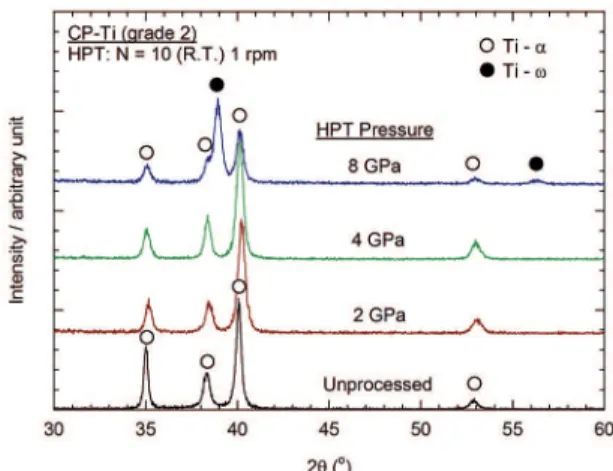
The X-ray difraction patterns of the material before and after processing by HPT at diferent pressures are shown in Figure 1. The peaks observed in the unprocessed material correspond to the h.c.p. α-phase and also in the material processed by HPT under pressures of 2 and 4 GPa. The α-phase is also present in the material processed under a pressure of 8 GPa but additional peaks are present in the difraction pattern and these correspond to the hexagonal ω-phase. Thus, the material processed under the largest pressure exhibits both crystalline structures. This result agrees with earlier reports as ω-phase formation and stabilization
was reported after HPT processing at pressures of 5 GPa and
larger and after multiple turns16,17,20,21,24. On the other hand,
no phase transformation was observed in a similar material
after HPT processing up to 10 turns at 6 GPa of pressure
which suggested higher impurity content in the material19.
Therefore, the present results show that a higher HPT pressure of 8 GPa favors a phase transformation in this material.
Figure 1: X ray difraction patterns for the material before and
after processing by HPT.
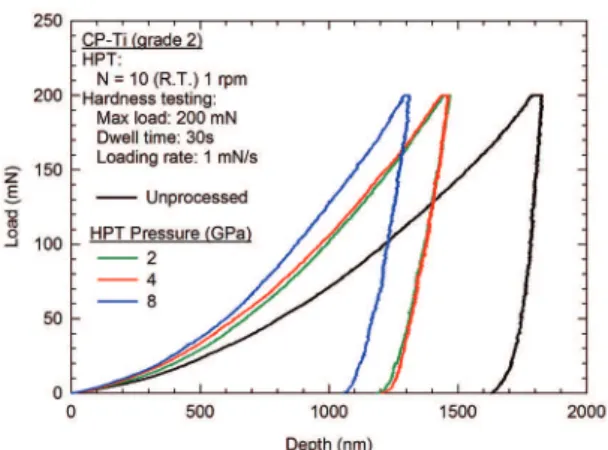
Figure 2 shows representative load vs. depth curves obtained from nanoindentation in the material before and
after HPT processing. The indentations were carried out at
the mid-radius position of the discs processed under diferent levels of pressure. There is a clear tendency of decreasing the depth at peak load in the material processed by HPT and this efect is more pronounced in the material processed at 8 GPa. It is also noted that the variation in depth during the 30 s period at peak load is larger in the unprocessed material
which suggests a higher strain rate sensitivity in this condition.
The hardness was determined at diferent locations of the processed discs and the average values are plotted as
a function of the distance from the center in Figure 3: the
hardness of the unprocessed material is also shown as a dashed line for comparison. The data show that HPT processing
under pressures of 2 and 4 GPa increase the hardness to
values between 3.55 - 3.87 GPa and the distribution is fairly
homogeneous throughout each disc. Processing under a
larger hydrostatic pressure of 8 GPa leads to an increased hardness in the range of 4.10 - 4.71 GPa but the distribution is slightly less homogeneous. Speciically, lower hardness values are observed near the center and at the edge of the disc while the mid-radius is harder. The signiicant increase in hardness in the material processed under the maximum pressure is attributed to the formation of the ω-phase and this is in agreement with other reports. For example, a saturation hardness of ~2.6 GPa was observed in Ti processed at 2 GPa without a phase transformation while a saturation hardness of ~3.4 GPa was observed in the same material processed at 6 GPa which exhibited ω-phase formation17.
The hardnesses near the center and at the edge of the
disc of the material processed at 8 GPa are lower than at the mid-radius position but nevertheless they are higher than observed in the material processed at lower pressures. This suggests these areas may have experienced lower amounts
of phase transformation. The area near the center of the
(dh/dt) where h is the displacement of the indenter and t is the time, and it is possible to estimate the strain rate
sensitivity of the material by comparing its response at diferent loading rates29. Figure 4 shows representative
curves for tests in the unprocessed material and the material processed at 8 GPa. Figure 4(a) shows the evolution of displacement as a function of time and it is possible to
estimate the strain rate during the test. The strain rate
variation was found to be proportional to the loading rate change. Figure 4(b) shows the load vs displacement curves and it conirms that the unprocessed material exhibits a diferent response to the diferent loading rates while the material processed by HPT at 8 GPa is essentially rate-insensitive. Calculations showed that the strain rate sensitivity in the unprocessed material is ~0.03 whereas it is ~0.0 in the material processed by HPT under all testing
conditions. The strain rate sensitivity of the unprocessed
material agrees with reports for pure titanium30,31 although
a slight lower value of 0.020 was also reported32. On the
other hand, the lower values determined for the material processed by HPT difers from the trend of increasing strain rate sensitivity with reining grain structure which was reported elsewhere31.
Figure 2: Load vs depth curves for the material before and after
processing by HPT using diferent pressures.
Figure 3: Hardness distribution on discs processed by HPT using
diferent pressures.
any reverse transformation during unloading. This is in agreement with experimental evidence of an increasing volume fraction of ω-phase with increasing imposed strain
during HPT16,17,20,24 and a lower hardness distribution near the center of the disc even after 10 turns of HPT16,17,20. By
contrast, the edge of the disc undergoes maximum plastic deformation and the reduced volume of ω-phase in this case is attributed to a lower hydrostatic stress. Thus, although the disc is subjected to a compressive load through the massive anvils in the HPT facility, inite element modeling has shown that the distribution of hydrostatic stress is not homogeneous and is larger near the center and lower near the
edge25. Thus, the edge of the disc may be processed under a
lower pressure and this efectively reduces the amount of the
phase transformation. This is in agreement with the reduced
volume fraction of the ω-phase detected by synchrotron
characterization at the edges of discs24.
Nanoindentation tests were also carried out using diferent loading rates. An early report showed that the strain rate, ε̇, during hardness testing is given by ε̇ = 1/h
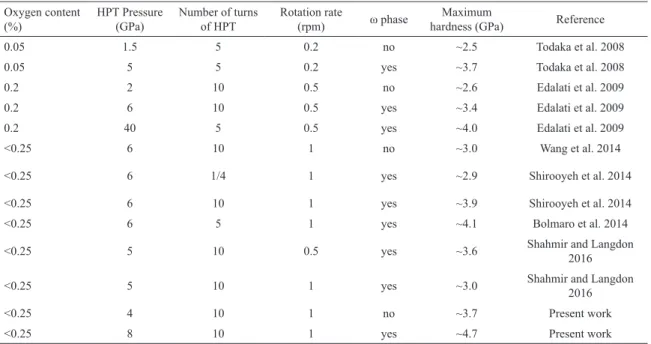
Table 1: Summary of data on hardness and development of ω phase in pure titanium processed by HPT16,17,19-21,24.
Oxygen content
(%) HPT Pressure (GPa) Number of turns of HPT
Rotation rate
(rpm) ω phase hardness (GPa)Maximum Reference
0.05 1.5 5 0.2 no ~2.5 Todaka et al. 2008
0.05 5 5 0.2 yes ~3.7 Todaka et al. 2008
0.2 2 10 0.5 no ~2.6 Edalati et al. 2009
0.2 6 10 0.5 yes ~3.4 Edalati et al. 2009
0.2 40 5 0.5 yes ~4.0 Edalati et al. 2009
<0.25 6 10 1 no ~3.0 Wang et al. 2014
<0.25 6 1/4 1 yes ~2.9 Shirooyeh et al. 2014
<0.25 6 10 1 yes ~3.9 Shirooyeh et al. 2014
<0.25 6 5 1 yes ~4.1 Bolmaro et al. 2014
<0.25 5 10 0.5 yes ~3.6 Shahmir and Langdon
2016
<0.25 5 10 1 yes ~3.0 Shahmir and Langdon
2016
<0.25 4 10 1 no ~3.7 Present work
<0.25 8 10 1 yes ~4.7 Present work
The development of the ω-phase and increase in hardness during HPT processing at large pressures for pure titanium has been reported in several investigations and Table 1 shows a summary of the available data. It is apparent that a phase transformation is readily observed after HPT processing of high purity Ti and at pressures larger than 4 GPa. Thus, the present results agree with the available reports since the phase transformation was observed only at the highest
pressure of 8 GPa.
Comparing similar materials processed at the same rotation rate and the same number of turns of HPT, the hardness increases significantly in materials exhibiting an ω-phase due to processing at higher pressures. This
confirms the effectiveness of enhancing the hardness of titanium through a phase transformation. There is
also a trend of increasing the hardness of the processed material with increasing processing pressure even after reaching the threshold pressure for ω-phase formation. For example, ω-phase formation was reported in samples processed at 6 GPa but the hardness of the processed material increased with increasing processing pressure
up to 40 GPa17. Thus, the present results show a higher hardness of ~4.7 GPa in titanium in Figure 3 and this
higher value is attributed to increased impurities and to
the higher processing pressure.
4. Summary and Conclusions
1. Commercial purity titanium of grade 2 was processed by 10 turns of HPT at pressures of 2, 4 and 8 GPa. X ray difraction revealed the presence of an ω-phase in the material
processed at the highest pressure.
2. Nanoindentation revealed a pronounced increase in hardness due to HPT processing and this efect was even more pronounced in the material processed at 8 GPa of pressure
due to the phase transformation which gave a maximum hardness of ~4.7 GPa.
3. The distribution of hardness in the material processed at 8 GPa was heterogeneous with higher values at the mid-radius position and lower values near the center and at the edge of the disc. These lower values were attributed to the reduced ω-phase content due to the low shear strain near
the center of the disc and the reduced pressure at the edge.
4. Nanoindentation tests with diferent loading rates
showed that HPT processing reduced the strain rate sensitivity
of titanium essentially to 0.
5. Acknowledgements
This work was supported by FAPEMIG and CNPq in Brazil and by the European Research Council under ERC Grant Agreement No. 267464-SPDMETALS.
6. References
1. Valiev RZ, Islamgaliev RK, Alexandrov IV. Bulk nanostructured materials from severe plastic deformation. Progress in Materials Science. 2000;45(2):103-189.
2. Valiev RZ, Langdon TG. Principles of equal-channel angular pressing as a processing tool for grain reinement. Progress in Materials Science. 2006;51(7):881-981.
3. Stolyarov VV, Zhu YT, Lowe TC, Valiev RZ. Microstructure and properties of pure Ti processed by ECAP and cold extrusion.
4. Zhao X, Fu W, Yang X, Langdon TG. Microstructure and properties of pure titanium processed by equal-channel angular pressing at room temperature. Scripta Materialia. 2008;59(5):542-545.
5. Valiev RZ, Semenova IP, Latysh VV, Rack H, Lowe TC, Petruzelka J, et al. Nanostructured titanium for biomedical applications.
Advanced Engineering Materials. 2008;10(8):B15-B17.
6. Stolyarov VV, Zeipper L, Mingler B, Zehetbauer M. Inluence of post-deformation on CP-Ti processed by equal channel angular pressing.
Materials Science and Engineering A. 2008;476(1-2):98-105.
7. Purcek G, Saray O, Kul O, Karaman I, Yapici GG, Haouaoui M, et al. Mechanical and wear properties of ultraine-grained pure Ti produced by multi-pass equal-channel angular extrusion.
Materials Science and Engineering A. 2009;517(1-2):97-104.
8. Kang DH, Kim TW. Mechanical behavior and microstructural evolution of commercially pure titanium in enhanced multi-pass equal channel angular pressing and cold extrusion. Materials & Design. 2010;31(Suppl 1):S54-S60.
9. Zhao X, Yang X, Liu X, Wang X, Langdon TG. The processing of pure titanium through multiple passes of ECAP at room temperature. Materials Science and Engineering: A. 2010;527(23):6335-6339.
10. Zhang Y, Figueiredo RB, Alhajeri SN, Wang JT, Gao N, Langdon TG. Structure and mechanical properties of commercial purity titanium processed by ECAP at room temperature. Materials Science and Engineering: A. 2011;528(25-26):7708-7714.
11. Zhang Y, Alhajeri SN, Figueiredo RB, Gao N, Wang JT, Langdon TG. Contribution of Twins to the Strengthening of Commercial Purity Titanium after Equal-Channel Angular Pressing. Materials Science Forum. 2010;667-669:719-724
12. Sordi VL, Ferrante M, Kawasaki M, Langdon TG. Microstructure and tensile strength of grade 2 titanium processed by equal-channel angular pressing and by rolling. Journal of Materials Science. 2012;47(22):7870-7876.
13. Figueiredo RB, Barbosa ERC, Zhao X, Yang X, Liu X, Cetlin PR, et al. Improving the fatigue behavior of dental implants through processing commercial purity titanium by equal-channel angular pressing. Materials Science and Engineering: A. 2014;619:312-318.
14. Zhilyaev AP, Langdon TG. Using high-pressure torsion for metal processing: Fundamentals and applications. Progress in Materials Science. 2008;53(6):893-979.
15. Islamgaliev RK, Kazyhanov VU, Shestakova LO, Sharafutdinov AV, Valiev RZ. Microstructure and mechanical properties of titanium (Grade 4) processed by high-pressure torsion. Materials Science and Engineering: A. 2008;493(1-2):190-194.
16. Todaka Y, Sasaki J, Moto T, Umemoto M. Bulk submicrocrystalline ω-Ti produced by high-pressure torsion straining. Scripta Materialia. 2008;59(6):615-618.
17. Edalati K, Matsubara E, Horita Z. Processing Pure Ti by High-Pressure Torsion in Wide Ranges of High-Pressures and Strain.
Metallurgical and Materials Transactions A. 2009;40(9):2079-2086.
18. Wang CT, Gao N, Gee MG, Wood RJK, Langdon TG. Processing of an ultraine-grained titanium by high-pressure torsion: An evaluation of the wear properties with and without a TiN coating. Journal of the Mechanical Behavior of Biomedical Materials. 2013;17:166-175.
19. Wang CT, Fox AG, Langdon TG. An Investigation of Hardness Homogeneity and Microstructure in Pure Titanium Processed by High Pressure Torsion. Materials Science Forum. 2014;783-786:2701-2706.
20. Shirooyeh M, Xu J, Langdon TG. Microhardness evolution and mechanical characteristics of commercial purity titanium processed by high-pressure torsion. Materials Science and Engineering: A. 2014;614:223-231.
21. Shamir H, Langdon TG. Characteristics of the allotropic phase transformation in titanium processed by high-pressure torsion using diferent rotation speeds. Materials Science and Engineering: A. 2016;667:293-299.
22. Jamieson JC. Crystal Structures of Titanium, Zirconium, and Hafnium at High Pressures. Science. 1963;140(3562):72-73.
23. Vohra YK, Sikka SK, Vaidya SN, Chidambaram R. Impurity efects and reaction kinetics of the pressure-induced α → ω transformation in Ti. Journal of Physics and Chemistry of Solids. 1977;38(1):1293-1296.
24. Bolmaro RE, Sordi VL, Ferrante M, Brokmeier HG, Kawasaki M, Langdon TG. High-Pressure Torsion of Ti: Synchrotron characterization of phase volume fraction and domain sizes.
IOP Conference Series: Materials Science and Engineering. 2014;63:012147.
25. Figueiredo RB, Cetlin PR, Langdon TG. Using inite element modeling to examine the low processes in quasi-constrained high-pressure torsion. Materials Science and Engineering: A. 2011;528(28):8198-8204.
26. Pereira PHR, Figueiredo RB, Cetlin PR, Langdon TG. Using inite element modeling to examine the low process and temperature evolution in HPT under diferent constraining conditions. IOP Conference Series: Materials Science and Engineering. 2014;63:012041.
27. Figueiredo RB, Pereira PHR, Aguilar MTP, Cetlin PR, Langdon TG. Using inite element modeling to examine the temperature distribution in quasi-constrained high-pressure torsion. Acta Materialia. 2012;60(6-7):3190-3198.
28. Pereira PHR, Figueiredo RB, Huang Y, Cetlin PR, Langdon TG. Modeling the temperature rise in high-pressure torsion.
Materials Science and Engineering: A. 2014;593:185-188.
29. Mayo MJ, Nix WD. A micro-indentation study of superplasticity in Pb, Sn, and Sn-38 wt% Pb. Acta Metallurgica. 1988;36(8):2183-2192.
30. Peykov D, Martin E, Chromik RR, Gauvin R, Trudeau M. Evaluation of strain rate sensitivity by constant load nanoindentation. Journal of Materials Science. 2012;47(20):7189-7200.
31. Hajizadeh K, Eghbali B, Topolski K, Kurzydlowski KJ. Ultra-ine graUltra-ined bulk CP-Ti processed by multi-pass ECAP at warm deformation region. Materials Chemistry and Physics. 2014;143(3):1032-1038.