Amino acid composition of parturient
plasma, the intervillous space of the
placenta and the umbilical vein of
term newborn infants
1Departamento de Puericultura e Pediatria, Hospital das Clínicas, Faculdade de Medicina de Ribeirão Preto, Universidade de São Paulo, Ribeirão Preto, SP, Brasil
2Grupo Interdisciplinar de Saúde da Criança, Faculdade de Medicina,
Universidade de Ribeirão Preto, Ribeirão Preto, SP, Brasil J.S. Camelo Jr.1,2,
S.M. Jorge1 and F.E. Martinez1
Abstract
The objective of the present study was to determine the levels of amino acids in maternal plasma, placental intervillous space and fetal umbili-cal vein in order to identify the similarities and differences in amino acid levels in these compartments of 15 term newborns from normal pregnancies and deliveries. All amino acids, except tryptophan, were present in at least 186% higher concentrations in the intervillous space than in maternal venous blood, with the difference being statistically significant. This result contradicted the initial hypothesis of the study that the plasma amino acid levels in the placental intervillous space should be similar to those of maternal plasma. When the maternal venous compartment was compared with the umbilical vein, we observed values 103% higher on the fetal side which is compatible with currently accepted mechanisms of active amino acid transport. Amino acid levels of the placental intervillous space were similar to the values of the umbilical vein except for proline, glycine and aspartic acid, whose levels were significantly higher than fetal umbilical vein levels (average 107% higher). The elevated levels of the intervillous space are compatible with syncytiotrophoblast activity, which main-tain high concentrations of free amino acids inside syncytiotropho-blast cells, permitting asymmetric efflux or active transport from the trophoblast cells to the blood in the intervillous space. The plasma amino acid levels in the umbilical vein of term newborns probably may be used as a standard of local normality for clinical studies of amino acid profiles.
Correspondence
J.S. Camelo Jr.
Departamento de Puericultura e Pediatria, HC, FMRP, USP Av. Bandeirantes, 3900, 7º andar 14049-900 Ribeirão Preto, SP Brasil
Fax: +55-16-602-2700 E-mail: [email protected] Research supported by CAPES. Publication supported by FAPESP.
Received April 10, 2003 Accepted March 22, 2004
Key words
•Fetal nutrition •Amino acid analyses •Placental intervillous space •Fetal umbilical vein
The placenta, much more than a simple organ supplying nutrients to the fetus, is a highly complex metabolic organ (1). In terms of protein nutrition, a broad range of placen-tal mechanisms have been shown to be in-volved in the amino acid transfer from mother
such as substrate specificity and sodium de-pendence have identified 15 different active transport systems in the human placenta, 7 of which are for neutral amino acids. With the advances in the study of the molecular biology of amino acid carrier proteins, at least 25 complementary DNA clones for amino acid carriers or their subunits have been identified (3).
Cationic amino acids are actively trans-ported by various systems on both sides of the trophoblastic cell, especially by a high capacity specific cationic system denoted y+ (3) and by three other low capacity systems called b0, + and y + L (3,4).
Among the transport systems for neutral amino acids, the A system is the most reac-tive with amino acids presenting linear, po-lar and short side chains. System 1 (previ-ously known as system L) is more reactive with large branched and apolar chain amino acids and also with aromatic amino acids. The reactivity of the ASC system (MeAIB-insensitive L-cysteine-and L-serine-trans-porting electroneutral system) is more or less limited to alanine, serine, and cysteine, and, at acid pH, this system can transport aspartate and its analogues. The B or ß sys-tem is specific for amino acids such as tau-rine and ß-alanine. The N system transports amino acids with side chains containing ni-trogen such as glutamine, asparagine and histidine. The remaining two systems are a specific system for glycine and sarcosine and a system denoted t for tyrosine transport (2,3).
Anionic amino acids are transported on both surfaces of the trophoblast by the spe-cific system X
-AG (3). Schneider and Dancis
(5) observed that aspartate was concentrated 23 times and glutamate was concentrated 34 times in vesicles of the trophoblast mem-brane of the human placenta, whereas the other amino acids tested did not exceed a 12-fold concentration. This difference in nega-tive umbilical arteriovenous concentration suggests uptake from the fetal circulation
(6). An explanation for these findings is the participation of the placenta, which contri-butes to the fetal nitrogen and amino acid balance through selective cycles in the so-called cooperative inter-organ metabolism involving anionic amino acids (1,6,7).
When mother/fetus amino acid exchanges are evaluated, the correlations between mother and fetus plasma amino acid levels are frequently analyzed. However, it is im-portant to bear in mind that maternal blood may be affected by food ingestion, by exer-cise, by amino acid release from muscle into the circulation, as well as by circadian rhythm. Analysis of intervillous space blood may be a more appropriate reference point for com-parison since this is an exchange interface, providing more information for a better un-derstanding of maternal-fetal physiology (8). In 1972, Meirelles and Matheus devel-oped a method for blood collection from the placental intervillous space (PIVS), later modified by Camelo Jr. et al (9), which permitted a more effective evaluation of fe-tal-maternal exchanges by means of the cor-relation between the findings for maternal blood, for the PIVS and for the umbilical cord vessels. This method permits the analy-sis of the transfer of various nutrients and this methodology proved to be able to detect different mechanisms of passage and/or trans-port of different nutrients through the pla-centa (10-13).
The objective of the present study was to determine the similarities and differences of plasma amino acid levels in the maternal venous compartment, PIVS, and umbilical vein on the basis of the mechanisms of pla-cental transport of the amino acids men-tioned above. Our hypothesis was that the plasma amino acid levels in the PIVS should be similar to those of maternal plasma.
written informed consent to participate in the study, which was approved by the Ethics Committee of the University Hospital, Fac-ulty of Medicine of Ribeirão Preto. We stud-ied maternal blood, blood from the intervil-lous space of the respective placenta and umbilical vein blood from 15 term new-borns, adequate for gestational age, which was calculated by the method of Dubowitz (14).
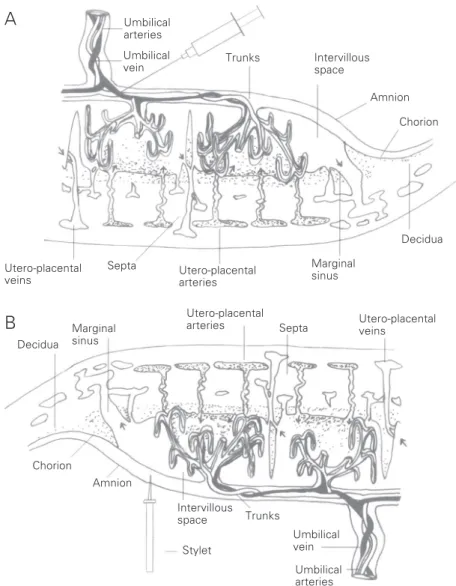
Maternal venous blood (5 ml) was col-lected by puncture of a peripheral forearm vein after delivery using 20% EDTA as anti-coagulant. Blood from the PIVS was col-lected by the method of Meirelles and Matheus, modified by Camelo Jr. et al. (9). After placental detachment, the retroplacental clot was removed and the basal plate was closed with the membranes. The placenta was placed inside a plastic bag which was lifted to a height that would permit the inves-tigator to observe it, with the chorial plate looking down, and a region of the chorial plate with no fetal vessels was identified. The plastic bag was sectioned with a scissors and the chorial plate was perforated at that site with a stylet. Blood (5 ml) was allowed to drip freely and directly into the collecting tube containing dried EDTA. Direct drip-ping into the tube reduces the possibility of hemolysis. We used the Kleihäuer test modi-fied by Sanguansemsri (9) and the samples containing contaminating fetal red blood cells in numbers exceeding 0.5% of the total were discarded (Figure 1B). Blood was collected from the umbilical vein by puncture of the vein close to the chorial plate immediately after placental detachment (Figure 1A). Blood was centrifuged and the plasma ob-tained was deproteinized with 10% sulfosali-cylic acid (v/v, plasma/10% sulfosalisulfosali-cylic acid), and only the supernatant was used after centrifugation. The quantitative and qualitative free amino acid composition was determined by automatic amino acid analy-sis by ion-exchange chromatography with ninhydrin post-column derivatization using
an analyzer built at the Protein Chemistry Center, Faculty of Medicine of Ribeirão Preto, University of São Paulo (15).
Data were analyzed statistically by the Student t-test and by Friedman two-way anal-ysis of variance for the comparison of all compartments, by the Wilcoxon test for 2 x 2 comparison of correlated samples, and by the Mann-Whitney test for 2 x 2 independent samples, with the level of significance set at 5%.
The newborns were 9 females and 6 males with a gestational age of 39 ± 1 weeks (range:
Utero-placental veins
Septa Utero-placental
arteries
Utero-placental
arteries Septa
Marginal sinus Decidua
Umbilical arteries
Umbilical
vein Trunks Intervillousspace
Amnion
Chorion
Decidua
Marginal sinus
Utero-placental veins
Trunks Intervillous space
Stylet
Umbilical vein
Umbilical arteries Amnion
Chorion
A
B
37-41 weeks) and weighing 3084 ± 392 g (range: 2570-3820 g). All infants were clas-sified as term babies adequate for gestational age.
The amino acid levels detected in the three compartments are reported as means ± SD and are listed in Table 1. Comparison of maternal plasma and PIVS plasma amino acids demonstrated a characteristic pattern for all amino acids evaluated, except for tryptophan. PIVS values were always sig-nificantly higher than maternal plasma val-ues, except for tryptophan that was statisti-cally similar for maternal and PIVS plasma, with the values being 29 ± 18 and 28 ± 18 µmol/l, respectively.
Comparison of PIVS and umbilical vein amino acid levels indicated similarity for lysine, arginine, histidine, threonine, serine, alanine, valine, isoleucine, leucine, methio-nine, cystine, and tyrosine. In contrast, pro-line, glycine and aspartic acid levels were significantly lower in the umbilical vein and
tryptophan levels were significantly higher in the umbilical vein.
When maternal values were compared to those of the respective infants, a highly ho-mogeneous pattern was again observed. Ex-cept for cystine, which did not present any difference, all other levels detected in the umbilical vein were significantly higher than maternal levels. Even tryptophan, which did not differ between maternal and PIVS plasma, was significantly higher in the umbilical vein compartment compared to the maternal one. Lysine and arginine exhibited high con-centrations in the umbilical vein compared to maternal levels. PIVS levels were signifi-cantly higher than the maternal venous com-partment but similar to the levels in the fetal umbilical vein.
Neutral amino acids usually presented the same behavior as cationic amino acids when maternal levels (venous blood) were compared to fetal levels (umbilical vein), i.e., maternal levels were invariably lower than umbilical vein levels, with the only exception being cystine (32 ± 14 µmol/l in maternal venous blood and 42 ± 24 µmol/l in the umbilical vein). Although cationic and neutral amino acids are transported by dif-ferent systems in the syncytiotrophoblast, the present data are consistent with the ac-tive transport mechanisms described in the literature, demonstrating a concentration of values in the direction from the mother to the fetus (2-4).
The anionic amino acids aspartic acid and glutamic acid presented significantly higher concentrations in the intervillous space compared to the umbilical vein. Studies on the transport of anionic amino acids by the syncytiotrophoblast have suggested that there is active glutamine transport from the mater-nal compartment to fetal blood (umbilical vein) and active glutamic acid uptake by the placenta from the fetal circulation (after fe-tal hepatic metabolism of glutamine), dem-onstrating the existence of a kind of inter-organ cooperative metabolism between
Table 1. Amino acid concentrations in maternal plasma, placental intervillous space blood and umbilical vein blood of term newborns.
Amino acids Maternal plasma Placental intervillous space Umbilical vein
Lysine 104 ± 37a,b 252 ± 130a 310 ± 94b
Arginine 39 ± 11a,b 100 ± 53a 78 ± 29b
Histidine 68 ± 13a,b 104 ± 38a 108 ± 31b
Threonine 138 ± 54a,b 241 ± 118a 232 ± 65b
Serine 127 ± 57a,b 251 ± 136a 197 ± 65b
Proline 114 ± 52a,b 292 ± 343a,c 171 ± 87b,c
Glycine 119 ± 62a,b 435 ± 247a,c 291 ± 121b,c
Alanine 250 ± 72a,b 448 ± 188a 392 ± 102b
Tryptophan 29 ± 18b 28 ± 18c 40 ± 25b,c
Valine 111 ± 32a,b 208 ± 82a 216 ± 51b
Isoleucine 38 ± 16a,b 83 ± 41a 70 ± 28b
Leucine 64 ± 22a,b 162 ± 76a 137 ± 66b
Methionine 18 ± 10a,b 36 ± 20a 35 ± 24b
Cystine 32 ± 14a 64 ± 53a 42 ± 24
Tyrosine 35 ± 14a,b 67 ± 34a 67 ± 21b
Phenylalanine 44 ± 18a,b 93 ± 49a 91 ± 39b
Aspartic acid 24 ± 17a,b 302 ± 233a,c 100 ± 103b,c
Glutamic acid 168 ± 13a,b 594 ± 268a 433 ± 293b
Data (µmol/l) are reported as means ± SD for N = 15 samples in each group.
aP < 0.05 comparing maternal plasma and placental intervillous space; bP < 0.05
comparing maternal plasma and umbilical vein; cP < 0.05 comparing placental
mother and fetus (5-7). These observations may explain the different levels between the maternal placental compartment and the umbilical vein (aspartic acid: PIVS 302 ± 233 and umbilical vein 100 ± 103 µmol/l; glutamic acid: PIVS 594 ± 268 and umbilical vein 433 ± 293 µmol/l). The present data are compatible with described mechanisms if we admit the possible existence of a passive escape from the syncytiotrophoblast cell to the blood of the intervillous space (16), not only for anionic amino acids, but also for cationic and neutral amino acids.
Studies on stable carbon isotopes with the labeling of leucine (a parameter of com-parison for the placental transport of an es-sential amino acid), glycine and serine have identified another metabolic cycle of amino acid exchange between the placenta and the fetal liver involving serine and glycine (17). Other investigators who studied this topic (6,7) confirmed these findings. The placenta produces and supplies glycine to the umbili-cal vein by active transport, and glycine is metabolized by the fetal liver, where it is partially converted to serine and CO2; serine,
in turn, is actively taken up by the placenta from both the fetal and maternal circulation. In the present study glycine levels differed significantly in all compartments, with higher values in the PIVS, intermediate in the um-bilical vein and lower in maternal blood. Maternal serine levels were significantly lower than PIVS and umbilical vein levels, but no significant difference was observed between the last two compartments.
The original finding of the present study was that all amino acids except tryptophan were significantly increased in the PIVS com-pared to maternal blood, even considering that the PIVS is a placental compartment containing maternal blood. This finding con-tradicts our initial hypothesis that the plasma amino acid levels in the PIVS should be similar to those of maternal plasma.
The concentrations of free amino acids in the PIVS, which were above maternal levels
and also above fetal levels for some of them such as proline, glycine and aspartic acid, may be indirect indicators of the activity of the syncytiotrophoblast, which would main-tain high concentrations of free amino acids inside its cells (18), permitting the asym-metrical efflux or the active transport of trophoblast cells to intervillous space blood. Critiques of this model suggest that the concentrations in the intervillous space of amino acids from maternal arterial blood may be equal to or lower than the maternal plasma levels and much lower than the fetal levels due to the concentration by active transport at the level of trophoblast cells. However, this was not observed in the pres-ent study in the determination of plasma amino acids at the level of the intervillous space. It may be argued that blood collection after detachment of the placenta may repre-sent a non-physiological situation, so that the altered levels in the intervillous space would not reflect the constant and stable equilibrium existing in utero, and that this type of maternal-fetal study may suffer dis-tortions due to the stress caused by labor. However, this behavior observed in the in-tervillous space in our study seems to be limited to the amino acids. Studies on other nutrients (vitamin E and total lipids, vitamin B12 and folic acid, trace elements, and vita-min A) using the same methodology as em-ployed in the present study have shown quite different distributions of values, compatible with differential transport mechanisms for each of these nutrients (10-13) and support-ing the physiological validity of the data obtained about the amino acids.
diffusion gradient may play a partial role in the placental transfer of amino acids. One should consider the difference in placental structure between species (epitheliochorial membrane in the placenta of horses and hemochorial villous membrane in the human placenta).
Although this was not one of the objec-tives of the present study, the present results can be considered to be a reference standard for the plasma amino acid levels of new-borns, both for the period immediately after birth and for studies of enteral and parenteral nutrition in which the adequacy of the pro-tein sources is evaluated. Plasma amino acid levels are used on the basis of the fact that the plasma profile reflects the composition of the amino acid solution administered by the parenteral route or the amino acid com-position of the feeding formula administered by the enteral route, representing an impor-tant indicator of the quality of the protein source offered. Despite the controversies about the PIVS, the plasma amino acid
lev-els detected in the umbilical vein of term newborns in the present study confirm the findings of Velazquez et al. (20), among others. The situation proposed by Wu et al. (21), i.e., the use as a reference standard of amino acid profiles obtained from term new-borns aged 30 days, breast-fed and healthy, presented values fully superimposable on those of the present study, although the meth-odology and age range studied were differ-ent. In view of these data, the present results can be considered as a reference standard for clinical studies with amino acid profiles.
Acknowledgments
We are grateful to Dr. Lewis J. Greene and Gilberto Padovan, Protein Chemistry Center, Faculty of Medicine of Ribeirão Preto, University of São Paulo, for the chro-matographic analysis of plasma amino acids, and to Dâmaris and Paulo Borges for the schematic drawing.
References
1. Hay Jr WW (1995). Current topic: Metabolic interrelationships of placenta and fetus. Placenta, 16: 19-30.
2. Moe AJ (1995). Placental amino acid transport. American Journal of Physiology, 268: C1321-C1331.
3. Jansson T (2001). Amino acid transporters in the human placenta. Pediatric Research, 49: 141-147.
4. Kamath SG, Furesz BA & Smith CH (1999). Identification of three cationic amino acid transporters in placental trophoblast: cloning, expression, and characterization of hCAT-1. Journal of Membrane Biology, 171: 55-62.
5. Schneider H & Dancis J (1974). Amino acid transport in human placental slices. American Journal of Obstetrics and Gynecology, 120: 1092-1098.
6. Battaglia F & Thureen PJ (1998). Nutrition of the fetus and the premature infant. Diabetes Care, 21: 70B-74B.
7. Cetin I (2001). Amino acid interconversions in the fetal-placental unit: the animal model and human studies in vivo. Pediatric Re-search, 49: 148-154.
8. Bernardini I, Evans MI, Nicolaides KH, Economides DL & Gahl WA (1991). The fetal concentrating index as a gestational age-independ-ent measure of placage-independ-ental dysfunction in intrauterine growth retarda-tion. American Journal of Obstetrics and Gynecology, 164: 1481-1490 (Discussion by Roux JF).
9. Camelo Jr JS, Martinez FE, Jorge SM & de Sala MM (1995). A new method for sampling maternal blood in the placental intervillous
space. Fetal Diagnosis and Therapy, 10: 322-325.
10. Martinez FE, Gonçalves AL, Jorge SM & Desai ID (1981). Vitamin E in placental blood and its interrelationships to maternal and new-born levels of vitamin E. Journal of Pediatrics, 99: 298-300. 11. Giugliani ERJ, Jorge SM & Gonçalves AL (1985). Serum vitamin B12
levels in parturients, in the intervillous space of the placenta and in full-term newborns and their interrelationships with folate levels. American Journal of Clinical Nutrition, 41: 330-335.
12. Giugliani ERJ, Gonçalves AL & Jorge SM (1985). Serum and red blood cell folate levels in parturients, in the intervillous space of the placenta and in full-term newborns. Journal of Perinatal Medicine, 13: 55-59.
13. Pinheiro FS, Jorge SM & Martinez FE (1992). Plasma zinc and copper levels in maternal, placental intervillous space and cord blood. Nutrition Research, 12: 367-373.
14. Dubowitz LMS, Dubowitz V & Goldberg C (1970). Clinical assess-ment of gestational age in the newborn infant. Journal of Pediatrics, 77: 1-10.
15. Alonso N & Hirs CHW (1968). Automation of sample application in amino acid analyzers. Analytical Biochemistry, 23: 272-278. 16. Eaton BM & Yudilevich DL (1981). Uptake and asymmetric efflux of
amino acids at maternal and fetal sides of the placenta. American Journal of Physiology, 241: C106-C112.
transport across the ovine placenta. Placenta, 17: 619-627. 18. Sooranna SR, Burston D, Ramsay B & Steer PJ (1995). Free amino
acid concentrations in human first and third trimester placental villi. Placenta, 15: 747-751.
19. Young M, Allen WR & Deutz NEP (2003). Free amino-acid concen-trations in the equine placenta: relationship to maternal and fetal plasma concentrations. Research in Veterinary Science, 74:
279-281.
20. Velazquez A, Rosado A, Bernal A, Noriega L & Arevalo N (1976). Amino acid pools in the feto-maternal system. Biology of the Neo-nate, 29: 28-40.