www.ann-geophys.net/30/1623/2012/ doi:10.5194/angeo-30-1623-2012
© Author(s) 2012. CC Attribution 3.0 License.
Annales
Geophysicae
Intraseasonal oscillation (ISO) in the MLT zonal wind over
Kolhapur (16.8
◦
N) and Tirunelveli (8.7
◦
N)
M. V. Rokade1, R. Kondala Rao2, S. S. Nikte1, R. N. Ghodpage3, P. T. Patil3, A. K. Sharma1, and S. Gurubaran4
1Earth and Space Science Laboratory, Department of Physics, Shivaji University Kolhapur, 416004, India 2Indira Gandhi Centre for Atomic Research, Kalpakkam, 603102, India
3Medium Frequency Radar, Indian Institute of Geomagnetism, Shivaji University Campus, Kolhapur, 416004, India 4Equatorial Geophysical Research Laboratory, Indian Institute of Geomagnetism, Tirunelveli, 627 011, India
Correspondence to:A. K. Sharma (sharma [email protected]) and S. Gurubaran ([email protected]) Received: 22 June 2011 – Revised: 1 November 2012 – Accepted: 5 November 2012 – Published: 5 December 2012
Abstract. Simultaneous observations of the mean zonal winds at 88 km obtained by the medium-frequency (MF) radars at Kolhapur (16.8◦N, 74.2◦E) and Tirunelveli (8.7◦N, 77.8◦E) have been used to study the intraseasonal oscillation (ISO) in the MLT region. The influences of the intraseasonal variations in the lower tropospheric convective activity as-sociated with the Madden-Julian oscillations on the latitudi-nal behavior of intraseasolatitudi-nal oscillations (ISO) of the zolatitudi-nal winds in the equatorial mesosphere and lower thermosphere (MLT) have been studied. The ISO activity in the lower tro-pospheric convective activity is examined by employing out-going long wave radiation (OLR) as a proxy for deep convec-tive activity occurring in the tropical lower atmosphere. The ISO activity in the zonal wind over TIR is more correlated with that in the convective activity compared to the ISO over KOL. The latitudinal and temporal variabilities of the ISO in MLT zonal winds are explained in terms of the intraseasonal variabilities in the convective activity.
Keywords. Meteorology and atmospheric dynamics (Mid-dle atmosphere dynamics)
1 Introduction
The equatorial/low latitude region is the source region of many unique atmospheric processes that couple the entire at-mosphere vertically. The circulation of the equatorial middle atmosphere is known to be dominated by a semi-annual oscil-lation (SAO) and a quasi-biennial osciloscil-lation (QBO) (Ebdon, 1960; Reed et al., 1961; Hirota, 1978; Hamilton, 1982; Gar-cia et al., 1997; Baldwin et al., 2001). Convectively generated
waves such as Kelvin, Rossby-gravity and gravity waves play a crucial role in driving the QBO in the lower stratosphere and the stratospheric SAO (SSAO) (Lindzen and Holton, 1968; Dunkerton, 1979, 1997; Garcia, 2000), whereas Kelvin waves and gravity waves are considered to be important for driving the mesospheric SAO (MSAO) (Hirota, 1978; Dunkerton, 1982).
Zonal winds in the equatorial mesosphere and lower ther-mosphere (MLT) region are characterized by long-term vari-ations such as the annual oscillation (AO) and the semi-annual oscillation (SAO) (e.g., Vincent, 1993). In addition, the SAO amplitudes show biennial variations (e.g., Bur-rage et al., 1996). Wind oscillations caused by the ultra-fast Kelvin waves (UFK) with 3–4 day period and quasi 2-, 5-, and 16-day wind oscillations have also been investigated (Tsutsumi et al., 1996; Riggin et al., 1997; Kovalam et al., 1999; Yoshida et al., 1999; Isoda et al., 2002; Sridharan et al., 2003; Mota Lima et al., 2008). Besides these oscillations, the MLT zonal winds also undergo variations with periods between the seasonal cycle and planetary-scale wave peri-ods (periperi-ods ranging from 20 to 100 days), which have been termed as the intraseasonal oscillation (ISO), first reported by Eckermann and Vincent (1994) from Christmas Island (2◦N, 150◦W).
1624 M. V. Rokade et al.: Intraseasonal oscillation in the MLT zonal wind over Kolhapur and Tirunelveli
Fig. 1.Time series of daily mean zonal winds at 88 km altitude over Kolhapur (KOL) (top plot) and Tirunelveli (TIR) (bottom plot) for the observational period 1 January 2008–31 December 2009.
because of its role in influencing the weather and climate system (Lau and Chan, 1985; Nakazawa, 1986; Knutson and Kutzbach, 1986; Hendon and Salby, 1994; Madden and Ju-lian, 1994; Matthews, 2000; Lau and Waliser, 2004; Zhang, 2005, and references therein). The studies of ISO over trop-ical Indian stations showed that the wind variabilities in the intraseasonal time period are diminished above tropopause and reintensified at the upper stratospheric heights (Nag-pal and Raghavarao, 1991; Ziemke and Stanford, 1991; Nagpal et al., 1994; Kumar and Jain, 1994). Ziemke and Stanford (1991) explained this behavior of ISO activity in terms of tropical Rossby waves that refract to mid-latitudes near the tropopause then back to tropical latitudes near the stratopause.
Eckermann and Vincent (1994), Eckermann et al. (1997), Lieberman (1998), Isoda et al. (2004), Miyoshi and Fuji-wara (2006), Kumar et al. (2007), Sridharan et al. (2007) and Rao et al. (2009) reported that the ISO periods observed in the zonal winds of the MLT region are similar to the MJO periods and suggested that the intraseasonal cycles in the tropospheric convection associated with the MJO modulate the intensity of the upward propagating gravity waves, non-migrating diurnal tides and ultra fast Kelvin waves and that these induce intraseasonal variations in the MLT region zonal winds through wave induced driving of the mean flow (when they either dissipate or break).
The above mentioned observational studies on the ISO ac-tivity in MLT region are pursued using the data of radars situated in the equatorial region (close to the equator i.e., 10◦S–10◦N). Simultaneous data obtained from the network of radars situated at the low latitude sites Kolhapur (KOL) (16.8◦N, 74.2◦E) and Tirunelveli (TIR) (8.7◦N, 77.8◦E)
during the period from January 2008 to December 2009 pro-vide an opportunity to study the latitudinal variation of the ISO of the zonal winds in the low latitude MLT region. The two sites are located almost at the same longitude but at dif-ferent latitudes. In the present work, we attempt to under-stand the latitudinal nature of the ISO in low latitude MLT region and its relation to the intraseasonal variability of con-vective activity associated with the MJO in the troposphere.
2 Data
In the present study we have utilized the data obtained from the MF radars operated at KOL and TIR. The radar system at KOL is very similar to the one installed at TIR (8.7◦N, 77.8◦E), India (Rajaram and Gurubaran, 1998). Both the MF radars are operating at 1.98 MHz frequency. The MF radar measures wind using the spaced antenna technique in the 68–98 km height range during day time. During night time, it measures wind in the 70–98 km height range. The MF spaced antenna technique provides reliable winds for synoptic stud-ies of neutral air motions in the height range 84–94 km at time scales of greater than 12 h. The data acceptance rate is relatively high at heights above 84 km with largest accep-tance rate around 88 km. Winds are recorded every 2 min at 2 km height intervals (for further details, see Vincent and Lesicar, 1991). The wind data with two minutes time interval are averaged to compute hourly mean winds. The daily mean values were calculated by averaging hourly data for those days having number of data points more than 18 points. The days with number of hourly data points less than 18 were not considered.
The outgoing long-wave radiation (OLR) data (obtained from the National Oceanic and Atmospheric Administration – National Centers for Environmental Prediction (NOAA-NCEP)) has been used as a proxy for deep tropical convec-tion (Hendon and Woodberry, 1993), to study the nature of the ISO activity in the lower tropospheric convection. The OLR data are indicators of cloud top heights. Very high and cold clouds (low OLR) at tropical latitudes are presumed to be associated with deep convection.
3 Results and discussion
3.1 Behavior of the ISO in zonal wind at 88 km height
The time series of daily mean zonal winds determined from the observations made by both the radars at a height of 88 km for the period of January 2008–December 2009 are shown in Fig. 1.
Fig. 2.Amplitude spectra of the daily zonal winds at 88 km over two sites Kolhapur (KOL) and Tirunelveli (TIR) for the three time intervals(a)1–128 days,(b)190–317 days and(c)590–717 days. The horizontal lines represent the 95 % confidence levels.
have chosen to consider the daily mean zonal winds at 88 km for studying the ISO.
The mesospheric semiannual oscillation (MSAO) is clearly evident over both the sites, with westward flow dur-ing the equinoxes and eastward flow durdur-ing the solstices. Also wind variabilities in intraseasonal time scale can be seen clearly. In order to examine dominant periods of time variations of the zonal winds in the intraseasonal time scale, a spectral analysis of zonal winds at 88 km was performed whose results are shown in Fig. 2a–c. From the whole data set, three data segments have been chosen corresponding to different time intervals in which data from both the sta-tions are available, namely, days 1–128 (1 January 2008– 7 May 2008) (128 data points), days 190–317 (9 July 2008– 13 November 2008) (128 data points) and days 590–717 (13 August 2009–18 December 2009) (128 data points), and a Fast Fourier transform (FFT) is applied to each data seg-ment to check the presence of dominant periodicities in dif-ferent time intervals. The 95 % confidence levels for both the stations are shown. To test the statistical significance of the spectral amplitude (Rk), we have used a method in which the probability “p” that the ratio Rk2/PRk2exceeds a parame-ter “g” is given byp= [m(1−g)m−1+higher order terms] (here,PRk2=2/NP(Xi−X mean)2), the summation on
Fig. 3.Band pass (20–100 days) filtered daily zonal winds at 88 km observed at Kolhapur (KOL) and Tirunelveli (TIR) for the observa-tional period 1 January 2008–31 December 2009.
the left hand side runs from k=1 to m and that on the right hand side runs fromi=1, N, the number of points; m=N/2. The error introduced in neglecting the higher or-der terms is only 0.1 % forp=0.05 (95 % confidence level). Therefore, the parameter g (for p=0.05) can be calcu-lated from the relationship,p=m(1−g)m−1. The parame-ter gk is given by gk=Rk2/{t2/NP(Xi−X mean)2}. If gk > gp=0.05 (for 95 % confidence level), the amplitude is 95 % significant.
1626 M. V. Rokade et al.: Intraseasonal oscillation in the MLT zonal wind over Kolhapur and Tirunelveli
Fig. 4.Time-height sections of the ISO of the zonal winds (m s−1) over Kolhapur (KOL) and Tirunelveli (TIR) for the observational period 1 January 2008–31 December 2009.
By applying a filter with band-pass of 20–100 days, fluc-tuations in the period range 20–100 days in the daily mean zonal winds at 88 km height were extracted and are shown in Fig. 3. As can be seen in Fig. 3, during the observational period days 1–128 (January 2008 to May 2008), the ISO ac-tivity in the 60–70 day period band is dominant over TIR and 30–40 day oscillation are dominant at both sites. The obser-vation period days 190–317 (June 2008 to February 2009) is dominated by both 30–40 day and weak 60–70 day ISO ac-tivity at both sites and for the period 590–717 (August 2009 to December 2009), 60–70 day activity is dominant at TIR. Also, 20–30 days and 30–40 days activities are dominant over both the stations. The results from this exercise reveal the similarity of 20–30 day and 30–40 day ISO variations over both sites during the observational period days 190– 317 and days 590–717, whereas 60–70 day ISO activity is not similar during the observational period days 1–128 and 590–717. The ISO activity at MLT heights is relatively more prominent over TIR as compared to other station KOL and ISO over TIR and KOL is not correlated well during most of the time in all time periods except few occasions.
Figure 4 shows the height-time contours of the ISO ampli-tudes (20–100 day filtered zonal winds) of the zonal winds over KOL and TIR. It can be observed from the Fig. 5 that the ISO over both the stations are not correlated well.
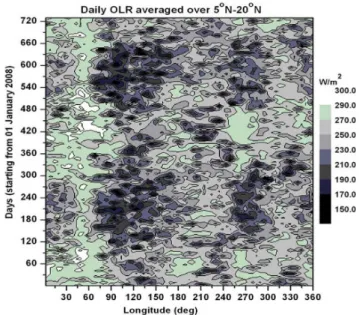
Fig. 5.Time–longitude cross sections of the OLR (W m−2) aver-aged over 5◦N–20◦N for the observational period 1 January 2008– 31 December 2009.
3.2 ISO in the lower tropospheric convective activity
Figure 5 depicts the time-longitude behavior of OLR aver-aged over 5◦N–20◦N. OLR values less than 190 W m−2 rep-resent deep convective activity. The deep and broad convec-tive clusters are present mainly over the 70◦E–180◦E lon-gitude sector and relatively weak convective activity is ob-served around 20◦E and 270◦E regions and the remaining regions are convectively quiescent. The contours over the 70◦E–180◦E longitude sector tilt slightly towards the right or towards the left during certain times with increasing or decreasing longitude indicating an eastward or a westward motion of the convective clusters.
It can be noticed clearly in Fig. 5 that there is a variation in the convective activity on the intraseasonal time scale over the 70◦E–180◦E longitude region that is evident without any filtering of OLR data. The convective clusters with nearly 60–70 day variability can be observed during the observa-tion periods 1–180 days, 300–480 days and 600–730 days (the convective centers are separated by specified number of days) and 30–50 day variability can be observed during the observational period 180–320 days. Convective clusters with 20–35 day variability are also observed during the pe-riod 480–640 days.
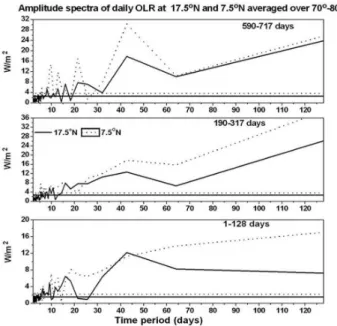
Fig. 6.Amplitude spectra of the daily OLR averaged over 70◦E– 80◦E and 5◦N–20◦N region for the three time intervals:(a)1– 128 days,(b)190–317 days and(c)590–717 days. The horizontal lines represent the 95 % confidence levels.
95 % confidence levels are also indicated in each of the pan-els. A dominant peak at 42 days over 17.5◦N latitude region is observed during the time interval days 1–128, whereas the spectrum increases from a period of 25 days to higher peri-ods continuously over 7.5◦N latitude region. A strong ISO activity with a 42 day period is observed during the period 190–317 days over 7.5◦N latitude region and the 42 wave activity is relatively weak over 17.5◦N latitude region dur-ing the same period. Durdur-ing the remaindur-ing time interval 590– 717 days, peaks around the period 42 day and 21 day are ob-served over both the latitude regions but the ISO over 7.5◦N latitude region is relatively strong and ISO activity with time period above 60 days is also observed over both the latitude regions. From this exercise, we can infer that the convective activity and its ISO variability over 7.5◦N region are rela-tively stronger compared to that over 17.5◦N region. Now, we shall proceed to examine the influence of latitudinal vari-ability in convective activity on the latitudinal nature of the ISO in MLT zonal winds by comparing the ISO in convec-tive activity at the latitudes corresponding to respecconvec-tive radar locations with the ISO in zonal winds at 88 km.
3.3 Comparison of ISO in zonal winds at 88 km height with ISO in lower tropospheric convective activity at the respective radar locations
In Figs. 7 and 8, the OLR at 17.5◦N latitude (over longi-tude sector 60◦E–140◦E) is compared with the ISO in zonal wind at 88 km over KOL (16.8◦N, 74.2◦E) and the OLR at 7.5◦N latitude (over longitude sector 60◦E–140◦E) is
com-Fig. 7.Bottom panel shows OLR at 17.5◦N latitude (over 60◦E– 140◦E longitude) and top panel shows the ISO in zonal wind at 88 km over Kolhapur (KOL).
Fig. 8.Bottom panel shows OLR at 7.5◦N latitude (over 60◦E– 140◦E longitude) and top panel shows ISO in zonal wind at 88 km over Tirunelveli (TIR).
1628 M. V. Rokade et al.: Intraseasonal oscillation in the MLT zonal wind over Kolhapur and Tirunelveli
Fig. 9.Bottom panel compares the ISO in OLR at 7.5◦N latitude (averaged over 70◦E–80◦E longitude) with ISO in zonal wind over TIR and top panel compares the ISO in OLR at 7.5◦N latitude (averaged over 70◦E–80◦E longitude) with ISO in zonal wind at 88 km over KOL.
seems that the zonal winds over TIR, as compared with those over KOL, are influenced more by the 50–70 day convective activity. During the observational period 150–300 days, 20– 30 and 30–40 day ISO variations in MLT zonal winds over both the stations are similar. One important thing to be no-ticed is that the ISO in MLT zonal winds over KOL is similar to ISO in MLT zonal winds over TIR during the observa-tional periods 150–300 days (see Fig. 3) during which the convective activity at 17.5◦N latitude region is also strong.
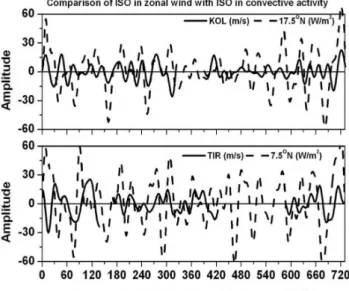
In Fig. 9, ISO in OLR at 17.5◦N latitude (averaged over longitude sector 70◦E–80◦E) is compared with the ISO in zonal wind at 88 km over KOL (16.8◦N, 74.2◦E) and the ISO in OLR at 7.5◦N latitude (averaged over longitude sec-tor 70◦E–80◦E) is compared with the ISO in zonal wind at 88 km over TIR (8.7◦N, 77.8◦E). It can be observed from the Fig. 9 that the phases of the correlation between the ISO in zonal winds over KOL and ISO in OLR at 17.5◦N lat-itude region are very poor but the ISO in zonal wind over TIR and ISO in OLR at 7.5◦N latitude region are correlated well. It seems the eastward zonal wind tends to correspond to the lower OLR during some periods. But, the eastward phase of the ISO need not always be linked with lower convective activity because the westward phase of the ISO was also as-sociated with the deeper convective activity during certain periods as reported in earlier works (Sridharan et al., 2007; Rao et al., 2009) on ISO. In addition, the direction of zonal mean winds in the MLT region depends on the phase of the SAO. So, the response of the zonal wind to forcing caused by the convectively modulated wave dissipation on the in-traseasonal time scale might then depend on the phase of the
SAO at those altitudes. The study of long-term variability of MLT winds by Sridharan et al. (2007) revealed the times of enhancement of the ISO amplitudes in zonal wind coincided with the times of large westward winds and this suggests that the ISO in zonal wind at least partly depends on the phase of the SAO. Even though the MLT zonal wind responds quite promptly to the ISO in the convective activity, the present observations indicate slight enhancement of ISO amplitudes (as seen in Figs. 1 and 3) during the westward phase of the MSAO.
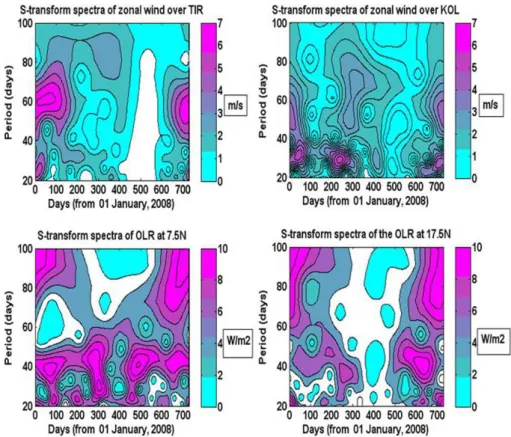
An S-transform method (Stockwell et al., 1996) is also ap-plied to both daily mean zonal winds at 88 km over TIR and KOL and to the OLR averaged over 70◦E–80◦E longitude region at 7.5◦N and 17.5◦N (at respective radar locations) latitudes to find out the temporal behavior of the ISO in both zonal wind and OLR. In Fig. 10, S-transform spectra of the zonal winds at 88 km over TIR and KOL are compared with that of the OLR. The ISO in zonal wind and OLR over TIR are strong with 20–40 day oscillations and oscillations with a period around 60 day and above, whereas the ISO activity in zonal wind and in OLR is relatively weak over KOL. The S-transform spectra of the zonal winds and OLR over TIR are not similar to that over KOL. The correlation between the ISO in zonal winds and the ISO in OLR over TIR is not evident clearly in S-transform spectra.
We have calculated cross-correlation functions (CCF) be-tween ISO of the zonal wind and ISO of the OLR at the re-spective radar locations to understand the latitudinal depen-dency of the correlation between the zonal winds and OLR. In Fig. 11, the cross-correlation functions between the ISO in zonal wind and OLR at both the locations have been shown for the three time periods 1–128 days, 190–317 days, and 590–717 days. It can be observed from Fig. 10 that the max-imum values of CCF between ISO in zonal wind and ISO in OLR over TIR during the observational periods 1–128 days, 190–317 days and 590–717 days are 0.4, 0.2 and 0.5 with lag in phase of about−12 days,−5 days and−12 days, re-spectively. On the other hand, the maximum values of CCF between ISO in zonal wind and ISO in OLR over KOL dur-ing the observational periods 1–128 days, 190–317 days and 590–717 days are 0.3, 0.1 and 0.6 with lag in phase of about 12 days,−1 day and 3 days, respectively. It can be under-stood from these observations is that the ISO in zonal winds and ISO in OLR over KOL are relatively less coherent (with CCF values around 0.3 and 0.1 during the periods 1–128 days and 190–317 days) except during the period 590–717 days (with CCF value around 0.6). The lag in phase is also not consistent during different observational periods. The com-mon feature that can be understood is that the relation be-tween the ISO in zonal wind and ISO in OLR over TIR are relatively more consistent compared to that over KOL.
Fig. 10.Comparison of the ISO in zonal wind with ISO in convective activity.
Fig. 11. Cross-correlation functions (CCF) between the ISO in zonal winds and the ISO in OLR, for three different time periods:
(a)1–128 days,(b)190–317 days,(c)590–717 days.
direction though the amplitudes of the ISO are different. In the present case, the ISO in zonal winds do not exhibit co-herency in the latitudinal direction during certain time
1630 M. V. Rokade et al.: Intraseasonal oscillation in the MLT zonal wind over Kolhapur and Tirunelveli
are of planetary scale and they could propagate zonally and vertically and could show their effect on the zonal mean cir-culation globally. But, the equatorial waves and small scale gravity waves decay rapidly away from the equator and could not propagate in the latitudinal direction (Matsuno, 1966; Yang et al., 2006; Garcia et al., 2005). That means the spec-trum of waves that could cause for driving the ISO in MLT zonal winds are stronger close to the equator. So, we may ex-pect a stronger ISO in MLT zonal winds at the locations close to the equator. The measurement sites are not many enough in latitudinal direction to make better assessment of the dis-tribution of ISO and the disdis-tribution of waves participating in driving the ISO.
4 Summary and conclusions
The present work is focused on studying the latitudinal be-havior of intraseasonal oscillations of the zonal wind in the low latitude MLT region, and its relation to the lower tropo-spheric convective activity, using data on zonal winds ob-tained by two low latitude MF radars at KOL (16.8◦N, 74.2◦E) and TIR (8.7◦N, 77.8◦E). The zonal winds at 88 km over both the sites i.e., KOL and TIR do not exhibit simi-lar ISO in different time period bands (around at 20–30 day, 30–40 day) except few times and 60–70 day ISO activity is stronger over TIR as compared to KOL. The convective ac-tivity over 7.5◦N latitude region and the zonal winds over TIR exhibit similar ISO variations, whereas convective ac-tivity over 17.5◦N latitude region is weak and do not show any similarity with the ISO in zonal winds over KOL during some periods. The reason for this could be the confinement of the convectively generated equatorial waves in the region close to the equator.
The latitudinal dependency of the ISO at MLT heights re-vealed stronger ISO activity in the regions where convective activity is strong. In order to estimate the role of equatorial waves, gravity waves and tides in the excitation of intrasea-sonal oscillation of the zonal wind, the intraseaintrasea-sonal variabil-ities of the waves and tides, and their latitudinal variabilvariabil-ities, need to be studied extensively using long-term data provided by satellites and a network of radars. This will be the subject of our future study.
Acknowledgements. This study was carried out through the scien-tific collaboration of Shivaji University, Kolhapur and Indian Insti-tute of Geomagnetism (IIG), Mumbai. Author would like to thank NOAA-NCEP climate prediction center for the daily OLR data which was downloaded from their website.
Topical Editor C. Jacobi thanks I. S. Joshi and three anonymous referees for their help in evaluating this paper.
References
Baldwin, M. P., Baldwin, M. P., Gray, L. J., Dunkerton, T. J., Hamil-ton, K., Haynes, P. H., Randel, W. J., HolHamil-ton, J. R., Alexander, M. J., Hirota, I., Horinouchi, T., Jones, D. B. A., Kinnersley, J. S., Marquardt, C., Sato, K., and Takahashi, M.: The quasi-biennial oscillation, Rev. Geophys., 39, 179–229, 2001.
Burrage, M. D., Vincent, R. A., Mayr, H. G., Skinner, W. R., Arnold, N. F., and Hays, P. B.: Long-term variability in the equatorial middle atmosphere zonal wind, J. Geophys. Res., 101, 12847– 12854, 1996.
Dunkerton, T. J.: On the role of the Kelvin wave in the westerly phase of the semimmual zonal wind oscillation, J. Atmos. Sci., 36, 32–41, 1979.
Dunkerton, T. J.: Theory of the mesopause semiannual oscillation, J. Atmos. Sci., 41, 1755–1764, 1982.
Dunkerton, T. J.: The role of gravity waves in the quasi-biennial oscillation, J. Geophys. Res., 102, 26053–26076, doi:10.1029/96JD02999, 1997.
Ebdon, R. A.: Notes on the wind flow at 50 mb in tropical and sub-tropical regions in January 1957 and January 1958, Q. J. Roy. Meteorol. Soc., 86, 540–542, 1960.
Eckermann, S. D. and Vincent, R. A.: First observations of intrasea-sonal oscillations in the equatorial mesosphere and lower ther-mosphere, Geophys. Res. Lett., 21, 265–268, 1994.
Eckermann, S. D., Rajopadhyaya, D. K., and Vincent, R. A.: In-traseasonal wind variability in the equatorial mesosphere and lower thermosphere: Long-term observations from the central Pacific, J. Atmos. Terr. Phys., 59, 603–627, 1997.
Garcia, R. R.: The role of equatorial waves in the semiannual oscil-lation of the middle atmosphere, in Atmospheric Science Across the Stratopause, Geophys. Monogr. Ser., vol. 123, pp. 161–176, Washington, D.C., 2000.
Garcia, R. R., Dunkerton, T. J., Lieberman, R. S., and Vincent, R. A.: Climatology of the semiannual oscillation of the tropical mid-dle atmosphere, J. Geophys. Res., 102, 26019–26032, 1997. Garcia, R. R., Lieberman, R. S., Russell, J. M., and Mlynczak, M.
G.: Large-Scale Waves in the Mesosphere and Lower Thermo-sphere Observed by SABER, JAS, May 2005.
Hamilton, K. P.: Rocketsonde observations of the mesospheric semiannual oscillation at Kwajalein, Atmos. Ocean., 20, 281– 286, 1982.
Hendon, H. H. and Salby, M. L.: The life cycle of the Madden-Julian Oscillation, J. Atmos. Sci., 51, 2225–2237, 1994.
Hendon, H. H. and Woodberry, K.: The diurnal cycle of tropical convection, J. Geophys. Res., 98, 16623–16637, doi:10.1029/93JD00525, 1993.
Hirota, I.: Equatorial waves in the upper stratosphere and meso-sphere in relation to the semiannual oscillation of the zonal wind, J. Atmos. Sci., 35, 714–722, 1978.
Isoda, F., Tsuda, T., Nakamura, T., Murayama, Y., Igarashi, K., Vin-cent, R. A., Reid, I. M., Nuryanto, A., and Manurung, S. L.: Long-period wind oscillations in the mesosphere and lower ther-mosphere at Yamagawa (30 N, 131 E), Pontianak (0 N, 109 E) and Christmas Island (2 N, 157 W), J. Atmos. Sol. Terr. Phys., 64, 1055–1067, 2002.
Res., 109, D21108, doi:10.1029/2003JD003378, 2004.
Knutson, T. R. and Kutzbach, J. E.: Global-scale intraseasonal os-cillations of outgoing longwave radiation and 250 mb zonal wind during Northern Hemisphere summer, Mon. Weather Rev., 114, 605–623, 1986.
Kovalam, S., Vincent, R. A., Reid, I. M., Tsuda, T., Nakamura, T., Nuryanto, A., and Wiryosumarto, H.: Longitudinal variations in planetary wave activity in the equatorial mesosphere, Earth Plan-ets Space, 51, 665–674, 1999.
Kumar, K. and Jain, A. R.: Latitudinal variations of 30–70 day pe-riod waves over the tropical Indian zone, J. Atmos. Terr. Phys., 56, 1135–1145, 1994.
Kumar, K. K., Antonia, T. M., Ramkumar, G., Deepa, V., Gu-rubaran, S., and Rajaram, R.: On the tropospheric origin of meso-sphere and lower thermomeso-sphere wind variability, J. Geophys. Res., 112, D07109, doi:10.1029/2006JD007962, 2007.
Lau, K. M. and Chan, P. H.: Aspects of the 40–50 day oscillation during the northern winter as inferred from outgoing longwave radiation, Mon. Weather Rev., 113, 1889–1909, 1985.
Lau, K. M. and Waliser, D. E.: Intraseasonal Variability in the Atmosphere-Ocean Climate System, 474 pp., Springer Praxis, New York, 2004.
Lieberman, R. S.: Intraseasonal variability of high-resolution Doppler Imager winds in the equatorial mesosphere and lower thermosphere, J. Geophys. Res., 103, 11221–11228, doi:10.1029/98JD00532, 1998.
Lindzen, R. S. and Holton, J. R.: A theory of the quasi-biennial oscillation, J. Atmos. Sci., 25, 1095–1107, 1968.
Madden, R. A. and Julian, P. R.: Detection of a 40–50 day oscilla-tion of the zonal wind in the tropical Pacific, J. Atmos. Sci., 28, 702–708, 1971.
Madden, R. A. and Julian, P. R.: Description of global-scale circu-lation cells in the tropics with a 40–50 day period, J. Atmos. Sci., 29, 1109–1123, 1972.
Madden, R. A. and Julian, P. R.: Observations of the 40–50-day tropical oscillation: A review, Mon. Weather Rev., 122, 814–837, 1994.
Matthews, A. J.: Propagation mechanism for the Madden-Julian Os-cillation, Q. J. Roy. Meteorol. Soc., 126, 2637–2651, 2000. Matsuno, T.: Quasi-geostrophic motions in the equatorial area, J.
Meteorol. Soc. Jpn., 44, 25–43, 1966.
Miyoshi, Y. and Fujiwara, H.: Excitation mechanism of in-traseasonal oscillation in the equatorial mesosphere and lower thermosphere, J. Geophys. Res., 111, D14108, doi:10.1029/2005JD006993, 2006.
Mota Lima, L., Alves, E. de Oliveira, Medeiros, A. F., Buriti, R. A., Batista, P. P., Clemesha, B. R., and Takahashi, H.: 3–4 day Kelvin waves observed in the MLT region at 7.4◦S Brazil, Geof´ısica Internacional, 47, 153–160, 2008.
Nagpal, O. P. and Raghavarao, R.: On the wave forcing of the semi-annual zonal wind oscillation, J. Atmos. Terr. Phys., 53, 1181– 1193, 1991.
Nagpal, O. P., Dhaka, S. K., and Srivastav, S. K.: Wave character-istics in the troposphere and stratosphere over the Indian tropics during the DYANA campaign, J. Atmos. Terr. Phys., 56, 1117– 1133, 1994.
Nakazawa, T.: Intraseaonal variations in OLR in the tropics during the FGGE year, J. Meteorol. Soc. Jpn., 64, 17–34, 1986. Rajaram, R. and Gurubaran, S.: Seasonal variabilities of
low-latitude mesospheric winds, Ann. Geophys., 16, 197–204, doi:10.1007/s00585-998-0197-4, 1998.
Rao, R. K., Gurubaran, S., Sathishkumar, S., Sridharan, S., Naka-mura, T., Tsuda, T., Takahashi, H., Batista, P. P., Clemesha, B. R., Buriti, R. A., Pancheva, D. V., and Mitchell, N. J.: Longitudinal varibility in intraseasonal oscillation in the tropical mesosphere and lower thermosphere region, J. Geophys. Res., 114, D19110, doi:10.1029/2009JD011811, 2009.
Reed, R. J., Campbell, W. J., Rasmussen, L. A., and Rogers, R. G.: Evidence of a downward propagating annual wind reversal in the equatorial stratosphere, J. Geophys. Res., 66, 813–818, 1961. Riggin, D., Fritts, D. C., Tsuda, T., Nakamura, T., and Vincent, R.
A.: Radar observations of a 3-day Kelvin wave in the equatorial mesosphere, J. Geophys. Res., 102, 26141–26157, 1997. Sridharan, S., Gurubaran, S., and Rajaram, R.: QBO influences on
the variability of planetary waves in the equatorial mesopause region, Earth Planets Space, 55, 687–696, 2003.
Sridharan, S., Tsuda, T., and Gurubaran, S.: Radar observations of long-term variability of mesosphere and lower thermosphere winds over Tirunelveli (8.7◦N, 77.8◦E), J. Geophys. Res., 112, D23105, doi:10.1029/2007JD008669, 2007.
Stockwell, R. G., Mansinha, L., and Lowe, R. P.: Localization of the Complex Spectrum: TheSTransform, IEEE transactions on signal processing, 44, no. 4, April 1996.
Tsutsumi, M., Tsuda, T., Nakamura, T., and Fukao, S.: Wind veloc-ity and temperature fluctuations due to a 2-day wave observed with radio meteor echoes, J. Geophys. Res., 101, 9425–9432, 1996.
Vincent, R. A.: Long-motions in the equatorial mesosphere, J. At-mos. Sol. Terr. Phys., 55, 1067–1080, 1993.
Vincent, R. A. and Lesicar, D.: Dynamics of the equatorial meso-sphere: First results with a new generation partial reflection radar, Geophys. Res. Lett., 18, 825–828, doi:10.1029/91GL00768, 1991.
Yang, G., Hoskins, B., and Slingo, J.: Convectively Coupled Equa-torial Waves. Part I: Horizontal and Vertical Structures, JAS, November 2006.
Yoshida, S., Tsuda, T., Shimizu, A., and Nakamura, T.: Seasonal variations of 3.0– 3.8-day ultra-fast Kelvin waves observed with a meteor wind radar and radiosonde in Indonesia, Earth Planets Space, 51, 675–684, 1999.
Zhang, C.: Madden-Julian oscillation, Rev. Geophys., 43, RG2003, doi:10.1029/2004RG000158, 2005.