THE IMPACT OF ENDORSERS’ CHARACTERISTICS ON
CONSUMERS’ REACTION TO THE ADS
Lecturer PhD Raluca COMIATI
Professor PhD Ioan PLĂIAŞ
Babes-Bolyai University of Cluj-Napoca
Abstract:
Everyday, consumers are bombarded by messages inducing them to change their attitudes. These persuasion attempts can range from logical arguments to expressive images, from regular consumers’ advice to celebrities’ recommendation. The literature and the research on advertising indicates the benefits of using the right type of endorser as consumers respond in a different manner to the same advertisement conveyed by various endorsers. Thus the objective of this empirical research paper regards the evaluation of the impact of endorsers’ characteristics (credibility, attractiveness) on consumers’ reaction toward advertisements. Furthermore we examine the consumer’s perception of the credibility and expertise of, the resemblance to, admiration for, and attractiveness of the source used in advertisements. Our research shows that there are no universal recipes in the selection of the endorser of the advertisement. Rather, each endorser may become the optimal solution depending on the circumstances under which it will be used.
Key words: advertising, endorser, consumers’ attitude, endorser’ credibility, endorsers’ attractiveness
Introduction
Consumers are constantly bombarded by messages inducing them to change their attitudes about products, services, brands, producers or suppliers, events etc. These persuasion attempts can range from logical arguments to expressive images, from regular consumers’ advice to celebrities’ recommendation.
The specialists in marketing and advertising try to understand how advertisements can change consumers’ attitudes by thinking in terms of the communications model, which specifies that a number of elements are necessary for communication to be achieved. One of these is the source, where the communication originates. The source is often assimilated to the endorser, who conveys the information within the advertisement, and could be an easily recognizable individual, a
regular consumer, an
organization/company or a character in the cartoons.
According to the studies made, there are three types of benefits of well chosen endorsers. First, endorsers enhance advertising readership (or viewership or listenership) scores. Second, endorsers can induce positive attitude change toward a company and its products. In general, the more credible a source, the more persuasive the source is likely to be. Third, the personality characteristics of the endorser can get associated with the brand’s imagery. These benefits are not automatic, however, and obtaining them requires a careful consideration of a brand’s marketing or advertising needs, and an endorser’s characteristics (Batra, Meyers, Aaker, 1996, p. 401).
38
likelihood that the message will be accepted. The source can be chosen because he or she is an expert, attractive, famous, or even a “typical” consumer who is both likable and trustworthy. Regardless of the situation, the two important features at the basis of choosing the endorsers are credibility and attractiveness (Petroshius, Crocker, 1989). The criterion according to which the specialists in marketing try to emphasize the credibility and the attractiveness of the endorser aim at insuring an agreement between the needs of the audience and the benefits provided by the endorser which motivates the audience to process the message. Therefore, consumers who tend to be sensitive about social acceptance and the opinions of the others are more persuaded by an attractive source, whereas those who are more internally oriented by a credible, expert source (DeBono, Harnish, 1988).
The choice may also depend on the type of product. A positive endorser can help to reduce risk and increase message acceptance overall, but particular types of endorsers are more effective at reducing different kinds of risks. Experts are efficient in changing the attitude toward utilitarian products that have high performance (household appliances); celebrities are efficient in the messages promoting products that have high social risk (jewellery, cars) while typical consumers are efficient in the case of current use products for which the consumer does not perceive a financial or a social risk (food) (Friedman, Friedman, 1979).
Endorser’s Characteristics
There are two ways of thinking about an endorser’s characteristics. The traditional way is to think of an endorser is a “source” of information in the advertisement, contributing to the acceptability of the content of (arguments in) the message because of the source’s credibility or attractiveness.
The second, more recent, way is to think of the endorser as possessing some symbolic properties, which are transferred from the endorser to the endorsed brand (through advertising) and them from the brand to the consumer (through the acts of purchasing and consuming or owning the brand) (Batra, Meyers, Aaker, 1996, p. 401).
Endorser credibility refers to the expertise, to the objectivity and the trustworthiness which the consumer associates to the endorser. This dimension shows consumer’s beliefs that the endorser is competent and willing to provide with accurate information which is necessary for an adequate evaluation of the competing products or brands. The persuasive capacity of a credible endorser is higher in the case in which the consumer doesn’t have information about the product (brand) or did not have an opinion about it.
The endorsers in the ads with demographic characteristics (age, social status, ethnicity, and lifestyle) similar to that of the target-audience are perceived as being much more credible and convincing. For instance, the testimonial advertisements in which a typical consumer, representative for the target audience tells about the positive experience with the product or service are efficient due to the credibility of the endorser (Reinarty, 1996).
services (beauty, restaurants) as compared to utilitarian services (banks) (Royne Stafford, Stafford, Day, 2000).
A category of endorsers whose credibility is explored in the ads is represented by the organizations of professional people in various fields. Phrases such as “recommended by the association of dentists” or “approved by the Association of dermatologists” have a strong impact on consumers’ attitude in the case in which they do not have the capacity to assess the performance of the product (Haley, 1996).
Consumers’ attitude to the product or brand may become unfavourable if the endorser promoting the product or the brand in the ad is perceived as supplying wrong information. In certain situations, the knowledge of the endorser about a certain subject or about a certain field is perceived as being inexact. In other circumstances, even if the endorser has the necessary knowledge, he is not perceived as honest as he is paid to promote and recommend the product or the brand (for instance, a basketball player who signed an exclusive contract with a sportswear producer).
It must be emphasized that an endorser perceived as credible by a segment of consumers could be disregarded by another segment of consumers. For instance, many sportspeople and artist enjoy credibility among young people who follow their advice about clothes, shoes, food habits etc. even if parents disapprove the image and the behaviour of these celebrities.
Endorser attractiveness refers to the perceived social value of the endorser which is based on the physical attractive appearance, personality, social status or the similarity resemblance of the endorser with the target-audience. In the actual context, in which society lays an increased emphasis on the attractive physical look, most people think that beautiful persons are more intelligent, smarter or happier.
This supposition is known in the literature as the stereotype “what is beautiful is good”. Therefore, for various products and services, companies appeal to attractive persons to promote their products or services.
According to the studies made, the endorsers with an attractive physical appearance may influence the purchasing intention and the way in which consumers assess the product determining a change in the attitude of consumers (Baker, Churchill, 1977). On the one hand, the attractive physical look (beauty) may facilitate or change the information processing by directing consumers’ attention to the relevant marketing stimuli. Therefore, there are signs indicating that an ad with attractive persons has more chances to draw the attention and to be remarked, but not necessarily to be read or understood. On the other hand, the beauty of the endorser may also be used as an information source. In the case of products and services for beauty and personal care, the use of some very attractive endorsers is efficient in the formation or in the change of consumers’ attitude as attractiveness is perceived as a confirmation of product or service efficiency. For instance, endorser attractiveness influence consumers’ attitude to an ad for a perfume (attractiveness is considered relevant for this category of product), but does not influence the attitude to an ad made for a coffee brand (attractiveness is not considered relevant for this category of product).
Celebrities as Endorsers
40
process of formation or change of consumers’ attitude as they draw the attention to the message and the product promoted and brings about an emotional relation (respect, liking etc.) with the target audience and this emotional relation is transferred to the product or the service presented in the message. Resorting to celebrities within advertising companies represents an efficient way to differentiate a brand from competitors when consumers do not perceive the significant differences between the competitive brands especially in the maturity stage of the product life cycle.
The notoriety of a person is not enough to ensure the success of an advertising campaign. The efficiency of using famous people as endorsers is conditioned by ensuring the compatibility between the celebrity image, product positioning and one’s self real image or the desired image of the target –audience.
The use of celebrities as endorsers within advertising campaign also brings about a number of risks. A first risk is represented by the fact that there are only a few famous persons who enjoy the appreciation from everybody. Therefore though generally the presence of some attractive persons has a positive impact, the use of some beautiful women as endorsers may cause negative reactions to the ad and to the promoted product among some women (Bower, 2001). Under these circumstances, it is important that the celebrity chosen to promote the product or the brand should be appreciated and liked by the target audience. Another risk aims at the excessive media exposure of a celebrity. The presence of a famous person in several advertising campaigns causes less favourable reactions of the consumers to it and to the messages in which that celebrity appears. Generally, advertising contracts comprise clauses of exclusivity by means of which celebrities undertake not to promote
other similar products or competitive brands.
One should not neglect either the possibility that, during the development of an advertising contract, the image and the popularity of that respective celebrity to be affected negatively by some events in the celebrity’s personal life which could have a negative impact on the promoted product or brand. For instance, Pepsi Company had to give up the ads featuring Madonna (after a controversial clip), Mike Tyson (after being accused of a rape) and Michael Jackson (after he was accused of paedophilia). Such events may have a negative influence on the image of the product and of the brand promoted by that celebrity.
Research Purpose
The literature and the research on advertising indicates the benefits of using the right type of endorser as consumers respond in a different manner to the same advertisement conveyed by various endorsers. When deciding whether to use TV stars rather than typical consumers it is necessary to take into consideration among other things also the target of consumers we are aiming. Thus the objective of this empirical research paper regards the evaluation of the relation between the attitudes toward different endorsers (experts, TV stars, artists, sportspeople, typical consumers, animated characters) and the socio-demographics segments, the impact of endorsers’
characteristics (credibility, attractiveness) on consumers reaction
toward advertisements. Furthermore we examine the consumer’s perception of the credibility and expertise of, the resemblance to, admiration for, and attractiveness of the source used in advertisements.
Research Methodology
respondent’s home. The sample frame included 550 people above 18 years old who watch television programs. We applied the quota sampling because we did not have a database of all the population in order to apply one of the random sampling techniques, moreover random sampling would have been more expensive and harder to achieve by our means.
From our knowledge, a similar study has not been done yet on the Romanian market, thus no prior information was available regarding the most important variables of interest. From the National Institute of Statistics we have obtained the structure of the population of Cluj-Napoca by age and gender which was used in creating the quotas. In the end we obtained a sample of 55% females and 45% males, 46% with ages 18-34, 19% of 35-44, 21% of 45-55 and 14% over 55 years old.
Research Results
In the assessment of the attitude toward the source of the ad, the main categories of endorsers used during advertising campaigns have been approached, to wit: TV stars, professional sportspeople, artists (actors, singers etc.), experts, typical consumers, animated and imaginary characters.
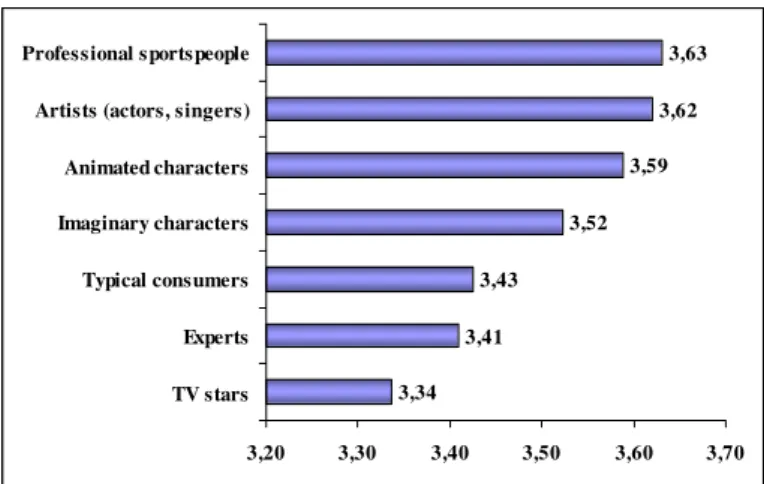
Following the analysis of the breakdown of variables which measure the consumers’ level of preference toward various sources used in advertising messages, the relatively high average scores (over 3) and the negative Skeewness coefficient, showing a negative asymmetry, highlight the fact that a significant percentage of the interviewed people state that they like much or very much all categories of endorsers. (Figure 1).
3,34 3,41
3,43 3,52
3,59 3,62
3,63
3,20 3,30 3,40 3,50 3,60 3,70 TV stars
Experts Typical consumers Imaginary characters Animated characters Artists (actors, singers) Professional sportspeople
Figure 1. A classification of endorsers used in ads according to average assessments
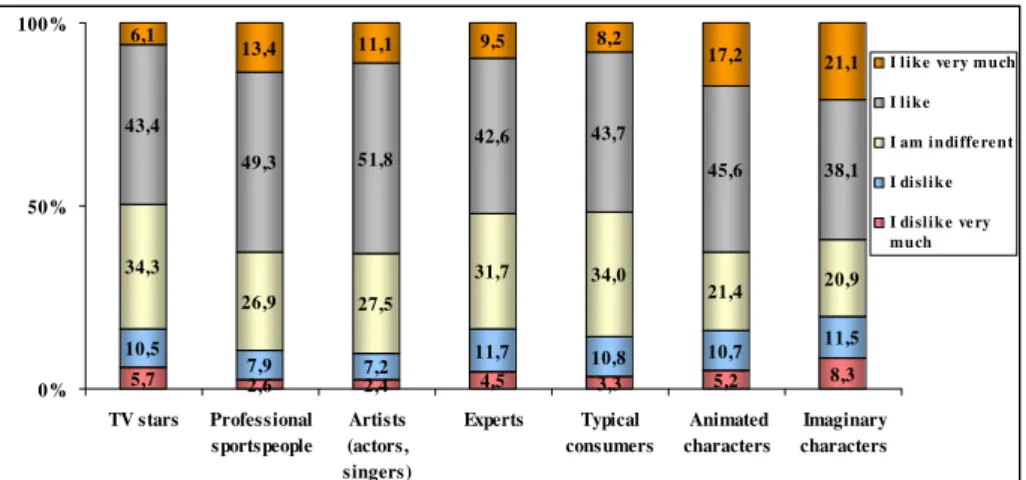
In the classification of endorsers appearing in ads (based on average assessments), sportspeople are ranked number one in order of preference, being preferred by 62.7% of respondents and generally or strongly disliked by only 9.5% (see Figure 2). Artists (actors, singers) are also held in high esteem, with little difference between them and sportspeople. Thus,
endorsers is 15.9% whereas 21% state that they are unconcerned. The imaginary characters, ranked forth, are liked very much by 21% of respondents, the highest level recorded in the “I like it very much” position. On the other hand, this type of “source” records the highest percentage of respondents (19.8%) who state that they dislike much or very much the imaginary characters. The interviewees’ attitude toward typical consumers in ads is neutral, 33% of
which stating that they are unconcerned (the fifth place in the classification). The inferior positions are held by experts and TV stars, whose presence in ads is positively assessed by about 50% of respondents. We notice the distinction between, and the different assessment of, artists and TV stars. Consequently, if the attitude to the presence of actors and singers in advertising messages is a favorable one, the same does not hold true for TV stars.
5,7 2,6 2,4 4,5 3,3 5,2 8,3
10,5
7,9 7,2 11,7 10,8 10,7
11,5 34,3
26,9 27,5
31,7 34,0
21,4 20,9
43,4
49,3 51,8
42,6 43,7
45,6 38,1
6,1
13,4 11,1 9,5 8,2 17,2
21,1
0% 50% 100%
TV stars Professional sportspeople
Artists (actors, singers)
Experts Typical
consumers
Animated characters
Imaginary characters
I li ke ve ry much I li ke I am indi ffe re nt I dislike I dislike ve ry much
Figure 2. The consumers’ attitude toward endorsers appearing in ads The consumers’
socio-demographic characteristics have an important influence on their attitude toward the source of the ad. Thus, women are more inclined than men to have a favorable attitude toward artists, TV stars, imaginary and animated characters as well as experts (Table 1).
On the other hand, age has the most important influence on the attitude toward imaginary characters. In this respect, the youth show a preference for imaginary characters to a greater extent than do the elderly, the latter displaying a more favorable attitude
toward artists and experts (acceptable level of significance but with a low intensity).
The formal education is the socio-demographic variable with the strongest influence on the attitude toward various sources used in ads. Therefore, consumers with a low level of education display a more favorable attitude toward artists, professional sportspeople and TV stars whereas low-income consumers have stronger preference for artists, TV stars and experts.
Table 1 Correlations between consumers’ attitude toward the source of the ad
and the socio-demographic characteristics Pearson
Chi-Square
Kendall's tau-b
Sex Age
Formal education
Monthly inc ome Correlation Coeficient 15.125 0.067 -0.146 -0.130 TV stars
Sig. (2-tailed) 0.004 0.060 0.000 0.000
Correlation Coeficient 4.866 0.066 -0.156 -0.068 Professional sportspeople
Sig. (2-tailed) 0.301 0.063 0.000 0.066
Correlation Coeficient 22.222 0.122 -0.206 -0.136 Artists (actors, singers)
Sig. (2-tailed) 0.000 0.001 0.000 0.000
Correlation Coeficient 16.151 0.093 -0.063 -0.102 Experts
Sig. (2-tailed) 0.003 0.010 0.083 0.006
Correlation Coeficient 2.285 0.072 -0.056 -0.033 Typical consumers
Sig. (2-tailed) 0.684 0.046 0.123 0.379
Correlation Coeficient 9.516 -0.011 -0.051 -0.048
Animated characters Sig. (2-tailed) 0.049 0.765 0.159 0.193
Correlation Coeficient 25.558 -0.157 0.063 -0.031 Imaginary characters
Sig. (2-tailed) 0.000 0.000 0.079 0.399
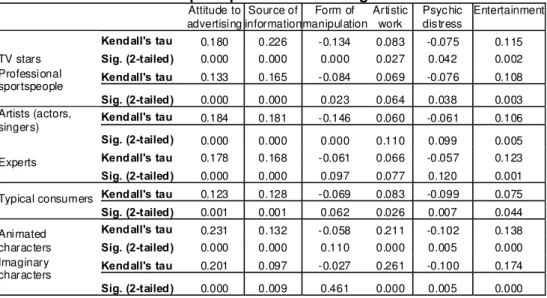
Generally, the attitude toward advertising has a influence on the attitude toward the endorsers used in ads. Thus, it can be noticed that people with a favorable attitude toward advertising also display the same attitude to any source of the ad (Table 2).
Consumers’ perception of the advertising phenomenon exerts an
influence over the attitude toward the source of the ad. Thus, perceiving advertising as a source of information, a form of entertainment or artistic work instills a more favorable attitude toward endorsers used in ads whereas the perception of advertising as a form of manipulation and a source psychic distress reveals a less favorable attitude towards any type of endorser.
Table 2 Correlations between consumers’ attitude toward the source of the ad
and perception of advertising
Attitude to advertising
Source of information
Form of manipulation
Artistic work
Psyc hic distress
Entertainment
Kendall's tau 0.180 0.226 -0.134 0.083 -0.075 0.115
TV stars Sig. (2-tailed) 0.000 0.000 0.000 0.027 0.042 0.002
Kendall's tau 0.133 0.165 -0.084 0.069 -0.076 0.108
Professional sportspeople
Sig. (2-tailed) 0.000 0.000 0.023 0.064 0.038 0.003
Kendall's tau 0.184 0.181 -0.146 0.060 -0.061 0.106
Artists (actors, singers)
Sig. (2-tailed) 0.000 0.000 0.000 0.110 0.099 0.005
Kendall's tau 0.178 0.168 -0.061 0.066 -0.057 0.123
Experts
Sig. (2-tailed) 0.000 0.000 0.097 0.077 0.120 0.001
Kendall's tau 0.123 0.128 -0.069 0.083 -0.099 0.075
Typical consumers
Sig. (2-tailed) 0.001 0.001 0.062 0.026 0.007 0.044
Kendall's tau 0.231 0.132 -0.058 0.211 -0.102 0.138
Animated
characters Sig. (2-tailed) 0.000 0.000 0.110 0.000 0.005 0.000
Kendall's tau 0.201 0.097 -0.027 0.261 -0.100 0.174
Imaginary characters
One of the objectives of the empirical research was to determine consumers’ perception of the credibility and expertise of the source used in ads. To this effect, the interviewees were required to assess, on a scale of “very poor” to “very good”, various endorsers appearing in ads, to wit: showbiz stars, sportspeople, experts and typical consumers.
According to the answers provided, the most trusted endorsers are experts and sportspeople. Thus, in terms of
trust, experts and sportspeople were scored “good” or “very good” by 55.8% and 44.6% of respondents respectively. A high score was achieved by typical consumers since they are trusted by 42.7% of interviewees and scored “neither good nor bad” by 28.5% of interviewees in terms of trust. The showbiz stars (music, film, TV) are at the opposite end of the scale, being only trusted by 27.3% of respondents (Figure 3).
18,4 12,8
8,3 7,6
27,9
19,8
12,5 21,3
26,3
22,9
23,4
28,5 22,5
34,6
42,7
36,2
4,8 10,0
13,1 6,5
0% 50% 100%
S howbiz stars (music, film, TV)
S portspeople Experts Typical consumers
Very good
Good
Neither good not bad
Poor
Figure 3. Assessment of endorsers used in ads according to consumers’ trust
The analysis of the correlation between consumers’ socio-demographic characteristics and their perception of the credibility of the source used in ads reveals the fact that women are more inclined than men to place trust in showbiz stars whereas
persons with a low level of education place more trust in showbiz stars and sportspeople (Table 3). The elderly consumers also deem showbiz stars, experts typical consumers to be more trustworthy (however, the intensity of the bond is very weak).
Table 3 The correlation between the way consumers perceive the credibility of the
source of the ad and the socio-demographic characteristics Kendall's tau
Pearson C hi-Square
Age
Form al
education Sex C orrelation C oefficient 0.080 -0.115 18.360 Showbiz stars
(m usic, fi lm, TV) Sig. (2-tailed) 0.022 0.001 0.001
C orrelation C oefficient 0.048 -0.092 6.854 Sportspeople
Sig. (2-tailed) 0.165 0.009 0.144
C orrelation C oefficient 0.076 -0.050 7.153 Experts
Sig. (2-tailed) 0.031 0.163 0.128
C orrelation C oefficient 0.071 -0.026 1.068 Typical cons um ers
As expected, in terms of expertise (knowledge) the experts are ranked first in the classification as their
expertise capacity is scored “good” or “very good” by 62.1% of interviewees (Figure 4).
17,8
12,1
5,8 8,8 35,1
28,5
11,0
20,6 25,6
28,3
21,2
33,4 19,4
25,3
45,3
31,9 2,1 5,8
16,8
5,3
0% 50% 100%
Showbiz stars (music, film, TV)
Sportspeople Experts Typical consumers
Very good Good
Neither good nor bad
Poor
Figure 4. Assessment of endorsers used in ads according to their expertise capacity perceived by consumers
We notice that only about 30% of respondents believe that the other sources used in advertising have expertise capacity, a very huge difference in comparison with the assessment of experts.
Another important objective of the empirical research was to also determine the consumer’s perception of the resemblance to, admiration for, and attractiveness of the source used in advertising messages. To this effect, the interviewees were required to assess, on a scale of “very poor” to
“very good”, the endorsers who appear in ads (showbiz stars, sportspeople, experts and typical consumers).
According to the answers provided, 50% of the interviewees stated that they most resembled to regular consumers, fact which accounts for the use of “typical consumers” as real referents in ads. The scores earned by the other endorsers for this indicator were modest, with less than 30% of respondents expressing their identification with stars, sportspeople or experts (Figure 5).
4,8 4,4 8,5 6,9
10,5 11,9
14,8 17,5 18,1 17,8
34,0 41,2 43,9 46,9
34,5
29,8 22,7 19,1
8,2 4,7
0% 50% 100%
S howbiz stars (music, film, TV)
S portspeople Experts Typical consumers Very good Good
Neither good nor bad
Poor
At the same time, it can be noticed a rather strong correlation between consumers’ age and how they perceive the reference (resemblance) capacity of the source of the ad (Kendall’s tau-b = 0.116, Sig. = 0.000). Consequently, the elderly regard typical consumers as the endorsers that they most resemble.
Regarding the attractiveness of the source of the ad, the showbiz stars and sportspeople are regarded as attractive by about 70% of interviewees, being followed by experts and typical consumers (Figure 6).
12,0 6,8
6,3 7,8
15,5
12,7 13,5
20,4 22,6
17,2
28,2
35,7 37,7
45,9
39,9
32,0
12,2 17,3 12,1 4,1
0% 50% 100%
S howbiz stars (music, film, TV)
S portspeople Experts Typical consumers
Very good
Good
Neither good nor bad
Poor
Figure 6. Assessment of endorsers used in ads according to the attractiveness perceived by consumers
Typical consumers are regarded as more attractive by the elderly (Kendall’s tau-b = 0.150, Sig. = 0.000).
In terms of the admiration that endorsers draw of consumers, the
ranking endorsers are the sportspeople, scored “very good” or “good” by 63.2% of respondents (Figure 7).
27,7
22,5 21,5
10,5 28,3
25,4 23,0
12,4 22,2
23,7 27,2
27,7 17,6
23,1 22,9
40,9
4,2 5,3 5,3 8,5
0% 50% 100%
S howbiz stars (music, film, TV)
S portspeople Experts Typical consumers
Very good
Good
Neither good nor bad
Poor
V
Figure 7. Assessment of endorsers used in ads according to the admiration they draw of consumers
These results provide further argument in favor of using professional
sportspeople as “symbolic referents”. Naturally, it may be that under certain
circumstances other types of endorsers may be preferred. What matters most, though, is to establish a correlation between endorsers, the intended message and the target segment.
Conclusions
As a result of the research conducted in the area of the endorsers used in advertising we emphasize the following conclusions:
In the hierarchy of endorsers appearing in advertisements, the first position in order of preference is held by professional sportspeople and artists (actors, singers) followed by animated characters, imaginary characters, typical consumers, experts and TV stars. Women are more inclined than men to have a favorable attitude toward artists, TV stars, imaginary and animated characters as well as experts. The youth prefer imaginary characters while the elderly people have a more favorable attitude toward artists and experts.
Advertisers exploit the influence exerted by the information provided by the reference groups by resorting, in ads, to experts who describe the characteristics and performance of the promoted products and services. To begin with, the option of using experts (dental practitioners, dermatologists, chemists, financial analysts) is accounted for by their expertise capacity and the authority granted by the knowledge they possess in their field of activity. Secondly, the message displays the celebrity in a certain field (sportsperson, artist, TV star) perceived as expert in a certain field (sporting
equipment, make-up products etc.). According to the answers given within the research, experts and sportspeople are the endorsers that consumers deem most trustworthy while showbiz stars are at the opposite end of the scale. However, women are more inclined than men to place trust in showbiz stars and persons with a low level of education tend to place more trust in showbiz stars and sportspeople. Experts are the ranking endorsers in terms of expertise (knowledge).
The comparative influence of the reference groups may be exploited by advertisers by means of two categories of referents. The first approach implies the use of a “real referent”, namely, a “typical consumer” trying to convince the audience that his/her like have chosen the product being advertised. The second approach involves the use of a “symbolic referent”, that is, a celebrity that the consumer admires and wishes to identify with. According to the answers given within the research, the interviewees stated that they most resembled to regular consumers, fact which accounts for the use of “typical consumers” as real referents in advertising messages. The sportspeople are the ranking endorsers in terms of the admiration they draw of consumers
Our research shows, as did other studies, that there are no universal recipes in the selection of the endorser, who convey information within the advertisement. Rather, each endorser may become the optimal solution depending on the circumstances under which it will be used.
REFERENCES
Agrawal, J., Kamakura, W. A. (1995), “The Economic Worth of Celebrity Endorsers”, Journal of Marketing, July: 56-62
48
Baker, Michael J., Churchill, Gilbert A. (1977), “The Impact of Physically Attractive Models on Advertising Evaluations”, Journal of Marketing Research, 14 (November): 538-555
Batra, Rajeev, Myers, John G., Aaker, David A.(1996), Advertising Management, Prentice Hall, Inc.
Bower, A. B. (2001), “Highly Attractive Models in Advertising and the Women Who Loathe Them”, Journal of Advertising, Fall: 51-63
DeBono, Kenneth G., Harnish, Richard J. (1988), “Source Exertise, Source Atractiveness and the Processing of Persuasive Information: A Functional Approach”, Journal of Personality and Social Psihology, 55, no. 4: 541-546 Friedman, Hersey H., Friedman, Linda (1979), “Endorser Effectiveness by Product
Type”, Journal of Advertising Research, 19, no. 5: 63-71
Haley, E. (1996), “Exploring the Construct of Organization as Source”, Journal of Advertising, Summer: 19-35
Hawkins, D. L., Best, R. J., Coney, K. A. (1986), Consumer Behavior. Implications for Marketing Strategy, Kent Publishing Company
Petroshius, Susan M., Crocker, Kenneth E. (1989), “An Empirical Analysis of Spokeperson Characteristics on Advertisement and Product Evaluations”,
Journal of the Academy of Marketing Science, 17 (Summer): 217-226
Ratneshwar, S., Chaiken, S.(1991), “Comprehension’s Role in Persuasion: The Case of Its Moderating Effect on the Persuasive Impact of Source Cues ”,
Journal of Consumer Research, 18 (June): 52-62
Reinarty, R. D. (1996), “Testimonial Ads”, Bank Marketing, March: 25-30
Royne Stafford, Marla, Stafford, Thomas F., Day, Ellen (2000), “A Contingency Approach; The Effects of Spokesperson Type and Service Type on Service Advertising”, Journal of Advertising, Summer: 17-32
Schiffman, Leon G., Kanuk, Leslie Lazar (2004), Consumer Behavior, eighth edition, Pearson Education Inc.