Received: 26.03.2007 Received in revision: 07.05.2007 Accepted: 12.05.2007 Published: 29.06.2007
Treeline advance
– driving processes and adverse factors
Friedrich-Karl Holtmeier
1*& Gabriele Broll
21 Institute of Landscape Ecology, University of Münster, Robert-Koch-Straße 26, D-48149 Münster, Germany,
Email: [email protected]
2 Division of Geo- and Agroecology, ISPA, University of Vechta, P.O. Box 1553, D-49364 Vechta, Germany,
Email: [email protected]
*
Corresponding authorAbstract
T
he general trend of climatically-driven treeline advance is modified by regional, local and temporal varia-tions. Treelines will not advance in a closed front parallel to the shift of any isotherm to higher elevations and more northern latitudes. The effects of varying topography on site conditions and the after-effects of his-torical disturbances by natural and anthropogenic factors may override the effects of slightly higher average temperatures. Moreover, the varying treeline-forming species respond in different ways to a changing climate. Forest advance upwards and northwards primarily depends on successful regenerationand survival of young growth rather than on increasing growth rates of mature trees. Every assessment of treeline response to future climate change must consider the effects of local site conditions and feedbacks of increasing tree population in modulating the climatically-driven change. Treeline-shift will influence regional and local climates, pedogenesis, plant communities, animal populations and biodiversity as well as having a considerable effect on economic changes in primary production. A better understanding of the functional relationships between the many treeline-relevant factors and treeline dynamics can be achieved only by extensive research at different scales within different climatic regions supported by as many as possible experimental studies in the field together with laboratory and remote sensing techniques.Keywords
Treeline pattern, treeline history, treeline dynamics, climate change, regeneration
1 Introduction
A
fter the major mid-Holocene treeline retreat (ca. 4000 - 5000 BP) it has been necessary to wait until the end of the “Little Ice Age” in the late 1800s to witness the ini-tiation of migration of plants and shifts of climatic treeline to greater elevations and higher latitudes. This review concentrates first of all on the changes that have been ob-served in the altitudinal and polar treeline ecotones of the northern hemisphere during the favourable climatic period from the 1920s to the 1940s (1950s) and during the last three decades (Holtmeier 2003, there further references). Comparatively little in-formation is available on treeline response to present climate changes in the southern hemisphere and in the tropics (Rundel et al. 1994; Villalba et al. 1997; Wardle & Coleman 1992; Cuevas 2000, 2002; Biondi 2001; Cul-len et al. 2001; Bader 2007).From a global view point, the increase of thermal deficiency with increasing altitude and latitude is the ultimate cause affecting tree physiological processes. From this it fol-lows that regeneration and survival are also affected both directly and indirectly. Various other modifying factors such as wind, or late-lying winter snow pack, energy loss through snow melt, and evaporation also have to be considered. The limiting role of heat-deficiency is clearly reflected in the gradual decline of the treeline from its maxi-mum altitudinal position in the subtropics towards the poles, and in tree stature de-creasing towards the tree-limit. There are nevertheless exceptions as in some semi-arid or arid inland mountain areas and several oceanic subtropical islands low precipitation and limited plant available water during the growing season are likely to be controlling position and local pattern of treeline (e.g., Troll 1973; Horvat et al. 1974; Henning
1974; Wardle 1974; Höllermann 1978; Leuschner & Schulte 1991; Leuschner 1996; Brandes 2006). This global pattern is under-lain by more or less great regional and local variations (cf. Arno 1984; Holtmeier 2003).
Altitudinal and polar treelines are conspicu-ous landscape boundaries. They usually oc-cur as more or less wide ecotones character-ized by specific ecological conditions that differ from those of the closed mountain and northern (subarctic) forests and alpine or northern tundra (Holtmeier 2003). Thus, treeline advance to higher elevation and a more northern position will bring about fun-damental landscape changes in mountains and subarctic regions.
2 Present change at treeline
I
n the northern hemisphere, the climati-cally-driven advance of altitudinal and po-lar treelines is ubiquitous. The general trend, however, is being modified by more or less great regional, local and temporal variation as a result of the regionally varying magni-tude of climate change and the role of the historical legacy of the landscape (climate, vegetation, soils, human use, etc.; e.g., Kear-ney & Luckman 1983; Kullman, 2000, 2005a, 2005c; Holtmeier 1985, 1993, 2003; Luckman & Kavanagh 1998; Lloyd et al. 2003; Lloyd & Fastie 2002; Dalen & Hof-gaard 2005; Lloyd 2005; Gamache & Payette 2005). This is demonstrated in the following examples.occurred at the treeline in Labrador (Elliott & Short 1979; Elliott-Fisk 1983). In the Churchill area (Hudson Bay, Manitoba), the tree population increased within the treeline ecotone while young growth did not become established at treeline until the end of the 1980s (Scott et al. 1987). In northern Qué-bec, no young growth has occurred until re-cently. Probably, the amplitude and magni-tude of recent warming has not been large enough to compensate at such extreme loca-tions for what is left of the negative after-effects of the “Little Ice Age” (Payette et al. 1989; Lescop-Sinclair & Payette 1995). Kull-man (1990) reported a similar situation at a treeline on the Swedish Scandes, where since the early 1970s no regeneration had occurred until the late 1980s.
In some localities of the Swedish Scandes, great numbers of fast-growing 10-15 years old saplings of mountain birch, spruce and pine occur 400-500 m or even up to 700 m above the current tree limits (Kullman 2003, 2004, 2005a, 2005c). In the Handölan Valley (southern Swedish Scandes) Scots pine (Pinus
sylvestris) population increased overall by
50% during a 32-year monitoring period
(1973-2005) despite having declined during the first decade. The consistent expansion that has taken place since the late 1980s more than compensates for the earlier de-cline. It appears that the exceptionally warm summers since 1997 and low mortality rates due to milder winters have been responsible for the improved establishment of pine seed-lings (Kullman 2007). In other places, height growth of climatically-stunted trees in wind-exposed sites with little or even no snow in winter is still impeded, despite the generally warmer climate (cf. Holtmeier 2003, 2005a, 2005b; Kullman 2005b).
On the mountains in Finnish Lapland, where a general trend of treeline advance is obvious (e.g., Juntunen et al. 2002), regeneration and seedling establishment vary considerably among the localities. In some areas of north-ernmost Finnish Lapland, for example, Holocene forest decline was locally followed by severe soil erosion (Fig. 1). Wind-eroded soils poor in nutrients and characterized by low water-holding capacity prevent moun-tain birch from resettling formerly forested sites within the treeline ecotone and beyond the present tree limit. (e.g., Holtmeier et al. 2003; Holtmeier et al. 2004; Kullman 2005c; Anschlag 2006; Broll et al. submitted).
This contrasts with the general “rule” that bare mineral soil surfaces provide favourable seed beds for wind-mediated tree seeds (e.g., larch, birch: e.g., Holtmeier 1967a, 1967b; Kinnaird 1974; Löffler et al. 2004), mainly because competition with dwarf shrubs or grass vegetation is absent or reduced (see also Kallio & Lehtonen 1973; Hobbie & Chapin III 1998). Overgrazing by reindeer, however, appears to be the most harmful factor for birch seedlings.
On the fells in western central Finnish Lap-land, Scots pine seedlings (Pinus sylvestris) be-came established at great numbers in the treeline ecotone during the favourable pe-riod from the 1920s to the 1940s (cf. Hus-Figure 1: Organic layer and upper mineral top
tich 1937, 1942, 1958; Blüthgen 1942; Holt-meier 1974; HoltHolt-meier et al. 1996; HoltHolt-meier et al. 2003), while comparatively few pines occurred in and above the birch-treeline ecotone on the fells in the northernmost part of Finland during the same period of time. It is probable that climatic conditions were less favourable than on the more southern fells (Autio & Colpaert 2005). Thus, current pine advance into the birch-treeline ecotone and alpine tundra on the northern fells (Fig. 2) may be attributed to recent environmental change, which also ini-tiated intensive regeneration on Pallastunturi (south-western Finnish Lapland). In this area, the number of seedlings has increased again since the 1970s, particularly since the mid-1980s until the end of the 20th century
(Holtmeier et al. 1996; Tasanen et al. 1998; Holtmeier et al. 2003; Holtmeier 2005b).
In Norway, regional differences in treeline response to climate warming are apparent. Stable or advancing treelines are common in the southernmost and probably in the mid-dle regions while treeline is declining in the north (Dalen & Hofgaard 2005).
In New Zealand, recent, continuous estab-lishment of seedlings in the Nothofagus menzi-esii treeline forests has not occurred nor has there been any upslope treeline movement. Recruitment continues to be as episodic as ever. Very likely, the absence of the natural disturbances that would create canopy open-ings is the main factor preventing seedling establishment (Cullen et al. 2001). In north-ern Patagonia, Nothofagus pumilio has not suc-cessfully regenerated at the treeline although the temperature has risen since 1970 (Daniels 2000). Regeneration failed probably because of moisture deficiency. This means that tree establishment above the present forest would only be possible if warming co-incided with canopy disturbance (New Zea-land) or favourable moisture conditions (Patagonia).
In the Spanish Pyrenees, warm springs and wet summers enhanced pine regeneration (Pinus uncinata) within the treeline ecotone between 1955 and 1975. However, the tree limit did not advance (Camarero & Gutiér-rez 2000).
Regional, local and temporal variations may also be a consequence of the different re-sponse of tree species to changing climate. On Beartooth Plateau (Montana/Wyoming), for example, seedlings of whitebark pine (Pinus albicaulis) have originated from seed caches of the Clark´s nutcracker (Nucifraga columbiana) during the last decade. By con-trast, seedlings of Engelmann spruce (Picea engelmannii) and subalpine fir (Abies lasiocarpa) are almost absent (Mellmann-Brown 2002, 2005).
In the Colorado Front Range, Engelmann spruce is being more successful in invading treeless terrain at high elevation than is subalpine fir (Holtmeier 1999).
On Pallastunturi (see above), spruce seed-lings (Picea abies)prevail and pine seedlings (Pinus sylvestris) are common. The number of birch seedlings (Betula pubescens ssp. czerepano-vii), however, abruptly declines within a few meters distance from the seed trees growing in the upper orchard-like birch stands (Tab. 1; Holtmeier et al. 2003).
Probably, the after-effects of landscape and site history are the most important agents shaping the present treeline. Primary and secondary succession (after disturbances), competition, natural and man-caused forest fires, heavy wind storms, extremely snow-rich winters or winters almost without snow, droughts, mass outbreaks of leaf-eating in-sects, and other extreme events often have a lasting impact. In the central Norwegian mountains (Møre and Romsdal County), for example, present plant species composi-tion and distribucomposi-tion pattern of the plant communities in the treeline ecotone and lower Alpine is strongly related to environ-mental conditions "inherited" from the for-mer forest, which has retreated steadily dur-ing the Holocene (Hofgaard & Wilmann 2002).
The decline of the natural climatic treeline in the European Alps after the postglacial opti-mum was considerably accelerated by human impact such as pastoral use, mining, salt-works, charcoal production, etc., particularly during the Middle Ages (Fig. 3). Modern changes in economic structure have resulted
in invasion of abandoned alpine pastures by trees. However, seedlings and young growth are being more affected by injurious climatic and biotic (snow fungi infection) influences than might be expected due to the anthropo-genically caused low position of the present forest limit (cf. Fig. 3; see also Holtmeier 1967a, 1967b, 1974, 2003; Stützer 2000).
Moreover, gradually closing plant cover in-fluences invading tree species differently. European larch (Larix decidua), a typical pio-neer species on unvegetated or exposed min-eral soils, is less successful than zoochorous Swiss stone pine (Pinus cembra) in resettling abandoned alpine pastures once a dense grass and dwarfshrub cover has developed (see also Holtmeier 1967a, 1967b, 1995b: Müterthies 2002). Grass cover also prevents prostrate mountain pine (Pinus mugo) from invading abandoned subalpine pastures in some areas of the northern limestone Alps. On the other hand, mountain pine is likely to invade rapidly alpine grassland at and above the present tree limit where competi-tion with other vegetacompeti-tion is reduced (Dullinger et al. 2003, 2004). Competition with dense dwarfshrub vegetation seems to be impeding mountain birch establishment also at the treeline in Vågå upland (southern central Norway; Löffler et al. 2004).
“Relic treelines” that became established at relatively high altitude under a warmer than the present climate, as on many ranges of the Rocky Mountains (Ives 1973, 1978; Ives
Table 1: Percentage of tree seedlings in altitudinal transects of Pallastunturi *).
---Pyhäkero transect--- up to 550 m 550 m – 745 m Tree species [%]
Palkaskero Transect 1
n = 52
Palkaskero Transect 2
n = 84
Palkaskero Transect 3
n = 83 n = 37 n = 15
Norway spruce 77 70 70 30 67
Scots pine 17 25 21 20 27
Mountain birch 6 5 9 50 6
& Hansen-Bristow 1983; Holtmeier 1985, 2003), for example, were characterized by in-creasing tree population within the treeline ecotone (Fig. 4) rather than by the establish-ment of seedlings above the upper limit of the climatically stunted trees (“krummholz”). A similar situation has been reported from the subarctic altitudinal treeline of north-western Canada (Szeicz & MacDonald 1995). More recently, however, and locally increasing numbers of tree seedlings can also be found beyond the tree limit (Fig. 5).
In many treeline ecotones, accelerated height growth of hitherto suppressed, low-growing trees (e.g., mat- or table-growth) rather than recent establishment of young growth be-yond the existing tree limit indicates envi-ronmental change. Many of these formerly
suppressed trees now exceed the minimum height considered to be a criterion for a “tree” (e.g., Kullman 1987, 2000, 2002, 2005a, 2005b, 2005d; Lavoie & Payette 1992; Lescop-Sinclair & Payette 1995; Kjällgren & Kullman 1998; Tasanen et al. 1998; Ga-mache & Payette 2004, 2005; Vallé & Pay-ette 2004). In other places, extreme events such as drought or severe frosts during the growing season have locally caused setbacks to tree development (Fig. 6).
al. 2001; Holtmeier et al. 2003; Holtmeier & Broll 2005; Mazeda 2005). Lack of current change, however, may be an after-effect of a fast local response in the past (e.g., Butler et al. 1998; Malanson 2001).
Insufficient carbon gain has long been con-sidered to be the factor setting an absolute limit to high-elevation tree growth (see Tran-quillini 1979 and Holtmeier 2003 for further references). Thus, increasing CO2 is
ex-pected to trigger altitudinal advance of treeline (e.g., Walsh et al. 1992). However, there has been no evidence of significant correlation of enriched CO2 and tree growth
at treeline, thus far. Other factors seem to override the effects of increased CO2. For
example, increased diameter growth that has occurred in bristlecone pines (Pinus longaeva ) in the treeline ecotone on the White Moun-tains (California) and limber pine (Pinus flex-ilis) on Mt. Washington (Nevada) (LaMarche & Mooney 1972; LaMarche et al. 1984) since the middle of the 19th century must be
as-cribed to increased precipitation rather than
to enriched CO2 and/or higher temperatures
(Stockton 1984). Diameter growth of subal-pine trees in the Cascades remained unaf-fected by increased CO2 and declined since
the favourable 1940s, following the regional trend of temperature (Graumlich & Brubaker 1986; Graumlich et al. 1989). In the southern Sierra Nevada, last year's pre-cipitation and current summer temperature have been completely overriding the effects of CO2-fertilization (Graumlich 1991). This
supports the hypothesis of Körner (2003) that continuing increase in atmospheric CO2
is unlikely to enhance tree growth and treeline advance on a global scale. The abun-dance of such conflicting research results en-sures that discussion on this is likely to con-tinue (e.g., Smith et al. 2003; Johnson et al. 2004).
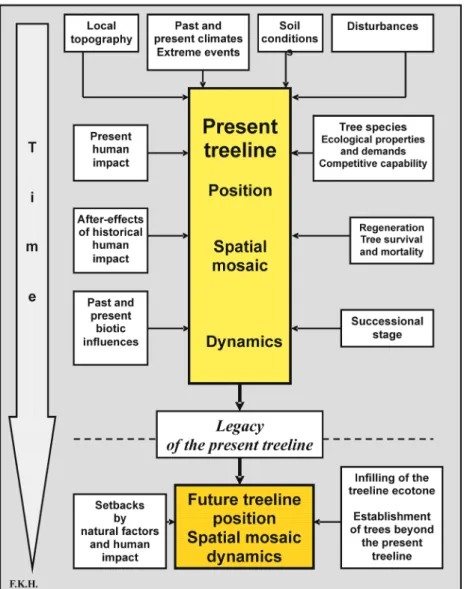
Altogether, the present conditions within the treeline ecotones can be explained only in view of the historical disturbances by natural and anthropogenic factors (cf. Fig. 3; see also Fig. 14). The current climate often has Figure 4: Seedlings of Engelmann spruce (Picea
engelmannii) and subalpine fir (Abies lasiocarpa) in-vading a swale (3373m) within the treeline ecotone of the Blue Lake Valley, Colorado Front Range. The swale was treeless in the early 1970s. Photo-graph taken by J. B. Benedict, 27 July 2006.
only a modulating effect. Past natural and anthropogenic disturbances have produced a spatial-temporal mosaic of patches at differ-ent successional stages. In many areas, they are the factors responsible for resilience of present treeless areas within the present treeline ecotone to invasion by trees in face of a warming climate.
3 Expected change at treeline
T
he relationship of the altitudinal or lati-tudinal positions of the treeline to the future thermal conditions is currently of great interest, both from a global viewpoint as well as for regional and local concerns. However, predicting the future treeline is problematic and often imponderable. Thus,projecting the present relation of treeline and a certain isotherm considered to be the tree-growth limiting factor into a warmer fu-ture may be misleading as in many places the present position of treeline is not in balance with the current climate. This holds particu-larly true for the altitudinal treeline in the high mountains of Eurasia, many of them being settled throughout history (Holtmeier 2003, further references therein). Another reason is the inertia of trees that became es-tablished some hundred years ago (Fig. 7; see also Fig. 6) under different climatic con-ditions from those that prevail at present cli-mate (e.g., Larsen 1965; LaMarche & Mooney 1967; LaMarche 1969; Tolmachev 1970; LaMarche & Mooney 1972; Ives 1973; Krebs 1973; LaMarche 1973; Nichols 1976; LaMarche 1977; Ives 1978; Elliott 1979; Pay-ette & Gagnon 1979; Larsen 1980; Hansen-Bristow 1981; Légère & Payette 1981; Ives & Hansen-Bristow 1983; Holtmeier 1985, 1986; Larsen 1989; Brunstein & Yamaguchi 1992; Payette & Morneau 1993; Kullman 2000). Moreover, we are used to basing “predictions” of treeline on our knowledge of past and current treeline dynamics which brings in additional problems. We have to be aware that we do not really know whether the present interrelationships of temperature and the many other tree-growth influencing factors and their relative effectiveness will be the same in a warmer climate (see also Giorgi & Hewitson 2001; Holtmeier 2003; Holtmeier & Broll 2005). Furthermore, it is still an open question which effects will re-sult from a delayed response of treeline to a rapid climatic change. Thus, the following “predictions” are speculative.
The linkages between tree-cover and perma-frost, for example, will be different. In su-barctic lowlands such as the Hudson Bay area and western Siberia increasing paludifi-cation, as a consequence of the warming cli-mate and melting permafrost, is likely to cause a southward retreat of the boreal for-est (e.g., Crawford 1978, 2005; Crawford et al. 2003). In high mountains such as the Figure 6: Severe winter injury to a clonal conifer
Alps, melting of local permafrost at high ele-vations will result in destabilization of steep mountain slopes, thus increasing erosion of potential forest sites (Fig. 8; Burga & Perret 2001; see also Harris 2005). At more wet-snow conditions (usually in spring and in maritime regions) snow fungi infection might increase and reduce survival of seed-lings and young growth of evergreen coni-fers (Holtmeier 2005a, 2005b), whereas in a warmer and drier climate, earlier snow melt will reduce the risk of snow fungus infec-tions.
Nevertheless, earlier snow melt will expose seedling and saplings to late frost and drought. The effects of soil permeability, for example, may also be different in dry regions compared to humid regions (Holtmeier & Broll 2005). In dry climates, high permeabil-ity may result in moisture stress to seedlings
and saplings. In humid climates, high perme-ability is likely to improve aeration of the rooting zone. Moreover, factors and proc-esses at one scale may not be as important at another scale (Turner 1989; Holtmeier & Broll 2005). Insufficient soil moisture and nutrient supply, for example, which may af-fect seedling establishment at the local scale will be less important in a global view of the factors controlling treeline dynamics.
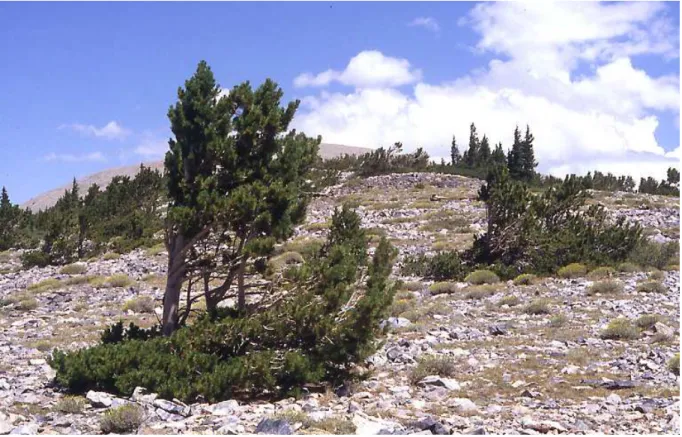
damage to trees) will be playing an important role in this respect (e.g., Holtmeier 2003, 2005a; Kullman 2005b). Likewise, soils, soil temperature, soil moisture and mineraliza-tion will all play a role. By their physiological and mechanical effects permanent strong winds may suppress tree growth or produce dwarfed growth forms that may assume up-right growth if climate will become more fa-vourable (Fig. 9). A deteriorating climate may cause dieback again (cf. Fig. 6).
Moreover, treeline response to changing cli-mate will vary with tree species and type of treeline (e.g., Luckman & Kavanagh 1998; Holtmeier 2003; Holtmeier & Broll 2005). Treeline type depends on topography, tree species represented, and on history of land-scape, climate and vegetation. In a warmer future, Engelmann spruce or subalpine fir (Rocky Mountains), for example, that have
reproduced mainly by layering in the past are likely to regenerate preferentially by seed-lings. This may have a sustainable effect on treeline dynamics.
In the long-term perspective, local topogra-phy is the only relatively constant factor in the treeline environment that will not be af-fected by climate change. In mountainous regions, topography may be highly variable over relatively short distances. Topography on steep mountain slopes differs from to-pography of a glacially moulded valley, a gently rolling uplifted land surface or a smoothly sculptured subarctic peneplain (Holtmeier 2003; Holtmeier & Broll 2005). Treelines on a rolling peneplain (e.g., Ga-mache & Payette 2004, 2005) will respond in a different way to a warming climate than will treelines on rugged mountain topogra-phy. In many steep-sided high mountain
leys, high avalanche activity (cf. Fig. 8), mass wasting, instable slope debris and frag-mented or missing soil cover prevent forest from reaching its possible thermal altitudinal limit (Fig. 10) while those factors do not oc-cur on flat or gently sloping topography.
Moreover, treelines will respond to rising temperatures mainly with gradual infilling of the gaps between the existing trees and tree groups and, to a lesser extend, with the es-tablishment of trees in places above the pre-sent tree limit (cf. Figs. 4 and 5). Even under continued favourable climatic conditions the altitudinal and polar shift of the treeline may lag behind climate change by decades or even centuries (Holtmeier 1985, 1986, 2003; Davis 1986; Woodward 1998; Noble 1993; Hofgaard & Wilmann 2002; Lloyd 2005). In-ter-annual and inter-decadal climate variabil-ity causing abrupt and reversible effects have played and will play an important role as may
be hypothesized in respect of recent treeline history (e.g., Bugmann & Pfister 2000; Müterthies 2002; Millar et al. 2004). Treeli-nes influenced by pastoral use for centuries will respond to a warming climate in a differ-ent way than undisturbed treelines. Aban-doned pasture areas above the man-caused forest limit will continue to be rapidly in-vaded by trees. However, establishment and survival of seedlings may be hampered more by negative effects of microclimates resulting from the historical removal of the high-elevation forests than should be expected at the low level of the present forest limit (cf. Fig 3). Severe microclimates are more likely than global warming to control treeline dy-namics at a local level, at least in the next fu-ture. In the long-term, however, increasing tree populations may have a mitigating ef-fect.
Forest advance to higher elevations and more northern latitudes does not and will in general not depend on increasing growth rates of mature trees and change in growth form from “krummholz” to erect stems (cf. Fig. 9) but on successful regenerationand survival of young growth (Holtmeier 1993; Smith et al. 2003). The survival rate of seed-lings has been generally low in the treeline environment during the first years after ger-mination (e.g., Cui & Smith 1991; Mellmann-Brown 2002). However, this may change in a warmer climate. Generally, the regeneration process is positively correlated to favourable thermal conditions of several sequential years (Fig. 11). Warmer summers are likely to favour production of viable seeds, seed-ling establishment and thereby tree recruit-ment in the present treeline ecotone pro-vided that other factors do not interfere. Such factors will include drought, late melt-ing snow pack and infection by snow blight or the brown snow felt fungus (Tab. 2). Their adverse effects may usually not be
compensated by a slightly warmer environ-ment (see also Henttonen et al. 1986; Holt-meier 1993; Almquist et al. 1998; HoltHolt-meier et al. 2003; Holtmeier & Broll 2005; Jun-tunen & Neuvonen 2006).
On rapidly draining substrates, soil moisture supply for seedlings and young growth may become the critical factor, particularly in dry continental climates. Late-lying snow, as a result of increased precipitation (higher va-pour pressure at warmer air temperatures), may prevent new tree generations in mari-time regions (cf. Holtmeier et al. 2003). Un-der warmer climatic conditions more wet snow is likely that will increase the risk of snow fungus infection in the evergreen coni-fers (cf. Tab. 2). On the other hand, at well-drained sites with late-melting snow, plant growth will start with comparatively rapidly rising temperatures, which means that the quality (warmth and moisture) rather than the length of the snow-free period will con-trol seedling establishment and growth (cf.
Walker et al. 1999; Weih 2000; Karlsson & Weih 2001). Although milder winters are likely to reduce mortality in seedlings and saplings (e.g., Kullman 2007) they will also bring about an increase of freeze-thaw tem-perature regimes that may prove extremely dangerous for plants that are not completely covered with snow (e.g., Skre 1988; Gross et al. 1991; Perkins et al. 1991). Dehardening of exposed needles and shoots during warm in-tervals in the winter weather will increase frost damage.
Treeline advancing to greater altitude will bring about exposure to a much windier en-vironment. As a result, frost drought, defla-tion and damage caused directly to the trees by strong winds, such as abrasion by snow, ice and sand particles, as well as frost drought are likely to increase as long as tree population is too small to enhance snow ac-cumulation (e.g., Holtmeier 1974, 1985; Dahms 1992; Holtmeier 2003, Holtmeier et al. 2004; Seppälä 2004; Holtmeier 2005a; Kullman 2005b). In the most exposed loca-tions of the treeline ecotone and above, seedling establishment and survival will profit from shelter provided by geomorphic features, i.e. the leeward sides of boulders, solifluction terraces or low ridges, for exam-ple (cf. Holtmeier 2003; Resler et al. 2005; Resler 2006). The physiological and me-chanical effects of strong winds will prevent the most exposed trees from developing “normal” growth. The advanced tree indi-viduals will reach “tree size” only if they can survive after being decoupled from the rela-tively warm microenvironment near the ground (Wegener 1923; Holtmeier 1974; Wardle 1974; Dahl 1986; Wilson et al. 1987; Grace 1988, 1989). This will probably change with increasing tree population den-sities (e.g., Germino & Smith 1999; Germino et al. 2002; Smith et al. 2003; Johnson et al. 2004; see also Fig. 14).
Although continued warming is likely to be followed by an altitudinal and latitudinal
treeline advance extreme events such as drought or severe frosts during the growing season, insect mass outbreaks, and wildfires may cause local setbacks to tree develop-ment as has repeatedly happened in the past (cf. Table 2 and Figs. 3, 6). Extreme events, however, and their relative importance for treeline change cannot be predicted. In addi-tion, the after-effects of landscape and site history (see also Halloy 1989) will have un-predictable effects on treeline dynamics in the future. There is no good reason to ex-pect that regional variations in treeline re-sponse to the changing climate will be smaller in the future than they were in the past.
Table 2: Factors influencing tree establishment within the treeline ecotone and beyond the present tree limit.
Adverse factors Beneficial factors
▪ Increase of cold and short growing seasons impeding photosynthetic performance and de-velopment of cold resistance
▪ Increase of warm and long growing seasons im-proving photosynthetic performance and develop-ment of cold resistance
▪ Extremely snow-rich winters (may impede tree establishment, particularly in maritime climates)
▪ Snow cover deep enough to provide seedlings and sapling with shelter from climatic injuries and her-bivores during winter
▪ Winters with little snow (may cause set-backs to seedlings and saplings, mainly in continental climates)
▪ Drought (may cause setbacks to seedling estab-lishment, mainly in continental climates)
▪ Paludification, waterlogging (on flat topogra-phy, in depressions and in the active layer)
▪ Balanced soil moisture conditions, sufficient soil moisture supply
▪ Frequent high wind velocities causing physio-logical and mechanical stress
▪ Low to moderate wind velocities
▪ Late and early frosts ▪ Frost-free growing seasons
▪ Avalanches, snow slides, snow creep ▪ No destructive snow movements
▪ Land slides (e.g., triggered by thawing perma-frost)
▪ Stable substrate
▪ Lack of viable seeds ▪ Sufficient viable seeds
▪ Lack of seed beds suitable for germination ▪ Seed beds suitable for germination
▪ Reproduction mainly by layering ▪ Large numbers of viable seedlings
▪ Strong competition of seedlings and saplings with grassland and dwarfshrub vegetation, al-lelopathic effects
▪ No or little competition of seedlings and saplings with non-arborescent vegetation for light, nutri-ents, and moisture
▪ High seedling and sapling mortality ▪ High seedling and sapling survival rates
▪ Facilitation of seedling establishment and survival by increasing tree population (reduced sky expo-sure and wind velocities)
▪ Overgrazing (wild-living ungulates) ▪ No or moderate grazing (wild-living ungulates)
▪ Insufficient adaptability of the tree species to the changing environment
▪ High adaptability of the trees species to the changing environment
▪ Intense pastoral use ▪ Nor or moderate pastoral use
▪ Pathogenic insects and fungi, diseases ▪ No or little disturbance by pathogenic insects and fungi, no diseases
▪ Severe wildfires ▪ No wildfires
▪ Nutrient deficiency ▪ Unlimited nutrient supply
almost not been considered so far. More fre-quent and persistent droughts might affect treeline more than would the rise of average air temperature (Rundel et al. 1994). Any-way, this is pure speculation, in particular as geoecological paradigms developed from studies on treelines outside the tropics are unlikely to be of any value for understanding treeline on tropical mountains (Biondi 2001). However, there are good reasons to expect regional variation also in tropical treeline re-sponse to changing climate. These include natural factors, tree species represented, past and current anthropogenic influences as well as treeline history. In the Ecuadorian Andes, for example, and also in other tropical mountains, the altitudinal treelines are usu-ally located below the present potential cli-matic limit of tree growth. They have not kept up with climatic change during the Holocene for several reasons. Besides hu-man impact (mainly pastoral use and fires), insufficient tolerance of tree seedlings to ex-cessive solar radiation appears to be the most important adverse factor. High diurnal radiation loads combined with low night temperatures causing photoinhibition may impede seedlings from becoming established above the usually abrupt forest limits (Bader 2007).
4 Possible consequences of
treeline advance
T
he feedbacks from advancing treelines and the influence of changing treelines on spatial structures will probably be as im-portant as the effects of climatic warming it-self. Tree line shift will influence regional and local climates, pedogenesis, mineraliza-tion, plant assemblages and animal popula-tions as well as biodiversity (e.g., Haag & Bliss 1974; Holtmeier 1979, Stugren & Pop-ovici 1991; Chapin et al. 2000; Sala et al. 2000; IPCC 2001; Callaghan et al. 2002a; Callaghan et al. 2002b; Bruun & Moen 2003;Holtmeier 2003; Sjögersten & Wookey 2005; Holtmeier & Broll 2006; Broll et al. submit-ted). Fragmentation of alpine vegetation and tundra for example, by advancing treeline will increase the risk of species extinction (Moen et al. 2004).
Advance of the altitudinal and northern treeline will also influence human occupa-tion of the forest-tundra transioccupa-tion zone (e.g., Mattson 1995; Vlassova 2002) or in high-mountain valleys (Holtmeier 1973, 1989, 2003). In high mountains, an altitud-inal advance of forest would have a stabiliz-ing effect on the snow in what at present are almost treeless avalanche-prone areas. A higher treeline position would improve the protective function of high-elevation forest (avalanches, erosion debris flows, etc.) and thus increase safety for the people living in the mountain valleys. As a consequence of northward shift of the polar treeline (boreal/ subarctic forest) considerable economic changes in primary production, for example, may be expected (e.g., IPCC 2001). It seems unlikely, however, that commercial timber production will take place in and beyond the present treeline ecotone in the foreseeable future as predicted by ACIA (2004). Infilling of the treeline ecotone will lag behind cli-matic change. Consequently, the trees that will become established beyond the present tree limit are likely to grow at too slow a rate for the production of commercial timber.
Krebs & Barry 1970; Larsen 1971). A com-parable significant and large-scale heating-effect from mountain forest advancing to higher elevations cannot be expected, as on steep mountain slopes the increase of the forested area will be relatively small com-pared with rolling northern peneplains. An advancing northern treeline will also have important implications for the global carbon cycle as the terrestrial carbon sink will probably increase (Grace et al. 2002). How-ever, warming due to decreasing albedo might compensate for higher carbon storage and would thus have an opposite effect (Bachelet & Neilson 2000; ACIA 2004).
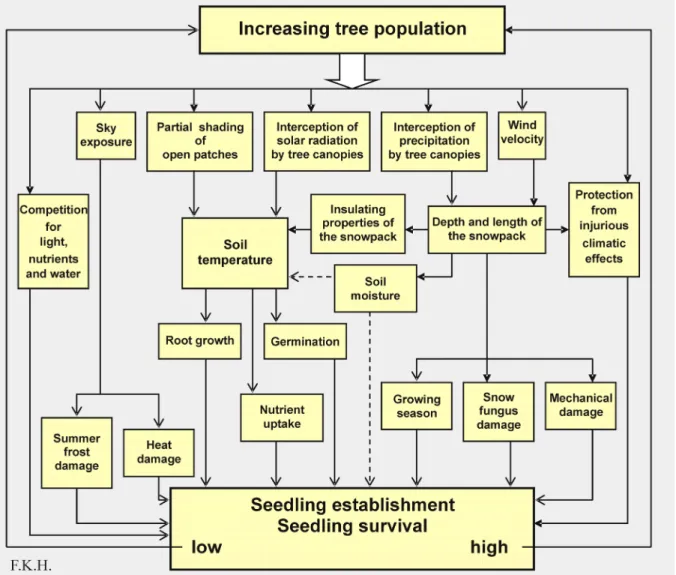
Increasing tree populations will bring about deeper winter snow pack. Consequently, snow cover will last longer in the treeline ecotone than in the wind-swept Alpine and in the open tundra (Fig. 12) (Hare 1971; Holtmeier 1978, Hiltunen 1980; Holtmeier 1993; Walsh et al. 1994; Holtmeier 1996; Hiemstra et al. 2002; Holtmeier 2003; Ged-des et al. 2005; Holtmeier 2005a). In the treeline ecotone, snow accumulation will also be greater than under dense forest cano-pies. The greater depth of the snow will in-crease its insulating properties and snowmelt runoff but decrease the length of the grow-ing season (Fig. 13; see also Liston et al. 2002, therein further references). Soil mois-ture will remain relatively high all-year round and soils will stay somewhat warmer during the winter as compared to the tundra (Rouse 1984). In an ecotone sparsely covered with trees and tree-stands, i.e. at the beginning of tree invasion, snow depth and its side effects may vary abruptly and widely (Holtmeier 1978, 2003, 2005a; Daly1984; Holtmeier & Broll 1992; Broll & Holtmeier 1994; Kull-man 2005a).
Increased snow pack may facilitate seedling establishment (e.g., Germino & Smith 1999, 2000; Germino et al. 2002; Smith et al. 2003; Bekker 2005), particularly in dry years and in dry regions. On the other hand, long-lying
snow may curtail the growing season and in-crease snow fungus infection (Phacidium in-festans, Herpotrichia juniperi, Gremeniella abi-etaina) of seedlings of evergreen conifers, mainly in wet years and maritime regions (Tab. 2, Fig. 13). Deciduous tree species such as birch, aspen and rowan (e.g., Sorbus aucuparia) would not be affected. In addition, mechanical damage to the seedlings and trees by heavy snow loads is likely (e.g., Seki et al. 2005).
Within the treeline ecotones, growing tree population may reduce the risk of summer frost damage by reducing the exposure of seedlings and saplings to intense solar radia-tion of days following cold nights (e.g., Lundmark & Hällgren 1987; Örlander 1993). Growing tree populations will even out the effects of local topography in the treeline ecotones on wind, snow relocation and solar radiation.
At the northern treeline, reduced wind ve-locity will exacerbate insect harassment of reindeer and caribou, mainly by warble flies
(Hypoderma tarandi L.) and nose-bot flies
(Cephenemyia trompe L.), thus affecting animal condition and survival (e.g., Mörschel & Klein 1997; Hagemoen & Reimers 2002; Holtmeier 2002). In northernmost Europe, this will have negative effects on the reindeer industry economy.
5 Research needs
re-search at the regional and landscape scales within different climatic regions, supported by as many as possible manipulations and other experimental studies in the field and laboratory (see also Callaghan et al. 2002a) appears to be the only way to obtain a deeper insight into the spatial and temporal treeline dynamics and to gain a better under-standing of the functional relationships be-tween the many treeline-relevant factors and the fate of the trees (growth, reproduction, survival, etc.).
As to the functional “mechanism” of treeline advance, studies on the functional relation-ships between regeneration success (survival of seedlings and saplings), for example, and topographically-controlled site conditions are still comparatively rare in the treeline zones and are urgently needed. The varying distribution of soil temperature and soil moisture, as related to topography (runoff, seepage), substrates (texture, soil organic
matter), plant cover (transpiration, intercep-tion of solar radiaintercep-tion, water use), needs to be studied more intensively at the local and landscape scales.
Sveinbjörnsson et al. 1996; Körner 1994; Karlsson & Nordell 1996; Cairns 1998; Cairns & Malanson 1998; Karlsson & Weih 2001; Hättenschwiler et al. 2002; Smith et al. 2003; Brodersen et al. 2006). It has been speculated that the better trees are adapted to harsh treeline climates the less likely car-bon will be a limiting factor to tree growth (Körner 2005). Thus, the carbon-sink hy-pothesis needs further verification, especially for the establishment and survival of seed-lings, before there can be any global gener-alizations (Smith et al. 2003).
Furthermore, the interactions of climatic summer and winter conditions (outside the tropics) and their effects on seedling estab-lishment and survival need to be more in-tensely studied in different treeline climates (continental, maritime) before speculating on the possible effects of a warmer environ-ment.
Moreover, consideration has to be given to the ecological properties and requirements of the tree species represented at the altitud-inal and polar treelines. In particular, their sensitivity and response to extreme events
and a gradually changing environment (physical and biotic) need to be considered. In this context, the adaptability of the tree species to the future environmental condi-tions will play an important role. Acclima-tion may lag behind a rapidly changing cli-mate.
Additionally, the distribution pattern of trees within the landscape mosaic, and not least, their competitive ability must be taken into consideration. Diseases, pathogens (e.g., parasitic snow fungi), insect infestations and the effects of wildlife (Holtmeier 2002; Cairns & Moen 2004) have also to be in-cluded as agents causing disturbances to
trees and other vegetation. Possible positive and negative effects of disturbances need to be assessed. Disturbances may result in in-creased tree mortality and decline of tree stands or in intense regeneration and better growth of trees thus influencing the dynam-ics (e.g., mosaic cycles) within the future treeline ecotones. Mosaic cycles often run counter to the long-term trend in treeline de-velopment. Not least, there is a great unsatis-fied need for studies on the consequences of changing climate for the treelines on tropical mountains (e.g., Bader 2007).
In principle, remote sensing using space borne techniques (high resolution satellite imagery, orthophotos) are excellent instru-ments to record the changing spatial and transient structures such as tree canopy cover, kind of vegetation, paludification (e.g., Callaghan et al. 2002b; Crawford et al. 2003), and temporal monitoring of the melt-out pattern in the treeline ecotone at high spatial resolution even in remote and inac-cessible regions (e.g., Rees et al. 2002). Re-mote sensing combined with data from as many as possible field studies and experi-mental studies in the field and laboratory will contribute to rapidly filling the present local and regional knowledge gaps on spatial and temporal structures of both the northern and mountain treelines and help exploring the functional relationships behind them. Not least, there is a particular need for simi-lar studies on the altitudinal treeline in the tropics and also in the southern hemisphere temperate zone. The worldwide documenta-tion of the treeline spatial patterns and de-velopment (e.g., changing tree population density) is an indispensable step in future treeline research rather than further focusing on “better” coincidences between the posi-tion of treeline and certain mean air and/or soil temperatures considered to be essential to tree growth.
Modelling will help to assess the possible magnitude of treeline advance to greater alti-tude and more northern latialti-tude. Scenarios may give an idea of changing spatial patterns of the treeline landscape. In contrast to first-generation “equilibrium models” (e.g., Cramer 1997; Skre et al. 2002), dynamic vegetation models (e.g., Wolf et al. 2007) are able to represent continuous changes by in-cluding processes such as establishment, growth, reproduction and mortality, physio-logical adaptation and competition. Every assessment of treeline response to future cli-mate change must consider the effects of lo-cal site conditions and feedbacks of increas-ing tree population in modulatincreas-ing this
change (e.g., Holtmeier 1985, 1989, 1995a; Luckman & Kavanagh 1998; Holtmeier 2003). So-called “ground truths” are impera-tive as ever. However, adding all these com-plexities to the existing models would in-crease uncertainties in the predictions (Bachelet & Neilson 2000).
Up- and downscaling of empirically found relationships between factors apparently in-fluencing tree growth and treeline have be-come very popular. The relative importance of the factors varies by the scale of consid-eration. However, downscaling of statistical relationships existing between the treeline and one or two apparently tree growth limit-ing environmental factors (e.g., low tempera-ture, aridity) found at the global or zonal scale would produce simplistic scenarios that disguise the complexity of the treeline phe-nomenon rather than being a contribution to a better causal (functional) understanding. On the other hand, the possibility of up-scaling relationships found between soil con-ditions, tree growth and patchiness of the treeline ecotone is also limited as they de-pend on the topographical context and thus vary very locally. Soils specific to treeline do not exist. Instead, mosaics of different soil types closely related to the geological sub-strate, more or less varying with microtopo-graphy and plant cover (e.g., grassland, dwarfshrub vegetation) are common to the mountain and northern treeline ecotones (e.g., Burns 1980; Holtmeier 2003; Broll 1994, 1998, 2000).
Acknowledgements
Our thanks go to the Deutsche Forschungs-gemeinschaft which supported our treeline field work in North America, northern Europe and in the Alps since the late 1960s. Moreover, we are grateful to the EU (LAPBIAT) for sponsoring our more recent fieldwork in Finnish Lapland. Special thanks go to Prof. Dr. Robert M. M. Crawford (St. Andrews, Scotland) for revising the manu-script and to Dr. James B. Benedict (Ward, Colorado) for pictures of treeline in his re-search areas.
References
ACIA (Arctic Climate Impact Assessment) 2004. Impacts of a warming Arctic. Cam-bridge University Press, CamCam-bridge. Almquist, C., Bergsten, U., Bondesson, L. &
U. Eriksson 1998. Predicting germina-tion capacity of Pinus sylvestris and Picea abies seeds using temperature data from weather stations. – Canadian Jour-nal of Forest Research 28, 1530-1535. Anschlag, K. 2006. Regeneration der
Fjell-birke (Betula pubescens ssp. czerepano-vii) und Wurzelsysteme ihres Jungwuch-ses im Waldgrenzökoton, Finnische Sub-arktis. Dissertation Fachbereich Geowis-senschaften, Mathematisch-Natur-wissenschaftliche Fakultät, Universität Münster.
Arno, S. F. 1984. Timberline, mountain and arctic frontiers. The Mountaineers, Seat-tle.
Autio, J. & A. Colpaert 2005. The impact of elevation, topography and snow load damage of trees in the position of the
ac-tual timberline on the fells in central Fin-nish Lapland. Fennia 183, 15-36.
Bachelet, D. & R. P. Neilson 2000. Biome redistribution under climate change. USDA Forest Service General Technical Report RMRS-GETR-59, 18-44
Bader, M. Y. 2007. Tropical alpine treelines - how ecological processes control vegeta-tion patterning and dynamics. PhD the-sis, Wageningen University, Wageningen, The Netherlands.
Bekker, M. F. 2005. Positive feedback be-tween tree establishment and patterns of subalpine forest advancement, Glacier National Park, Montana, U. S. A. Arctic, Antarctic, and Alpine Research 37, 97-107.
Beneke, U. 1972. Wachstum, CO2
-Gaswechsel und Pigmentgehalt einiger Baumarten nach Ausbringung in ver-schiedenen Höhenlagen. Angewandte Botanik 46, 117-135.
Betts, A. K. & J. H. Ball 1997. Albedo over the boreal forest. Journal of Geophysical Research 102 (D 24), 28.901-28.909. Biondi, F. 2001. A 400-year-tree-ring
chro-nology from the tropical treeline of North America. Ambio 30, 162-166. Blüthgen, J. 1942. Die polare Baumgrenze in
Lappland. Veröffentlichungen des Deut-schen Wissenschaftlichen Institutes zu Kopenhagen, Reihe I, Arktis 10.
Bonan, G. B., Pollard, D. & S. L. Thompson 1992. Effects of boreal forest vegetation on global climate. Nature 359, 716-718. Brandes, R. 2006. Waldgrenzen griechischer
Hochgebirge unter besonderer Berück-sichtigung des Taygetos, Südpeloponnes (Waldgrenzdynamik, Tannensterben, Dendroökologie). Dissertation, Univer-sity of Erlangen.
Broll, G. 1994. Influence of the soil mosaic on biodiversity at heath sites in the Euro-pean Subarctic. Transactions 15th World
Congress of Soil Science (Mexico) 4a, 220-231.
Broll, G. 1998. Diversity of soil organisms in alpine and arctic soils in Europe. Review and research needs. Pireneos 151-152, 43-72.
Broll, G. 2000. Influence of overgrazing by reindeer on soil organic matter and soil microclimate of well-drained soils in the Finnish Subarctic. In: R. Lal, J. M. Kimble & B. A. Stewart (eds.): Global climate change and cold regions ecosys-tems, Boca Raton Advances in Soil Sci-ence 2000, 163-172.
Broll, G. & F.-K. Holtmeier, 1994. Die Ent-wicklung von Kleinreliefstrukturen im Waldgrenzökoton der Front Range (Colorado, USA) unter dem Einfluß lee-wärts wandernder Ablegergruppen (Picea engelmannii and Abies lasiocarpa). Erdkunde 48, 48-59.
Broll, G., Holtmeier, F.-K., Anschlag, K., Brauckmann, J., Wald, S. & B. Drees (submitted). Landscape mosaic in the treeline ecotone on Mt Rodjanoaivi, Sub-arctic Finland.
Brunstein, F. C. & D. K. Yamaguchi 1992. The oldest known Rocky Mountains bristlecone pines (Pinus aristata Engelm.). Arctic and Alpine Research 24, 253-256.
Bruun, H. & J. Moen 2003. Nested commu-nities of alpine plants on isolated moun-tains: relative importance of colonization and extinction. Journal of Biogeography 30, 297-303.
Bryson, R. A. 1966. Air masses, streamlines, and the boreal forest. Geographic Bulle-tin 8, 228-269.
Bugmann, H. & C. Pfister 2000. Impacts of interannual climate variability on past and future forest composition. Regional Environmental Change 1, 112-125. Burga, C. & R. Perret 2001. Monitoring of
eastern and southern Swiss alpine
tim-berline ecotones. In: Burga, C. A. & A. Kratochwil (eds.): Biomonitoring. Gen-eral and applied aspects on regional and global scales, Kluwer Academic Publish-ers, Dordrecht, Boston, London, 179-194.
Burns, S. 1980. Alpine soil distribution and development, Indian Peaks, Colorado Front Range. Ph. D. thesis, University of Colorado, Boulder.
Butler, D. R., Malanson, G. P., & D. M. Cairns 1998. Stability of alpine treeline in Glacier National Park, Montana, USA. Phytocoenologia 22, 485-500.
Cairns, D. 1998. Modeling controls on pat-tern at alpine treeline. Geographical and Environmental Modelling 2, 43-63. Cairns, D. & G. P. Malanson 1998.
Environ-mental variables influencing the carbon balance at the alpine treeline: a model ap-proach. Journal of Vegetation Science 9, 679-692.
Cairns, D. & J. Moen 2004. Herbivory influ-ences tree lines. Journal of Ecology 92, 1019-1024.
Callaghan, T. V., Crawford, R. M. M., Er-onen, M., Hofgaard, A., Payette, S., Rees, W. G., Skre, O., Sveinbjörnsson, B., Vlassova, T. K. & B. R. Werkman 2002a. The dynamics of the tundra-taiga bound-ary: an overview and suggested coordina-tion and integrated approach to research. Ambio Special Report 12, 3-5.
Callaghan, T. V., Werkman, B. R. & R. M. M. Crawford 2002b. The tundra-taiga in-terface and its dynamics: concepts and applications. Ambio Special Report 12, 6-14.
Camarero, J. J. & E. Gutiérrez 2000. Recent spatiotemporal variability of Pinus unci-nata regeneration in altitudinal treeline ecotones (Spanish Central Pyrenees). In-ternational Conference on Dendrochro-nology for the Third Millenium, 2.-7. April, Mendoza, Argentina, 222.
in regional climate forcing. Journal of Climate 13, 2002-2010.
Cramer, W. 1997. Modeling the possible im-pact of climate change on broad-scale vegetation structure: example from northern Europe. In: W. C. Oechel, T. Callaghan, T. Gilmanov, J. I. Holten, B. Marwell, U. Molau, & B. Sveinbjörsson (eds.): Global change and Arctic terres-trial ecosystems, Springer, New York, 312-329.
Crawford, R. M. M. 1978. Ecological haz-ards of oceanic environments. New Phy-tologist 128, 257-281.
Crawford, R. M. M. 2005. Peripheral plant populations survival in polar regions. In: Broll, G. & B. Keplin (eds.): Mountain ecosystems. Studies in treeline ecology, Springer, Berlin, Heidelberg, 44-76. Crawford, R. M. M., Jeffree, C. E. & W. G.
Rees 2003. Paludification and forest re-treat in northern oceanic environments. Annals of Botany 91, 213-226.
Cuevas, J. G. 2000. Tree recruitment at the
Nothofagus pumilio alpine timberline in
Tierra del Fuego. Chile Journal of Ecol-ogy 88, 840-855.
Cuevas, J. G. 2002. Episodic regeneration of the Nothofagus pumilio alpine timber-line in Tierra del Fuego, Chile. Journal of Ecology 90, 52-60.
Cui, M. & W. K. Smith 1991. Photosynthe-sis, water relations and mortality of Abies lasiocarpa seedlings during natural estab-lishment. Tree Physiology 8, 37-46. Cullen, L. E., Stewart, G. H., Duncan, R. P.
& J. G. Palmer 2001. Disturbance and climate warming influences on New Zea-land Nothofagus tree-line population dy-namics. Journal of Ecology 89, 1061-1071.
Dahl, E. 1986. Zonation in arctic and alpine tundra and fellfield ecobiomes. In: N. Polunin (ed.): Ecosystem theory and ap-plication, Chichester, 32-62.
Dahms, A. 1992. Wachstumsbedingungen bei Picea engelmanni (Parry) Engelm. und
Abies lasiocarpa (Hook) Nutt. an
unter-schiedlich windexponierten Standorten im Waldgrenzbereich der Colorado Front Range (U.S.A.). Dissertation, Ma-thematisch-Naturwissenschaftliche Fa-kultät, Westfälische Wilhelms-Uni-versität, Münster.
Dalen, L. & A. Hofgaard 2005. Differential regional treeline dynamics in the Scandes Mountains. Arctic, Antarctic, and Alpine Research 37, 284-296.
Daly, C. 1984. Snow distribution patterns in the alpine Krummholz zone. Progress in Physical Geography 8, 157-175.
Daniels, L. D. 2000. The dynamics of alti-tudinal treelines in northern Patagonia: spatio-temporal influences. PhD Thesis, University of Colorado.
Davis, M. B. 1986. Climate instability, time lags, and community disequilibrium. In: J. Diamond. & T. Case (eds.): Commu-nity ecology: Harper and Row, New York, 269-284.
Dullinger, S., Dirnböck, T. & G. Grabherr 2003. Patterns of shrub invasion into high mountain grassland of the Northern Calcareous Alps, Austria. Arctic, Antarc-tic, and Alpine Research 35, 434-441. Dullinger, S., Dirnböck, T. & G. Grabherr,
G. 2004. Modelling climate change-driven treeline shifts: relative effects of temperature increase, dispersal and in-vasibilty. Journal of Ecology 92, 241-252. Ellenberg, H. 1975. Vegetationsstufen in
perhumiden bis ariden Bereichen der tro-pischen Anden. Phytocoenologia 2, 368-387
Elliott, D. 1979. The current regenerative as-pect of the northern Canadian trees, Keewatin, N.W.T., Canada: Some pre-liminary observations. Arctic and Alpine Research 11, 243-251.
Elliott-Fisk, D. 1983. The stability of the northern Cascade tree-limit. Annals of American Geographers 73, 560-576. Elliott, D. & S. Short 1979. The northern
Foley, J. A., Kutzbach, J. E., Coe, M. T. & S. Levis 1994. Feedbacks between climate and boreal forests during the Holocene. Nature 371, 52-54.
Gamache, I. & S. Payette 2004. Height growth response of treeline black spruce to recent climate warming across the for-est-tundra of eastern Canada. Journal of Ecology 92, 835-845.
Gamache, I. & S. Payette, S. 2005. Latitu-dinal response of subarctic tree lines to recent climate change in eastern Canada. Journal of Biogeography 32, 849-862. Geddes, C. A., Brown, D. G. & D. B. Fagre
2005. Topography and vegetation as pre-dictors of snow water equivalent across the alpine treeline ecotone at Lee Ridge, Glacier National Park, Montana, U.S.A. Arctic, Antarctic, and Alpine Research 37, 197-205.
Germino, M. J. & W. K. Smith 1999. Sky ex-posure, crown architecture, and low-temperature photoinhibition in conifer seedlings at alpine treeline. Plant Cell En-vironment 22, 407-415.
Germino, M. J. & W. K. Smith 2000. Differ-ences in microsite, plant form, and low-temperature photoinhibition of photo-synthesis in alpine plants. Arctic, Antarc-tic, and Alpine Research 32, 388-396. Germino, M. J., Smith, W. K. & A. C. Resor
2002. Conifer seedling distribution and survival in an alpine tree ecotone. Plant Ecology 162, 157-168.
Giorgi, F. & B. Hewitson 2001. Regional cli-mate information - evaluation and pro-jections. Climate change 2001. In: J. T. Houghtons, Y. Ding, D. J. Griggs, P. Noguer, S. Van der Linden, X. Dai, K. Maskell & C. A. Johnsons (eds.): The sci-entific basis. Contributions of working group 1 to the third assessment report of the intergovernmental panel on climate change, Cambridge University Press, Cambridge, 583-638.
Grace, J. 1988. The functional significance of short stature in montane vegetation. Plant form and vegetation structure,
SPH Academic publishing by, The Hague, 201-209.
Grace, J. 1989. Tree lines. Philosophical Transactions Royal Society London B 234, 233-245.
Grace, J., Beringer, F. & L. Nagy 2002. Im-pacts of climate change on the tree line. Annals of Botany 90, 537-544.
Graumlich, L. J. & L. B. Brubaker 1986. Re-construction of annual temperature (1590-1979) for Longmire, Washington, derived from tree rings. Quaternary Re-search 25, 223-234.
Graumlich, L. J., Brubaker, L. B. & C. C. Grier 1989. Long-term trends in forest net primary production: Cascade Moun-tains, Washington. Ecology 70, 405-410. Graumlich, L. 1991. Subalpine tree growth,
climate and increasing CO2: an
assess-ment of recent growth trends. Ecology 72, 1-11.
Gross, M., Rainer, I. & W. Tranquillini 1991. Über die Frostresistenz der Fichte mit besonderer Berücksichtigung der Zahl der Gefrierzyklen und der Geschwindig-keit der Temperaturänderung beim Frie-ren und Auftauen. Forstwissen-schaftliches Centralblatt 110, 207-217. Haag, R. W. & L. C. Bliss 1974. Functional
effects of vegetation on the radiant en-ergy budget of boreal forest. Canadian Geotechnical Journal 11, 374-379.
Hagemoen, R. I. M. & E. Reimers 2002. Reindeer summer activity pattern in rela-tion to weather and insect harassment. Journal of Animal Ecology 71, 883-892. Halloy, S. 1989. Altitudinal limits of life in
subtropical mountains: What do we know? Pacific Science 43, 170-184.
Hansen-Bristow, K. J. 1981. Environmental controls influencing the altitude and form of the forest-alpine tundra ecotone, Colorado Front Range. PhD thesis, Uni-versity of Colorado, Boulder.
tundra-taiga interface. Special Ambio Re-port 12, 47-55.
Hare, F. K. 1971. Snow-cover problems near the Arctic tree-line of North America. Report Kevo Subarctic Research Station 8, 31-40.
Harris, C. 2005. Climate change, mountain permafrost degradation and geotechnical hazard. In. U. M. Huber, H. K. M. Bug-mann & M. A. Reasoner (eds.): Global change and mountain regions. An over-view of current knowledge. Advances in Global Change Research 23, 215-524. Hättenschwiler, S., Handa, T., Egli, L.,
As-hoff, R., Amman, W. & C. Körner, C. 2002. Atmospheric CO2 enrichment of
alpine treeline conifers. New Phytologist 156, 363-375.
Henning, I. 1974. Geoökologie der Hawaii-Inseln. Erdwissenschaftliche Forschung 9, Wiesbaden.
Henttonen, H., Kanninen, M., Nygren, M. & R. Ojansuu 1986. The maturation of Pinus sylvestris seed in relation to tem-perature climate in northern Finland. Scandinavian Journal of Forest Research 1, 243-249.
Hiemstra, C. A., Liston, G. E. & W. A. Rei-ners 2002. Snow redistribution by wind and interactions with vegetation at upper treeline in the Medicine Bow Mountains, Wyoming, U.S.A. Arctic, Antarctic, and Alpine Research 34, 262-273.
Hiltunen, R. 1980. Tuulenpieksemän ja lu-menviipymän lämpötila ja lumioloista Pikku Mallalla (Temperature and snow conditions on snow beds and wind-exposed places on Pikku Malla). Luon-non Tutkija 84, 11-14.
Hobbie, S-E. & F. S. Chapin III 1998. An experimental test of limits to tree estab-lishment in Arctic tundra. Journal of Ecology 86, 449-461.
Hoch, G., Popp, M. & C. Körner 2002. Alti-tudinal increase in mobile carbon pools in Pinus cembra suggests sink limitation in growth at the Swiss treeline. Oikos 98, 361-374.
Hoch, G. & C. Körner 2003. The carbon charging of pines at the climatic treeline: a global comparison. Oecologia 135, 10-21.
Hofgaard, A. & B. Wilmann 2002. Plant dis-tribution pattern across the forest-tundra ecotone: The importance of treeline po-sition. Ecoscience 9, 375-385.
Höllermann, P. 1978. Geoecological aspects of the upper timberline in Tenerife, Ca-nary Islands. Arctic and Alpine Research 10, 365-382.
Holtmeier, F.-K. 1967a. Zur natürlichen Wiederbewaldung aufgelassener Alpwei-den im Oberengadin. Wetter und Leben 19, 195-202.
Holtmeier, F.-K. 1967b. Die Verbreitung der Holzarten im Oberengadin unter dem Einfluß des Menschen und des Lokalkli-mas. Erdkunde 21, 249-258.
Holtmeier, F.-K. 1973. Geoecological as-pects of timberline in Northern and Cen-tral Europe. Arctic and Alpine Research 5, 45-54.
Holtmeier, F.-K. 1974. Geoökologische Be-obachtungen und Studien an der subark-tischen und alpinen Waldgrenze in ver-gleichender Sicht (nördliches Fennoskan-dien/Zentralalpen). Erdwissenschaftliche Forschung VIII, Wiesbaden.
Holtmeier, F.-K. 1978. Die bodennahen Winde in den Hochlagen der Indian Peaks Section, Colorado Front Range. Münstersche Geographische Arbeiten 3, 3-47.
Holtmeier, F.-K. 1979. Die polare Waldgren-ze (forest-tundra-ecotone) in geoökolog-ischer Sicht. In: L. M. Müller-Wille & H. Schroeder-Lanz (eds.): Kanada und das Nordpolargebiet, Trierer Geographische Studien, Sonderheft 2, 230-246.
Holtmeier, F.-K. 1986. Über Bauminseln (Kollektive) an der klimatischen Wald-grenze unter besonderer Berücksichti-gung von Beobachtungen in verschiede-nen Hochgebirgen Nordamerikas. Wet-ter und Leben 38, 121-139.
Holtmeier, F.-K. 1989. Ökologie und Geo-graphie der oberen Waldgrenze. Berichte der Reinhold Tüxen-Gesellschaft 1, 45-54.
Holtmeier, F.-K. 1993. Der Einfluß der ge-nerativen und vegetativen Verjüngung auf das Verbreitungsmuster der Bäume und die ökologische Dynamik im Wald-grenzbereich. Beobachtungen und Un-tersuchungen in Hochgebirgen Nord-amerikas und den Alpen. Geoökodyna-mik 14, 153-182.
Holtmeier, F.-K. 1995a. Waldgrenze und Klimaschwankungen – ökologische As-pekte eines vieldiskutierten Phänomens. Geoökodynamik 16, 1-24.
Holtmeier, F.-K. 1995b: European larch in Middle Europe with special reference to the Swiss Alps. In: W. C. Schmidt, & K. J. McDonald, (eds.): Ecology and man-agement of Larix forests, A look ahead, Proceedings of an international sympo-sium, Whitefish, Montana, U.S.A., Octo-ber 5-9, 1992. United States Department of Agriculture, Forest Service, Inter-mountain Research Station, General Technical Report GTR-INT 319, 41-49. Holtmeier, F.-K. 1996. Der Wind als
land-schaftsökologischer Faktor in der subal-pinen und alsubal-pinen Stufe der Front Ran-ge, Colorado. Arbeiten aus dem Institut für Landschaftsökologie 1, Münster, 19-45.
Holtmeier, F.-K. 1999. Ablegerbildung im Hochlagenwald und an der oberen Wald-grenze in der Front Range, Colorado. Mitteilungen der Deutschen Dendrologi-schen Gesellschaft 84, 39-61.
Holtmeier, F.-K. 2002. Tiere in der Land-schaft. Einfluss und ökologische Bedeu-tung, Ulmer Verlag, Stuttgart.
Holtmeier, F.-K. 2003. Mountain timber-lines. Ecology, patchiness, and dynamics. Advances in Global Change Research 14, Dordrecht, Boston, London.
Holtmeier, F.-K. 2005a. Relocation of snow and its effects in the treeline ecotone. Die Erde 136, 143-173.
Holtmeier, F.-K. 2005b. Change in the tim-berline ecotone in northern Finnish Lap-land during the last thirty years. Reports from the Kevo Subarctic Research Sta-tion 23, 97-113.
Holtmeier, F.-K. & G. Broll 1992. The influ-ence of tree island on microtopography and pedoecological conditions in the for-est-alpine tundra ecotone on Niwot Ridge, Colorado Front Range, U.S.A. Arctic and Alpine Research 24, 216-228. Holtmeier, F.-K., Müterthies, A. & G. E.
Stevens 1996. Effektive Verjüngung und Zuwachs der Kiefer (Pinus sylvestris) und Fichte (Picea abies) an ihrer Höhen-grenze in Finnisch-Lappland während der letzten 100 Jahre. Arbeiten aus dem Institut für Landschaftsökologie 1, Münster, 85-99.
Holtmeier, F.-K., Broll, G., Müterthies, A. & K. Anschlag 2003. Regeneration in the treeline ecotone: northern Finnish Lapland. Fennia 181, 103-128.
Holtmeier, F.-K., Broll, G. & K. Anschlag, 2004. Winderosion im Waldgrenzbereich und in der alpinen Stufe einiger nordfin-nischer Fjelle. GeoÖko 25, 203-224. Holtmeier, F.-K. & G. Broll 2005. Sensitivity
and response of the northern hemi-sphere altitudinal and polar treelines to environmental change at landscape and local scales. Gobal Ecology and Biogeog-raphy 14, 395-410.
Holtmeier, F.-K. & G. Broll, 2006. Radiocar-bon-dated peat and wood remains from the Finnish Subarctic – evidence of treeline and landscape history. The Holo-cene 16, 743-751.
Hustich, I. 1937. Pflanzengeographische Stu-dien im Gebiet der Niederen Fjelde im westlichen Finnisch Lappland. Teil I. Ac-ta BoAc-tanica Fennica 19.
Hustich, I. 1942. Pflanzengeographische Forschungen und Probleme in Finnisch-Lappland. Botanikai Közlemenyek 36, 233-246.
Hustich, I. 1958. On the recent expansion of the scotch pine in northern Europe. Fen-nia 82.
IPCC (Intergovernmental Panel on Climate Change) 2001. Climate change 2001. Im-pacts, adaptation, and vulnerability. Cam-bridge University Press, CamCam-bridge. Ives, J. D. 1973. Studies on high altitude
geoecology of the Colorado Front Range. A review of the research program of the Institute of Arctic and Alpine Re-search 5, 67-75.
Ives, J. D. 1978. Remarks on the stability of timberline. Erdwissenschaftliche For-schung 11, 313-317.
Ives, J. D. & K. J. Hansen-Bristow 1983. Stability and instability of natural and modified upper timberline landscapes in the Colorado Rocky Mountains, U. S. A. Mountain Research and Development 3, 149-155.
Johnson, D. M., Germino, M. J. & W. K. Smith 2004. Abiotic factors limiting pho-tosynthesis in Abies lasiocarpa and Picea engelmannii seedlings below and above the alpine timberline. Tree Physiology 24, 377-386.
Juntunen, V., Neuvonen, S., Norokorpi, Y. & T. Tasanen 2002. Potential for timber-line advance in northern Finland, as re-vealed by monitoring during 1983-99. Arctic 55, 348-361.
Juntunen, V. & S. Neuvonen 2006. Natural regeneration of Scots pine and Norway spruce close to the timberline in north-ern Finland. Silva Fennica 40 (3), 443-458.
Kallio, P. & J. Lehtonen 1973. Birch forest damage caused by Oporinia autumnata (Bkh.) in 1965-1966 in Utsjoki,
N-Finland. Reports from the Kevo Subarc-tic Research Station 10, 55-69.
Karlsson, P. S. & O. Nordell 1996. Effects of soil temperature on nitrogen economy and growth of mountain birch seedlings near its presumed low temperature distri-bution limit. Ecoscience 3, 183-1189. Karlsson, P. S. & M. Weih 2001. Soil
tem-peratures near the distribution limit of the mountain birch (Betula pubescens ssp. czerepanovii): Implications for seed-ling nitrogen economy and survival. Arc-tic, AntarcArc-tic, and Alpine Research 33, 88-92.
Kearney, M. S. & B. H. Luckman 1983. Holocene timberline fluctuations in Jas-per National Park, Alberta. Science 221, 261-263.
Kinnaird, J. W. 1974. Effects of site condi-tions on the regeneration of birch (Betula pubescens roth. and Betula pu-bescens erh.). Journal of Ecology 62, 647-474.
Kjällgren, L. & L. Kullman 1998. Spatial pat-terns and structure of the mountain birch tree-limit in the southern Swedish Scan-des – a regional perspective. Geograf-iska Annaler 80A, 1-16.
Körner, C. 1994. Impact of atmospheric changes on high mountain vegetation. In: M. Beniston (ed.): Mountain environ-ments in changing climates, London, New York, 155-166.
Körner, C. 1998a. A re-assessment of high elevation treeline positions and their ex-planation. Oecologia 115, 445-459. Körner, C. 1998b. Worldwide positions of
alpine alpine treelines and their causes. In: M. Beniston (ed.): The impacts of cli-matic variability on forest, 221-229. Körner, C. 1999. Alpine plant life.
Springer-Verlag, Berlin, Heidelberg, New York. Körner, C. & J. Paulsen 2004. A world-wide
study of high altitude treeline tempera-tures. Journal of Biogeography 31, 713-732.