J of Evolution of Med and Dent Sci/ eISSN- 2278-4802, pISSN- 2278-4748/ Vol. 3/ Issue 47/Sep 25, 2014 Page 11349
A COMPARATIVE STUDY OF SMALL DOSE KETAMINE, MIDAZOLAM AND
PROPOFOL AS CO-INDUCTION AGENT TO PROPOFOL
Neelesh Nema1, K. K. Arora2, Abhimanyu Rana3
HOW TO CITE THIS ARTICLE:
Neelesh Nema, K. K. Arora, Abhimanyu Rana. A Comparative Study of Small Dose Ketamine, Midazolam and Propofol as Co-Induction Agent to Propofol. Journal of Evolution of Medical and Dental Sciences 2014; Vol. 3, Issue 47, September 25; Page: 11349-11357, DOI: 10.14260/jemds/2014/3485
ABSTRACT: Intravenous anesthesia is an integral part of modern anesthesia. But till date there is no single intravenous agent which fulfills all the characteristics of an ideal anesthetic agent. Co- induction agents are being used to reduce the dose and adverse effects of a single I.V agent. This comparative study is planned to compare the Hemodynamic Changes and Dose Reduction of Propofol, using small dose of Propofol, Ketamine or Midazolam as co-inducing agents to Propofol. In this Prospective, Randomized, Double Blind, Control study 100 patients of ASA grade I and II, Age 20-40 years of either sex undergoing Elective surgery were randomly divided in 4 groups. SP – Saline (10 mL) + Propofol; KP- Ketamine(0.4 mg/kg) + Propofol; MP – Midazolam(0.3mg/kg)+ Propofol; PP - Propofol (0.4mg/kg + Propofol); During study, the Parameters like Induction dose & Prop up dosage requirements & Hemodynamic changes were compared - just after premedication and at just after co induction and then 5, 10, 15 & 20 min after induction. All four groups were comparable with respect to age, sex, weight. The study shows Induction Dose and Total dose of Propofol was least in group KP and prop up dose is also least required in group KP. After induction Heart Rate & MAP decreased in all the groups. Change in MAP & HR was least in Group KP.
KEYWORDS: General anesthesia, intravenous inducing agent, co-induction, auto induction, propofol, Ketamine Midazolam, induction dose, heart rate, mean arterial pressure.
INTRODUCTION: Intravenous anesthesia is integral part of modern anesthesia. But till date there is no single intravenous agent which fulfills all the characteristics of an ideal anesthetic agent.
With this came the concept of co-induction anesthesia. The term co-induction has been used to describe the practice of administering of small dose of a sedative or other anesthetic agent to reduce the dose of inducing agent. (1, 2)
The main objective of this technique is to reduce the adverse effects and the dose of induction agents such as Propofol.(3) So far the most common co-induction agent to Propofol has been Midazolam.(4, 5) Ketamine has also been used for same purpose. The advantages of using Ketamine include better hemodynamic stability.(6, 7)
Recent studies (3, 8) have shown that if a small dose of Propofol was given prior to induction by Propofol itself (auto co-induction); its dose requirement was reduced considerably along with less adverse hemodynamic effects.
This comparative study is planned to compare the hemodynamic changes and dose reduction of Propofol when small dose of, Ketamine, Midazolam or Propofol as co-induction to Propofol.
J of Evolution of Med and Dent Sci/ eISSN- 2278-4802, pISSN- 2278-4748/ Vol. 3/ Issue 47/Sep 25, 2014 Page 11350 age 20-40 years of either sex were divided in four equal groups. Each patient underwent a thorough Pre-Anesthetic Checkup.
Patients with history of any significant medical diseases, pregnancy, drug or alcohol abuse were excluded from the study.
All patients were pre-medicated with Inj. Glycopyrolate 0.004 mg/kg body weight intravenously.
Patients were randomly divided in four groups of 25 patients each. Patients were pre-oxygenated with 100% for three minutes followed by co-induction agent which was 10 ml saline (control group SP), 0.3 mg/kg Ketamine (group KP), 0.03 mg/kg Midazolam (group MP) or 0.4 mg/kg Propofol (group PP).
The co-induction agent prepared in a ml syringe by another Anesthesiologist who didn t took part in the study. The total amount was made to 10 ml. Two minutes after the co- induction agent injection, each patient received Propofol at the rate of 30 mg every 10 seconds until the loss of verbal contact. If there is any intolerance to placement of face mask, additional bolus of Propofol was given as prop up dose. A separate observer assessed this.
The patient and the observer were blind to the drug combination used. Patients were intubated after intravenous succinylcholine (1.5 mg/kg). Patients were maintained on Oxygen & Nitrous oxide (ratio 40/60) atracurium and isoflurane. Patients were reversed at the end of operation with neostigmine and glycopyrolate.
Blood pressure (systolic, diastolic and mean arterial pressure: MAP) and Heart Rate monitored at following interval:
Baseline (before placement of IV line). One minute after co-induction agent. One minute after induction agent.
There after every 5 minute till 20 minutes after induction agent.
RESULTS:
Group SP Group KP Group MP Group PP
No. of patients 25 25 25 25
Age (yrs) 27.24+-4.49 27.44+_5.41 26.76+_4.51 25.88+_3.49 Wt.(kg) 58.04+_5.15 58.8+_5.16 58.04+_4.73 57.84+_3.91
M/F 21/4 11/14 16/9 16/9
Table 1
Table 1: Patients Characteristic (Mean ±SD): The table shows distribution of the patients with respect to their age, weight and sex in all the four groups. There was statistically no significant difference in the demographic data between the groups.
J of Evolution of Med and Dent Sci/ eISSN- 2278-4802, pISSN- 2278-4748/ Vol. 3/ Issue 47/Sep 25, 2014 Page 11351
Groups No. of patients
Induction Dose (mg/kg)
Prop up dose(mg) in no. of patients
Total dose of Propofol (in mg)
Group SP 25 2.71 +-0.05 16 157.22+-13.39
Group KP 25 1.21+_0.04 Nil 71.55+-6.26
Group MP 25 1.46+-0.04 5 81.58+-6.89
Group PP 25 1.58+-0.06 6 91.6+-6.88
Table 2
Table 2: Induction dose and prop- up dose in number of Patients: The table shows number of patients, induction dose, prop up in number of patents and total dose of Propofol. Induction dose and total dose of Propofol was least in group KP and prop up dose is also not required in group KP.
Group %Reduction of induction dose
KP (Ketamine-Propofol) 55.35% MP (Midazolam- Propofol) 46.13% PP (Propofol- Propofol) 41.7%
Table 3
Table 3: Percent reduction of induction dose from that in control Group: The table show percent reduction of induction dose from that in control group. Reduction in induction dose was maximum in group KP (Ketamine – Propofol) thereafter in decreasing order in group MP & PP.
Group % fall of HR
SP (Saline-Propofol) 15.17 KP (Ketamine- Propofol) 3.38 MP (Midazolam- Propofol) 14.9 PP (Propofol- Propofol) 12.0
Table 4
Table 4: The table shows percent fall of heart rate from baseline values that was least in group KP (Ketamine- Propofol) indicating hemodynamic stability.
Group Pre-
operative
After premedication
1 min after co-induction
1 min after induction
5 min after co-induction
10 min after co-induction
15 min after co-induction
20 min after co-induction
Group
SP 88.4±9.97 91.12± 9.95 90.8±9.96 74.88±10.13 75.36±10.19 75.04±10.34 74.84±10.45 74.84±10.5 Group
KP 86.76±8.66 89.48±8.7 95.68±8.42 79.2±7.96 91.72±7.99 80.68±8.09 83.76±8.66 83.76±8.66 Group
MP 90±9.4 92.72±967 86.68±9.5 72.2±9.01 83.04±9.14 78.12±9.12 75.6±9.38 74±9.4 Group
J of Evolution of Med and Dent Sci/ eISSN- 2278-4802, pISSN- 2278-4748/ Vol. 3/ Issue 47/Sep 25, 2014 Page 11352
Table 5: Heart rate at different time intervals (Mean ±SD): The table shows mean heart rate with standard deviation at different time intervals in group SP, KP, MP& PP.
There was initially rise in heart rate after premedication. Change in heart rate was least in group KP among all the groups.
Group
Pre-operative
After pre-medication
1 min after co-induction
1 min after induction
5 min after co-induction
10 min after co-induction
15 min after co-induction
20 min after co-induction
Group
SP 94.03±6.27 94.4±5.94 94.27±6.03 69.78±4.79 79.95±5.21 73.84±5.24 73.31±5.03 74.08±4.8 Group
KP 94.67±5.30 94.91±4.87 97.65±5.45 86.88±4.86 91.68±5.14 90.96±4.78 90.4±4.74 91.79±5.31 Group
MP 92.11±4.04 92.37±3.79 89.73±4.07 77.71±3.23 80.67±3.19 80.11±3.29 80.08±-3.05 78.59±3.19 Group
PP 90.99±5.97 91.25±5.76 88.96±603 79.7±5.3 82.24±5.12 78.96±5.42 79.97±5.24 78.59±5.27 Table 6
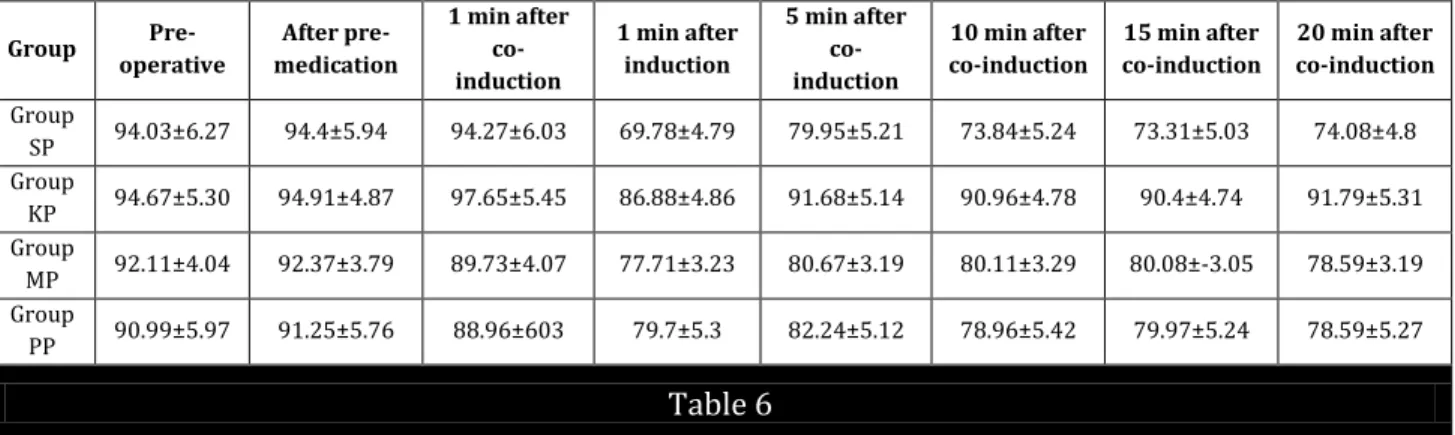
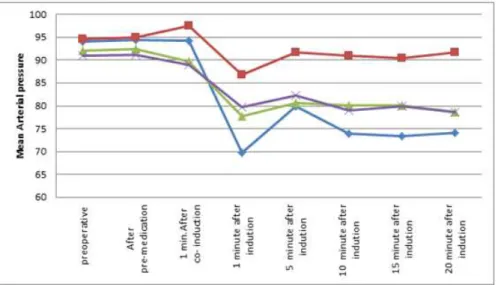
Table 6: Mean arterial pressure at Different Time intervals (Mean +SD): The table shows mean arterial pressure with standard deviation at different time intervals in group SP, KP, MP & PP. Change in mean arterial pressure was least in group KP among all the groups.
Group % reduction of MAP
SP (Saline-Propofol) 21.13% KP (Ketamine- Propofol) 4.57% MP (Midazolam- Propofol) 13.76% PP (Propofol- Propofol) 11.98%
Table 7
Table: 7: Percent reduction of mean arterial pressure from baseline.
DISCUSSION: We found that all the three co-induction agents were effective in reducing the induction dose of propofol considerably compared to placebo (saline). Dose reduction following midazolam is probably due to synergistic interaction between the two drugs (9, 10)
Synergism has been reported between agents with known functional link in the central nervous system viz. midazolam and propofol acting on a common receptor site, the GABA receptors.
Reduced dose requirement of propofol following ketamine cannot be explained by this mechanism as these agents act via distinctly different receptors, ketamine acts by antagonism of NMDA receptors while propofol acts on GABA receptors.
J of Evolution of Med and Dent Sci/ eISSN- 2278-4802, pISSN- 2278-4748/ Vol. 3/ Issue 47/Sep 25, 2014 Page 11353 Predosing and co-induction both reduce the dose of induction agent required to achieve hypnosis and any form of premedication is likely to have similar effect(2,12,13) Many previous authors have reported reduced dose requirement of propofol following pre-administration of midazolam(2,4,5,14) ketamine(6,7,11) or propofol(l,3,8) with or without fentanyl.
Anderson and Robb (1998) proposed a pharmacokinetic theory that part of the mechanism of action of co-induction drugs is to reduce anxiety and the associated sympathetic response. When administered before induction and this mechanism reduces cardiac output, helps in preventing rapid distribution of Propofol. (3)
Ketamine in Sub-Anesthetic doses with Propofol has gained attention in total intravenous anesthetic technique because of its powerful analgesic action in a small dose and sympathetic stimulation which tends to counterbalance the cardiovascular effects of Propofol. One of the major drawbacks with Ketamine anesthesia has been emergence deliriums, which seems to be eliminated by Propofol. (7)
Induction doses prop up doses and total induction dose of Propofol: Mean induction dose of Propofol in group SP was 2.71±0.05 (mg/kg); in group KP was 1.21±0.04; in group MP was 1.46±0.04 in group PP; was 1.58±0.06.
Similar results were observed by Srivastava Uma et al. (15)
In our study sixteen patients in Saline -Propofol group, five patients in Midazolam-Propofol group required prop up doses but prop up doses were not required in Ketamine Propofol group.
Mean induction dose of Propofol was least in KP group.
The total induction dose was reduced by 55.35% (Group KP) 46.13% (Group MP) and 41.7 % (Group PP) from that in control group. Our results are consistent with studies of Srivastava Uma et al. (2006). (15)
HEART RATE: In group MP and PP after co- induction with Midazolam and Propofol respectively there is decrease in heart rate due to cardio depressant action. In group KP there is increase in the heart rate which is due to a reflex cardiac stimulant action of Ketamine
Percent fall in heart rate from baseline was 3.38% in Ketamine – Propofol group, 14.9% in Midazolam Propofol group and 12% in Propofol-Propofol group compared to 15.17% in control group. Our results are similar with Shrivastava Uma et al. (2006) study. (15) Change in heart rate was least in group KP indicated hemodynamic stability.
Our results are also comparable to Anderson and Robb et al. (1998) (3), Djaiani, Ripes Pastor MP (1999). (8)
Blood Pressure: After co-induction mean arterial pressure in group KP increased and in group MP and PP it decreased.
After induction mean arterial pressure decreased in all the groups. In group KP change in mean arterial pressure was least in comparison to rest all the groups.
J of Evolution of Med and Dent Sci/ eISSN- 2278-4802, pISSN- 2278-4748/ Vol. 3/ Issue 47/Sep 25, 2014 Page 11354 Ketamine is known to produce as effect resembles central sympathetic stimulation, which produces a dose related increase in the rate-pressure product, leading to a rise in heart rate and mean arterial pressure.
Rise of mean arterial pressure at 5 minutes after induction may be explained by laryngoscopy and intubation.
Hui T. W. Short T.G. et al (1995) (9) also reported a fall in mean arterial pressure in patients induced with Propofol +Ketamine but the magnitude of the fall was significantly less that Propofol alone. They observed that the combination of Propofol- Ketamine ensured a stable hemodynamic status.
Short T. G and Chui P.T. (1991) (16) studied interactions between I.V. Propofol and Midazolam for induction of anesthesia. They reported that the reduction in arterial pressure at induction was the same for the combination as for the individual agents.
Propofol in the recommended dose of 2-2.5 mg/kg almost always causes fall in blood pressure. The extent of fall depends upon the dose and adjuvant drugs used. The fall in mean arterial pressure in placebo group (SP) was 21.13% from baseline and that in Ketamine group (KP); Midazolam group (MP) and Propofol group (PP) was 4.57%, 13.76% and 11.98% respectively.
So the fall in mean arterial pressure was least in group KP. The minimum change observed in arterial pressure in group KP may be dose related and also because sympathomimetic actions of Ketamine were effective in counteracting the hemodynamic depression of Propofol. Our results coincide with Shrivastava Uma et al. (2006). (15)
Our results are comparable with Djaiani G. Ripes Pastor MP et al. (1999). (8)
CONCLUSION: The groups were compared on the line of induction dose required and hemodynamic variables. The following conclusions were made in our study.
Requirement of induction dose was reduced in all four groups and in Ketamine – Propofol group the induction dose was least.
There was greater change in heart rate and mean arterial pressure in control group and the groups in which Midazolam & Propofol were used as co-induction agents as compared to Ketamine group.
Thus we conclude that co-induction with Ketamine in dose of 0.3 mg/kg provide better hemodynamic stability and lesser induction dose of Propofol as compared to Midazolam and Propofol.
J of Evolution of Med and Dent Sci/ eISSN- 2278-4802, pISSN- 2278-4748/ Vol. 3/ Issue 47/Sep 25, 2014 Page 11355
BIBLIOGRAPHY:
1. Armein R, Hetzel W, Allen SR. Co-induction of anaesthesia, the rationale. Eur J Anesthesiol 1995; 12 (12): 5-11.
2. Cressey DM, Claydon P, Bhaskaran NC, Reilly CS. Effect of midazolam pre-treatment on induction dose requirement of propofol in combination with fentanyl in younger and older adults. Anesthesia 2001; 56: 108-13.
3. Anderson L, Robb H. A comparison of midazolam co-induction with propofol predosing for induction of anaesthesia. Anesthesia 1998; 53: 117-20.
4. Elwood T, Huchcroft S, Mac Adams C. Midazolam co-induction does not delay discharge after very brief propofol anaesthesia. Can J Anesth 1995; 42: 114-18.
5. Ong LB, Plummer JL, Waldow WC, Owen H. Timing of midazolam and propofol administration for co-induction of anaesthesia. Anaesth Intensive Care 2000; 28: 527-31.
6. Furuya A, Matsukawa T, Czaki M, Nishiyama T, Kume M, Kumazawa T. Intravenous ketamine attenuates arterial pressure changes during induction of anesthesia with propofol. Eur J Anesthesiol 2001; 18: 88-92.
7. Saha K, Saigopal M, Sundar R, Palaniappan M, Mathew AC. Comparative evaluation of propofol-ketamine and propofol-fentanyl in minor surgery. Indian J Anaesth 2001; 45:100-03.
8. Djaiani G, Ribes Paster MP. Propofol auto-induction as an alternative to midazolam co-induction for ambulatory surgery. Anesthesia 1999; 54: 51-85.
9. Short TG, Chui PT. Propofol and midazolam act synergistically in combination. Br J Anaesth 1991; 67: 539-45.
10.McClune S, McKay AC, Wright PM, Patterson CC, Clarke RS. Synergistic interaction between midazolam and propofol. Br J Anaesth 1992; 69: 240-45.
11.Hui TW, Short TG, Hong W, Suen T, Gin T, Plummer J. Additive interactions between propofol and ketamine when used for anesthesia induction in female patients. Anesthesiology 1995; 82: 641-48.
12.Adachi YU, Uchihashi Y, Watanabe K, Satoh T. Small dose midazolam or droperidol reduces the hypnotic doses of propofol at the induction of anaesthesia. Euro J Anaesthesiol 2000; 17: 126-31.
13.Olimos M, Gallester JA, Vedate MA, Elizalde JL, Escobar A. The combined effect of age and premedication on the propofol requirement for induction by target controlled infusion. Anaesth Analg 2000; 90: 1157-61.
14.Wilder-Smith OHG, Ravussin PA, Decosterd LA, Despland PA, Bissonnette B. Midazolam premedication reduces propofol dose requirement for multiple anaesthetic endpoints. Can J Anaesth. 2001 May; 48(5):439-45.
15.Uma Srivastava, Neeraj Sharma, Aditya Kumar, Surekha Saxena. Small dose of Propofol or ketamine vs. Midazolam as coinduction to propofol. Indian J Anaesth. 2006; 50 (2): 112 – 114 16.Djaiani G, Ribes Paster MP. Propofol autocoinduction agent as an alternative to Midazolam co
J of Evolution of Med and Dent Sci/ eISSN- 2278-4802, pISSN- 2278-4748/ Vol. 3/ Issue 47/Sep 25, 2014 Page 11356
Fig. 1: Patients Characteristics
Fig. 2
J of Evolution of Med and Dent Sci/ eISSN- 2278-4802, pISSN- 2278-4748/ Vol. 3/ Issue 47/Sep 25, 2014 Page 11357
AUTHORS:
1. Neelesh Nema 2. K. K. Arora 3. Abhimanyu Rana
PARTICULARS OF CONTRIBUTORS:
1. Senior Resident, Department of Anaesthesiology, MGM, Indore.
2. Professor, Department of Anaesthesiology, Bundelkhand Medical College, Sagar. 3. Senior Resident, Department of
Anaesthesiology, MGM, Indore.
NAME ADDRESS EMAIL ID OF THE CORRESPONDING AUTHOR:
Dr. Neelesh Nema,
Room No. 24, Medical P. G. Boys Hostel, Residency Area, Indore, M. P.
Email: [email protected]
Date of Submission: 17/09/2014. Date of Peer Review: 18/09/2014. Date of Acceptance: 19/09/2014. Date of Publishing: 24/09/2014.