Original article (short paper)
Comparison of electromyographic activity during
the bench press and barbell pullover exercises
Yuri de Almeida Costa Campos Sandro Fernandes da Silva Federal University of Lavras, Brazil
Abstract—The aim of the study was to compare the electromyographic (EMG) activity of the following muscles: cla-vicular portion of pectoralis major, sternal portion of pectoralis major, long portion of triceps brachii, anterior deltoid, posterior deltoid and latissimus dorsi during dynamic contractions between lat horizontal bench press and barbell pullover exercises. The sample comprised 12 males individuals experienced in resistance training. The volunteers made three visits to the laboratory. The irst one consisted of 12 repetitions of the exercises for the electromyographic data collection. The results showed a higher EMG activation of the pectoralis major and anterior deltoid muscles in the lat horizontal bench press in comparison with the barbell pullover. The triceps brachii and latissimus dorsi muscles were more activated in the barbell pullover.
Keywords:EMG, exercises, upper-body, horizontal bench press, barbell pullover
Resumo—“Comparação da atividade eletromiográica entre os exercícios supino horizontal e pull-over na barra.” O
objetivo do estudo foi comparar a atividade eletromiográica dos músculos peitoral maior porção clavicular, peitoral maior porção externa, porção longa do tríceps braquial, deltóide anterior, deltóide posterior e grande dorsal durante con-trações dinâmicas entre os exercícios supino horizontal e pull-over. A amostra foi composta por 12 indivíduos do sexo masculino experientes em treinamento resistido. Os voluntários izeram três visitas ao laboratório; a primeira consistiu na avaliação antropométrica e no teste de 1RM em ambos os exercícios, e a segunda e terceira consistiram na realização de 12 repetições para a coleta dos dados da eletromiograia. Após a análise dos resultados foi possível identiicar uma ativação eletromiográica superior dos músculos peitoral maior e deltóide anterior no supino horizontal em relação ao pull-over barra. Já as musculaturas do tríceps braquial e grande dorsal foram mais ativadas no pull-over barra. Palavras-chave: EMG, exercício, parte superior do tronco, supino, pull-over
Resumen—“Comparación de la actividad electromiografíca entre los ejercicios press de banca horizontal y pull-over barra.” El objetivo del estudio fue comparar la actividad electromiografíca de los músculos pectoral mayor en la porción clavicular, pectoral mayor porción esternal, porción larga del tríceps braquial, deltoides anterior, deltoides posterior y dorsal ancho durante las contracciones dinámicas entre los ejercicios press de banca y pullover. Hicieron parte de la muestra 12 individuos del sexo masculino expertos en el entrenamiento con pesas. Los voluntarios hicieran tres visitas al laboratorio, la primera, consistió en la evaluación antropométrica y en el teste de 1RM en los dos ejercicios, y la segunda y tercera, consistió en la realización de 12 repeticiones para la recolecta de los datos de la electromiografía. Después del análisis de los resultados fue posible identiicar una activación electromiografíca superior en las porciones del musculo pectoral mayor y en el deltoides anterior en el press de banca horizontal en relación al pull-over barra. Ya las musculaturas del tríceps braquial y del dorsal ancho fueron las más activadas en el pull-over barra.
Palabras clave: EMG, ejercicio, tren superior del tronco, press de banca, pull-over
Introduction
The deltoid and pectoralis major muscles are the main muscles of the glenohumeral joint, with an important function in daily activities and in numerous sports skills (Santana, Vera-Garcia, & McGill, 2007). Thus, it is important to include exercises to increase the strength of the front and upper body, either for aesthetic or therapeutic purposes. Also, such exercises can im-prove sport performance in which the use of a sport equipment is common, or upper body movements are required (Escamilla
well as the use of other exercise equipments (McCaw & Friday, 1994; Trebs, Brandenburg, & Pitney, 2010), dumbbell exercises (Uribe et al., 2010), dumbbell ly exercises (Welsch, Bird, & Mayhew, 2005), cables and pulleys (Clemons & Aron, 1997; Sadri et al., 2011), and stable and unstable surfaces (Goodman et al., 2008). These are exercise alternatives routinely prescribed as a way to complement training.
Recently, a study performed by Marchetti et al. (2011) demonstrated that the barbell pullover could also be used to develop anterior and upper body muscles, the pectoralis major. However, some other reports have shown that the exercise in question also recruits latissimus dorsi ibers, without signiicant differences between that musculatures and muscles portions of the pectoralis major (Takara et al., 2005). When we analyzed the biomechanics of the barbell pullover exercise compared with other basic exercises used to improve the upper and front part of the body, we observed a great difference between the move-ments (Hall, 1999). However, even with these biomechanical differences, barbell pullover exercise is still prescribed more often to develop the musculatures of the upper and anterior parts of the trunk, besides the back part of the trunk. Such choices generate doubts about its true prescription, as they may result in different responses, especially in the levels of electrical acti-vation on the target muscles. In order to clarify these questions, electromyography emerges as a reliable research tool, being constantly employed for the analysis of physiological aspects of muscle activity during exercise (De Luca et al, 2006; Escamilla & Andrews, 2009).
Thus, the purpose of the study was to compare clavicular portion of pectoralis major (CPPM), pectoralis major sternal portion (PMSP), long portion of the triceps (LPTB), anterior deltoide (AD), posterior deltoide (PD) and latissimus dorsi (LD) muscles between horizontal bench press and barbell pullover exercises with trained men.
Methods
Experimental approach to the problem
In order to investigate differences in EMG activation of muscles for the horizontal bench press and the barbell pullover exercises, two test sessions were established, in which partici-pants were assigned to perform two exercises in a random order in different sessions. The EMG signal was recorded during the concentric and eccentric phases of each of 12 repetitions in order to compare the levels of muscle activation in CPPM, PMSP, LPTB, DA, DP and LD. Participants were selected according to their experience in resistance training and in the target exercises.
Participants
Participants for this study consisted of 12 men (age: 24.50 ±4.34 years, relative body fat: 13.63 ±1.94%, height: 176.0 ±0.04 cm, body mass: 73.12 ±6.10 kg and, years of training: 3.58 ±2.90). To be included in the study, they could not have bone nor muscle disorders that could compromise the execution
Electromyography
To avoid potential interference with the EMG signal, each participant’s skin area was prepared before placing the electrodes through the processes of trichotomy, abrasion and cleaning with isopropyl alcohol. Two electromyography Mio-tool 400 (Miotec Biomedical Equipment Ltd., POA, Brazil®) with 4 input channels, 14 bit resolution and an acquisition rate of 2,000 per channel samples, with a sensor SDS-500 with a maximum gain of 1000 times were used for the data collection with Common Mode Rejection in 110 dB. The electrodes used were 3M® model 2223BR, with a catchment surface with Ag/AgCl 1 cm diameter in the shape of discs. The electrodes were attached to the individual’s body accor-ding to the points proposed by Merletti et al. (1999), respec-ting a distance of 2 cm, and parallel to the muscle ibers. The low impedance of the skin was evaluated (< 2kΩ) and each channel of the electromyography was properly calibrated before the data collection. After attaching the electrodes in the muscles portions to be analyzed, the biding sites were marked with demographic pencil to avoid any interference between evaluators and the different days on which the tests were applied. All measurements were taken on the right side of the individual’s body. Reference electrodes were placed on the clavicle and the styloid process of the ulna. Electromyo-graphy data were collected and stored in a personal computer (Samsung RV411, Samsung, Brazil).
Signal processing
Signals collected were iltered through 5th order Butte-rworth band-pass type ilter with a 20-500 Hz cutoff fre-quency. The amplitude of the signals was expressed by the square root of the average values. To avoid any possibility of phase delay during the signal iltering, an extended time of EMG signal was determined with an interval of 1 minute. For analysis and data processing Miograph 9 Build 2.0 Alpha 5 software was used.
Data organization process for statistical analysis
From the raw signal (RAW) it was possible to make a cut in the original signal of 12 repetitions (48 seconds) in a new signal of 8 repetitions (36 seconds), i.e., we excluded the irst two and the last two repetitions. We adopted these criteria in order to prevent the sample from failing to exert the proper speed of execution during the initial and inal moments of the exercise, thus minimizing the chances of error. Soon after, the new signal was handled from the 5th order band-pass type Butterworth ilter with a cutoff frequency of 20-500 Hz. The electromyographic signal amplitude was calculated in RMS (Root Mean Square). The signals were normalized according to the maximum peak of the EMG signal. Then, mean signals of all participants were obtained and transferred into the SPSS software version 20.0 (SPSS, Inc., Chicago, IL, USA) for statistical analysis.
Statistical analysis
Data analysis was performed with statistical comparison of averages and standard deviations. In order to investigate the distribution of the sample, Shapiro-Wilk test was used. Statis-tical analysis of the activation of muscle groups between the horizontal bench press and barbell pullover exercises adopted the t-test for independent samples. To identify the performan-ce between muscle activations within each exercise, t-test for dependent samples was adopted. In order to verify the effect size of the sample test, d Cohen was adopted. For statistical evidence α < 0.05 was adopted.
Results
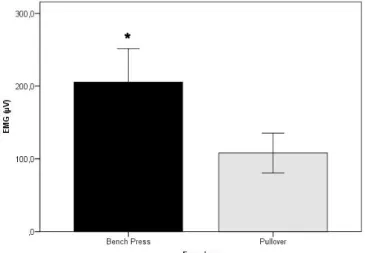
The ICC between repetitions was 0.99 (lower limit= -0.003, upper limit= 0.281). Figure 1 shows the comparison of elec-tromyography activity of the major pectoral clavicular portion between the horizontal bench press and barbell pullover exer-cises (p < 0.01, d = 0.628, moderate effect size). The results
Figure 2. Comparison of the electromyographic activation of major pectoral sternal portion between horizontal bench press and barbell pullover exercises (mean and SD). #p < 0.05 - signiicant difference #p < 0.05 - signiicant difference between BP and HBP
Figure 5. Comparison of electromyographic activation of posterior deltoid between horizontal bench press and barbell pullover exercises (mean and SD).
indicated signiicant differences between the horizontal bench press and barbell pullover.
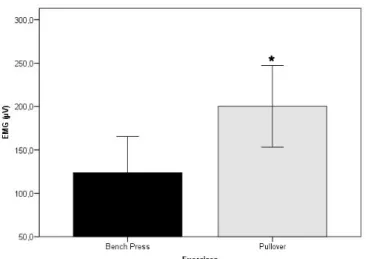
In Figure 2, we observed a signiicant difference between the studied exercises regarding electromyography in major pectoral sternal portion (p < 0.01, d = 0.453, moderate effect size). In the analysis of Figure 3, it was identiied that the barbell pullover shows a statistically signiicant higher electromyographic acti -vity than the horizontal bench press for the long portion of the triceps (p < 0.014, d = 0.268, small effect size).
When checking the results of the anterior deltoid (Figure 4), we observed a higher electromyographic activity during the horizontal bench press compared to the barbell pullover (p < 0.01, d = 0.802, large effect size). Figure 5 shows the result of posterior deltoid, in which we found no signiicant difference between both exercises (p < 0.812).
Figure 6 shows the latissimus dorsi muscle’s electromyo-graphy, in which we found a signiicant difference between barbell pullover and horizontal bench press (p < 0.012, d = 0.303, small effect size).
Discussion
Based on the analysis of the results it was possible to conirm the initial research hypothesis. The anterior and upper body mus-cles activity showed signiicant differences in the CPPM, PMSP, LPTB and AD muscles. During horizontal bench press, CPPM, PMSP and AD muscles showed higher levels of EMG activity in comparison with the barbell pullover. These results show that horizontal bench press presents concentric and eccentric phases only in the front and the upper part of the body, while the barbell pullover has the end of its eccentric phase and the beginning of its concentric one located in the posterior and upper body part—during which the pectoralis major musculature are most requested, being responsible for performing the lexion of the glenohumeral joint (Smith, Weiss, & Lehmuhl, 1997; Wirhed, 1986). Another major factor that may have inluenced a divergent electromyographic response between the two exercises relates to the shoulder joint’s movement biomechanics. While in the horizontal bench press shoulder shows horizontal adduction and abduction (Hall, 1999; Marchetti & Uchida, 2011) movements, in the barbell pullover the shoulder shows lexion and extension (Graham, 2004; Marchetti & Uchida, 2011) movements.
During the barbell pullover, LPTB showed higher levels of EMG activation in comparison with the horizontal bench press (Figure 3). This higher activity of LPTB during barbell pullover was mainly attributed to the isometric action of this muscle, emphasized by a slight elbow lexion during the movement. This elbow lexion occurred in the movements of all the evaluated individuals, and apparently was due to the great distance be-tween the axis (shoulder) and the resistance (represented by the apparatus – barbell + weight), which increased signiicantly the isometric request of this muscle during exercise execution. On the other hand, the horizontal bench press showed lower levels of electrical activation mainly due to the grips separation relative to the bi-acromial distance (Clemons & Aron, 1997; Lehman, 2005). The standard grip used during the horizontal bench press basic execution did not allow the absolute recruitment of these muscles during the inal concentric phase in which the extension of the elbows occurred.
Figure 4. Comparison of electromyographic activation of anterior deltoid between horizontal bench press and Barbell Pullover exercises (Mean and SD). #p < 0.05 - signiicant difference.
Figure 3. Comparison of electromyographic activation of brachial tri-ceps long portion between horizontal bench press and barbell pullover
electromyographic activity found in our study in the LD muscle, which shows a tendency of barbell pullover to show electrical activity in the muscle in question (Takara et al., 2005).
In conclusion, the results of this study suggest that the barbell pullover exercise cannot be indicated as an exercise for the front and upper body muscles, and that the horizontal bench press exercise is the most indicated to the training and development of this body musculature region. It is appropriate to emphasize that a variety of training programs that include speciic exercises have been applied to athletes in sports where equipment is controlled and/or directed with a muscle complex of the front and the upper body parts (Es-camilla & Andrews, 2009; Schick et al, 2010). Training protocols show great applicability of these exercises in the treatment of pa-thologies located in the shoulders (Dorrestijn et al, 2009; Kuhn et al, 2009). Taking into account the speciic movement of the barbell pullover exercise, as well as the similarity of this exercise with the varieties of movements performed during some sports modalities that require lexion and extension of the shoulder joints, injuries or pathologies in these musculatures can be prevented.
Barbell pullover is indicated as a good transition exercise from the anterior to the posterior portions of the body. With regard the adjustment of the barbell pullover in training programs, we sug-gest its application in agonist/antagonist training to provide take advantage of the transitional potential offered by this exercise. In sports, the barbell pullover could be usually prescribed as part of strength training for athletes in many sports modalities, both for performance improvement, enhancement of strength and power, and for the prevention of injuries (Dorrestijn et al., 2009; Kuhn et al., 2009) that may result from repetitive movements above the shoulder line (Schale, Requa, & Patton, 1990; Watkins & Green, 1992). In such situations, glenohumeral joint is often requested due to the exercise speciicity degree that is very similar to mo -vements of serving and cutting in volleyball, serving in tennis and pitching in baseball, to name a few examples.
References
Barnett, C., Kippers, V., & Turner, P. (1995). Effects of variations of the Horizontal Bench Press exercise on the EMG activity of Five shoulder muscles. Journal of Strength and Conditioning Research,
9(4): 222-227.
Cachio, A., Don, R., Ranavolo, A., Guerra, E., McCaw, S., Procaccianti, R., ... & Santilli V. (2008). Effects of 8-weeks strength training with two models chest machines on muscular activity pattern and stren-gth. Journal of Electromyography and Kinesiology,18, 618-627.
Clemons, J., & Aron, C. (1997). Effect of grip width on the myoelectric activity of the prime movers in the Horizontal Bench Press. Journal of Strength and Conditioning Research,11, 82-87.
De Luca, C., Adam, A., Wotiz, R., Gilmore, D., & Nawab, S. (2006). Decomposition of surface EMG signals. Journal of Neurophysio-logy,96, 1646-1657.
Dorrestijn, O., Stevens, M., Winters, J.C., van der Meer, K., & Diercks, R. L. (2009). Conservative or surgical treatment for subacromial impingement syndrome? A systematic review. Journal of Shoulder and Elbow Surgery,18, 652-660.
Escamilla, F., & Andrews, J. (2009). Shoulder Muscle Recruitment Patterns and Related Biomechanics during Upper Extremity Sports.
Sports Medicine,39, 569-590. With regard the posterior and upper body muscles, the results
showed a signiicant difference in the LD muscles, but they did not show differences in the PD muscles (Figure 5). During the barbell pullover, LD muscles showed higher levels of electrical activation regarding the horizontal bench press (Figure 6). This LD tendency of showing higher electromyographic activity during the horizontal bench press can be explained by the mo-vement characteristic itself, which begins concentric phase and ends eccentric phase at the posterior part of the trunk.
In summary, from the results of this study, the horizontal ben-ch press still appears as an essential exercise for the development musculature of the anterior and upper chest, given the higher levels of electrical activation regarding the barbell pullover. Thus, when the primary goal is the development of the anterior and upper body muscles, the horizontal bench press exercise and its variations still stands out as having the greatest magnitude in comparison with the barbell pullover. We recognize that this study has limitations as we did not use other variations of bench press with different bench angles, dumbells, machines and other exercises in order to compare with the barbell pullover. Howe-ver, other studies (Cachio et al., 2008; Sadri et al., 2011; Schick et al., 2010; Trebs, Brandenburg, & Pitney, 2010; Welsch, Bird, & Mayhew, 2005) comparing the horizontal bench press with other bench press variations fail to ind signiicant differences on levels of electrical activation on the studied muscles. Such evidence allows one to classify these variations or exercises as complementary, or (most of them) primordial and effective for the anterior and upper body development.
Therefore, according to our indings we cannot classify the barbell pullover as a complementary exercise, nor primary for the development of the anterior and upper body muscles. This is due primarily to three factors: the EMG activation levels in the evaluated muscles, and, speciically, in the portions of the pecto -ralis major, which are practically duplicated when comparing the horizontal bench press with the barbell pullover; the movement of the shoulder joint, (while in the barbell pullover we have lexion and extension movements, in all other variations and exercises that have been studied, we have the horizontal abduction and abduction movements) (Marchetti & Uchida, 2011); and the
Earle, R., & Baechle, T. (2004). NSCA’s Essentials of Personal
Trai-ning. Champaign, IL: Human Kinetics.
Glass, S., & Armstrong, T. (1997). Electromyographical activity of the pectoralis muscle during incline and decline Horizontal Bench Pres -ses. Journal of Strength and Conditioning Research,11, 163-216. Goodman, C., Pearce J., Nicholes, J., & Gatt, B. (2008). No diffe -rence in 1RM strength and muscle activation during the barbell chest press on stable and unstable surface. Journal of Strength and Conditioning Research,22, 88-94.
Graham, J. (2004). Dumbbell Barbell Pullover. Strength and Condi-tioning Journal,26, 48–49.
Hall, S. (1999). Basic Biomechanics. New York: McGraw- Hill Companies.
Kellis, E., & Baltzopoulos, V. (1998). Muscle activation differences between eccentric and concentric isokinetic exercise. Medicine Science Sports Exercise,30, 16–23.
Kuhn, J. E. (2009). Exercise in the treatment of rotator cuff impin-gement: a systematic review and a synthesized evidence based rehabilitation protocol. Journal of Shoulder and Elbow Surgery, 18, 138-160.
Lehman, G. (2005). The inluence of grip width and forearm prona
-tion/supination on upper-body myoelectric activity during the lat
Horizontal Bench Press. Journal of Strength and Conditioning
Research,19, 587-591.
Marchetti, P., & Uchida, M. (2011). Effects of the Barbell Pullover exercise on the pectoralis major and latissimus dorsi muscles as evaluated by EMG. Journal of Applied Biomechanics,27, 380-384.
McCaw, S., & Friday, J. (1994). A comparison of muscle activity be-tween a free weight and machine Horizontal Bench Press. Journal of Strength and Conditioning Research,8, 259-264.
Merletti, R. (1999). Standards for Reporting EMG Data. Journal Electromyography Kinesiology,9, 3-4.
Santana, J., Vera-Garcia, F., & McGill, S. (2007). A Kinetic and electromyographic comparison of the standing cable press and
Horizontal Bench Press. Journal of Strength and Conditioning
Research,21, 1271-1279.
Sadri, I., Jourkesh, M., Ostojic, S., Calleja-Gonzales J., Ojagi, & Neshati A. (2011). A comparison of EMG luctuation of deltoid and pectoralis major muscles in Horizontal Bench Press. Sports Science,1, 30-33.
Schale, M., Requa, R., & Patton, W. (1990). Injuries in the 1987 na -tional amateur volleyball tournament. American Journal of Sports Medicine,18, 624-631.
Schick, E., Coburn, J., Lee, B., Judelson, D., Khamoui, A., Tran, T., & Uribe, B. (2010). A comparison of muscle activation between a smith machine and free weight Horizontal Bench Press. Journal of strength and condition Research,24, 779-784.
Smith, L. K., Weiss, E. L., & Lehmuhl, L. D. (1997). Cinesiologia Clínica de Brunnstom. São Paulo: Manole.
Tillaar, R. & Ettema G. (2010). The “sticking period” in a maximum Horizontal Bench Press. Journal of Sports Sciences. 28: 529-535.
Trebs, A., Brandenburg, J., & Pitney, W. (2010). An electromyography analysis of 3 muscles surronding the shoulder joint during the performance of a chest press exercise at several angles. Journal of Strength and Conditioning Research. 24: 1925-1930.
Uribe B., Coburn W., Brown E., Judelson A., Khamoui V., & Guyen N. (2010). Muscle activation when performing the chest press and shoulder press on a stable Horizontal Bench Press vs. swiss ball.
Journal of Strength and Conditioning Research,24, 1028-1930.
Wagner, L., Evans, S., Weir, J., Housh T., & Johnson, G. (1992). The effect of grip width on Horizontal Bench Press performance.
Journal Sport Biomechanics,8,1–10.
Watkins, J., & Green, B. (1992). Volleyball injuries: a survey of injuries of Scottish National League male players. British Journal of Sports Medicine, 26, 135-137.
Welsch, E., Bird, M., & Mayhew, L. (2005). Electromyographic activity of the pectoralis major and anterior deltoid muscles during three upper-body lifts. Journal of Strength and Conditioning Research, 19, 449–452.
Wirhed, R. (1986). Atlas de anatomia do Movimento. São Paulo: Manole.
Authors’ note
Yuri de Almeida Costa Campos and Sandro Fernandes da Silvaare afiliated with the Group of Research and Studies on Neuromuscular Behavior (GEPREN), Department of Physical Education, Federal University of Lavras, MG, Brazil.
Corresponding author
Yuri de Almeida Costa Campos
Universidade Federal de Lavras, Departamento de Educação Física PO box 3037
Lavras 37200-000, MG, Brazil Phone: (35) 3829-5132 email: [email protected]
Acknowledgments
Financial Support by FAPEMIG (Fundação de Amparo à Pesquisa de Minas Gerais); Junior research scholarship.
Manuscript received on July 23, 2013 Manuscript accepted on April 1, 2014