ABSTRACT
C o l o r s t a b i l i t y, s u r f a c e r o u g h n e s s a n d
microhardness of composites submitted to
mouthrinsing action
Marília Salomão Campos Cabrini FESTUCCIA1, Lucas da Fonseca Roberti GARCIA2, Diogo Rodrigues CRUVINEL3, Fernanda de Carvalho Panzeri PIRES-DE-SOUZA4
1- DDS, Department of Dental Materials and Prosthodontics, Ribeirão Preto School of Dentistry, University of São Paulo, Ribeirão Preto, SP, Brazil. 2- DDS, MS, PhD, Department of Dental Materials and Prosthodontics, Ribeirão Preto School of Dentistry, University of São Paulo, Ribeirão Preto, SP, Brazil. 3- DDS, MS, Department of Dental Materials and Prosthodontics, Ribeirão Preto School of Dentistry, University of São Paulo, Ribeirão Preto, SP, Brazil. 4- DDS, MS, PhD, Department of Dental Materials and Prosthodontics, Ribeirão Preto School of Dentistry, University of São Paulo, Ribeirão Preto, SP, Brazil.
Corresponding address: Profa. Dra. Fernanda de Carvalho Panzeri Pires-de-Souza - Faculdade de Odontologia de Ribeirão Preto - USP - Departamento de Materiais Dentários e Prótese - Avenida do Café, s/n - Bairro Monte Alegre - 14040-904 - Ribeirão Preto - SP - Brazil - Phone: +55-16-3602-3973 - Fax: +55-016-3633-0999 - e-mail: [email protected]
O
bjective: The purpose of this study was to evaluate the effect of mouth rinse solutionson color stability, surface roughness and microhardness of two composite resins. Material and Methods: Fifty test specimens of each composite (Filtek Z250 and Z350; 3M !" microhardness baseline measurements of each specimen were made and specimens (n=10) were immersed in 5 mouth rinse solutions: G1: distilled water (control), G2: Plax Classic, G3: Plax alcohol-free; G4: Periogard, and G5: Listerine. Final measurements of color, roughness and microhardness were performed and the results submitted to statistical analysis (2-way #$%&#' *+"/66789<> ? @ for Z250 when immersed in Listerine (p<0.05). Z350 showed greater color change when B "/667 ? > D "E667H ?"> immersed in Listerine in comparison with Plax alcohol-free (p<0.05). Microhardness of IJ76?>K" alcohol-free (p<0.05). Conclusion: Composite changes depended on the material itself rather than the mouth rinse solution used.
Key words: Composite resins. Oral hygiene. Dental materials. Physical properties.
INTRODUCTION
Color and surface roughness are very important properties in aesthetics, characterizing a smile21. Since the introduction of composites in 1960, efforts have been made to increase the longevity of composite restorations. Although some progress has been made, optical properties in this type of materials need to be improved5.
The color change of composites is multifactorial, being associated with intrinsic discoloration and extrinsic staining of the material. Intrinsic factors involve changes in the chemical stability of resin matrix and matrix/particles interface, and extrinsic
factors are related to absorption of staining solutions from exogenous sources related to hygiene habits, food, and smoking8.
Composite structure and the characteristics of the inorganic fillers have a direct impact on composite resin surface smoothness26 and susceptibility to extrinsic staining24. Several studies have shown that composite resins are susceptible to color alteration when exposed to staining solutions, especially red wine, coffee, cola, tea and whisky2,9. Furthermore, this property depends on both water absorption of the composite and its hydrophilic resin matrix to allow permeation of staining agents, thus resulting in greater color changes2.
solutions for anti-microbial control has increased not only because of professional recommendations, but also due to the capacity of such materials to provide cooling sensation and to reduce halitosis7. Mouth rinse solutions have various components > dyes and alcohol. It is known that composite resins exposed to ethanol exhibit lower microhardness values compared to non-exposed materials23. According to Sarret, et al.22 (2000), alcohol acts as a plasticizer of the polymeric matrix, making the material more ductile. In addition, ethanol can reduce bonding between resin matrix and inorganic > cause staining of resin matrix23.
Thus, the purpose of this study was to evaluate the effect of mouth rinse solutions on color stability, surface roughness and microhardness of composite resins. The null hypothesis stated that mouth rinse solutions would not promote changes in the properties of the studied composites.
MATERIAL AND METHODS
Samples preparation
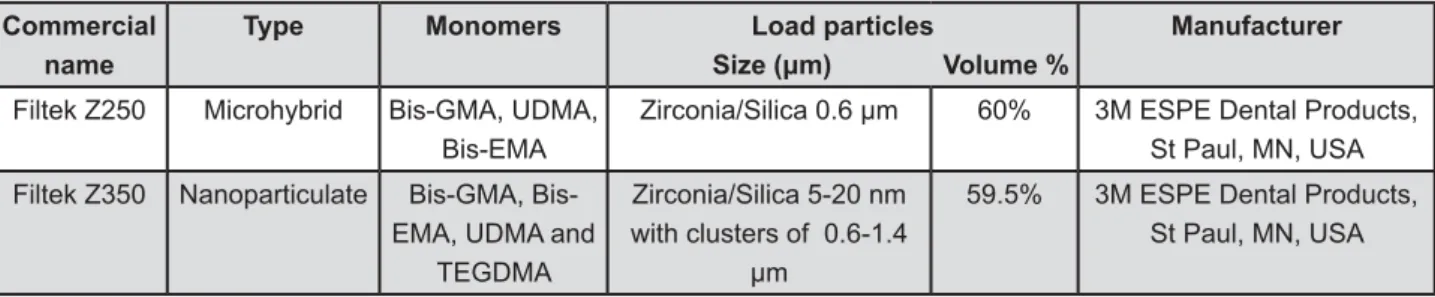
Two direct composite resins (shade A3) currently indicated for esthetic anterior and posterior restorations were used in the present study. Information regarding composite type, composition and manufacturer is given in Figure 1.
Fifty cylindrical test specimens (12 mm diameter x 2 mm thick) of each composite were made using < the matrix in 2 increments and light-activated by a LED device (FLASHlite 1401, Discus Dental, @ K # ]# K ^66 H_ cm2, wavelength in the range between 460 and 480 nm), for 20 seconds, according to manufacturer’s recommendations. The specimens were polished with 320, 600, 1200 and 2000-grit sandpapers. The thickness of every test specimen was checked with a digital caliper (Digimess, São Paulo, SP, Brazil). Next, the test specimens were randomly separated into 5 groups (n=10) according to the mouth rinse solution in which they had been immersed (Figure
2): Group 1 - distilled water (control); Group 2 - Plax classic; Group 3 - Plax alcohol-free; Group 4 - Periogard; and Group 5 - Listerine Cool Mint.
To simulate the use of mouth rinse solutions once a day during a period of 1 year, the test specimens were submitted to 12 cycles of 1-min immersion, then washed in running water and immersed in distilled water for 29 min at 37°C, during 30 days, totaling 360 cycles11.
Color stability
Before immersion, color reading of the test specimens was performed according to the CIE { * D||?| system, against a white background (Standard for 45/0°; Gardner Laboratory Inc., Bethesda, }~]# " " ' 6807, BYK Gardner, Geretsried, Germany). This ""> J6 LED lamps with 10 different colors arranged in a circle, which directs a light bundle at 45° with the <? 6 back to the equipment, which captures and records D||?|@"<D| axes refers to the lightness coordinate and its value ranges from zero (black) to 100 (white). The axis |?| K B green axis and the yellow-blue axis, respectively. @ | @ negative values indicate a shift to green. Similarly, "@?|@K and negative values indicate the blue color range.
After immersion in mouth rinse solutions, s p e c i m e n s c o l o r w a s m e a s u r e d b y t h e spectrophotometer, as previously described. Based
D||?|@ @ 'E) was
determined using the following equation:
'E=[('2+('2+('2]1/2
Values of '^JJ K
unacceptable20.
Surface roughness and Knoop microhardness
Surface roughness (Ra) and Knoop microhardness
Commercial name
Type Monomers Load particles
!"# $" %
Manufacturer
Filtek Z250 Microhybrid Bis-GMA, UDMA, Bis-EMA
Zirconia/Silica 0.6 μm 3M ESPE Dental Products, St Paul, MN, USA
Filtek Z350 Nanoparticulate GMA, Bis-EMA, UDMA and
TEGDMA
Zirconia/Silica 5-20 nm with clusters of 0.6-1.4
μm
3M ESPE Dental Products, St Paul, MN, USA
Bis-GMA: bisphenol A diglycidyl ether dimethacrylate; Bis-EMA: Ethoxylated bisphenol A dimethacrylate, TEGDMA:Triethylene glycol dimethacrylate; UDMA: urethane dimethacrylate
of the test specimens were performed before and after mouth rinse solution immersion. Surface roughness was measured with a Rugosimeter (Mitutoyo SJ-201P, Mitutoyo, Tokyo, Japan), cut-off - 0.25 mm, Lc parameter - 1.25, speed - 0.1 mm/s. The rugosimeter needle (10 μm diameter) was positioned over each test specimen, performing three readings in different locations of the sample surface, after which, the mean roughness of the test specimens were obtained. Surface roughness changes were calculated by the differences between mean values obtained before and after immersion.
The Knoop microhardness of the test specimens was measured (Shimadzu device, HMV Shimadzu, Kyoto, Japan) in three different points, with a 10 N/15 s load. After three readings, the microhardness mean values of the test specimens were obtained. For Knoop microhardness calculation, the baseline mean values were subtracted from those obtained after immersion.
Statistical analysis
For each property, data obtained were subjected to two-way ANOVA and the measurements were compared by the Bonferroni’s test. All statistical testing was performed at a pre-set alpha of 0.05.
RESULTS
Color stability
The mean values and standard deviations for ?K " <? 1. None of the studied composites exhibited color change with values above the clinically acceptable ^JJ20. With regard to Z250, comparison of the effects of different mouth rinse solutions revealed a small color change for specimens D K> difference compared with the other mouth rinse solutions (p<0.05). When immersed in Plax Classic solution, this composite exhibited an intermediate
Commercial name Composition pH Manufacturer
Plax Classic Triclosan, Gantrez, Sodium lauryl sulphate, !! "#""$% phosphate, Sodium saccharine, red dye, ethylic
# &"
5.8 Colgate Palmolive Ind. e Com. Ltda., São Bernardo do
Campo, SP, Brazil
Plax Alcohol-free '"'#'' !!")%#"
Glycerin and Propylene, Sodium methyl taurate, phosphoric acid, Disodium phosphate, Sodium
saccharine and water
4.96 Colgate Palmolive Ind. e Com. Ltda., São Bernardo do
Campo, SP, Brazil
Periogard *! <"<">" &"###?H>""J water, glycerin, ethanol, polysorbate 20, aromatic
%"&"#"K>" sodium saccharine, FD&C blue dye #1
5.0-7.0 Colgate Palmolive Ind. e Com. Ltda., São Bernardo do
Campo, SP, Brazil
Listerine Cool Mint
Thymol, eucalyptol, methyl salicylate, menthol, ?"%WX&"%"%"# Y ?\J)"%%
sodium saccharine, sodium benzoate, green dye #3
3.7 "^X)"_ Paulo, SP, Brazil
Figure 2- Tested mouth rinses
Z250 Z350
Control 1.52 (0.37)a,A 0.96 (0.24)b,AB
Listerine 0.99 (0.29)a,B 1.25 (0.24)a,AC
Plax Classic 1.32 (0.46)a,AB 0.64 (0.23)b,B
Plax alchohol-free 1.42 (0.45)a,A 1.46 (0.30)a,C
Periogard 1.40 (0.71)a,A 0.93 (0.16)b,AB
'@K>
" "E667 With regard to Z350, the highest 'E change was
observed for Plax alcohol-free solution, with K > " "E667" D Comparing the composites to each other, it was ? @K> "/667 for the test specimens immersed in distilled water (control), with both Plax Classic and Periogard solutions allowing smaller color changes for Z350.
Surface roughness
The mean values and standard deviations for surface roughness (Ra) changes are presented in Table 2. For both composites, the greatest change in Ra occurred when the samples were immersed in Listerine solution, with statistically > " B free (p<0.05). When compared to each other, I76IJ76K> difference (p>0.05) regarding any studied mouth rinse solution.
Knoop microhardness
The mean values and standard deviations for Knoop microhardness changes are presented in Table 3. When compared to each other, Z250 and IJ76K> (p>0.05) regarding any studied mouth rinse solution. Immersion of Z350 in Plax alcohol-free solution resulted in greater decrease of @K> difference in relation to the other mouth rinse
solutions (p<0.05).
DISCUSSION
The variability in our results was consistent with other studies, which showed that several factors, including composite resin type, mouth rinse K > ?K microhardness of composites28. Therefore, the null hypothesis could not be accepted.
Color stability can be evaluated both visually
?K"> 5,8,11. The methodology
used in the present study is according to previous studiesthat used spectrophotometry and the CIE
D||?| K5,11 < { D||?|
system was chosen to evaluate color variation ('E)
because it is appropriate for small color changes determination and have advantages such as repeatability, sensitivity and objectivity11.
@ @ " @ ranging from 1 to 3 are perceptible to the naked
eye18@ JJ K
unacceptable20. Considering these concepts; the composite resins tested in the present study demonstrated acceptable color stability when stored in the different types of mouth rinse solutions (Table 1).
< >K modulated by its conversion degree and by some physical properties, such as water sorption2,6. Water sorption of composite resins depends on the resinous matrix composition. It has been reported that water uptake in Bis-GMA based composite
Z250 Z350
Control 44.94 (0.34)a,A 27.60 (0.28)a,A
Listerine 78.46 (0.56)a,AB 61.99 (0.53)a,AB
Plax Classic 38.28 (0.18)a,A 13.36 (0.18)a,A
Plax alcohol-free -4.22 (0.20)a,AC -10.76 (0.27)a,AC
Periogard 64.43 (0.46)a,AB 58.22 (0.34)a,AB
$>>"&%""%%%""%%"%""%"%<X">> Table 2- Means (standard deviations) for Ra K%!H&|}~|>%"%"
Z250 Z350
Control 7.30 (0.17)a,A 22.28 (0.18)a,A
Listerine -14.88 (0.10)a,A 1.20 (0.27)a,A
Plax Classic -6.98 (0.08)a,A 15.83 (0.40)a,A
Plax alcohol-free -5.03 (0.23)a,A -25.73 (0.19)a,B
Periogard -0.24 (0.18)a,A 14.80 (0.24)a,A
resins increased from 3 to 6%, as the proportion of TEGDMA increased from 0 to 1%13. UDMA seems to be more stain resistant than Bis-GMA15, and under normal curing conditions, UDMA based composite resins presented lower water sorption and higher color stability than other dimethacrylates in their resin matrix15,20, which could be observed in the present study.
Moreover, it is important that the composite " > " ? in the polymer network to minimize the formation > B > B" composites. This is especially important regarding the performance of composites in aqueous environments, such as mouth rinse solutions, @ ? " > _ matrix interface may increase the water sorption of composites25.
Nanocomposites correspond to a class of new materials with nanoscale inorganic filler particles dispersed within the resinous matrix27. In comparison with microhybrid composites, these materials have been reported to have improved properties, such as, elasticity modulus, mechanical strength and color stability. Furthermore, these improvements are achieved at low concentrations > " < K@>" generally require high loadings within the range of 60%11,19. This is an important factor in aesthetic maintenance of non-particulate composites, since > " "? " light, which in turn, provides the opacity of the @ < > particle size the greater the light spread, and consequently, the greater the opacity16. The opacity of composites increases as the difference between > particles also increases16. In addition, the smaller > " absorbed by the polymer network, which results in lower degradation of the interface matrix/particle, and consequently, lower color change10. The Z250 > " @ 6 IJ76> " 7 to 20 nm, which could explain the greater color stability for Z35029. Also, according to Kawaguchi, et al.14 (1994), microhybrid composites present a > various sizes of their particles, which contributed @ I76
According to Villalta, et al.30 (2006), the low pH and alcohol concentration of solutions affect the surface roughness of composite resins and cause staining. Nevertheless, the composite IJ76 " K > regarding color stability, surface roughness and microhardness values when the composite was
immersed in the alcohol-free mouth rinse solution (Plax alcohol-free), thus contradicting the results of a previous study30. However, Miranda, et al.17 (2011) demonstrated that despite the absence of alcohol, Plax alcohol-free has phosphoric acid in its composition, which might alter the polymer matrix of composites by catalysis of the ester groups present in the dimethacrylate monomers. The hydrolysis of the ester groups forms alcohol and carboxylic acid molecules, which accelerate polymer network degradation by the decrease of pH inside the composite matrix10,17. The degradation of the polymer network leads to a phenomenon called “plasticization”, which decreases microhardness values in composites10.
According to the methodology used in the present study, the negative values regarding microhardness represent a smoothening of the resin matrix, and positive values, hardening. Despite the great decrease in the composite microhardness (-25.73), the surface roughness improved when compared to the pre-immersion values, except when the composite was immersed in the Plax alcohol-free solution. The same result ? @ I76> in surface roughness was found after immersion into the same mouth rinse solution. It is worth emphasizing, however, that there exists a critical value regarding surface roughness change (Ra^6 μm). According to Bollen, et al.3 (1997), a greater ?> caries. Another critical value for Ra is 0.3 μm, which can be detected when the patient’s lips or tongue enters in contact with the restorative material, causing discomfort3. None of the studied composites showed values for surface roughness change above the critical limits, irrespective of the type of mouth rinse solution used.
Asmussen1 (1984) reported that mouth rinse solutions with high alcohol content might soften the composite resin, especially Bis-GMA-based composites. However, Gürgan, et al.12 (1997) showed that regardless of the alcohol concentration, both alcohol-containing and alcohol-free mouth rinse solutions could affect the properties of composite resins. Immersed of Z350 in Listerine, the mouth rinse solution with the highest alcohol concentration (30%), resulted in decrease in microhardness @> the other mouth rinse solutions. As for Z250, the results were the opposite; there was an increase in the microhardness values when immersed in Listerine and a decrease when immersed in Plax B K > difference. These results suggest that changes in the microhardness of composites do not depend on mouth rinse’s ethanol concentration12.
to color stability. Z350 showed significant changes when immersed in Listerine and Plax alcohol-free solutions, both having entirely different concentrations of ethanol12. However, this fact could be explained, once again, by the presence of phosphoric acid in Plax alcohol-free composition. Studies have reported the release of by-products from polymer network degradation, K K"> methacrylate molecules, which are capable of promoting color change in composites4,10,17.
On the other hand, Z250 had greater color change when immersed in Listerine compared to the other solutions, unlike Celik, et al.4 (2008), who found no color change in the composites immersed in the same mouth rinse solution, despite the high ethanol concentration.
Clinically, the effect of mouth rinse solutions on @ ? > ?K @ factors that were not replicated in this in vitro
study. Among these factors, saliva could dilute or buffer pH of mouth rinse solutions, thus reducing the effect of resinous matrix plasticization10 and forming a pellicle that could have a protective effect on the composite surface, thus, decreasing material staining4. Based on such factors, further
in vivo studies are needed to determine the effects
of mouth rinse solutions on these properties of composites.
CONCLUSIONS
The results of the present study allow us to conclude that the changes observed in the composites depended on the material itself rather than the mouth rinse solution used.
REFERENCES
1- Asmussen E. Softening of BISGMA-based polymers by ethanol and by organic acids of plaque. Scand J Dent Res. 1984;92:257-61. B ' 8 ' } <K } { B >"?K restorative materials. J Dent. 2005;33:389-98.
3- Bollen CM, Lambrechts P, Quirynen M. Comparison of surface roughness of oral hard materials to the threshold surface roughness for bacterial plaque retention: a review of the literature. Dent Mater. 1997;13:258-69.
4- Celik C, Yuzugullu B, Erkut S, Yamanel K. Effects of mouth rinses on color stability of resin composites. Eur J Dent. 2008;2:247-53. 5- Cruvinel DR, Garcia LF, Consani S, Pires-de-Souza FCP. Composites associated with pulp-protection material: color-?K K > ~ 2010;4:6-11.
6- De Gee AJ, ten Harkel-Hagenaar E, Davidson CL. Color dye for >"K " Dent. 1984;52:626-31.
7- DeVore LR. Antimicrobial mouthrinses: impact on dental hygiene. J Am Dent Assoc. 1994;2:23S-28S.
8- Dietschi D, Campanile G, Holz J, Meyer JM. Comparison of the color stability of ten new-generation composites: an in vitro study. Dent Mater. 1994;10:353-62.
B #]#!" ?K of resin composites after immersion in different drinks. Dent Mater J. 2006;25:371-6.
10- Ferracane JL. Hygroscopic and hydrolytic effects in dental polymer networks. Dent Mater. 2006;22:211-22.
11- Gürdal P, Akdeniz BG, Hakan Sen B. The effects of mouthrinses on microhardness and colour stability of aesthetic restorative materials. J Oral Rehabil. 2002;29:895-901.
12- Gürgan S, Önen A, Köprülü H. In vitro effects of alcohol-containing and alcohol-free mouthrinses on microhardness of some restorative materials. J Oral Rehabil. 1997;24:244-6.
13- Kalachandra S, Turner DT. Water sorption of polymethacrylate networks: bis-GMA/TEGDM copolymers. J Biomed Mater Res. 1987;21:329-38.
14- Kawaguchi M, Fukushima T, Miyazaki T. The relationship ? " >@?BB activated resin composites. J Dent Res. 1994;73:516-21. 15- Khokhar ZA, Razzoog ME, Yaman P. Color stability of restorative resins. Quintessence Int. 1991;22:733-7.
B D ! { > ? " " Dent Mater. 2008;24:1243-7.
17- Miranda DA, Bertoldo CE, Aguiar FH, Lima DA, Lovadino JR. Effects of mouthwashes on Knoop hardness and surface roughness of dental composites after different immersion times. Braz Oral Res. 2011;25:168-73.
18- Noie F, O’Keefe KL, Powers JM. Color stability of resin cements after accelerated aging. Int J Prosthodont. 1995;8:51-5. 19- Rong MZ, Zhang MQ, Pan SL, Friedrich K. Interfacial effects in polypropylene-silica nanocomposites. J Appl Polym Sci. 2004;92:1771-81.
20- Ruyter IE, Nilner K, Moller B. Color stability of dental composite resin materials for crown and bridge veneers. Dent Mater. 1987;3:246-51.
21- Samra AP, Pereira SK, Delgado LC, Borges CP. Color stability evaluation of aesthetic restorative materials. Braz Oral Res. 2008;22:205-10.
22- Sarret DC, Coletti DP, Peluso AR. The effect of alcoholic beverages on composite wear. Dent Mater. 2000;16:62-7. 23- Schneider LF, Moraes RR, Cavalcante LM, Sinhoreti MA, Correr-Sobrinho L, Consani S. Cross-link density evaluation through softening tests: effect of ethanol concentration. Dent Mater. 2008;24:199-203.
24- Shintani H, Satou J, Satou N, Hayashihara H, Inoue T. Effects of various methods on staining and accumulation of Streptococcus mutans HS-6 on composite resins. Dent Mater. 1985;1:225-7. 25- Skrtic D, Antonucci JM, McDonough WG, Liu DW. Effect of chemical structure and composition of the resin phase on mechanical strength and vinyl conversion of amorphous calcium phosphate-based composites. J Biomed Mater Res A. 2004,68:763-72.
26- Tjan AH, Chan CA. The polishability of posterior composites. J Prosthet Dent. 1989;61:138-46.
27- Ure D, Harris J. Nanotechnology in dentistry: reduction to practice. Dent Update. 2003;30:10-5.
28- Venturini D, Cenci MS, Demarco FF, Camacho GB, Powers JM. Effect of polishing techniques and time on surface roughness, hardness and microleakage of resin composite restorations. Oper Dent. 2006;31:11-7.
29- Vichi A, Ferrari M, Davidson CL. Color and opacity variations in three different resin-based composite products after water aging. Dent Mater. 2004;20:530-4.