DOI: http://dx.doi.org/10.5007/1980-0037.2016v18n5p539
Screen time as discriminator for overweight,
obesity and abdominal obesity in adolescents
Tempo de tela como discriminador de excesso de peso,
obesidade e obesidade abdominal em adolescentes
Francisco JG Pitanga1
Carlos FA Alves2
Marina L Pamponet1
Maria G Medina1
Rosana Aquino1
Abstract – Many researches have concluded that the time spent in front of TV, computer and other screen-type devices is an important risk factor for overweight and obesity. he aim of this study was to identify the discriminatory power and to propose screen time cutof points for overweight, obesity and abdominal obesity in adolescents. his household survey had cross-sectional design with sample of 613 adolescents aged 15-18 years living in a city in northeastern Brazil. he predictive power and cutofs points of screen time for the outcomes of interest were identiied by receiver operating characteristic curves (ROC). he study adopted 95% conidence interval (CI). Screen time during one day on the weekend was a good discriminator for the presence of overweight only among girls, area under the curve ROC = 0.59 (0.51 to 0.65). here were no areas under the ROC curve with statistical signiicance to discriminate obesity and abdominal obesity. Remain sitting for accumulated four hours per day during the weekend discriminates presence of overweight among girls (sensitivity = 60.9%, speciicity = 52%). he long time spent in front of TV, computer and other screen-type devices on the weekend discriminate overweight in girls.
Key words: Abdominal obesity; Obesity; Overweight; Sedentary lifestyle.
Resumo – Diversas investigações vêm observando que o tempo de tela frente a TV, computador e assemelhados é um importante fator de risco para sobrepeso e obesidade. Objetivou-se iidentiicar o poder discriminatório e propor pontos de corte do tempo de tela para excesso de peso, obesidade e obesidade abdominal em adolescentes. O desenho de estudo foi transversal, tipo inquérito domiciliar, com amostra composta por 613 adolescentes de ambos sexos, com idade entre 15 a 18 anos residentes em município do nordeste do Brasil. O poder preditivo e os pontos de corte do tempo de tela para os desfechos de interesse foram identiicados por meio das curvas Receiver Operating Characteristic (ROC). Utilizou-se intervalo de coniança (IC) a 95%. O tempo de tela durante um dia no inal de semana foi um bom discriminador da presença de excesso de peso apenas entre as moças, área sob a curva ROC=0,59 (0,51-0,65). Não foram observadas áreas sob a curva ROC com signiicância estatística para discriminar obesidade e obesidade abdominal. Ficar sentado a partir de 4 horas acumuladas por dia, durante o inal de semana, discrimina a presença do excesso de peso entre moças (Sensibilidade=60,9%, Especiicidade=52%). O maior tempo de tela frente à TV, computador e assemelhados no inal de semana discrimina ao excesso
1 Federal University of Bahia. Salva-dor, Bahia, Brazil.
2 Catholic University of Bahia. Salva-dor, Bahia, Brazil.
Received: 30 July 2016
Screen time and overweight Pitanga et al.
INTRODUCTION
Currently, there are several reasons to believe that sedentary behaviors, especially those related to technology such as watching television, play-ing on the phone or video game and computer use, i.e., screen time, are signiicant risk factors for metabolic and cardiovascular diseases, as well as physical activity levels, and deserve to be investigated1-6.
Recent investigation carried out in Australia has shown that prolonged sitting time is a risk factor for all-cause mortality regardless of regular physical activity7. Especially in the case of children and adolescents, studies
have shown that having TV in the bedroom and/or watching TV for more than two hours/day is positively associated with overweight8, and there
is evidence that prolonged sitting time have deleterious association with obesity and cardiometabolic risk markers9.
he investigation of possible mechanisms that explain the association between sedentary behavior and metabolic and cardiovascular health, de-spite being in initial research phase, already shows some results. Signiicant reductions in muscle lipoprotein lipase activity (LPL), a key enzyme that regulates the metabolism of lipids were observed during sedentary activity. Low levels of LPL activity, in turn, appear to be associated with decreased absorption of plasma triglycerides by skeletal muscles, decreased HDL cholesterol concentration and postprandial elevation of lipids, causing fats to become deposited on vessels or adipose tissue, particularly visceral abdominal area, contributing to obesity10.
he conduction of studies addressing not only physical activity, but also screen time, especially in adolescents, is of utmost importance to the extent that even the existence of an active behavior by performing leisure activities, common adolescence, does not guarantee the necessary protec-tion against the occurrence of diseases and problems related to sedentary behavior since spending long times in a sitting position in front of the TV, computer and other screen-type devices is common practice in this group.
his study aims to identify the discriminatory power and propose cutof points of screen time for overweight, obesity and abdominal obesity in adolescents.
METHODOLOGICAL PROCEDURES
Study design
his is a household survey with cross-sectional design that is part of the study “Evaluation of the Family Health Strategy efects: adoption of healthy habits and accessibility to primary health promotion services and prevention of risks and diseases”, a household survey with young people aged 15-24 years held in the city of Camaçari, Bahia, Brazil.
Sampling
To calculate the sample size, Stata 12 software was used, estimating the number of subjects required to detect a 20% diference in the preva-lence of unhealthy eating habits among adolescents in two populations (one ascribed to the Family Health Unit - FHU and other to conventional BHU), with 5% signiicance level and 80% statistical power. Intraclass correlation coeicient of 0.010412, conglomeration size of 30 and design
efect of 1.30 were considered reference indicator for prevalence of 36%11.
he sample was estimated in 1,755 individuals, it was thus approximate to 1,800 (900 per group). he inal sample obtained was representative of the municipality, totaling 1701 individuals aged 15-24 years living in 65 micro areas of Camaçari.
Dealing with a cluster sampling, the irst stage of the study used a database from the Municipal Health Secretary with information on all municipal territories, divided into 477 micro areas, characterized by presenting similar number of households and identiication of streets. To achieve the sample of 1,800 individuals and considering micro areas as conglomerates, the random drawing of forty micro areas was conducted (ten micro areas considered as reserve) for each group (FHS and BHU), totaling eighty micro areas. Of randomly selected micro areas, ifteen were excluded, fourteen of them being excluded before the ield work because they were considered areas of extreme violence and one micro area was excluded because interviewers were unable to reach the place of diicult access in the countryside. At the end, 65 micro areas were included in the study, 33 of Family Health Strategy and 32 conventional BHU.
In the second stage, in each micro area, streets were ordered following a random drawing, and data collection started up from the lowest numbered address, following domicile to domicile by the right and at the end, going to the left side of the street. At the end of the street, the interviewer fol-lowed to the next street ordered by draw to complete the planned sample of 30 households per micro area.
In the third sampling stage, after domicile identiication with at least one resident aged 15-24 years, random draw was performed among eligible residents. Excluded criteria were: pregnant women, people with special needs that make the completion of the questionnaire impossible and domestic servants in that household. In case of closed households without information about its residents, and when the randomly selected resident was absent, the interviewer returned up to three times, preferably in diferent shift or weekend. Scheduling by phone or in person were also strategies adopted for the interviews.
Screen time and overweight Pitanga et al.
All study participants or their legal guardians signed the free and informed consent form and the project was approved by the Ethics Research Com-mittee of the Collective Health Institute, protocol No. 019-09 / CEP-ISC.
Study variables
For this study, the following were used as independent variables:
a) Screen time, deined in hours and checked by two questions about the average time that the respondent spend watching television, playing video games, using mobile phone or computer on a normal weekday and one day on the weekend;
b) Respondent’s gender;
c) Respondent’s age, calculated from the reported date of birth.
he following were used as dependent variables: overweight, obesity and abdominal obesity.
Overweight and obesity were analyzed by body mass index (BMI) and identiied by means of percentiles proposed by Cole et al.13. Overweight
was identiied by including individuals who had both overweight as obesity. Abdominal obesity was analyzed by waist circumference and identiied by the 75th percentile in tables proposed by Fernandez et al.14. Waist
circum-ference was obtained through the average of two measures located in an equidistant line between lower edge of the rib and the iliac crest.
Data collection
Data collection was carried out between October 2011 and January 2012 and consisted of the application of structured tool by a team of trained interviewers (undergraduates or health area graduates), monitored by ield supervisors and health professionals.
Anthropometric measurements were performed at home, in a standard-ized way, according to procedures recommended by the Anthropometric Standardization Reference Manual15. Interviewers were trained by
nutri-tionists and used the following instruments:
• Leicester Portable Height Measure Stadiometer with 0.1cm precision scale to measure in upright position;
• Portable Tanita BF-680W Electronic scale;
• Inelastic 150cm anthropometric tape (graduated in centimeters and millimeters).
Waist circumference was measured at the midpoint between the lower edge of the rib and the iliac crest in the middle axillary line. If the evaluator could not ind the points, the measure was taken in the height of the umbilicus. Two measurements were performed, considering the arithmetic mean between them.
obesity and abdominal obesity, was identiied through Receiver Operat-ing Characteristic curves (ROC), commonly used to determine cutofs in diagnostic or screening tests16. Nonparametric estimation with bootstrap
by conglomerates stratiied by sex and age was used to obtain an accurate quantitative measure of screen time to discriminate overweight, obesity and abdominal obesity. Bootstrapping corrects the uncertainty of estimates associated with ROC curves, incorporating the sampling process by con-glomerates in the estimation methodology17.
he total area under the ROC curve between screen time in a week day and a day on the weekend and presence of overweight, obesity and abdominal obesity was initially identiied. he greater the area under the ROC curve, the more discriminatory power for the presence of overweight, obesity and abdominal obesity. Conidence interval (CI) of 95% was used. he calcula-tion of the 95% CI determines whether the predictive capacity of the sitting time is not by chance, and its lower limit should not be less than 0.5018.
Following, cutofs were found with their respective sensitivity and speciicity of screen time (hours/day) for the presence of overweight, obesity and abdominal obesity,
he cutof points were identiied according to the most appropriate balance between sensitivity and speciicity. Data were analyzed using the “STATA” statistical software version 12.0.
RESULTS
For the purposes of this study, all adolescents aged 15-18 years who made all anthropometric measurements and answered questions related to screen time were evaluated, totaling 275 boys and 338 girls.
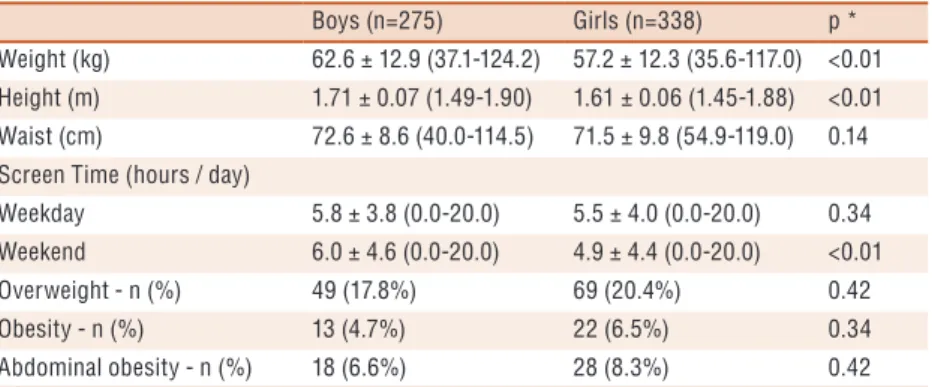
he sample characteristics are in shown in Table 1. It is noteworthy that boys have higher absolute weight and height values and spend more time sitting in front of the TV, computer screen and others on the weekend than girls. With respect to absolute waist circumference values and screen time during the week, there are no diferences between girls and boys. here are also no diferences in the proportions of overweight, obesity and abdominal obesity between sexes.
Table 2 shows the areas under the ROC curve between screen time and overweight, obesity and abdominal obesity in male adolescents. he time spent in front of TV, computer screen, and others both on a weekday as in one day on the weekend does not discriminate the presence of overweight, obesity and abdominal obesity.
Screen time and overweight Pitanga et al.
Table 1. Mean, standard deviation, minimum and maximum values or percentage of variables analyzed in the study.
Boys (n=275) Girls (n=338) p * Weight (kg) 62.6 ± 12.9 (37.1-124.2) 57.2 ± 12.3 (35.6-117.0) <0.01 Height (m) 1.71 ± 0.07 (1.49-1.90) 1.61 ± 0.06 (1.45-1.88) <0.01 Waist (cm) 72.6 ± 8.6 (40.0-114.5) 71.5 ± 9.8 (54.9-119.0) 0.14 Screen Time (hours / day)
Weekday 5.8 ± 3.8 (0.0-20.0) 5.5 ± 4.0 (0.0-20.0) 0.34 Weekend 6.0 ± 4.6 (0.0-20.0) 4.9 ± 4.4 (0.0-20.0) <0.01 Overweight - n (%) 49 (17.8%) 69 (20.4%) 0.42
Obesity - n (%) 13 (4.7%) 22 (6.5%) 0.34
Abdominal obesity - n (%) 18 (6.6%) 28 (8.3%) 0.42
* Continuous variables were compared using the “t” Student test for independent samples and categorical variables using the chi-square test.
Table 2. Areas under the ROC curve and 95% CI of screen time as a discriminator of the presence of overweight, obesity and abdominal obesity in male adolescents.
Overweight Obesity Abdominal obesity Sitting time
Weekday 0.44 (0.36-0.53) 0.39 (0.20-0.57) 0.45 (0.29-0.61) Weekend 0.51 (0.42-0.59) 0.45 (0.26-0.65) 0.57 (0.36-0.72)
ROC = receiver operating characteristic; 95% CI = 95% confidence interval.
Table 3. Areas under the ROC curve and 95%CI of screen time as a discriminator for the presence of overweight, obesity and abdominal obesity in female adolescents.
Overweight Obesity Abdominal obesity
Sitting time
Weekday 0.50 (0.43-0.58) 0.40 (0.28-0.52) 0.38 (0.28-0.48)
Weekend 0.59 (0.51-0.65)* 0.38 (0.29-0.49) 0.49 (0.37-0.61)
ROC = receiver operating characteristic; 95% CI = 95% confidence interval. * Area under the ROC curve showing discriminatory power for the presence of overweight, obesity and abdominal obesity (Li-CI ≥ 0.50).
Figure 1 shows the screen time cutof point with its respective sensi-tivities and speciicities as overweight discriminator in female adolescents. It was found that accumulating more than 4 hours sitting front of the TV, computer screen and other screen-type devices in one day on the weekend discriminates the presence of overweight.
he research sought to demonstrate the discriminatory power and screen time cutof points for overweight, obesity and abdominal obesity in adoles-cents of both sexes. No studies on this topic using the ROC curves tech-nique as analysis method were found in literature. hus, our comparisons were made based on association or intervention studies.
Areas under the ROC curve with statistical signiicance were observed only for girls (overweight). Recent research19 found that having TV in the
bedroom and/or watching television for more than two hours/day were positively associated with overweight. In our study, it was found that screen time at the weekend discriminate overweight in female adolescents. Furthermore, it was also found that the cutof of 4 hours accumulated per day was the most appropriate value for this fact to occur.
In a recent systematic review, it was found that adiposity and cardio-metabolic risk markers are positively associated with sedentary behavior in general, especially with sitting time related to computer use and television and these relationships appear to be mediated by the inluence of seden-tary behaviors and food intake as well as by the direct metabolic impact of prolonged sitting time20.
Another systematic review that analyzed 170 studies on sedentary behavior and health indicators in children and adolescents at school age found that the increase in sitting time was associated with an increase in fat mass, BMI and body weight gain21. Among these studies, the intervention
study by Robinson 22 stands out, where it was observed that the reduction
in sitting time decreased abdominal obesity (waist circumference) in 192 children from two public schools in San Jose, California, USA.
In our study, we could not demonstrate discriminatory power of screen time on one day in the week or weekend for obesity and abdominal obesity in male and female adolescents.
he mechanisms by which the increase in sitting time inluences over-weight, obesity and abdominal obesity are related to reduced lipoprotein lipase activity (LPL), which decreases the absorption of plasma triglycerides, mainly by skeletal muscle23. hus, fats are deposited on vessels or on the adipose
tis-sue, particularly in the visceral abdominal area, thus contributing to obesity. In this perspective, considering studies in rats, there is evidence that muscular inactivity causes decreased lipoprotein lipase protein activity (LPL), which has the function of regulating the absorption of triglycer-ides and production of high-density lipoproteins (HDL) in muscle24. he
absence of muscle contraction in muscles of lower limbs specialized in the maintenance of posture is associated with 75% reduction in the capacity of absorbing fat from the blood stream25.
On the other hand, some authors suggest that sedentary behavior based on screen time, especially watching television, can lead to a greater intake of calories through a variety of mechanisms that increase food intake26,27,
Screen time and overweight Pitanga et al.
an inluence in our study, so that there was no discriminatory power of screen time for overweight, obesity and abdominal obesity in boys, as the caloric intake of adolescents included in the study was not analyzed. However, we were able to demonstrate discriminatory power of screen time for overweight in girls, which leads us to believe that this sedentary behavior can inluence changes in body weight regardless of calorie intake.
Corroborating our results, recent literature systematic review study showed that most of the studies analyzed found association between seden-tary behavior and increased body weight levels in children and adolescents28.
One of the main limitations of this work was the construction of screen time variable from self-reported information, which may have underestimated this sedentary behavior. As main strength, we highlight the determination of screen time cutof point for discriminating overweight in girls, since there are only few studies that have identiied these values, especially in Brazil.
CONCLUSIONS
Based on the results found in this study, it could be inferred that the time spent in front of TV, computer and other screen-type devices in one day on the weekend discriminates overweight in girls aged 15-18 years. he screen time cutof point in one day on the weekend to discriminate overweight was 4 hours accumulated per day.
hese results point to the need to expand health promotion actions among young people to encourage the reduction of time sitting in front of the TV, computer screen and other screen-type devices, especially on days of the weekend. Adolescents should also be clariied about the importance of the regular practice of physical activities and avoid sedentary behaviors.
REFERENCES
1. Jakes RW, Day NE, Khaw KT, Luben R, Oakes S, Welch A, Bingham S, Ware-ham NJ. Television viewing and low participation in vigorous recreation are independently associated with obesity and markers of cardiovascular disease risk: EPIC-Norfolk population-based study. Eur J Clin Nutr 2003; 57 (9): 1089-96.
2. Hu FB, Li TY, Colditz GA, Willett WC, Manson JE. Television watching and other sedentary behaviors in relation to risk of obesity and type 2 diabetes mellitus in women. JAMA 2003; 289 (14):1785-91.
3. Banks E, Jorm L, Rogers K, Clements M, Bauman A. Screen-time, obesity, ageing and disability: indings from 91 266 participants in the 45 and Up Study. Public Health Nutr 2011;14 (1): 34-43.
4. Chang PC, Li TC, Wu MT, Liu CS, Li CI, Chen CC, et al. Association between television viewing and the risk of metabolic syndrome in a community-based population. BMC Public Health 2008; 8:193.
5. Stamatakis E, Hamer M, Dunstan DW. Screen-based entertainment time, all-cause mortality, and cardiovascular events: population-based study with ongoing mortality and hospital events follow-up. J Am Coll Cardiol 2011;57 (3): 292-9.
6. Dunstan DW, Barr EL, Healy GN, Salmon J, Shaw JE, Balkau B, et al. Television viewing time and mortality: the Australian Diabetes, Obesity and Lifestyle Study (AusDiab). Circulation 2010; 121(3):384-91.
CORRESPONDING AUTHOR
Francisco JG Pitanga, Rua Professor Isaias Alves de Almeida, 144 / 1301
Bairro: Costa Azul, Salvador, Bahia, Brasil
CEP: 41.760-120
E-mail: [email protected]
9. Saunders TJ, Chaput JP, Tremblay MS. Sedentary behaviour as an emerging risk factor for cardiometabolic diseases in children and youth. Can J Diabetes 2014;38(1):53-61.
10. Edwardson CL, Gorely T, Davies MJ, Gray LJ, Khunti K, Wilmot EG, et al. Association of sedentary behaviour with metabolic syndrome: a meta-analysis. PLoS One 2012; 7(4): e34916.
11. Neutzling MB, Araújo CL, Vieira MDE F, Hallal PC, Menezes AM. Freqüência de consumo de dietas ricas em gordura e pobres em fibra entre adolescentes. Rev Saude Publica 2007; 41(3):336-42.
12. Amorim LD, Bangdiwala SI, MCmurray RG, Creighton D, Harrell J. Intraclass correlations among physiologic measures in children and adolescents. Nurs Res 2007; 56(5): 355-60.
13. Cole TJ, Bellizzi MC, Flegal KM, Dietz WH. Establishing a standard deinition for child overweight and obesity worldwide: international survey. BMJ 2000; 320 (7244):1240-3.
14. Fernández JR, Redden DT, Pietrobelli A, Allison DB. Waist circumference percen-tiles in nationally representative samples of african-american, european-american, and mexican-american children and adolescents. J Pediatr 2004;14(5):439-44.
15. Lohman TG, Roche AF, Martorell R. Anthropometric Standardization Reference Manual. Human Kinetics: Champaign, IL, USA; 1988.
16. Erdreich LS, Lee ET. Use of relative operating characteristics analysis in epidemiology: a method for dealing with subjective judgment. Am J Epidemiol 1981;114(5):649-62.
17. Janes H, Longton G, Pepe MS. Accommodating covariates in receiver operating characteristic analysis. Stata J 2009; 9(1):17-39.
18. Schisterman EF, Faraggi D, Reiser B, Trevisan M. Statistical inference for the area under the receiver operating characteristic curve in the presence of random measurement error. Am J Epidemiol 2001;154(2):174-9.
19. Garmy P, Clausson EK, Nyberg P, Jakobsson U. Overweight and television and computer habits in Swedish school-age children and adolescents: a cross-sectional study. Nurs Health Sci 2014;16(2):143-8.
20. Saunders TJ, Chaput JP, Tremblay MS. Sedentary behaviour as an emerging risk factor for cardiometabolic diseases in children and youth. Can J Diabetes 2014;38(1):53-61.
21. Tremblay MS, LeBlanc AG, Kho ME, Saunders TJ, Larouche R, Colley RC, Goldield G, Connor Gorber S. Systematic review of sedentary behaviour and health indicators in school-aged children and youth. Int J Behav Nutr Phys Act 2011;8:98.
22. Robinson TN. Reducing children’s television viewing to prevent obesity: a rand-omized controlled trial. JAMA 1999; 282(16):1561-7.
23. Edwardson CL, Gorely T, Davies MJ, Gray LJ, Khunti K, Wilmot EG, Yates T,Biddle SJ. Association of sedentary behaviour with metabolic syndrome: a meta-analysis. PLoS One 2012; 7(4): e34916.
24. Bey L, Hamilton MT. Suppression of skeletal muscle lipoprotein lipase activity during physical inactivity: a molecular reason to maintain daily low intensity activ-ity. J Physiol 2003;551 (Pt 2):673-82.
25. Bey L, Akunuri N, Zhao P, Hofman EP, Hamilton DG, Hamilton MT. Patterns of global gene expression in rat skeletal muscle during unloading and low intensity ambulatory activity. Physiol Genomics 2003; 13(2): 157-67.
26. hivel D, Aucouturier J, Doucet É, Saunders TJ, Chaput JP. Daily energy balance in children and adolescents: does energy expenditure predict subsequent energy intake? Appetite 2013; 60 (1): 58-64.
27. Pearson N, Biddle SJ. Sedentary behavior and dietary intake in children, adoles-cents, and adults: a systematic review. Am J Prev Med 2011; 41(2): 178-88.