DOI: http://dx.doi.org/10.5007/1980-0037.2016v18n5p567
1 Federal University of Santa Maria. Graduate Program in Physical Educa-tion. Santa Maria, RS. Brazil.
2 Federal University of Santa Maria. Center for Research on Physical Activity and Health. Santa Maria, RS. Brazil.
3 Federal University of Santa Maria. Department of Administrative Scien-ces. Santa Maria, RS. Brazil.
Received: 02 March 2016
Accepted: 07 July 2016
Perceived barriers to physical activity practice
in high school students
Barreiras percebidas à prática de atividades físicas em
escolares do ensino médio
Kelly Christine Maccarini Pandolfo1,2
Tatiane Minuzzi1,2
Rafaella Righes Machado2
Luís Felipe Dias Lopes3
Cati Reckelberg Azambuja1,2
Daniela Lopes dos Santos1,2
Abstract – In an attempt to understand the problem of declining physical activity (PA) among adolescents, there has been an increasing interest in identifying perceived barriers (PB) that can reduce the involvement of adolescents in PA. he aim of this study was to identify PB to PA practice among public high school students. he samples was composed of 348 students aged 14-19 years, 46.8% females and 53.2% males. To investigate BP, an instrument consisting of 12 statements and validated for the study population was used. he analysis of results was carried out by descriptive statistics, Kruskal Wallis test to check the possible diferences in PB throughout high school years and chi-square for the diference in proportions of barriers. Having many tasks to do, lack of time and adverse weather conditions were the most cited PB. here was no diference in the perception of barriers among high school years (males: p = 0.44; females: p = 0.23). PB “not having how to go or return” (p = 0.04), “adverse weather conditions” and “laziness” (p = 0.02), “lack of time” (p = 0.01) and “at home nobody performs PA” (p = 0.04) showed statisti-cally signiicant diferences between sexes. Both sexes reported similar barriers; however, girls reported higher number of PB and with greater frequency. Identifying which PB prevent the adoption of a physically active lifestyle may be the beginning of solutions to minimize the negative efects.
Key words: Adolescent; Behavior; Exercise.
Barriers to physical activity practice Pandolfo et al.
INTRODUCTION
Physical activity (PA) is an important factor to prevent the development of non-communicable diseases such as cardiovascular disease, cancer, diabe-tes1,2, hypertension and cholesterol3 and is also a behavioral determinant of
risk of overweight and obesity4. According to the world Health
Organiza-tion (WHO)1, physical inactivity is a major death risk factor worldwide
and, although diseases associated with lack of PA commonly manifest in adulthood, scientiic evidence points to their development early in child-hood and adolescence5.
he habits that deine the lifestyle of an individual are established and consolidated before adulthood6, and physically active children and
ado-lescents are more likely to be suiciently active in adulthood7. However,
survey data indicate that during adolescence, PA decreases, with association between decreased PA levels with increasing age8-10.
In an attempt to understand the problem of PA decline among adoles-cents, there is a growing need of identifying which elements can cause this phenomenon, since active behaviors are inluenced by the interaction of a variety of biological, behavioral and environmental factors11. Studies have
made reference to factors that impair the practice of PA as barriers6,9,12-16.
According to Brown17, barriers are obstacles perceived by individuals
and that have a negative inluence, reducing the chance of engaging in PA practice. A recent systematic review conducted by Martins et al.18 brings the
perspective of adolescents about PA barriers and facilitators. In the works found, attitudes towards physical activity, motivation, body image percep-tions, entertainment and the inluence of friends, family, physical education teachers and environmental opportunities for PA practice, were mentioned.
Although studies on the perception of barriers5,16,19 and associated
factors13,20 have already been developed, including those investigating
South Brazilian adolescents6,14,15, the characteristics of each age group and
socio-cultural characteristics must be identiied, approaching the analysis of barriers to the reality of the study population12. it was observed that
students included in this study are part of an education system with own characteristics and that have shown signiicant positive results in the selec-tion and evaluaselec-tion processes to which they have been submitted, obtained by the full-time dedication of students21, who may be involved in various
extracurricular activities, in detriment to participation in physical activities. hus, the aim of this study was to identify perceived barriers (PB) that impair the involvement in PA practice by public high-school students from Santa Maria, RS.
METHODOLOGICAL PROCEDURES
his cross-sectional and descriptive study had a population of 377 public high-school students enrolled in the 2015 school year (10th, 11th and 12th
answering all questions of the survey instruments. Not answering any of the instruments was considered as an exclusion criterion.
Data were collected through the application of instruments in June 2015 in the last week of school before school break during physical educa-tion classes. his study was approved by the Ethics Research Committee (CEP) of the Federal University of Santa Maria (UFSM) under protocol number 1.108.196 of 06/12/2015.
To identify the barriers, the instrument proposed by Santos et al.22
was used, which consists of 12 questions in a Likert scale, with the fol-lowing response options for every situation that may pose a barrier to PA practice: “strongly disagree”, “disagree” “agree,” “strongly agree”. For analysis purposes, adolescents were classiied only according to the presence or absence of PB. Factors to which the adolescent responded “agree” or “strongly agree” were considered PB and when the answer was “disagree” or “strongly disagree”, it was not considered a barrier.
For information on the physical activity (PA) level, the short-version International Physical Activity Questionnaire, IPAQ , was used, which was validated for use in adolescents by Guedes et al.23. his version is composed
of eight open questions and its information allows us estimating the time spent per week in diferent PA dimensions (walks and physical eforts of moderate and high intensity) and physical inactivity (sitting position). he results of this study show that, in adolescents both sexes over 14 years, the IPAQ presents acceptable measurement properties for monitoring PA level. For classiication of the PA level, those with time longer than 300 minutes / week of PA will be considered as active and as insuiciently active, those with time less than 300 minutes / week1.
Descriptive data analysis was performed in the characterization of the study population and in the statements of the survey instrument. he data distribution curve was analyzed through the Kolmogorov-Smirnov test and after, the Kruskal Wallis test was used to check the possible diference of barriers throughout the high school years. A test for the diference in proportions (chi-square) was used for the analysis of individual barriers between sexes, respecting the signiicance level of 5%.
RESULTS
Table 1 describes the study population stratiied by sex, high school grade, PA level and PB. he study included 348 students of the total enrolled in high school, 53.2% males (n = 185) and 46.8% females (n = 163), with mean age of 16.28 ± 1.07 years. Of all students, 29 (7.7%) did not participate in the study, either because they refused or because they were not present on the days of data collection.
Barriers to physical activity practice Pandolfo et al.
inactivity (53.1%) compared to boys (36.8%). Regarding barriers for PA practice, girls reported more PB than boys in all high school grades.
Table 1. Distribution of the study population stratified by sex, high school grade, physical activity level and perceived barriers to PA practice.
Characterization Male Female Total
n % n % n %
Population
10th Grade 73 52.5 66 47.5 139 100
11th Grade 60 51.7 56 48.3 116 100
12th Grade 52 55.9 41 44.1 93 100
Physical Activity Level Active
10th Grade 47 33.8 38 27.3 85 61.2¤
11th Grade 39 33.6 29 25.0 68 58.6¤
12th Grade 31 33.3 20 21.5 51 54.8¤
Insufficiently Active
10th Grade 26 18.7 28 20.1 54 38.8¤
11th Grade 21 18.1 27 23.3 48 41.4¤
12th Grade 21 22.6 21 22.6 42 45.2¤
Perceived Barriers – PB#
10th Grade 4 - 5 - -
-11th Grade 3 - 7 - -
-12th Grade 2 - 6 - -
-# Values obtained by the avenge PB stratified in high school grades. ¤ Total of 100% is obtained by adding active and insufficiently active subjects. Values presented in f: frequency; %: percentage
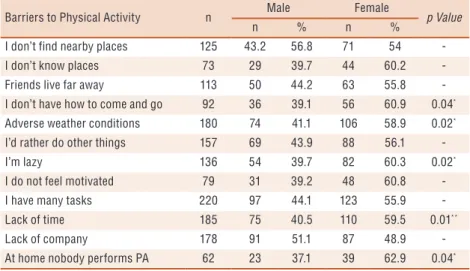
Table 2 shows the frequency and percentage of responses to the presence of PB among all the students who participated in the study. he occur-rence of positive responses (agree or strongly agree) for each barrier was grouped for each statement of the instrument, and after stratiied by sex.
Table 2. Frequency and percentage of the presence of perceived barriers to physical activity,
stratified by sex
Barriers to Physical Activity n Male Female p Value
n % n %
I don’t find nearby places 125 43.2 56.8 71 54 -I don’t know places 73 29 39.7 44 60.2 -Friends live far away 113 50 44.2 63 55.8 -I don’t have how to come and go 92 36 39.1 56 60.9 0.04*
Adverse weather conditions 180 74 41.1 106 58.9 0.02*
I’d rather do other things 157 69 43.9 88 56.1 -I’m lazy 136 54 39.7 82 60.3 0.02*
I do not feel motivated 79 31 39.2 48 60.8 -I have many tasks 220 97 44.1 123 55.9 -Lack of time 185 75 40.5 110 59.5 0.01**
Lack of company 178 91 51.1 87 48.9 -At home nobody performs PA 62 23 37.1 39 62.9 0.04*
X2: Pearson’s Chi-square test for the presence of barriers between sexes; * P <0.05; PA: physical
tions” (51.7%). PB with the lowest frequency of answers by students were “I do not know nearby places where I can go” (21%) and “it is diicult to make physical activity at home because at home nobody performs PA” (17.8%). With the exception of barrier “it is diicult to make physical activ-ity without a company”, all the others had higher frequencies of answers in females compared to males. PB “I don’t have how to come and go”, “adverse weather conditions” “laziness”, “lack of time” and “it is diicult to make physical activity at home because at home nobody performs PA” showed a statistically signiicant diference between sexes.
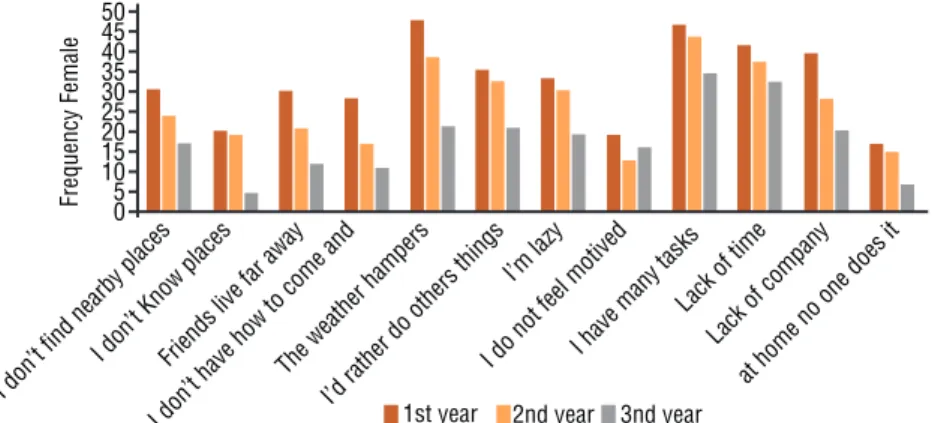
When analyzing PB stratiied by school grade, there was no signiicant diference (male: p = 0.44; female: p = 0.23). Perceived barrier “adverse weather conditions” was more prevalent among girls in the 10th grade
(44.3%) and “I have many tasks to do” among girls in the 11th (35%) and
12th grades (27.6%) (Figure 1). For males, barrier “it is diicult to make
physical activity without a company” was the most prevalent for 10th and
11th graders (41.1% and 38.9% respectively). In the 12th grade, barrier “I
have many tasks” (35.1%) was the most reported among students (Figure 2). here is a tendency to decrease the number of PB by students of both sexes over the years, with increasing education. Despite this tendency, there was no statistical diference between the mean PB in diferent school grades.
Figure 1. Frequency of responses to the presence of perceived barriers to physical activity for females, stratified by school grade.
Barriers to physical activity practice Pandolfo et al.
DISCUSSION
As PA is multifactorial behavior inluenced by the interaction of biologi-cal, behavioral and demographic aspects11,24, which can provide positive
or negative inluence on individuals25, collecting information to assist
un-derstanding how these factors act on the involvement of individuals with PA becomes fundamental. Since Brazil is a country of great cultural and social diversity, investigations aimed at identifying the relevant features of each study group become important tool to obtain information about the barriers that may hinder or prevent PA practice.
For adolescents in this study, having many tasks to do, followed by lack of time and adverse weather conditions were the main PB. he school in which these students are enrolled is notoriously recognized by the pres-ence of large amount of extracurricular tasks, some of compulsory nature, which can cause adolescents to perceive them as a barrier. he fact that 12th graders reported it as the main PB corroborates this justiication. he
proximity of tests for admission to universities can make students to spend more time dedicated to studies at the expense of time spent for PA.
When the study population is stratiied by school grade, the perceived barrier “I have many tasks to do” is also presented as the most prevalent among 11th grade girls. he literature presents justiication for this barrier,
emphasizing the fact that the tasks related to home and family care begin to be attributed in adolescence9, and socially are roles assigned to girls,
which makes the time to practice some activity to become limited. How-ever, this justiication loses strength with the fact that changes in family relationships are taking place and roles that were assigned exclusively to women today are shared by all family members.
Another reason that can be attributed to the fact that the large amount of tasks is considered a barrier by 11th grade girls lies in the opportunity to
go to the university, which starts in high school. he Federal University located in the city where the study was conducted ofers a program in which students can perform objective tests at the end of each high school grade: 10th grade (PS1), 11th grade (PS2) and 12th grade (PS3). Involvement in
the study by PS2 students may have afected these indings.
It seems that PB “I have many tasks” triggers the perception of lack of time, since the performance of tasks and extracurricular activities take time and involvement after school hours, which could be used for PA practice. Although it was found through diferent instruments used in this study, the lack of time was also considered a barrier for adolescents from Curitiba, PR20 and also for adolescents from Santa Maria, RS15, the latter
being speciically referred to as the time dedicated to studies.
Research conducted by Müller and Da Silva14 with adolescents from the
fact observed in American schoolchildren27. Arab Students13 also reported
a lack of time and was one of the ive barriers most reported by 40% of Polish adolescents, indicating that home or other commitments have been perceived as a priority on PA28.
Regarding PB “adverse weather conditions”, the results conirm that the climatic conditions of southern Brazil are a strong barrier to PA practice, as has been reported in other studies developed in the region6,14,15. Climate instability
ultimately impairs PA practice, especially in the winter6, making it diicult to
carry out outdoor activities14, negatively interfering with PA practice. Climatic
variations in Santa Maria are very sharp, with high temperatures in summer and wet and cold winter, which discourages people to the practice of physical exercises, aggravated by the lack of appropriate outdoor places such as safe streets and parks, and lack of adequate infrastructure in indoor places.
It is noteworthy that data of this study were collected in June, at the beginning of the winter season. his situation, coupled with the fact that physical education classes are held in the institution in the irst periods of the school day, between 07:20 am and 10:00 am, may have inluenced this result.
he diiculty in making PA without some company was the only PB that showed positive responses higher in boys compared to girls, and the most prevalent for male 10th and 11th graders. Much of the free time in
adolescence is illed with the company of friends and the adoption of be-haviors is linked to interactions with the circumstances to which adolescents are exposed27 and the characteristics and behaviors of their peers. Another
study also found reports that the main barriers cited by adolescents are of socio-cultural nature and include the lack of company of friends16.
Friends can inluence motivation11 and thus the fact of having no
company can be considered a strong barrier, because without social support generated by the presence of a friend, the engagement to in some practice becomes diicult, since behaviors result from group interactions. his justiication gains support with the results of studies in which friends have similar physical activity levels11,29, adolescents with sports friends have a
tendency to be physically active20 and adolescents who have friends who
exercise can more easily perceive the beneits of PA30.
One of the less prevalent barriers among students in this study was “it is diicult to make physical activity at home because at home nobody performs PA”. Family support is an important aspect to understand the beneits of PA30. However, the example of parents in relation to
perform-ing or not PA is not a factor that interferes with the proactive behavior of adolescents. he characteristics of this age group, which involve certain detachment from the nuclear unit and the search for greater autonomy, makes this barrier to be against one of the most prevalent, lack of company, which is only perceived as a barrier when the friend cannot be along.
he trend found that PB decrease from the 10th grade to the 12th grade
Barriers to physical activity practice Pandolfo et al.
with their peers. he entry into the high school is a new stage in school life, marked by the end of elementary school. New students arriving to school and the redistribution of classes establish new relationships and the consolidation of these friendship ties take time to be strengthened. When arriving in the 12th grade, these relationships already solidiied and network
of friends is once again formed.
Overall, adolescent girls in the three school grades reported more barriers when compared to boys, corroborating what has been found in literature, regardless of country13,20, place of residence, rural14 or urban6,
state capitals9,16 or inland cities15 in which studies have been conducted.
Some limitations of this study should be highlighted: (1) diiculty of establishing the cause and efect temporality inherent of cross-sectional studies; (2) despite the thorough guidance to participants on the instru-ment and the importance of collecting information, the self application aspect of the questionnaire can lead to loss of more accurate information, and (3) although the instrument is validated for the study population and ofers statements that meet the environmental, cultural and social aspects of southern Brazil, it is a closed instrument and can cause loss of informa-tion. In addition (4), the study includes only students from a public school, with own characteristics of its education system, suggesting caution in extrapolating the results to other populations.
However, these limitations do not invalidate the importance of the indings, since the information collected seem to be unprecedented for the population of this education system. It is noteworthy that many of the students are from other Brazilian regions and bring with them particu-larities and speciic customs of their places of origin. his unique feature found in this study allows these results, with traces of the Brazilian cultural diversity, to be extrapolated to other groups, even if it has not been one of the research goals.
CONCLUSION
he indings showed that for the study participants, the most prevalent PB were “I have many tasks to do”, “lack of time” and “adverse weather conditions”. Boys and girls reported similar barriers; however, girls reported a higher number of PB and with greater frequency. An important point to be considered relates to the inding that barriers to students to engage in PA practices are related to the amount of tasks and homework, and consequently lack of time. he long school day, which is characteristic of the federal education system, together with the pedagogical praxis of teachers in relation to extra class school tasks, may limit the involvement with PA, often subjecting the adolescent to choose between achieving school obligations or the search for a more active and healthier lifestyle.
within the school environment is an interesting strategy, as the school is the place where the appropriation and construction of knowledge has been developed, making it a promising space for actions in this purpose.
REFERENCES
1. World Health Organization. Global recommendations on physical activity for health. Geneva. 2015; disponível em: http://www.who.int/dietphysicalactivity/ factsheet_recommendations/en/ [2015 ago 31].
2. Reiner M, Niermann C, Jekauc D, Woll A. Long-term health beneits of physical activity–a systematic review of longitudinal studies. BMC Public Health 2013; 13(1):813-21.
3. Carson V, Ridgers ND, Howard BJ, Winkler EA, Healy G, Owen N, et al. Light-intensity physical activity and cardiometabolic biomarkers in US adolescents. PLoS One 2013; 8(8): e71417.
4. Palakshappa D, Virudachalam S, Oreskovic NM, Goodman E. Adolescent Physi-cal Education Class Participation as a Predictor for Adult PhysiPhysi-cal Activity. Child Obes 2015; 11(5): 616-23.
5. Ceschini F, Figueira Júnior A. Barreiras e determinantes para a prática de atividade física em adolescentes. Rev Bras Cienc Mov 2007; 15(1): 29-36.
6. Copetti J, Neutzling MB, Silva MCD. Barreiras à prática de atividades físi-cas em adolescentes de uma cidade do sul do Brasil. Rev Bras Ativ Fis Saúde 2012; 15(2):88-94.
7. Azevedo MR, Araújo CL, Silva MCD, Hallal PC. Tracking of physical activity from adolescence to adulthood: a population-based study. Rev Saúde Públ 2007; 41(1): 69-75.
8. Collings PJ, Wijndaele K, Corder K, Westgate K, Ridgway CL, Sharp SJ, et al. Magnitude and determinants of change in objectively-measured physical activity, sedentary time and sleep duration from ages 15 to 17.5 y in UK adolescents: the ROOTS study. Int J Behav Nutr Phys Act 2015;12(1): 61.
9. De Farias Junior JC, Da Silva Lopes A, Mota J, Hallal PC. Prática de atividade física e fatores associados em adolescentes no Nordeste do Brasil. Rev Saúde Públ 2012; 46(3): 505-15.
10. Hallal PC, Knuth AG, Cruz DKA, Mendes MI, Malta DC. Prática de atividade física em adolescentes brasileiros. Ciênc Saúde Colet 2010; 15(2): 3035-42. 11. Lopes VP, Gabbard C, Rodrigues LP. Efects of psychosocial variables in the
similarity and interdependence of physical activity levels among adolescent best friend dyads. J Sports Sci 2016; 34(9):1-8.
12. Engers P, Bergmann M, Bergmann G. Barreiras para atividade física em adoles-centes: validade e reprodutibilidade de um instrumento. Rev Bras Ativ Fis Saúde 2014; 19(4):504-13.
13. Musaiger AO, Al-Mannai M, Tayyem R, Al-Lalla O, Ali EY, Kalam F, et al. Perceived barriers to healthy eating and physical activity among adolescents in seven Arab countries: a cross-cultural study. Scientiic World Journal 2013;232164. 14. Müller WA, Silva MC. Barreiras à prática de atividades físicas de adolescentes escolares da zona rural do sul do Rio Grande do Sul. Rev Bras Ativ Fis Saúde 2013; 18(3): 344-53.
15. Dambros DD, Lopes LF, Santos DL. Barreiras percebidas e hábitos de atividade física de adolescentes escolares de uma cidade do sul do Brasil. Rev Bras Cinean-tropom Desempenho Hum 2013; 13(6): 422-8.
Barriers to physical activity practice Pandolfo et al.
CORRESPONDING AUTHOR
Daniela Lopes dos Santos Rua Irmã Maristela, 64. CEP: 97060-273, Santa Maria, Brasil
E-mail: lopesdossantosdaniela@ gmail.com
17. Brown, SA. Measuring perceived beneits and perceived barriers for physical activ-ity. Am J Health Behav 2005; 29(2):107-16.
18. Martins J, Marques A, Sarmento H, Da Costa FC. Adolescents’ perspectives on the barriers and facilitators of physical activity: a systematic review of qualitative studies. Health Educ Res 2015; 30(5): 742-55.
19. Garcia LMT, Fisberg M. Atividades físicas e barreiras referidas por adolescentes atendidos num serviço de saúde. Rev Bras Cineantropom Desempenho Hum 2011; 13(3): 163-9.
20. Fermino CR, Rech CR, Hino AAF, Rodriguez-Añez CR, Reis RS. Atividade física e fatores associados em adolescentes do ensino médio de Curitiba, Brasil. Rev Saúde Públ 2010; 44(6): 986-95.
21. Azambuja CR, Pandolfo KCM, Brum LM, dos Santos DL, Schetinger MRC. Edu-cação em Ciências: a inluência do estilo de vida dos adolescentes de escolas públicas federais frente às ações preventivas de saúde. Rev Ciênc Ideias 2014; 5(2): 81-99. 22. Santos MS, Reis RS, Rodriguez-Añez CR, Fermino RC. Desenvolvimento de um
instrumento para avaliar barreiras para a prática de atividade física em adolescentes. Rev Bras Ativ Fis Saúde 2012; 14(2): 76-85.
23. Guedes DP, Lopes CC, Guedes JERP. Reprodutibilidade e validade do Ques-tionário Internacional de Atividade Física em adolescentes. Rev Bras Med Esporte 2005; 11(2): 151-8.
24. Martins MDO, Petroski EL. Mensuração da percepção de barreiras para a prática de atividades físicas: uma proposta de instrumento. Rev Bras Cineantropom De-sempenho Hum 2000; 2(1):58-65.
25. Duan J, Hu H, Wang G, Arao T. Study on Current Levels of Physical Activity and Sedentary Behavior among Middle School Students in Beijing, China. PloS one 2015; 10(7): e0133544.
26. Câmara, SG, Aerts, DRGC, Alves, GG. Estilos de vida de adolescentes escolares no sul do Brasil. Aletheia 2012; 37(1):133-4.
27. Goh YY, Bogart LM, Sipple-Asher BK, Uyeda K, Hawes-Dawson J, Olarita-Dhungana J, et al. Using community-based participatory research to identify potential interventions to overcome barriers to adolescents’ healthy eating and physical activity. J Behav Med 2009; 32(5): 491-502.
28. Jodkowska M, Mazur J, Oblacińska A. Perceived barriers to physical activity among polish adolescents. Przegl Epidemiol 2015; 69 (1): 73-8.
29. Cheng LA, Mendonça G, Junior F. Physical activity in adolescents: analysis of the social inluence of parents and friends. J Pediatr 2014; 90(1):35-41.