Rev Bras
Cineantropom
Hum
DOI: http://dx.doi.org/10.5007/1980-0037.2016v18n5p520
original article
Prevalence of commuting physical activity and
associated factors in long-lived older adults
Prevalência de atividade física de deslocamento e
fatores associados em idosos longevos
Rodrigo de Rosso Krug1
Marize Amorim Lopes2
Giovane Pereira Balbé3
Moane Marchesan2
Giovana Zarpellon Mazo4
Abstract – he aim of this study was to estimate the prevalence of commuting physical activity and associate sociodemographic, behavioral and health characteristics in long-lived older adults of Florianópolis/SC. his cross-sectional epidemiologic study included 343 individuals aged 80 and older; these individuals are members of community groups registered in the municipality of Florianópolis/SC. Sociodemographic information and health and behavior data were collected. To assess physical activity, the “commuting” domain of the International Physical Activity Questionnaire (IPAQ) was used, adapted for older adults. Data were analyzed using Stata 11.0 with Logistic regression expressed in odds ratios and 95% conidence interval. he prevalence of commuting physical activity was 19.5%. he oldest members of the group (p= 0.011; OR= 0.90; 95%CI= 0.83/0.98), with worse health perception (p< 0.001; OR= 0.33, 95%CI= 0.18/0.60) and with hy-pertension diagnosis (p= 0.009; OR=0.47; 95%CI= 0.27/0.83) had lower odds ratio of commuting physical activity. Knowledge about sociodemographic, behavioral and health characteristics associated with commuting physical activity can serve as a basis for the development of programs and actions to encourage commuting physical activity among long-lived older adults.
Key words: Health conditions; Health status; Individuals aged 80 years and over; Motor activity; Population characteristics.
Resumo – O objetivo deste estudo foi estimar a prevalência da realização de atividades físicas de deslocamento e associar as características sociodemográicas, comportamentais e de saúde de idosos longevos de Florianópolis/SC. Trata-se de um estudo epidemiológico transversal, com 343 idosos, com 80 anos ou mais de idade, participantes dos grupos de convivência, cadastrados na Prefeitura Municipal de Florianópolis/SC. Foram obtidas informações sociodemográicas, de saúde e comportamentais. Para avaliar a realização de atividade física, utilizou-se o domínio “deslocamento” do Questionário Internacional de Atividade Física (IPAQ), adaptado para idosos. Os dados foram analisados no programa estatístico Stata 11.0, por meio de regressão logística expresso em Odds Ratio e intervalo de coniança de 95%. A prevalência da realização de atividade física no deslocamento foi de 19,5%. Os longevos com maior idade (p= 0,011; OR= 0,90; IC95%= 0,83/0,98), pior percepção de saúde (p< 0,001; OR= 0,33; IC95%= 0,18/0,60) e com diagnóstico de hipertensão arterial sistêmica (p= 0,009; OR= 0,47; IC95%= 0,27/0,83) apresentaram menores chances de realização de atividades físicas de deslocamento. O conhecimento sobre as características sociodemográicas, comportamentais e de saúde, associadas à realização de atividade física de deslocamento de idosos longevos, pode servir de base para a elaboração de ações que promovam a atividade física de deslocamento em idosos longevos.
1 Federal University of Santa Cata-rina. Graduate Program in Medical Sciences. Florianópolis, SC. Brazil.
2 Federal University of Santa Cata-rina. Sports Center. Florianópolis, SC. Brazil.
3 University Center for the Develo-pment of Alto Vale do Itajaí. Rio do Sul, SC. Brazil.
4 University of the State of Santa Catarina. Center for Health Science and Sport. Florianópolis, SC. Brazil.
he prevalence of physical activities is low worldwide, although in the elderly, it can reach values up to 47%1. he absence or reduction in levels
of physical activity generates negative impact, similar to smoking2,3, being
considered a major public health problems of modern society4. Furthermore,
low levels of physical activity increase the number of chronic diseases and disabilities, reduce life expectancy3 and are responsible for over three
mil-lion deaths per year5.
he prevalence of physical activity and associated factors in the elderly have been investigated in other studies, either in the domains of commuting, leisure, work, or in the domain of daily activities6,7. However, information
is still contradictory and vary widely due to the methodology used, and few studies have investigated long-lived individuals, those aged over 80 years8.
Long-lived older adults have health characteristics very distinct from younger age groups, because, with advancing age, there is decline of physical9, cognitive and social capacities10,11, and reduction in the levels of
physical activity12. Considering that recently, researchers have focused their
eforts on the health-related aspects in long-lived older adults 4,
highlight-ing physical activity8,13,14, there is still little information on the prevalence
and factors associated with commuting physical activity in this age group. Commuting physical activities are strongly encouraged worldwide be-cause, in addition to reducing the use of cars, traic and air pollution and noise15, it can contribute to health through the prevention and treatment of
cardiovascular diseases, cancer, reducing the risk of type 2 diabetes, stroke, obesity and reducing the risk of mortality due to all causes16. However,
the performance of commuting physical activity has been considered as a strategy for increasing the levels of physical activity of elderly people, helping individuals to reach recommendations for health promotion17.
It is noteworthy that long-lived older adults are at the limit of their functional capacities, with more diseases and hence poorer health. his reinforces the importance of commuting physical activity in the reduction in functional disability, regarded as one of the factors that most afect older adults, causing numerous damages to their quality of life18.
In this sense, the prevalence and factors associated with commuting physical activities in long-lived older adults can assist in the planning of public policies17, providing information consistent with the needs of this
population9. he aim of this study was to estimate the prevalence of
com-muting physical activities and associated sociodemographic, behavioral and health characteristics of long-lived older adults in Florianópolis / SC.
METHODOLOGICAL PROCEDURES
Population and sample
Commuting physical activity in long-lived older adults Krug et al.
community groups registered in the City of Florianópolis / SC in the years 2010 and 2011.
he sample was intentionally selected through records of long-lived older adults in at least one of the social groups and be present on the day of data collection. Of the 497 registered subjects, 139 who were not present on the days of data collection, seven who refused to participate and eight who had incomplete data were excluded from the study. hus, the sample consisted of 343 long-lived older adults.
Variables analyzed
Variables were analyzed through questionnaire containing the following information: 1) socio-demographic aspects - age (years), sex (female, male), marital status (married, single, separated, widowed), education (illiterate, incomplete elementary school, complete elementary school, complete high school, higher education), skin color (white, other), occupation (not work, work), family income (<1 minimum wage, 1-3 minimum wages, 3-6 mini-mum wages, > 6 minimini-mum wages); 2) health conditions - self-perceived health (excellent or good, regular / poor or very poor) and disease self-report (absence, presence); 3) Behavioral - Tobacco use (absence, presence), alcohol use (absence, presence) and falls in the last year (absence, presence).
Commuting physical activity was evaluated by the block II Interna-tional Physical Activity Questionnaire (IPAQ ), long version and normal week, adapted for older adults19. his variable was dichotomized into
physically inactive (elderly people who performed less than 150 minutes of commuting physical activity per week) and physically active (elderly people who practiced 150 minutes or more).
Prior to data collection, interviewers were trained to standardize the application of instruments. First, the City Hall of Florianópolis, SC was contacted to access the address of the community groups of registered elderly and the contact of the group coordinators. he Elderly Manage-ment of the City Hall of Florianópolis-SC provided the database with the identiication of the place of operation and contact telephone numbers of the coordinators of the 102 Community Groups of the municipality. Later, there was contact with the coordinators to request consent for the research. he next step was to identify how many long-lived older adults were registered these community groups so that they could be contacted. Long-lived older adults were invited in the community group they attended, where the date and time of the interview were scheduled. By agreeing to voluntarily participate in the research, questionnaire of sociodemographic data, health and behavioral conditions, in addition to the block II IPAQ were applied in the form of interview. Collection took place in the social groups surveyed, in a reserved place.
Data treatment
analysis was adopted. he magnitude of the association between factors and physical activity was expressed as Odds Ratio (OR) and respective 95% conidence intervals. he variables included in the adjusted analysis were those that showed statistical signiicance of p≤0.20 in the unadjusted analyses. Variables with p = 0.05 remained in the inal adjusted model. Analyses were performed using Stata software (Stata Corporation, College Station, USA) version 11.0.
Ethical aspects
For this survey, all ethical principles in accordance with Resolution 466/2012 of the National Health Council were fulilled, and the study was approved by the Ethics Committee on Human Research of the University of the State of Santa Catarina (protocol 149/2010). All participants who agreed to voluntarily participate in the study signed the informed consent form.
RESULTS
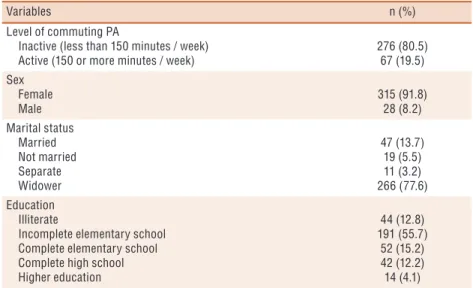
Of the 497 long-lived older adults registered in community groups of Flo-rianópolis / SC, 343 participated in this study (69% response rate), with mean age of 84.09 ± 3.89 years. Most were women, widows, who lived with a partner, with incomplete elementary school, white, who did not work and he received up to three minimum wages. As for the health characteristics, most subjects perceived their health as excellent or good, had at least one disease diagnosed by a physician (hypertension was the most prevalent), and used one or more drugs every day. With regard to behavioral aspects, most respondents have never smoked, did not show moderate or high alcohol use and had no falls in the last year. he prevalence of commuting physical activity was 19.5% (95% CI: 15.3; 23.7), as Table 1.
Table 1. Prevalence of commuting physical activity and sociodemographic, behavioral and health characteristics of long-lived older adults. Florianópolis / SC, Brazil 2011 (n = 343).
Variables n (%)
Level of commuting PA
Inactive (less than 150 minutes / week) Active (150 or more minutes / week)
276 (80.5) 67 (19.5) Sex
Female Male
315 (91.8) 28 (8.2) Marital status
Married Not married Separate Widower
47 (13.7) 19 (5.5) 11 (3.2) 266 (77.6) Education
Illiterate
Incomplete elementary school Complete elementary school Complete high school Higher education
44 (12.8) 191 (55.7)
Commuting physical activity in long-lived older adults Krug et al.
Variables n (%)
Skin color White Others 323 (94.2) 20 (5.8) Occupation Not work Work 335 (97.7) 8 (2.3) Income
< 1 minimum wage 1-3 minimum wage 3-6 minimum wage > 6 minimum wage
40 (11.7) 167 (48.7)
73 (21.2) 63 (18.4) Self-perceived health
Regular / Poor or Very Poor Excellent or good
175 (51.0) 168 (49.0) Column disease Absence Presence 332 (96.8) 11 (3.2) Arthritis Absence Presence 240 (70.0) 103 (30.0) Fibromyalgia Absence Presence 343 (100.0) 0 (0.0) Cancer Absence Presence 341 (99.4) 2 (0.6) Diabetes Absence Presence 332 (96.8) 11 (3.2) Bronchitis / Asthma
Absence Presence 329 (95.9) 14 (4.1) Hypertension Absence Presence 138 (40.2) 205 (59.8) Depression Absence Presence 332 (96.8) 11 (3.2) Stroke Absence Presence 339 (98.4) 4 (1.6) Stomach ulcer Absence Presence 337 (98.2) 6 (1.8) Urinary incontinence Absence Presence 333 (97.1) 10 (2.9) Drug use Absence Presence 38 (11.1) 305 (88.9) Tobacco use Absence Presence 308 (89.8) 35 (10.2) Alcohol use Absence Presence 343 (100.0) 0 (0.0) Falls in last year
Absence Presence
234 (68.2) 109 (31.8)
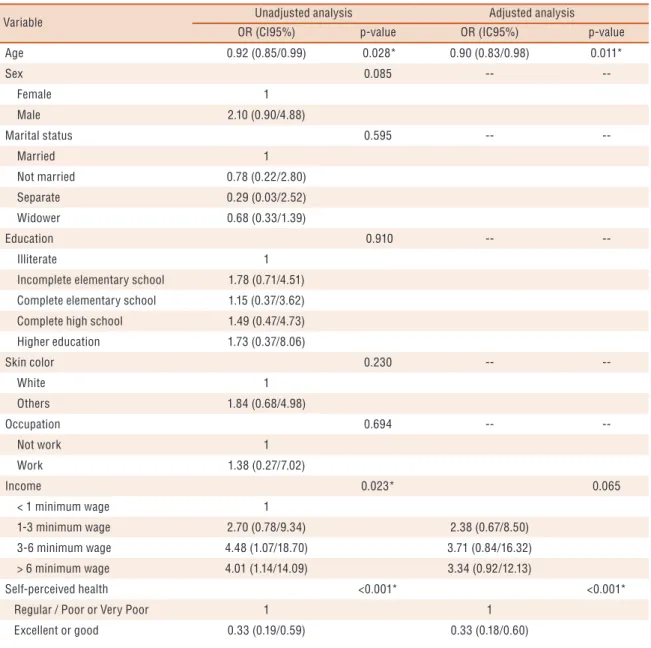
commuting physical activities in relation to sociodemographic, behavioral and health characteristics. he factors signiicantly associated with the outcome in the unadjusted model, variables arthritis / rheumatism and income, did not remain associated in the inal model after adjustments.
he performance of commuting physical activity was inversely associ-ated in the adjusted analysis to age (p = 0.011; OR = 0.90; 95% CI = 0.83 / 0.98), to self-perceived health (p <0.001; OR = 0.33; 95% CI = 0.18 / 0.60) and hypertension diagnosis (p = 0.009; OR = 0.47; 95% CI = 0.27 / 0.83). hat is, individuals with older age, poorer health perception and hypertension diagnosis were less likely of achieving commuting physical activity when compared to individuals with better perceived health and without hypertension diagnosis, respectively.
Table 2. Unadjusted and adjusted analysis of factors associated to the performance of commuting physical activities of long-lived older adults participants in community groups of Florianópolis / SC, Brazil 2011 (n = 343).
Variable Unadjusted analysis Adjusted analysis
OR (CI95%) p-value OR (IC95%) p-value
Age 0.92 (0.85/0.99) 0.028* 0.90 (0.83/0.98) 0.011*
Sex 0.085 --
Female 1
Male 2.10 (0.90/4.88)
Marital status 0.595 --
-- Married 1
Not married 0.78 (0.22/2.80)
Separate 0.29 (0.03/2.52)
Widower 0.68 (0.33/1.39)
Education 0.910 --
-- Illiterate 1
Incomplete elementary school 1.78 (0.71/4.51) Complete elementary school 1.15 (0.37/3.62)
Complete high school 1.49 (0.47/4.73)
Higher education 1.73 (0.37/8.06)
Skin color 0.230 --
White 1
Others 1.84 (0.68/4.98)
Occupation 0.694 --
Not work 1
Work 1.38 (0.27/7.02)
Income 0.023* 0.065
< 1 minimum wage 1
1-3 minimum wage 2.70 (0.78/9.34) 2.38 (0.67/8.50)
3-6 minimum wage 4.48 (1.07/18.70) 3.71 (0.84/16.32)
> 6 minimum wage 4.01 (1.14/14.09) 3.34 (0.92/12.13)
Self-perceived health <0.001* <0.001*
Regular / Poor or Very Poor 1 1
Commuting physical activity in long-lived older adults Krug et al.
DISCUSSION
Participants in this study achieved low prevalence of commuting physical activities, similar to data presented in survey of Brazilian adults17. One
explanation for this result may be related to the occupation of long-lived older adults, which, mostly, were retired and therefore did not need to commute to work17.
Another factor that may have supported this inding refers to the advanced age, which was inversely associated with commuting physical activity. It was observed that, with advancing age, there was a decrease in the time of performance of commuting physical activities, according to the results of other studies7,17. his decrease in levels of commuting physical
activity occurs from the age of 55 years, being more pronounced in peo-ple over 80 years7. Increasing age leads to decreased commuting physical
activity due to the natural process of human aging. his process involves functional losses, particularly progressive reduction in the functional abil-ities of the body and decreased physical capacabil-ities such as aerobic capacity, muscular strength, lexibility, balance, reaction time, movement, agility, coordination, and increased number of diseases12. hus, in general, as the
chronological age increases, people become less physically active20.
he health condition seems to play an important role in the perfor-mance of commuting physical activities, according to the data of this study. Elderly people who perceive their health as regular, poor or very poor were less likely to perform commuting physical activity when compared to those who perceive their health as good or very good, in agreement with other studies20,21,22. Health perception inluences the performance of
physical activity in all domains, because people who reported poor health
… continue
Variable Unadjusted analysis Adjusted analysis
OR (CI95%) p-value OR (IC95%) p-value
Arthritis / Rheumatism 0.037* 0.097
Absence 1 1
Presence 0.50 (0.26/0.96) 0.55 (0.27/1.11)
Hypertension 0.013* 0.009*
Absence 1 1
Presence 0.50 (0.29/0.87) 0.47 (0.27/0.83)
Drug use 0.266 --
Absence 1
Presence 0.64 (0.30/1.40)
Tobacco use 0.159 --
Absence 1
Presence 1.76 (0.80/3.87)
Falls in last year 0.068 --
Absence 1
Presence 0.56 (0.30/1.04)
reported better health20,23. Poor health perception may limit the forms of
commuting among elderly individuals, as well as the presence of diseases17.
In this investigation, hypertension was also associated with commuting physical activities, and people diagnosed with the disease are less likely to perform commuting physical activities in relation to older people without the diagnosis. his can be explained, since hypertension, disease of highest prevalence in the elderly24, and in long-lived older adults25,26, has as its major
risk factors physical inactivity. When checking the level of physical activity of 310 hypertensive people followed in the Outpatient Center (18-69 years of age), a study27 showed that the majority of these hypertensive patients
are physically inactive, especially hypertensive patients with advanced age. hus, our results are extremely useful for the creation of health pro-motion activities close to the homes of long-lived older adults and with the ofer of various activities that meet the male public interest, as in most community groups, gymnastics is the only type of exercise ofered21. it
should be noted that such measures may encourage walking as a way to commute whether for shopping, use health services, visit relatives and neighbors, or to move to the community group.
his hypothesis is supported, since walking is considered a low-cost physical activity, easy to perform and can be incorporated into the daily lives of older adults for being more accessible and allowing the participa-tion of more people, being an indicaparticipa-tion for health promoparticipa-tion programs28,
especially in long-lived older adults. hus, the increase in the performance of commuting physical activities is essential to bring about health beneits, increase the functional capacity, social contacts, brain function, psycho-logical well-being and reduce stress and depression28.
Some limitations of this study can be highlighted, such as the low proportion of men in the sample, the lack of survey of individual physical information (gait speed, muscle strength etc.) and the geographic location of the home of participants, which may have inluenced the commuting physical activity of respondents. In contrast, the cross-sectional study conducted with elderly people aged 80 and older and attending commu-nity centers are positive points. hese features allow a speciic diagnosis of factors associated with the displacement of this age group so that pre-cise actions can be directed. In addition, studies that investigated levels of physical activity are diicult to compare, especially due to the lack of standardization regarding the methodological aspects related to the in-struments used, the physical activity terminologies, the cutofs 1 and the
age amplitude of the sample.
CONCLUSION
Commuting physical activity in long-lived older adults Krug et al.
regular, poor or very poor self-perceived health and hypertension diagnosis. hus, the results of this study have shown that knowledge about factors associated with commuting physical activity among long-lived older adults can serve as a basis for the preparation of new proposals to encourage phys-ical activity, especially through walk. In addition, it may assist in urban planning, traic safety and commuting modes, increasing levels of physical activity and hence contributing to the health of this population group.
REFERENCES
1. Hallal PC, Andersen LB, Bull FC, Guthold R, Haskell W, Ekelund U, et al. Physical Activity 1 - Global physical activity levels: surveillance progress, pitfalls, and prospects. Lancet 2012; 380(21):247-57.
2. Holme I, Anderssen SA. Increases in physical activity is as important as smoking cessation for reduction in total mortality in elderly men: 12 years of follow-up of the Oslo II study. BJSM 2015; 49(11):743-8.
3. Lee IM, Shiroma EJ, Lobelo F, Puska P, Blair SN, Katzmarzyk PT. Efect of physical inactivity on major non-communicable diseases worldwide: an analysis of burden of disease and life expectancy. Lancet 2012; 380(9838):219-29.
4. Kohl HW, Craig CL, Lambert EV, Inoue S, Alkandari JR, Leetongin G, et al. he pandemic of physical inactivity: global action for public health. Lancet 2012; 380(9838):67-78.
5. Pratt M, Sarmiento OL, Montes F, Ogilvie D, Marcus BH, Perez LG, et al. he implications of megatrends in information and communication technology and transportation for changes in global physical activity. Lancet 2012; 380(9838):55-66.
6. Tribess S, Virtuoso-Júnior JS, Petroski EL. Fatores associados à inatividade física em mulheres idosas em comunidades de baixa renda. Rev Salud Pública 2009; 11(1):39-49.
7. Queiroz BM, Coqueiro RSC, Leal Neto JS, Borgatto AF, Barbosa AR, Fernandes MH. Inatividade física em idosos não institucionalizados: estudo de base popula-cional. Ciênc Saúde Colet 2014; 19(8):3489-96.
8. Krug RR, Lopes MA, Mazo GZ. Barreiras e facilitadores para a prática da atividade física de longevas inativas isicamente. Rev Bras Med Esporte 2015; 21(1):57-64.
9. Santos VR, Christofaro DGD, Gomes IC, Santos LL, Freitas Junior IF. Predictive capacity of anthropometric indicators for abdominal fat in the oldest old. Rev Bras Cineantropometria Desem Hum 2013; 15(5):561-9.
10. Freire RS, Lélis FLO, Fonseca Filho JA, Nepomuceno MO, Silveira MF. Prática regular de atividade física: estudo de base populacional no Norte de Minas Gerais, Brasil. Ver Bras Med Esporte 2014; 20(5):345-9.
11. Gallucci M, Ongaro F, Meggiolaro S, Antuono P, Gustafson DR, Forloni GL, et al. Factors related to disability: evidence from the “Treviso Longeva (TRELONG) Study”. Arch Gerontol Geriatr 2011; 52(3):309-16.
12. Hirvensalo M, Lintunen T. Life-course perspective for physical activity and sports participation. Eur Rev Aging Phys Ac 2011; 8(1):13-22.
13. Krug RR, Sacomori C, Lopes MA, Marchesan M, Mazo GZ. Factors associated with being insuiciently physically active among the oldest old participatingin community groups. J Aging Res Clin Practice 2013; 2(4):334-8.
14. Mazo GZ, Krug RR, Virtuoso JF, Lopes MA, Tavares AG. Nível de Atividade Física de Idosos Longevos Participantes de Grupos de Convivência. BEPA 2012; 9(105):4-14.
CORRESPONDING AUTHOR
Rodrigo de Rosso Krug. Universidade Federal de Santa Catarina.
Centro de Ciências da Saúde, Bloco A, sala 126
Campus Universitário, Trindade, Florianópolis, SC, Brasil. CEP: 88040-410.
E-mail: [email protected]
urban environments compared with car use: health impact assessment study. BMJ 2011; 343(D4521):1-8.
17. Madeira MC, Siqueira FCV, Facchini LA, Silveira DS, Tomasi E, humé E, Silva SM, Dilélio A, Piccini RX. Atividade física no deslocamento em adultos e idosos do Brasil: prevalências e fatores associados. Cad. Saúde Pública 2013; 29(1):165-74.
18. Avlund K, Pedersen AN, Schroll M. Functional decline from age 80 to 85: inlu-ence of preceding changes in tiredness in daily activities. Psychosom Med 2003; 65(5):771-7.
19. Mazo GZ, Benedetti TRB. Adaptação do questionário internacional de atividade física para idosos. Rev Bras Cineantropometria Desem Hum 2010; 12(6):480-4.
20. Moschny A, Platen P, Klaaβen-Mielke R, Trampisch U, Hinrichs T. Barriers to physical activity in older adults in Germany: a cross-sectional study. Inter J Behav Nutr Phys Act 2011; 2(8):121-31.
21. Mazo GZ, Mota J, Gonçalves LHT, Matos MG. Nível de atividade física, condições de saúde e características sócio-demográicas de mulheres idosas brasileiras. Rev Port Cien Desp 2005; 5(2):202-12.
22. Souza DL, Vendrusculo R. Fatores determinantes para a continuidade da partici-pação de idosos em programas de atividade física: a experiência dos participantes do projeto “Sem Fronteiras”. Rev Bras Educ Fís Esporte 2010; 24(1):95-105.
23. Eiras SB, Silva WHA, Souza DL, Vendruscolo R. Fatores de adesão e manutenção da prática de atividade física por parte de idosos. Rev Bras Cien Esporte 2010; 31(2):75-89.
24. Barroso WKS, Jardim PCBV, Vitorino PV, Bittencourt A, Miquetichuc F. In-luência da atividade física programada na pressão arterial de idosos hipertensos sob tratamento não-farmacológico. Rev Ass Med Bras 2008; 54(4):328-33.
25. Instituto Brasileiro de Geograia e Estatística. Projeção da População do Brasil por sexo e Idade: 1980-2050. Rio de Janeiro, 2008. Disponível em: http://www. ibge.gov.br/home/estatistica/populacao/projecao_da_populacao/2008/projecao. pdf> acesso em: 12 de junho de 2010.
26. Yates LB, Dioussé L, Kurth T, Buring JE, Gaziano JM. Exceptional Longevity in Men. Modiiable Factors Associated With Survival and Function to Age 90 Years. Arc Int Med 2008; 168(3):284-90.
27. Martins LCG, Guedes NG, Teixeira IX, Lopes MVO, Araújo TL. Physical Ac-tivity Level in People Witch High Blood Pressure. Rev Latino-am Enfermagem 2009; 17(4):462-7.