Licença
Rev Bras
Cineantropom
Hum
DOI: http://dx.doi.org/10.5007/1980-0037.2016v18n5p602
original article
Reliability of physical, physiological and
tactical measures in small-sided soccer
Games with numerical equality and
numerical superiority
Coniabilidade das medidas de demanda física,
isiológica e tática em pequenos jogos com
superioridade e igualdade numérica no futebol
Sarah da Glória Teles Bredt1
Gibson Moreira Praça2
Lucas Savassi Figueiredo1
Leandro Vinhas de Paula1
Patrick Costa Ribeiro Silva1
André Gustavo Pereira de Andrade1
Pablo Juan Greco1
Mauro Heleno Chagas1
Abstract – he aim of this study was to investigate the physical, physiological (HR) and tactical demands of small-sided soccer games (SSG) with numerical equality (3x3) and numerical superiority (4x3). Eighteen male players of a soccer team played against each other both types of SSG, both played as two 4-minute bouts interspersed with 4-minute rest. Physical (distances, velocities and accelerations) and HR demands were recorded by a GPS system (15hz) and a heart rate monitor during SSG. he individual tactical behaviors proposed by the System of Tactical Assessment in Soccer were registered by an observer who analyzed the SSG videos. Reliability was veriied calculating the intraclass correlation coeicient (ICC) and the absolute and percentage standard error of measurement (SEM and %SEM, respectively), both considering athletes’ individual scores in each SSG bout. As a result, higher number of variables related to physical and physiological demands presented signiicant ICC values, being classiied as moderate to excellent in relation to variables related to tactical demands. Considering these variables that presented signiicant ICC values in both SSG, the SEM% values found for physical and physiological variables ranged from 3.0 to 42.0%, while those found for the tactical variables ranged from 31.6 to 75.0%. It could be concluded that several variables related to physical and physiological demands present moderate to excellent reliability. Diferently, the majority of variables related to tactical demands were not reliable in both types of SSG.
Key words: Reliability; Soccer; Task performance analysis.
Resumo – O objetivo do presente estudo foi investigar a coniabilidade das demandas física, isiológica (FC) e tática em conigurações de pequenos jogos (PJ) em igualdade (3x3) e supe-rioridade numérica (4x3) no futebol. Dezoito jogadores do sexo masculino de uma equipe de futebol jogaram entre si os dois tipos de PJ, com duas séries de 4 minutos e 4 minutos de pausa entre elas. Durante os jogos, as variáveis relacionadas à demanda física (distâncias, velocidades, acelerações) e isiológica foram registradas utilizando-se um equipamento de GPS (15hz) e um cardiofrequencímetro. Os comportamentos táticos individuais propostos pelo Sistema de Avaliação Tática no Futebol foram registrados por um avaliador partir da análise da ilmagem dos jogos. A coniabilidade das medidas foi veriicada considerando os valores individuais de cada atleta em cada série de PJ, por meio do coeiciente de correlação intraclasse (CCI) e do erro padrão de medida absoluto e percentual (EPM e EPM%, respectivamente). Como resultado, um maior número de variáveis relacionadas às demandas física e isiológica apresentaram valores de CCI signiicativos com classiicação moderada a excelente em relação às variáveis relacionadas à demanda tática. Considerando as variáveis com valores de CCI signiicativos em ambas as conigurações de jogo, o EPM% variou entre 3,0 e 42,0% para as variáveis físicas e para a FC, e de 31,6 a 75,0% para as variáveis relativas à demanda tática. Conclui-se que diversas variáveis relacionadas às demandas física e isiológica apresentaram coniabilidade moderada à excelente. Diferentemente, a maioria das medidas relacionadas à demanda tática não foi coniável em ambos PJ.
1 Federal University of Minas Gerais. Graduate Program in Sports Science. Belo Horizonte, MG. Brazil.
2 Federal University of Vales do Je-quitinhonha and Mucuri. Department of Physical Education. Diamantina, MG. Brazil.
Small-sided games (SSG), as a means of training in soccer, enables tech-nical, physical and physiological demands to occur associated to tactical
demands similar to those found in the formal game1. Researching the
reliability of the diferent variables that represent these demands provides data for understanding the variability of responses when athletes are ex-posed to the same training condition. Reliability refers to the consistency or reproducibility of a measure when the individual performs a repeated test condition2. hus, knowledge on the variability of responses in SSG
supports the prescription of this type of training.
Previous studies have investigated the reliability of variables related to physiological and physical demands of soccer SSG3-5. In these, heart rate
(HR) showed high reliability, while blood lactate concentration and rate of perceived exertion showed low to moderate reliability3-6. In terms of
phys-ical demand, the distance traveled at low speeds shows high reliability5,6.
However, actions of acceleration and displacements at high speeds have low reliability in soccer SSG4,5, possibly due to the low sampling frequency of
GPS receivers7,8, the natural variation of these responses between exercise
bouts and training sessions9 and diferences among SSG conigurations10.
he reliability of physical and physiological demands has been observed only in conigurations with numerical equality (1x1 to 6x6)3,4,6,10.
How-ever, considering that the formal game presents situations with numerical unbalance among players11 (e.g. ofensive numerical superiority) and that
such situations may have diferent demands from those with numerical equality12,13, researching SSG reliability with numerical superiority can
provide subsides for coaches regarding training prescription. In addition, the reliability of tactical demand in SSG has not been investigated, lim-iting the understanding of the variability of these responses during SSG. herefore, the aim of this study was to investigate the reliability of physical, physiological and tactical demands in soccer SSG with numerical equality (3x3) and numerical superiority (4x3).
METHODOLOGICAL PROCEDURES
Sample
Eighteen U-17 male players were selected from a professional soccer club (age: 16.4 ± 0.4 years, weight: 68.4 ± 8.0 kg). All participated in compe-titions at national/international level and performed, on average, seven weekly training sessions. Players and their legal guardians signed the in-formed consent form with information about the research. he study was approved by the Ethics Research Committee of the Federal University of Minas Gerais (CAAE: 29215814.8.0000.5149).
Procedures
Reliability of measures in small-sided soccer games Bredt et al.
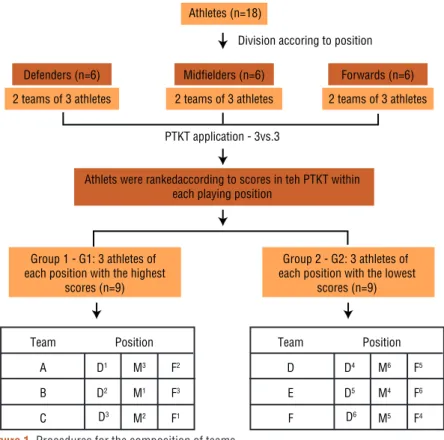
Figure 1. Procedures for the composition of teams
G1 and G2 = Athletes with higher and lower performance in PTKT, respectively; D = Defender; M = midfielder; F = Forward. Superscript number indicates the classification in the PTKT performance ranking in each positional category from 1st to 6th place.
To assess the procedural tactical knowledge of players in each
posi-tion, the Procedural Tactical Knowledge Test (PTKT)14 was applied to
each group of six athletes from the same position (e.g., six defenders). In each of these groups, two teams of three athletes (randomly allocated) played a game that was ilmed for later analysis of the procedural tacti-cal knowledge. Based on the PTKT results, a performance ranking was established within each positional status (1st to 6th place). hen, the sample
was divided into Group 1 (G1) and Group 2 (G2) composed of three play-ers each positional status (total of 9 athletes each) with greater and lesser performance on the PTKT, respectively. Each group was divided into three teams (A, B and C and D, E and F) of three athletes, one defender, one midielder and one forward. In order to make balanced teams, they could not have two athletes with the same classiication in the PTKT performance ranking.
be-Instruments
• Small-sided games
In both SSG, pitch size was 36x27 meters, with goals of 5x2 meters15. All
the rules of formal soccer game were used, including ofside. Auxiliary balls were at hand for a quick ball replacement. Two coaches provided external encouragement3 to teams. In the 4x3 coniguration, an additional loater
player was included (midielder of same tactical knowledge level of the team that was not playing - e.g., midielder of team C in the AXB game in G1). After the loss of the ball by a team, the player was transferred to the other team and conducted the ofensive actions for the new team. his player could perform all actions of the ofensive process, except free kicks and ball replacement on sides and corners.
• Physical demand
GPS units brand GPSports Systems model SPIProX2 (15Hz) with coupled triaxial accelerometer (100Hz) were attached between athletes’ shoulder blades. he validity and reliability of this equipment have been reported in previous studies7. Variables related to physical demand were total distance
traveled, percentage of the total distance traveled in speed ranges from 0 to 7.2 km/h (% D0-7.2), 7.3 to 14.3 km/h (%D7.3-14.3), and 14.4 to 21.5 km/h (%D14.4-21.5)16, peak speed, peak acceleration, number of accelerations
greater than 2.0 m/s² and distance traveled in accelerations above 2.0 m/s.
• Physiological demand
HR was recorded using Polar®, FS1 transmitters (Finland), compatible with the GPS interface. Data relating to rest between bouts were excluded.
Mean heart rate (HRMEAN) expresses the mean values recorded by the
equipment during the four minutes of SSG. Peak heart rate (HRPEAK) is
the highest value recorded in the four minutes.
• Tactical demand
Games were analyzed using the Soccer Analyser® software. Two observ-ers assessed the frequency of occurrence of individual tactical behavior of players using the System of Tactical Assessment in Soccer (FUT-SAT)15,
considering the location of actions on the playing ield.
Intra- and inter-observer concordances were considered “perfect”17,
with Kappa coeicient values above 0.9 (standard error <0.006).
Statistical analysis
Reliability was calculated through the intraclass correlation coeicient
3,1 (ICC3,1) and standard error of measurement (SEM) considering the
individual values obtained in each bout of each type of SSG.
Reliability of measures in small-sided soccer games Bredt et al.
intervals and classiied as weak (<0.4), moderate (0.4 to 0.59), good (0.6 to 0.74) and excellent (0.75-1)18. SEM9 was relativized by the average
values of variables, resulting in percentage SEM (%SEM)9. All analyses
were performed using SPSS 20.0 software (Chicago, IL). he statistical signiicance level was 5%.
RESULTS
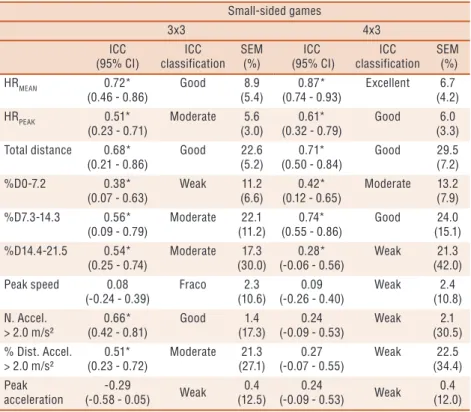
ICC, SEM, %SEM values and ICC classiications are shown in Tables 1 and 2. he number of accelerations and the distance traveled in accelera-tions above 2.0 m/s showed signiicant reliability values only in 3x3 SSG. For some variables, the absolute ICC values were higher in 4x3 SSG compared to 3x3 SSG.
Table 1. ICC, SEM, %SEM values and ICC classification for variables related to physical and physiological demands in 3x3 and 4x3 SSG.
Small-sided games 3x3 4x3 ICC (95% CI) ICC classification SEM (%) ICC (95% CI) ICC classification SEM (%)
HRMEAN 0.72*
(0.46 - 0.86)
Good 8.9
(5.4)
0.87* (0.74 - 0.93)
Excellent 6.7 (4.2)
HRPEAK 0.51*
(0.23 - 0.71)
Moderate 5.6 (3.0)
0.61* (0.32 - 0.79)
Good 6.0
(3.3) Total distance 0.68*
(0.21 - 0.86)
Good 22.6
(5.2)
0.71* (0.50 - 0.84)
Good 29.5
(7.2)
%D0-7.2 0.38*
(0.07 - 0.63)
Weak 11.2
(6.6)
0.42* (0.12 - 0.65)
Moderate 13.2 (7.9) %D7.3-14.3 0.56*
(0.09 - 0.79)
Moderate 22.1 (11.2)
0.74* (0.55 - 0.86)
Good 24.0 (15.1) %D14.4-21.5 0.54*
(0.25 - 0.74)
Moderate 17.3 (30.0)
0.28* (-0.06 - 0.56)
Weak 21.3 (42.0) Peak speed 0.08
(-0.24 - 0.39)
Fraco 2.3 (10.6)
0.09 (-0.26 - 0.40)
Weak 2.4
(10.8) N. Accel.
> 2.0 m/s²
0.66* (0.42 - 0.81)
Good 1.4
(17.3)
0.24 (-0.09 - 0.53)
Weak 2.1
(30.5) % Dist. Accel.
> 2.0 m/s²
0.51* (0.23 - 0.72)
Moderate 21.3 (27.1)
0.27 (-0.07 - 0.55)
Weak 22.5 (34.4) Peak
acceleration
-0.29
(-0.58 - 0.05) Weak
0.4 (12.5)
0.24
(-0.09 - 0.53) Weak
0.4 (12.0)
* = statistical significance for the ICC values. HRMEAN and HRPEAK = mean heart rate and peak heart rate; %0-7.2, %7.3-14.3, %14.4-21.5 = percentage of the total distance in speed ranges from 0 to 7.2 km/h, 7.3 to 14.3 km/h and 14.4 to 21.5 km/h, respectively; N. Accel.> 2.0 m/s² and % Dist. Accel.> 2.0 m/s ² = number of accelerations above 2.0 m/s² and percentage of the total distance traveled in accelerations above 2.0 m/s², respectively.
Table 2 indicates that 3x3 and 4x3 SSG show two and three variables, respectively, with signiicant ICC values which were classiied as moderate. hese variables are diferent in 3x3 and 4x3 SSG.
3x3 4x3 ICC (95% CI) ICC classification SEM (%) ICC (95% CI) ICC classification SEM (%) Penetration 0.07
(-0.27 - 0.39)
Weak 1.9
(40.6)
0.14 (-0.20 - 0.45)
Weak 1.9 (50.1) Offensive coverage 0.40* (0.08 -0.64) Moderate 2.0 (55.1) 0.16 (-0.18 - 0.47)
Weak 2.8
(72.1) Width and length
(without ball) 0.06 (-0.28- 0.39) Weak 3.3 (45.9) 0.43* (0.14 - 0.66)
Moderate 2.9 (37.6) Width and length
(with ball) 0.17 (-0.17-0.47) Weak 1.1 (82.0) 0.21 (-0.14 - 0.50)
Weak 1.0
(87.0) Depth Mobility 0.35*
(0.02- 0.61)
Weak 1.4
(71.5)
0.40* (0.08 - 0.65)
Moderate 2.1 (75.0) Offensive unit 0.40*
(0.08 - 0.64)
Moderate 3.5 (38.0)
0.23 (-0.11 - 0.52)
Weak 5.1 (43.7)
Delay 0.01
(-0.33 - 0.33)
Weak 2.1
(41.1)
-0.13 (-0.45 - 0.21)
Weak 2.6
(53.2) Defensive
cov-erage
0.36* (0.04 - 0.61)
Weak 2.2
(47.8)
0.19 (-0.15 - 0.49)
Weak 3.1 (53.8) Defensive
balance
0.02 (-0.32 - 0.34)
Weak 3.3
(60.4)
0.01 (-0.32 - 0.34)
Weak 3.0
(55.6) Recovery
bal-ance
0.35* (0.02 - 0.61)
Weak 1.4
(70.9)
0.17 (-0.13 - 0.46)
Weak 1.9
(80.7) Concentration 0.078
(-0.25 - 0.39)
Weak 1.8
(76.6)
0.07 (-0.27 - 0.39)
Weak 2.1 (78.0) Defensive unit 0.22
(-0.12 - 0.51)
Weak 3.7
(30.9)
0.20 (-0.09 - 0.47)
Weak 4.0
(30.0) (A) MC. OF. 0.38*
(0.05 - 0.63)
Weak 4.4
(41.4)
0.69* (0.47 - 0.83)
Moderate 3.7 (31.6) (A) MC. DEF. 0.36*
(0.04 - 0.61)
Weak 6.4
(31.3)
0.23 (-0.11 - 0.51)
Weak 7.7
(35.5) (D) MC. OF. 0.16
(-0.18 - 0.46)
Weak 6.5
(49.5)
0.34* (0.01 - 0.60)
Weak 5.2
(36.6)
(D) MC. DEF. 0.07
(-0.27 - 0.39) Weak
5.7 (31.1)
0.27
(-0.05 - 0.55) Weak 5.1 (26.5)
* = statistical significance for ICC values; (A) MC. OF. = Tactical attack actions carried out in the offensive midfield; (A) MC. DEF. = Tactical attack actions carried out in the defensive midfield; (D) MC. OF. = Tactical defense actions carried out in the offensive midfield; (D) MC. DEF. = Tactical defense actions carried out in the defensive midfield.
DISCUSSION
he ICC value relects the magnitude of the variability between subjects and the consistency of this variability in various measures of the same test9. Low ICC values indicate that the diferences between subjects are
not maintained between repeated conditions of a test. he SEM value relects the degree of luctuation of the scores of an individual in a test/ condition, indicating the expected natural variability (random error) for the response of a given variable9. Higher SEM values indicate higher ranges of
Reliability of measures in small-sided soccer games Bredt et al.
Considering both SSG in the present study, several variables related to physical and physiological demands showed moderate or good ICC values and one variable showed excellent ICC, suggesting that individuals who had higher scores in the irst bout continued to have higher scores in the second bout. In relation to HR, other studies with SSG corroborate the good consistency of this variable3,4, and Hill-Haas et al.5 showed a
percent-age typical error from 2 to 4% for HR in 4x4 SSG with athletes percent-aged 17 years. In this study, %SEM (equivalent to percentage typical error) showed similar values from 4.2 to 5.4 and 3.0 to 3.3 for mean HR and peak HR, respectively. In addition, Ngo et al.10 presented ICC of 0.95 and 0.96 for
mean HR in 3x3 SSG with soccer players of the same age.
Physical demands showed moderate to good ICC values. For the total distance traveled, %SEM values between 5 and 7% corroborate the results of Ade et al.4, who showed coeicients of variation from 6 to 8%
for this variable in 1x1 and 2x2 SSG. For the distance traveled between 14.4 and 21.5 km/h, higher %SEM values were found (30.0 to 42.0%), but also close to those found by Ade et al.4 (40-60%) in a similar speed range
(14.5-19.8 km/h). In fact, studies have shown a decrease in reliability for
higher speeds in SSG using 1Hz, 5Hz, and 10Hz GPS7,8,19. his may be
related to the low sampling frequency of GPS devices, which limits the capture of short movements at high speeds20.
Comparing SSG, only 3x3 coniguration showed signiicant reliability for the number of accelerations and the distance traveled in accelerations above 2.0 m/s2. Considering that these variables represent the most intense actions during
SSG, greater reproducibility of these actions might be related to the increased need for intense confrontations among players in game with numerical equality. he other variables showed equal or greater reliability in the 4x3 coniguration, suggesting that numerical superiority may show greater reproducibility in less intense demands, which are facilitated by the presence of the additional player. However, to prove the existence of statistical diferences between absolute ICC values of the diferent variables in each SSG, an inferential analysis would be necessary and, consequently, a diferent experimental design.
For tactical variables with signiicant and moderate ICC values, %SEM values ranged from 31.6 to 75.0%, considering both SSG. hese data indicate a high luctuation of measures and low consistency of diferences between subjects in bouts 1 and 2 of each SSG. hese results may be related to in-herent characteristics of the game, such as unpredictability and complexity, requiring players to adapt their actions to tactical situational demands21.
if four minutes are suicient for such events to occur with a frequency capable of representing the expected variability for each principle remains an issue to be investigated.
Another important result indicates that variables with signiicant ICC in 3x3 SSG were not the same that presented signiicant ICC in 4x3 SSG. herefore, the reproducibility of the tactical demand seems to be inluenced by SSG coniguration. For example, the ofensive unit may have had greater reproducibility in 3x3 SSG due to greater participation of players behind the line of the ball in attack due to the diiculty to progress with the ball in game with numerical equality. he presence of the additional player in 4x3 SSG may have allowed the three athletes of the team to be free to move between the ball line and the line of the last defender, providing moderate reliability in width and length (without the ball) principle. In 3x3 SSG, only two athletes would be able to perform this movement. hese examples allow us considering that the ICC values of variables related to tactical demands may be associated to the frequency of a certain behavior, allowing it to present a “representative” variability for the investigated conditions.
he number of participants in this study may be a limitation to the generalization of results. In addition, considering that the level of tactical knowledge can be diferent between athletes of diferent ages23, diferent
patterns of tactical behavior in diferent categories are expected, thus limiting the conclusions of this study to the U-17 category.
CONCLUSION
he results indicate moderate to excellent reliability for several variables related to physical and physiological demands in soccer SSG, while most variables related to tactical demand have low reliability. hese results suggest that coaches should be aware that 3x3 and 4x3 SSG as a means of train-ing in soccer generate physical and physiological demands with variability around 3-42% and variability of up to 75% for tactical responses of athletes.
Acknowledgments
his study received support from the FAPEMIG, CAPES (Brazil), and PRPq da Universidade Federal de Minas Gerais.
REFERENCES
1. Davids K, Araújo D, Correia V, Vilar L. How small-sided and conditioned games enhance acquisition of movement and decision-making skills. Exerc Sport Sci Rev 2013; 41(3):154–61.
2. Hopkins WG. Measures of reliability in sports medicine and science. Sport Med 2000; 30(1):1–15.
Reliability of measures in small-sided soccer games Bredt et al.
CORRESPONDING AUTHOR
Mauro Heleno Chagas Universidade Federal de Minas Gerais
Escola de Educação Física, Fisioterapia e Terapia Ocupacional Av. Presidente Antônio Carlos, 6627 Campus Pampulha, Belo Horizonte, MG, Brasil
CEP 31270-901
E-mail: [email protected]
4. Ade JD, Harley JA, Bradley PS. Physiological response, time-motion character-istics, and reproducibility of various speed-endurance drills in elite youth soccer players: Small-sided games versus generic running. Int J Sports Physiol Perform 2014; 9(3):471–9.
5. Hill-Haas S, Coutts A, Rowsell G, Dawson B. Variability of acute physiological responses and performance proiles of youth soccer players in small-sided games. J Sci Med Sport 2008; 11(5):487–90.
6. Hill-Haas S, Rowsell G, Coutts A, Dawson B. he Reproducibility of Physiologi-cal Responses and Performance Proiles of Youth Soccer Players in Small-Sided Games. Int J Sports Physiol Perform 2008; 3(3):393–6.
7. Köklü Y, Arslan Y, Duield R. Accuracy and reliability of SPI ProX global posi-tioning system devices for measuring movement demands of team sports. J Sports Med Phys Fitness 2015; 55(2):1–2.
8. Varley MC, Fairweather IH, Aughey RJ. Validity and reliability of GPS for measuring instantaneous velocity during acceleration, deceleration, and constant motion. J Sports Sci 2012; 30(2):121–7.
9. Weir JP. Quantifying test-retest reliability using the Intraclass Correlation Coef-icient and the SEM. J Strength Cond Res 2005; 19(2):231–40.
10. Ngo JK, Tsui MC, Smith AW, Carling C, Chan GS, Wong DP. he efects of man-marking on work intensity in small-sided soccer games. J Sport Sci Med 2012; 11(1):109–14.
11. Travassos B, Vilar L, Araújo D, Mcgarry T. Tactical performance changes with equal vs unequal numbers of players in small-sided football games. Int J Perform Anal Sport 2014; 14(2):594–605.
12. Sampaio JE, Lago C, Gonçalves B, Maçãs VM, Leite N. Efects of pacing, status and unbalance in time motion variables, heart rate and tactical behaviour when playing 5-a-side football small-sided games. J Sci Med Sport 2014; 17(2):229–33. 13. Bekris E, Mylonis E, Sarakinos A, Gissis I, Anagnostakos A, Kombodieta N.
Supernumerary in small sided games 3Vs3 & 4Vs4. J Phys Educ Sport 2012; 12(3):398–406.
14. Greco PJ, Aburachid LMC, Silva SR, Morales JCP. Content validation of tactical-technical actions of the Tactical Procedure Knowledge Test - Sporting Orientation. Motrici 2014; 10(1):38–48.
15. Teoldo I, Garganta J, Greco PJ, Mesquita I, Maia J. System of tactical assessment in Soccer (FUT-SAT): Development and preliminary validation. Motri 2011; 7(1):69–83.
16. Owen AL, Wong DP, Paul D, Dellal A. Physical and technical comparisons between various-sided games within professional soccer. Int J Sports Med 2014; 35(4):286–92.
17. Landis JR, Koch GG. he measurement of observer agreement for categorical data. Biometrics 1977; 33(1):159–174.
18. Cicchetti DV. Guidelines, criteria, and rules of thumb for evaluating normed and standardized assessment instruments in psychology. Psychol Assess 1994; 6(4):284–90.
19. Gray AJ, Jenkins D, Andrews MH, Taafe DR, Glover ML. Validity and reli-ability of GPS for measuring distance travelled in ield-based team sports. J Sports Sci 2010; 28(12):1319–25.
20. Jennings D, Cormack S, Coutts A, Boyd L, Aughey R. he Validity and Reliability of GPS Units for Measuring Distance in Team Sport Speciic Running Patterns. Int J Sports Physiol Perform 2010; 5(10):328–41.
21. Garganta JM. Trends of tactical performance analysis in team sports: bridging the gap between research, training and competition. Rev Port Ciênc Desporto 2009; 9(1):81–9.
22. Mateus N, Gonçalves G, Abade E, Liu H, Torres-Ronda L, Leite N, et al. Game-to-game variability of technical and physical performance in NBA players. Int J Perform Anal Sport 2015; 15(3):764–76.