http://dx.doi.org/10.1590/s2175-97902017000300075
A
r
*Correspondence: W. F. Pacheco. Departamento de Química Analítica, Insti-tuto de Química, Universidade Federal Fluminense, CEP 24020141 - Outeiro
São João Batista s/n., Centro, Niterói/RJ, Brasil. E-mail: [email protected]
Spectrophotometric determination of rosuvastatin in
pharmaceutical formulations using quinalizarin
Monica Força Lima, Ricardo Jorgensen Cassella, Wagner Felippe Pacheco
*Fluminense Federal University, Institute of Chemistry, Department of Analytical Chemistry, Niterói, Rio de Janeiro
This work presents the development of a methodology based on the formation of a charge transfer complex between quinalizarin and rosuvastatin, allowing for the spectrophotometric determination of rosuvastatin at 579 nm. The factors involved in the sensitivity of the technique were studied (nature and proportion of the solvent, reaction time, pH of aqueous phase and quinalizarin concentration). The
proposed spectrophotometric procedures were validated with respect to linearity, ranges, precision,
accuracy, detection and quantiication limits. Calibration curves of the formed color products showed
good linear relationships over the concentration range of 6-15 mg L-1. The proposed method has been
successfully applied, which can be conirmed by interference test (comparison between the standard curves and addition of analyte), method precision (RSD 2.3% to 6 mg L-1), and by accuracy (statistically
equivalent results between the proposed method and a chromatographic method of reference).
Keywords: Rosuvastatin/spectrophotometric determination. Rosuvastatin/charge transfer complex.
Quinalizarin/charge transfer complex. Pharmaceutical formulations.
INTRODUCTION
Cardiovascular diseases, deined as diseases that afect the heart and blood vessels, are the leading cause
of death worldwide. These diseases manifest in various
ways, one of which being coronary artery disease, which
leads to acute myocardial infarction. In this case, there is a progressive accumulation of lipid material on the wall
of the arteries that supply blood to the heart, leading to their strengthening due to so-called atheroma plaques (Brats, 2009).
Concerns about these diseases are not new, and
have led to the development of many drugs in an attempt to reduce the associated risks. One noteworthy class of drugs in this regard is composed of statins, which have
revolutionized the prevention of cardiovascular diseases and are currently the most prescribed drugs in these cases. They act by inhibiting 3-hydroxy-3-methylglutaryl coenzyme A (HMG-CoA) reductase, which is important
in the synthesis of intracellular cholesterol in hepatocytes
(Campo, Carvalho, 2007).
Many drugs belonging to this this class are registered with the Food And Drug Administration (FDA) and difer in terms of potency and pharmacological proile. One of them is rosuvastatin (RSV) (Figure 1), which represents a new class of synthetic statins, with enantiomeric purity (Campo, Carvalho, 2007).
Rosuvastatin ((3R,5S,6E)-7-[4-(4-luorophenyl)- 6-(1-methylrthyl)-2-[methyl(methylsulfonyl)amino]-5-pyrimidinyl]-3,5-dihydroxy-6-heptenoic acid) was approved in 2003 by the FDA and is sold by AstraZeneca
as Crestor®. It is sparingly soluble in water and methanol
and slightly soluble in ethanol (The Merck Index, 2006). Some methods have been developed for the quantitation of rosuvastatin in pharmaceutical
formulations. Ramadan, Mandil and Alshelhawil (2014) developed a spectrophotometric method based on a derivatization reaction of rosuvastatin with iodine, as well as an electrochemical method based on diferential
pulse polarography using a dropping mercury electrode
(Ramadan, Mandil, Ghazal, 2015). In addition, some methods based on chromatographic separation have also been proposed (Beludari, Prakash, Mohan, 2013; Purkar et al., 2014).
Alzoman et al. (2013) and Wani et al. (2013)
developed and applied a spectrophotometric method
based on the charge transfer reaction between calcium rosuvastatin and π acceptors (Alzoman et al., 2013;
Wani et al., 2013). El-Bagary also proposed a method
for the determination of this drug (El-Bagary, Elkady, Kadry, 2012) in pharmaceutical preparations based on
spectrophotometric determinations.
In urine, Silva et al. proposed an electrochemical
methodology using carbon nanotubes and graphene oxide as the electrode material (Silva et al., 2015), while Braga et al proposed a luorimetric determination method after liquid-liquid extraction (Braga et al., 2013).
The present study reports the development of a spectrophotometric method for the determination of
rosuvastatin in pharmaceutical formulations by employing a charge transfer reaction with quinalizarin. This reaction
leads to the formation of a colored complex, which is
the result of the interaction between a donor, in this case rosuvastatin, and an electron acceptor, quinalizarin, (Mostafa, El-Sadek, Alla, 2002) that absorbs in the visible
region of the eletromagnetic spectrum and posses a high
molar absorptivity coeicient (Arslan, Duymus, 2007; Alzoman et al., 2013). The anion radical, resulting from the reaction between the drug and quinalizarin, absorbs
radiation at a wavelength of 579 nm. This method has the advantage of assessing the reaction product in an area
where less interferences from other substances are present,
such as in the ultraviolet region.
The methodology was applied to the quantiication of rosuvastatin in pharmaceutical formulations acquired from a local market in Niterói City (RJ/Brazil). The
results were compared with a reference methodology
(HPLC-UV). To the best of our knowledge, this is the irst study on the determination of rosuvastatin using quinalizarin.
MATERIAL AND METHODS
Instrumentation
The spectrophotometric measurements were
conducted on an Agilent Technologies Cary 60 UV-Vis spectrophotometer, in scanning mode, from 200 to 800 nm. Quartz cuvettes with an optical path of 1
cm were employed. The maximum wavelength set for
checking absorbance was 579 nm. For the comparative chromatographic methodology, a 3000 HPLC from Dionex, with injection volume of 20 µL and UV detector set at 241 nm were used. The mobile phase consisted of a mixture 60/40 (v/v) acetonitrile/water with pH adjusted to 2.9 with phosphoric acid, at a low rate of 1 mL min-1.
A C-18 column (150 x 4.6 mm, 4 mm) from Phenomenex was used. The temperature was maintained at 30 °C. The mobile phase was sonicated for 20 min in an USC-1600 ultrasound (Unique, São Paulo, Brazil).
An analytical AY 220 balance (Shimadzu, São Paulo, Brazil) was used for the preparation of all solutions. An ADM-22 model pH meter (Digimed, São Paulo, Brazil) equipped with a combination electrode glass (Ag/AgCl)
was used for the pH evaluations.
Reagents and solutions
All reagents were of analytical grade. All solutions
were prepared using puriied water obtained by a Millipore Direct-Q System 3 (Milford, USA), with resistivity of 18.2 MΩ cm.
The rosuvastatin standard was provided by Neopharma (Minas Gerais, Brazil). The methanolic
200 mg L-1 stock solution used in the spectrophotometric
methodology was prepared by dissolving 20.83 mg of rosuvastatin calcium in a 100 mL volumetric lask, subsequently adjusted to 100 mL with methanol.
For the conirmatory chromatographic methodology,
the 200 mg L-1stock solution was prepared in the same
way, with inal volume adjustment by the addition of a (60/40) acetonitrile solution, with subsequent addition of phosphoric acid to pH 2.9. This solution was then iltered through a Millipore Millex – GV hydrophilic PVDF membrane, with 0.22 µm pore size.
Quinalizarin was provided by Acros Organics (St. Louis, USA). The quinalizarin 500 mg L-1 stock solution
was prepared by dissolving 25 mg of quinalizarin in dimethylsulfoxide (DMSO) (Tedia, Brazil) with final
volume adjusted with the same solvent in a 50 mL
volumetric lask.
Analytical curves
The analytical curve used in the spectrometric
methodology was prepared by dilutions of a 200 mg
The concentrations ranged from 6.0 to 15 mg L-1. The
final volume was adjusted by adding water. For the
comparative chromatographic study, the analytical curve
was prepared by the dilution of the same stock solution in 10 mL volumetric lasks, with the inal volume adjusted by adding the 60/40 acetonitrile/phosphoric acid pH 2.9
solution. This curve was prepared in the range from 0.5 to 2.5 mg L-1.
Sample preparation
The samples submitted to the quantiication process were acquired from local markets in the city of Niterói - RJ. Three of the samples (A1, A2 and A3) had an RSV amount per tablet of 10 mg, while sample A4 had 20 mg, as stated by the manufacturers.
Two tablets from each sample were taken, weighed and subsequently crushed with a mortar and pestle. An aliquot of each was taken, weighed and transferred to a 50 mL lask, where they were solubilized with methanol and iltered through a Millipore Millex – GV, hydrophilic PVDF membrane (0.22 µm pore size), into a 25.0 mL volumetric flask, followed by 400 µL of the 500 mg
L-1quinalizarin solution, 3.75 mL of DMSO and 600 µL of
water. The inal volume was adjusted with methanol. These solutions were then analyzed spectrophotometrically at
579 nm.
For the comparative HPLC methodology, the solid
aliquots were solubilized in the acetonitrile/phosphoric acid (pH 2.9) 60/40 solution and iltered in the same way as described above.
RESULTS AND DISCUSSION
The proposed method optimization was carried out in 3 steps. In the irst step, variables such as solvent, time, pH, and the proportion of DMSO/quinalizarin were optimized. The stoichiometry of the reaction between rosuvastatin and quinalizarin was then evaluated by molar ratio calculations. The third step evaluated the possibility
of matrix interferences.
After method optimization, the determination
of rosuvastatin in pharmaceutical formulations was
conducted, with the results subsequently compared to an
alternative method.
In preliminary studies, the influence of time was
evaluated and no signiicant alterations were observed
in a timeframe of 15 to 6 hours. This indicates that time
does not inluence the analytical signal, suggesting that
the reaction is fast and that the formed product does not degrade.
Nature of the solvent
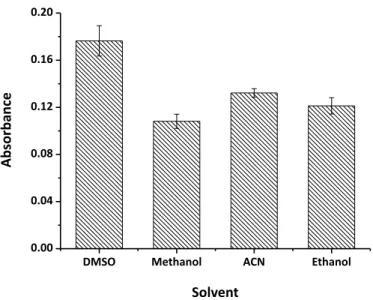
The first studied parameter was the effect of the nature of the solvent. The solvent acts in promoting the
stabilization of the radical anion formed upon the charge transfer reaction, as well as in stabilizing the complex. It is worth emphasizing that polar solvents facilitate this charge transfer reaction (Basavaiah, 2004). Thus, the evaluated solvents were: DMSO, methanol, ethanol and acetonitrile (ACN). All the solutions were prepared at a 50% solvent, 50% water ratio. The results are displayed in Figure 2.
The best analytical signal was attained with the use of DMSO. This is probably due the fact that this solvent
has the highest dielectric constant among the tested
solvents (The Merck Index, 2006), which provides the best conditions for stabilizing the anion radical formed in the charge transfer reaction. Thus, DMSO was chosen as the solvent in all subsequent assays.
Figure 3 displays the rosuvastatin, quinalizarin and the charge transfer complex absorption spectra in DMSO 50% v/v solutions. Quinalizarin shows an absorption band at 486 nm, while the complex shows an absorption band at 579 nm. Rosuvastatin (colorless) shows only one band at 308 nm.
pH effect
The study of pH is important because both the analyte, rosuvastatin, and the reagent, quinalizarin, show different equilibria as a function of pH (Yamini et al.,
FIGURE 2 - Effect of the solvent on the analytical signal.
Conditions: quinalizarin: 30 mg L-1; rosuvastatin: 20 mg L-1 in
2002). To evaluate the pH efect, diferent solutions of the anion radical were prepared in diferent pHs, adjusted by adding the Britton-Robbinson bufer. The condition that provided the best analytical signal was no pH adjustment at all (pH 5.5). To guarantee that the absence of the bufer would not produce a calibration problem, the pH of a
sample solution was prepared, and exactly the same value
observed for the samples was found.
DMSO/Water proportion
The reaction between rosuvastatin and quinalizarin requires DMSO to stabilize the anion radical, but also requires another solvent, since rosuvastatin was separated by the most of the excipients of the pharmaceutical formulation by solid-liquid extraction in methanol, followed by filtration. As this extract is miscible with water, the efect of the DMSO/water ratio on the analytical
signal was investigated.
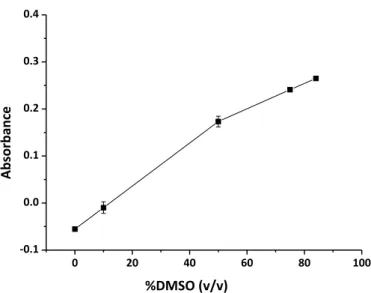
The results of this investigation are displayed in
Figure 4. The proportion of 75% DMSO and 25% water
was chosen, since the increase in the analytical signal from
that value onwards was insigniicant.
Study of quinalizarin concentration influence
The influence of quinalizarin concentrations on
the analytical signal was also investigated. The results displayed in Figure 5 indicate that the analytical signal
increased until reaching a plateau, beginning at 30 mg
L-1. This maximum is probably due to the end of the
reaction. To ensure suicient robustness, the quinalizarin
concentration used in all further assays was 40 mg L-1.
Study of the reaction stoichiometry
The stoichiometry of the reaction between rosuvastatin and quinalizarin was evaluated by the molar ratio technique, developed by Yo and Jones (Yoe, Jones, 1944). Several solutions of the complex were
prepared, with constant rosuvastatin concentration, while
quinalizarin concentrations ranged from 0 to 70 mg L-1.
The absorbances of the solutions were measured and the
results are displayed in Figure 6.
FIGURE 3 - Absorption spectra of rosuvastatin 20 mg L-1,
quinalizarin 40 mg L-1 and the radical anionic, all DMSO in
solutions.
FIGURE 4 - Investigation of the DMSO/Water proportion efect
on the analytical signal. Experimental conditions: quinalizarin: 30 mg L-1; rosuvastatin: 20 mg L-1.
FIGURE 5 - Study of the efect of quinalizarin concentrations
The condition that provided the higher analytical
signal was shown to be two quinalizarin for each rosuvastatin, corroborating other studies in the literature for other charge transfer reactions with quinalizarin (Paula, Almeida, Cassella, 2010; Gouda, El-Sheikh, El-Azzazy, 2012).
Method evaluation
Analytical parameters of merit
Partial validation, as the establishment of some
analytical parameters of merit is called, is performed
in order to ensure that the method produces reliable information (Ribani et al., 2004). This is conducted during and after the optimization of all investigated variables. In the present study case, the parameters of merit obtained were linear response range (linearity), repeatability (precision), limit of detection (L.O.D), limit of quantitation (L.O.Q.) and accuracy.
Linearity
The linear response range between the analytical signal and the rosuvastatin concentration was obtained by constructing a calibration curve from 6.0 to 15.0 mg L-1
(Figure 7).
Precision
The precision was evaluated by the measurement
of 10 standard solutions of the complex, prepared at 6.0 mg L-1, and was of 2.3%, expressed as relative standard
deviation (RSD).
The standard deviation of the relative value obtained
for this solution indicates that the developed method has
adequate precision, since, according the most of references
which deals with the validation of analytical RSD values
higher than 5% are not acceptable (FDA, 2015; Ermer, Miller, 2006; ANVISA, 2003)
Limit of Detection (L.O.D) and Limit of Quantification (L.O.Q)
The limit of detection (LOD) and the limit of quantiication (LOQ) were calculated according equations (1) and (2), where “σ” is the standard deviation of 10 measurements of the blank, and “S” is the angular coeicient of the linear equation.
L.O.D. = 3σ/S (Equation 1) L.O.Q. = 10 σ/S (Equation 2)
The L.O.D. obtained was 0.9, while the L.O.Q was 3.0 mg L-1.
Study of interferences
One of the reasons that methanol is used in the
extraction of process of RSV from the pharmaceutical formulation is due to the fact that RSV solubility is higher in this solvent than in water, while the solubility of the
excipients is lower in methanol compared to water. Of the several compounds used as vehicles present in the pharmaceutical formulation evaluated in the present study,
only lactose is methanol-soluble.
The interference of diferent lactose concentrations
FIGURE 6 - Aplication of the molar ration technique to determine the stoichiometry of the charge transfer reaction. Experimental conditions: rosuvastatin: 20 mg L-1 and DMSO: 75% (v/v).
FIGURE 7 - Analytical curve for the determination of rosuvastin using the charge transfer reaction. Experimental conditions:
quinalizarin: 40 mg L-1; rosuvastatin: 20 mg L-1 and DMSO
(1.0 x 10⁻⁴ to 1.0 x 10⁻² mol L-1) in the formation of the charge transfer complex was evaluated, and results indicate that this compound does not interfere in the reaction.
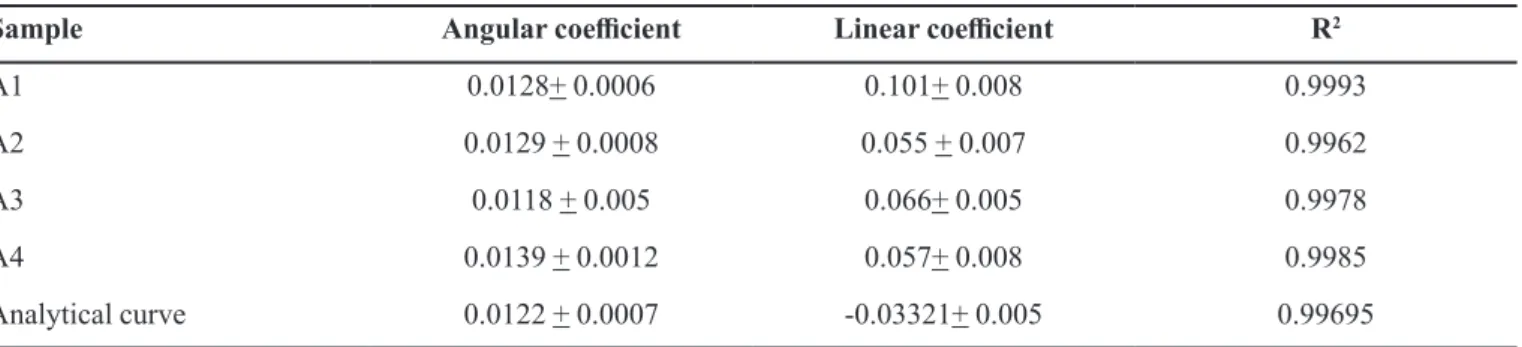
Comparisons were also conducted between an
analytical curve and an analyte addition curve for all
investigated samples. As displayed in Table I, the analyte addition curve showed the same angular coeicient of the
analytical curve, demonstrating that this methodology is
not susceptible to matrix interferences.
Application of the developed method for the determination of rosuvastatin in pharmaceutical formulations and comparison with a chromatographic methodology
As the proposed method is free from matrix interferences, the developed methodology was applied to the determination of rosuvastatin in samples prepared as
described in section 2.3.
To calculate the accuaracy of the proposed method,
the same samples analyzed in the present study were also submitted to rosuvastatin quantiication by an alternative methodology (HPLC-UV), adapted from Sultana, Arayne and Naveed (2010). The samples were also treated as described in section 2.3, and the results of the quantiications are displayed in Table II.
The paired t-test was then applied to compare the
two methods. The calculated t (1.29) is less than the tabulated t (3.18) at a confidence level of 95% and 3 degrees of freedom. This indicates no statistical diference between the two methods.
CONCLUSIONS
In the present study, a novel methodology for rosuvastatin determination in pharmaceutical formulations
was proposed, based on a charge transfer reaction between RSV with quinalizarin. An L.O.Q. of 3.0 mg L-1 is enough for the determination of rosuvastatin in pharmaceutical formulations, and the method is free from matrix
interferences. The precision of the method was evaluated
by ten authentic replicas, and a value of 2.3% (reported as relative standard deviation) was found. The comparison
of this methodology with another method reported in the
literature (based on HPLC-UV determinations) indicates that the proposed method can be considered accurate, since no statistical diference was observed between the RSV concentrations obtained by both techniques. Furthermore, this is a simple method that does not require many steps with regard to sample preparation. Such a method may be a suitable alternative for the determination of this drug in
routine analyses.
ACKNOWLEDGEMENTS
The authors would like to thank FAPERJ for
inancial support.
REFERENCES
Agência Nacional de Vigilância Sanitária. ANVISA. Resolução nº 899, de 29 de maio de 2003. Guia para validação de métodos analíticos e bioanalíticos. Diário Oicial da República Federativa do Brasil, Brasília, DF, 02 jun. 2003.
TABLE I - Comparison between the analytical curves and the analyte addition curves
Sample Angular coeicient Linear coeicient R2
A1 0.0128+ 0.0006 0.101+ 0.008 0.9993
A2 0.0129 + 0.0008 0.055 + 0.007 0.9962
A3 0.0118 + 0.005 0.066+ 0.005 0.9978
A4 0.0139 + 0.0012 0.057+ 0.008 0.9985
Analytical curve 0.0122 + 0.0007 -0.03321+ 0.005 0.99695
TABLE II - Results from rosuvastatin quantification by the
developed methodology (UV-vis) and the reference method (HPLC)
Sample Proposed method (Means ± S.D.)* (Means ± S.D.)HPLC method
A1 12.9 ± 0.004 12.6 ± 0.02
A2 11.0 ± 0.006 11.5 ± 0.004
A3 10.50 ± 0.006 11.82 ± 0.01
A4 23.90 ± 0.009 24.13 ± 0.02
Alzoman NZ, Sultan M, Maher H, Alshehri M, Wani T,
Darwish A. Analytical study for the charge-transfer complexes
of rosuvastatin calcium with pi-acceptors. Molecules. 2013;18:7711-7725.
Arslan M, Duymus H. Spectroscopic studies of chrage transfer complexes between colchicine and some pi acceptors. Spectrochim Acta A. 2007;67(3-4):573-577.
Basavaiah K. Determination of some psychotropic phenothiazine drugs by charge-transfer complexation reaction with chloranilic acid. Il Farmaco. 2004;59(4):315-321.
Beludari MI, Prakash KV, Mohan GK. RP-HPLC method for simultaneous estimation of rosuvastatin and ezetimibe from their combination tablet dosage form. Int J Chem Anal Sci. 2013;4(4):205-209.
Braga VSM, Mancilha TP, Cassella RJ, Pacheco WF. Determination of rosuvastatin in urine by spectroluorimetry after liquid-liquid extraction and derivatization in acidic medium. J Fluoresc. 2013;23(1):49-55.
Boletim Brasileiro de Avaliação de Tecnologias em Saúde. BRATS. Estatinas na prevenção primária de eventos cardiovasculares. Brasília: ANS; 2009. [citado 2015 Nov 10]. Disponível em: http://www.ans.gov.br/images/stories/ Materiais_para_pesquisa/Perfil_setor/Brats/2009_mes09_
brats_09.pdf.
Campo VL, Carvalho I. Estatinas hipolimêmicas e novas tendências terapêuticas. Quím Nova. 2007;30(2):425-430.
Ermer J, Miller JHMCB. Method validation in pharmaceutical
analysis: a guide to best practice. Weinheim: Wiley; 2006. 403 p.
El-Bagary RI, Elkady EF, Kadry AM. Spectrofluorimetric determination of certain antihyperlipidemic agents in bulk
and pharmaceutical preparations. Spectroscopy: Int J.
2012;27(2):83-92.
Food and Drug Administration. FDA. Guidance for industry:
analytical procedures and methods validation: chemistry, manufacturing, and controls and documentation. Silver Spring:
FDA; 2015. 15 p.
Gouda AA, El-Sheikh R, El-Azzazy RM. Charge transfer spectrophotometric determination of Zolmitriptan in pure and dosage forms. J Anal Bioanal Techniques. 2012;3(6):1-8.
Mostafa M, El-Sadek M, Alla E. Spectrophotometric determination of ciproloxacin, enroloxacin and peloxacin
through charge transfer complex formation. J Pharmaceut
Biomed Anal. 2002;27(1-2):133-142.
Paula CER, Almeida, VGK, Cassella, RJ. Determinação espectrofotométrica de cefalexina em formulações farmacêuticas explorando a sua reação de transferência de carga. Quim Nova. 2010;33(4):914-919.
Purkar AJ, Balap AR, Sathiyanarayanan L, Mahadik, KR.
Development and validation of HPTC method for simultaneous determination of rosuvastatin calcium and aspirin in its pure and pharmaceutical dosage form. Int J Pharm Pharm Sci.
2014;6(5):704-706.
Ramadan AA, Mandil H, Alshelhawi, N. Spectrophotometric
determination of rosuvastatin calcium in pure form and
pharmaceutical formulations by the oxidation using iodine and
formation triiodide complex in acetonitrile. Int J Pharm Pharm
Sci. 2014;6(5):579-585.
Ramadan AA, Mandil H, Ghazal, N. Differential pulse polarographic behavior and determination of rosuvastatin in
oure form and in pharmaceutical preparations using a static
mercury drop electrode. Int J Pharm Pharm Sci. 2015;7(1):389-396.
Ribani M, Bottoli CBG, Collins CH, Jardim ICSF, Melo LE. Validação em métodos cromatográicos e eletroforéticos. Quím Nova. 2004;27(5):771-780.
Silva TA, Zanin H, Vicentini FC, Corat EJ, Filho OF.
Electrochemical determination of rosuvasatin calcium in
pharmaceutical and human body luid samples using a composite of vetically aligned carbon nanotubes and graphene oxide as the electrode material. Sensor Actuat B: Chem. 2015;218:51-59.
Sultana N, Arayne MS, Naveed S. Simultaneous determination
of captopril and statins in API, pharmaceutical formulations
and in human serum by RP-HPLC. J Chin Chem Soc-Taip. 2010;57(3A):378-383.
The Merck Index. 14ª ed. New Jersey: Merck & Co.; 2006.
Wani TA, Darwish IA, Khalil NY. Novel microwell-based
spectrophotometric assay for the determination of rosuvasatin calcium in its pharmaceutical formulations. Curr Pharm Anal.
Yamini Y, Hassan J, Mohandesi R, Bahramifar N. Preconcentration of trace amounts of beryllium in water samples on octadecyl silica cartridges modiied by quinalizarine and its determination with atomic absorption spectrometry. Talanta. 2002;56(3):375-381.
Yoe JH, Jones AL. Colorimetric determination of iron with
disodium-1,2-dihydroxybenzene-3,5-disulfonate. Ind Eng Chem Anal. 1944;16(2):111-115.
Received for publication on 07th October 2016