*Correspondence: G. C. Halila. Federal University of Paraná. Av. Pref. Lothário Meissner, 632 - Jardim Botânico - 80210-170 - Curitiba - PR, Brasil. E-mail: [email protected]
A
vol. 51, n. 2, apr./jun., 2015 http://dx.doi.org/10.1590/S1984-82502015000200018
Review of the efficacy and safety of over-the-counter medicine
Gerusa Clazer Halila
1,2,*, Alexandra Ingrid dos Santos Czepula
1, Michel Fleith Otuki
1,2, Cassyano
Januário Correr
11Pharmacy Department,Federal University of Paraná, Curitiba, PR, Brazil, 2Pharmaceutical Sciences Department, State University of Ponta Grossa, Ponta Grossa, PR, Brazil
Over-the-counter medicines are available without prescription because of their safety and effectiveness, to treat minor ailments and symptoms. The objective of the study wasto analyze the availability and quality of systematic reviews published about nonprescription medicines, identifying the groups for
which there are gaps in evidence. We identiied published articles through the Cochrane Database of Systematic Review and MEDLINE, from the start of the database until May 2012, using the search terms
“nonprescription drugs,” “over the counter,” and “OTC.” We searched for articles that describe systematic
reviews addressing the eficacy and safety of drugs dispensed without a prescription, according to the lists published by the Association of the European Self-Medication Industry and in Brazil, in the clinical conditions listed in Groups and Speciied Therapeutic Indications. We included 49 articles, 18 articles were of moderate quality and 31 of high quality. Of the studies, 74.5% demonstrated eficacy in favor of the use of drugs evaluated. Of the 24 studies that evaluated safety, 21% showed evidence unfavorable
to the drug. Overall, the evidence found in the studies included in the overview is favorable to the use of the drugs evaluated. However, there are gaps in evidence for some therapy groups.
Uniterms: Nonprescription medicines. Medicines/safety use. Self-medication. Evidence-based health.
Os medicamentos isentos de prescrição são disponíveis sem prescrição médica devido a sua efetividade e segurança, para tratar sintomas e males menores. O objetivo deste trabalho é revisar a disponibilidade e
qualidade das revisões sistemáticas publicadas sobre medicamentos isentos de prescrição, identiicando os grupos para os quais há lacunas de evidência. Foram identiicados artigos publicados através da Cochrane Database of Systematic Review e MEDLINE (via PubMed) desde o início da base até maio de 2012,
utilizando os termos “nonprescription drugs,” “over the counter,” “OTC”. Foram procurados artigos
que descrevessem revisão sistemática abordando a eicácia e segurança dos medicamentos dispensados
sem prescrição, de acordo com as listas publicadas pela Association of the European Self-Medication Industry e no Brasil, nas condições clínicas constantes na lista de Grupos e Indicações Terapêuticas Especiicadas. Foram incluídos 49 artigos, 18 artigos eram de qualidade moderada e 31 de alta qualidade. 74,5% dos estudos demonstraram eicácia favorável ao uso do medicamento avaliado. Dos 24 estudos que avaliaram segurança, 21% mostraram evidência desfavorável ao uso do medicamento. No geral, a
evidência encontrada nos estudos incluídos nesta revisão é favorável ao uso dos medicamentos avaliados. Entretanto, há grupos terapêuticos para os quais há lacunas na evidência.
Unitermos: Medicamentos isentos de prescrição. Automedicação. Saúde baseada em evidências.
INTRODUCTION
According to the World Health Organization
(WHO), over-the-counter (OTC) medicines are drugs
approved by health authorities to treat minor ailments and symptoms. They are available without prescription because of their safety and effectiveness, if used in accordance with the guidelines available on the package
inserts and on labels (ABIMIP, 2012).
2003, which provides for the sale category of products
(ANVISA, 2003). According to ANVISA, OTC drugs
can be registered as medicines that meet the conditions of
the list of Groups and Speciied Therapeutic Indications (GITE).
The Association of the European Self-Medication
Industry (AESGP) has lists of nonprescription drugs
marketed in 36 countries. These lists group the drugs according to their chemical, pharmacological, and therapeutic characteristics, according to the Anatomical
Therapeutic Chemical (ATC) Classification System established by WHO. In this case, the symbol “OTC”
means that at least one dosage or form of the drug has the legal status of nonprescription medication in some of the
countries considered (ABIMIP, 2012).
Although OTC medicines are considered relatively safe drugs to be dispensed without a prescription, some studies, like the one conducted by Smith et al. (2012),
call into question their eficacy and safety because of the lack of good quality trials. In this sense, evidence-based health (EBH) assumes that the behavior of professionals in clinical practice should be based on the best scientiic evidence available at the time (Guaudard, 2008). Thus,
EBH integrates clinical expertise with the ability to
analyze and apply rational scientiic information (Lopes,
2000; Manchikanti et al., 2009).
With respect to studies of treatment, systematic
reviews (SR) are considered currently to provide the
highest level of evidence in relation to any clinical
question (El Dib, 2007), as the SR and meta-analyses are
useful for monitoring important innovations in healthcare.
A systematic review of systematic reviews (overview) is a
survey designed primarily to summarize data from several reviews, focusing on the effects of clinical interventions on a health condition; this is carried out in order to analyze the quality of systematic reviews and inform readers how
failures may inluence the results (Higgins, Green, 2011).
The aim of this study was to analyze the availability and quality of systematic reviews published about nonprescription medicines, identifying the groups for which there are gaps in evidence.
METHODS
Data sources
We performed the overview of systematic reviews, following a pre-established protocol, according to the
PRISMA model (Preferred Reporting Items for Systematic Reviews and Meta-Analyses) (Moher et al., 2009).
A systematic search was performed on the Cochrane
Database of Systematic Reviews (CDSR) and MEDLINE (via PubMed) over the period from the beginning of the
database until May 2012. To seek systematic reviews in PubMed the following strategy was used for the search:
(systematic review*[tiab] OR meta-analysis[pt] OR meta-analysis[tiab] OR systematic literature review[tiab] OR “Cochrane Database Syst Rev”[Journal] OR (search*[tiab] AND (medline or embase OR peer-review* OR literature OR “evidence-based” OR pubmed OR IPA or “international pharmaceutical abstracts”))) NOT (letter[pt] OR newspaper article[pt] OR comment[pt]) AND hasabstract AND (“Nonprescription Drugs”[Mesh] OR “Nonprescription Drugs”[tiab] OR OTC*[tiab] OR “over the counter”[tiab]). To format the Cochrane
Library the following strategy was used: #1 (systematic review OR meta-analysis OR “evidence-based”):ti,ab,kw; #2 (“Nonprescription Drugs” OR OTC OR “over the counter”):ti,ab,kw; #1 AND #2.
Study selection
After obtaining the articles, all the steps of the process were performed by two independent reviewers
(GCH and AISC), and discrepancies were resolved by consensus. In the absence of agreement, the assistance of a third reviewer (CJC) was requested. The process for selecting the studies followed the PRISMA model (Moher
et al., 2009): (a) all articles were analyzed based on their
titles and abstracts (screening); (b) the articles deemed
relevant were then fully analyzed by two reviewers, noting
the inclusion and exclusion criteria (eligibility); and (c)
articles that met all the criteria were included in the data
collection (inclusion). Articles that generated questions
during screening were included and passed through the
eligibility stage for examination in full. In addition, we
performed a manual search of references in all articles read in full. A search was not performed for unpublished articles or articles in conference proceedings. To be
included, articles had to fulill the following criteria: there
was a systematic review, with or without meta-analysis;
they addressed the eficacy and safety of nonprescription
medicines considered according to lists released by AESGP and OTC drugs in Brazil; the clinical conditions
were listed in the GITE list.
The exclusion criteria were: (a) items whose full
text was not available through the databases or after
contact with the author; (b) items that did not describe or were overviews of systematic reviews; (c) systematic reviews that included only prescription drugs; (d) articles
that evaluated the use of medicinal herbs, vitamins, and
reviews, but whose full text did not comply with items
4, 7 and 9 of the PRISMA checklist (provide an explicit
statement of questions being addressed with reference to participants, interventions, comparisons, outcomes, and study design; describe all sources of information in the search and date last searched; indicate the selection
process of the study) (Moher et al., 2009).
Data extraction
Data were extracted in duplicate and disagreements
were resolved by consensus between the reviewers. At the stage of full reading a critical evaluation of the studies was made in order to verify the methodological quality of the reviews and possible sources of bias present in each review through the Assessment of Multiple Systematic Reviews
(AMSTAR) instrument developed by Shea et al. (2009).
The AMSTAR total score was obtained by adding one point for each “yes” answer, while any other answer
did not receive a point. The score ranged from 0 (zero), as the worst quality, to 11 (eleven) as the best quality. In
addition, studies were categorized as proposed by the work
of Mikton and Butchart (2009) in which a score from 0 to 4 indicated a review of low quality, from 5 to 8 indicated moderate quality, and from 9 to 11 indicated high quality. To collect data on eficacy and safety we used a second
standard instrument developed by the authors.
RESULTS AND DISCUSSION
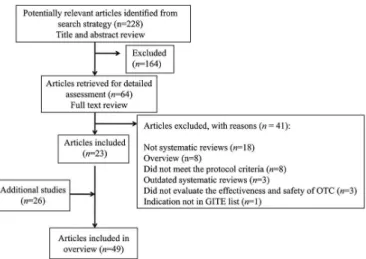
By searching the databases, 228 articles of potential relevance were found, but only 23 were included. The supplementary manual search selected 26 articles, so a
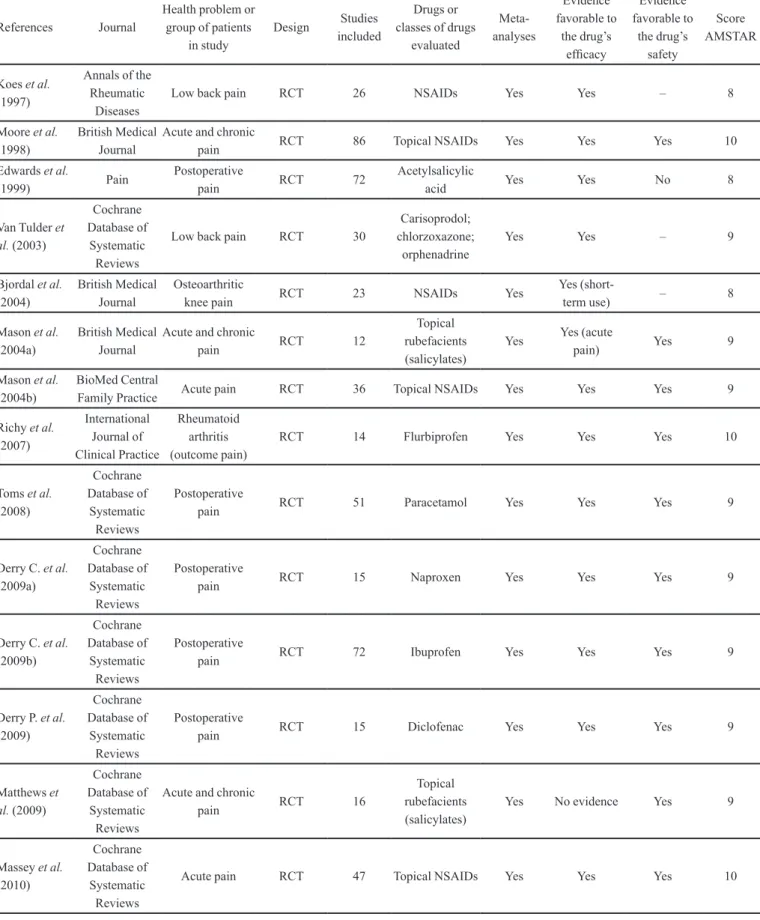
total of 49 were included in the overview (see lowchart as shown in Figure 1). Of these, six articles were published in the 90s and others after 2000. The collected data from the included studies are shown in Table I.
Three articles were outdated and were therefore
replaced by updating the manual search (Smith et al.,
2012). Among the articles included by supplementary
manual search, two were withdrawn from The Cochrane
Library for lack of update (De Sutter et al., 2009;
Taverner, Latte, 2009), as recommended by the Cochrane Collaboration (Higgins, Green, 2011).
In order to widen the scope of this overview, we
included an extensive list of such OTC drugs marketed in 36 countries and in Brazil. Then, some of the medicines included are not OTC drugs in Brazil, for example, diclofenac, sumatriptan, and ranitidine are OTC medicines in some countries in Europe.
Considering the conditions encountered in clinical
FIGURE 1 - Flowchart for the selection ofsystematic reviews included in theoverview.
studies, it can be seen that most of the articles evaluated
patients with acute or chronic pain (35.4%) or speciically migraine (14.6%). Studies to evaluate the eficacy and
safety of medicines used to combat pain are extremely important, since self-medication in this context is a reality. Other clinical conditions assessed in this
overview were quitting smoking (10.4%), cough (8.3%), symptoms of common cold (8.3%), fever and/or pain (8.3%), constipation (8.3%), fungal infections (4.2%), and dyspepsia (2.1%). Only one study (Jenkins, Costello, Hodge, 2004) assessed the safety of the drug against
various clinical conditions.
Compared with the GITE list, various therapeutic
groups and clinical indications have not been evaluated by systematic reviews, using the proposed strategy. There are, therefore, gaps for groups such as antidiarrheal, antispasmodic, antiparasitic, and antiseptic medicines in general.
Of the 24 studies that evaluated safety, ive (21%)
showed evidence unfavorable to the drug, due to
signiicant side effects presented (Edwards et al., 1999;
Jenkins; Costello, Hodge, 2004; De Sutter et al., 2009;
Derry, Moore, 2012; Derry C. et al., 2012). Data of
security should be considered when dispensing medicines, especially in regard to OTC drugs, to encourage rational use of these medications.
With regard to studies on the efficacy of OTC
medicines, 35 articles (74.5%) showed evidence favorable
for the use of the intervention in at least one of the groups of
patient studied. Three studies (6.4%) did not show evidence favorable to the drug’s eficacy. In one of these, the use of
antihistamines was not proven effective in the treatment of common cold symptoms and showed more side effects
TABLE I - Main characteristics of systematic reviews on OTC drugs
References Journal
Health problem or group of patients
in study
Design Studies included
Drugs or classes of drugs
evaluated
Meta-analyses
Evidence favorable to
the drug’s eficacy
Evidence favorable to
the drug’s safety
Score AMSTAR
Koes et al.
(1997)
Annals of the Rheumatic
Diseases
Low back pain RCT 26 NSAIDs Yes Yes – 8
Moore et al.
(1998)
British Medical Journal
Acute and chronic
pain RCT 86 Topical NSAIDs Yes Yes Yes 10
Edwards et al.
(1999) Pain
Postoperative
pain RCT 72
Acetylsalicylic
acid Yes Yes No 8
Van Tulder et al. (2003)
Cochrane Database of
Systematic Reviews
Low back pain RCT 30
Carisoprodol; chlorzoxazone;
orphenadrine
Yes Yes – 9
Bjordal et al.
(2004)
British Medical Journal
Osteoarthritic
knee pain RCT 23 NSAIDs Yes
Yes (short-
term use) – 8
Mason et al.
(2004a)
British Medical Journal
Acute and chronic
pain RCT 12
Topical rubefacients (salicylates)
Yes Yes (acute pain) Yes 9 Mason et al.
(2004b)
BioMed Central
Family Practice Acute pain RCT 36 Topical NSAIDs Yes Yes Yes 9 Richy et al.
(2007)
International Journal of Clinical Practice
Rheumatoid arthritis (outcome pain)
RCT 14 Flurbiprofen Yes Yes Yes 10
Toms et al.
(2008)
Cochrane Database of
Systematic Reviews
Postoperative
pain RCT 51 Paracetamol Yes Yes Yes 9
Derry C. et al.
(2009a)
Cochrane Database of
Systematic Reviews
Postoperative
pain RCT 15 Naproxen Yes Yes Yes 9
Derry C. et al.
(2009b)
Cochrane Database of
Systematic Reviews
Postoperative
pain RCT 72 Ibuprofen Yes Yes Yes 9
Derry P. et al.
(2009)
Cochrane Database of
Systematic Reviews
Postoperative
pain RCT 15 Diclofenac Yes Yes Yes 9
Matthews et al. (2009)
Cochrane Database of
Systematic Reviews
Acute and chronic
pain RCT 16
Topical rubefacients (salicylates)
Yes No evidence Yes 9
Massey et al.
(2010)
Cochrane Database of
Systematic Reviews
References Journal
Health problem or group of patients
in study
Design Studies included
Drugs or classes of drugs
evaluated
Meta-analyses
Evidence favorable to
the drug’s eficacy
Evidence favorable to
the drug’s safety
Score AMSTAR
Moll et al.
(2011)
Cochrane Database of
Systematic Reviews
Postoperative
pain RCT 4 Mefenamic acid Yes Yes – 9
Derry, Moore (2012)
Cochrane Database of
Systematic Reviews
Postoperative
pain RCT 68
Acetylsalicylic
acid Yes Yes No 9
Derry S. et al.
(2012a)
Cochrane Database of
Systematic Reviews
Chronic musculoskeletal
pain
RCT 34 Topical NSAIDs Yes Yes Yes 9
Oldman et al.
(2002) Pain
Migraine
headaches RCT 48
Sumatriptan; acetylsalicylic
acid + metoclopramide;
naratriptan
Yes Yes – 8
Suthisisang et al. (2007)
The Annals of Pharmacotherapy
Migraine
headaches RCT 13 Ibuprofen Yes Yes – 10
Derry S. et al.
(2010)
Cochrane Database of
Systematic Reviews
Migraine
headaches RCT 10
Paracetamol with or without
antiemetic
Yes Yes Yes 9
Kirthi et al.
(2010)
Cochrane Database of
Systematic Reviews
Migraine
headaches RCT 13
Acetylsalicylic acid with or without antiemetic
Yes Yes Yes 9
Rabbie et al.
(2010)
Cochrane Database of
Systematic Reviews
Migraine
headaches RCT 9
Ibuprofen with or without antiemetic
Yes Yes Yes 9
Derry C. et al.
(2012)
Cochrane Database of
Systematic Reviews
Migraine
headaches RCT 61 Sumatriptan Yes Yes No 9
Derry S. et al.
(2012b)
Cochrane Database of
Systematic Reviews
Migraine
headaches RCT 5
Diclofenac with or without
antiemetic
Yes Yes Yes 9
Hughes et al.
(2003) Tobacco Control
Quit smoking
RCT; quasi-experimental
trial
7 NRT Yes Yes – 8
Etter, Stapleton (2006)
Tobacco Control Quit
smoking RCT 12 NRT Yes Yes – 9
References Journal
Health problem or group of patients
in study
Design Studies included
Drugs or classes of drugs
evaluated
Meta-analyses
Evidence favorable to
the drug’s eficacy
Evidence favorable to
the drug’s safety
Score AMSTAR
Walsh (2008) Drug and Alcohol Review
Quit smoking
RCT; observational
studies
12 NRT No No – 7
Hughes et al.
(2011)
Nicotine & Tobacco
Research
Quit smoking
Observational
studies 18 NRT No Inconclusive – 7
Stead et al.
(2012)
Cochrane Database of
Systematic Reviews
Quit smoking
RCT; quasi-experimental
trial
150 NRT Yes Yes – 10
Schroeder, Fahey (2002a)
British Medical Journal
Cough in
adults RCT 15
Antitussives; expectorants; mucolytics;
antihistamine-decongestant combinations; other drug combinations
No Inconclusive – 9
Schroeder, Fahey (2002b)
Archives of Disease in Childhood
Cough in
children RCT 6
Antitussives; expectorants; mucolytics;
antihistamine-decongestant combinations; other drug combinations
No No – 8
Chang et al.
(2012)
Cochrane Database of
Systematic Reviews
Cough in adults
and children RCT 4
Antitussives;
mucolytics Yes Inconclusive – 10
Smith et al.
(2012)
Cochrane Database of
Systematic Reviews
Cough in adults
and children RCT 26
Antitussives; expectorants; mucolytics;
antihistamine-decongestant combinations; other drug combinations
No Inconclusive – 9
Kollar et al.
(2007)
Clinical Therapeutics
Alleviating nasal symptoms of common cold
RCT 8 Phenylephrine Yes Yes – 6
De Sutter, et al. (2009)
Cochrane Database of
Systematic Reviews
Alleviating nasal symptoms of common cold
RCT 32 Antihistamines Yes No No 9
References Journal
Health problem or group of patients
in study
Design Studies included
Drugs or classes of drugs
evaluated Meta-analyses Evidence favorable to the drug’s eficacy Evidence favorable to the drug’s safety Score AMSTAR Taverner & Latte (2009) Cochrane Database of Systematic Reviews Alleviating nasal symptoms of common cold RCT 7 Nasal decongestants (oral and topical)
Yes
Yes (adults) No evidence (children)
Yes 9
De Sutter et al.
(2012) Cochrane Database of Systematic Reviews Alleviating symptoms of common cold RCT 27 Oral antihistamine- decongestant-analgesic combinations Yes Yes (adults) No evidence (children) – 10 Purssell (2002) British Journal of Community Nursing
Fever in children RCT 8 Ibuprofen;
paracetamol Yes Yes Yes 8
Perrott et al.
(2004)
Archives of Pediatrics & Adolescent Medicine
Fever or pain
in children RCT 17
Ibuprofen;
paracetamol Yes Yes Yes 8
Meremikwu, Oyo-Ita (2009) Cochrane Database of Systematic Reviews Fever in children RCT; quasi-experimental trial
12 Paracetamol Yes Inconclusive – 9
Southey et al.
(2009)
Current Medical Research and
Opinion
Fever or pain in children
RCT; observational
studies
36 Ibuprofen;
paracetamol Yes – Yes 7
Tramonte et al. (1997)
Journal of General Internal
Medicine
Chronic
constipation RCT 36
Bulk-producing agents; irritants or stimulants; osmotically active agents; surfactants
No Yes - 7
Petticrew
et al. (1999)
British Journal of General Practice Chronic constipation in elderly RCT 19 Bulk-producing agents; irritants or stimulants; osmotically active agents; surfactants
No No evidence - 7
Hurdon
et al. (2000)
Journal of Pain and Symptom Management
Chronic
constipation RCT 4 Docusate No No evidence - 8
Jones et al.
(2002)
Digestive Diseases and
Sciences
Chronic
constipation RCT 11
Bulk-producing agents; irritants or stimulants; osmotically active agents; surfactants
Yes Inconclusive - 7
Hart et al.
(1999)
British Medical Journal
Fungal infections of the skin and nails of the feet
RCT 67 Topical
antifungal Yes Yes - 8
References Journal
Health problem or group of patients
in study
Design Studies included
Drugs or classes of drugs
evaluated
Meta-analyses
Evidence favorable to
the drug’s eficacy
Evidence favorable to
the drug’s safety
Score AMSTAR
Crawford, Hollis (2007)
Cochrane Database of
Systematic Reviews
Fungal infections of the skin and nails of the feet
RCT 67 Topical
antifungal Yes Yes - 10
Tran et al.
(2007)
Alimentary Pharmacology &
Therapeutics
Dyspepsia RCT 14
Histamine-2 receptor antagonists;
alginates; antacids
Yes Yes - 9
Jenkins et al.
(2004)
British Medical Journal
Induction of
asthma RCT 21
Acetylsalicylic
acid No - No 8
Abbreviations used: NSAIDs, Non-steroidal anti-inlammatory drugs; RCT, randomized controlled trial; NRT, nicotine replacement therapy. TABLE I - Main characteristics of systematic reviews on OTC drugs (cont.)
study evaluating the efficacy of nicotine replacement
therapy (NRT), without prescription, concluded that the superiority of OTC NRT over unaided smoking cessation had not been demonstrated convincingly (Walsh, 2008).
Likewise, the use of medications for coughs were reported in children and the results do not demonstrate greater
eficacy than a placebo, noting the small number of trials found (Schroeder, Fahey, 2002b). The other three studies
related to treatment of coughs showed no good evidence
in favor of the use of these medicines (Schroeder, Fahey,
2002a, Chang, Cheng, Chang, 2012; Smith et al., 2012).
Moreover, some systematic reviews were inconclusive or showed no evidence for the use of the drug, suggesting more studies.
Concerning the methodological quality of systematic reviews, according to the evaluation by the AMSTAR instrument, 18 reviews were of moderate quality
(namely, AMSTAR score of 5-8), 31 were of high quality (9-11), and no reviews received a score of 0 to 4, which
indicates a review of low quality. These data suggest that the methodological quality of reviews showed that the majority of the published studies are of good quality. Moreover, we noticed that all the systematic reviews conducted by the Cochrane Collaboration were of high quality.
Among the items examined those that mostly did not receive the answer “yes” were item numbers 10 and
11 of the AMSTAR instrument. Item 10 verifies that
the likelihood of publication bias was assessed, which is the tendency for studies with positive results to be more often published than studies with negative results
(Zhou, Obuchowski, McClish, 2002). The possibility of
the occurrence of this type of bias was not reported in
42 articles (86%). Item 11 evaluates whether a conlict
of interest was included in the study; namely, potential sources of support should be clearly recognized in both
the systematic review and in the studies included (Shea et al., 2009). Although some studies have reported sources of
support, there was no explicit statement of this in 32 (65%)
of the reviews. Similar results were found in the literature
(Santaguida et al., 2013; Remschmidt, Wichmann, Harder,
2014), demonstrating the need to improve the description of potential conlicts of interest and publication bias.
Relating the quality of studies to clinical conditions, we note that all studies on constipation showed moderate methodological quality. The same occurred with three
studies (of four) evaluating fever and/or pain and three studies (of five) on quitting smoking. In this case, in
addition to the items described above, some reviews failed in describing other items, such as showing a list of excluded studies, describing if the studies undertook duplicate study selection and extraction, and rarely undertaking meta-analyses.
Regarding the design of the studies found in the
systematic review, in just one review (Hughes et al.,
2011) did the design not include a randomized clinical trial (RCT). According to the author, prospective
controlled trials are the best way to assess effectiveness by determining the effect of therapy on the actual conditions of use. Another four studies, in addition to RCTs,
employed non-randomized studies (Hughes et al., 2003),
2008). The Cochrane Collaboration focuses primarily on
systematic reviews of randomized clinical trials because they are more likely to provide unbiased information than
other study designs (Higgins, Green, 2011).
The sale of medicines without the need to present a prescription suggests that they are safe and effective. Thus, systematic reviews, which correspond to the highest
level of evidence to evaluate the eficacy and safety of
nonprescription medicines, are essential contributions
to their rational use. The present study examined 49
systematic reviews published up to May 2012, which show
no evidence of eficacy or safety for at least three of the
nine clinical conditions assessed. This leads us to think that the use of such medicines in certain clinical conditions is questionable.
Our overview also presents some limitations. In our search strategy, we chose a query with greater speciicity,
instead of a higher sensitivity, for considering the large number of OTC drugs marketed. Moreover, many of the authors of systematic reviews on OTC medications do not use general descriptors such as “nonprescription drugs” or “OTC,” which makes the location of these in databases
dificult. In order to minimize the possible omission of
studies due to this fact, we conducted a manual search of work in the bibliographies of all the studies read in full. Finally, we constrained the inclusion of systematic reviews only to those health conditions considered treatable with OTC medications. This was necessary, considering the existence of several reviews involving OTC drugs for conditions which require prior medical diagnosis, which
would be outside the scope of our work. In order to avoid
biases related to this aspect, we included an extensive list of such OTC drugs marketed in 36 countries and in Brazil.
CONCLUSION
The methodological quality of systematic reviews of nonprescription medicines, according to studies included, is moderate to high. Thus, the quality of the available evidence in these is good enough for their use in clinical practice. The evidence found in the studies included in the overview is favorable to the use of most of the drugs evaluated, like topical antifungal, analgesics, and
anti-inlammatory drugs. However, some systematic reviews
were inconclusive or showed no evidence for the use of the drug, suggesting more studies, as in the case of nicotine replacement therapy without prescription, medications for coughs, and chronic constipation. Then, there are therapy groups for which there are gaps in evidence, necessitating the need for studies in this area.
REFERENCES
ASSOCIAÇÃO BRASILEIRA DA INDÚSTRIA DE MEDICAMENTOS ISENTOS DE PRESCRIÇÃO. ABIMIP. Available from: <http://www.abimip. org.br/site/
index.php>. Acessed on: 2 Feb. 2012.
AGÊNCIA NACIONAL DE VIGILÂNCIA SANITÁRIA. ANVISA. Resolução RDC nº. 138, de 29 de maio de 2003. Dispõe sobre o enquadramento na categoria de venda de
medicamentos. Diário Oicial da União, Brasília, 2 jun. 2003.
BJORDAL, J.M.; LJUNGGREN, A.E.; KLOVNING, A.; SLORDAL, L. Non-steroidal anti-inflammatory drugs,
including cyclo-oxygenase-2 inhibitors, in osteoarthritic knee pain: meta-analysis of randomised placebo controlled trials. BMJ, v.329, n.7478, p.1317, 2004.
CHANG, C.C.; CHENG, A.C.; CHANG, A.B. Over-the-counter (OTC) medications to reduce cough as an adjunct
to antibiotics for acute pneumonia in children and adults. Cochrane Database Syst Rev., CD006088, 2014.
CRAWFORD, F.; HOLLIS, S. Topical treatments for fungal
infections of the skin and nails of the foot. Cochrane Database Syst. Rev., n.3, CD001434, 2007.
DE SUTTER, A.I., LEMIENGRE, M.; CAMPBELL, H. WITHDRAWN: Antihistamines for the common cold. Cochrane Database Syst. Rev., n.4, CD001267, 2009.
DE SUTTER, A.I.; VAN DRIEL, M.L.; KUMAR, A.A.;
LESSLAR, O.; SKRT, A. Oral antihistamine-decongestant-analgesic combinations for the common cold. Cochrane Database Syst. Rev., v.2, CD004976, 2012.
DERRY, C.; DERRY, S.; MOORE, R.A.; MCQUAY, H.J.
Single dose oral naproxen and naproxen sodium for acute postoperative pain in adults. Cochrane Database Syst. Rev., n.1, CD004234, 2009a.
DERRY, C.; DERRY, S.; MOORE, R.A.; MCQUAY, H.J. Single
dose oral ibuprofen for acute postoperative pain in adults. Cochrane Database Syst. Rev., n.3, CD001548, 2009b.
DERRY, C.J.; DERRY, S.; MOORE, R.A. Sumatriptan (oral routes of administration) for acute migraine attacks in
DERRY, p.; DERRY, S.; MOORE, R.A.; MCQUAY, H.J. Single
dose oral diclofenac for acute postoperative pain in adults. Cochrane Database Syst. Rev., n.2, CD004768, 2009.
DERRY, S.; MOORE, R.A. Single dose oral aspirin for acute
postoperative pain in adults. Cochrane Database Syst. Rev., n.4, CD002067, 2012.
DERRY, S.; MOORE, R.A.; MCQUAY, H.J. Paracetamol (acetaminophen) with or without an antiemetic for acute
migraine headaches in adults. Cochrane Database Syst. Rev., n.11, CD008040, 2010. Update in: Cochrane Database Syst. Rev., v.4, CD008040, 2013.
DERRY, S.; MOORE, R.A.; RABBIE, R. Topical NSAIDs for
chronic musculoskeletal pain in adults. Cochrane Database Syst.Rev., n.9, CD007400, 2012a.
DERRY, S.; RABBIE, R.; MOORE, R. A. Diclofenac with
or without an antiemetic for acute migraine headaches in adults. Cochrane Database Syst Rev., v.2, CD008783, 2012b. Update in: Cochrane Database Syst Rev., v.4, CD0087, 2013.
EDWARDS, J.E.; OLDMAN, A.D.; SMITH, L.A.; CARROLL, D.; WIFFEN, p.J.; MCQUAY, H.J.; MOORE, A. Oral
aspirin in postoperative pain: a quantitative systematic review. Pain, v.81, n.3, p.289-297, 1999.
EL DIB, R.P. How to practice evidence-based medicine. J. Vasc.
Bras., v.6, n.1, p.1-4, 2007.
ETTER, J.F.; STAPLETON, J.A. Nicotine replacement therapy
for long-term smoking cessation: a meta-analysis. Tob Control., v.15, n.4, p.280-285, 2006.
GUAUDARD, A.M. Medicina Baseada em Evidência, uma
relexão. Com Ciências Saúde, v.19, p.297-398, 2008.
HART, R.; BELL-SYER, S.E.; CRAWFORD, F.; TORGERSON, D.J.; YOUNG, p.; RUSSELL, I. Systematic review of
topical treatments for fungal infections of the skin and nails of the feet. BMJ, v.319, n.7202, p.79-82, 1999.
HIGGINS, J.P. T.; GREEN, S. (Eds). Cochrane handbook for
systematic reviews of interventions version 5.1.0 [updated March 2011]. The Cochrane Collaboration, 2011. Available
from: <www.cochrane-handbook.org>. Acessed on: 2 Feb.
2012.
HUGHES, J.R.; SHIFFMAN, S.; CALLAS, p.; ZHANG, J. A meta-analysis of the eficacy of over-the-counter nicotine
replacement. Tob Control., v.12, n.1, p.21-27, 2003.
HUGHES, J.R.; PETERS, E.N. ; NAUD, S. Effectiveness of
over-the-counter nicotine replacement therapy: a qualitative review of nonrandomized trials. Nicotine Tob Res., v.13,
n.7, p.512-522, 2011. Erratum in: Nicotine Tob Res., v.14,
n.12, p.1499, 2012.
HURDON, v.; VIOLA, R.; SCHRODER, C. How useful is
docusate in patients at risk for constipation? A systematic review of the evidence in the chronically ill. J. Pain Symptom Manage., v.19, n.2, p.130-136, 2000.
JENKINS, C.; COSTELLO, J.; HODGE, L. Systematic review
of prevalence of aspirin induced asthma and its implications for clinical practice. BMJ, v.328, n.7437, p.434, 2004.
JONES, M.P. ; TALLEY, n.J.; NUYTS, G.; DUBOIS, D. Lack of objective evidence of eficacy of laxatives in chronic
constipation. Dig. Dis. Sci., v .47, n.10, p.222-2230, 2002.
KIRTHI, v.; DERRY, S.; MOORE, R.A.; MCQUAY, H.J.
Aspirin with or without an antiemetic for acute migraine headaches in adults. Cochrane Database Syst. Rev., n.4,
CD008041, 2010. Update in: Cochrane Database Syst. Rev.,
v.4, CD008041, 2013.
KOES, B.W.; SCHOLTEN, R.J.; MENS, J.M.; BOUTER, L.M. Eficacy of non-steroidal anti-inlammatory drugs for low
back pain: a systematic review of randomised clinical trials. Ann. Rheum. Dis., v.56, p.214-223, 1997.
KOLLAR, C.; SCHNEIDER, H.; WAKSMAN, J.; KRUSINSKA, E. Meta-analysis of the eficacy of a single
dose of phenylephrine 10 mg compared with placebo in adults with acute nasal congestion due to the common cold. Clin. Ther., v.29, n.6, p.1057-1070, 2007.
LOPES, A.A. Medicina baseada em evidências: a arte de aplicar
o conhecimento cientíico na prática clínica. Rev. Assoc.
Med. Bras. v. 46 n. 3, p.285-288, 2000.
MANCHIKANTI, L.; BENYAMIN, R.M.; HELM, S.; HIRSCH, J.A. Evidence-based medicine, systematic
MASON, L.; MOORE, R.A.; EDWARDS, J.E.; MCQUAY, H.J.; DERRY, S.; WIFFEN, p.J. Systematic review of eficacy of topical rubefacients containing salicylates for
the treatment of acute and chronic pain. BMJ, v.328, n.7448, p.995, 2004a.
MASON, L.; MOORE, R.A.; EDWARDS, J. E.; DERRY, S.; MCQUAY, H. J. Topical NSAIDs for acute pain: a
meta-analysis. BMC Farm. Pract., v.5, p.10, 2004b.
MASSEY, T.; DERRY, S.; MOORE, R.; MCQUAY, H. J. Topical
NSAIDs for acute pain in adults. Cochrane Database Syst.
Rev., n.6, CD007402, 2010.
MATTHEWS, p.; DERRY, S.; MOORE, R.A.; MCQUAY, H.J.
Topical rubefacients for acute and chronic pain in adults. Cochrane Database Syst. Rev., n.3, CD007403, 2009.
MEREMIKWU, M.M.; OYO-ITA, A. Paracetamol versus
placebo or physical methods for treating fever in children. Cochrane Database of Syst. Rev., n.9, CD003676, 2009.
MIKTON, C.; BUTCHART, A. Child maltreatment prevention:
a systematic review of reviews. Bull. World Health Organ.,
v.87, p.353-361, 2009.
MOHER, D.; LIBERATI, A.; TETZLAFF, J.; ALTMAN, D.G.; The PRISMA Group. Preferred reporting items for systematic reviews and meta-analyses: the PRISMA
statement. BMJ, v.339, p.b2535, 2009.
MOLL, R.; DERRY, S.; MOORE, R.A.; MCQUAY, H. J. Single
dose oral mefenamic acid for acute postoperative pain in adults. Cochrane Database Syst.Rev., n.3, CD007553, 2011.
MOORE, R.A.; TRAMÈR, M.R.; CARROLL, D.; WIFFEN,
p.J.; MCQUAY, H.J. Quantitive systematic review of
topically applied non-steroidal anti-inlammatory drugs.
BMJ, v.316, n.7128, p.333-338, 1998. Erratum in: BMJ,
v.316, n.7137, p.1059, 1998.
OLDMAN, A.D.; SMITH, L.A.; MCQUAY, H.J, MOORE, R.A.
Pharmacological treatments for acute migraine: quantitative systematic review. Pain, v.97, n.3, p.247-257, 2002.
PERROTT, D.A.; PIIRA, T.; GOODENOUGH, B.; CHAMPION, G.D. Eficacy and safety of acetaminophen
vs ibuprofen for treating children’s pain or fever: a meta-analysis. Arch.Pediatr. Adolesc. Med., v.158, n.6, p.521-526, 2004.
PETTICREW, M.; WATT, I.; BRAND, M. What’s the ‘best buy’
for treatment of constipation? Results of a systematic review
of the eficacy and comparative eficacy of laxatives in the
elderly. Br. J.Gen. Pract., v.49, n.442, p.387-393, 1999.
PURSSELL, E. Treating fever in children: paracetamol or ibuprofen?. Br. J. Community Nurs., v.7, n.6, p.316-320, 2002.
RABBIE, R.; DERRY, S.; MOORE, R.A.; MCQUAY, H.J. Ibuprofen with or without an antiemetic for acute migraine
headaches in adults. Cochrane Database Syst. Rev., n.10,
CD008039, 2010. Update in: Cochrane Database Syst. Rev.,
v.4, CD008039, 2013.
REMSCHMIDT, C.; WICHMANN, O.; HARDER, T. Methodological quality of systematic reviews on inluenza
vaccination. Vaccine, v.32, n.15, p.1678-1684, 2014.
RICHY, F.; RABENDA, v.; MAWET, A.; REGINSTER,
J.Y. Flurbiprofen in the symptomatic management of rheumatoid arthritis: a valuable alternative. Int.J. Clin. Pract., v.61, n.8, p.1396-1406, 2007.
SANTAGUIDA. P. L.; KESHAVARZ, H.; CARLESSO, L.C.; LOMOTAN, M.; GROSS, A.; MACDERMID, J.C.; WALTON, D.M.; ICON WORKING GROUP. A
description of the methodology used in an overview of reviews to evaluate evidence on the treatment, harms,
diagnosis/classiication, prognosis and outcomes used in
the management of neck pain. Open Orthop., v.7, p.461-472, 2013.
SCHROEDER, K.; FAHEY, T. Systematic review of randomised
controlled trials of over the counter cough medicines for acute cough in adults. BMJ, v.324, n.7333, p.329-331, 2002a.
SCHROEDER, K.; FAHEY, T. Should we advise parents to
administer over the counter cough medicines for acute cough? Systematic review of randomised controlled trials. Arch. Dis. Child., v.86, n.3, p.170-175, 2002b.
SHEA, B.J.; HAMEL, C.; WELLS, G.A.; BOUTER, L.M.;
KRISTJANSSON, E.; GRIMSHAW, J.; HENRY, D.A.;
SMITH, S.M.; SCHROEDER, K.; FAHEY, T. Over-the-counter (OTC) medications for acute cough in children and adults
in ambulatory settings. Cochrane Database Syst. Rev., n.8,
CD001831, 2012.
SOUTHEY, E.R.; SOARES-WEISER, K.; KLEIJNEN, J.
Systematic review and meta-analysis of the clinical safety and tolerability of ibuprofen compared with paracetamol in paediatric pain and fever. Curr. Med. Res. Opin., v.25, n.9, p.2207-2222, 2009.
STEAD, L.F.; PERERA, R.; BULLEN, C.; MANT, D.; HARTMANN-BOYCE, J.; CAHILL, K.; LANCASTER, T. Nicotine replacement therapy for smoking cessation. Cochrane Database Syst. Rev., v.11, CD000146, 2012.
SUTHISISANG, C.; POOLSUP, n.; KITTIKULSUTH, W.; PUDCHAKAN, p.; WIWATPANICH, p.Eficacy of
low-dose ibuprofen in acute migraine treatment: systematic review and meta-analysis. Ann. Pharmacother., v.41, n.11, p.1782-1791, 2007.
TAVERNER, D.; LATTE, G.J. WITHDRAWN: Nasal
decongestants for the common cold. Cochrane Database of Syst. Rev., n.2, CD001953, 2009.
TOMS, L.; MCQUAY, H. J.; DERRY, S.; MOORE, R. A. Single dose oral paracetamol (acetaminophen) for postoperative
pain in adults. Cochrane Database Syst. Rev., n.4, CD004602, 2008.
TRAMONTE, S.M.; BRAND, M.B.; MULROW, C.D.; AMATO, M.G.; O’KEEFE, M. E.; RAMIREZ, G. The
treatment of chronic constipation in adults. A systematic review. J. Gen. Intern. Med., v.12, n.1, p.15-24, 1997.
TRAN, T.; LOWRY, A.M.; EL-SERAG, H.B. Meta-analysis: the eficacy of over-the-counter gastro-oesophageal relux
disease therapies. Aliment. Pharmacol. Ther., v.25, n.2, p.143-153, 2007.
VAN TULDER, M.W.; TOURAY, T.; FURLAN, A.D.;
SOLWAY, S.; BOUTER, L. M. Muscle relaxants for
non-speciic low back pain. Cochrane Database Syst. Rev., n.2,
CD004252, 2003.
WALSH, R.A. Over-the-counter nicotine replacement therapy: a methodological review of the evidence supporting its effectiveness. Drug Alcohol Rev., v.27, n.5, p.529-547, 2008.
ZHOU, X.; OBUCHOWSKI, n.; MCCLISH, D. Issues in meta-analysis for diagnostic tests. In: ZHOU, X.;
OBUCHOWSKI, n.; MCCLISH, D., (Eds.). Statistical
methods in diagnostic medicine. New York: Wiley & Sons, Inc, 2002. p. 222-240.
Received for publication on 02nd May 2014