*Correspondence: S. R. C. J. Santos. Departamento de Fármácia. Faculdade de Ciências Farmacêuticas. Universidade de São Paulo. Av. Prof. Lineu Prestes, n.580, 05508-000 – São Paulo – SP, Brasil. E-mail: [email protected]
A
vol. 51, n. 2, apr./jun., 2015 http://dx.doi.org/10.1590/S1984-82502015000200007
Pharmacokinetic-pharmacodynamic correlation of imipenem in
pediatric burn patients using a bioanalytical liquid chromatographic
method
Silvia Regina Cavani Jorge Santos
1,*, Cristina Sanches-Giraud
2, Carlindo Vieira Silva Júnior
1,
David Souza Gomez
31School of Pharmaceutical Sciences, University of São Paulo, São Paulo, SP, Brazil, 2Federal University of São João del Rei, Divinópolis, MG, Brazil, 3School of Medicine, University of São Paulo, São Paulo, SP, Brazil
A bioanalytical method was developed and applied to quantify the free imipenem concentrations for pharmacokinetics and PK/PD correlation studies of the dose adjustments required to maintain antimicrobial effectiveness in pediatric burn patients. A reverse-phase Supelcosil LC18 column (250 x 4.6 mm 5 micra),
binary mobile phase consisting of 0.01 M, pH 7.0 phosphate buffer and acetonitrile (99:1, v/v), low
rate of 0.8 mL/min, was applied. The method showed good absolute recovery (above 90%), good linearity (0.25-100.0 µg/mL, r2=0.999), good sensitivity (LLOQ: 0.25 µg/mL; LLOD: 0.12 µg/mL) and acceptable stability. Inter/intraday precision values were 7.3/5.9%, and mean accuracy was 92.9%. A bioanalytical method was applied to quantify free drug concentrations in children with burns. Six pediatric burn patients (median 7.0 years old, 27.5 kg), normal renal function, and 33% total burn surface area were prospectively investigated; inhalation injuries were present in 4/6 (67%) of the patients. Plasma monitoring and PK assessments were performed using a serial blood sample collection for each set, totaling 10 sets. The PK/PD target attained (40%T>MIC) for each minimum inhibitory concentration (MIC: 0.5, 1.0, 2.0, 4.0 mg/L) occurred at a percentage higher than 80% of the sets investigated and
100% after dose adjustment. In conclusion, the puriication of plasma samples using an ultrailtration technique followed by quantiication of imipenem plasma measurements using the LC method is quite
simple, useful, and requires small volumes for blood sampling. In addition, a small amount of plasma (0.25 mL) is needed to guarantee drug effectiveness in pediatric burn patients. There is also a low risk of neurotoxicity, which is important because pharmacokinetics are unpredictable in these critical patients with severe hospital infection. Finally, the PK/PD target was attained for imipenem in the control of sepsis in pediatric patients with burns.
Uniterms: Imipenem/quantiication. Antibiotics/dosage. Pediatric patients/burn/antibiotics use. High
Performance Liquid Chromatography/quantitative analysis. Drug plasma monitoring. PK/PD.
Desenvolveu-se e aplicou-se método bioanalítico para quantiicar concentrações de imipenem livre para estudos de farmacocinética (PK) e de correlação PK/PD dos ajustes de dose requeridos para manter a
efetividade antimicrobiana em pacientes pediátricos queimados. Utilizou-se coluna Supelcosil LC18 (250 x 4,6 mm 5 micra), fase móvel binária, consistindo de tampão fosfato 0,01M pH 7,0 e acetonitrila
(99:1, v/v) e luxo de 0,8 mL/min. O método mostrou boa recuperação absoluta (acima de 90%), boa
linearidade (0,25-100,0 µg/mL, r2=0.999), boa sensibilidade (LLOQ: 0,25 µg/mL; LLOD: 0,12 µg/mL) e estabilidade aceitável. Os valores de precisão inter/intradia foram 7,3/5,9% e a exatidão média foi
totalizando 10 conjuntos. O alvo PK/PD alcançado (40%T>MIC) para cada concentração inibitória
mínima (MIC: 0,5, 1,0, 2,0, 4,0 mg/L) ocorreu em porcentagem maior do que 80% dos conjuntos
investigados e 100% após o ajuste de dose. Em conclusão, a puriicação das amostras do plasma usando técnica de ultrailtração seguida de quantiicação das medidas do imipenem no plasma usando método de cromatograia líquida é bastante simples, útil e necessita de pequenos volumes para as amostras de
sangue. Além disso, pequena quantidade de plasma (0,25 mL) é necessário para garantir a efetividade do fármaco nos pacientes pediátricos queimados. Há, ainda, baixo risco de neurotoxicidade, o que é
importante, visto que as farmacocinéticas são imprevisíveis nesses pacientes críticos, com grave infecção hospitalar. Finalmente, o alvo PK/PD foi alcançado para o imipenem no controle da sepse em pacientes
pediátricos com queimaduras.
Unitermos: Imipenem/quantiicação. Antibióticos/dosagem. Pacientes pediátricos/queimaduras/uso de
antibióticos. Cromatograia líquida de alta eiciência/análise quantitativa. Monitoramento plasmático.
PK/PD.
INTRODUCTION
Imipenem is a broad-spectrum carbapenem agent that has been widely used to treat life-threatening infections in critically ill and burn patients (Belzeberg
et al., 2004). Imipenem has been shown to have dose-independent kinetics in male adult patients with preserved renal function, and its biological half-life of approximately one hour is a function of fast excretion of the drug by the
kidneys (Drusano et al., 1984; Belzeberg et al., 2004;
Zhanel et al., 2007).
In a burn injury, several factors may affect a drug’s PK, such as the extension of area affected, depth of the burn, the presence of sepsis, the degree of hydration, serum
protein concentrations, age, creatinine clearance (CLcr) and
the time since the injury (Weinbren, 1999; Blanchet et al,
2008). Patients with major burns have shown a reduction
of antimicrobial activity resulting from PK alterations due to the extensive hydration and physiological changes
following the burn injury (Fry, 1996).However, few
clinical studies have examined imipenem prescribed to pediatric patients with burns to control infection with Gram negative pathogens and have provided data related to PK. A thorough understanding of imipenem pharmacokinetics in pediatric patients is important for optimizing imipenem dosing regimens to guarantee drug effectiveness in controlling infection against nosocomial
pathogens (Belzeberg et al., 2004).
A survey of the literature has revealed several analytical methods to determine imipenem in biological fluids using high-cost procedures, including LC-MS/
MS (Xu et al., 2009) and capillary zone electrophoresis
(Taniguchi et al., 1999) or methods that rely on low-cost
and very simple microbiological assays with quite low
speciicities (Pietroski et al., 1991).
Then, the aim of the present study was to develop and to validate a simple bioanalytical liquid chromatographic
method to determine imipenem in plasma according
to FDA guidelines (FDA, 2001)for pharmacokinetics
and PK/PD correlation studies that focus on the dose adjustments required to ensure antimicrobial effectiveness in pediatric burn patients.
MATERIAL AND METHODS
Reagents and chemicals
Drug standards of imipenem and ceftriaxone
(internal standard) and 3-(N-morpholino)-propane
sulphonic acid (MOPS) were purchased from Sigma (St. Louis, MO, USA). All solvents (LC grade) and
reagents for drug plasma puriication and LC analysis were purchased from Merck (Darmstadt, Germany). Puriied
water was obtained from Millipore Simplicity System (Milford, MA, USA).
LC system
The chromatographic system consisted of a Shimadzu model LC-10AVP solvent delivery module (Kyoto, Japan) equipped with a SCL-10AVP controller/ software Class VP, autosampler model SIL-10ADVP and a detector UV-VIS model SPD-10ADPV. The peak area ratio of imipenem to its internal standard was integrated using Class VP/computer Intel Celeron software. The analytical column was a Supelcosil LC18, 250 x 4.6 mm, 5 µm (Supelco, Bellefonte, PA, USA) connected to a Nova Pak C18 guard column (Waters Assoc., Milford, USA).
The binary mobile phase was freshly prepared on the day of its use from a mixture of 0.01 M phosphate buffer
pH 7.0 that had been previously iltered through a 0.45
µm ilter and acetonitrile (99:01, v/v), which was helium degassed for one minute. The chromatographic analysis
0.8 mL/min at room temperature. The injection volume
was 5 µL, and the effluent was monitored at 300 nm.
A run time of 15 minutes was required to guarantee the selectivity of chromatographic analysis.
Preparations of standards and internal controls
The standard stock solution was prepared by dissolving the appropriate amount of imipenem standard (10 mg), which was accurately weighted in the 5 mL volumetric flask with purified water, to reach a final drug concentration of 1.0 mg/mL. The standards were prepared to obtain 100.0, 50.0, 20.0, 10.0, 5.0, 2.0, 1.0, 0.5,
0.25 µg/mLof imipenem by adding the appropriate amount
of stock drug standard solution to a stock solution of drug-free fetal bovine serum (blank serum) and 0.5 mL of a mixture containing 0.5 M MOPS-ethylene glycol aqueous solution. Linearity was investigated in the range
of 0.25-100.0 µg/mL, and the calibration curve was
constructed daily. Additionally, internal controls were prepared by diluting the stock solution with a drug-free
fetal bovine blank serum to obtain the high (80 µg/mL),
medium high (40 µg/mL), medium low (4.0 µg/mL) and
low (1.0 µg/mL) concentrations and stored until assay in
a deep freezer at -80 °C.
The internal standard (IS) was ceftriaxone, and the
stock solution was prepared in puriied water to obtain
1 mg/mL and kept at -80 °C until assay. The working solution of the internal standard was freshly prepared by diluting the stock solution with water to reach the
100 µg/mL drug concentration.
Sample ultrafiltration plasma purification procedure
Drug plasma measurements were performed by high performance liquid chromatography, requiring the addition 0.25 mL plasma to a mixture containing 0.5 M MOPS-ethylene glycol aqueous solution (1:1, v/v) and the internal standard (10 µg/assay), followed by a protein
removal procedure prior to HPLC analysis. Puriication
of the plasma samples required a Amicon Ultra - 0.5 mL
Ultracel 30k centrifugal ilter device (Merck-Millipore Corporation, USA) to provide fast ultrailtration during spinning at 8,000 g, 4 °C on a centrifuge with a ixed-angle rotor for 10 minutes. A ilter device with the capacity for
high concentration factors and easy concentrate recovery from dilute and complex sample matrices with 30K cut-offs (30,000 NMWL: nominal molecule weight limit) was applied. After centrifugation, a 0.20 mL volume of
the luid protein removed from the iltrate collection tube
was transferred to a 1 mL vial containing a microvial/vial insert for drug analysis in the autosampler.
Linearity, calibration curve and calculation procedures
The calibration curve was obtained by plotting the peak area ratio obtained for imipenem to its internal standard as a function of drug plasma concentration and nominal values. The linear regression curve was obtained
using the following equation: y = a + bx, where (x) is
the drug concentration, (y) the peak area ratio (a) the
intercept and (b) the slope. The calibration curve was accepted for the linear coefficient of determining the
estimated (r2>0.99) and systematic error (SE%) lower
than 15% for all standards with the exception of the lower limit of quantifications (LOQ: SE<20%). The parameter can be estimated by the value of the mean back-calculated concentrations divided by theoretical concentrations, expressed as a percentage. Additionally, at least six calibrators were considered to construct the daily
calibration curve 0.25-100.0 µg/mL, and the daily curve
was accepted if at least 6/8 of the internal controls (high, medium and low concentrations analyzed in duplicate) presented with a systematic error lower than 15%. At least one control of each concentration was required to be within the acceptable variation. Once accepted, the calibration curve was applied to estimate drug plasma concentration in plasma samples collected from the patient. The linearity of the bioanalytical method was determined in triplicate
for each concentration ranging from 0.25 to 100.0 µg/mL.
Accuracy, precision and recovery
The precision of the bioanalytical method was expressed by relative standard deviation as a percentage (RSD). The intra-day precision was evaluated by
analyzing the three replicates for the high (80 µg/mL),
medium high (40 µg/mL), medium low (4.0 µg/mL) and
low (1.0 µg/mL) concentrations. The inter-day precision
was determined by analyzing the three replicates for the high, medium and low concentrations of imipenem on three different days (n=27).
The absolute recovery values for imipenem and the internal standard from plasma, expressed as percentage, were estimated by the peak area integrated for each drug (10 replicates each) in plasma, assayed according to the
described procedure, versus the peak area integrated for
each drug after direct injection when considering the same
nominal drug concentration. The eficiency of the relative
recovery was estimated by the peak area ratio integrated for the analyte and its internal standard (10 replicates),
assayed according to the described procedure, versus
the peak area ratio integrated for the drug and its internal standard after direct injection.
Specificity
The speciicity of the bioanalytical method and the
ability to accurately measure an analyte in the presence of endogenous compounds were evaluated by analyzing samples in drug-free plasma (normal, hemolyzed and lipemic plasma samples) by applying the previously introduced procedure; the retention times of endogenous compounds were compared with those obtained for imipenem and the internal standard in normal plasma extract.
Limit of detection and limit of quantification
The lower limits of detection (LLOD) and of quantification (LLOQ) were determined based on the analysis of ten replicates for each parameter considered. The LLOQ was defined as the lowest drug plasma concentration of the calibration daily curve that could be determined with an accuracy of 80-120% and precision lower than 20%.
Stability study
Spiked blank plasma was analyzed by LC after three freezing/thawing cycles considering three different
concentrations (1.0, 40, 80 µg/mL) analyzed in triplicate by
applying the analytical procedure as detailed above. Data were represented by the systematic error, expressed as a percentage. The acceptance criterion for all concentrations studied and adopted was lower than the 15% variation expressed by the systematic error.
Therapeutic drug monitoring and
pharmacokinetics of imipenem in burned children
The clinical protocol was a prospective, open-label study approved by the Ethical Committee (Protocol
nº 0069/09) of Hospital das Clínicas, Medical School, University of Sao Paulo. The study was conducted from April 2009 to March 2013, and informed written consent was obtained from all legally designated patient representatives.
Pediatric patients up to 10 years old from the Burn Intensive Care Unit (ICU), presenting with severe thermal injuries and a sepsis diagnosis (clinical and laboratorial)
(Greenhalgh et al., 2007) were eligible for inclusion.
Patients with imipenem intolerance or signiicant renal
impairment were excluded. The study was based on imipenem treatment for suspected or documented gram-negative nosocomial infections. Initially, the patients were treated four times a day with systemic imipenem (2 g daily) through a 30-minute infusion every 6 hours according to the institutional protocol.
Complete medical histories, physical examinations,
microbiological proile and laboratory data were obtained
for each enrolled patient. Creatinine clearance was
estimated by Schwartz’s method (Schwartz et al., 1976).
Individual demographic and clinical characteristics are shown in Table I.
Patient blood samples were obtained by a venous catheter after achieving steady state, with a time point
periodicity equal to at least ive elimination half-lives.
After drug infusion, serial blood samples (1 mL) were collected into sodium EDTA tubes for drug plasma assay at 1, 2, 3, 4 and 6 hours. During the patients’ stay in the ICU, imipenem pharmacokinetics were investigated weekly or when a re-infection by imipenem-sensitive strains occurred.
Imipenem plasma concentration-time data were analyzed using PK Solutions 2.0 software (Summit, USA), and the area under the curve at the time/dose
interval (AUCss
τ), the elimination rate constant (Kel), the
biological half-life (t(1/2)β), the plasma clearance (CLT)
and the volume of distribution (Vdss) were estimated.
Antimicrobial susceptibility expressed by the minimum inhibitory concentration (MIC) was obtained from the confirmed data after strain documentation by the Microbiological laboratory/Central Laboratory by VITEK micro diffusion technique plus an automated method according to Clinical Laboratory Standards Institute (CLSI M100). When any strain was documented by the hospital Central Laboratory in time, PK/PD was estimated based on MIC data obtained from the European Committee on Antimicrobial Susceptibility Testing (EUCAST, 2013).
PK/PD data were based on the 40% fT>MIC for each
patient investigated; then, the targets for the control of infection and drug effectiveness against strains with MIC
TABLE I - Demographic and clinical characteristics of paediatric burn patients after thermal injury: individual and population data (n=6)
Patient
allocation Gender
Age
(yrs) Weight (kg)
BMI (kg/m2) TBSA (%) CLcr (mL/ min) Inhalation injury Endotracheal intubation Vasoactive Drugs Outcome
#1 M 09 30 17.1 30 207.4 (-) (-) (-) Survivor
#2 F 06 25 19.4 75 185.4 (+) (+) (+) Nonsurvivor
#3 M 02 12 14.8 15 682.0 (+) (+) (-) Survivor
#4 M 01 16 25.0 28 702.2 (-) (-) (-) Survivor
#5 M 08 40 23.7 45 388.1 (+) (+) (+) Survivor
#6 M 03 16 17.7 36 372.8 (+) (+) (+) Survivor
Patients 5M/1F NAP NAP NAP NAP NAP 4/6 4/6 3/6 5/6
Median NAP 7.0 27.5 21.5 33.0 377.8 NAP NAP NAP NAP
Quartile 25-75%
NAP 2.3-8.0 16.0-37.5 17.3-23.7 28.9-45.0 246.9-608.5 NAP NAP NAP NAP Abbreviations - M: male; F: female; (+) presence; (-) absence; BMI: body mass index; TBSA: total burn surface area; CLcr: creatinine clearance; Quartile (25-75%); NAP: not applicable.
plasma concentrations for more than 40% of the dosing
interval (Ikawa et al., 2008).
Data analysis
Statistical data analysis was carried out using GraphPad Prism Version 4.0 (GraphPad Software Corporation, San Diego, USA). P-values below 0.05 were
considered to be signiicant. Quantitative variables were
described using central tendency and dispersion measures.
RESULTS AND DISCUSSION
Experimental
Several drug measurements have been reported previously for imipenem in biological matrices by applying
microbiological techniques (Pietroski et al., 1991) and
chromatographic methods such as LC-UV (Buckley
et al., 1992; Belzeberg et al., 2004; Ebey, Boucher,
Pieper, 1988; Garcia-Capdevila et al., 1997; Gravallese
et al., 1984; Kurihara, Kizu, Hori, 2008; Legrand et al.,
2008;) and LC-MS/MS (Xu et al., 2009). With regard to
the drug assay for imipenem dose adjustment, LC-UV was preferred by its relative low cost relative to routine LC/MS/MS drug plasma measurements.
Peaks monitored at 300 nm were eluted at 5.5 min and 11.7 min, respectively for IS and imipenem. The total time required for each chromatographic run was 10
minutes to guarantee the high selectivity and speciicity; chromatograms are presented in Figure 1. The speciicity
of the bioanalytical method was guaranteed once the
endogenous compounds were eluted, up to 4.5 minutes of chromatographic run time; consequently, no peaks were co-eluted with the analyte or its internal standard in the analytical run.
When considering plasma puriication, ultrailtration
is a more suitable assay technique than the precipitation of plasma proteins for free-drug plasma monitoring in
clinical laboratories (Buckley et al., 1992; Dailly et al.,
2011; Ebey, Boucher, Pieper, 1988; Garcia-Capdevila et
al., 1997; Gravallese et al., 1984; Verdier et al., 2011) or
liquid-liquid extraction (Dailly et al., 2003).
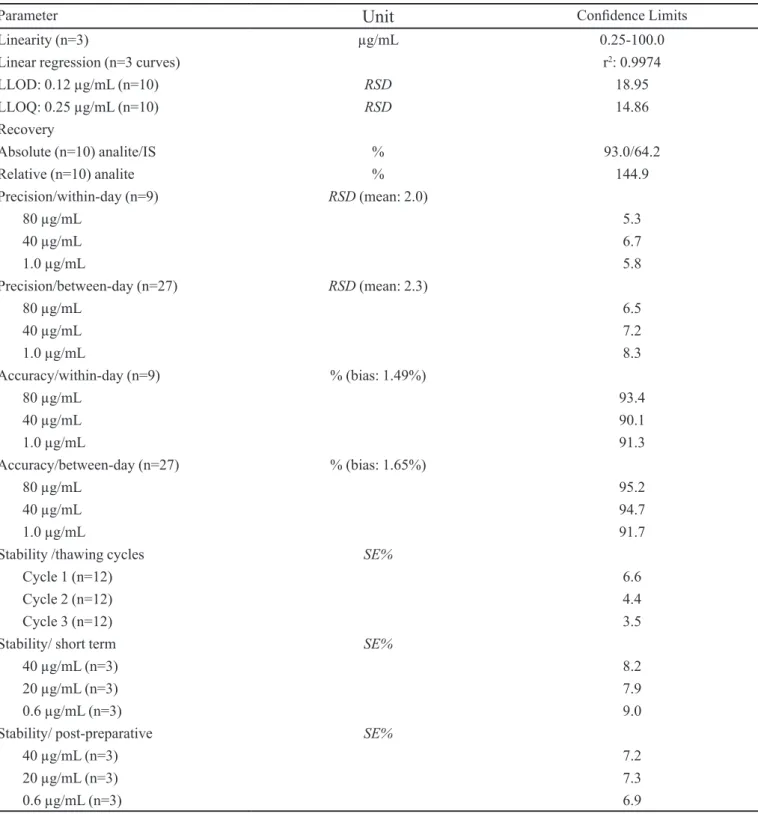
Validated method parameters for the quantiication
of imipenem in plasma according to FDA guidance (FDA, 2001) are shown in Table II.
For the bioanalytical method, linearity was
determined in the range of 0.25-100.0 µg/mL, and data
were expressed by the intercept and the slope of the linear function as the mean, standard error of the mean (SEM) and
linear coeficient of determination (r2) as follows: intercept
0.0146 (SEM: 0.0183), slope 0.0273 (SEM: 0.0004)
and r2: 0.998. Based on plasma analysis (250 µL) in
10 replicates, the lower limit of detection was 0.12 µg/mL,
and the lower limit of quantiication was 0.25 µg/mL. The linearity of the LC-UV measurements data obtained in the present study (0.25 up to 100.0 µg/mL) is superior or comparable to those previously reported
(Buckley et al., 1992; Belzeberg et al., 2004; Dailly et
al., 2011; Ebey, Boucher, Pieper, 1988; Garcia-Capdevila
et al., 1997; Gravallese et al., 1984; Verdier et al., 2011).
Additionally, the selectivity and speciicity for imipenem
recommended (Buckley et al., 1992; Dailly et al., 2011;
Garcia-Capdevila et al., 1997; Verdier et al., 2011).
The bioanalytical method of therapeutic drug plasma monitoring, pharmacokinetic study and dose adjustments by PK/PD modelling in pediatric patients showed good sensitivity, absolute and relative recoveries, linearity and stability, with acceptable accuracy and precision (Table II).
Thus, good sensitivity for plasma imipenem measurements was obtained in the study as a consequence of high drug recovery, an essential factor for drug analyses in small plasma volumes that clearly contributes to reducing volume in blood sampling.
Additionally, good drug plasma stability was demonstrated after three consecutive thawing/freezing
FIGURE 1 - Chromatographic proile of imipenem in plasma puriied extract, run time 15 min (A): High drug concentration
cycles on the bench; in addition, the post processing stability was guaranteed at room temperature up to 24 hours for
puriied extracts on the rack of auto sampler (Table II).
I n g e n e r a l , b l o o d s a m p l i n g f o r l a b o r a t o r y
measurements is mainly a limiting factor for drug plasma monitoring in children; consequently, lower volumes for drug plasma measurements in pediatric patients would be an additional advantage.
TABLE II - Conidence limits of bioanalytical method for imipenem plasma measurements
Parameter
Unit
Conidence LimitsLinearity (n=3) µg/mL 0.25-100.0
Linear regression (n=3 curves) r2: 0.9974
LLOD: 0.12 µg/mL (n=10) RSD 18.95
LLOQ: 0.25 µg/mL (n=10) RSD 14.86
Recovery
Absolute (n=10) analite/IS % 93.0/64.2
Relative (n=10) analite % 144.9
Precision/within-day (n=9) RSD (mean: 2.0)
80 µg/mL 5.3
40 µg/mL 6.7
1.0 µg/mL 5.8
Precision/between-day (n=27) RSD (mean: 2.3)
80 µg/mL 6.5
40 µg/mL 7.2
1.0 µg/mL 8.3
Accuracy/within-day (n=9) % (bias: 1.49%)
80 µg/mL 93.4
40 µg/mL 90.1
1.0 µg/mL 91.3
Accuracy/between-day (n=27) % (bias: 1.65%)
80 µg/mL 95.2
40 µg/mL 94.7
1.0 µg/mL 91.7
Stability /thawing cycles SE%
Cycle 1 (n=12) 6.6
Cycle 2 (n=12) 4.4
Cycle 3 (n=12) 3.5
Stability/ short term SE%
40 µg/mL (n=3) 8.2
20 µg/mL (n=3) 7.9
0.6 µg/mL (n=3) 9.0
Stability/ post-preparative SE%
40 µg/mL (n=3) 7.2
20 µg/mL (n=3) 7.3
0.6 µg/mL (n=3) 6.9
Therapeutic drug monitoring
Imipenem plasma monitoring was performed in six pediatric burn patients, covering 10 sets of plasma levels. The investigated pharmacokinetics of a dosage of 2 g daily each 6 hours are described in Table III. Additionally, drug
eficacy was evaluated by the previously reported PK/
PD correlation (Zhanel et al., 2007; Ikawa et al., 2008).
Free-fraction drug plasma concentrations were maintained
above the MIC within the time interval (fT>MIC),
expressed as a percentage, and imipenem effectiveness
is guaranteed at 40%fT>MIC. PK/PD modelling was
investigated; the estimated data for the predictive index are described in Table III.
In critically ill adult burn patients, extensive changes in drug kinetic disposition were reported for many drugs,
including imipenem (Weinbren, 1999; Belzeberg et al.,
2004; Blanchet et al., 2008). The pharmacokinetics of
imipenem in adults have been described by Dailly et
al. (2003); the changes in burn patients were related to
an increased distribution volume, with a consequent
prolongation of the biological half-life (Drusano et al.,
1984). In addition, a prolongation of biological half-life is expected if a decrease in drug plasma clearance and an increase in the distribution volume of critically ill patients
occurs (Belzeberg et al., 2004).
The pharmacokinetic data for imipenem obtained in pediatric burn patients investigated in the present study varied greatly from data previously reported for septic adult burn patients and critically ill adult patients (Dailly
et al., 2003; Belzeberg et al., 2004). Because kinetic disposition is quite different between adult patients and
pediatric patients due to differences in body size, luid
compartments and drug elimination by urinary excretion
or drug metabolism (Onishi et al., 2005), these data may
agree with the previous studies.
PK/PD data obtained in the present study were based on in vitro microbial susceptibility testing (MIC data) of pathogens isolated from blood, fluids or secretions collected from pediatric burn inpatients and measured as part of routine clinical practice in the hospital Central Laboratory. In addition, if the MIC hospital data were not available on time, the PK/PD results were estimated based on available data (EUCAST, 2013).
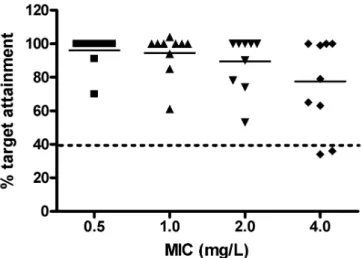
Then, according to Figure 2, drug effectiveness was obtained in 100% of the plasma sets based on MIC hospital data obtained up to 2 mg/L, considering hospital Gram-positive or Gram-negative pathogens isolated from
luids or secretions of each patient. In contrast, imipenem
effectiveness was reduced by 20% for Gram-positive
pathogens (Enterococcus faecium, Enterococcus faecalis;
MIC: 4 mg/L), with unchanged drug effectiveness against
TABLE III - Imipenem pharmacokinetics and PK/PD correlation in burn children (n=6)
Parameters Pharmacokinetics (10 sets) PK/PD Correlation (10 sets) 13 MIC values
Patient allocation t(1/2)β
(h)
CLT
(mL/min.kg)
Vdss
(L/kg) 0.5 mg/L 1 mg/L 2 mg/L 4 mg/L
#1 (set 1) 1.3 1.4 0.16 100 100 100 99
#1 (set 2) 0.5 2.4 0.10 70 61 53 36
#2 1.7 0.9 0.14 100 100 100 100
#3 0.8 3.8 0.26 100 104 90 63
#4 (set 1) 2.4 1.4 0.30 100 100 100 100
#4 (set 2) 1.6 13.1 1.78 100 94 74 34
#5 (set 1) 1.9 1.9 0.32 100 100 100 100
#5 (set 2) 4.8 6.4 2.68 100 100 100 100
#5 (set 3) 1.0 2.2 0.19 100 100 100 79
#6 0.4 5.5 0.17 91 85 78 65
Median 1.45 2.3 0.23 100 100 100 89
IQ (25/75%) 0.85-1.85 1.5-5.1 0.16-0.32 100-100 96-100 81-100 64-100
%TA (40%fT>MIC) NAP NAP NAP 100% 100% 100% 80%
Abbreviations and symbols - t(1/2)β: biological half-life; CLT: total body clearance; Vd
ss: apparent volume of distribution; TA: Target
Gram-negative pathogens (MIC 0.25 - 2 mg/L) relative to the Eucast database.
Imipenem (2 g daily, 0.5 hour infusion of 0.5 g every 6 to 8 hours) provides sufficient drug exposure in the pediatric burn patients investigated in the present study according to data reported previously in critically ill adult
patients (Dailly et al., 2003;Xu et al., 2009).
PK/PD data obtained for pediatric burn patients were estimated based on the percentage of the dose interval that the drug plasma concentration was maintained above the MIC, and the time-dependent imipenem effectiveness criterion was considered to be 40%
fT>MIC, as recommended by Ikawa et al. (2008). Drug
effectiveness against isolated pathogens during the antimicrobial susceptibility testing reached MIC values of 2 mg/L for patients in all sets investigated.
CONCLUSION
The bioanalytical method validated for imipenem p l a s m a m e a s u r e m e n t s b y L C p r e s e n t e d s e v e r a l advantages, such as simplicity, rapidity, specificity and selectivity and low required plasma volume,
with acceptable conidence limits related to linearity,
sensitivity and stability for the drug plasma assay. The method was appropriate for drug plasma measurements focused on drug efficacy to treat sepsis described in severe pediatric burn patients. A high PK/PD target for imipenem was attained in burned children. Finally, despite the altered pharmacokinetics for imipenem in pediatric burn patients, drug effectiveness was guaranteed in all sets investigated for isolated strains
(MIC 2 mg/L) receiving the recommended daily dose (2 g) at a dose regimen of 0.5 g 4 times a day.
ACKNOWLEDGEMENTS
This work was supported by FAPESP.
Authors are grateful to Mrs. Adriana Maria dos Santos for the technical laboratory support in drug plasma measurements.
REFERENCES
BELZEBERG, H.; ZHU, J.; CORNWELL III, E.E.; MURRAY, J.A.; SAVA, J.; SALIM, A.; VELMAHOS, G.C.; GILL, M.A. Imipenem levels are not predictable in the critically ill patient. J. Trauma, v.56, n.1, p.111-117, 2004.
BLANCHET, B.; JULLIEN, V.; VINSONNEAU, C.; TOD, M. Influence of burns on pharmacokinetics and pharmacodynamics of drugs used in the care of burn patients. Clin. Pharmacokinet., v.47, n.10, p.635-654, 2008.
BUCKLEY, M.M.; BROGDEN, R.N.; BARRADELL, L.B.; GOA, K.L. Imipenem cilastatin. A reappraisal of its antibacterial activity, pharmacokinetic properties and
therapeutic eficacy. Drugs, v.44, n.3, p.408-444, 1992.
CLINICAL AND LABORATORY STANDARDS INSTITUTE. C L S I . P e r f o r m a n c e S t a n d a r d s f o r a n t i m i c r o b i a l susceptibility testing; Seventeenth Informational Supplement. CLSI document M100-S17, Pennsylvania, USA, 2007.
DAILLY, E.; BOUQUIÉ, R.; DESLANDES, G.; JOLLIET, P.; LE FLOCH, R. A liquid chromatography assay for a quantification of doripenem, ertapenem, imipenem, meropenem concentrations in human plasma: application to a clinical pharmacokinetic study. J. Chromatogr. B., v.879, n.15-16, p.1137-1142, 2011.
DAILLY, E.; KERGUERIS, M.F.; PANNIER, M.; JOLLIET, P.; BOURIN, M. Population pharmacokinetics of imipenem in burn patients. Fundam. Clin. Pharmacol., v.17, n.6, p.645-650, 2003.
DRUSANO, G.L.; STANDIFORD, H.C.; BUSTAMANTE, C.; FORREST, A.; RIVERA, G.; LESLIE, J.; TATEM, B.; DELAPORTAS, D.; MACGREGOR, R.R.; SCHIMPFF, S.C. Multiple-dose pharmacokinetics of imipenem-cilastatin. Antimicrob. Agents Chemother., v.26, n.5, p.715-721, 1984.
FIGURE 2 - Imipenem target achievement (40%fT>MIC;
EBEY, W.J.; BOUCHER B. A.; PIEPER, J.A. A rapid HPLC method for determination of imipenem in plasma. J. Liq. Chromatogr.,v.11, n.16, p.3471-3481. 1988.
E U R O P E A N C O M M I T T E E O F A N T I M I C R O B I A L SUSCEPTIBILITY TESTING. EUCAST –. MIC- distribution. Available at: <http://www.eucast.org/mic_ distributions>. Accessed on: 15 Sept 2013.
FOOD AND DRUG ADMINISTRATION. FDA Guidance for Industry: Bioanalytical Method Validation. US Department of Health and Human Services, Food and Drug Administration, Center for Drug Evaluation and Research, 2001.
FRY, D.E. The importance of antibiotic pharmacokinetics in critical illness. Am. J. Surg., v.172, n.6, p.20S-25S, 1996.
GARCIA-CAPDEVILA, L.; LÓPEZ-CALULL, C.; ARROYO, C.; MORAL, M.A.; MANGUES, M.A.; BONAL, J. Determination of imipenem in plasma by high-performance liquid chromatography for pharmacokinetic studies in patients. J. Chromatogr. B Biomed. Sci. Appl., v.692, n.1, p.127-32, 1997.
GRAVALLESE, D.A.; MUSSON, D.G.; PAULIUKONIS, L.T.; BAYNE, W.F. Determination of imipenem (N-formimidoyl thienamycin) in human plasma and urine by high-performance liquid chromatography, comparison with microbiological methodology and stability. J. Chromatogr., v.310, n.1, p.71-84, 1984
GREENHALGH, D.G.; SAFFLE, J.R.; HOLMES, J.H.; GAMELLI, R.L.; PALMIERI, T.L.; HORTON, J.W.; TOMPKI NS, R . G. ; T R AB E R , D. L . ; MOZ I NGO, D.W.; DEITCH, E.A.; GOODWIN, C.W.; HERNDON, D.N.; GALLAGHER, J.J.; SANFORD, A.P.; JENG, J.C.; AHRENHOLZ, D.H.; NEELY, A.N.; O’MARA, M.S.; WOLF, S.E.; PURDUE, G.F.; GARNER, W.L.; YOWLER, C.J.; LATENSER, B.A.; AMERICAN BURN ASSOCIATION CONSENSUS CONFERENCE ON BURN SEPSIS AND INFECTION GROUP. American
Burn Association consensus conference to deine sepsis
and infection in burns. J. Burn Care Res., v.28, n.6, p.776-90, 2007.
IKAWA, K.; MORIKAWA, N.; IKEDA, K.; OHGE, H.; SUEDA, T. Development of breakpoints of carbapenems for intraabdominal infections based on pharmacokinetics and pharmacodynamics in peritoneal fluid. J. Infect. Chemother., v.14, n.4, p.330-332, 2008.
KURIHARA, Y.; KIZU, J.; HORI, S. Simple and rapid determination of serum carbapenem concentrations by high-performance liquid chromatography. J. Infect. Chemother., v.14, n.1, p.30-34, 2008.
LEGRAND, T.; CHUN, S.; REY, E.; BLANCHET, B.; ZAHAR, J.R.; LANTERNIER F.; PONS, G.; JULLIEN, v.Simultaneous determination of three carbapenem antibiotics in plasma by HPLC with ultraviolet detection. J. Chromatogr. B., v.875, n.2, p.551-556, 2008.
ONISHI, A.; YANO, Y.; ISHIBASHI, T.; KATSUBE, T.; OGUMA, T. Evaluation of bayesian predictability o f v a n c o m y c i n c o n c e n t r a t i o n u s i n g p o p u l a t i o n pharmacokinetic parameters in paediatric patients. Drug Metab. Pharmacokinet., v.20, n.6, p.415-422, 2005.
PIETROSKI, N.A.; GRAZIANI, A.L.; LAWSON, L.A.; BLAND, J.A.; ROGERS, J.D.; MACGREGOR, R.R. Steady-State Pharmacokinetics of Intramuscular Imipenem-Cilastatin in Elderly Patients with Various Degrees of Renal Function. Antimicrob. Agents Chemother., v.35, n.5, p.972-975, 1991.
SCHWARTZ, G.J.; HAYCACK, G.B.; EDELMANN, C.M.;
SPITZER, A. A simple estimate of glomerular iltration rate
in children derived from body length and plasma creatinine. Paediatrics, v.58, p.259-263, 1976.
TANIGUCHI, S.; HAMASE, K.; KINOSHITA, A.; ZAITSU, K. Simple and rapid analytical method for carbapenems using capillary zone electrophoresis. J. Chromatogr. B., v.727, n.1-2, p.219-225, 1999.
VERDIER, M.C.; TRIBUT, O.; TATTEVIN, P.; LE TULZO, Y.; MICHELET, C.; BENTUÉ-FERRER, D. Simultaneous determination of 12 beta-lactam antibiotics in human plasma by high-performance liquid chromatography with UV detection: application to therapeutic drug monitoring. Antimicrob. Agents Chemother., v.55, n.10, p.4873-4879, 2011.
XU, Y.; XIE, W.; MILLER-STEIN, C.M.; WOOLF, E.J. Hydrophilic interaction chromatography/tandem mass spectrometry for the simultaneous determination of three polar non-structurally related compounds, imipenem, cilastatin and an investigational beta-lactamase inhibitor, MK-4698, in biological matrices. Rapid Commun. Mass Spectrom., v.23, n.14, p.2195-2205, 2009.
ZHANEL, G.G.; WIEBE, R.; DILAY, L.; THOMSON, K.; RUBINSTEIN, E.; HOBAN, D.J.; NOREDDIN, A.M.; KARLOWSKY, J.A. Comparative review of the carbapenems. Drugs, v.67, n.7, p.1027-1052, 2007.
Received for publication on 31st January 2014