Resumo
Este artigo analisa o manual Mestre da Vida que ensina a viver e morrer santa-mente, escrito por João de Castro e pu-blicado na Espanha, na primeira metade do século XVIII. Sabe-se que a obra me-receu várias traduções e reedições ao longo do século XIX, e que algumas de-las chegaram a circular no Brasil. Além da identificação e da análise das repre-sentações da Virgem presentes na obra, nos detemos nas orientações que os fiéis deveriam seguir no culto e nas práticas devocionais a Maria, propondo uma avaliação sobre sua aceitação e difusão no mundo luso-brasileiro. Tal análise insere-se nas recentes discussões histo-riográficas acerca das práticas de leitura, considerando as formas plurais de apro-priação e de recepção de textos, inseri-das em seus contextos de produção e circulação.
Palavras-chave: manual religioso; devo-ção à Virgem; salvadevo-ção das almas.
Abstract
This article analyses the manual Mestre da Vida que ensina a viver e morrer san-tamente, written by João de Castro and published in Spain in the first half of the eighteenth century. It is known that the work was translated and republished many times during the nineteenth cen-tury, and that some of these copies cir-culated in Brazil. In addition to the identification and analysis of the repre-sentations of the Virgin present in the work, we are concerned with the guid-ance that believers were supposed to follow in devotional practices to Mary, suggesting an evaluation of the accep-tance and diffusion of these orientations in the Luso-Brazilian world. This analy-sis takes into account recent discussions regarding reading practices, including the many forms of appropriation and reception of texts, inserted in their con-texts of production and circulation. Keywords: religious manual; devotion to the Virgin; salvation of souls.
* Centro de Ciências Humanas – História, Universidade do Vale do Rio dos Sinos (Unisinos). Av. Unisinos, 950, Cristo Rei. 93022-000 São Leopoldo – RS – Brasil. [email protected]
** Doutorando em História. Universidade do Vale do Rio dos Sinos (Unisinos). maurodillmann@ hotmail.com
Virgin as a guarantee of salvation of the souls
in an eighteenth century manual of devotion
This article presents the analysis of a Catholic manual of devotion from the eighteenth century which provided its readers with guidance on how to guarantee the salvation of their souls through devotion and faith in the inter-cessory power of the Virgin Mary. Published in Spain1 in the eighteenth
cen-tury, the manual Mestre da vida que ensina a viver e morrer santamente (Master of life who teaches how to live and die in a saintly manner) was written by the Dominican friar João de Castro with the aim of instructing readers2 in the
“mysteries of the Catholic religion” extracting “truths which... instruct and... lead to virtue and perfection,” to a “holy life and death” and to a “happy and glorious eternity” (Castro, 1882, p.v, vi, vii). In addition to prayers for different purposes, the manual includes papal bulls and encyclicals from the fifteenth and sixteenth centuries which are in harmony with Counter-Reformation thought. Various editions3 and translations4 were published in Europe, while
it also circulated in the American colonial empires until the nineteenth cen-tury,5 which favored the diffusion of its guidance among Catholics.
It is worth remembering that during the colonial period the entry of reli-gious books and manuals to the Americas took place through the acquisitions of manuscripts and printed material by the secular clergy and religious orders, who kept these works in their libraries.6 Catholic brotherhoods also had
reli-gious pamphlets and manuals in their collections, favoring the spreading of Catholic advice about how to live and die in a saintly manner among their members. In the nineteenth century, the coming of the Court and the estab-lishment of the Royal Press also favored the circulation of books in Portuguese America, especially those which spread content favorable to religion, govern-ment and good customs.7
The manual ‘which teaches how to live and die in a saintly manner’ was published in the form of a pamphlet – despite having more than four hundred pages –, the proper format for individual reading8 – thereby facilitating
The general acceptance which the book entitled Mestre da Vida deserves; the utility of this Compendium of devotions, spread through various volumes, for Catholics; and the blessings, which God gives to anyone who undertakes to teach the Faithful to live and die in a saintly manner, are the strongest stimuli to undertake the reprinting of the book in question. (Castro, 1882, p.v, emphasis added)
Figure 1 – Mestre da Vida que ensina a viver e morrer santamente
The various reprints appear to be indicative of the acceptance that the pub-lication enjoyed, not only among lay Catholics,9 but also among the popes and
ecclesiastical hierarchy, who authorized its distribution and encouraged its read-ing. It is worth noting that from the seventeenth century onwards the Catholic Church, through a ‘pedagogical effort’ increased the ‘book baggage’ of parish priests, recommending the reading of books of moral theology, with the objec-tive of transforming them into “men of study and books” (Julia, 1999, p.92).
Despite its circulation at different moments and in different spaces, in which the model behavior, attitudes and values were transformed, the manu-al appears to have been kept as a devotionmanu-al guide, promoting the effective interiorization of the norms of conduct and the religious sensibilities valorized by the Catholic Church over the centuries.10 However, it has to be taken into
account that, although the manual – due to its devotional nature – was con-cerned with the adoption of determined practices and behavior reiterated by the Church, it also allows different appropriations by the reader,11 to the extent
Since it is a guidance manual for Catholics about the religious behavior to be adopted during life and in the moments preceding death – in order to guarantee salvation –, its analysis not only permits the identification of forms of devotion and intercession for the saving of souls, but also the different rep-resentations that the Virgin received and assumed. Although it was not a work that was especially orientated to Marian devotion, the publication seems to have been very efficient in disseminating the representation of Mary as a mod-el of sanctity to be followed by bmod-elievers to obtain salvation at the moment of death. In the Western Christian religious mentality, the purity attributed to Mary and her maternal nature were fundamental in the definition of her func-tions of intercessor, mediator, and aide that she would assume in the economy of salvation.13
About the origins of devotion to Mary
The Catholic Church constructed its religious universe linking the spiri-tual to the terrestrial, and the sacred to daily life, with the religious experi-ences propelled by feverous devotions to Christ and Mary,14 responsible to a
great extent for the salvation of the souls of sinners. Faced with death, in me-dieval religious thought expressions of lamentation were common for the end of power, honor and pleasure, but also of jubilation for the saved soul (Huizinga, 2010, p.243). As can be perceived in the introductory passage of the eighteenth century religious manual, leading a life based on the sanctity of religious mysteries and inculcating in believers the need for worship and ado-ration were objectives shown to be fundamental in obtaining salvation:
Herein is what we have to put all our efforts and care into; however, for these to be effective and to triumph at the hour of death the terrible combat of the universal enemy, it is necessary to pray to God, to turn to Holy Mary and the Saints of our particular devotion, ask them to be our protectors, that they help us, and intercede for us. (Castro, 1882, p.v, vi, emphasis added)
This extract from the manual reinforces the need for believers to ‘turn to Mary` to obtain the path to salvation, an instruction which in general began to spread in the sixteenth century, due to the Counter-Reformation the moth-er of Christ became the favorite saint of the ecclesiastic himoth-erarchy.15 However,
devel-oped by the Church and later spread throughout Europe and America (Souza, 2002, p.233), including the Hispanic dominions.16 This increase in the
venera-tion of the Virgin Mary during the Middle Ages, especially from the twelfth century onwards, has been highlighted by Juliana de Souza and Ronaldo Vainfas (1999) as being associated with the values of virginity and maternity.17
In this period Mary was taken to be the central personality in the religious universe, which can be observed in the iconography, in the architecture and in the literature.18 The relation between the Virgin and salvation had already
been consolidated in the medieval period, since “in the narratives produced in the Abby of Cluny, there was presented the need for alms and the celebration of the souls of the dead, as well as presenting the Virgin Mary as the principal help for souls regarding salvation.”19
Among the indications of the practice of the Marian Cult in the Catholic kingdoms of the Iberian Peninsula during the medieval period, the most im-portant are the Cantigas de Santa Maria, a set of musical poems from the thirteenth century, seen as the “greatest medieval compilation in praise of the Virgin.”20 These poems “narrate many miracles of the Virgin conceded in
Marian sanctuaries in Europe.” With the cantigas, “Afonso X sought ... to spread devotion to and praise of Our Lady,” some of which “referred to pil-grims and miracles that occurred in Portuguese lands” (Pereira, 2009, p.2), which, possibly, favored the addition of devotion to Mary to the knightly ide-al of the medievide-al period, which defined the Virgin as the preferred prototype of woman.
During the age of discoveries in the fifteenth and sixteenth centuries, invocations to the Virgin were used to name vessels, such as Columbus’ Sancta Maria, and to baptize islands, such as Santa Maria da Conceição. Furthermore the explorers carried with them images of the Virgin Our Lady of Hope, brought by Cabral on his expedition (Souza, 2001a, p.78). In the sixteenth century, the cult of Mary, in addition to being intensified, came to play a new role, by being used as a weapon against the Lutheran Reformation, being thus transformed into a symbol of religious identity and fidelity to the Catholic Church21 (Souza; Vainfas, 1999, p.203).
This mobilization of Church around the cult of the Virgin appears to have been successful, since according to Michel Vovelle, between the sixteenth cen-tury and the end of the eighteenth, the Virgin was practically omnipresent in Provençal paintings, maintaining her condition as the ‘queen do purgatory’ and ‘our defender.’22 Also dedicated to the Virgin were works of moral
the names of Maria Santissima de los Llanos, Prodigiosa Imagen de Guadalupe,
Maria Santissima del Rosario and Virgen de los Dolores –, as we have found in a recently concluded investigation.23 In our analysis of some of these eighteenth
century treatises, we found that most often their authors, in addition to the functions linked to the arts of healing, had close ties with the Church, being members of religious orders or ecclesiastics. Dedications to the Virgin in this genre of publication were actually constituted in reverence to the ‘great artifi-cer of healing’ – God – and in a strategy which legitimated the knowledge di-vulged through compliance with the norms of approval and circulation then in force.24 The author of the manual Mestre da Vida – the Dominican Friar
João de Castro – confirmed the use of this usual practice in the period, by dedicating it to the “Holy Virgin of the Rosary through the hands of her pro-digious image which is venerated in Vila do Barreiro” (Figure 2).
Figure 2 – Frontispiece of Mestre da Vida que ensina a viver e morrer santamente
especially in the seventeenth century and eighteenth centuries. In 1764 when the Englishwoman Jemima Kindersley (1741-1809) – the first woman to register her impressions of Brazil25– recorded daily life in Salvador in the letters she wrote,
she highlighted that in the houses of people ‘of some distinction,’ the room had white walls decorated with paintings of the Virgin. In the city’s Churches Kindersley found “richly dressed” statues of the Virgin, under the care of priests who kept in drawers “richly embroidered clothes” and “beautiful jewels, with which the images are adorned on solemn occasions” (França, 2008, p.43-44).
Devotion to Mary in Portuguese America was almost an extension of me-dieval Mariology, since “Mary is presented as the Mother of Jesus in almost all her expressions: joy, sorrow, loneliness, glory and triumph. The Mary who had power to grant victory in difficult battles, such as Aljubarrota; the Mary who freed souls from purgatory; the Mary who protected her devotees from the dangers of plagues, sicknesses...”.26 This positive representation of Mary was
constructed under the argument that her maternity was a response to the appeal to God for the conception of Jesus. The French theologian Bernard Sesboüé highlighted that Mary’s virginal maternity was used by the Church to establish the relationship between purity and salvation in the souls of sinners. As the mother of the Savior, the Virgin also played for the Church a salvationist role.27
In the seventeenth and eighteenth centuries, Marian devotions multiplied and the specialized literature about the Virgin became part of the history of salvation. According to Richard Nebel, from the seventeenth century onwards the Iberian Peninsula witnessed many personifications and representations of the Mother of God, placing Marian veneration at the center of the Christian faith.28 In relation to this, the Counter-Reformation actions of the Catholic
Church were efficient in spreading the Marian cult, especially if we consider that publications such as the Mestre da Vida manual were successful, accepted by the public and widely distributed until the nineteenth century. In that cen-tury the devotional fervor grew to such an extent that in “1842, Luís Maria Gringnion de Monfort’s Tratado da verdadeira devoção à Santa Virgem was rediscovered. This dated from the seventeenth century and exercised a great influence” in Marian devotion (Sesboüé, 2005, p.468).
p.495). However, the dogma was only officially established on 8 December 1854 by Pope Pius IX, who solemnly defined the Immaculate Conception of the Virgin Mary, who was thus “exempt from sin from the first moment of her existence” (Sesboüé, 2005, p.497).
As can be seen, the devotion to Mary, as had been structured since the medieval period, came to be even more widespread between the seventeenth and nineteenth centuries, both by clergy and by the Church – through preach-ing and Councils – and through books of Christian morality and devotional manuals – such as Mestre da Vida – which were read by Catholics. Next we will analyze in more detail the representations of the Virgin and the forms of devotion to her we identified in João de Castro’s work.
About the representations of the Virgin Mary
The representations of the Virgin present in the manual Mestre da Vida
emphasize her chastity, purity and virginity, presenting her as a model of ab-negation and of the faith proposed by Catholic doctrine. Her ‘life’ is presented as a kind of archetype of the perfect Christian life. ‘Mary the always virgin’ – or ‘Queen of virgins’ – remained ‘the sovereign lady’ by being conceived as the ‘Holy Mother of God,’ achieving as a result of this the titles of ‘glory of Jerusalem’ or ‘Glorious star’, serving as a ‘very clear mirror of humility’ and example for all sinners (Castro, 1882, p.120-250).
For the guarantee of the perfect health of the body and spirit, Mary was considered the ‘health for the ill’ and the ‘help of Christians,’ to whom they should resort in times of ailments, pains and sufferings, since she was capable of remedying ‘not only the illnesses of the body, but also those of the soul.’ The Virgin Mary was also represented as the ‘refuge of sinners,’ the ‘consoler of the afflicted,’ the ‘gate to heaven’ and the ‘star of heaven,’ for those tormented by the sins of pride and selfishness, which prevented their souls from going to eternal salvation after death (Castro, 1882, p.184-254).
These representations of the Virgin are constantly shown throughout the manual, reinforcing for the reader – or listener – her importance in the life of Christians, or those considered perfect Christians. To the reader of the man-ual29 they had to demonstrate their devotion to the Virgin, their condition as
saying applied that the law of prayer is the law of faith – Lex orandi, Lex cre-dendi – (Sesboüé, 2005, p.467).
The numerous adjectives used to describe the Virgin Mary in the manual were constructed in accordance with the doctrine of the Catholic Church, and were not just historically imposed, but also favored the expansion and spread of devotion to the cult of the saint. If priests, in the exercise of their office, used the manual to guide the faithful, it is possible to suppose that the qualifications and functions attributed to Mary operated as efficient means of conversion, since the Virgin was presented as the help and cure for various evils, espe-cially for sinners, those suffering, the ill and the afflicted.
At the beginning of the manual we can find the following guidance: “As soon as the Christian wakes, at the right time to get out of bed, he should send his thoughts to God, bless himself and say the Hail Mary three times” (Castro, 1882, p.1). Devotion to the Virgin, as we can see in the manual, stipulated many prayers and the saying of the Rosary.30 It is that worth noting that
devo-tion to the Rosary grew at a moment when, according to the historian Juliana de Souza, “the Church felt weak and used it as a combative mechanism. The method of praying proposed by the rosary valorized, alongside the repetition of the Hail Marys, meditation, re-establishing interior contemplation” (Souza, 2001b). Devotion to the Virgin and the rosary were thus “weapons at a time when Catholics increasingly believed in the exteriority of the faith and in the buying of indulgences to achieve salvation” (Souza, 2001b).
Devotion to Mary was affirmed by prayers which the devout dedicated to her to purify their souls and consequently achieve the ‘worthy living place,’ as can be seen in this ‘devout anthem, in submission to the Immaculate Conception Mother of God’:
You are all beautiful, oh Mary, And there was no stain in You: You are the Glory of Jerusalem, You are the happiness of Israel, You are the honor of our people, Oh Mary, oh Mary,
Merciful Virgin, Pray for us,
Intercede for us with Our Lord Jesus Christ. Immaculate you are, Virgin, in your Conception.
The beautiful and purified Mary, as the prayer transcribed here highlights, also assisted in leading of a saintly life, especially for women.31 By
communicat-ing with the Virgin through prayer, through the practice of spiritual exercises, believers policed their attitudes with an intimate reflection, which favored the mystic connection with the transcendental.32
Another prayer to the Virgin recommended that over the breast on top of the heart three crosses be placed during morning and night prayers, in order to achieve chastity. Only the “Pure Virgin,” who kept her “holy virginity before birth, in birth and after birth” can eliminate the “sensual appetite” (Castro, 1882, p.183-184) and the stains of impurity. A concern can be noted here with emphasizing faith in Mary as a means of eliminating the ‘sensual appetite’ – or, why not, sexual – and to maintain sanctified conduct based on the example of purity and the maintenance of virginity of the mother of Jesus.
The prayers to the Virgin, the ‘Star of Heaven,’ helped in the fight against the ‘influx of stars, which in their malign dispositions hurt people with mortal wounds.’ Dying as a result of a plague meant the possibility of dying suddenly, without the administration of sacraments, and leaving one´s soul in eternal condemnation. The prayers effectively pointed to the awareness of the dangers which plagues represented to the devout, who, in addition to asking ‘free us from the plague’ (Castro, 1882, p.184), invoked the Mother, whose ‘sacred breast’ offered ‘sweetly the counter-venom’ to the condemnation of the soul.
Finally, the prayer Salve Regina (Hail Holy Queen) appears to have been full of significance:
Hail Holy Queen, Mother of Mercy, our life, our sweetness and or hope. To thee do we dry, poor banished children of Eve. To thee do we send up our sighs, mourning and weeping in this valley of tears. Turn them, most gracious advo-cate, thine eyes of mercy toward us. And after this our exile show unto us the blessed fruit of thy womb, Jesus. O clement, o loving, o sweet virgin Mary. Pray for us, o Holy Mother of God. Santa Madre de Deus, that we be made worthy of the promises of Christ. Amen Jesus. (Castro, 1882, p.277)
– as well as others dedicated to the Virgin – reinforces the ‘hope’ of/in salva-tion, to the extent that Mary advocates and prays ‘for us.’
The Mestre da Vida also guides the devout to ‘meditate the rosary’ based on their ‘mysteries:’ the joyful mysteries, the sorrowful mysteries and the glori-ous mysteries.33 We will focus here on the joyful mysteries, since they refer to
how certain parts of the life of the Virgin Mary should be meditated by believ-ers. There are five joyful mysteries and they are related to the attributions of the Virgin, seen as models for the Christian life. The first mystery is that Our Lady ‘was greeted by the Angel Gabriel and she was told she had conceived Jesus Christ.’ In the discourse of meditation presented, João de Castro pro-posed to make believers aware of the importance of humility and love demon-strated by Mary, counterpoising them to the pride and ingratitude of humans, by stating: “Be horrified, Catholic, take care in joining with the God who calls you” (Castro, 1882, p.120).
The second mystery is related to the visit Mary made to her cousin, St. Isabel, who was pregnant. In the meditation, the objective is to demonstrate that Mary spared no efforts to help them in an “act of charity,” leading believ-ers to reflect on “culpable indifference in other needs” and about the impor-tance of prayer for cleansing the heart “of all sin” (Castro, 1882, p.121-122).
The third mystery refers to the birth of Jesus Christ in Bethlehem. With the intention of stressing that Jesus was born in poverty, this mystery is in-tended to teach the poor to accept being poor and the ‘rich’ the proper use of the goods they possess, through the following recommendation: “Be joyful, since the poor has his luck; the rich love poverty making good use of the goods they possess and living comfortably in accordance with the laws of temperance, justice and equity... we who live so pure and holily will obtain this” (Castro, 1882, p.123).
The fourth mystery is related to the ‘purification’ of Mary in the Temple and the ‘offering of the child Jesus.’ The aim of this mystery was to demonstrate that despite the ‘divine maternity’ and her ‘inviolable virginity,’ Mary ‘did not take advantage of her privilege,’ but rather ‘subjected herself to it to build more and not to scandalize simple people who ignored the motives of her exemp-tion.’ There were thus many reasons, faced with so much love and humility, for “us to praise her day and night.” (Castro, 1882, p.123-125).
place for his dwelling.’ The prayer to the Virgin included the request: “grant that we know how to search and that we deserve to find the Lord in the Catholic Church and not to let our sins ever drive us away from him” (Castro, 1882, p.126-127).
Another mode of devotion to the Virgin Mary, in accordance with João de Castro’s manual, could be found in the correct way of holding novenas during the festivities for Our Lady. For each day of the novena – nine days of prayers and venerations – the manual had instructions for how believers should express their religiosity and adoration of Mary.
While in the Christian faith the Most Holy Mary, ‘since she enjoyed the highest dignity and excellence,’ received this title with ‘all worth,’ it had to be asked: ‘With what effort and with what craving should we not seek to have on our part a similar protector?’ In light of this, care and zeal in fulfilling religious obligations, and the devotion to and veneration of her son, Jesus, was one of the manners of not only conquering her shelter and protection, but also of commemorating her. Commemorations were also to be seen as a form of ven-erating Jesus, since “it would be madness for us and injurious to the same Lady to take advantage of her maternity regarding us, like a strong wall, for in doing this we can offend more securely Jesus Christ,” since “first, she was mother of the Lord; love him a lot; be zealous of his honor; and strongly dislike that which offends him. We should avoid causing him this dissatisfaction, for her to help us and get for us celestial happiness” (Castro, 1882, p.249-251). Among the recommendations for the third day of the novena is to revere the Virgin with devotion, an attitude which will guarantee that the devout will be removed from all dangers, anguish and temptations, which may come to compromise the salvation of their soul in the Final Judgment, as we can perceive in this transcription:
This extract presents the Virgin as the one who, in addition, to promoting joy and good feelings, has virtues which should be imitated by the faithful, for atonement and the tranquilization of consciences, especially those of sinners. It should be considered that belief in the Final Judgment not only determines the concerns of the faithful about the destination of their souls, but revives personal culpability,34 for which reason the invocation and devotion to Mary
was imposed.
On the fourth day of the novena, the prayers invoked the Virgin as a guarantee of protection against the dangers of the world, encouraging the faithful to repent:
we should go to her to find asylum and protection that can serve as a shield against the arrows of Divine anger and our enemies; however, this does not give us security to continue our disorders. If by chance though human fragility and corrupt nature, in which to our regret we are participants, we fall into guilt, we repent and soon after we are reconciled with God through the sacrament of Penance. And to avoid the traps and pitfalls which the Devil leaves for us and the punishments which for our sins we deserve: we turn with true devotion to Mary. We support ourselves on this secure and strongly fortified Tower to de-fend ourselves from all dangers and so that in the shelter of her we can trium-phantly enter into the Holy City of Sion. (Castro, 1882, p.252-253)
As can been seen the manual presents Mary as ‘an asylum and protection’ against ‘divine anger’ and against the ‘pitfalls which the demon leaves for us,’ protection which implies repentance and reconciliation with God ‘for the Sacrament of Penance.’
On the fifth day of the novena, the prayers said to the Virgin are about Christian obligations, such as charity, virtuous behavior which facilitated the opening of the ‘celestial door’ to the devout:
and resort to Mary, who will be the Gate of Heaven for us to receive the grace of the Lord and to enter into the festivities celestial and eternal vows. (Castro, 1882, p.253)
The excerpt we highlighted reveals that access to access to ‘celestial and eternal vows’– the ultimate purpose of all moral improvements35 –, was subject
to the evaluation of Mary – ‘the Gate to Heaven’ –, attentive to invocations and to the behavior of man.
For the sixth day of the novena, the manual highlighted the need to rid oneself of all the ills of the souls the most effective remedy for which was the protection of the Virgin:
Consider that the Most Holy Mary is the Health of the sick and the cure not just for the ailments of the body, but also of the soul. These are what we should take greatest care with and to be thrown out of us with the greatest diligence. For this reason we continually invoke Mary; however, at the same time, we cannot place obstacles to our cure. When we seriously want to heal ourselves from the ailments of the body we use the medicines we judge the most effective and we flee from all that is noxious to our health. And why do we not practice the same for the infirmities of the soul which along are fearful and dangerous? We thus run from vices, though they increase and we resort to an very effective remedy, which is the protection of the Most Holy Virgin and we can achieve that corpo-ral health which is most convenient for the spiritual and which will be followed by the happy eternal rest. (Castro, 1882, p.253-254)
Devotion to Mary appears as an ideal model to guarantee physical and spiritual health, since it is represented as a ‘medicine’ for the ‘infirmities of the soul,’ whose effectiveness lay in driving away vices. The reference to physical health is certainly associated with the fear provoked by the constant plagues which ravaged Europe in the eighteenth century (Delumeau, 2009, p.182), favoring an increase in devotion to the Virgin.
For the seventh day of the novena the prayers represent the Virgin as a refuge against the ‘dangers of life and death,’ which leads believers to bliss:
us through her virtues as a perfect model and whose sanctity hates sin? This is to defame her, making he a accomplice in our crimes. We take care to follow her example where possible: and repenting from have offended God we avoid falling into sin again. We pray with fervor and we turn with trust to Mary and we dis-cover that she is our refuge who frees us from the dangers of life and of death to lead us to bliss. (Castro, 1882, p.254-255)
In this, and in all the other days of the novena, Mary assumed the function of a mediator for salvation, being presented as the ‘perfect model’ of sanctity, which should be followed by Catholics. In the Catholic imagination, the Virgin has a universal character (being the mother of Jesus) and a private character (she possesses different invocations), with “her capacity to be one and at the same time multiple” (Reesink, 2003, p.134). In addition to defining what should be the behavior of the devout during the days of the novena, João de Castro highlights the peculiarities and particularities of the sanctity of the Virgin – independent of her invocation –, reinforcing the universal discourse of the salvation of the Catholic Church.
Consolation at the time of death is the theme of reflection proposed for the eight day of the novena, since Mary is also seen as the consoler of the af-flicted. The instructions state that the believers should avoid the exaggerations of mundane pleasures:
Consider that the Most Holy Mary is the Consoler of the afflicted, we have the strongest motives for wait for her to console us at the hour of death; the time of greatest affliction. However, in order for this hope to be well founded we should not gorge ourselves on mundane pleasures and luxuries. The Virgin Sovereign takes pleasure in such sweetness and glory, first, on Earth she suffered on Earth many bitter tasks always resigned to her God. She invites us to follow her luck and to suffer with resignation in this world the transitory mortifica-tions and punishments so that we can go with her to the celestial and eternal pleasures. (Castro, 1882, p.255)
with her example of resignation and trust in the promise of eternity, for reduc-ing believers’ fear of death.
Finally, for the last day of the novena, and following the directions to keep away from carnal and mundane pleasures, Catholics are told to witness and to persevere in maintaining a life free from scandals:
Consider that the Most Holy Mary is the Help of Christians; and enjoying this nature we have in the same Lady someone who effectively helps and supports us. How can we be certain of this benefit if as Catholics we only preserve the name? If our deeds do not give testimony that we actually are Christians, it matters lit-tle if we call ourselves that. It is not enough that these feelings are so prejudicial to truth and to Religion, feelings that the spirit of novelty and the whims of good taste invented at every step; it is necessary that we flee from a free, blameworthy and scandalous life. We pray devotedly and fervently to the Most Holy Virgin and she will be our Assistance so that we can be free of so many evils and all the dangers to achieve eternal happiness. (Castro, 1882, p.256)
In this extract the author of the manual seems to show his opposition to the distortion of the practice of good ‘works’ by Catholics, revealing his percep-tion of some behavior in eighteenth century European society. It has to be con-sidered that Castro was writing the manual at a time when the Iberian elites – nobles and bourgeois – still enjoyed the riches coming from the Colonial American Empire, which perhaps led Castro to criticize the ‘the spirit of nov-elty and the whims of good taste invented at every step,’ believing in the need to remain distant from a ‘free, blameworthy and scandalous life.’
This novena for the feast of Our Lady evidently had the intention of pre-paring and guiding believers in devotion to the Virgin, being characterized by recommendations which assumed an interiorized devotional experience, from which would result the behavior expected from a devotee of the Virgin.
About the Virgin and intercession
for the salvation of souls
Jesus. Holy Mary, Mother of God, pray for us sinners, now and at the hour of our death. Amen, Jesus” (Castro, 1882, p.276). For eighteenth century man, “dying a sinner meant going to Hell, where the soul would suffer eternal tor-ture,”36 a perception that was present in the manual written by João de Castro
and which give importance to the intercession of Mary. This mediation is evidenced in the use of the verb rogai (pray), invoked principally ‘at the hour of our death,’ indicating that the request is not made in the imminence of ‘my’ death, but ‘our’ death.37
In Colonial America, missionaries were instructed to trust in the ‘interces-sion of the Virgin Sovereign,’ who helped deliver salvation, with the adminis-tration of the necessary sacraments. Devotion to the Virgin, seen as a guaran-tee of salvation, was highlighted by Zulmira Santos in her study of the actions of the Company of Jesus between the end of the seventeenth century and the beginning of the eighteenth (Santos, 2004, p.582). According to the author, the doctrinaire program of the Company, amongst other things, considered “the importance of and need for frequent confession and communion, mental prayer [and] the practice of spiritual exercises.”38 The Jesuit José de Anchieta
even stated that “God had conferred on the Virgin Mary the mission of mul-tiplying her sons, extending to her a fourth part of the world to share her grace there.” Mary, due to her closeness to God and man, represented the link “be-tween Heaven and Earth” (Souza; Vainfas, 1999, p.205).
While Christians were supposed to think daily about the salvation of their soul, it was in the imminence of death that the search for protection and eter-nal ‘glory’ became more present, as can be seen in this prayer to the Most Holy Mary given in the manual:
O most pious Virgin, and most loveable Lady, it has never been heard that You forsook anyone who has supplicated your help and aid. You, like the most tender mother, are sensitive to our prayers and to our miseries. With trust I then turn to You to help me in the hour of my death! Commit yourself o most clem-ent and powerful mother, commit yourself in favor of me and protect me in this dangerous moment in which I most need your effective protect. Make me a par-ticipant in your glory for all the centuries. (Castro, 1882, p.11-12)
discover that she is our refuge who frees us from the dangers of life and of death to lead us to bliss’. Similarly, the manual constantly reinforces the need for efforts to ‘always turn to her with devotion’ and to accompany her ‘in the same feelings,’ in such a way to be able to participate in the ‘fidelity’ and the ‘constancy’ attributed to her (Castro, 1882, p.204-255).
To the Virgin went the requests in the final moments of life, when the moribund in prayer, turning to her, sought help and protection, in search of the ‘final grace,’ the ‘crown of all,’ in other words a ‘holy death.’ Concern with the salvation of the soul dominated prayers to the Virgin and is repeatedly present in the manual we analyze:
My soul, Virgin Mary, will reach eternal life through your merits and your intercessions ... Intercede for me with the King of Glory, Sovereign Lady ... save the soul of this sinner who has the honor of being your son ... O Queen and Lady of all the universe, stairway to heaven, throne of God, gate of Paradise, listen to the prayers of this poor soul, do not despise the moans of this miserable being ... help this sinner in his last fight ... deign to free the soul of your servant from the eternal punishments and let him enjoy the celestial goods. (Castro, 1882, p.329-350)
Mary was the one who could free Christians from condemnation, punish-ments and hell, as well as from the traps of the devil. While, as we can seen in the prayers analyzed here, in relation to the first dangers, ‘we have the strongest reasons to hope that she will console us at the time of our death,’ since she was the ‘consoler of the afflicted’ and the ‘greatest advocate to free us from the eternal damnation we deserve for our guilt,’ in relation to other threats Mary was perceived as an antidote “to avoid the traps and pitfalls which the demons leave for us and the punishments which for our sins we have deserved” (Castro, 1882, p.251-256).
The Most Holy Mary, Mother of God, Lady, it is now time to show you are my loving Mother: take me from this conflict: from the pain, sighs and agonies you had at the foot of the cross, turn your eyes to my soul so besieged by afflictions. Guide it to the presence of your and my beloved Jesus; present to him your ser-vices and ask him in reward for this to put my soul in the possession of eternal felicity. (Castro, 1882, p.353-354)
Castro’s manual dedicates various pages to guide devotees of the Most Holy Virgin on how to pray for her intercession ‘at the hour of death to be free of the illusions and temptations of the devil,’ in order to merit the ‘Sacred Death.’ In one of these the devout should say: “into your hands I deliver my soul: into your care I deliver the matter of my salvation...”, while in another, the ties between the Virgin and the devout should be reinforced: “a thirst served to reach us in our salvation with your effective intercession” (Castro, 1882, p.5-145).
In Portuguese America,39 the Most Holy Mary, “mother of sinners and
most tender and compassionate mother... sensitive to our supplications and miseries,” assumed the important function of bringing hope to her believers who, through penance, novenas and processions, sought to free themselves of their weaknesses to deserve salvation (Buarque, 2007, p.5), an aspect which is very evident in the manual which teaches the following prayer: “grant us that like the memory of this Sovereign Lady pleases us, your pious intercession favors us, freeing us of the evils of this life and much more from eternal death” (Castro, 1882, p.250).
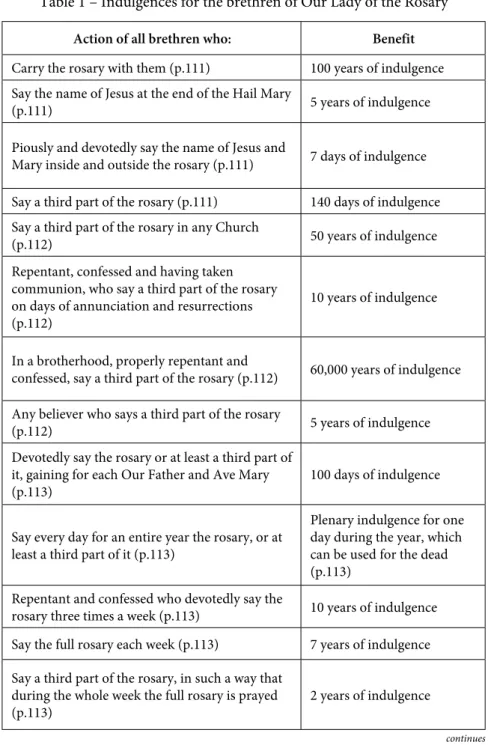
Chapter V of Mestre da Vida is concerned with guiding believers in devotion to the Rosary,40 as well as highlighting the spiritual benefits which
resulted from this. To this was added the “Summary of the Graces and Indulgences granted by many Pontiffs to the Brethren and Devotes of the SS. Rosary, declared in the Bull of Innocence XI,” dated 31 July 1679,41 and in
other bulls (Castro, 1882, p.108). It is interesting to note that the praying of the rosary consisted of a channel for communication between believers and the Virgin,42 whose importance lay in the protection of a dead relative or
Table 1 – Indulgences for the brethren of Our Lady of the Rosary
Action of all brethren who: Benefit
Carry the rosary with them (p.111) 100 years of indulgence
Say the name of Jesus at the end of the Hail Mary
(p.111) 5 years of indulgence
Piously and devotedly say the name of Jesus and
Mary inside and outside the rosary (p.111) 7 days of indulgence
Say a third part of the rosary (p.111) 140 days of indulgence
Say a third part of the rosary in any Church
(p.112) 50 years of indulgence
Repentant, confessed and having taken communion, who say a third part of the rosary on days of annunciation and resurrections (p.112)
10 years of indulgence
In a brotherhood, properly repentant and
confessed, say a third part of the rosary (p.112) 60,000 years of indulgence
Any believer who says a third part of the rosary
(p.112) 5 years of indulgence
Devotedly say the rosary or at least a third part of it, gaining for each Our Father and Ave Mary (p.113)
100 days of indulgence
Say every day for an entire year the rosary, or at least a third part of it (p.113)
Plenary indulgence for one day during the year, which can be used for the dead (p.113)
Repentant and confessed who devotedly say the
rosary three times a week (p.113) 10 years of indulgence
Say the full rosary each week (p.113) 7 years of indulgence
Say a third part of the rosary, in such a way that during the whole week the full rosary is prayed (p.113)
2 years of indulgence
Say the rosary for a week (p.114)
Plenary indulgence for all since, applied by the confessor chosen for arbitration, once in life and another time at the time of death (p.114)
Say the rosary (p.114)
All the Indulgences which believers in the Kingdom of Spain enjoy
Devotedly watch the Procession of the Rosary (p.114)
7 years and 7 quarantines of Indulgences
Watch the procession properly repentant,
confessed and having taken communion (p.114) Plenary indulgence
Watch the procession praying piously to God for the harmony of the Christian princes, extirpation of heresies and exaltation of our Holy Mother the Church (p.114)
Plenary indulgence
For illness or legitimate impediment not being
able to watch the said processions... (p.114) Plenary indulgence
Following the processions on the due days
(p.115) 100 days of indulgence
Following the procession on the days of
Purification, annunciation, visitation, Assumption, nativity, presentation and conception (p.115)
Plenary indulgence
Visiting the Rosary Chapel on the first Sunday of any months and on all the feast days of the Blessed Virgin Mary (p.115)
Plenary indulgence
Visiting on the octave of the Feast of the Rosary the chapel in which the Society of the Rosary is based, on a day chosen, if confessed and having taken communion (p.115)
Plenary indulgence
Giving alms, consoling the sick, teaching the doctrine or doing any work of piety or charity (p.116)
60 days of indulgence
Pray to God for the happy state of the Roman
Pontiff and all the Catholic Church (p.116) Plenary indulgence
At the time of death, confessing and communing
by Viaticum (p.116) Plenary indulgence
Invoking at the time of death the pious name of
Jesus with the heart, if the mouth cannot (p.116) Plenary indulgence
At the time of death, receiving the holy
sacraments, stating their faith in the Church and saying the Salve Regina (p.117)
Plenary indulgence
With the firm purpose of confessing those who (having in their hands, at the time of death, the blessed candle in honor of the Virgin Mary) died; if in life they had said the Rosary at least once (p.117)
Plenary indulgence
Walk, sail and serve, devotedly praying the
Rosary (p.117) Plenary indulgence
Source: prepared by the authors, based on the “Summary of Graces and Indulgences.”
In addition to the “Summary of Graces and Indulgences”, the manual repeatedly recommends that believers keep piously praying to God for the concord of the Christian princes, the extirpation of heresies and the exaltation of the Holy Mother Church, in order to eliminate any doctrinal deviation which hurts Catholic morality. The divulgation of the concession of these in-dulgences sought to reinforce devotion to the Virgin Mary, highlighting her capacity to intercede for the salvation of souls. The feeling of repentance and devout behavior were to accompany believers in their prayers, pilgrimages and visits to churches and also during religious festivals.
Indulgences they would get if, on a pilgrimage, they visited the stations in Rome” (Castro, 1882, p.116). The Plenary indulgence of all sins was aimed at the most pious and devotees of the Rosary and the Virgin who, in times of illness or near to death, kept the faith and trust in the intervention of the Virgin, maintaining the rosary in their hands and thought in their prayers. According to the author of the manual, João de Castro, various pontiffs had granted Indulgences to the dead, such as Pope Innocence XI (1611-1689), who “had perpetually conceded that all and each of the Indulgences conceded to the Brotherhoods of the Rosary, can apply in accordance with the suffrage to the Souls of dead believers who left this world united to God in holy charity” (Castro, 1882, p.117).43
As observed by Vovelle, in the eighteenth century there was a diffusion of the rosary and the scapular, devotions which gained in importance (2010, p.171), which leads us to understand better the statement of the author of the manual: “Lately, a separate volume is needed to refer to the Indulgences of the Rosary, everyday they are increased; the pontiffs which concede them and the Bulls which grant them. This brief report is enough and hopefully we will use all those written here.” The text of the manual was, thus, in harmony with the expression of religiosity in force in Europe in the eighteenth century, by man-ifesting a “new sensitivity, in relation to a more affable Virgin, gracious and even sweet” (Castro, 1882, p.117), as can be seen in the artistic images which portray her with the Christ child in her lap – a Virgin to “be contemplated and to give consolation” (Vovelle, 2010, p.173) – or in practice, adopted by families, meeting every night to recite the rosary (Delumeau, 2009, p.134).
of it. The Indulgences received, as has been shown,were dependent on the number of prayers made, participation in liturgical rituals and the conviction of thoughts and feelings.
Exercising the function of mother of the Savior of all, Mary provided as-sistance to all of humanity, principally guaranteeing comfort in face of the suffering at the hour of death and the so-desired salvation. To obtain this, the believer had to observe the recommendations: devout oneself to the Virgin with great faith, pray and recite the rosary and principally adopt virtuous con-duct and religious behavior in novenas and festivities.
Final considerations
In our first contact with the work Mestre da Vida, what called our attention was the number of republications and translations of the manual between 1731 and 1882, instigating us to reflect on the circulation and appropriation of the guidance for the veneration of and devotion to the Virgin prescribed in it.
One of the intentions of the author of the manual we have analyzed in this article was to guide the thoughts and religious practices of Catholics devotees of the Virgin Mary. Irrespective of whether the reading of the manual was done as a private and subjective experience, the constant republications seen to point to the acceptance of the advice contained in it and for its application by Catholics – both individual and collective demonstrations of devotion to Mary – which aimed to achieve “Your grace in our feelings” (Castro, 1882, p.180). The adoption of the guidance prescribed by João de Castro can espe-cially be perceived in the resort for Marian intervention to guarantee the salva-tion of the soul – which in fact guided numerous passages of the manual ana-lyzed here – in the holding of novenas, prayers to the Virgin and the concessions of Indulgences.
Roger Chartier, we believe that the reader is always being considered by the author, the commentator or the editor of a work, who resorts to strategies to curb the subjectivity of readers and impose a forced reading.44 Some of these
are more evident, as can be seen in the prologues, prefaces and notes, others are implicit, “making the text machinery which must impose a fair comprehen-sion” (Chartier, 1990, p.123). This resource can be found in the Prologue of the manual, in which João de Castro recommends to readers that they should take from the “Compendium the spiritual use necessary for a holy life and death,” dedicating to the Virgin, “sovereign Lady of God, specialized in all creatures and our greatest Protector ... particular recognition,” offering her “as a specialty some tribute of our gratitude,” which “can make us eternally happy and glorious” (Castro, 1882, p.vii).
Despite the difficulties in measuring and evaluating the reception and appropriation of a determined text, we believe it will be possible to evaluate them through the socio-cultural effects which it has produced, even because a text is always marked “by a complex game between various temporal and spa-tial layers. Each reading is an event of translating and updating the work: the reader reconstructs – at a given moment and a given place – the various levels of inter-textuality of the ‘original.’”45
Not only readers contemporary to João de Castro in eighteenth century can have attributed, applied and experimented feelings distinct from the Dominican priest, but also readers from the nineteenth century, principally if we consider the effects of the promulgation of the dogma of the Immaculate Conception in 1854, and the significant alterations in the conceptions and representations of death, especially in the second half of the nineteenth century.
simplification of funeral rituals, associated with the process of secularization of death (Rodrigues, 2005, p.346-347).
The republication of Mestre da Vida in 1882, thus, seems to suggest the reiteration of the importance of devotional practices and the virtuous conduct prescribed by João de Castro at the beginning of the eighteenth century, since the changes that occurred in the second half of the nineteenth century did not provoke an increase in incredulity of a supposed ‘loss’ of religiosity, but new and different representations of death and life beyond the grave (Rodrigues, 2005, p.346-352).
Considering its purpose, the manual Mestre da vida que ensina a viver e morrer santamente, like many other devotional manual and works of morality and theology, must have circulated among lay Catholics and among clerics in ecclesiastic teaching establishments – for regular and diocesan clergy – in the second half of the nineteenth century and in the initial decades of the twenti-eth. The 1882 example which we have analyzed has on its title page a stamp with the letter JHS,46 and shortly below the inscription Novo Hamburgo (RS),
which seems to suggest that it was part of the personal collection of a Jesuit priests or the library of a Jesuit seminary, favoring its reading and the practice of its orientations by young members of this religious order.
The Episcopal Seminary of Porto Alegre (RS) – which when it was trans-ferred to São Leopoldo in 1913, came to be called the Central Seminary of São Leopoldo47 – offered courses in philosophy, theology, morals, and canon law
and to it “flocked, in addition to seminarists from the archdiocese, the other dioceses of Rio Grande do Sul, Santa Catarina, Paraná and other states” (Rambo, 2002, p.302). Imbued with spirit of Catholic Restoration, ecclesiastic education centers– like this Jesuit seminary – were concerned with the educa-tion of a theologically disciplined clergy, committed to religious practice which observed the papal bulls, the sacraments, the commandments, and the dogmas, such as the Assumption of the Virgin Mary, proclaimed by Pius XII in 1950, which preached her elevation to heaven in body and soul at the end of her earthly life.
was not venerated,” while in the public manifestations of faith, the Marian Congregations used blue ribbons and carried banners, militating in the name of Catholicism, very much ‘to the taste of the Jesuits.’ Rambo also mentions Daughters of Mary Associations, stating that “There was no parish with this type of association which did not bring together adolescents and girls in devo-tion to Our Lady. The high point of these groups was also the intense motiva-tion for the sacramental life and the cultivamotiva-tion of Christian virtues” (Rambo, 2002, p.294-295).
The ‘cultivation of Christian virtues’ by these young Catholics in the middle of the twentieth century seemed to evoke the instructions formulated by João de Castro at the beginning of the eighteenth century.48 Instructions
like the ones we found in the first pages of the manual, in which the Dominican friar orientates believers on how to start their day in a ‘saintly’ manner – on their knees in from of an image of the crucified Christ – praying for his salva-tion:
I adore you... Queen of Heaven and Earth, The Most Holy Mary, Mother of God; into your hands I deliver my soul: into your care I deliver the question of my salvation: to your intercession I commend the beginning and end of my life; and by your sweetest entrails of piety I ask thee that I may reach your son with your grace, so that in all thoughts, words and works I do this day I will do your holy will. (Castro, 1882, p.5)
During the eighteenth and nineteenth centuries, lay and clerical Catholics could use the recommendations prescribed by João de Castro to ‘live and die in a holy manner.’ The latter – in their condition of teachers, preachers or confessors – must have used the manual Mestre da Vida to instruct their stu-dents and parishioners ‘in the mysteries of religion’ and to guide them ‘to virtue and perfection.’49 Lay readers – and perhaps listeners – must have sought
the Virgin in Catholic doctrine” as a “privileged symbol of conversion, reaf-firmation and seduction of Catholicism” (Reesink, 2003, p.132).
NOTES
1 This manual of devotion was one of many religious writings which circulated in the
Iberian Peninsula and in Portuguesa America during the colonial period, which generally had an ‘origin and inspiration’ in Spain. SOUZA, Juliana Beatriz Almeida de. Virgem mes-tiça: devoção à Nossa Senhora na colonização do Novo Mundo. Tempo – Revista do Departamento de História da UFF, Rio de Janeiro, v.6, n.11, p.77-92, 2001. p.83; see also: SOUZA, Juliana Beatriz Almeida de. Viagens do Rosário entre a Velha Cristandade e o Além-Mar. Estud. afro-asiát. [online], 2001b, v.23, n.2. Available at: www.scielo.br/scielo. php?script=sci_arttext&pid=S0101-546X2001000200005&lng=en&nrm=iso. Accessed on: 7 June 2011.
2 It is worth noting that in the seventeenth century and, principally in the eighteenth, the
practice of reading was widespread in Europe. Chartier considers that in this period much was read, both in silence and out loud, guaranteeing not only the diffusion of writings, but also a form of familiar, mundane and public sociability. CHARTIER, Roger. A ordem dos livros. Brasília: Ed. UnB, 1994. p.98.
3 It is known that between 1731 and 1750 there were 16 editions of Mestre da vida and that
in 1762, its twentieth was published. RODRIGUES, Cláudia. Nas fronteiras do Além: a sec-ularização da morte no Rio de Janeiro, séculos XVIII e XIX. Rio de Janeiro: Arquivo Nacional, 2005. p.63. It is interesting to highlight that the eighteenth century was fruitful in terms of religious publications. Dominique Julia, referring to the reading of official Catholic publications during the Counter-Reformation in ecclesiastic libraries in France, stated that “the decisive take-over occurred... in the first quarter of the eighteenth century, since this proportion passed in the period of a generation from 45% of inventories, while three-quarters of priests had at least twenty books; around 1755-1760, the priests who had more 100 volumes it had risen to 60% and on the eve of Revolution 75%.” JULIA, Dominique. Leituras e Contra-Reforma. In: CHARTIER, Roger; CAVALLO, Guglielmo. História da leitura no mundo ocidental. São Paulo: Ática, 1999. p.96. Publications before this period, in other words before the sixteenth and seventeenth centuries,were used by missionaries in their fieldwork. According to Charles Boxer, this involved the use of the printed word for spreading the faith, both of lay and clerical writings, such as: catechisms, compendiums, vocabularies, grammars, devotion manuals, edifying works, etc. BOXER, Charles. A Igreja Militante e a Expansão Ibérica. 1440-1770. São Paulo: Companhia das Letras, 2007. p.56.
4 According to the historian Cláudia Rodrigues, this manual was “the second largest work
de Queiroz (1845-1900) makes to it. Available at: simetrikus.wordpress.com/2011/03/29/4/; Accessed on: Apr. 2011.
5 The example analyzed in this article dates from 1882 and is found in the collection of the
Memorial Jesuíta of Universidade do Vale do Rio dos Sinos (Unisinos). Unfortunately there is no information in it about the number of the edition of the work. CASTRO, João de. Mestre da Vida que ensina a Viver e Morrer Santamente. Novamente correto por um Religioso da Ordem dos Pregadores e oferecido à Virgem Santíssima do Rosário por mãos da sua prodigiosa imagem que se venera na Vila do Barreiro. Nova edição. Lisboa: Rolland & Semiond, 1882.
6 Analyzing inventories from 1759 and 1768, referring to the goods of Fazenda Santa Cruz
–belonging to the Jesuit College of Rio de Janeiro –, which were made after the Company of Jesus had been expelled from Brazil, Marília de Azambuja Ribeiro, a researcher in UFPE, found that the Livraria of the Fazenda had “a set of books which we can classify with the label ‘liturgical’, both in the strict sense, in other words they were written to be used in litur-gical rituals as Missals, Rituals, Breviaries, Books of Hours and Martyrologies,” and “books aimed at the Christian community in a broader manner, such as Breve aparelhode bem morrer by Estevão Castro, Mestre da vida que ensina a viver e morrer by João Franco [sic] or Gritos do inferno by Joseph Boneta.” The reference to the manual Mestre da Vida among the works which were part of the collection of the library in Fazenda de Santa Cruz, no Rio de Janeiro, in the second half of the eighteenth century, confirms its circulation in American colonial dominions and points to the diffusion of the prescriptions contained it among Catholics in Portuguesa America. RIBEIRO, Marília de Azambuja. A Livraria da Fazenda Santa Cruz (2011). In print.
7 FERREIRA, Tânia Maria Tavares Bessone da Cruz. Livros, bibliotecas e censores: os
im-pedimentos para os leitores no Brasil do século XIX. In: HEYNEMANN, Cláudia Beatriz; VALE, Renata William Santos do. Temas luso-brasileiros no Arquivo Nacional. Rio de Janeiro: Arquivo Nacional, 2010.
8 GILMONT, Jean-François. Reformas protestantes e leitura. In: CHARTIER; CAVALLO,
1999, p.59.
9 Reflections inspired by TORRES, Magda Maria Jaolino. O “livro-teatro” jesuítico: uma
leitura a partir de Foucault. In: RAGO, Margareth; VEIGA-NETO, Alfredo (Org.) Para uma vida não-fascista. Belo Horizonte: Autêntica, 2009.
10 FLECK, Eliane Cristina Deckmann. Cartografia da sensibilidade: a arte de viver no
cam-po do outro (Brasil, séculos XVI e XVII). In: ERTZOGUE, Mariana; PARENTE, Temis (Org.) História e sensibilidade. Brasília: Paralelo 15, 2006. p.217-248.
11 Like Chartier, we believe that discourses “are produced and diffused in a specific social
beira da falésia: a História entre certezas e inquietudes. Porto Alegre: Ed. UFRGS, 2002. p.258, 259.
12 PESAVENTO, Sandra Jatahy. História & História Cultural. 2.ed. Belo Horizonte:
Autêntica, 2004. p.70.
13 According to Beatris dos Santos Gonçalves, “the economy of salvation presupposes a
distribution of functions or a ‘sharing of tasks’ within the societas christiana”. GONÇALVES, Beatris dos Santos. Os marginais e o Rei: a construção de uma estratégica relação de poder em fins da Idade Média portuguesa. Doctoral dissertation in History – UFF. Rio de Janeiro, 2010. p.31.
14 HUIZINGA, Johan. O outono da Idade Média: estudo sobre as formas de vida e de
pensa-mento dos séculos XIV e XV na França e nos Países Baixos. São Paulo: Cosac Naify, 2010. [1919], p.269. According to some of those who studied the question, Marian dogma origi-nated in passages of the New Testament in which Mary is present in scenes of Jesus’ life and in reports about virginal maternity. It is as a result of this condition that Mary is considered to be a saint, and is presented as the model for virgins. Cfe. SESBOÜÉ, SJ. BOURGEOIS, H. PAUL TIHON, SJ. História dos dogmas. Tomo 3: Os sinais da salvação (século XII–XX). São Paulo: Loyola, 2005. p.467-480.
15 SOUZA, Maria Beatriz de Mello e. Mãe, mestra e guia: uma análise da iconografia de
Sant’Anna. Revista Topoi, Rio de Janeiro: 7 Letras, n.5, p.232-250, 2002. In Colonial Brazil, Mary was the most important saint. Her image and hagiography were also used as a meth-od of conversion, appearing, for example, in iconographic documents prmeth-oduced by the Company of Jesus, notably scenes referring to his life and death, with a biblical interpreta-tion. See more in TORRES, 2009.
16 In his analysis of images which circulated in Hispanic America, Gruzinski emphasized
the Virgin of Guadalupe, which exploited “the miracle [which] seeks to reunite around the common intercessors in the ethnicities which composed colonial society: Spanish, Indians, mestiços, blacks and mulattos.” Later various baroque images of the Virgin Mary reinforced the religious fervor, saturating daily life, invading residences, clothes and family objects. Indigenous painters appropriated the Christian image of the Virgin, transforming them into a new expression of faith and identity. GRUZINSKI, Serge. A guerra das imagens: de Cristóvão Colombo a Blade Runner (1492-2019). São Paulo: Companhia das Letras, 2006. p.160-161.
17 VAINFAS, Ronaldo; SOUZA, Juliana Almeida de. Nossa Senhora, o fumo e a dança. In:
NOVAES, Adauto (Org.) A outra margem do Ocidente. São Paulo: Companhia das Letras, 1999. p.203.
18 ALVES, Franciele. As imagens da Virgem Maria nos vitrais da Catedral de Chartres. II
in a de facto manner, to the members of the trinity, a real regina coeli, a beneficent star who intercedes for men. Cathedrals, generally dedicated to Our Lady, which emerged in the north of France around 1150, are the visible symbol of the new spirituality.” ELIADE, Mircea; COULIANO, Ioan. Dicionário das religiões. Trad. Ivone Benedetti. 2.ed. São Paulo: Martins Fontes, 1999. p.109-110.
19 ZIERER, Adriana. Paraíso versus Inferno: a Visão de Túndalo e a Viagem Medieval em
Busca da Salvação da Alma (séc. XII). Revista Mirabilia, n.2. Available at: www.revistamira-bilia.com/Numeros/Num2/tundalo.html; Accessed on: 7 June 2011. In addition to the his-toriographic studies mentioned until now, there are also recent theological interpretations which give great emphasis to the figure of Mary, such as those found in works, such as the Grupo de Dombes book, a French ecumenical group for reflection, which reference is Maria no desígnio de Deus e a comunhão dos santos: na história e na Escritura – controvérsia e conversão. Aparecida (SP): Ed. Santuário, 2010. Also from a theological perspective we can highlight the article by IWASHITA, Pedro. A relação entre experiência e dogma mariano – Sensus Fidelium e Psicologia da profundidade. Revista Eletrônica Espaço Teológico, v.5, n.8, jul.-dez., p.4-16, 2011. The theological interpretation of Marian dogma was not consid-ered in the analysis we make in this article, to the extent that we propose to look at the circulation of an eighteenth century manual in Europe and in American colonial domin-ions, as well as the appropriation of guidance related to devotional practices, virtues and acceptable social conduct.
20 PEREIRA, Teresa Lopes. O culto de Nossa Senhora dos Mártires em Alcácer do Sal, a
Senhora da Cinta e as Cantigas de Santa Maria. Medievalista, ano 5, n.6, 2009, p.1-23. Available at: www2.fcsh.unl.pt/iem/medievalista; Accessed on: 6 Dec. 2011. According to Rejane Jardim “the Cantigas were the most attractive Mariologies, a work which reflected the devotion, beliefs and concerns of that epoch, in which the Virgin was one of the princi-pal protagonists ... In many of the Cantigas there occurs a reference to the participation of the community in the celebration of Marian miracles ... The Cantigas presented in a com-bined form, six nouns referring to St. Mary: Mother, Virgin, Queen, Lady, Saint and Glorious.” JARDIM, Rejane. Ave Maria, Ave Senhoras de todas as graças! Um estudo do feminino na perspectiva das relações de gênero na Castela do século XIII. Doctoral dis-sertation in History – PUC-RS. Porto Alegre, 2006. p.85-89.
21 In light of the Reformation, Mary was seen as the “Damsel of Nazareth, bearer of total
cultura e poder. In: ENCONTRO DO GT NACIONAL DE HISTÓRIA DAS RELIGIÕES E RELIGIOSIDADES, Anpuh, 1., 2007, Maringá (PR). Available at: www.dhi.uem.br/gtreli-giao/pdf/; Accessed on: 6 June 2011.
22 VOVELLE, Michel. As almas do purgatório, ou, O trabalho de luto. Trad. Aline Meyer e
Roberto Cattani. São Paulo: Ed. Unesp, 2010. p.170. This omnipresence of the Virgin in Catholic doctrine has crossed through the centuries and reaching the present day in such a consolidated manner that the anthropologist Mísia Reesink classified it as a “privileged symbol of conversion, reaffirmation and seduction of Catholicism ... being omniscient and omnipresent ... and almost omnipotent.” REESINK, Mísia Lins. Nossa Senhora de Angüera, Rainha da Paz e do mundo católico contemporâneo. In: STEIL, Carlos; MARIZ, Cecília; REESINK, Mísia. Maria entre os vivos: reflexões teóricas e etnografias sobre aparições mar-ianas no Brasil. Porto Alegre: Ed. UFRGS, 2003. p.132, original emphasis. For an analysis of Marian devotion in Brazil as one of the principal traits of Brazilian religiosity, see CIPOLINI, Pedro Carlos. A devoção mariana no Brasil. Teocomunicação, Porto Alegre, v.40, n.1, p.36-43, jan.-abr. 2010.
23 The investigation included the treatises Principios de Cirugia, by Geronimo de Ayala,
Medicina Practica de Guadalupe, by Francisco Sanz de Dios, Medicina y Cirugia Domestica, by Felipe Borbon, Doctrina Moderna para lossangradores, by Ricardo Le Preux, Secretos Medicos y Chirurgicos, by João Curvo Semmedo, Medicina Ilustrada Chymica Observada and Chirurgia Methodica Chimica Reformada, by Francisco Suarez de Ribera and a manu-script of Materia Medica Misionera, written in America by the Jesuit brother Pedro Montenegro. In our analysis we found that all were dedicated to a member of the royalty or to a Catholic saint, especially Our Lady –, and contained prologues, censures, or approvals granted by the qualifying clerics from the Holy Office or by doctors who were generally linked to some university. In this still unpublished article [it is in print], we present the writing strategies – adopted by authors and editors – which we identified in these texts – which preceded the actual content of the treatises of surgery and medicine –, and which by highlighted suitable paths of reading, were aimed at the diffusion of certain scientific knowledge in Spain and in areas of its vast colonial Empire.
24 Moreover, the control which the Holy Office exercised over the publication may have
25 According to Jean Marcel França, Jemima remained in Bahia from August to September
1764, during which time she wrote seven letters. FRANÇA, Jean Marcel Carvalho (Org.) Mulheres viajantes no Brasil (1764-1820): antologia de textos. Jemima Kindersley, Elizabeth Henrietta Macquarie, Rose Freycinet. Rio de Janeiro: J. Olympio, 2008. p.15-16.
26 HAUCK, Fagundes. Visão histórica da devoção Mariana no Brasil. In: CALIMAN, Cleto
(Org.) Teologia e Devoção Mariana no Brasil. São Paulo: Paulinas, 1989. p.73. According to Virgínia Buarque, Mariology – as a specific form of knowledge about Mary –is theological knowledge, of interest to the historian as ‘imaginary production.’ BUARQUE, Virgínia et al. Devoção à Virgem em Mariana colonial: religiosidade, cultura e poder. In: ENCONTRO DO GT NACIONAL DE HISTÓRIA DAS RELIGIÕES E RELIGIOSIDADES, Anpuh, 1., 2007, Maringá (PR). Anais... Available at: www.dhi.uem.br/gtreligiao/pdf/; Accessed on: 6 June 2011.
27 The title Theotokos, which signified Mother of God, was given to Mary in the fourth
century, but it only crystallized after the Council of Ephesus in 431, which considered Mary to be the Glorious Mother of God and always Virgin. Later, especially during the Middle Ages, the devotion of Christians to Mary was testified in Cathedrals and in the hymns dedicated to her and in the devotion to the rosary (SESBOÜÉ, 2005, p.467-485).
28 NEBEL, Richard. Santa María Tonantzin Virgen de Guadalupe: continuidad y
transfor-mación religiosa en México. México: Fondo de Cultura Económica, 1995. p.48.
29 In Europe until the middle of the nineteenth century, the habit of reading was much
greater than or writing; reading was stimulated by the Church and ‘essentially aimed at young girls,’ becoming a characteristic of societies marked by semi-literacy. CERTEAU, Michel de. A invenção do Cotidiano. v.1: artes de fazer. Petrópolis (RJ): Vozes, 1994. p.263. Reading, not just of Catholic manuals, but also of travel reports, fables, and novels, was more common among the feminine reading public, especially women from bourgeois fam-ilies. WITTMANN, Reinhard. Existe uma revolução da leitura no final do eighteenth cen-tury? In: CHARTIER; CAVALLO, 1999, v.2, p.143.
30 The rosary was created by Canon Domingos de Gusmão in Europe at the beginning of
the thirteenth century, in compliance with the message he received from Our Lady. The rosary, a “means of prayer which intermixing the Hail Mary with small dogmatic medita-tions of the Life, Passion, and Death of Jesus Christ, contained all of Christian doctrine, and finished with a prayer very dear to the heart of the Holy Virgin, suitable for the most humble persons, teaching ... placing them in an attitude of humility towards the Mother of the Savior of the World.” LIMA JÚNIOR, Augusto de. História de Nossa Senhora em Minas Gerais: origens das principais invocações. Belo Horizonte: Autêntica; PUC-Minas, 2008 [1956]. p.89.
31 Laura de Mello e Souza highlights cases of Portuguese women who, accused of false