Application of the comet assay in erythrocytes of
Oreochromis niloticus
(Pisces): A methodological comparison
Cintya A. Christofoletti
1, José Augusto O. David
2and Carmem S. Fontanetti
1 1Departamento de Biologia, Instituto de Biociências, Universidade Estadual Paulista
“Júlio de Mesquita Filho”, Rio Claro, SP, Brazil.
2
Departamento de Genética, Instituto de Biociências, Universidade Federal do Pará, Belém, PA, Brazil.
Abstract
The present study applied the comet assay to erythrocytes ofOreochromis niloticus with the aim of improving proto-cols to detect DNA damage in these cells, by using two distinct pHs (pH = 12.1 and pH > 13) and evaluating whether there is a correspondence between silver and ethidium bromide staining. Comets were visually examined and, the frequency of cells with and without damage was obtained, as well as the distribution of classes and scores. By using the Kruskal-Wallis test, our results revealed that pH 12.1 is more effective, although both pHs can be used. Our find-ings also suggest that silver staining can substitute ethidium bromide, an expensive and highly toxic stain that re-quires specific equipment for examination.
Key words:comet assay, ethidium bromide, silver staining, tilapia. Received: April 2, 2008; Accepted: September 5, 2008.
The development of new methodologies and the ap-plication of more sensitive assays to detect genotoxicity in different samples have been the subject of several scientific studies on environmental monitoring (Al-Sabti and Metcal-fe, 1995; Lemoset al., 2005). The Comet Assay, or single cell gel electrophoresis, is a sensitive genotoxicological method for assessing DNA damage in single cells, allowing for the quantification of DNA breaks and alkaline labile sites. Compared with other genotoxicity tests, the advan-tages of the comet assay are the detection of slight DNA damage, the low number of cells required, low cost, preci-sion, ease of application, reproducibility, and short period of time to conduct the experiment (Belpaemeet al., 1998; Ticeet al., 2000; Bückeret al., 2006).
This technique is the result of studies undertaken by Östling and Johanson, who developed the methodology of DNA electrophoresis in micro-gel, and those by Singhet al. (1988), who improved the technique. Currently, several in-ternational research groups have published recommenda-tions describing protocols and criteria for the comet assay, aiming at establishing high standards to obtain valid, repro-ducible, and accurate data (Klaudeet al., 1996; Brendler-Schwaabet al., 2005; Di-Paolo, 2006).
The comet assay has been successfully applied in erythrocytes of several fish species, thereby showing the
sensitivity of the blood cells of these animals to genotoxic effects (Padrangiet al., 1995; Belpaemeet al., 1998; Gon-tijoet al., 2003). Thus, the aim of the present study was to apply the comet assay to erythrocytes of specimens of the fishOreochromis niloticus, in order to improve protocols for analyzing DNA damage in these cells, by using two dis-tinct pHs, and evaluate whether there is a correspondence between silver and ethidium bromide staining.
For the bioassay, two 20 L aquaria were filled with water from an artesian well, this then being aerated for 48 h and maintained at a room temperature ranging from 20 to 23 °C, prior to the experiment. Five specimens of Oreochromis niloticus (Perciformes, Cichilidae), com-monly known as Nile tilapia, were placed in the aquaria (ta-ble 1). Fishes were obtained from a fish tank of the Institute of Biosciences of the São Paulo State University, Rio Claro campus. The fishes were not fed during the experiment and were exposed to a 14:10 h light/dark cycle, under constant aeration. These were then divided into two groups, treated and non-treated. Non-treated fishes were injected intra-peritonially with saline solution (30 mL of physiological solution/50 g of fish) 72 h prior to the end of the experi-ment. The treated group received an intraperitonial injec-tion of cyclosphosphamide (20 mg/mL) (30 mL of cyclo-sphosphamide /50 g of fish), also 72 h prior to the end of the experiment.
The comet assay was undertaken according to Singh et al.(1988) and Villelaet al.(2006), with certain modifica-tions, as follows. Slides were previously covered with 1.5%
Genetics and Molecular Biology, 32, 1, 155-158 (2009)
Copyright © 2009, Sociedade Brasileira de Genética. Printed in Brazil www.sbg.org.br
Send correspondence to Carmem S. Fontanetti. Departamento de Biologia, Instituto de Biociências, Universidade Estadual Paulista “Júlio de Mesquita Filho”, Av. 24-A, 1515, 13506-900 Rio Claro, SP, Brazil. E-mail: [email protected].
normal melting point agarose. Cardiac punctures were per-formed and 0.3 mL of blood was drawn from the speci-mens. The assay was done in triplicate and later evaluated regarding the effect of different pHs and staining. After car-diac punctures, 5mL of the blood sample were diluted in
1000mL of PBS. 10mL of cell suspension with 120mL of
0.5% low melting point agarose at 37 °C, were layered on previously prepared slides, cover-slipped and placed in the refrigerator for 5 min, for solidification of the gel. The cover-slips were then removed and the slides immersed in a freshly-prepared lysis solution (1 mL of Triton-X 100, 20 mL of DMSO and 79 mL of lysis stock solution: 2.5 M NaCl, 100 mM EDTA and 10 mM Tris, pH 10.0-10.5) for a minimum of at least one hour and a maximum of two, at 4 °C. After lysis, slides were transferred to a horizontal electrophoresis tank. For the first two runs, alkaline solu-tion was added (300 mM NaOH and 1 mM EDTA, pH = 12.1) for 20 min. Upon completion of the relaxing time, slides were subjected to electrophoresis for 15 min at 21 V and 270 mA (0.8 V.cm-1). The same procedures were followed for the last run, although an alkaline buffer (NaOH 300 mM and 1 mM EDTA, pH > 13) was used in this case. All procedures were carried out under indirect light. After electrophoresis, slides were carefully removed from the tank. Neutralization was performed through three baths of 5 min with a neutral buffer (0.4 M Tris-HCl, pH 7.5) to remove salts and detergents. Slides were then al-lowed to dry at room temperature.
For ethidium bromide staining (Figure 1A-C), slides were fixed with 100% ethanol for 10 min and allowed to dry at room temperature. These were then stained with an aqueous solution of ethidium bromide (0.02 mg/mL) before examination under a fluorescence microscope (Leica DMLB), filter B-34 (excitation: i = 420 nM; barrier: I = 520 nM), magnification 1000x.
For silver staining (Figure 1D-F), slides were im-mersed in a fixative solution (15% trichloroacetic acid, 5% zinc sulfate, 5% glycerol), for 10 min in a vertical tank, rinsed three times with distilled water and allowed to dry overnight at room temperature. They were then rehydrated for 5 min with distilled water and stained with 36 mL of so-lution A (5% sodium carbonate) and 54 mL of soso-lution B (0.1% ammonium nitrate, 0.1% silver nitrate, 0.1% silico-tungstic acid, 0.15% formaldehyde, freshly prepared and in the dark) under constant shaking at 37 °C for 10 min, or un-til they became either gray or brown. After staining, the slides were washed twice with distilled water and im-mersed in a stop solution (1% acetic acid) for 5 min, to be
then washed again three times with distilled water and after allowed to dry at room temperature. They were later exam-ined under a light microscope at 400x magnification.
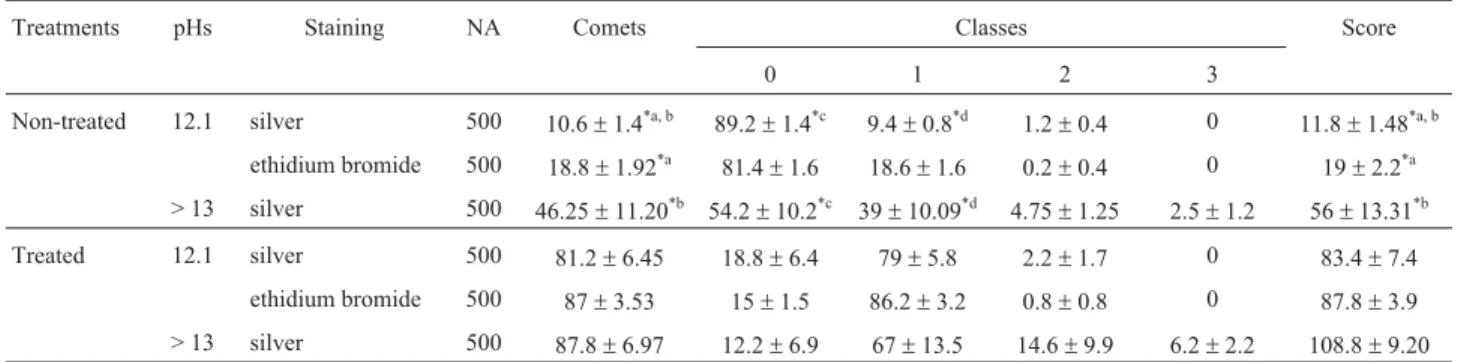
One hundred comets per slide were examined using visual classification based on the migration of DNA frag-ments of the nucleus. Comets were classified into four classes: class 0 (no damage), class 1 (little damage), class 2 (medium damage), and class 3 (extensive damage). Data were presented as the frequency of damaged cells, class dis-tribution, and damage scores, calculated as the sum of cells in each class and the total number of cells in each class mul-tiplied by the number of classes (0-3). Scores ranged from zero (all cells with no damage - 0x100) to 300 (all cells with maximum damage 3x100), according to Rigonato et al. (2005). Statistical analysis was performed using the Krus-kal-Wallis test, with the level of significance set at p < 0.05. The results obtained here for the comet assay in Oreochromis niloticuserythrocytes showed similar images (Figure 1) and score (Table 2) for both staining procedures when pH 12.1 was used in the assay.
In the untreated group, a cell statistical difference was observed between pH 12.1 and pH > 13 (Table 2). When pH > 13 was used in this group, the number of class 0 com-ets decreased while class 1 comcom-ets revealed a significant increase (Table 2). This can probably be due to, the expres-sion of alkali-labile sites that occur only with pH > 13.
Similar levels of damage were registered in treated group cells at pH 12.1 and pH > 13 (Table 2). The effect of treatment could be measured with both staining and pH, al-though the difference between treated and untreated groups was greater at pH 12.1, probably because of the expression of different DNA damage in pH > 13.
According to Padrangiet al.(1995) and Lemoset al. (2005), different tissues of aquatic organisms can be used for the comet assay. However, in most cases, erythrocytes have been used as target-cells, as they require small vol-umes that can be obtained through a non-damaging tech-nique and cell dissociation is not needed (Belpaemeet al., 1998). Gontijoet al.(2003) also applied the comet assay to erythrocytes ofOreochromis niloticus to assess possible
156 Christofolettiet al.
Table 1- Mean and standard deviation of the weight and size of fishes used in the comet assay for both treatments.
Treatments Weight (g) Size (cm)
Non-treated 37.1±10.60 13.24±1.66
Treated 41.34±8.01 13.98±0.82
modulation of induced DNA damage by benzocaine, in erythrocytes exposed to two known mutagens, (methyl methanesulfonate and hydrogen peroxide). Their findings suggested that benzocaine does not interfere with comet as-say results and can be recommended for the welfare of the animal, thus preventing stress.
Souza and Fontanetti (2007) used erythrocytes ofO. niloticus for the comet assay to detect possible geno-toxicants in the waters of the Paraíba do Sul River in an area affected by an oil refinery. The authors concluded that sub-stances with genotoxic potential were present in the waters of the river, as a frequency increase in class 2 and 3 nucleoids was observed in all the months of collection.
According to Belpaemeet al.(1998), the comet assay can also be used to complement studies of chromosome ab-errations, micronuclei, and sister chromatid exchanges. Our findings revealed that blood cells ofO. niloticusused in the comet assay can be used as genotoxic indicators, thus constituting an efficient, fast, and sensitive method to de-tect DNA damages in these cells.
Since being described, single cell gel electrophoresis has been used by researchers in a wide variety of organisms and tissues, thereby improving its usefulness. Thus, to better understand the effects of different pHs on the eryth-rocytes of tilapias, certain changes were made, based on studies by Ticeet al.(2000), Gontijoet al.(2003) and Da-vid (2007), using pH 12.1, unwinding time equivalent to 20 min and electrophoresis time of 15 min, 21 V and 270 mA. pH variation during the lysis and electrophoresis steps affect the type of DNA breaks that can be detected, as DNA denatures and unwinds at pHs of around 12, due to breaks in hydrogen bridges between DNA strands (Kohn, 1991).
At pH 12.3, breaks in the double and single strands are detected, as well as alkali-labile sites or abasic sites (Lee and Steinert, 2003). According to Ticeet al.(2000), pH > 13 is widely used to maximize the expression of al-kali-labile sites and single-strand breaks and thus it is the most recommended, especially for vertebrate cells. How-ever, it is worth pointing out that there is a wide variety of
DNA lesions. Among these, single-strand breaks, do not give rise to drastic effects, as they are quickly repaired, whereas double stranded DNA breaks are much more se-vere and have much more complex repair pathways (Gon-tijoet al., 2003; Moller, 2006; David, 2007).
Di-Paolo (2006) evaluated the different exposure times of erythrocytes in snooks during the various steps in lysis and electrophoresis, and observed that there was a gradual increase in the intensity of DNA migration due to the effects from an increase in voltage of electrophoresis on the morphology of comets. The author also concluded that the best results were obtained at pH 12.6 and pH > 13, under the following conditions: 10 min for unwinding and, 20 min for electrophoresis at 0.8 V/cm and 300 mA, thereby indi-cating the suitability of the assay for measuring damage in the blood cells of snooks.
Our results revealed that pH 12.1 as well as pH > 13 are effective for the comet assay in tilapia erythrocytes. Al-though many authors, such as Ticeet al.(2000) and Gontijo et al.(2003) suggested a pH > 13 for both vertebrate cells andO. niloticus, pH 12.1 was the most efficient in this study, as there was a greater difference between treated and untreated cells on using pH 12.1 when compared to pH > 13 (Table 2).
Ethidium bromide is traditionally used for staining materials examined by fluorescence. However, this dye has certain negative aspects, such as its toxic and mutagenic ef-fects, the need for specific equipment and the short duration of staining. Silver staining, on the other hand, has been de-scribed as a good alternative for the comet assay, demon-strating high sensitivity when compared to ethidium bromide (Reinhardt-Poulinet al., 2000; Di-Paolo, 2006).
Di-Paolo (2006) applied silver staining in a comet as-say on the blood cells of snooks and found high sensitivity when visually examining comets, as this is a fast and simple method that can be observed under the light microscope. Villelaet al.(2006) obtained similar results in a study un-dertaken with the bivalveLimnoperna fortunewhen using different concentrations of copper sulfate and pentachloro-phenol.
Comet assay in erythrocytes 157
Table 2- Average number of cells with comet, distribution of classes and damage scores (mean and standard deviation) for the two treatments using two pHs and forms of staining.
Treatments pHs Staining NA Comets Classes Score
0 1 2 3
Non-treated 12.1 silver 500 10.6±1.4*a, b 89.2
±1.4*c 9.4
±0.8*d 1.2
±0.4 0 11.8±1.48*a, b
ethidium bromide 500 18.8±1.92*a 81.4±1.6 18.6±1.6 0.2±0.4 0 19±2.2*a
> 13 silver 500 46.25±11.20*b 54.2±10.2*c 39±10.09*d 4.75±1.25 2.5±1.2 56±13.31*b
Treated 12.1 silver 500 81.2±6.45 18.8±6.4 79±5.8 2.2±1.7 0 83.4±7.4
ethidium bromide 500 87±3.53 15±1.5 86.2±3.2 0.8±0.8 0 87.8±3.9
> 13 silver 500 87.8±6.97 12.2±6.9 67±13.5 14.6±9.9 6.2±2.2 108.8±9.20
Garciaet al. (2007) described a protocol for silver staining when using the comet assay in human lymphocytes exposed to gamma radiation, and obtained a significant per-centage of DNA in the tail of silver-stained comets, very similar to those obtained by fluorescence staining. Other parameters of comets, such as length and momentum of the tail, were also quantified using conventional microcopy and Internet software.
The results obtained in our study showed that both stains were efficient. Silver staining, however is recom-mended, as it is less toxic than ethidium bromide, does not require specific equipment for analysis, and provides long lasting staining.
Thus, this study suggests that erythrocytes of Oreochromis niloticus are good genotoxicity indicators through the comet assay, an efficient, fast, and sensitive method to detect DNA damage. Our data also revealed that pH 12.1 is the best, although both pHs, 12.1 and pH > 13 can be used with adaptations under electrophoresis condi-tions. Moreover, silver staining is recommended in prefer-ence to ethidium bromide.
Acknowledgments
The authors are thankful to Dr. Dejanira Franceschi de Angelis of the Laboratory of Water Toxicity, Depart-ment of Biochemistry and Microbiology of the Institute of Biology of UNESP-Rio Claro/SP for technical support, to FUNDUNESP (Foundation for the Development of the UNESP) and to CNPq (National Council for Scientific and Technological Development) for financial support.
References
Al-Sabti K and Metcalfe CD (1995) Fish micronuclei for assess-ing genotoxicity in water. Mutat Res 343:121-135. Belpaeme K, Cooreman Kand, Kirsch-Volders M (1998)
Devel-opment and validation of thein vivoalkaline comet assay for detecting genomic damage in marine flatfish. Mutat Res Genet Toxicol Environ Mutagen 415:167-184.
Brendler-Schwaab S, Hartmann A, Pfuhler S and Speit G (2005) Thein vivocomet assay: Use and status in genotoxicity test-ing. Mutagenesis 20:245-254.
Bücker A, Carvalho W and Alves-Gomes JA (2006) Avaliação da mutagênese e genotoxicidade em Eigenmannia virescens
(Teleostei, Gymnotiformes) expostos ao benzeno. Acta Amazônia 36:357-364.
Garcia O, Romero I, Gónzalez JE and Mandina T (2007) Mea-surements of DNA on silver stained comets using free Internet software. Mutat Res 627:186-190.
Gontijo AMMC, Barreto RE, Speit G, Reyes VAV, Volpato GL and Salvadori DMF (2003) Anesthesia of fish with benzo-caine does not interfere with comet assay results. Mutat Res 534:165-172.
Klaude M, Eriksson S, Nygren J and Ahnström G (1996) The comet assay: Mechanisms and technical considerations. Mutat Res 363:89-96.
Kohn KW (1991) Principles and practice of DNA filter elution. Pharmacol Ther 49:55-77.
Lee RF and Steinert S (2003) Use of the single cell gel electropho-resis/comet assay for detecting DNA damage in aquatic (marine and freshwater) animals. Mutat Res 544:43-64. Lemos NG, Dias AL, Silva-Souza AT and Mantovani MS (2005)
Evaluation of environmental waters using the comet assay in
Tilapia rendalli. Environ Toxicol Pharmacol 19:197-201. Moller P (2006) The alkaline comet assay: Towards validation in
biomonitoring of DNA damaging exposures. Pharmacol Toxicol 98:336-345.
Padrangi R, Petras M, Ralph S and Vrzoc M (1995) Alkaline sin-gle cell gel (comet) assay and genotoxicity monitoring using bullheads and carp. Environ Mol Mutagen 26:345-356. Reinhardt-Poulin P, McLean JR, Deslauriers Y, Gorman W,
Cabat S and Rouabhia M (2000) The use of silver-stained “comets” to visualize DNA damage and repair in normal and
Xeroderma pigmentosumfibroblasts after exposure to simu-lated solar radiation. Photochem Photobiol 71:422-425. Rigonato J, Mantovani MS and Jordão BQ (2005) Comet assay
comparison of differentCorbicula fluminea(Mollusca) tis-sues for the detection of genotoxicity. Genet Mol Biol 28:464-468.
Singh NP, McCoy MT, Tice RR and Schneider EL (1988) A sim-ple technique for quantification of low levels of DNA dam-age in individual cells. Exp Cell Res 175:184-191. Tice RR, Agurell E, Anderson D, Burlinson B, Hartmann A,
Kobayashi H, Miyamae Y, Rojas E, Ryu JC and Sasaki YF (2000) Single cell gel/comet assay: Guidelines forin vitro
and in vivo genetic toxicology testing. Environ Mol Mutagen 35:206-221.
Villela IV, Oliveira IM, Silva J and Henriques JAP (2006) DNA damage and repair in haemolynph cells of golden mussel (Limnoperna fortunei) exposed to environmental contami-nants. Mutat Res 605:78-86.
Internet Resources
David JAO (2007) Estudo deMytella falcata(Mollusca, Bivalvia) como indicadora de efeitos genotóxicos e citotóxicos no es-tuário de Santos, SP (PhD Thesis, UNESP, Rio Claro, 2007), http://www.athena.biblioteca.unesp.br/exlibris/bd/brc/3300 4137046P4/2007/david_jao_dr_rcla.pdf (January 25, 2008) Di-Paolo C (2006) Aplicação do ensaio do cometa a estudo de danos ao DNA de robalos,Centropomus parallelus(Poey, 1860), expostos à ß-naftoflavona (Master Thesis, USP,
São Paulo, 2006),
http://www.teses.usp.br/teses/disponiveis/21/21131/tde-17 102006-154149/ (January 25, 2008)
Souza TS and Fontanetti CS (2007) Ensaio do cometa para avalia-ção das águas do rio Paraíba do Sul, numa área sob influência de uma refinaria de petróleo. 4º Congresso Brasileiro de P&D em Petróleo e Gás-PDPETRO, 2007, Campinas, p. 1-10, http://www.portalabpg.org.br/PDPetro/4/resumos/4PDPET RO_6_2_0018-1.pdf (August 5, 2008).
Associate Editor: Catarina S. Takahashi
License information: This is an open-access article distributed under the terms of the Creative Commons Attribution License, which permits unrestricted use, distribution, and reproduction in any medium, provided the original work is properly cited.