1226
OPPORTUNITIES OF EXERCISING THE ROLE OF AN ACTIVE STUDENT AS A PREMISE OF STUDENT-CENTERED EDUCATION IN THE ECONOMIC SCIENCES FACULTY OF THE UNIVERSITY OF ORADEA
Rosca Remus
The University of Oradea, Economic Sciences Faculty, The Management and Marketing Department, Oradea, Romania
Abstract: This paper presents the opportunities offered by the Economic Sciences Faculty from Oradea regarding the taking of the role of an active student as a condition of the student-centered education. It also includes a quantitative research on the availability of the first-year students to take the role of active students by involving themselves into the curricular and extracurricular activities. The research method was a survey based on a questionnaire on a 92- student sample. We have also developed a qualitative research based on the focus group method in which seven students of the faculty participated. Starting from the research results we have suggested a series of extremely important projects to implement the student-centered education within the Economic Sciences Faculty from Oradea, the most important being: Excelsior - the involved student community, the professional portofolio of the students and the student magazine Excelsior.
The ideas presented in this paper are to represent a part of a good practice guide on implementing student-centered education within a high educational institution. The concern for this concept is determined by the current context of the high educational system in Romania characterized by: the intensification of the competitive environment; increasing employers’ demands; increasing high school graduates and students’ demands towards the quality offered by a high educational institution; the performance indicators used by ARACIS in the evaluation of the universities, a very relevant example being the graduates’ professional route in the labour field. We are convinced that the ideas presented in this paper are important to the decision factors from the academic environment, factors that should initiate and facilitate the implementation of the student- centered education concept.
Keywords: active student, student-centered education, good practice guide on implementing student-centered education.
JEL classification: A23
1. The analysis of the current situation on the opportunities to assume the role of an active student as a premise to the student-centered education within the Economic Sciences Faculty from Oradea.
“I never teach my students, I only attempt to provide the conditions in which they can learn.19”. The statement of the great scientist Albert Einstein demonstrates the fact that he practised a student-centered education even more than half a century ago. In the nowadays context, the high educational institutions in Romania strive to implement this paradigm of the student-centered education at the level of current everyday practice. The
1227
specific conditions of this context that put more and more pressure on universities to implement SCE are:
ü The intensification of the competitive environment due to the emergence of private universities in the Romanian academic environment but also of foreign universities providing more and more advantageous facilities to high school graduates in Romania while their number is reduced. In these conditions high school graduates have many options of choosing the university they want to attend.
ü Increasing the employers’ demands, a greater and greater part of job offers coming from the corporations.
ü Increasing the high school graduates and students’ demands toward the quality offered by a high educational institution.
ü The performance indicators used by ARACIS in the evaluation of the universities, a very relevant example being the graduates’ professional route in the labour field. The performances recorded by these significantly determine the financial resources allocated from the state budget.
In this context, in the past years, The Economic Sciences Faculty from Oradea (ESF) made a constant and sustained effort to implement the student-centered education (SCE). Next we inventory and present only some of the projects undertaken by the ESF in order to give students the possibility to assume an active role in their institution, this being an underlying condition of SCE.
A. Student circles and associations are extremely important organizational structures for providing our students extracurricular experiences. There are nine student circles in The ESF20. All of them offer the ESF students many opportunities for learning and experimentation which can significantly contribute to their professional and human development. For example Excelsior’s plan of activities for the academic year 2013-2014 is entitled “Entrepreneurship and voluntariate”. Within it they carry out a series of activities that encourage entrepreneurship and voluntariate idea, we develop necessary skills for this, we provide models and opportunities to let them express themselves effectively in both directions. Regarding student associations, the ESF students have the opportunity to become members and/or to work in one of the largest global young people association , AISEC21.
B. The encouragement and support of the student participation in competitions like student Olympiad, scientific communications for students, Talent Scholarship. Relevant in this respect are the places of our students in these events : first place in 2012 at the national stage of the Management Olympiad, and the grand prize won in the 2013 at the national stage of the Marketing Olympiad.
C. Partnerships Development with NGOs and representative companies in Oradea and Bihor county where they organize: work visits to companies, internships, practice stages, inviting business representatives to lectures, seminars and other events organized by the ESF. There are relevant partnerships with: Celestica located in the top five largest companies in Bihor county; Oradea Community Foundation, one of the most active NGOs from Bihor and which hosts numerous programmes for young people. To highlight the importance of these partnerships, we will present some of the activities with Celestica:
20 ***
http://studentocratia.com/informatii-utile/cercuri-stiintifice-studentesti/facultatea-de-stiinte-economice/31.03.2014
1228
ü Work visits to the company, with the students. One of these took place on
4.04.2014. The visit called „Quality in action. Good practice – Celestica_SRL-Oradea facility” was meant to present the students what quality culture is and the quality instruments used by the company.
ü The development of our students’ practice stages in the company. Regarding this,
Celestica company contribution in the Practeam project by the ESF has been significant.
ü Annual internship offer for the ESF students
ü Company giving a scholarship to a student after a strict evaluation process. ü A free course developed by the employees of Celestica company inside the ESF,
called Supply Chain Excellence. Here, the participant students are trained to have a job in a certain department of the company.
ü The participation of the company representatives in a series of events organised by the students and the ESF.
This bringing together of the universitary environment and the socio-economical one represents a priority for the ESF. Thus, the chances for our students to be according to the demands and, consequently, to find a suitable job, are considerably higher.
D. The elaboration of some subject records focused on the students’ practice, on the development of some skills coming from the concept – learning by doing. The simulations and management projects subject from the management study programme as well as the simulations and marketing projects subject from the marketing study programme are relevant examples. These school subjects encourage and support the students to think and act as managers, marketers, respectively. Not only do they have to elaborate a project on a certain topic but they also have to implement it. Their evaluation is according to the level of their project objectives and also according to the efficiency of their accomplishment.
E. The constitution and the good working of the Consultativ Council at the level of the study programmes managed by the ESF. This is an opportunity for the managers and the teachers of the ESF to be familiar with the employers’ requirements towards the graduates and also towards the students, through the students members of the council. In the same time it is a chance to mobilize resources outside the ESF in order to develop some value adding projects for our students and teachers.
F. The encouragement of the students’ voluntariate through the procedure of The University of Oradea regarding the granting of the transferable credits for this kind of activitiy22 and through some partnerships with the NGOs in Oradea, where the students can be actually involved in the voluntariate. The students’ revaluation of these voluntariate opportunities considerably enlarges their experience portofolio so necessary to the human and professional development.
G. Mentor actions of the ESF students. These actions were initiated at both Management and Marketing Excelsior Circle and ESF levels. In this programme the students in the third yesr of study were to become the mentors of the students in the first year of study. The purpose is to improve the ESF student experience for those in the first year and to develop the feeling of involvement and belonging to the ESF of those in the third year. These represent only a part of the ESF projects which offer the students very interesting opportunities to assume the role of active students, students involved in the life of the university in which they study.
2. Study concerning the availability of the students in the first year of study to agree with SCE in The ESF
22 ***
1229
The role of this study is to measure and analyse the availability of the first year ESF students to assume the role of active students, involved students. The purpose of the research is the substantiation of the decisions concerning the projection of the curricular and extracurricular ESF activities to successfully implement the student-centered education concept.
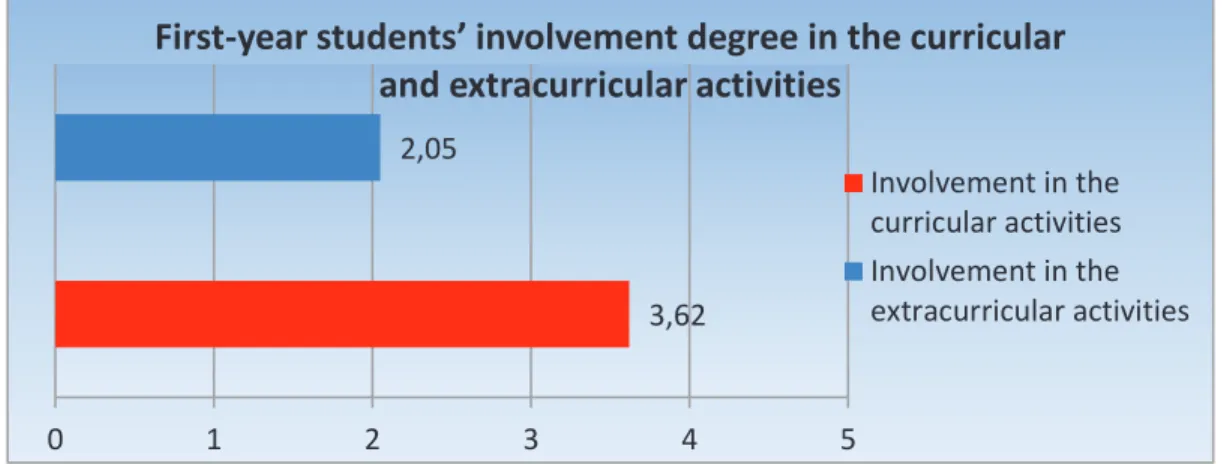
The research method is a survey based on a questionnaire. The research was done between 17- 21.03.2014, the statistical population being represented by 92 first-year students of the ESF from Oradea. We will present below the results of this research. For a start we wanted to find out about the first-year students’ current degree of involvement in all the activities of the second semester in the faculty in which they study. On a scale from 1 to 5 we got a result of 3,62 for the involvement in the curricular activities and 2,05 in the extracurricular ones. From our point of view, the involvement in the extracurricular activities is pretty reduced whereas the other one is moderate, both being likely to be significantly improved.
Figure 1: First-year students’ involvement degree in the curricular and extracurricular activities
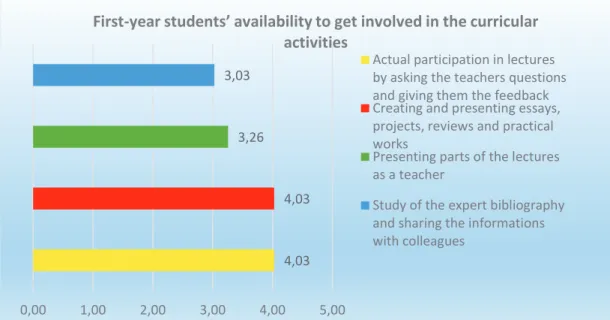
The results regarding the students’ availability to get involved in the curricular activities in the next two years of study are presented in the chart of figure 2. What can be noticed here is that the greatest availability is related to the actual participation in lectures by asking the teachers questions and giving them the feedback, as well as by creating and presenting essays, projects, reviews and practical works. The lowest availability is related to the study of the expert bibliography.
3,62 2,05
0 1 2 3 4 5
First-
year students’ involvement degree in the curricular
and extracurricular activities
Involvement in the curricular activities
1230
Figure 2: First-year students’ availability to get involved in the curricular activities
The results regarding the students’ availability to get involved in the extrcurricular activities in the next two years of study are presented in the chart of Figure 3. What can be noticed here is that the greatest availability is related to the participation in work visits to companies and to the participation in internships in companies. These are excellent opportuities to gain practical experience. The lowest availability is related to assuming the mentor role for the younger colleagues and to the participation in scientific communication sessions dedicated to students and/or student olympiad. An average level of availability was shown regarding the involvement in student circles and/or associations and taking the volunteer role.
Figure 3: First-year students’ availability to get involved in extracurricular activities 4,03
4,03 3,26 3,03
0,00 1,00 2,00 3,00 4,00 5,00
First-year students’ availability to get involved in the curricular
activities
Actual participation in lectures by asking the teachers questions and giving them the feedback Creating and presenting essays, projects, reviews and practical works
Presenting parts of the lectures as a teacher
1231
3. Future projects concerning the student-centered education at the Faculty of Economic Sciences in Oradea
These future projects regarding CSE at the ESF started from the results of the research presented above, from the focus group organized with the students and from the discussions with the teachers of the Management Marketing Department of the ESF. We will present a part of these projects.
3.1 Excelsior – the community of the students with initiative. Through this project, the current student circle Excelsior, coordinated by teachers is to become the exclusive or almost exclusive property of the students. The management team will be exclusively formed by students who will benefit from the support of teachers. Excelsior will develop its activity as legal entity/person as a non-government organization.
The role of this structure and project is to offer the students a series of extracurricular opportunities which allow them the human and professional development. Excelsior will manage a portofolio of multiannual activities but it will also organize activities specific to a certain topic during the university school year. For example, the topic of the university school year 2013-2014 for Excelsior was entrepreneurship and voluntariate and for 2014-2015 is the financial education of the students. What they would like for the continuous activities of Excelsior community are the following:
a. The management of some partnership with business and non-profit environment for: Ø organizing work visits with the students to high reputation Romanian companies Ø the management of an internship portofolio which can be accessed by
students;
Ø the access to job offers for which the ESF students can apply too;
Ø the development of practice stages of the students in the second year of study; Ø inviting the business environment and non-profit field representatives to
lectures, seminars and different organized events;
Ø the participation in training and events organized by the business environment and non-profit field;
Ø getting some sponsorship necessary for the development of some projects and activities;
Ø the performance of some services for the small and medium firms (creating the visual identity, naming, creating sites and facebook pages, on-line promoting, mistery shopper services, etc).
b. The support of the educational process of the ESF in close cooperation with the teachers.
c. Partnerships with other student associations for the experience exchange and for developing together some activities and projects.
d. Access some financing sources dedicated to the non-profit field through the development of projects and their implementation after. This way important resources can be obtained in order to create the necessary conditions for an activity and also to motivate the students to get involved.
3.2 Students’ professional portofolio is a project at the first stage of
implementation, as the students in the first year of study are asked to create their site where to develop their professional portofolio. This project should be continued with the following:
ü Informing and educating all ESF students about the professional portofolio development necessity and opportunity
1232
ü Providing students opportunities to enrich the professional portofolio (this aspect is also presented in 3.2).
The purpose of students’ professional portofolio is to give them higher chances to become integrated in the labour market, on the one hand due to their high education, on the other hand due to the superior way of behaving at an interview or job exam.
3.3 Excelsior is a student magazine in which:
ü the students in the economic field can publish expert articles to share their knowledge with their colleagues;
ü they present interesting information about different opportunities students can access: Erasmus scholarships, jobs, internships, activities of the initiative students’ Community , etc.
ü students write about their own experiences with: Erasmus scholarships, Work & Travel, student camps, voluntariate, trips, entrepreneurship, working in a company, etc.
4. In conclusion
We believe that the three projects we have presented will significantly improve the experience of the ESF students with positive aspects for all the stakeholders: the students through satisfaction and three years of human and professional development; the faculty through a pleasant work environment for the teachers and consequently high work satisfaction due to the content of their customers who will become the most important promoters of the ESF; business environment and non-profit department which will benefit from well trained workforce, with a value system focused on involvement and work performance; community through responsible and educated citizens.
Under the circumstances, the continuous effort to implement the SCE at the ESF is a priority. The success of this process is conditioned by the constant effort of all the stakeholders: students, teachers, the management team of the ESF, business environment and non-profit department.
Acknowledgment
This paper has been financially supported within the project entitled „SOCERT.
Knowledge society, dynamism through research”, contract number
POSDRU/159/1.5/S/132406. This project is co-financed by European Social Fund through Sectoral Operational Programme for Human Resources Development 2007-2013. Investing in people!
References
1. Good practices guide regarding student-centered education – Nicolae Titulescu University.
2. Student-centered education – guide for students, teachers and universities – The European students Union.
3. http://universitateaalternativa.ro/
4. http://www.anosr.ro/wp-content/uploads/2012/07/2012-Toolkit-ICS-cadre-didactice1.pdf
1233
6. http://aiesecoradea.ro7.