Method of operational
diagnostic state of flow and calculation of calibration
Coefficients using artificial neural networks
Dr. Safarini Osama
IT Department University of Tabuk,
Tabuk, KSA
Abstract— An important task of operational management in oil and gas production is the control of fluid flow and technological objects of engineering network (EN).
This paper proposed a method for diagnosis of fluid flow measurement and calibration operations. The method is based on the relationship between various parameters of the flow of Engineering Network.
To calculate the actual flow rate on other parameters of the flow, such as pressure, temperature, and the parameters that determine the composition of the liquid (oil), it is proposed to use a neural network.
Keywords: Engineering Network (EN), Neural Network (NN)
I.
Introduction
An important task of operational management in oil and gas production is the control of fluid flow and
technological objects of engineering network (EN). A
sign of deviation from the normal operation of EN is the appearance of an imbalance in the nodes of the EN that is mismatch between the amount of expenditure of fluid input and output node.
The causes of the imbalance may be:
mismatch model EN of the real EN;
changes in technological regime;
leakage of fluid;
uncertainty of the measurement results of liquid flow.
Using the well-known mechanical-mathematical models of processes in hydraulic circuits, and based on these models and methods of analysis of parameters identification of EN oil and gas production difficult because of the complexity of the processes themselves, the incompleteness of the data collected real-time and the
large number of unaccounted factors.
In such cases, are becoming increasingly important, methods based on knowledge, which use additional a priori and experimental data on the operation of EN violations in its work. One of the most promising among these methods is neural networks methods [1].
In [1] considered the solution of EN diagnostics with neural networks (NN). In addition to determining the causes of imbalance in our method allows to calculate calibration coefficients measuring tools. The structure of the EN is in the form of the Neural Network, i.e., NN is a model of engineering networks. The weights of the Neural Network are the coefficients that characterize the relationship between the imbalance and the resulting flow measurement (e.g., calibration coefficients of the measurement).
The learning process of the Neural Network with the determination of model parameters on the EN nodes subsequent interval estimation (calibration factors of measurement, the parameters of production lines and inflow / leakage at the nodes) is performed based on the values of a set of vectors imbalances, and the parameters of production lines and inflow / leakage obtained the previous interval estimation. An Education adjustable coefficient of neural network model is repeated until a balance of the corrected measurements of parameters at the nodes of the EN.
From the values of the coefficients obtained by learning, diagnose the state of the equipment, put forward the hypothesis of change in the structure of the site or EN of measuring process parameters, change the initial organizing neural network model, taking into account the indicators of degree of confidence in the models of EN nodes and the results of flux measurements, and repeat the learning process.
Thus, in this method each time the diagnosis is required to conduct its training to determine the calibration coefficients.
II.
Discussion
Problem statement of operational
calibration of the flow rate of EN
To calibrate the instruments necessary to satisfy the following conditions:
imbalance in the node exceeds the value of EN;
EN model corresponds to the real EN;
during the analysis of imbalances no change in the
technological regime;
IJCSI International Journal of Computer Science Issues, Vol. 9, Issue 1, No 3, January 2012 ISSN (Online): 1694-0814
www.IJCSI.org 197
At the sites corresponding to the edges of the model - the EN is not revealed leakage of the fluid.
These conditions suggest that the cause of the imbalance was the unreliability of the results of measurement of liquid flow. It is therefore necessary to calibrate the flow measuring means of the flow.
To solve this problem, each node IP is considered separately, i.e., without interaction with other nodes. In order to conduct an operational calibration, you must solve the following problems:
1. To determine which edges of the EN unit show
unreliable results.
2. Calculate the correction factors to the measured
values.
During calibration of the EN is required to find the coefficient k, which is necessary to multiply the measured flow rate to obtain the real value of liquid flow:
Q
r= Q
mk
,
(1)
where Qr - the real value of consumption; Qm - the measured
flow rate.
From equation (1) that the coefficient k can be calculated from the actual flow rate is:
(2)
Knowing the actual and calculated flow rates you can
determine which flows measurements are unreliable. If these
two flows close to value, it can be concluded that the results
measurements are reliable. In the opposite case it is decided
that the results of measurements are unreliable.
Thus, the problem of operational calibration consumption can be reduced to the calculation of the real value of liquid flow.
Neural network method for calculating
correction coefficients
At any time, the flow state is characterized by a number of parameters {P, Q, W, Vpro, Vcr, C, M,ρ, η}:
pressure P,flow rate Q(volume or mass), the water content W,
content of dissolved gas Vpro, content of free gas Vcr, content
of salts in anhydrous oil C, content of mechanical impurities
M,density ρ, viscosityη
Between flow and other parameters there is a connection, which is derived from the laws of hydraulics:
Q = f (P, W, Vpro, Vcr, C, M,ρ, η). (3)
The main idea of solving the problem lies in the fact that the known parameters to calculate the flow rate and compare it with the measured flow rate.
If the calculated and measured costs are equal or close by value, it is decided that the result flow measurement in this thread is valid, i.e., the rate of EN function is correct. If these costs are not equal, then the decision is made that the measurement is invalid.
In this case, knowing the measured and calculated costs we can calculate the correction coefficient of flow measurement this stream. In other words, knowing the other parameters of the flow, we can calculate the flow rate.
One of the most famous formulas that determine the function (3) is the Poiseuille formula [2].
However, its use for the calculation of the other parameters can give a large error, and the calculation is incorrect
There are the following general deficiencies using the analytical formula:
it focuses on the ideal fluid;
takes into account not all parameters of each stream;
contains parameters that cannot be measured for real
objects;
Some of the coefficients in the formula flow cannot
be measured for calculations they assumed to be constant (quality pipes, internal friction, etc.).
To solve the problem of calculating the flow rate by indirect methods proposed to use a neural network. In contrast to the formula, NN calculates flow rate, taking into account the characteristics of each particular stream, which is achieved by setting the NN for each thread and its proper training on the actual results of the measurement of various parameters of the flow.
The essence of the Neural Network is as follows:
for each stream node is assigned its NN;
NN is trained as an imbalance in the node is less
allowable values, i.e., the node is in the normal state;
NN goes into operation, expects to consumption,
when an imbalance in the site than the maximum
value and accurately determined that the cause
imbalance is the uncertainty of measurement results.
Education of the Neural Network can occur in two ways:
IJCSI International Journal of Computer Science Issues, Vol. 9, Issue 1, No 3, January 2012 ISSN (Online): 1694-0814
www.IJCSI.org 198
1. If there is a large database of already accumulated information about the values of flow parameters at the same time, whereas the NN can be trained in advance, and as new sets in up to be trained online.
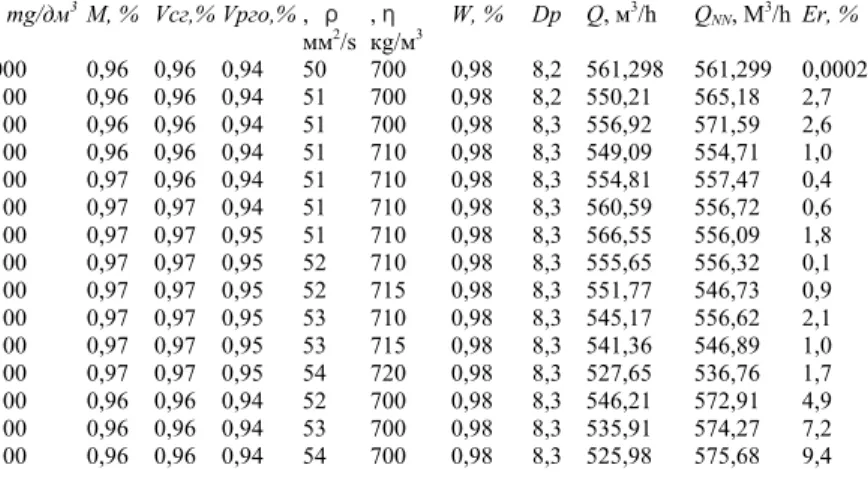
Table 1 The results of the neural network
2
.
In online mode, when the imbalance in the node is less thanthe permissible value, i.e. it is assumed that all measurements are reliable.
Suppose at a particular time Ti each flow j EN has the
following set, which characterizes its state: {Pji, Qji, Wji, Vproji,
Vcrji, Cji, Mji, ,η }. This set is said that if the values of the
flow parameters are equal Pji, Wji, Vproji, Vcrji, Cji, Mji, ,η
respectively, the flow rate is equal to Qji .
If at that moment of imbalance in the node is less than the permissible value, this collection describes the normal state of flow. A lot of these sets describes a set of normal states of the flow.
Suppose at a particular time Ti node is operating normally, i.e.,
the imbalance is absent, then supplied to the input of the Neural Network set Pji, Wji, Vproji, Vcrji, Cji, Mji, ,η and the
output Qji,. Having learned on the set of such collections, the
Neural Network is able to recognize the normal state of flow. Further, in case of abnormal operation of the node at a
moment of time Tk when the input, is a set of {Pki, Qki, Wki,
Vproki, Vcrki, Cki, Mki, ,η }. NN finds the most similar state
(set parameters) and calculates what should be the rate for given values of the parameters.
Thus, the NN studies situations where the flow is functioning normally, with no deviations. In other words, the NA simulates the flow in the normal mode and in case of abnormal operation (the unreliability of the results) to determine what flow rate corresponds to the current values of other parameters.
To assess the possibility of the NN to solve the problem posed, was conducted a preliminary simulation of the NN.
Simulation of the NN was done in MatLab using the tool nntool.
As a training sample sets were selected {P, W, Vpro, Vcr, C, M,
,η }.
As the desired output - the corresponding value Q. Sets
represent different combinations of parameter values. By the formula of Poiseuille [2] for each such set was calculated rate Q. It is important to note that in this case, this formula is only used for obtaining the training set. The total number of sets was 500.
The results of the efficiency of NN is shown in the table1.
The first line represents one set of training sample. Other lines - these are examples in which the parameters are changed to a small value compared with the training set, i.e., examples of similar parameter values to the training set.
According to the table the following conclusions can be made:
1. NN gives an error of generalization 1 ... 2% for small
deviations of the parameters Vpro, Vcr, C, M, Dp and
by proportional change in the parameters ,η
2. Further study of the relationship between density,
viscosity and output of the NN.
III.
Conclusions
This paper proposed a method for diagnosis of fluid flow measurement and calibration operations. The method is based on the relationship between various parameters of the flow of EN.
To calculate the actual flow rate on other parameters of the flow, such as pressure, temperature, and the parameters that determine the composition of the liquid (oil), it is proposed to use a neural network
For NN training are encouraged to use the accumulated information about the states of flow, and conduct additional training in on-line mode during normal operation flow.
The method allows to determine which streams the measured flow rate results unreliable, and to calculate correction factors to the EN.
Differences between the proposed method to the case considered in [1] are:
In this method, NN simulates only one node and not
the entire EN;
Calibration coefficients are calculated based on the
output of the Neural Network, which is the calculated value of flow.
when doing the calculations is not required to
re-generate the NN by changing the structure of EN;
C, mg/ м3M, % V ,% V о,% ,
ρ
мм2/s , кηg/м3 W, % Dp Q, м 3/h Q
NN, M3/h Er, %
1000 0,96 0,96 0,94 50 700 0,98 8,2 561,298 561,299 0,00029 1100 0,96 0,96 0,94 51 700 0,98 8,2 550,21 565,18 2,7 1100 0,96 0,96 0,94 51 700 0,98 8,3 556,92 571,59 2,6 1100 0,96 0,96 0,94 51 710 0,98 8,3 549,09 554,71 1,0 1100 0,97 0,96 0,94 51 710 0,98 8,3 554,81 557,47 0,4 1100 0,97 0,97 0,94 51 710 0,98 8,3 560,59 556,72 0,6 1100 0,97 0,97 0,95 51 710 0,98 8,3 566,55 556,09 1,8 1100 0,97 0,97 0,95 52 710 0,98 8,3 555,65 556,32 0,1 1100 0,97 0,97 0,95 52 715 0,98 8,3 551,77 546,73 0,9 1100 0,97 0,97 0,95 53 710 0,98 8,3 545,17 556,62 2,1 1100 0,97 0,97 0,95 53 715 0,98 8,3 541,36 546,89 1,0 1100 0,97 0,97 0,95 54 720 0,98 8,3 527,65 536,76 1,7 1100 0,96 0,96 0,94 52 700 0,98 8,3 546,21 572,91 4,9 1100 0,96 0,96 0,94 53 700 0,98 8,3 535,91 574,27 7,2 1100 0,96 0,96 0,94 54 700 0,98 8,3 525,98 575,68 9,4
IJCSI International Journal of Computer Science Issues, Vol. 9, Issue 1, No 3, January 2012 ISSN (Online): 1694-0814
www.IJCSI.org 199
to calculate the calibration factor does not require repeated training of the NN, it is only necessary additional training in the process of operation.
References
1. Neural network technology in solving problems of
analysis and diagnostics utilities / Y.I. Zozulya, D.F. Nazipov, R.R. AKHMETZYANOV, A.A. Geltsov / / Automation, telemechanization and communications in the oil industry. - Moscow: JSC "VNIIOENG",
2007. - № 4. - pp. 25-31.
2. Virtual science fund, scientific and technical effects
"effective physics." Poiseuille flow. URL:
http://www.effects.ru/science/199/index.htm.
3. Analysis of the balance in the oil and gas engineering
company networks: training materials / M.A. Slepian [and others]. - Ufa: Monograph, 2002. – 120p.
4. Uossermen F. Neuro-Computer Technology: Theory
and Practice / Trans. in Russian. language. J.A. Zueva, V.A. Tochenova. - 1992.
AUTHORS PROFILE
Dr. Osama Ahmad Salim Safarini had finished his PhD. from The Russian State University of Oil and Gaz Named after J. M. Gudkin, Moscow, 2000, at a Computerized-Control Systems Department. He obtained his BSC and MSC in Engineering and Computing Science from Odessa Polytechnic National State University in Ukraine 1996. He worked in different universities and countries . His research is concentrated on Automation, Simulation and Control in different branches.
IJCSI International Journal of Computer Science Issues, Vol. 9, Issue 1, No 3, January 2012 ISSN (Online): 1694-0814
www.IJCSI.org 200