COBALT SALTS PRODUCTION BY USING SOLVENT EXTRACTION
Liudmila V. Dyakova*, Aleksander G. Kasikov, Elena S. Kshumaneva,
Svetlana V. Drogobuzhskaya
I.V. Tananaev Institute of Chemistry and Technology of Rare Elements and Mineral Raw Materials of Kola Science Centre of Russian Academy of Science, 26a, Fersman str., Apatity, Murmansk reg., 184209, Russia
*e-mail: [email protected], phone: +7(81555)79160, fax: +7(81555)79653
Abstract: The paper deals with the extracting cobalt salts by using mixtures on the basis of tertiary amine from multicomponent solutions from the process of hydrochloride leaching of cobalt concentrate. The optimal composition for the extraction mixture, the relationship between the cobalt distribution coeffi cients and modifi er’s nature and concentration, and the salting-out agent type have been determined. A hydrochloride extraction technology of cobalt concentrate yielding a purifi ed concentrated cobalt solution for the production of pure cobalt salts has been developed and introduced at Severonikel combine.
Keywords: cobalt, solvent extraction, tertiary amines, salting-out, octanoic acid.
Introduction
Cobalt is a strategic element widely applied both in the form of a high-quality metal and pure salts. In Russia, cobalt is produced from cobalt concentrates resulting from the copper-nickel ore processing [1]. One of the major producers of cobalt in Russia is Severonikel combine of the Kola Mining and Metallurgical Company, where the cobalt concentrates contain, w/o: Co – 45-46; Ni – 2-4; Fe – 3.5-5; Cu – 0.1-1.0; Mn – 0.1-0.3; Pb – 0.1-0.5; SO4 – 5-10, and also trace amounts of As, Pb, Zn, SiO2.
Separating cobalt from impurities involves preliminary dissolution of cobalt concentrate in, for instance, hydrochloric acid. The peculiar feature of this reaction is that dissolving of Co(III) and Ni(III) hydrate concentrates is accompanied by evolution of gaseous chlorine:
2Co(OH)3 + 6HCl → 2CoCl2 + 6H2O +Cl2; 2Ni(OH)3 + 6HCl → 2NiCl2 + 6H2O + Cl2.
Since the reactive gaseous chlorine has to be utilized, this complicates the process.
The solvent extraction hydrochloride technology of cobalt concentrates developed and introduced at the Institute of Chemistry KSC RAS and introduced at Severonikel Combine, incorporates digestion of the concentrate in the presence of a solid-phase reducer, preventing chlorine evolution at the leaching stage and providing a fast and safe transition of cobalt and impurity elements to solution [2]. The resulting concentrated multicomponent chloride solutions can be effectively processed by an advanced, easily controllable and automated method, i.e. solvent extraction. The non-ferrous metals and iron, contained in solution, form complex MeCl2-, MeCl
3 -, MeCl
4
2- anions of varying stability and, consequently, can be extracted by anion-exchanging extracting agents, for instance, by tertiary amines Fig.1 [3].
This work discusses cobalt extraction by mixtures based on tertiary amine from multicomponent solutions resulting from hydrochloride leaching of cobalt concentrate of a quality suffi cient for producing pure cobalt salts. Result and discussion
Creating of an effi cient pattern enabling to process multicomponent solutions after cobalt concentrate digesting has involved a quest for the optimal composition of the extraction mixture and studying of the effect of the salt background nature and concentration on cobalt extraction.
In many cases, extracting elements with tertiary amines makes one resort to modifi ers enhancing the solubility of extracted components in the extracting phase, facilitating phase stratifi cation, and reducing the amine viscosity (spirits, ketones, tributylphosphate, etc.) [4].
Fig. 1. Plots of metals recovery level vs. [Cl-] concentration.
Our experiments, taking into account the time of phases mixing and separation, and distribution coeffi cients, have led us to propose an organic mixture of the following composition, % v/v: (30-35) TAA + (10-20) long-chain aliphatic alcohol, the rest being a diluent.
During the solvent extraction from multi-component solutions of the target component (cobalt in our case) its extraction may be affected by different metal salts. Sometimes the components proper of the salt background are not extracted but, nevertheless, seriously affect the extraction of other elements. This is due to the fact that the activity of both water and other solution components may be changing due to the nature and concentration of the salting-out agent. The process may be occurring either way: increasing of the element distribution coeffi cient (salting-out) or decreasing one (salting-in) [5, 6]. In this connection, we have studied the impact of the nature and concentration of a large number of metal chlorides on cobalt extraction by organic mixtures based on tertiary amines.
It has been found that the cobalt distribution coeffi cient is affected both by salting-out agent concentration and nature or, to be more exact, the cation radius and its charge [7]. This is due to the cation ability to bind various water quantities in their hydrate shells, which changes the share of water able to solvate the metal compound being extracted.
The desalinating action of cations can be formulated thus: the lower the level of salting-out agent hydration, the greater the water activity and the lower the active concentration of dissolved substance. So, hydrating of salting-out agent ions will be diminishing the quantity of free water and increasing the activity of CoCl2 ions. To put it differently, the diminishing free water concentration will promote the growth of chlorine ions concentration, facilitating the formation of an anion, readily extractable complex, CoCl42-. Comparing the chlorides investigated according to their salting-out ability, it is evident that they can be arranged in the following series:
LiCl>AlCl3>MgCl2>CaCl2>NiCl2>CrCl3>LaCl3/NdCl
3>>FeCl2/NaCl>NH4Cl
Notwithstanding the fact that H+ is also highly hydrated in aqueous solutions, the degree of cobalt extraction from HCl is considerably lower than from most of the salt solutions. The reason for it is that the tertiary amine chlorides can additionally extract hydrochloric acid inhibiting the CoCl42- extraction. At a later stage, the nickel-containing cobalt solutions were processed using nickel chloride, in which case no extra reagents are needed.
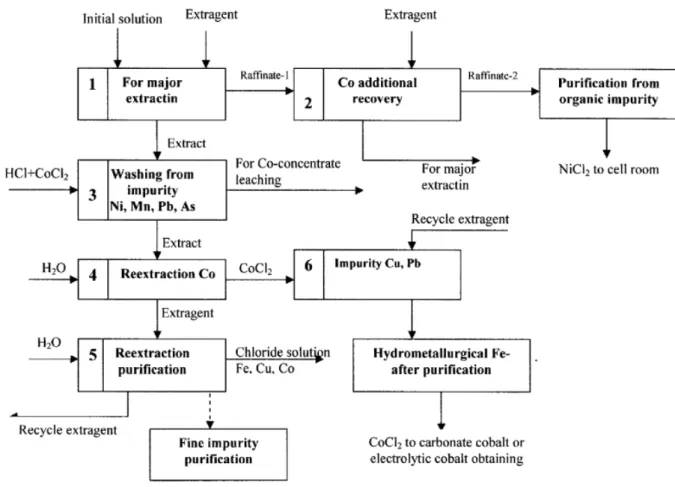
The research has resulted in developing, large-scale testing and introducing of a solvent extraction hydrochloride technology of cobalt concentrate at Severonikel Combine Fig.2.
Fig. 2. Principle diagram of Co extraction at Severonikel combine.
In particular, the fi rst parameters to be investigated were the effect of the ratio between the precipitator (Na2CO3, NaHCO3 and CoCl2), initial CoCl2 concentration, temperature, duration and order of reagent feeding, and also exposure of the precipitate formed in the mother liquor, and the structure and composition of forming precipitates. It was discovered that the main prerequisite for minimizing the chlorine content in precipitates (0.01% w/o) is duration and order of reagent feeding.
Slow feeding of soda solution to cobalt chloride solution creates a stable defi cit of CO32- ions with resulting precipitates containing up to 4.6% of structural chlorine unremovable by water. In the case of reverse slow adding of cobalt chloride solution to a vigorously stirred Na2CO3 solution, the process occurs under an excess of carbonate ions preventing the chlorine from entering into the structure.
At the same time, the excess of carbonate ions in solutions should not be too high, since it may promote the formation of [Co(CO3)]2- anion complexes interacting with sodium cations to form a hardly soluble salt, Na
2[Co(CO3)], which explains why a part of sodium can be removed from cobalt carbonate.
Based on these studies, we developed a method [8] for the production of basic cobalt carbonate, yielding a salt containing not less than 0.05% of sodium and chlorine. Currently the Severonikel Combine has manufactured several thousand tons of paste and dry cobalt carbonate.
Table 1 Composition of high-purity cobalt salts obtained from cobalt chloride solutions
Element Content, ppm
hydroxide dichloride acetate carbonate
Co base base base Base
Ni 20 20 30 30
Cu 0.6 0.9 1 0.8
Fe 10 10 10 20
Mn 0.5 2 1 0.9
Si <7 5 <2 5
Bi <0.1 <0.1 <0.1 <0.1
Sb <0.5 <0.5 <0.5 1
Sn <0.1 <0.1 <0.1 0.5
Pb 0.2 0.1 0.1 0.1
Zn 1 0.5 0.2 2
P <0.5 <0.5 <0.5
-Mg 2 1 0.5 5
Te <0.1 <0.1 <0.1 <0.1
Tl <0.01 <0.01 <0.01 <0.01
Na 15 10 2 100
Ca 15 10 2 200
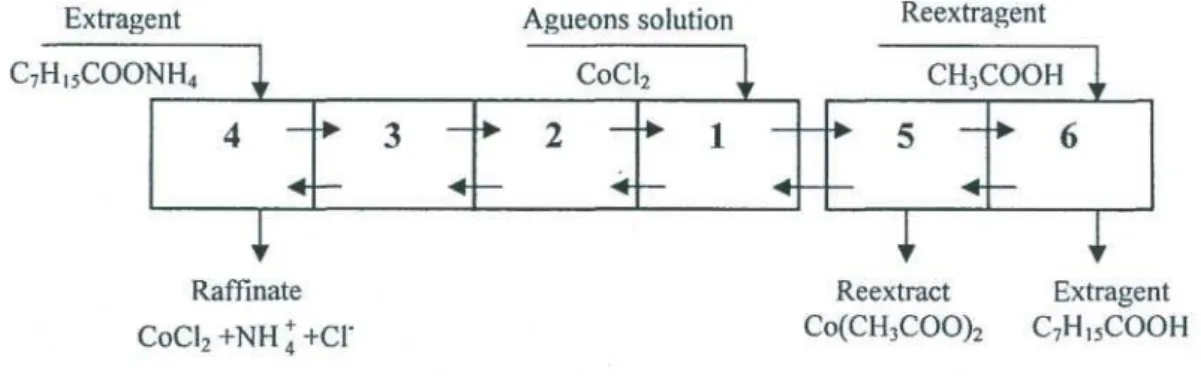
The possibility of carrying out the method of cation-exchange solvent extraction conversion in continuous regime was tested at a laboratory cascade, when cobalt was extracted from a chloride solution of the following composition, g/l: Co – 112; Ni – 0.01; Fe, Mn, Cu <0.005 with ammonium form of n-octanoic acid in Escaid 100 at four stages followed by a two-stage re-extraction with a 2 mole/l vinegar acid solution. The pattern of the experiment on the production of cobalt acetate solution at an extractor cascade with ammonium form of n-octanoic acid is presented in Fig. 3.
Fig. 3. Pattern of cobalt chloride extraction conversion to acetate at an extractor cascade.
The obtained cobalt acetate solution was fi ltered and evaporated. After cooling, the crystals were separated at a nutsch fi lter and dried under vacuum by gradually increasing the temperature to 100ºC. The content of impurities in the salt is given in Table 1.
The impurity elements were determined by mass spectrometry in induction-bound argon plasma (MS IBP) on ELAN 9000 DRG-e (Perkin Elmer, USA). The method was developed at the Institute of Chemistry Laboratory of chemical and optic methods of analysis.
Shmidt V.S. Extraction with amines; Moscow: “Atomizdat”, 1970. 312 p. [3].
Medkov M.A., Steblevskaya N.I., Smolkov A.A. et al. Zhurnal Neorganicheskoi Khimii (Russ). 1993, V. 38, 2, [4].
382-384.
Zolotov Yu.A., Golovanov V.I. Mutual infl uence of elements on their extraction from chloride solutions (Russ.). [5].
Moscow: “GEOKhI”, 1971; 99 p.
Dimond R.M., Tak D.G. Solvent extraction of inorganic compounds (Russ.); Moscow: “Gosatomizdat”, 1962; [6].
88 p.
Dyakova L.V., Kasikov A.G., Bagrova E.G. Zhurnal Analiticheskoi Khimii (Russ). 2006, V.79, 4, 589-592. [7].
RF patent №2240287. Method for the production of divalent cobalt carbonate. A.G. Kasikov, A.A. Ankhimov, [8].
![Fig. 1. Plots of metals recovery level vs. [Cl - ] concentration.](https://thumb-eu.123doks.com/thumbv2/123dok_br/17038293.233494/2.892.282.606.137.444/fig-plots-metals-recovery-level-vs-cl-concentration.webp)