BGD
12, 5015–5053, 2015Hydrologic controls on DOC, As and Pb
export
T. Broder and H. Biester
Title Page
Abstract Introduction
Conclusions References
Tables Figures
◭ ◮
◭ ◮
Back Close
Full Screen / Esc
Printer-friendly Version Interactive Discussion
Discussion
P
a
per
|
Discussion
P
a
per
|
Discussion
P
a
per
|
Discussion
P
a
per
|
Biogeosciences Discuss., 12, 5015–5053, 2015 www.biogeosciences-discuss.net/12/5015/2015/ doi:10.5194/bgd-12-5015-2015
© Author(s) 2015. CC Attribution 3.0 License.
This discussion paper is/has been under review for the journal Biogeosciences (BG). Please refer to the corresponding final paper in BG if available.
Hydrologic controls on DOC, As and Pb
export from a polluted peatland – the
importance of heavy rain events,
antecedent moisture conditions and
hydrological connectivity
T. Broder and H. Biester
Institut für Geoökologie, AG Umweltgeochemie, Technische Universität Braunschweig, Langer Kamp 19c, 38106 Braunschweig, Germany
Received: 23 February 2015 – Accepted: 9 March 2015 – Published: 30 March 2015 Correspondence to: T. Broder ([email protected])
BGD
12, 5015–5053, 2015Hydrologic controls on DOC, As and Pb
export
T. Broder and H. Biester
Title Page
Abstract Introduction
Conclusions References
Tables Figures
◭ ◮
◭ ◮
Back Close
Full Screen / Esc
Printer-friendly Version Interactive Discussion
Discussion
P
a
per
|
Discussion
P
a
per
|
Discussion
P
a
per
|
Discussion
P
a
per
|
Abstract
Bogs can store large amounts of lead (Pb) and arsenic (As) attributed to atmospheric deposition of anthropogenic emissions. Pb and As are exported along with dissolved organic carbon (DOC) in these organic-rich systems, but it is not yet clear which hy-drological (pre-)conditions favor their export. This study combines one year continuous
5
monitoring of precipitation, bog water level and pore water concentration changes with bog discharge, DOC, As and Pb stream concentrations and fluxes. Concentrations ranged from 5 to 30 mg L−1 for DOC, 0.2 to 1.9 µg L−1 for As and 1.3 to 12 µg L−1 for Pb with highest concentrations in late summer. As and Pb concentrations significantly correlated with DOC concentrations. Fluxes depended strongly on discharge, as 40 %
10
of As and 43 % of Pb were exported by the upper 10 % of discharge, pointing out the over-proportional contribution of heavy rain and high discharge events to annual As, Pb and DOC export. Exponential increase in element export from the bog is explained by connection of additional DOC, As and Pb pools in the acrotelm during water table rise, which is most pronounced after drought. Pb, As and DOC concentrations in pore
15
water provide evidence of an increase of the soluble Pb pool as soon as the peat layer gets hydrologically connected, while DOC and As peak concentrations in runoff lag in comparison to Pb. Our data indicates a distinct bog-specific discharge threshold of 8 L s−1, which is thought to depend mainly on the bogs size and drainage conditions. Above this threshold element concentration do not further increase and discharge gets
20
diluted. Combining pore water and discharge data shows that As and Pb exports are not only dependent on the amount of precipitation and discharge, but on the frequency and depth of water table fluctuations. Comparing the annual bog As and Pb export with element inventories indicates that As is much more mobilized than Pb, with annual fluxes accounting for 0.85 and 0.27 ‰ of total As and Pb inventory, respectively.
BGD
12, 5015–5053, 2015Hydrologic controls on DOC, As and Pb
export
T. Broder and H. Biester
Title Page
Abstract Introduction
Conclusions References
Tables Figures
◭ ◮
◭ ◮
Back Close
Full Screen / Esc
Printer-friendly Version Interactive Discussion
Discussion
P
a
per
|
Discussion
P
a
per
|
Discussion
P
a
per
|
Discussion
P
a
per
|
1 Introduction
Peatlands inherit important functions in the environmental system. They play an im-portant role in the storage of carbon and other elements such as heavy metals. On one hand the filtering function of peatlands partly prevents the input of these pollutants to streams. On the other hand, peatlands can release heavy metals as soluble
DOM-5
metal complexes. Even though, acting as major carbon sink, peatlands are also the greatest source of dissolved organic carbon (DOC) to the aquatic system (Aitkenhead et al., 1999). Several studies demonstrated runoff, water level fluctuations and tem-perature to be the most important controls on terrestrial DOC production and export (Freeman et al., 2001; Hongve et al., 2004; Köhler et al., 2008; Seibert et al., 2009;
10
Laudon et al., 2011). Lately, numerous studies describe the emerging problem of rising DOC levels in streams and lakes especially in catchment areas comprising peatlands (e.g. Worrall et al., 2004; Monteith et al., 2007), which might cause severe problems for aquatic biota and in drinking water production (Chow et al., 2003). Next to the observed general increase in concentrations, which has been attributed to the decrease in acid
15
rain deposition or temperature rise (Freeman et al., 2001; Evans et al., 2005; Monteith et al., 2007), a flushing effect, which produces high instantaneous DOC loads during high discharge events after a summer dry period has been described (e.g. Worrall et al., 2002; Clark et al., 2007). Even though temporally limited, the high concentra-tions might affect the aquatic system even stronger. This effect gains more importance
20
through the predicted climate change with enhanced dry periods and more frequent heavy rain events (IPCC, 2013). How these high DOC concentrations after re-wetting of the peatlands surface-near layer built up is not yet fully understood. Fenner and Free-man (2011) proposed that the microbial DOC production is stimulated after a drought period by reduced concentrations of phenolic compounds through an enhanced phenol
25
BGD
12, 5015–5053, 2015Hydrologic controls on DOC, As and Pb
export
T. Broder and H. Biester
Title Page
Abstract Introduction
Conclusions References
Tables Figures
◭ ◮
◭ ◮
Back Close
Full Screen / Esc
Printer-friendly Version Interactive Discussion
Discussion
P
a
per
|
Discussion
P
a
per
|
Discussion
P
a
per
|
Discussion
P
a
per
|
Knorr, 2013; Riedel et al., 2013), as well as DOC solution through pH rise (Grybos et al., 2009). Similar, Clark et al. (2012) described a decrease of DOC solubility due to acidification during droughts.
Although the general focus in most studies is set on changing DOC dynamics, it is also known that some elements are mainly exported by transport with DOC to the
5
discharging stream. Lead (Pb) strongly binds to organic matter (Tipping, 1998; Rothwell et al., 2007) and high DOC concentrations increase Pb mobility (Jordan et al., 1997). In spite of the high affinity of arsenic (As) to iron(oxy)hydroxides, recent mechanistic studies revealed a strong binding of As to sulfhydryl groups of organic matter in the anaerobic peat layer (Langner et al., 2011, 2014). Due to the low pH (pH<4.5) and
10
the low amount of mineral phases in peat a correlation of DOC and As concentrations in bog draining streams has been observed (Rothwell et al., 2009; Neubauer et al., 2013). Especially, As is known to be subjected to post-depositional mobilization due to water level fluctuations and resulting redox changes (Blodau et al., 2008; Rothwell et al., 2009; Langner et al., 2014).
15
Ombrotrophic bogs, which receive element inputs exclusively by atmospheric depo-sition, have the potential of accumulating As and Pb in the peat. The anthropogenic deposition rate of those two elements largely exceeds pre-industrial background fluxes (Shotyk, 1998; Bindler, 2006). Mining activity, fossil fuel combustion, especially emis-sions from burning of leaded gasoline, often resulted in high As and Pb concentrations
20
in peat layers of the past centuries. Based on metal concentrations some peatlands especially those influenced by mining areas would even be classified as highly con-taminated soils.
The near surface layer of a bog, the acrotelm, is the most active part, and conducts most of the bogs discharge (Evans et al., 1999; Holden and Burt, 2003) and DOC
pro-25
BGD
12, 5015–5053, 2015Hydrologic controls on DOC, As and Pb
export
T. Broder and H. Biester
Title Page
Abstract Introduction
Conclusions References
Tables Figures
◭ ◮
◭ ◮
Back Close
Full Screen / Esc
Printer-friendly Version Interactive Discussion
Discussion
P
a
per
|
Discussion
P
a
per
|
Discussion
P
a
per
|
Discussion
P
a
per
|
host large amount of atmospheric derived metals is the main source of metal release from peatlands.
Up to now, most studies on heavy metal release from contaminated peatlands have been focused on discharge measurements, only. Studies connecting DOC export with in situ pore water chemistry measurements are rare or lacking in regard of Pb and
5
As. Clark et al. (2005) found a strong correlation between peat soil solution DOC and stream water DOC concentrations over a ten-year record. However, a lot of field or lab experiment studies focused on DOC production in view of water level, redox-state, acidification, temperature or microbial conditions (e.g. Grybos et al., 2009; Clark et al., 2012; Evans et al., 2012) without connection to discharge measurements or were
con-10
ducted within mineral soils (e.g. Kokfelt et al., 2009; Singh et al., 2014, for Pb see Vinogradoffet al., 2005). In regard of As, Blodau et al. (2008) found a higher release of As in minerogenic peat mesocosms after a drought period, which is in line with leach-ing experiments described by Tippleach-ing et al. (2003). Rothwell et al. (2009) observed higher As concentrations during late summer storm flow after the summer dry period
15
in an ombrotrophic bog catchment.
The aim of this study is to gain further understanding in the generation and controls of Pb and As export from ombrotrophic bogs. If the export of Pb and As is mainly controlled by DOC production and transport, higher metal concentrations and fluxes are expected during periods of elevated DOC concentrations as well. Export dynamics are
20
strongly dependent on peatland hydrology. This study tries to unravel the importance of hydrologic conditions like antecedent bog water levels, as well as precipitation and temperature, pH and redox-conditions for the export of As and Pb. These factors should control hydrologic pathways, DOC production and the hydraulic connection of different As and Pb pools. We aim to investigate to which extent As and Pb export is constrained
25
BGD
12, 5015–5053, 2015Hydrologic controls on DOC, As and Pb
export
T. Broder and H. Biester
Title Page
Abstract Introduction
Conclusions References
Tables Figures
◭ ◮
◭ ◮
Back Close
Full Screen / Esc
Printer-friendly Version Interactive Discussion
Discussion
P
a
per
|
Discussion
P
a
per
|
Discussion
P
a
per
|
Discussion
P
a
per
|
at a first order stream to gain information of the DOC, Pb and As export dynamics de-pendent on precipitation. To combine discharge generation and element concentrations with (pre-)conditions within the peat catchment, we sampled pore water to investigate time- and depth resolved DOC and metal release patterns and monitored temperature, precipitation and water level at the bog. For an estimation of the overall export and
5
mobilization potential from the bog we calculated fluxes and peat As and Pb inven-tories. To examine the importance of storm flow events we conducted high resolution measurements occasionally during snowmelt and rain events in spring and fall.
2 Materials and methods
2.1 Study area 10
The Odersprung bog (OS, 52◦46.383′N, 10◦33.816′E; 800 m a.s.l., 1500 mm mean an-nual precipitation and 5◦C mean annual temperature) is an ombrotrophic peatland
lo-cated within the nature protection area in the Harz Mountains in Northwestern Ger-many. The treeless part of the bog covers an area of about 17 ha and has a mean peat depth of 3 m (Beug et al., 1999). Vegetation is dominated bySphagnum magellanicum
15
and Sphagnum rubellum. Eriophorum angustifolium and Molina caerulea occur less frequently (Baumann, 2009). The bog is drained by a small erosion rill, which orig-inates within the bog and further drains adjacent peaty and upslope podzolic forest soils with dominant spruce vegetation. Discharge sampling was conducted at the rill outflow of the bog where all water is exclusively received from the bog. Former studies
20
on the effect of past local mining activities in the Harz Mountains indicate Pb and As peat concentrations of up 2300 and 100 mg kg−1, respectively, which is by a factor of
BGD
12, 5015–5053, 2015Hydrologic controls on DOC, As and Pb
export
T. Broder and H. Biester
Title Page
Abstract Introduction
Conclusions References
Tables Figures
◭ ◮
◭ ◮
Back Close
Full Screen / Esc
Printer-friendly Version Interactive Discussion
Discussion
P
a
per
|
Discussion
P
a
per
|
Discussion
P
a
per
|
Discussion
P
a
per
|
2.2 Sampling and field measurements
Seasonal discharge sampling was conducted from April 2013 to November 2013 cov-ering the time from snowmelt to begin of snowfall. Water samples were taken in a six day interval by an automated water sampler (ISCO autosampler 3700), equipped with 0.5 L PE bottles and a Teflon hose, which was automatically rinsed with sample water
5
before sampling. Further grab samples as well as pH and electric conductivity mea-surements were conducted every two to three weeks. For grab samples new PE tubes were used and previously rinsed with sample twice before sampling. For all sampling techniques blank controls were run. Several storm flow events were sampled at high frequency (every 3 h) over a period of three days, respectively.
10
Pore water samples at the Odersprung bog were taken using a suction sampler described in Broder et al. (2012). Sampling resolution was 20 until 60 cm depth and 30 until 210 cm. The suction sampler was installed within the catchment area of the erosion rill (Fig. 1). Close to the pore water sampler a peat core was extracted using a Russian peat corer (Eijkelkamp Agrisearch Equipment). Cores were collected down
15
to 300 cm depth, sliced in 2.5 cm sections, frozen and freeze dryed. For the calculation of As and Pb inventories in the acrotelm 15 short cores (30 cm depth) were sampled by means of a Wardenaar peat profile sampler (Eijkelkamp Agrisearch Equipment).
Discharge quantification at the bog outlet was conducted using a V-notch weir. Stage was recorded every 15 min by water level logger (Odyssey dataflow systems) for the
20
recalculation to the actual discharge. Water level at the bog site was monitored in close proximity to the pore water sampler using PVC piezometer tubes of 4 cm diameter, fully slotted until 120 cm depth and a water level logger (Odyssey dataflow systems). Temperature, relative humidity and precipitation (using a tipping-bucket rain gauge) were individually monitored (tinytag tgp 4500 and 4810, Gemini) on site.
BGD
12, 5015–5053, 2015Hydrologic controls on DOC, As and Pb
export
T. Broder and H. Biester
Title Page
Abstract Introduction
Conclusions References
Tables Figures
◭ ◮
◭ ◮
Back Close
Full Screen / Esc
Printer-friendly Version Interactive Discussion
Discussion
P
a
per
|
Discussion
P
a
per
|
Discussion
P
a
per
|
Discussion
P
a
per
|
2.3 Laboratory analyses
Water samples were filtered with 0.45 µm nylon filter (Merck, Millipore) within the labo-ratory and stored at 4◦C. All water samples were analyzed for total dissolved organic carbon by a thermo-catalytic total carbon analyzer (Analytik Jena multi N/C 2100S) us-ing the NPOC method. As, Fe and Pb concentrations were determined by an ICP-MS
5
(Agilent 7700). Instrumental drift and quality was checked by certified reference ma-terials (SPS-SW 1 and SLRS-4, riverine water, National Research Council, Canada). Detection limits for Fe, As and Pb were 0.01, 0.001 and 0.001 µg L−1, respectively.
All peat samples were freeze dried, milled and further analyzed with a resolution of 2.5 until 50 cm depth and 10 cm resolution below. Peat As and Pb concentrations
10
were determined by an energy-dispersive miniprobe multielement analyzer (EMMA-XRF, see Cheburkin and Shotyk, 1996). Carbon and nitrogen concentrations in peat were measured using an elemental analyzer (Euro EA 3000, HEKAtech).
2.4 Flux calculations and As and Pb inventory estimates
DOC, As and Pb annual fluxes were estimated by calculating the total annual load
15
from analyzed water samples and the continuous discharge record using method 5 according to Walling and Webb (1985) and Littlewood (1992):
Load=K×Qr Pn
i=1CiQi Pn
i=1Qi !
(1)
WhereK is a conversion factor (here number of seconds per year),Qrhere the annual mean discharge from the continuous record,Cithe instantaneous concentration,Qithe
20
instantaneous discharge andnthe number of samples. Load estimates were divided by catchment size to gain fluxes in g ha−1a−1.
BGD
12, 5015–5053, 2015Hydrologic controls on DOC, As and Pb
export
T. Broder and H. Biester
Title Page
Abstract Introduction
Conclusions References
Tables Figures
◭ ◮
◭ ◮
Back Close
Full Screen / Esc
Printer-friendly Version Interactive Discussion
Discussion
P
a
per
|
Discussion
P
a
per
|
Discussion
P
a
per
|
Discussion
P
a
per
|
high-frequency concentration measurements during snowmelt and discharge events were calculated according to method 3 (Walling and Webb, 1985), where instantaneous loads were calculated by the measured concentration and the integrated discharge data of the preceding sampling interval (3 h) to obtain a most accurate discharge esti-mate. To further improve flux estimates the annual record was separated by season or
5
hydrograph and was also calculated by method 2 (after Walling and Webb, 1985). Stan-dard error and 95 % confidence limits of flux calculations were conducted after Hope et al. (1997). As and Pb inventories for the peatland catchment were calculated from the median value of the upper 30 cm As and Pb inventories of the long peat core and 15 short cores to estimate an inventory per unit area of the bog surface. Uncertainties
10
of the inventory calculations were estimated by the SD from the mean of all As and Pb inventories of the 16 peat cores.
3 Results and discussion
3.1 Hydrologic conditions
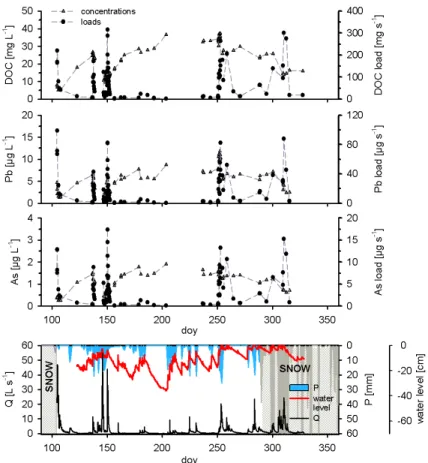
Precipitation pattern in 2013 is characterized by strong snow melt and several intense
15
rain events (Fig. 2). The precipitation record before day of the year (doy) 100 (mid of April) and after doy 289 (end of October) was affected by snowfall, which produces exceptionally high precipitation values that distorts quantification as we used a tipping-bucket. Also, at two occasions the rain gauge got clogged, resulting in a few high flow discharges and water level rises, where no rain was recorded (doy 150–162 and doy
20
256–270). During the snow-free record from mid-April to mid-October the catchment received 537 mm rain. Monthly precipitation totals recorded highest rainfall in fall, where rain events followed up in short time intervals. A longer dry period prevailed in summer, where only short but intense rainfall occurred.
In total, 36 discharge events with high flow can be distinguished after the end of
25
BGD
12, 5015–5053, 2015Hydrologic controls on DOC, As and Pb
export
T. Broder and H. Biester
Title Page
Abstract Introduction
Conclusions References
Tables Figures
◭ ◮
◭ ◮
Back Close
Full Screen / Esc
Printer-friendly Version Interactive Discussion
Discussion
P
a
per
|
Discussion
P
a
per
|
Discussion
P
a
per
|
Discussion
P
a
per
|
in fall where rain was frequent. Even though discharge did not return to low flow under those conditions, event peaks can be clearly distinguished. The two main discharge events of the 2013 record triggered by a longer rain fall period occurred in spring peak-ing at discharge of 44 and 55 L s−1. The three largest events in fall peaked at 23– 24.5 L s−1. High discharge values at the beginning of the record indicate that snowmelt
5
contributed an important portion to the annual discharge (Fig. 2). As quantification of the complete snowmelt discharge was impossible, calculated annual element fluxes might be underestimated (Dyson et al., 2011). A typical event hydrograph exhibits a steep rising and falling limb with a slow decline as the event subsides. Setting a low flow limit at 0.3 L s−1 by thorough visual hydrograph separation, low flow occurred
dur-10
ing more than 28 % of the time record but contributed only 2.5 % of total discharge. This is indicative of an event runoffregime with negligible groundwater contribution. In fact, constant base flow over longer periods could never be observed, as flow steadily declined without rain fall until it almost ceased when the accessible water pool in the acrotelm was depleted. Therefore, we do not refer to base flow conditions, but rather
15
use the term low flow as no steady groundwater component seem to contribute to the bog’s discharge. The flashy hydrograph response fits to a rapid runoffgeneration by surface-near and surface flow. The dominance of this kind of runoffgeneration is sim-ilar to previously reported flashy regimes at blanket bogs (Evans et al., 1999; Holden and Burt, 2003).
20
Lag times from the begin of rainfall to discharge were rapid with a mean response time of 1.3 h±0.5 h. Shortest lag times occurred when discharge was still high at the beginning of a new high flow event similar as observed in an blanket bog (Daniels et al., 2008). This reduced response time indicates that at wet preconditions surface runoff prevail as this is the most rapid runoffcomponent.
25
begin-BGD
12, 5015–5053, 2015Hydrologic controls on DOC, As and Pb
export
T. Broder and H. Biester
Title Page
Abstract Introduction
Conclusions References
Tables Figures
◭ ◮
◭ ◮
Back Close
Full Screen / Esc
Printer-friendly Version Interactive Discussion
Discussion
P
a
per
|
Discussion
P
a
per
|
Discussion
P
a
per
|
Discussion
P
a
per
|
ning of rainfall at doy 205. The water table ranged between 3.5 and −36 cm related to the peat surface over the entire record with a median depth of 10.48 cm. The low-est water level occurred during the summer drought (−36 cm) after 20 days without precipitation. Water level recession varied between 0.6–2 cm d−1 with a median value of 1.2 cm d−1, but no seasonal or water level depth pattern could be observed within
5
recession variation. From the 36 discharge events 22 can be determined as following wet and 13 as following dry precondition based on the median water level of 10.5 cm as threshold value. Estimated precipitation to runoffratios for discharge events are lowest for those events with exceptionally dry preconditions following the summer drought and a low water table of up to−36 cm. In general, dry precondition events exhibited lower
10
runoffratios than wet precondition events. Absolute values are not shown here, as no exact event water determination could be conducted based on our data set. However, this estimation should be an additional indication for how the bog generates runoff.
3.2 DOC, As and Pb stream concentrations
DOC release patterns from the Odersprung bog were similar than those reported
15
from other peatlands (e.g. Worrall et al., 2002; Laudon et al., 2004; Clark et al., 2008). Lowest DOC concentrations (5 mg L−1) were observed in the middle of April during snowmelt when dilution was highest, whereas highest DOC concentrations (∼30 mg L−1) occurred in late summer to fall when DOC production was highest and mostly low flow conditions occur (Fig. 2). DOC concentration decreased then until
be-20
gin of winter and the end of the annual record. This general seasonal trend with lower concentrations in winter and spring and increasing concentrations during summer can be attributed to reasons unrelated to discharge, but to the seasonal temperature gra-dients and therefore enhanced biological activity, organic matter decomposition and solubility. Additionally, the low DOC concentrations during snowmelt can be mainly
at-25
BGD
12, 5015–5053, 2015Hydrologic controls on DOC, As and Pb
export
T. Broder and H. Biester
Title Page
Abstract Introduction
Conclusions References
Tables Figures
◭ ◮
◭ ◮
Back Close
Full Screen / Esc
Printer-friendly Version Interactive Discussion
Discussion
P
a
per
|
Discussion
P
a
per
|
Discussion
P
a
per
|
Discussion
P
a
per
|
Concentrations of As ranged from 0.2 to 1.9 µg L−1, whereas Pb concentrations were significantly higher (1.3 to 12 µg L−1) and in some cases even exceeded the WHO threshold value for drinking water (10 µg L−1; WHO, 2011). Highest Pb concentrations
occurred during a rain event in fall, which is discussed further below. As concentrations showed the same seasonal trend as observed for DOC with highest concentrations in
5
summer (Fig. 2). This trend was recognizable for Pb as well, but less pronounced as for DOC and As (Fig. 2). Both, As and Pb concentrations significantly correlate with DOC (r2: 0.96 and 0.87, respectively), which supports the assumption that both elements are mainly transported along with DOC within and out of this organic-rich system. Pb is known to strongly bind to organic matter (Tipping, 1998), while As forms soluble
DOM-10
complexes (Buschmann et al., 2006), too, it also shows sorption to iron(hydr)oxides or formation of As-Fe-NOM colloids or complexes (Ritter et al., 2006; ThomasArrigo et al., 2014). This is supported by the observation that Fe concentrations significantly correlate with DOC and As (Fig. 1; r2 Fe/DOC: 0.86; r2 Fe/As: 0.80). At the bog’s outflow, acidic conditions (pH<4.5) prevail over the whole sampling period. Under this
15
condition iron-DOM complexes such as a ternary complex of As-Fe-DOM, dominate the soluble fraction (Tipping et al., 2002; Lofts et al., 2008; Neubauer et al., 2013). However, As, Fe and DOC export seem to be strongly linked and it is likely that both elements are mobilized by the same processes and originate from the same source area within the bog.
20
3.3 DOC, As and Pb concentrations during storm flows
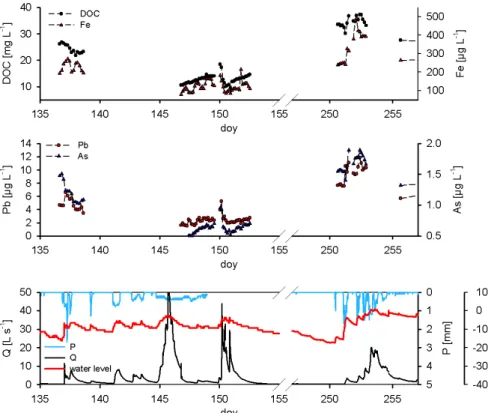
Three high frequency samplings of storm flows were conducted at the bog outlet in 2013. The first spring event started after a longer low flow period and a low water level within the bog of around 13 cm below surface, indicating dry preconditions (doy 137; 18/5/13; Fig. 3). The second event followed shortly after the first with wet preconditions
25
BGD
12, 5015–5053, 2015Hydrologic controls on DOC, As and Pb
export
T. Broder and H. Biester
Title Page
Abstract Introduction
Conclusions References
Tables Figures
◭ ◮
◭ ◮
Back Close
Full Screen / Esc
Printer-friendly Version Interactive Discussion
Discussion
P
a
per
|
Discussion
P
a
per
|
Discussion
P
a
per
|
Discussion
P
a
per
|
In general, concentration changes of all elements during high discharge events were rather small compared to the annual variations indicating that high precipitation and increased runoff do not necessarily cause dilution but seem to mobilize or connect additional pools of DOC, As and Pb.
At the first event, DOC and As concentration started to decrease immediately after
5
the onset of high flow from 26.8 and 1.5 µg L−1 to 21.8 and 1.0 µg L−1, respectively at the end of the event. No flushing effect with increasing stream water concentrations was visible (Fig. 3). Pb concentrations however, immediately increased with rising wa-ter level and discharge. Wawa-ter level rose from 13 to 6 cm depth, while Pb concentrations increased from 5 to 7 µg L−1. With the falling limb of the hydrograph Pb concentrations
10
also decreased to concentrations of about 4 µg L−1. The reason for the di
fferent behav-ior of Pb compared to As and DOC is unknown. The increase in Pb concentrations with increasing water level indicates that there is no dilution but that additional Pb pools are mobilized as surface-near peat layers gets hydrologically connected to discharge. It is still unknown how the Pb pool evolves during the winter months, probably by
mineral-15
ization of organic matter in the acrotelm. In case of DOC concentrations, which did not increase with increasing water level, we assume that a readily mobilized DOC pool has not yet been built up in spring when temperature and thus biological productivity are still low. The role of redox induced formation or dissolution of mineral Fe-phases for As mobilization during water level changes is not yet understood. One explanation could
20
be that As and DOC, as well as As-organic complexes are adsorbed to Fe-oxides when water levels are low and Fe-oxides are precipitated. Re-installation of anoxic condition, Fe-oxides dissolution and release of DOC and As after water level rise are assumingly too slow to be visible within a storm flow event (Grybos et al., 2007). However, this hypothesis will be further discussed in the pore water section further below. The
sec-25
ond storm flow event exhibited very low concentrations of 13 mg L−1DOC, 2 µg L−1Pb
BGD
12, 5015–5053, 2015Hydrologic controls on DOC, As and Pb
export
T. Broder and H. Biester
Title Page
Abstract Introduction
Conclusions References
Tables Figures
◭ ◮
◭ ◮
Back Close
Full Screen / Esc
Printer-friendly Version Interactive Discussion
Discussion
P
a
per
|
Discussion
P
a
per
|
Discussion
P
a
per
|
Discussion
P
a
per
|
and 1 µg L−1, respectively at the onset of the event, while Pb concentrations peaked 3 h later coinciding with maximum flow and a water level rise from 9.5 to 5.6 cm depth. Regardless of further smaller discharge peaks, DOC, As and Pb stream concentrations decreased to former low flow concentrations until the end of the discharge event. Even though a distinct concentration rise of DOC, As and Pb caused by this rain event was
5
evident, concentration ranges for all three elements were comparable to the lower con-centrations before the first event. This indicates a strong depletion of all three elements through the directly preceding event, which exhibited the highest recorded discharge of the whole record. The obvious exhaustion of readily mobilized DOC, As and Pb here, induces an element export constraint by production rates. While low flow established
10
again after this rain event, concentrations started to rise again slowly in the same way it has been recorded just before the rain event.
At the fall event concentrations before the event were higher than in spring with 33.5 mg L−1DOC, 8 µg L−1Pb and 1.5 µg L−1As. Here, DOC, Pb and As behave diff er-ently (Fig. 3). DOC concentrations first decreased at the onset of the rising limb of the
15
hydrograph and rising water level within the bog, but DOC concentrations started to rise again until discharge peaked (Fig. 3) and remained high with 35 to 37 mg L−1until discharge increased again. Unfortunately, the automated autosampler failed to sample part of the following main event, but DOC concentrations after the event were much lower (27 mg L−1, doy 255) than concentrations before the whole event. The As
con-20
centrations during this fall event were similar to that of DOC with a peak concentration of 1.9 µg L−1. For Pb, the first decrease in concentration was not apparent, but an
im-mediate rise to higher concentrations and a second discharge peak resulted also in distinct higher Pb concentrations up to 11.9 µg L−1. After the event As and Pb
concen-trations were again slightly lower than before the event (6 µg L−1Pb and 1.2 µg L−1As).
25
BGD
12, 5015–5053, 2015Hydrologic controls on DOC, As and Pb
export
T. Broder and H. Biester
Title Page
Abstract Introduction
Conclusions References
Tables Figures
◭ ◮
◭ ◮
Back Close
Full Screen / Esc
Printer-friendly Version Interactive Discussion
Discussion
P
a
per
|
Discussion
P
a
per
|
Discussion
P
a
per
|
Discussion
P
a
per
|
less intense DOC and As mobilization or dilution. However, Pb concentrations got not diluted, but increased with first discharge peak, which is contradicting. Similar, Roth-well et al. (2007) observed variable peak dynamics for Pb amongst other metals over several fall discharge events. Taking together the response of Pb stream water con-centrations at this three rain events, Pb concon-centrations seem to respond immediately
5
on water level rise within the bog with increasing concentrations. When fast surface runoffat the beginning of the event can be ruled out as a reason for the decrease in As and DOC stream concentrations, the different behavior of the three elements indicates that DOC and As seemed to be controlled by different mobilization processes than Pb. In general, DOC, As and Pb concentrations did not respond entirely similar during the
10
high resolution sampling of rain events. This dynamic cannot be explained by our data set alone and prompt the question why the strong correlation of DOC to As and Pb concentrations observed for the annual low resolution record is not valid for the rain events.
The weak flushing effect during the spring events indicates a lack of supply of DOC
15
and As caused by a low biological productivity early in the year. The stronger flush-ing effect of Pb will be discussed further below in relation to the results of pore water analyses. The fall event followed after the summer dry period and the time of highest productivity. When bog water level rises to the surface the entire previously aerated peat layer gets hydrologically connected and contributes to near-surface flow.
There-20
fore, a much greater amount of DOC, As and Pb can be mobilized and exported by such discharge events resulting in the highest discharge concentrations of all three el-ements of that year. High frequency sampling revealed a great dependency of DOC, As and Pb discharge concentrations on pool exhaustion within the bog. This is evident by decreasing concentrations during an event, but also a decline in DOC, As and Pb
25
BGD
12, 5015–5053, 2015Hydrologic controls on DOC, As and Pb
export
T. Broder and H. Biester
Title Page
Abstract Introduction
Conclusions References
Tables Figures
◭ ◮
◭ ◮
Back Close
Full Screen / Esc
Printer-friendly Version Interactive Discussion
Discussion
P
a
per
|
Discussion
P
a
per
|
Discussion
P
a
per
|
Discussion
P
a
per
|
These results are congruent with Rothwell et al. (2007), who sampled subsequent dis-charge events at a bog draining stream in fall.
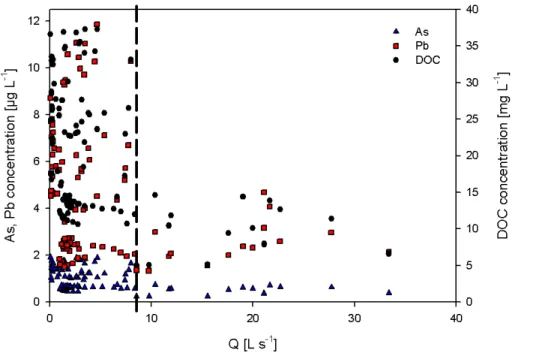
Figure 4 displays an element concentration to discharge (c/Q) plot for DOC, As and Pb. Here, it is apparent that above a discharge threshold value of about 8 L s−1 concen-trations of DOC, As and Pb decrease or stay at constant concentration. This indicates
5
that at discharge above 8 L s−1element concentrations get diluted most likely because all available pools have been connected. As this threshold is distinct and uniform for all three elements, pool exhaustion might be less likely as the pool size is expected to differ over the vegetation period with a longer supply in summer and fall. Also, mobiliza-tion processes are probably different for DOC, Pb and As depending on binding types,
10
which result in different responses depending on moisture and temperature precondi-tions of discharge events. However, rain water concentraprecondi-tions of DOC, As and Pb are much lower than pore water concentrations. Assuming that surface runofftakes place after saturation of the entire peat layer, the discharge volume should be similar over the whole year, when surface runoffcommences. This conclusion also implies that at
15
this bog, surface runoff is generated after peat saturation and not through infiltration excess.
3.4 Peat decomposition and solid phase As, Pb and Fe concentrations
Solid phase Pb and As concentration exhibited the same general trend with depth with higher contents in the uppermost meter (Fig. 5a). Pb concentrations peaked in
20
40 and 72.5 cm depth with 1200 and 706 mg kg−1, respectively. These two peaks has
been seen before in other bogs in the Harz Mountains (Biester et al., 2012) and can be clearly related to mining activities in the past. Due to the strong historic mining influence the recent decrease in Pb concentrations in the uppermost cm was very pronounced. Below 75 cm Pb concentrations sharply decreased to non-anthropogenic background
25
BGD
12, 5015–5053, 2015Hydrologic controls on DOC, As and Pb
export
T. Broder and H. Biester
Title Page
Abstract Introduction
Conclusions References
Tables Figures
◭ ◮
◭ ◮
Back Close
Full Screen / Esc
Printer-friendly Version Interactive Discussion
Discussion
P
a
per
|
Discussion
P
a
per
|
Discussion
P
a
per
|
Discussion
P
a
per
|
As were high, even compared to other contaminated sites (e.g. Rothwell et al., 2009). Pb is thought to be immobile after deposition, while As is redox-sensitive and might be mobilized after deposition and enriched in the surface-near layer, especially, when strong water level fluctuations prevail (Rothwell et al., 2010). As As(V) associates with Fe-(hydr)oxides, As mobility is known to be controlled by the reductive dissolution of
5
Fe-(hydr)oxides, which causes the release of As into pore waters and would lead to an enrichment in the surface-near layer along with precipitated Fe-(hydroxides). Fe enrich-ment at the redox boundary occurs through the upward diffusion of dissolved Fe(II) and precipitation when oxic conditions are re-installed. The Fe depth profile here showed enrichment in the uppermost peat layer with a peak concentration of 5.5 g kg−1at 5 cm
10
depth and decreasing concentration until 1.3 g kg−1 at 32.5 cm depth. Lowest Fe
con-centrations were found below 100 cm depth with concon-centrations less than 1.3 g kg−1. In general Fe concentrations were low if compared to other peatlands (Riedel et al., 2013) and much lower than in studies describing Fe as an important factor for DOC and As retention. As concentrations showed no enrichment in the upper peat layer congruently
15
with Fe, indicating that As is not coupled to redox induced changes of Fe phases here. We assume that As in our bog is predominately bound to organic matter similar as observed in other peatlands, where As is mainly bound to organic matter by reduced organic sulphur groups under reducing conditions (Langner et al., 2011).
In previous studies peat decomposition has been found to enrich particular element
20
concentrations through mass loss (Biester et al., 2003, 2004, 2014). Figure 5a displays C/N ratios of the organic matter as proxy for peat decomposition (Kuhry and Vitt, 1996; Broder et al., 2012; Biester et al., 2014). In the upper 12.5 cm C/N ratios were high (88–128) with a distinct decrease to a value of 54 in 15 cm depth (Fig. 5a). Further below, C/N ratios remained low between 23–50 with higher values between 70 and
25
BGD
12, 5015–5053, 2015Hydrologic controls on DOC, As and Pb
export
T. Broder and H. Biester
Title Page
Abstract Introduction
Conclusions References
Tables Figures
◭ ◮
◭ ◮
Back Close
Full Screen / Esc
Printer-friendly Version Interactive Discussion
Discussion
P
a
per
|
Discussion
P
a
per
|
Discussion
P
a
per
|
Discussion
P
a
per
|
As and Pb distribution was not found here and concentrations were rather determined by enhanced deposition rates or redox processes for Fe than peat decomposition.
3.5 Pore water DOC, As and Pb concentrations
DOC concentrations in the pore water profile ranged from 20 to 250 mg L−1 (Fig. 5). Highest concentrations were found at the down most sample in 225 cm depth. DOC
5
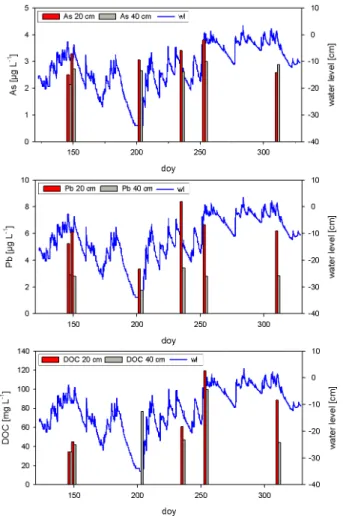
concentrations in the upper 50 cm, where most discharge is generated, were low in spring under wet conditions (doy 147: 34–41 mg L−1; Fig. 6) and much higher in fall after rewetting following the dry summer period with concentrations of 119 mg L−1 in
20 cm depth and 100 mg L−1 in 40 cm depth (Fig. 6, doy 254). In late fall
concentra-tions decreased again, but were still much higher than in spring. This is in line with the
10
recorded seasonal trend of DOC concentrations at the discharging stream and the fact that DOC stream concentrations are dependent on temperature and microbial activity (Clark et al., 2005) through pool size built-up, next to the hydraulic connectivity of the surface-near peat layers. Normally, after a drought period a higher pH develops in pore waters through anaerobic respiration processes, like sulfate- or iron reduction within
15
a couple of weeks after rewetting (Fenner and Freeman, 2011). This should favor DOC solubility through higher pH, but also by release of formerly Fe-(hydr)oxid-bound DOM (Grybos et al., 2009). Moreover, anaerobic conditions suppress peat mineralization and the described enzymatic latch of phenol oxidase activity favors DOC production after rewetting (Fenner and Freeman, 2011). In line with these assumptions, DOC
concen-20
trations were highest several weeks after the summer drought in fall, where the water level was fully recovered again (doy 254, Fig. 6). However, the lower DOC concen-trations measured during rewetting, with a water level depth of 14 cm probably reflect rather a limitation in DOC supply and an exhaustion of the DOC pool through export, as the sampling just followed after two rain events, which also triggered discharge events
25
accompanied by high DOC stream concentrations.
BGD
12, 5015–5053, 2015Hydrologic controls on DOC, As and Pb
export
T. Broder and H. Biester
Title Page
Abstract Introduction
Conclusions References
Tables Figures
◭ ◮
◭ ◮
Back Close
Full Screen / Esc
Printer-friendly Version Interactive Discussion
Discussion
P
a
per
|
Discussion
P
a
per
|
Discussion
P
a
per
|
Discussion
P
a
per
|
during drought and following rewetting (doy 254) were higher than in spring and dur-ing rewettdur-ing (doy 236). On the one hand, this might contradict the concept of Fenner and Freeman (2011) or Clark et al. (2012) who stated low DOC concentrations during drought due to microbial limitations by moisture stress and acidification by drought-induced oxidation processes. On the other hand, the low pH, in all pore water samples
5
at our site might indicate that the drought acidification effect is not pronounced here, as pH in our peat is generally low. Moreover, due to the low Fe concentrations in our peat, the effect of DOC immobilization through binding to Fe-(hydr)oxides during drought and aeration as proposed elsewhere (Riedel et al., 2013) is probably low at our study site. Accordingly, due to the low pH and the low amount of Fe-(hydr)oxides at our site
sup-10
pression of DOC production by drought events seems to be of low importance here and probably in ombotrophic peatlands in general.
Pore water As and Pb concentrations in the Odersprung bog ranged from 1.2 to 3.8 µg L−1and 0.5 to 8.4 µg L−1, respectively (Fig. 5). Both, As and Pb concentrations
were highest in the uppermost sample at 20 cm depth. While As was steadily
decreas-15
ing and leveled out in 70 cm depth, Pb concentrations peaked again around 60 cm depth with 4–5 µg L−1 Pb before it leveled out at about 120 cm depth. Concentration
profiles throughout the year show low changes only in the uppermost samples. Low-est As pore water concentrations at 20 and 40 cm depth occurred at the first sam-pling in spring (Fig. 6, doy 136) with 2.5 and 2.1 µg L−1, respectively. At the end of the
20
summer drought As concentrations remained at around 3 µg L−1 (doy 203), while Pb pore water concentrations decreased from about 6 µg L−1 (20 cm depth) and 3 µg L−1 (40 cm depth) to lowest annual concentrations of 3.3 and 1.7 µg L−1Pb during summer
drought, respectively. While highest Pb concentrations (8.4 µg L−1) were measured at the beginning of fall, (Fig. 6, doy 236) when the water level was not yet fully recovered,
25
mo-BGD
12, 5015–5053, 2015Hydrologic controls on DOC, As and Pb
export
T. Broder and H. Biester
Title Page
Abstract Introduction
Conclusions References
Tables Figures
◭ ◮
◭ ◮
Back Close
Full Screen / Esc
Printer-friendly Version Interactive Discussion
Discussion
P
a
per
|
Discussion
P
a
per
|
Discussion
P
a
per
|
Discussion
P
a
per
|
bilization of a Pb pool, which built up during drought in the most reactive surface-near peat layer by microbial decomposition or mineralization processes. This assumption might also explain the decoupling of DOC and Pb export apparent at discharge events after dry preconditions, as a readily solubilized Pb pool is easily flushed which explains the absence of the initial dilution effect as seen in DOC stream concentrations.
Fur-5
thermore, the DOC pool increases after drought, when wet conditions prevail again, explaining the lag time of DOC peak concentrations in pore waters.
The generally decreasing Pb concentrations with depth allow determining the source of discharge water. The hydrologic response of the bog discharge was characteristic for a rapid near-surface runoff. Comparing absolute concentrations in pore water and
10
discharging water, the high Pb concentrations of more than 10 µg L−1 in runo
ffat the fall rain event can only be generated in the uppermost part of the bog, where Pb con-centrations were highest. Following this assumption also the low flow concon-centrations must have been generated in the upper part of the peat profile as Pb concentrations below 1 m depth were too low to generate discharge Pb concentrations. The variable
15
Pb concentrations at different flow conditions are attributed to different water levels, which affect variable parts of the Pb pool in the acrotelm and are thus able to mobilize different amounts of Pb. This does also indicate that, in line with the hydrologic dis-charge response, low flow disdis-charge is generated from upper peat layers and not from seeping water from the deep peat sections.
20
3.6 Fluxes and inventory estimations
As Pb, As and DOC concentrations correlate, fluxes of these elements are necessarily exhibiting the same trends. However, element concentrations and bog discharge were not correlated. Consequentially, fluxes show a different seasonal pattern than concen-tration records (Fig. 7). While DOC and As concenconcen-trations were highest in summer
25
BGD
12, 5015–5053, 2015Hydrologic controls on DOC, As and Pb
export
T. Broder and H. Biester
Title Page
Abstract Introduction
Conclusions References
Tables Figures
◭ ◮
◭ ◮
Back Close
Full Screen / Esc
Printer-friendly Version Interactive Discussion
Discussion
P
a
per
|
Discussion
P
a
per
|
Discussion
P
a
per
|
Discussion
P
a
per
|
highest element fluxes occurred during high discharge events in spring and fall and dur-ing snowmelt also. Flux calculations show that the upper 10 % of discharge contributed 39, 40 and 43 % of the annual DOC, As and Pb export. When separating the annual record by hydrograph in storm flow and low flow conditions (boundary at 0.3 L s−1 by visual examination), 28 % of the record exhibited low flow conditions, which contributed
5
2.4 % of total annual discharge and about 4 % of annual As, Pb and DOC export, only. This means that 96 % of annual As, Pb and DOC export occur at high discharge con-ditions, which contributed 97.6 % of the annual discharge quantity, though. Similar pat-tern, have been described by Koehler et al. (2009) for DOC fluxes from a blanket bog in Ireland. Clark et al. (2008) calculated that the upper 10 % of discharge contributed
10
50 % of the annual DOC export and Hinton et al. (1997) estimated 41–57 % of annual DOC export by the upper 10 % of discharge.
This flux calculations implicate, that high discharge events contributes over-proportional to element exports. While low flow conditions generate high element con-centrations, greater discharge not only dilutes element concon-centrations, but connects
15
additional pools to discharge, which results in higher fluxes. Therefore, even if the up-per 10 % of discharge might generate overland flow and a strong concentration dilution, fluxes are still highest as all pools contribute to stream discharge. Concluding, as diff er-ent DOC, As and Pb pools, i.e. different peat layers, correspond to different hydrologic conditions, also different linkages to element export are likely. If low flow discharge is
20
expected to be generated rather in the lower peat layers not only general pool sizes are different, also mobilization conditions, i.e. different pH, redox, DOC quality. Further in-sight into differences between low flow and high flow export dynamics might be gained through Pb isotope determinations, a DOC age specification or DOC characterization. A record separation by season indicates that fall contributes to the largest extend to
25
BGD
12, 5015–5053, 2015Hydrologic controls on DOC, As and Pb
export
T. Broder and H. Biester
Title Page
Abstract Introduction
Conclusions References
Tables Figures
◭ ◮
◭ ◮
Back Close
Full Screen / Esc
Printer-friendly Version Interactive Discussion
Discussion
P
a
per
|
Discussion
P
a
per
|
Discussion
P
a
per
|
Discussion
P
a
per
|
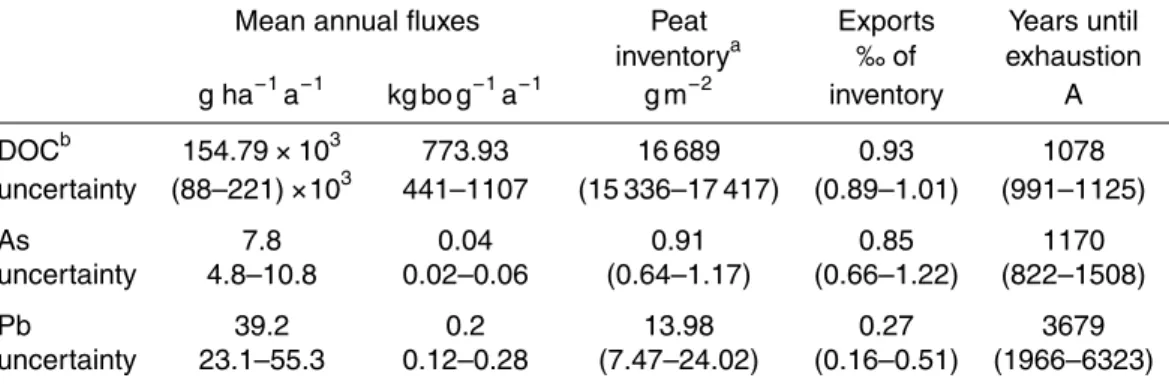
low flow, dry conditions. The annual DOC export from the investigated bog catchment can be estimated to 155 kg C ha−1a−1
±43 % (Table 2) and is similar to values from other studies (Worrall et al., 2003; Koehler et al., 2009).
As and Pb fluxes were calculated to 7.8±3.0 g As ha−1a−1 and 39±16 g Pb ha−1a−1. Annual Pb export was in the same range than values
re-5
ported by Rothwell et al. (2011) with annual aqueous Pb export of 55±18 g Pb ha−1a−1 from a contaminated eroded ombrotrophic peatland. They also highlighted the importance of particulate Pb export for peatland systems, which needs to be con-sidered when estimating total Pb export. The calculated As fluxes from our site were much lower than fluxes reported by Rothwell et al. (2011) (47.1±9.9 g As ha−1a−1),
10
in spite of higher As contents in our peat. This might be due to the eroded nature of their sampled bog and the prevailing post-depositional mobilization of As in peat due accelerated water table drawdowns and a consequent binding to Fe-(hydr)oxids (Rothwell et al., 2010).
As and Pb inventories were calculated based on the median element contents in the
15
upper 30 cm of the 16 analyzed cores and were 0.91 g As m−2 (0.64–1.17 g m−2) and 13.98 g Pb m−2 (7.47–24.02 g Pb m−2), respectively (Table 2). Element contents in the
upper 30 cm varied over a wide range pointing out the importance of a multi-core ap-proach for calculating peatland element inventories. Rothwell et al. (2010) calculated storage of 0.19–0.44 g As m−2 and 12.2–13.5 g Pb m−2 in another contaminated
peat-20
land. While our calculated Pb inventory is similar, As inventory are higher as those reported by Rothwell et al. (2010). When referring annual fluxes to the bog area of the catchment 0.04 kg As a−1and 0.2 kg Pb a−1were exported in 2013 by the bog drainage.
This equals to 0.85 and 0.27 ‰ of the calculated As and Pb inventories respectively (Table 2). Even though conclusions based on a one year data set are limited and
un-25
BGD
12, 5015–5053, 2015Hydrologic controls on DOC, As and Pb
export
T. Broder and H. Biester
Title Page
Abstract Introduction
Conclusions References
Tables Figures
◭ ◮
◭ ◮
Back Close
Full Screen / Esc
Printer-friendly Version Interactive Discussion
Discussion
P
a
per
|
Discussion
P
a
per
|
Discussion
P
a
per
|
Discussion
P
a
per
|
4 Conclusions
Our results highlight the importance of comprehensive field studies to gain further un-derstanding in generation and controls of element exports from peatlands. Combination of pore water and discharge data showed that As and Pb exports are not only depen-dent on the amount of precipitation and discharge, but on the frequency and depth of
5
water table fluctuations, and the extend of pool connectivity in the acrotelm. This has been demonstrated by higher As and Pb concentrations and exponential increase of export at high discharge events, especially after a longer dry period and higher tem-perature. A distinct bog-specific discharge threshold of 8 L s−1was observed, which in-dicate connection of all available pools and depends mainly on bogs size and drainage
10
conditions. Significant correlations of annual As, Pb and DOC concentrations in dis-charge hints to transport of As and Pb as organic complexes with decoupling of Pb concentrations at storm events following dry preconditions. Comparing the annual bog As and Pb export with element inventories indicates that As is much more mobilized than Pb, with annual fluxes accounting for 0.85 and 0.27 ‰ of total As and Pb inventory,
15
respectively. Results also point out the over-proportional contribution of high discharge events to As, Pb and DOC annual export. The challenge for prospective research is to unravel the biogeochemical effects of short term water level fluctuations on trace element and DOC mobilization processes within peatlands to further improve parame-terization of peatland catchment models.
20
The Supplement related to this article is available online at doi:10.5194/bgd-12-5015-2015-supplement.
BGD
12, 5015–5053, 2015Hydrologic controls on DOC, As and Pb
export
T. Broder and H. Biester
Title Page
Abstract Introduction
Conclusions References
Tables Figures
◭ ◮
◭ ◮
Back Close
Full Screen / Esc
Printer-friendly Version Interactive Discussion
Discussion
P
a
per
|
Discussion
P
a
per
|
Discussion
P
a
per
|
Discussion
P
a
per
|
Julian Fricke, Hannah Huster, Ricarda Rissel and Tabea Neudeck for help with lab and field work.
References
Aitkenhead, J. A., Hope, D., and Billett, M. F.: The relationship between dissolved organic car-bon in stream water and soil organic carcar-bon pools at different spatial scales, Hydrol. Pro-5
cess., 13, 1289–1302, 1999.
Bauer, M. and Blodau, C.: Arsenic distribution in the dissolved, colloidal and particulate size fraction of experimental solutions rich in dissolved organic matter and ferric iron, Geochim. Cosmochim. Ac., 73, 529–542, doi:10.1016/j.gca.2008.10.030, 2009.
Baumann, K.: Entwicklung der Moorvegetation im Nationalpark Harz, 1.th edn., Schriftenreihe 10
aus dem Nationalpark Harz, 4, 244 pp., 2009.
Beug, H.-J., Henrion, I., and Schmüser, A.: Landschaftsgeschichte im Hochharz, Die Entwick-lung der Wälder und Mooreseit dem Ende der letzten Eiszeit, Goslar, 1999.
Biester, H., Martinez-Cortizas, A., Birkenstock, S., and Kilian, R.: Effect of peat decomposi-tion and mass loss on historic mercury records in peat bogs from Patagonia, Environ. Sci. 15
Technol., 37, 32–39, doi:10.1021/es025657u, 2003.
Biester, H., Keppler, F., Putschew, A., Martinez-Cortizas, A., and Petri, M.: Halogen retention, organohalogens, and the role of organic matter decomposition on halogen enrichment in two Chilean peat bogs, Environ. Sci. Technol., 38, 1984–1991, doi:10.1021/es0348492, 2004. Biester, H., Hermanns, Y.-M., and Martinez Cortizas, A.: The influence of organic matter decay 20
on the distribution of major and trace elements in ombrotrophic mires – a case study from the Harz Mountains, Geochim. Cosmochim. Ac., 84, 126–136, doi:10.1016/j.gca.2012.01.003, 2012.
Biester, H., Knorr, K.-H., Schellekens, J., Basler, A., and Hermanns, Y.-M.: Comparison of diff er-ent methods to determine the degree of peat decomposition in peat bogs, Biogeosciences, 25
11, 2691–2707, doi:10.5194/bg-11-2691-2014, 2014.
BGD
12, 5015–5053, 2015Hydrologic controls on DOC, As and Pb
export
T. Broder and H. Biester
Title Page
Abstract Introduction
Conclusions References
Tables Figures
◭ ◮
◭ ◮
Back Close
Full Screen / Esc
Printer-friendly Version Interactive Discussion
Discussion
P
a
per
|
Discussion
P
a
per
|
Discussion
P
a
per
|
Discussion
P
a
per
|
Blodau, C., Fulda, B., Bauer, M., and Knorr, K.-H.: Arsenic speciation and turnover in intact organic soil mesocosms during experimental drought and rewetting, Geochim. Cosmochim. Ac., 72, 3991–4007, doi:10.1016/j.gca.2008.04.040, 2008.
Broder, T., Blodau, C., Biester, H., and Knorr, K. H.: Peat decomposition records in three pristine ombrotrophic bogs in southern Patagonia, Biogeosciences, 9, 1479–1491, doi:10.5194/bg-5
9-1479-2012, 2012.
Buschmann, J., Kappeler, A., Lindauer, U., Kistler, D., Berg, M., and Sigg, L.: Arsenite and ar-senate binding to dissolved humic acids: influence of pH, type of humic acid, and aluminum, Environ. Sci. Technol., 40, 6015–6020, doi:10.1021/es061057+, 2006.
Cheburkin, A. and Shotyk, W.: An energy-dispersive miniprobe multielement analyzer (EMMA) 10
for direct analysis of Pb and other trace elements in peats, Fresen. J. Anal. Chem., 354, 688–691, doi:10.1007/s0021663540688, 1996.
Chow, A. T., Tanji, K. K., and Gao, S.: Production of dissolved organic carbon (DOC) and trihalomethane (THM) precursor from peat soils, Water Res., 37, 4475–4485, doi:10.1016/S0043-1354(03)00437-8, 2003.
15
Clark, J. M., Chapman, P. J., Adamson, J. K., and Lane, S. N.: Influence of drought-induced acidification on the mobility of dissolved organic carbon in peat soils, Glob. Change Biol., 11, 791–809, doi:10.1111/j.1365-2486.2005.00937.x, 2005.
Clark, J. M., Lane, S. N., Chapman, P. J., and Adamson, J. K.: Export of dissolved organic car-bon from an upland peatland during storm events: implications for flux estimates, J. Hydrol., 20
347, 438–447, doi:10.1016/j.jhydrol.2007.09.030, 2007.
Clark, J. M., Lane, S. N., Chapman, P. J., and Adamson, J. K.: Link between DOC in near surface peat and stream water in an upland catchment: biogeochemistry of forested ecosys-tem – selected papers from BIOGEOMON, the 5th International Symposium on Ecosysecosys-tem Behaviour, held at the University of California, Santa Cruz, on 25–30 June 2006, Sci. Total 25
Environ., 404, 308–315, doi:10.1016/j.scitotenv.2007.11.002, 2008.
Clark, J. M., Heinemeyer, A., Martin, P., and Bottrell, S. H.: Processes controlling DOC in pore water during simulated drought cycles in six different UK peats, Biogeochemistry, 109, 253– 270, doi:10.1007/s10533-011-9624-9, 2012.
Daniels, S., Agnew, C., Allott, T., and Evans, M.: Water table variability and runoff
30
BGD
12, 5015–5053, 2015Hydrologic controls on DOC, As and Pb
export
T. Broder and H. Biester
Title Page
Abstract Introduction
Conclusions References
Tables Figures
◭ ◮
◭ ◮
Back Close
Full Screen / Esc
Printer-friendly Version Interactive Discussion
Discussion
P
a
per
|
Discussion
P
a
per
|
Discussion
P
a
per
|
Discussion
P
a
per
|
Dyson, K. E., Billett, M. F., Dinsmore, K. J., Harvey, F., Thomson, A. M., Piirainen, S., and Kortelainen, P.: Release of aquatic carbon from two peatland catchments in E. Finland during the spring snowmelt period, Biogeochemistry, 103, 125–142, 2011.
Evans, C. D., Monteith, D. T., and Cooper, D. M.: Long-term increases in surface water dissolved organic carbon: observations, possible causes and environmental impacts, Environ. Pollut., 5
137, 55–71, doi:10.1016/j.envpol.2004.12.031, 2005.
Evans, C. D., Jones, T. G., Burden, A., Ostle, N., Zieliński, P., Cooper, M. D. A., Peacock, M., Clark, J. M., Oulehle, F., Cooper, D., and Freeman, C.: Acidity controls on dissolved organic carbon mobility in organic soils, Glob. Change Biol., 18, 3317–3331, doi:10.1111/j.1365-2486.2012.02794.x, 2012.
10
Evans, M. G., Burt, T. P., Holden, J., and Adamson, J. K.: Runoffgeneration and water table fluctuations in blanket peat: evidence from UK data spanning the dry summer of 1995, J. Hydrol., 221, 141–160, 1999.
Fenner, N. and Freeman, C.: Drought-induced carbon loss in peatlands, Nat. Geosci., 4, 895– 900, doi:10.1038/ngeo1323, 2011.
15
Freeman, C., Evans, C. D., Monteith, D. T., Reynolds, B., and Fenner, N.: Export of organic carbon from peat soils, Nature, 412, p. 785, 2001.
Grybos, M., Davranche, M., Gruau, G., and Petitjean, P.: Is trace metal release in wetland soils controlled by organic matter mobility or Fe-oxyhydroxides reduction?, J. Colloid Interf. Sci., 314, 490–501, doi:10.1016/j.jcis.2007.04.062, 2007.
20
Grybos, M., Davranche, M., Gruau, G., Petitjean, P., and Pédrot, M.: Increasing pH drives or-ganic matter solubilization from wetland soils under reducing conditions, Geoderma, 154, 13–19, doi:10.1016/j.geoderma.2009.09.001, 2009.
Hinton, M. J., Schiff, S. L., and English, M. C.: The significance of storms for the concentration and export of dissolved organic carbon from two Precambrian Shield catchments, Biogeo-25
chemistry, 36, 67–88, 1997.
Holden, J. and Burt, T. P.: Runoffproduction in blanket peat covered catchments, Water Resour. Res., 39, 1191, doi:10.1029/2002WR001956, 2003.
Hongve, D., Riise, G., and Kristiansen, J. F.: Increased colour and organic acid concentrations in Norwegian forest lakes and drinking water? A result of increased precipitation?, Aquat. 30
Sci., 66, 231–238, doi:10.1007/s00027-004-0708-7, 2004.
BGD
12, 5015–5053, 2015Hydrologic controls on DOC, As and Pb
export
T. Broder and H. Biester
Title Page
Abstract Introduction
Conclusions References
Tables Figures
◭ ◮
◭ ◮
Back Close
Full Screen / Esc
Printer-friendly Version Interactive Discussion
Discussion
P
a
per
|
Discussion
P
a
per
|
Discussion
P
a
per
|
Discussion
P
a
per
|
IPCC (Ed.): Climate Change 2013: The Physical Science Basis. Contribution of Working Group I to the Fifth Assessment Report of the Intergovernmental Panel on Climate Change, Cam-bridge University Press, CamCam-bridge, UK and New York, USA, 1535 pp., 2013.
Jordan, R. N., Yonge, D. R., and Hathhorn, W. E.: Enhanced mobility of Pb in the presence of dissolved natural organic matter, J. Contam. Hydrol., 29, 59–80, 1997.
5
Knorr, K.-H.: DOC-dynamics in a small headwater catchment as driven by redox fluctuations and hydrological flow paths – are DOC exports mediated by iron reduction/oxidation cycles?, Biogeosciences, 10, 891–904, doi:10.5194/bg-10-891-2013, 2013.
Koehler, A.-K., Murphy, K., Kiely, G., and Sottocornola, M.: Seasonal variation of DOC con-centration and annual loss of DOC from an Atlantic blanket bog in South Western Ireland, 10
Biogeochemistry, 95, 231–242, doi:10.1007/s10533-009-9333-9, 2009.
Köhler, S. J., Buffam, I., Laudon, H., and Bishop, K. H.: Climate’s control of intra-annual and interannual variability of total organic carbon concentration and flux in two contrasting boreal landscape elements, J. Geophys. Res., 113, G03012, doi:10.1029/2007JG000629, 2008. Kokfelt, U., Rosén, P., Schoning, K., Christensen, T. R., Förster, J., Karlsson, J., Reuss, N., 15
Rundgren, M., Callaghan, T. V., Jonasson, C., and Hammarlund, D.: Ecosystem responses to increased precipitation and permafrost decay in subarctic Sweden inferred from peat and lake sediments, Glob. Change Biol., 15, 1652–1663, doi:10.1111/j.1365-2486.2009.01880.x, 2009.
Kuhry, P. and Vitt, D. H.: Fossil carbon/nitrogen ratios as a measure of peat decomposition, 20
Ecology, 77, 271–275, 1996.
Langner, P., Mikutta, C., and Kretzschmar, R.: Arsenic sequestration by organic sulphur in peat, Nat. Geosci., 5, 66–73, doi:10.1038/ngeo1329, 2011.
Langner, P., Mikutta, C., and Kretzschmar, R.: Oxidation of organosulfur-coordinated arsenic and realgar in peat: implications for the fate of arsenic, Environ. Sci. Technol., 48, 2281– 25
2289, doi:10.1021/es4049785, 2014.
Laudon, H., Köhler, S., and Buffam, I.: Seasonal TOC export from seven boreal catchments in northern Sweden, Aquat. Sci., 66, 223–230, doi:10.1007/s00027-004-0700-2, 2004.
Laudon, H., Berggren, M., Ågren, A., Buffam, I., Bishop, K., Grabs, T., Jansson, M., and Köh-ler, S.: Patterns and dynamics of dissolved organic carbon (DOC) in boreal streams: the role 30