© 2001 Blackwell Science Ltd. http://www.blackwell-science.com/geb
411
R E S E A R C H L E T T E RGlobal Ecology & Biogeography (2001) 10, 411– 422
Blackwell Science, Ltd
Patterns of diversity of the north-eastern Atlantic blenniid
fish fauna (Pisces: Blenniidae)
VÍTOR C. ALMADA, RUI F. OLIVEIRA , EMANUEL J. GONÇALVES, ARMANDO
J. ALMEIDA†, RICARDO S. SANTOS ‡ and PETER WIRTZ‡ Unidade de Investigação em
Eco-Etologia, Instituto Superior de Psicologia Aplicada, Rua Jardim do Tabaco 34, 1149 – 041 Lisboa, Portugal, E-mail: [email protected] †Laboratório Marítimo da Guia — IMAR, Universidade de Lisboa, Estrada do Guincho, 2750 Cascais, Portugal; and ‡Departamento de Oceanografia e Pescas — IMAR, Universidade dos Açores, 9900 Horta, Portugal
ABSTRACT
This paper presents an analysis of the distribu-tional patterns of blenniids (Pisces: Blenniidae) in the north-eastern Atlantic. Two peaks of species diversity were found, both in terms of number of species and number of endemics: one in the tropical African coast and another in the Mediterranean Sea. A cluster analysis of similar-ity values (Jaccard coefficient) among the eastern Atlantic zoogeographical areas, revealed the following groups: a north temperate group, a tropical group formed by the tropical African coast and Mauritania, another group formed by the islands of Cape Verde, a south temperate group (South Africa), and a southern Atlantic group
formed by the islands of Ascension and St Helena. Within the north temperate group, the sub-groups with higher similarities were: Azores and Madeira, Canary Islands and Morocco, and the Mediterranean and the Atlantic coast of the Iberian Peninsula. Based on affinity indices, the probable directions of faunal flows were inferred. The tropical coast of Africa and the Mediter-ranean emerged from this analysis as probable speciation centres of the north-eastern Atlantic blenniid fauna. The Mediterranean may have also acted as a refuge during glacial periods. Key words Blenniid fishes, distributional patterns, eastern Atlantic, Macaronesia, Mediterranean, speciation centres, species diversity, zoogeography.
INTRODUCTION
The blennioids have served as models for differ-ent scenarios that deal with the evolution and zoogeography of the ichthyofauna of the north-eastern Atlantic and the Mediterranean (Zander, 1973, 1980; Wirtz, 1978; Santos et al., 1995).
In a study on the behaviour of Mediterranean tripterygiid fishes, Wirtz (1978) proposed that the three species that currently occur in the Mediter-ranean may be derived from a common Atlantic ancestor. According to this model, several inva-sions of the Mediterranean by an Atlantic stock, interspersed with periods of relative isolation, would have promoted speciation and ecological segregation among descendants from previous
invasions, leading to a higher level of diversity in the Mediterranean area (Wirtz, 1978).
Zander (1980) emphasized the possible role of the Macaronesian islands (i.e. Azores, Madeira and Canary Islands), especially the Azores, as sites of speciation of eastern Atlantic blennioids, from which the new species would have subsequently migrated to the west European shores.
Santos et al. (1995) emphasized the strong connections between the fish faunas of the Azores, Madeira and Canary Islands. They discussed the possible oceanographic patterns of circulation that may explain the affinities between the faunas of the Macaronesian islands and those of the Mediterranean and the eastern Atlantic shores, despite the prevalence, at least in the Azores, of
412
V. C. Almada
et al.
© 2001 Blackwell Science Ltd, Global Ecology & Biogeography, 10, 411– 422 eastward-flowing currents. Similar considerations
concerning the marine fauna of the Azores have been presented for other animal groups (e.g. gobiid fishes: Miller, 1984; Rissoidae and Anabathridae molluscs: Gofas, 1990).
In recent years, knowledge of the blenniid faunas of Macaronesia and the West African coast has substantially progressed (Wirtz, 1980, 1994; Dooley et al., 1985; Bath, 1990; Brito, 1991; Santos et al., 1997). Similar improvements have occurred in relation to the shores of the Iberian Peninsula (Nieto & Alberto, 1990, 1993–94; Oliveira et al., 1992; Almada et al., 1993; Gonçalves et al., 1993).
In this paper, the distributional relationships of the blenniids from the eastern Atlantic and the Mediterranean are analysed, and the different hypotheses on the origin of the blenniid ichthy-ofauna of the north-eastern Atlantic are re-evaluated.
METHODS
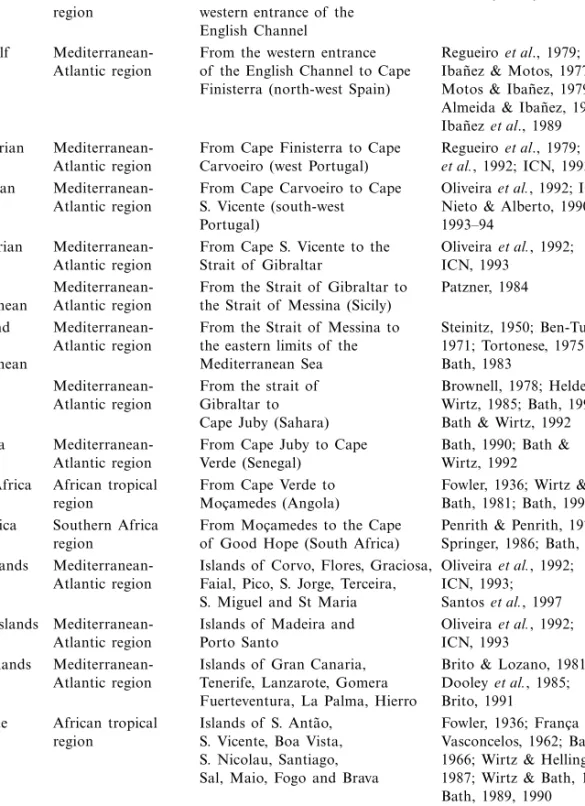
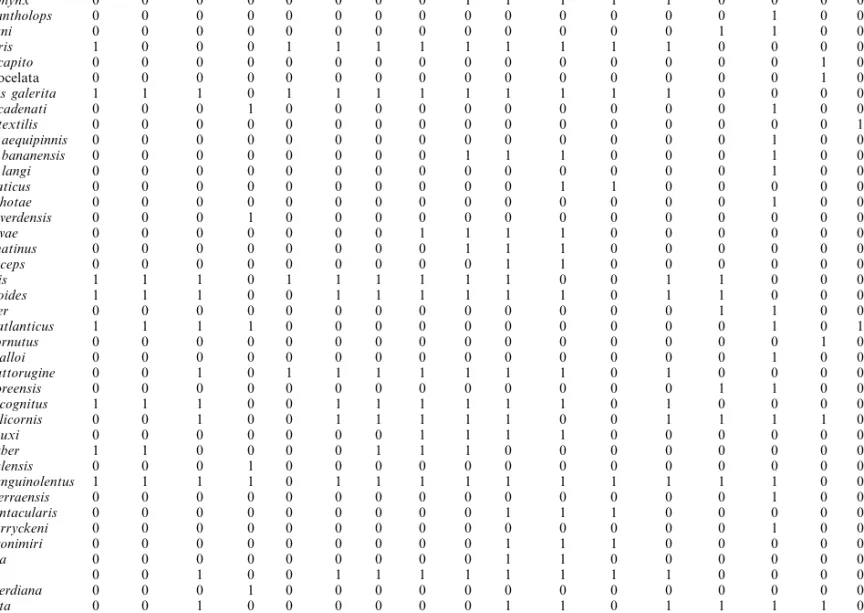
The division of the main zoogeographic areas of the eastern Atlantic and the Mediterranean shores considered in this study is summarized in Table 1. The database used in the present work (Table 2) was compiled based on this division. The information on the fauna of the Black Sea is also provided for completeness, although it was not subsequently analysed since it is an impover-ished subset of the Mediterranean fauna.
Nomenclatural authorities for most species present in Table 2 can be found in Zander (1986) and Bath (1990). The species Parablennius sangui-nolentus include populations ascribed to another species (P. parvicornis) by some authors (Zander, 1979; Bath, 1996). Since the populations of the Atlantic islands, namely those of the Azores, are intermediate between those of the Mediterranean and the west coast of Africa (Santos, 1992), it is not yet clear to us if the two species are valid, and the distributional limits of the two morphs are also not yet clearly defined. A species that is referred to in the literature (Lipophrys sabry: Bath, 1982) was not included since it has been shown to be a synonym of L. trigloides (Bath, 1996). Finally, the species Petroscirtes ancylodon was not included since it is a recent immigrant from the Red Sea (Goren & Galil, 1989).
The Atlantic shore of the Iberian Peninsula was subdivided in more detail than other areas
because it was felt that, due to its transitional character, this division would provide a better picture of the relationships between the Mediter-ranean and the north-eastern Atlantic faunas. Other areas, namely the north-west coast of Africa, should also be further subdivided but the lack of adequate information made this unfeasible. The similarity among different areas was assessed using a cluster analysis procedure. The Jaccard coefficient of similarity was used and the resulting similarity matrix was analysed through a sequential, agglomerative, hierarchical and nested clustering algorithm described by Sneath & Sokal (1973). The option used was (unweighted pair-group method, arithmetic aver-ages). This option uses a linkage criterion inter-mediate between the single and the complete ones, in which the decision to include a new element in a cluster is taken with reference to the arithmetic average of the similarity values of the elements already in the cluster. The PC program used was version 1.60 (©Applied Biostatistics, Inc.).
To further the analysis of the relationships between areas the following indices (XA and XB)
were computed for each pair of areas (A and B): XA = A∩B/A; XB = A∩B/B
where: A∩B is the number of species present in both areas, A is the total number of species present in area A, and B is the total number of species present in area B. If, for a given pair of areas, there was a marked flux of fauna in a given direction, we would expect that the target area should present a subset of the species present in the source area rather than the reverse. Thus, an asymmetry between the two indices would be predicted with the smaller value occurring in the source area.
It is important to stress that we are dealing with historical hypotheses that are not necessar-ily in contradiction with other approaches to the problem of diversity, namely those that relate area and diversity, or energy base and species richness. We are aware that our divisions do not have the same area but, for this type of fish, area is probably not a very relevant issue, since they live in an almost linear band, the shoreline, a few hundred metres wide at most. Our comparisons refer to points located in different geographical
Blenniid zoogeography in the Atlantic
413
© 2001 Blackwell Science Ltd, Global Ecology & Biogeography, 10, 411– 422
Table 1 Definition of the zoogeographic areas considered in the present study and references used for the description of their blenniid fauna
Area Zoogeographic
region (Briggs, 1974)
Area borders References
Boreal Eastern Atlantic
region
From the North Sea to the western entrance of the English Channel
Wheeler, 1969, 1992
Biscay Gulf Mediterranean-Atlantic region
From the western entrance of the English Channel to Cape Finisterra (north-west Spain)
Regueiro et al., 1979; Ibañez & Motos, 1977; Motos & Ibañez, 1979; Almeida & Ibañez, 1981; Ibañez et al., 1989 North Iberian
Peninsula
Mediterranean-Atlantic region
From Cape Finisterra to Cape Carvoeiro (west Portugal)
Regueiro et al., 1979; Oliveira et al., 1992; ICN, 1993 West Iberian Peninsula Mediterranean-Atlantic region
From Cape Carvoeiro to Cape S. Vicente (south-west Portugal)
Oliveira et al., 1992; ICN, 1993 Nieto & Alberto, 1990, 1993–94
South Iberian Peninsula
Mediterranean-Atlantic region
From Cape S. Vicente to the Strait of Gibraltar Oliveira et al., 1992; ICN, 1993 Western Mediterranean Mediterranean-Atlantic region
From the Strait of Gibraltar to the Strait of Messina (Sicily)
Patzner, 1984 Central and Eastern Mediterranean Mediterranean-Atlantic region
From the Strait of Messina to the eastern limits of the Mediterranean Sea Steinitz, 1950; Ben-Tuvia, 1971; Tortonese, 1975; Bath, 1983 Morocco Mediterranean-Atlantic region
From the strait of Gibraltar to Cape Juby (Sahara)
Brownell, 1978; Helden & Wirtz, 1985; Bath, 1990; Bath & Wirtz, 1992
Mauritania
Mediterranean-Atlantic region
From Cape Juby to Cape Verde (Senegal)
Bath, 1990; Bath & Wirtz, 1992 Tropical Africa African tropical
region
From Cape Verde to Moçamedes (Angola)
Fowler, 1936; Wirtz & Bath, 1981; Bath, 1990 South Africa Southern Africa
region
From Moçamedes to the Cape of Good Hope (South Africa)
Penrith & Penrith, 1972; Springer, 1986; Bath, 1990 Azores Islands
Mediterranean-Atlantic region
Islands of Corvo, Flores, Graciosa, Faial, Pico, S. Jorge, Terceira, S. Miguel and St Maria
Oliveira et al., 1992; ICN, 1993; Santos et al., 1997 Madeira Islands
Mediterranean-Atlantic region
Islands of Madeira and Porto Santo
Oliveira et al., 1992; ICN, 1993
Canary Islands Mediterranean-Atlantic region
Islands of Gran Canaria, Tenerife, Lanzarote, Gomera Fuerteventura, La Palma, Hierro
Brito & Lozano, 1981; Dooley et al., 1985; Brito, 1991 Cape Verde Islands African tropical region Islands of S. Antão, S. Vicente, Boa Vista, S. Nicolau, Santiago, Sal, Maio, Fogo and Brava
Fowler, 1936; França & Vasconcelos, 1962; Bauchot, 1966; Wirtz & Hellinger, 1987; Wirtz & Bath, 1989; Bath, 1989, 1990
Ascension Island African tropical region
Ascension Island Bauchot, 1966; Bath, 1990
St Helena Island African tropical region
St Helena Island Bauchot, 1966; Bath, 1990
414
V. C
. Almada
et al.
© 2001 Blackw ell Science Ltd, Global Ecolog y & Biog eogr aph y , 10 , 411– 422Table 2 Database used in the present study on the distribution of the different blenniid fishes present in the eastern Atlantic and Mediterranean area;
1 = present; 0 = absent. AZO = Azores, MAD = Madeira, CAN = Canary islands, CV = Cape Verde, BOR = Boreal, BIS = Biscay Gulf, NIP = north Iberia, WIP = west Iberia, SIP = south Iberia, WME = western Mediterranea, EME = central and eastern Mediterranean, BSEA = Black Sea, MOR = Morroco, MAU = Mauritania, TRA = tropical Africa, SA = south Africa, ASC = Ascension, SH = St. Helena
Species AZO MAD CAN CV BOR BIS NIP WIP SIP WME EME BSEA MOR MAU TRA SA ASC SH
Aidablennius sphynx 0 0 0 0 0 0 0 0 1 1 1 1 1 0 0 0 0 0 Bathyblennius antholops 0 0 0 0 0 0 0 0 0 0 0 0 0 0 1 0 0 0 Blennius normani 0 0 0 0 0 0 0 0 0 0 0 0 0 1 1 0 0 0 Blennius ocellaris 1 0 0 0 1 1 1 1 1 1 1 1 1 0 0 0 0 0 Chalaroderma capito 0 0 0 0 0 0 0 0 0 0 0 0 0 0 0 1 0 0 Chalaroderma ocelata 0 0 0 0 0 0 0 0 0 0 0 0 0 0 0 1 0 0 Coryphoblennius galerita 1 1 1 0 1 1 1 1 1 1 1 1 1 0 0 0 0 0 Entomacrodus cadenati 0 0 0 1 0 0 0 0 0 0 0 0 0 0 1 0 0 0 Entomacrodus textilis 0 0 0 0 0 0 0 0 0 0 0 0 0 0 0 0 1 1 Hypleurochilus aequipinnis 0 0 0 0 0 0 0 0 0 0 0 0 0 0 1 0 0 0 Hypleurochilus bananensis 0 0 0 0 0 0 0 0 1 1 1 0 0 0 1 0 0 0 Hypleurochilus langi 0 0 0 0 0 0 0 0 0 0 0 0 0 0 1 0 0 0 Lipophrys adriaticus 0 0 0 0 0 0 0 0 0 0 1 1 0 0 0 0 0 0 Lipophrys bauchotae 0 0 0 0 0 0 0 0 0 0 0 0 0 0 1 0 0 0 Lipophrys caboverdensis 0 0 0 1 0 0 0 0 0 0 0 0 0 0 0 0 0 0 Lipophrys canevae 0 0 0 0 0 0 0 1 1 1 1 0 0 0 0 0 0 0 Lipophrys dalmatinus 0 0 0 0 0 0 0 0 1 1 1 0 0 0 0 0 0 0 Lipophrys nigriceps 0 0 0 0 0 0 0 0 0 1 1 0 0 0 0 0 0 0 Lipophrys pholis 1 1 1 0 1 1 1 1 1 1 0 0 1 1 0 0 0 0 Lipophrys trigloides 1 1 1 0 0 1 1 1 1 1 1 0 1 1 0 0 0 0 Lipophrys velifer 0 0 0 0 0 0 0 0 0 0 0 0 0 1 1 0 0 0 Ophioblennius atlanticus 1 1 1 1 0 0 0 0 0 0 0 0 0 0 1 0 1 1 Parablennius cornutus 0 0 0 0 0 0 0 0 0 0 0 0 0 0 0 1 0 0 Parablennius dialloi 0 0 0 0 0 0 0 0 0 0 0 0 0 0 1 0 0 0 Parablennius gattorugine 0 0 1 0 1 1 1 1 1 1 1 0 1 0 0 0 0 0 Parablennius goreensis 0 0 0 0 0 0 0 0 0 0 0 0 0 1 1 0 0 0 Parablennius incognitus 1 1 1 0 0 1 1 1 1 1 1 0 1 0 0 0 0 0 Parablennius pilicornis 0 0 1 0 0 1 1 1 1 1 0 0 1 1 1 1 0 0 Parablennius rouxi 0 0 0 0 0 0 0 1 1 1 1 0 0 0 0 0 0 0 Parablennius ruber 1 1 0 0 0 0 1 1 1 0 0 0 0 0 0 0 0 0 Parablennius salensis 0 0 0 1 0 0 0 0 0 0 0 0 0 0 0 0 0 0 Parablennius sanguinolentus 1 1 1 1 0 1 1 1 1 1 1 1 1 1 1 0 0 0 Parablennius sierraensis 0 0 0 0 0 0 0 0 0 0 0 0 0 0 1 0 0 0 Parablennius tentacularis 0 0 0 0 0 0 0 0 0 1 1 1 0 0 0 0 0 0 Parablennius verryckeni 0 0 0 0 0 0 0 0 0 0 0 0 0 0 1 0 0 0 Parablennius zvonimiri 0 0 0 0 0 0 0 0 0 1 1 1 0 0 0 0 0 0 Salaria basilisca 0 0 0 0 0 0 0 0 0 1 1 0 0 0 0 0 0 0 Salaria pavo 0 0 1 0 0 1 1 1 1 1 1 1 1 0 0 0 0 0 Scartella caboverdiana 0 0 0 1 0 0 0 0 0 0 0 0 0 0 0 0 0 0 Scartella cristata 0 0 1 0 0 0 0 0 0 1 1 0 1 1 1 1 0 0 Scartella nuchifilis 0 0 0 0 0 0 0 0 0 0 0 0 0 0 0 0 1 0 Scartella springeri 0 0 0 0 0 0 0 0 0 0 0 0 0 0 0 0 0 1 Spaniblennius clandestinus 0 0 0 0 0 0 0 0 0 0 0 0 0 0 1 0 0 0 Spaniblennius riodourensis 0 0 0 0 0 0 0 0 0 0 0 0 1 1 0 0 0 0
Blenniid zoogeography in the Atlantic
415
© 2001 Blackwell Science Ltd, Global Ecology & Biogeography, 10, 411– 422 conditions, rather than units of area. On the other
hand, when a flux of species from point A to B is detected this is an historical finding and, if it is due to a richer energy base in A or a greater quantity of shoreline that promoted an increasing diversity in the past, that is a different problem, at another level — causation of histor-ical processes — while our aim is primarily detect-ing patterns.
RESULTS Diversity
Diversity, as measured by the number of species present in the different areas, is presented in Fig. 1. There is a clear trend for a decrease in
the number of species with an increase in latit-ude, from tropical Africa to the boreal shores of Europe. This finding is in accordance with the distributional patterns of a warm water taxon, as is the case of the blenniids (Springer, 1968, 1993; Nelson, 1994). Two groups depart markedly from this trend: the Mediterranean (both the eastern and the western basins), with a higher number of species than the eastern Atlantic shores of similar latitude; and the Atlantic islands, where the num-bers are lower than those for the mainland at similar latitudes.
Endemic species
Concerning the analysis of the distribution of endemic species, the pattern presented above is
Fig. 1 Total species richness in blenniid faunas of each of the areas considered in this study: (a) mainland: BOR = boreal, BIS = Biscay Gulf, NIP = north Iberian Peninsula, WIP = west Iberian Peninsula, SIP = south Iberian Peninsula, WME = western Mediterranean, EME = central and eastern Mediterranean, MOR = Morocco, MAU = Mauritania, TRA = tropical Africa, SA = South Africa; (b) Atlantic islands: AZO = Azores, MAD = Madeira, CAN = Canary Islands, CV = Cape Verde, ASC = Ascension, SH = St Helena. The areas are ordered according to decreasing latitude from left to right.
416
V. C. Almada
et al.
© 2001 Blackwell Science Ltd, Global Ecology & Biogeography, 10, 411– 422 further emphasized (Table 3). Two peaks of
endem-ism are found: one in the eastern Atlantic coast of tropical Africa (N = 8) and another in the Mediterranean (N = 5). Interestingly, these two areas are separated by the Atlantic coast of North Africa (Morocco and Mauritania areas taken together), which contains only one endemic species. Concerning the Atlantic islands, only the tropical groups of Cape Verde, Ascension and St Helena have endemic species. This low level of endemism is also manifested by the absence of endemic species in the islands of S. Tomé (Afonso et al., 1999), in spite of their unquestion-able tropical character (Briggs, 1974).
Similarity among areas
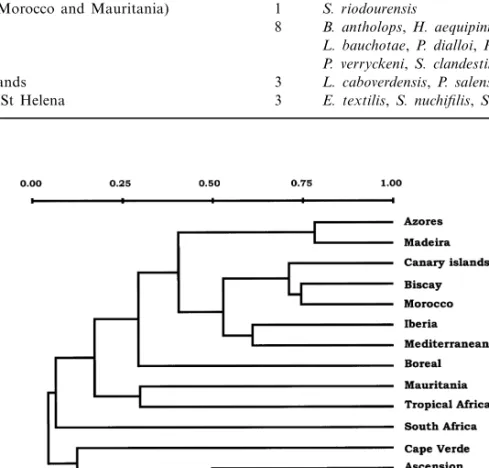
The results of the cluster analysis, performed on the similarity matrix of Jaccard index values for the areas under consideration, reveals that five groups of areas can be recognized in the east-ern Atlantic blenniid ichthyofauna (Fig. 2): (i) a temperate group including the Azores, Madeira, Iberian Peninsula, Mediterranean, Canary Islands, Morocco, Biscay and boreal areas; (ii) a tropical group including tropical Africa and Mauritania; (iii) the south temperate area of South Africa; (iv) the islands of Cape Verde; and (v) the islands of Ascension and St Helena. In the temperate Table 3 Distribution of endemic Blenniidae species in the eastern Atlantic and Mediterranean biogeographic areas
Area n Endemic species
Boreal, Biscay, Iberian Peninsula and Macaronesia 0 None
Mediterranean sea (western and eastern basins) 5 L. adriaticus, L. nigriceps, S. basilisca, P. tentacularis, P. zvonimiri
North Africa (Morocco and Mauritania) 1 S. riodourensis
Tropical Africa 8 B. antholops, H. aequipinnis, H. langi,
L. bauchotae, P. dialloi, P. sierraensis, P. verryckeni, S. clandestinus
Cape Verde Islands 3 L. caboverdensis, P. salensis, S. caboverdiana
Ascension and St Helena 3 E. textilis, S. nuchifilis, S. springeri
Fig. 2 Dendrogram of the similarities (Jaccard coefficient, cluster analysis) of the blenniid fauna among the eastern Atlantic and Mediterranean zoogeographic areas.
Blenniid zoogeography in the Atlantic
417
© 2001 Blackwell Science Ltd, Global Ecology & Biogeography, 10, 411– 422 group, the affinity of the Azores and Madeira
is remarkable (Jaccard index = 77.9%), as is the similarity between the Canary Islands and Morocco (75.0%). The Mediterranean and the Atlantic coast of the Iberian Peninsula are also closely related (61.9%).
To analyse further the relationships between these different areas, two additional affinity indices were computed for each pair of areas (see Methods). The results are summarized in Fig. 3, and confirm the patterns found already for both diversity and endemism. There are two main source areas of blenniid ichthyofauna in the north-eastern Atlantic, one corresponding to the Mediterranean and another to tropical Africa. A faunal movement originating in the Mediterranean seems to have developed northwards from the
southern Iberian Peninsula to the boreal region, and southwards to Morocco and Mauritania. The tropical West Africa source seems to have extended northwards to Mauritania, which thus acquires a dual faunistic character.
To investigate the possible origin of the Macar-onesian fauna, we have computed these indices between each pair of island groups, and between each island group and the various adjacent main-land areas that could have acted as sources. The computed indices show that the Cape Verde archipelago probably had its main source area in tropical Africa (50.0%), while its connections with Mauritania and Morocco are weak (16.7% in both cases). This relationship between Cape Verde and tropical Africa was not evident in the cluster analysis, possibly because of the high level Fig. 3 Probable colonization patterns of blenniid fauna between adjacent zoogeographic areas in the eastern Atlantic and Mediterranean. The arrows represent the probable main flux direction of faunas between adjacent areas. The figures in the boxes represent, for each pair of areas, the higher of the two similarity index values computed for that pair of areas, as described in the methods. This value was used to predict the main direction of colonization between these areas. For abbreviations, see legend to Fig. 1.
418
V. C. Almada et al.
© 2001 Blackwell Science Ltd, Global Ecology & Biogeography, 10, 411– 422 of endemism of Cape Verde, that in the cluster
procedure tended to single it out as a separate entity. The Canary Islands had their main source area in the Morocco coast (90.0%), with a minor affinity with Mauritania (55.6%). Madeira is closely related to the Canary Islands (85.7%).
The relationship between the Azores and Madeira is remarkable. Both indices for this pair are very high (Madeira–Azores = 100% and Azores–Madeira = 87.5%). It is, however, imposs-ible under this method to determine the poten-tial direction of faunal movement. A similar situation applies to the relationships between the Azores and its possible source areas (other than Madeira): the Canary Islands, Morocco and the Mediterranean (all with 75.0%) and the Iberian Peninsula (87.5%). Indeed, each of these five areas could have influenced the colonization of the Azores archipelago.
One striking feature of the present relation-ships is that the Cape Verde archipelago shows a very weak relationship with the remaining Macaronesian islands (all with 33.3%). For this reason, the Cape Verde Islands should not be included in the Macaronesian biogeographic unit, as already pointed out by Wirtz (1994).
Finally, it must be noted that, when high latitudes are considered, the number of species decreases sharply and the dispersion of the family into the boreal region is very weak, being mostly restricted to the British shores (three species). The northern limit for the family is Bergen (Norway — L. pholis).
DISCUSSION
Two features that deserve special consideration emerged from this study. The levels of diversity and endemism in the Mediterranean Sea and tropical West Africa blenniid fauna, and the pat-terns of species distribution in the Atlantic islands.
There is a negative relationship between the number of species and latitude, with tropical West Africa as the area of highest diversity and endemism. The occurrence of this maximum of diversity in the tropics is a widespread phe-nomenon in a broad range of organisms (Briggs, 1974; Wootton, 1990) and thus is not surprising, especially if one considers that blenniids are pre-dominantly distributed in warm waters (Springer,
1968, 1993; Nelson, 1994). In this context, the faunal situation of the Mediterranean is striking, both because it is comparatively rich for its latit-ude and because it is richer than the adjacent shores of the Atlantic. The presence of several endemic species (N = 5, which corresponds to 11% of the total number of Atlantic species) further emphasizes this special character of the Mediterranean fauna. In addition, four more species (A. sphynx, L. dalmatinus, L. canevae and P. rouxi), although not being strictly endemic to the Mediterranean, probably evolved there, as they have only spread to the adjacent areas of the Iberian Peninsula and North Africa. Similar findings have been noted by other authors (e.g. Tortonese, 1964; Eckman, 1967; Zander, 1973, 1980; Wirtz, 1978) and have led to the proposal of several models of speciation for Mediterranean blennioids.
In general, these models take into account the desiccation of most of the Mediterranean in the Messinian (6.5 million years ago) (Hsü et al., 1973; Hsü, 1974). This indicates that most blenniid species that currently live in the Mediterranean must have evolved from stocks that colonized this sea from the Atlantic after the Miocene, except probably for the freshwater species Salaria fluviatilis (Zander, 1973). Both Zander (1973) and Wirtz (1978) proposed that the tripterygiids currently living in the Mediterra-nean may have evolved from a single ancestral stock coming from the Atlantic. Successive waves of immigration interspersed with periods of geo-graphical isolation would have lead to speci-ation and eco-ethological specializspeci-ation (Zander & Heymer, 1970, 1976; Zander, 1973; Wirtz, 1978). Zander (1973) assumed that during the Pleistocene most blennioid species would have been unable to survive in the Mediterranean and that the ancestors of the present forms should have sur-vived in warmer refuges in the western African coast. Zander (1980) also suggested that, for some blenniid lineages, speciation may have taken a different course, with populations colonizing and becoming isolated in the Macaronesian islands and subsequently re-invading the eastern Atlantic and the Mediterranean.
Studies of foraminifera taken from sedi-ments in the Mediterranean floor (Thiede, 1978) indicate that, at least in southern parts of the Mediterranean, the water temperatures during ice
Blenniid zoogeography in the Atlantic
419
© 2001 Blackwell Science Ltd, Global Ecology & Biogeography, 10, 411– 422 ages were only a few degrees lower than today.
This means that most blenniids that currently live in the northern shores of the Mediterranean may have been able to survive there, rendering the idea of a western African refuge unnecessary.
We suggest that the succession of glaci-ation episodes, interspersed with periods of high temperatures, probably even higher than today (Thiede, 1978), could provide the mechanism of isolation and re-invasion of the Mediterranean by the same primitive stock that Wirtz (1978) had suggested without detailing the scenario. During interglacial periods it is likely that, at the peaks of the interglacial warming, warm water species could have migrated from the tropics, while during the glacial phases the tropical West Africa and the Mediterranean faunas would have been isolated from each other. This model implies that, apart from a primary speciation centre of high diversity in the tropics, the Mediterranean may have acted as a secondary speciation centre. It would also operate as a refuge for warm-temperate Atlantic species during glaciations.
This would explain the patterns of endemism and diversity found in our data. It must be stressed, however, that the importance of the Mediterranean as a centre of speciation and divers-ity preservation may have been underestimated, due to the fact that several species that prob-ably evolved or survived there, are presently found in adjacent Atlantic waters, especially those of the Iberian Peninsula. The fall of the sea level during the glaciations and the restriction of warm water to parts of the southern shores could also explain the occurrence of differences, both at the species and subspecies levels, that occur between the eastern and western Mediterranean (Thiede, 1978; Wirtz, 1980). If this scenario proves to be true, a large proportion of the speciation events that led to the present-day Mediterranean and adjacent Atlantic blenniid fauna must be recent and have occurred during the Pleistocene.
Concerning the Macaronesian islands, our results confirm that the icthyofauna of Cape Verde is markedly distinct from the remaining islands and should not be placed in the same entity, as stated above. In addition the Cape Verde Islands, although located near tropical Africa and probably having received their ori-ginal fauna from there, must have undergone a distinct faunal history for a considerable period
of time. Of six blenniid species present in the Cape Verde Islands, three are endemic. This level of endemism is much higher than that of the typ-ical Macaronesian islands. It is clear from our data that the Canary Islands show a high level of similarity with western North Africa, and that the Azores and Madeira possess a blenniid fauna that forms a subgroup of that of the Canary Islands. Despite the fact that predominant cur-rents flow eastwards at the Azores, some authors have provided indications that transport routes operate from Madeira and north-west Africa, carrying organisms, at least sporadically, to the Azores (e.g. Miller, 1984; Gofas, 1990; Santos et al., 1995). It would also be interesting to investigate the possible role of the countless sea mounts present in the north-eastern Atlantic as stepping-stones for the colonization of the Macaronesian islands, during glacial periods when the sea level was a hundred metres or more lower than today. Although the evidence presented in this paper does not exclude a possible migratory route from West Europe to the Azores, at least for some species the colonists must have arrived from Madeira and/or north-west Africa. For instance, the Azorean populations of Parablennius sanguinolentus are intermediate between those of European and Mediterranean shores and those of West Africa, also known as P. parvicornis (Arruda, 1979; Zander, 1979; Santos, 1992). Another example is the tropical blenniid Ophioblennius atlanticus that must have been transported from the western to the eastern Atlantic probably at/ or near the tropics, since its closest relative (O. steindachneri) lives along the eastern coasts of the tropical Pacific (Springer, 1962). This spe-cies is absent from the Mediterranean and the northern African Atlantic shores and thus must have reached the Azores and Madeira from an African source. It is probably a very recent colonizer of the Azores since it seems that, in the glacial periods, sea temperatures in the archipelago were several degrees lower than today (Corliss, 1975; Lamb, 1977; Crowley, 1981).
If the arguments presented above are correct, then most blenniid fauna of the Azores must be of postglacial origin (< 12 000 –15 000 years), which would be consistent with the lack of endemics in Macaronesia (i.e. Azores, Madeira and Canary Islands) (see also Briggs, 1966, 1970; Santos et al., 1995). In this scenario, the model
420
V. C. Almada et al.
© 2001 Blackwell Science Ltd, Global Ecology & Biogeography, 10, 411– 422 of speciation in the Atlantic islands proposed by
Zander (1973, 1980) is probably not applicable to most blenniids, although it may be feasible for Parablennius ruber, a species with a very atyp-ical distribution, occurring in the Azores and Madeira and the south-west Atlantic coast of Europe (Oliveira et al., 1992).
More work is needed to test further the hypotheses raised by this study. In particular, molecular studies have the potential to evaluate the timing of events presented in this paper, and more detailed phylogenetic studies could iden-tify possible species groups representing distinct lineages of Atlantic ancestors that invaded the Mediterranean and evolved there.
ACKNOWLEDGMENTS
This study was financially supported by Fundação para a Ciência e a Tecnologia (FCT) through the Plurianual Program (UI & D 331/94) and through the research projects PBIC/1313/MAR/92 and PRAXIS XXI/3/3.2/EMG/1957/95. The authors would like to thank A.J. dos Santos for valuable help with the statistics, and J.I. Robalo and R.J. Whittaker for help in the final editing of the manuscript.
REFERENCES
Afonso, P., Porteiro, F.M., Santos, R.S., Barreiros, J.P., Worms, J. & Wirtz, P. (1999) Coastal marine fishes of São Tomé Island (Gulf of Guinea). Arquipélago — Life and Marine Sciences, 17A, 65–92. Almada, V.C., Oliveira, R.F., Gonçalves, E.J.,
Almeida, A.J. & Barata, E.N. (1993) A new northern limit for the distribution range of Lipophrys canevae (Pisces: Blenniidae) in the Atlantic Ocean. Arquivos Do Museu Bocage — Nova Série, 2, 403– 408. Almeida, A.J. & Ibañez, M. (1981) Au sujet de la
citation de Blennius rouxi Cocco, 1833 sur la coté Basque. Arquivos Do Museu Bocage — Série B, 1, 37– 40.
Arruda, L.M. (1979) On the study of a sample of fish captured in the tidal range at Azores. Boletim Da Sociedade Portuguesa de Ciências Naturais, 19, 5–36.
Bath, H. (1982) Lipophrys sabry n. sp. von der Mittelmeerküste Libyens (Pisces: Blenniidae). Senckenbergiana Biologica, 63, 153–160.
Bath, H. (1983) Blenniidae. Check-list of the fishes of the north-eastern Atlantic and of the Mediter-ranean (ed. by J.C. Hureau and Th. Monod), pp. 519–527. UNESCO, Paris.
Bath, H. (1989) Taxonomie und verbreitung von Parablennius Ribeiro 1915 an der W-Küst Afrikas und den Kapverdischen Inseln mit revalidation von P. verryckeni (Poll 1959) und beschreibung drei neuer arten (Pisces: Blenniidae). Senckenbergiana Biologica, 70, 15 – 69.
Bath, H. (1990) Blenniidae. Check-list of the fishes of the eastern tropical Atlantic (ed. by J.C. Quéro, J.C. Hureau, C. Karrer, A. Post and L. Saldanha), pp. 905–915. JNICT, Lisboa.
Bath, H. (1996) Beitrag zur Osteologie der Arten der Tribus Parablenniini Die Beziehungen der Knochen des Schädeldaches zum Seitenorgan-System und zu den Weichteilbildungen der Kopfberseite sowie die systematische Bedeutung der Befunde nebst Bemerkungen zu Lupinoblennius dispar Herre 1942. Senckenbergiana Biologica, 76, 65–92.
Bath, H. & Wirtz, P. (1992) On a collection of blen-niid fishes from Mauritania, with a redescription of Spaniblennius riodourensis (Metzelaar, 1919). Zoologische Mededelingen, 66, 265–276.
Bauchot, M.L. (1966) Poissons marins de l’Est Atlantique tropical. V. Blennioidei. Atlantide Report, 9, 63–91.
Ben-Tuvia, A. (1971) Revised list of the Mediter-ranean fishes of Israel. Israel Journal of Zoology, 20, 1–39.
Briggs, J.C. (1966) Oceanic islands, endemism and marine paleotemperatures. Systematic Zoology, 15, 153–163.
Briggs, J.C. (1970) A faunal history of the north Atlantic Ocean. Systematic Zoology, 19, 19–34. Briggs, J.C. (1974) Marine zoogeography,
McGraw-Hill, New York.
Brito, A. (1991) Catálogo de los peces de las Islas Canarias. Francisco Lemos Editores, La Laguna. Brito, A. & Lozano, G. (1981) El suborden Blennio-idei (Pisces, Percomorphi) en las Islas Canarias. Boletin Del Instituto Español de Oceanografia, 6, 8–17.
Brownell, C.L. (1978) Sur quelques collections de poissons littoraux de l’Atlantique Marocain. Bul-letin de l’Institut de Pêches Maritimes, 23, 111–133. Corliss, B.H. (1975) Late Pleistocene paleocli-matology: planktonic foraminiferal analyses of sediment cores from the central North Atlantic. Paleogeography, Paleoclimatology & Paleoecology, 18, 45 – 61.
Crowley, T.J. (1981) Temperature and circulation changes in the eastern north Atlantic during the last 150,000 years: evidence from the planktonic foraminiferal record. Marine Micropaleontology, 6, 97–129.
Dooley, J.K., van Tassel, J. & Brito, A. (1985) An annotated checklist of the shorefishes of the Canary Islands. American Museum Novitates, 2824, 1– 49.
Eckman, S. (1967) Zoogeography of the Sea. Sidgwick & Jackson, London.
Blenniid zoogeography in the Atlantic
421
© 2001 Blackwell Science Ltd, Global Ecology & Biogeography, 10, 411– 422 Fowler, H.W. (1936) The marine fishes of West
Africa, based on the collection of the American Museum Congo Expedition 1909–15. Bulletin of the American Museum of Natural History, 70, 1– 606. França, M.L. & Vasconcelos, M.S. (1962) Peixes do Arquipélago de Cabo Verde. Notas mimeografadas. Centro de Biologia Piscatória, Lisboa, 28, 1– 86. Gofas, S. (1990) The littoral Rissoidae and
Ana-bathridae of São Miguel, Azores. Açoreana Sup-plement, 97, 1–134.
Gonçalves, E.J., Almada, V.C., Almeida, A.J. & Oliveira, R.F. (1993) On the occurrence of Para-blennius sanguinolentus (Pisces: Blenniidae) on the Portuguese coast. Journal of the Marine Biological Association of the United Kingdom, 73, 465 – 467. Goren, M. & Galil, B. (1989) Petroscirtes ancylodon:
first lessepsian migrant blenny in the eastern Medi-terranean. Israel Journal of Zoology, 36, 125 –128. Helden, L. & Wirtz, P. (1985) A comparison of Blennius ocellaris L. 1758, B. riodourensis Metze-laar 1919 and B. normani Poll 1949. Spixiana, 8, 197–217.
Hsü, K.J. (1974) The Miocene dessication of the Mediterranean and its climatical and zoogeo-graphical implications. Naturwissenschaften, 61, 137–142.
Hsü, K.J., Ryan, W.B.F. & Cita, M.B. (1973) Late Miocene desiccation of the Mediterranean. Nature, 242, 240 –244.
Ibañez, M. & Motos, L. (1977) Blennius ponticus (Slastenenko, 1934) nueva especie para la fauna Atlantica. Vie et Milieu, 27, 377–383.
Ibañez, M., San Mill, M.D. & Ripa, M.I. (1989) Intertidal ichthyofauna of the Spanish Atlantic coast. Scientia Marina, 53, 451– 455.
ICN (1993) Livro Vermelho dos Vertebrados de Por-tugal, 3 — Peixes Marinhos E Estuarinos. Instituto da Conservação da Natureza, Lisboa.
Lamb, H.H. (1977) Climate: present, past and future, vol. 2 — Climatic History and the future. Methuen, London.
Miller, P.J. (1984) The gobiid fishes of temperate Macaronesia (eastern Atlantic). Journal of Zoology, 204, 363 – 412.
Motos, L. & Ibañez, M. (1979) Contribucion al estudio de los blenideos de la costa Vasca. Primer Simposio de Bentos, San Sebastian, pp. 215–222. Nelson, J.S. (1994) Fishes of the world, 3rd edn.
John Wiley and Sons, New York.
Nieto, P. & Alberto, L.J. (1990) Hypleurochilus bananensis (Poll, 1959) (Blenniidae). New record for the European Atlantic coast and for the Span-ish fauna. Cybium, 14, 361–364.
Nieto, P. & Alberto, L.J. (1993–94) Gobiidae y Blen-niidae de la zona intermareal de la costa sur-occidental de Andalucía (Espanã). Miscelanea Zoologica, 17, 179–188.
Oliveira, R.F., Almada, V.C., Almeida, A.J., Santos, R.S. & Gonçalves, E.J. (1992) A checklist of the
Blennioid fishes (Teleostei, Blennioidei) occurring in Portuguese waters. Arquipélago — Life and Earth Sciences, 10, 23–37.
Patzner, R.A. (1984) Die Blenniiden von Ibiza (Bal-earen) und ihre Verbreitung im West-Mittelmeer. Senckenbergiana Biologica, 65, 179–203.
Penrith, M.J. & Penrith, M.L. (1972) The Blenniidae of western southern Africa. Cimbebasia — Serie A, 2, 65–90.
Regueiro, S.D., Alvarez, J.C.P. & Solórzano, M.R. (1979) Contribuicion al estudio de los blenidos del litoral Gallego (Pisces: Blenniidae). Brama, 3, 55–73.
Santos, R.S. (1992) Behavioural ecology, phenology and ethology of an intertidal blenny Parablennius sanguinolentus parvicornis (Valenciennes in Cuvier & Valenciennes 1836) (Pisces: Blenniidae) from the Azores. PhD Thesis, University of Liverpool. Santos, R.S., Hawkins, S., Monteiro, L.R., Alves, M.
& Isidro, E.J. (1995) Marine research, resources and conservation in the Azores. Aquatic Conserva-tion: Marine and Freshwater Ecosystems, 5, 311–354. Santos, R.S., Porteiro, F.M. & Barreiros, J.P. (1997) Marine fishes of the Azores: an annotated check-list and bibliography. Arquipelago — Life and Marine Sciences Supplement, 1, 1– 244.
Sneath, P.H.A. & Sokal, R.R. (1973) Numerical tax-onomy. W.H. Freeman, San Francisco.
Springer, V.G. (1962) A review of the blenniid fishes of the genus Ophioblennius Gill. Copeia, 1962, 426– 433. Springer, V.G. (1968) Osteology and classification of the fishes of the family Blenniidae. Bulletin of the United States National Museum, 284, 1– 83. Springer, V.G. (1986) Blenniidae. Smiths’ sea fishes
(ed. by M.M. Smith and P.C. Heemstra), pp. 742– 755. Springer-Verlag, Berlin.
Springer, V.G. (1993) Definition of the suborder Blennioidei and its included families (Pisces: Per-ciformes). Bulletin of Marine Science, 52, 472– 495. Steinitz, H. (1950) Contribution to the knowledge of the Blenniidae of the eastern Mediterranean III. Reviews of the Faculty of Sciences of the University of Istanbul B, 15, 60 – 87.
Thiede, J. (1978) A glacial Mediterranean. Nature, 276, 680 – 683.
Tortonese, E. (1964) The main biogeographical fea-tures and problems of the Mediterranean fish fauna. Copeia, 1964, 98–107.
Tortonese, E. (1975) Fauna d’Italia. Osteichthyes (Pesci, Ossei), Parte Seconda. Editores Calderini, Bologna.
Wheeler, A. (1969) The fishes of the British Isles and north-west Europe. MacMillan, London.
Wheeler, A. (1992) A list of common and scientific names of fishes of the British isles. Journal of Fish Biology, 41 (Suppl. A), 1–37.
Wirtz, P. (1978) The behaviour of the Mediterranean Tripterygion species (Pisces, Blennioidei). Zeitschrift für Tierpsychologie, 48, 142–174.
422
V. C. Almada et al.
© 2001 Blackwell Science Ltd, Global Ecology & Biogeography, 10, 411– 422 Wirtz, P. (1980) A revision of the eastern-Atlantic
Tripterygiidae (Pisces, Blennioidei) and notes on some West African blennioid fish. Cybium, 3e Serie, 11, 83–101.
Wirtz, P. (1994) Underwater guide Madeira, Canary Islands, Azores — Fish. Verlag Stephanie Naglschmid, Stuttgart.
Wirtz, P. & Bath, H. (1981) Lipophrys bauchotae n. sp. from the eastern tropical Atlantic (Pisces: Blenniidae). Senckenbergiana Biologica, 62, 225–232. Wirtz, P. & Bath, H. (1989) Lipophrys caboverdensis n. sp. from the Cape Verde Islands (Pisces: Blen-niidae). Senckenbergiana Biologica, 69, 15–27. Wirtz, P. & Hellinger, J. (1987) Zur Zoogeographie
der Atlanto-mediterranen Blennioidea mit beson-derer Berücksichtigung der Kapverdischen Inseln (Vertebrata: Pisces). Courier Forschungsinstitut Senckenberg, 95, 99–102.
Wootton, R.J. (1990) Ecology of Teleost fishes. Chapman & Hall, London.
Zander, C.D. (1973) Evolution of Blennioidei in the Mediterranean sea. Revue Travaux de L’Institut de Péches Maritimes, 37, 215 –221.
Zander, C.D. (1979) Morphologische und
ökolo-gische Untersuchung der Schleimfische Parablennius sanguinolentus (Pallas, 1811) und P. parvicornis (Valenciennes, 1836) (Perciformes, Blenniidae). Mitteilungen Aus Dem Hamburgischen Zoologis-chen Museum und Institut, 76, 469– 474.
Zander, C.D. (1980) Zoogeography and speciation of Mediterranean blennioids. Journées de Etudes Systématiques et Biogéographiques de Mediterraneen, CIESM, Cagliari, 13 –38.
Zander, C.D. (1986) Blenniidae. Fishes of the North-Eastern Atlantic and the Mediterranean (ed. by P.J.P. Whitehead, M.-L. Bauchot, J.-C. Hureau, J. Nielsen and E.E. Tortonese), pp. 1096 –1112. UNESCO, Paris.
Zander, C.D. & Heymer, A. (1970) Tripterygion tripteronotus Risso 1810 und Tripterygion xantho-soma n. sp., eine ökologische Speziation. Vie et Milieu, 21, 363–394.
Zander, C.D. & Heymer, A. (1976) Morphologische und ökologische Untersuchungen an den speleo-philen Schleimfischartigen Tripterygion melanurus Guichenot 1850 und T. minor Kolombatovic 1892. Zeitschrift für Zoologische Systematik und Evolu-tionsforschung, 14, 41–59.