Received: 07 July 2009 / Accepted: 03 December 2009 / Published (online): 01 March 2010
Stability of patterns of behavior in the butterfly technique of the elite swimmers
Hugo Louro 1,2 , António J. Silva 2,3, Teresa Anguera 2,4, Daniel A. Marinho 2,5, Conceição Oliveira 2,4,
Ana Conceição 1,2 and Jorge Campaniço 2,3,4
1 Sports Sciences School of Rio Maior, Polytechnic Institute of Santarém, Portugal, 2 Centre of Research in Sports,
Health and Human Development, Vila Real, Portugal, 3 University of Trás-os-Montes and Alto Douro, Department of
Sport Sciences, Exercise and Health, Vila Real, Portugal, 4 University of Barcelona, Barcelona, Spain, 5 University of
Beira Interior, Department of Sport Sciences, Covilhã, Portugal
Abstract
The purpose of this study was to find patterns in the butterfly swimming technique, with an adaptation of the Behavioral Observation System Tech. This, as an instrument for ad-hoc qualitative analysis, enables the study of the stability of the technical implementation. When used in the training of swim-mers, analysis can reduce the variability of behavioral tuning swimming technique. Through the analysis of temporal patterns (T-pattern) and a sequence of five cycles running at hand maxi-mum speed, the behavior of four technical Portuguese elite swimmers, with a record of 259 alphanumeric codes and a total of 160 configurations, were studied. The structure of the original instrument, based on a mixed system of categories and formats Field, can record technical features, observed during the execu-tion of hand cycles. The validity was ensured through the index of intra-observer reliability (95%) and inter-observer accuracy (96%). To detect patterns in each swimmer, the Theme 5.0 software was used, which allowed to identify the stable struc-tures of technical performance within a critical interval of time (p <0.05) - t-patterns. The patterns were different, adjusting to the characteristics of technical implementation of the swimmers. It was found that the swimmer can create settings with different levels of structure complexity, depending on the implementation of changes within the hand cycle. Variations of codes in each configuration obtained using the SOCTM, allowed determining the differences between swimmers. However, the records showed a clear behavioral similarity when comparing the result with a general pattern of the butterfly technique. The potential quality of this instrument seems to be important due to the pat-terns obtained from a temporal sequence.
Key words: Technical analysis, patterns, butterfly, chronology.
Introduction
The sports technique aimed to achieve an optimum reso-lution of the tasks of competition in a particular sport (Grosser and Neumaier, 1986). It is defined as a rational process, appropriate and economic, for a sport result (Bompa, 1983; 1990). Generally, it is described by a set of characteristics and dynamics of cinematic form: verbal, graphic design, mathematics, biomechanics, anatomy, functional, or other.
To analyze the sport movements of a swimmer, the level of swimming in a cinematic perspective and in terms of technical effectiveness should be carried-out (Barbosa et al., 2008; Marinho et al., 2009). Thus, we have to take into account the differences between the model and the
individual response (Counsilman, 1968; Campaniço et al., 2006). In this context, we must also remember that the stagnation in technical (Knapp, 1980), stems from the acquisition of engines weak habits that the swimmer use to achieve the proposed objective in terms of efficiency, are not the most profitable and efficient.
The butterfly technique is characterized by models and variants identified (Colman and Persyn 1993; Persyn et al., 2000; Silva and Alves, 2000). These models can be observed, described and analyzed with high accuracy compared to existing technological resources. The de-mand of the particular hand champions, so often dis-cussed in technical terms in the scientific community, is the main reason why the procedures used in this study can be used to know the actual reason for its success.
Persyn et al. (2000) compared and characterized the main variants of the butterfly technique in wave and flat styles, accurately defining the phases and sub-phases in each cycle of swimming. Silva and Alves (2000) rein-forced some aspects of the new variants associated to wave criteria, focusing in particular on the importance of lumbar hyper-extension and torso arched position. Sanders et al. (1995), Sanders (1996), Scheihauf et al. (1988), Togashi and Nomura (1992), Mason et al. (1992), Maglischo (2003), Barbosa et al. (2003), Barbosa et al. (2005), Silva and Alves (2000), Platonov (2005), Chollet et al. (2005) confirm the technical standard as a typical set of actions: (i) position of the body wave, (ii) action of the upper limbs, (iii) ascending and descending action of the lower limbs, (iv) coordination between actions of the upper and lower limbs and, (v) coordination between these and the breathing action.
The observational methodology, particularly as a strategy of scientific method, used for analyzing the be-haviour situation, involves the fulfilment of an ordered series of tasks to collect and process data (Sackett, 1978; Bakeman and Gottman, 1989; Anguera 1993; Anguera et al., 2001). In swimming, we can note the importance of such scientific procedures to study the technical perform-ance (Campaniço et al., 2006; Oliveira et al., 2006; Car-doso et al., 2008; Louro et al., 2009a).
According to Anguera et al. (2001), there are ad-vantages in using this method because not only can the user take the procedures of the laboratory into the field, but also can provide data without interfering with or ma-nipulating the behaviour of the observed subjects. To examine the technical performance (Campaniço and
guera, 2001), using the observation as a tool for coding (Anguera and Blanco-Villaseñor, 2003), one must: (i) isolate the object of observation, (ii) create a system suit-able for the purpose of research, (iii) develop criteria and specifications in relation to the observed behaviour (cate-gories and formats of the field), (iv) involve a process of rating and measurement and, (v) ensure and validate the instrument of observation.
In this context, the objective of this study was to introduce a method to examine the data and to analyse the inter-temporal relationship between the structures of events (movements) in the butterfly technique. This method of analysis is based on the detection of patterns using the software THEME, developed by Magnusson (1996; 2000). This instrument intend to identify consis-tent patterns that exist within a flow of conduct and thus to provide a different view of the complex relationships between movements. The detection of the pattern is based on the theory of probability and, more specifically, the binomial distribution (Magnusson, 2000). The major advantage of this software lies on the identification of hidden patterns allowing a different approach of the com-plex relationships continuously established during a se-quence of actions. According to Magnusson (2000), the algorithm used in the detection of temporal patterns is based on a binominal theory of probabilities allowing identifying the sequential and temporal data systems. Hence, observational methods applied to sport are scien-tific procedures that reveal the occurrence of perceptible motor behaviours, allowing them to be formally recorded and quantified. In addition, they also allow the analysis of the relations between these behaviours, such as sequen-tiality, association and covariation. Theme software was used to determine behaviour patterns in sports, rendered precisely around the process of observation of sport events guided by ad-hoc instruments, answering to several problems, such as performance in collective sport games (e.g. Anguera and Jonsson, 2003; Anguera et al., 2003) or recording and reproduction of technical actions for visu-alization of flows of conduct in individual sports (e.g. Castañer et al., 2009; Louro et al., 2009a; Lyon et al., 1994).
Methods
Our study was based on observational methodology. In this context the design of this study was classified as punctual, nomotetic, multidimensional (Anguera et al., 2001). Punctual, since the acquired data were obtained in a single moment, or a single session. Nomotetic, since our sample comprised four subjects with a common bond, cycles of the butterfly swim. It also seeks to investigate the conduct in which several dimensions of technical execution occur simultaneously (multidimensional char-acter).
In the exploratory phase, we defined the behavior to be observed, based on deductive explanation. The units of measurements were defined as units of events, or events.
Participants
The sample comprised four international level swimmers, all with a male performance sports with more than 750 points in the table of FINA for 100m butterfly. The ath-letes involved were representative of the national team of Portugal in absolute Olympics in butterfly.
Instruments
Instrument for measurement
For the record of the image a Sony Mini-DV Camera (50 Hz) was used, and recorded in real time, connected via Firewire to the hard disk of a laptop (Centrino Airis, 1700 Mhz). The camera had been protected by a sealed housing Ikelite. To perform the capture of the image to digital format the MovieMaker software was used and the dis-play of images was carried out using Quintic Software. All procedures were conducted in an indoor 50m swim-ming pool.
Instruments of observation
We used an Ad-hoc reference (Anguera et al., 2000). The instrument has been configured by the nature of research: (i) criteria, (ii) system of codes and, (iii) units of coding. The structure of the observation was taken as individual events at the discretion of time and order (Anguera, 1990; Anguera and Blanco, 2003), representing one or more specific technical behavior of a hand cycle.
The adaptation of the Observing System Perform-ance in Butterfly Technique (SOCTM) was conducted based on four core criteria: EMA, PAP, SAP and SMRB, as Table 1 (Louro et al., 2009a), characterizing the con-duct considered critical in the cycle of the butterfly swim. Each criterion represents a stage of a complete cycle ges-ture, adding movements and actions that represent the technical conduct, independent of any existing variant. Each criterion is divided into two phases, comprising a few frames of video sequence.
The conduct was in accordance with the temporal characterization delimiting the beginning and end of each stage. In each of these stages a list of key points were defined, being critical to the implementation in the ex-ploratory phase. To each of them an alphanumeric code was assigned.
In this context, the analysis of data was conducted based on the following settings on two occasions: (i) for the moment that determines the entry in the time period and, (ii) relating to the movement performed by the first moment that marks the entrance to the following criterion. This means that we have a characterization of temporal sub-events, characterizing the technical achievement of the swimmer for a given time of the swimming cycle. Table 1 represents the four criteria.
For this study the instrument was set with 83 al-phanumeric codes. Each swimmer can get 40 different settings by examining a hand cycle, i.e., eight settings, or events, per cycle, making 40 in all the five cycles.
Observational Sample
The sample was represented by many observational re-cords, 259 alphanumeric codes and a total of 160 configu-rations, or lines of code per event, used to catalog the
Table 1. Moments of observation and description of observation instrument used in hoc – SOCTM.
EMA Input your hand
in the water
Focuses on aspects of the relationship cycle with another gesture, particularly when that occurs the entry of the hands in water, associated with the position of the head, torso and legs. The transitional approach is marked by the beginning of flexion of the arms and below the point of the leg. This is divided into two stages: Entry 1 of the hands in water, coinciding with the onset of action of the kick-down, 2 extending out of the arms and the end of the downward action of the legs.
PAP First propulsive
support
Focuses on critical aspects of the generation of propulsive support the arms as they performed in front of the line of the shoulders, associated with new positions of the head, trunk and legs during the movement. The transitional approach is the deepest point of the hands. It is divided into two stages: 1 Flexion of the forearm in relation to the long arm and onset of action upwards legs 2 The deepest point of the hands occurring in front of the head and shoulder line.
SAP Second
propul-sive support
Focuses on critical aspects of the second generation of the propulsive support of the arms as they planned for behind the line of the shoulders, associated with new positions of the head, trunk and legs during the movement. The criterion is the transition from hands on the vertical line of the thigh. It is divided into two stages: 1 The hands are on the vertical line of the shoulder, at the commencement of the action; 2 hands are on the vertical line of the thigh.
SMRB
Out of the hands and arms recovery
Focuses on critical aspects of the arms and out as they planned ahead for the recovery carrier. The transitional approach is the entry point of the hands in the water, which coincides with the moment of departure the effect of two-foot vertical climb of the legs. It is divided into two stages: 1 out of the hands in water and rising action of the legs, 2 during the immersion of the head and in the 2nd half (after the vertical shoulder) and recovery of arms.
performance of each swimmer during the five hand cy-cles.
Review procedures
Each subject performed the overall butterfly swimming technique in a distance of 25m. The filming was con-ducted in a sagital plane with rotation from right to left, following the motion of swimming, to permit the viewing of five complete cycles of swimming. The camcorder had been fixed, protected by a sealed housing and was placed perpendicular to the direction of displacement at a 6m distance from the swimmer and about 30cm deep, pro-tected by a sealed housing.
Five cycles were extracted to ensure the behavioral sequence, taken from closer to the midline of the focal center, 8 to 10m after finishing between 18 and 20m.
The descriptive analysis was performed by the number of codes, settings and levels of stability (I) and variable (Iv). The stability is given by the ratio between the highest point on the frequency of occurrence and the total on each moment of observation. The closer to 1, the greater the stability is and was used to interpret each of the moments in study, or parts of the movement. This index is important for analysis of a single subject, or sev-eral subjects. The variability was given by the ratio of n-frequency settings recorded and the maximum possible settings for time of observation. For all the swimmers analysis, n = 20 was performed. The lower the index, the more similarity between swimmers executions in each moment of observation is observed.
To detect the patterns, the software first identifies the relationship between the two types of events and then detects the most complex patterns, using simple combina-tions. After detecting simple patterns, the user can then add up these patterns and simple patterns become more
complex, since it combine with each other. Throughout the process of detection, a selection of models is done by deleting the less complete versions (Magnusson, 1996, 2000).
It is important to note that to interpret behavioral patterns hidden by the hierarchical structures of the graph obtained in the output, in this study it was defined that it would be only subjected to analysis the patterns whose events represent the four phases, regardless the use, or not, of the eight moments of integrated observation of the four criteria.
This filtering options selected in the software, also took into account the temporal distances of each event and the context of sequences during the swim.
The results of the patterns, that are found for the time period of five cycles and to find a pattern to the events, must occur at least twice during this period. Not all the events that occur are mentioned twice, because the software filters them and exposes only the events that have a higher chance, in the critical time.
The representation of this information differs from swimmer to swimmer; a type case study. Natural condi-tion of implementacondi-tion, the maximum speed, regardless of each swimmer, compels us to explore different types of settings.
Results
The results that are presented refer to the table of fre-quency events, and analysis of the behaviour pattern of relationships through the sequential and critical intervals.
Descriptive analysis
Noting, for example, the table of frequencies of a swim-mer, representing a codification of the system of
Table 2. Number of codes found by each swimmer and settings of each swimmer and the index of stability (IOS).
Swimmer 1 Swimmer 2 Swimmer 3 Swimmer 4
Quantity Absolute (A) IOS (i.e.) A I E A IE A IE A IE
Criteria recorded 67 69 64 59
Diferents criteria recorded 30 1 38 .79 38 .79 35 .86 36 .83
Table 3. Characterization of the events and the occurrence frequency of swimmer 1 in the eight times of observation.
Criteria Times of Observation Settings(moles) N IE
1st time 1b2,1b4,1c3,1t2,1p4 1b1,1b4,1c3,1t2,1p4 1b1,1b4,1c3,1t2,1p3 3 1 1 ,60 ,20 ,20 EMA 2nd time 1b8,1t5,1t7 1b8,1t6,1t7 1b9,1t6,1t7 1 1 3 ,20 ,20 ,60 1st time 2b2,2b5,2c2,2t1,2t4,2p4 5 1 PAP 2nd time 2b6,2p8 2b6,2p9 2b7,2p9 1 1 3 ,20 ,20 ,60 1st time 3b1,3b4,3c1,3t2,3p3 3b1,3b4,3c1,3t3,3p3 3b1,3b4,3c2,3t3,3p3 1 1 3 ,20 ,20 ,60 SAP 2nd time 3t5,3t8 5 1 1st time 4b1,4c1,4t2,4t4,4p7 4b1,4c2,4t2,4t4,4p7 2 3 ,40 ,60 SMRB 2nd time 4t8,4t12 4t7,4t12 3 2 ,60 ,40
gestures over five cycles (Table 2). One can easily visual-ize the structure of the settings of each criterion and its variations in performance.
In terms of technical description of the conduct, we can observe the conduct stable (I) and the overall imple-mentation from the configurations obtained. Values less than or equal to 0.5 are considered weak, between 0.5 and 0.75 reasonable, less than 0.75 very reasonable, and 1.0 is considered excellent.
We can observe that the swimmers had a high sta-bility. All values are above 0.79, i.e. very close to 1.
In Table 3 we can verify the events and changes occurred. At the entrance of the hand in the water (EMA) in the 1st time, there was a variation in the position of the hands relative to shoulders position being near (i.e. 0.40) or distant (i.e. 0.60), with variation of the heels being below the water line (i.e. 0.20) or above (i.e. 0.80). In the 2nd time the change happens in the path of the hands ranged from down (i.e. 0.40) and down and out (i.e. 0.60).
During the first propulsive support (PAP), there were variations in the second swirl around the hand (i.e. 0.60) and vorticity (i.e. 0.40), and changes from below the knee (i.e. 0.80) or near the surface of the water (i.e. 0.20). Dur-ing the second propulsive support (SAP), the behaviour change occurred between cycles, due to the position of the head for breathing, above (i.e. 0.40) and below (i.e.0.60) the waterline. We also found a variation in the position of the gluteus, near the waterline (i.e. 0.20) or below (i.e. 0.80). In the last criterion, on the output of the recovery of the arms and hands (SMRB), the variation was due to the head being above (i.e. 0.40) and below (i.e. 0.60) and in the 2nd time, due to the posture of the trunk, showing a dorsi-flexion (i.e. 0.40) or a flat position (i.e. 0.60).
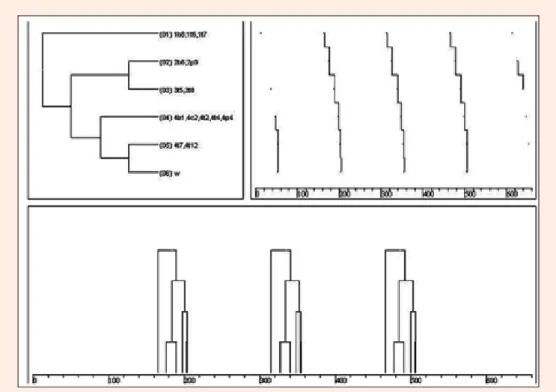
The patterns displayed by the software Theme give us an overview of the behavioural interaction between times and between cycles. The output gives us three levels to view the same graph. The lower representation allows the visualization of time in which the default occurs, in
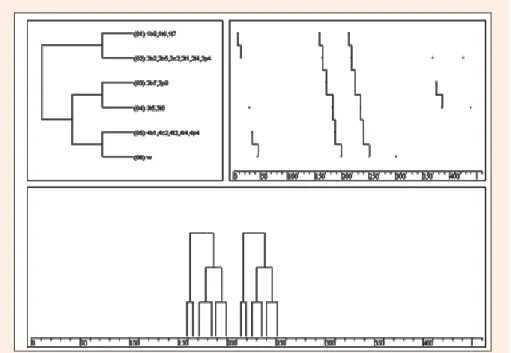
Figure 1. Swimmer 1 - Schematic representation of incomplete behavioural pattern, with five
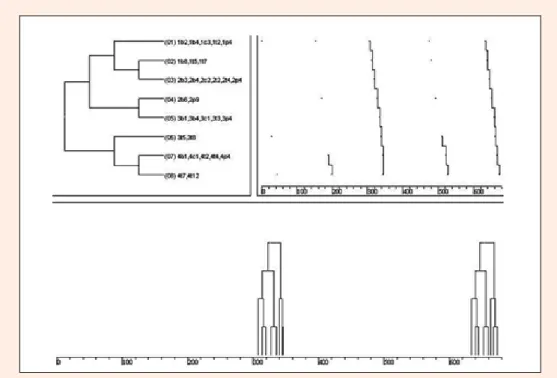
Figure 2. Swimmer 1 - Schematic representation of incomplete behavioural pattern, with four events in con-secutive cycles with breathing.
the total sample time, and vertically, as characterized the diagram. The top right gives the relationship between time cycles. In the upper left corner we find the tree struc-tures corresponding to the cycle times and the lines of events and their relationships within cyclical.
In terms of data description in a swimmers’ study, the pattern was classified as incomplete (five lines of events). In terms of general description of the technical conduct, interpreting Table 1, we can describe that we also ob-tained the settings, but now all related through a critical
time interval (t-pattern) for the five cycles. Figure 1 the first class has two settings: 1b9, 1t6, 1t7 (Ic 0.60) for the 2nd time of EMA. These data give a trajectory of the hand downwards, with the trunk in flexion, tilted and below the hip. Its stability is considered reasonable. Regarding the second configuration, 2b2, 2b5, 2C2, 2t1, 2t4, 2p4 (Ic 1) refers to 1 when considered the PAP, indicating that the hands are in the extension of the shoulders, elbows away from the line of water (below this), head below the water line, gluteus above and below the trunk, tilted hip and
Figure 4. Swimmer 2 - Schematic representation of complete behavioural pattern. Pattern with eight events in alternating cycles.
heels above the water. These two events are crucial to the remaining structure. Its stability is excellent. The second branch corresponds to the event 2b7, 2p9 (Ic 0.60), for the 2nd time of PAP, characterized by a turbulent flow around the hand and knees below the waterline; reason-able stability. The second event 3T5, 3t8 (Ic 1) is the 2nd time of SAP, indicates that the trunk has a flat and in-clined position above the hip; it has an excellent stability. Moreover, the third line shows only the configuration of the events 4B1, 4C2, 4t2, 4t4, 4p4 (Ic 0.60) which corre-sponds to 1 when the SMRB occurs, which reveals the hands out and behind the elbows; the head and shoulders are above the water line, close to the gluteus and well below the heel; its stability is reasonable.
The pattern formed by the Sub 2 when EMA oc-curred and 1st when PAP is the triggering of other behav-iour, consisting of a sub standard and a range of events, thus the standard of the swimmer but an incomplete one.
In Figure 2 one can observe the pattern correspond-ing to the inspiratory cycle which is the 4th and 5th cycle. Here is the relevant combination, the first branch of the 1st moment of EMA with the 1st PAP, first registered in the found patterns (1B2, 1b4, 1c3, 1t2, 1p4) (Ic 0.60), which means the hands from the extension of the shoul-ders, placing the hands before the elbow, guiding the vision down, gluteus near waterline and position of heels below the waterline, which seems to explain the associa-tion between the height of the body with the time of hands’ entry; its stability is reasonable. The second branch, connecting the 2nd stage of the SAP with 1 out of hands, seems to explain the importance of acceleration of the arms in the output to compensate the breathing movement.
We found that the behavioural patterns of the swimmer were incomplete, and five events were the most complete ones. The behavioural pattern of Figure 2,
Table 4. Characterization of the events and the occurrence frequency of swimmer 2 in the eight times of observation.
Criteria Times of Observation Settings(moles) N IE
1st time 1b2,1b4,1c3,1t2,1p4 5 1 EMA 2nd time 1b8,1t5,1t7 1b8,1t6,1t7 3 2 ,60 ,60 1st time 2b3,2b4,2c1,2t2,2t4,2p4 2b3,2b4,2c2,2t1,2t4,2p4 2b3,2b4,2c2,2t2,2t4,2p4 1 2 2 ,20 ,40 ,40 PAP 2nd time 2b6,2p8 2b6,2p9 1 4 ,20 ,80 1st time 3b1,3b4,3c1,3t3,3p3 3b1,3b4,3c1,3t3,3p4 3b1,3b4,3c2,3t3,3p3 3b1,3b4,3c2,3t3,3p4 1 2 1 1 ,20 ,40 ,20 ,20 SAP 2nd time 3t5,3t8 3t6,3t8 4 1 ,80 ,20 1st time 4b1,4c1,4t2,4t4,4p3 4b1,4c1,4t2,4t4,4p4 1 4 ,20 ,80 SMRB 2nd time 4t7,4t12 5 1
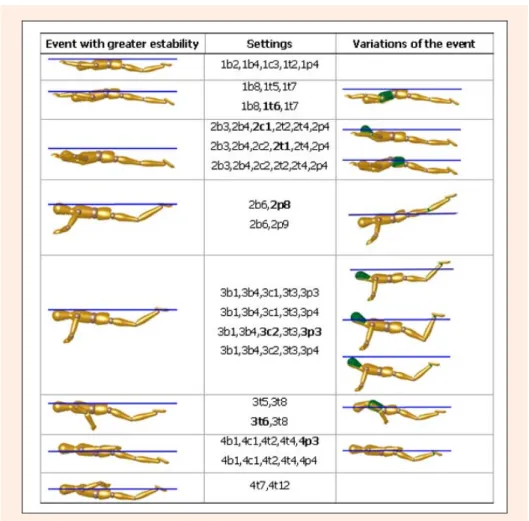
Figure 5. Schematic representation of events with greater stability and its variations in swimmer 2. corresponding to the inspiratory cycle, is only the event
corresponding to the time path of the SAP.
In Figure 3 the swimmer presents a stable technical execution. We can describe his technical side conduct using the In Table 4 configurations obtained in five cy-cles. In the first configuration, at the entrance of the hand in the water (EMA), there is a variation in the trunk, may be in dorsiflexion (i.e. 0.60) or flexion (i.e 0.40). In the second configuration, there is a support in the first propul-sive variation between the head above (i.e. 0.20) or below (i.e. 0.80) the waterline, the gluteus above (i.e. 0.40) or near (i.e. 0.60) the water line. There is still variation be-tween knees next (ie 0.20) or below (i.e. 0.80) the
water-line. In the second propulsive support (third configura-tion), there is variability in the criteria when the head is above (i.e. 0.60) or below (i.e. 0.40) the waterline, and the heel is above (i.e. 0.40) or below (i.e. 0.60) the water. Even the trunk varies from plan (i.e. 0.80) to a dorsiflex-ion positdorsiflex-ion (i.e. 0.20). In the fourth configuratdorsiflex-ion, In and Out of the Hand and Arms Recovery, the change occurs in close heels (i.e. 0.20) or below (i.e. 0.80) the water line. There are two cycles’ patterns where there is inspi-ration and a behaviour pattern not incomplete in inspira-tory cycles.
This swimmer presents a complete pattern (eight events). He presents a great stability in swimming. The
Table 5. Characterization of the events and the occurrence frequency of swimmer 3 in the eight times of observation.
Criteria Times of Observation Settings(moles) N IE
1st time 1b2,1b3,1c3,1t2,1p4 1b2,1b4,1c3,1t2,1p4 1 4 ,20 ,80 EMA 2nd time 1b8,1t5,1t7 5 1 1st time 2b3,2b4,2c2,2t1,2t4,2p4 2b3,2b4,2c2,2t2,2t4,2p4 4 1 ,80 ,20 PAP 2nd time 2b6,2p9 5 1 1st time 3b1,3b4,3c1,3t3,3p3 3b1,3b4,3c2,3t3,3p3 3b1,3b4,3c2,3t3,3p4 1 3 1 ,20 ,60 ,20 SAP 2nd time 3t6,3t8 3t5,3t8 4 1 ,80 ,20 1st time 4b1,4c1,4t2,4t4,4p3 4b1,4c1,4t2,4t4,4p4 4b1,4c2,4t2,4t4,4p4 1 2 2 ,20 ,40 ,40 SMRB 2nd time 4t7,4t12 5 1
Figure 6. Swimmer 3 - Schematic representation of incomplete behavioural pattern. Pattern with seven events in consecutive cycles.
pattern of Figure 4 and 5 corresponds to two cycles (3 and 5), which are inspiratory ones, as verified by the code 3c1 where the head is above 2 during the propulsive sup-port.
In terms of technical description of the conduct, we can observe that the first branch presents a configuration relating to 1 when the EMA occurs: 1B2, 1b4, 1c3, 1t2, 1p4 (Ic 1) correspond to the behaviour of the swimmers’ hands on the extension of the shoulders, elbows or before the hands’ entering, guiding the vision down, legs bends heel and below the waterline; in this time an excellent
stability was found.
This event is crucial for the rest of the action. There is a link of this single event to the following event configurations, which constitute various sub-standards. In the following sub-standard we have two configurations: The first configuration corresponds to two events. The first, 1b8, 1t5, 1t7 (i.e. 0.60), corresponding to the 2nd time of EMA, when the swimmer displays a out and down trajectory of the hand, trunk in dorsi-flexion position and tilted down the hip; a reasonable stability.
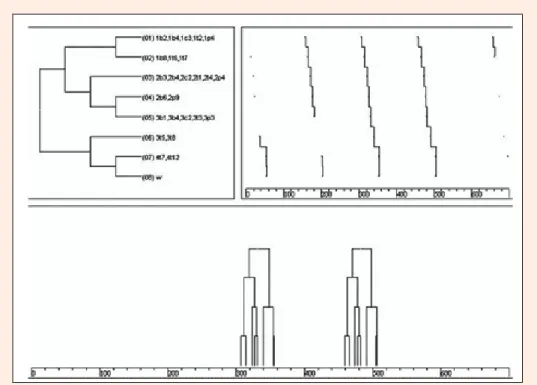
Figure 7. Swimmer 3 - Schematic representation of incomplete behavioural pattern. Pattern with seven events
Figure 8. Schematic representation of events with greater stability and its variations in swimmer 3. The second configuration, 2b3, 2b4, 2C2, 2T2, 2t4,
2p4, (i.e. 0.40), refers to the first of PAP, indicated that the hands are outside the extension of the shoulders, el-bows close to the water line (below this), head below the water line, trunk tilted and below the hip and heels below the water line; the stability is poor.
This subdivision of the event is a crucial link to the next cycle of events.
This subdivision consists of a sub-standard with two events for the 2nd time of PAP, 2b6, 2p9 (I 0.80), characterized by a flow of vortices around the hands and knees below the waterline, and a reasonable stability.
In the 1st stage of the SAP, 3b1, 3b4, 3c1, 3T3, 3p4 (Ic 0.40), the swimmer presents the elbows close to the chest, the thumbs close, the head above, the gluteus above, the heels below the water line. In this stage the movement presents a low stability.
These two settings, plus the subdivisions that have previously mentioned, presented a strong relationship
with the end of the observations of the cycle, thus creating a line of the event and a bunch of two configurations.
The first corresponded to the 2nd time of SAP. The event 3T5, 3t8 (Ic 0.80) indicates that the trunk has a flat and inclined position above the hip, and a reasonable stability.
This event is related to the two configurations cor-responding to the observed movements of the SMRB, being the configuration composed by the event.
The second configuration, 4B1, 4C1, 4t2, 4t4, 4p4 (Ic 0.40), corresponds to the 1st time of SMRB where the hands leave the water behind the elbows, the head and shoulders are above the water line, the gluteus close to the water line and the heels below. The second configuration corresponds to the moment when the hands leave the water and the arms recovery (4t7, 4t12), indicating that the trunk is flat and below the hip; this event has a low stability.
Table 6. Characterization of the events and the occurrence frequency of swimmer 4 in the eight times of observation.
Criteria Times of Observation Settings(moles) N IE
1st time 1b1,1b4,1c3,1t2,1p4 1b1,1b4,1c3,1t3,1p4 4 1 ,80 ,20 EMA 2nd time 1b8,1t6,1t7 5 1 1st time 2b3,2b4,2c2,2t1,2t4,2p4 2b3,2b4,2c2,2t2,2t4,2p4 2 3 ,40 ,60 PAP 2nd time 2b6,2p9 5 1 1st time 3b1,3b4,3c2,3t3,3p4 3b1,3b4,3c1,3t2,3p4 3b1,3b4,3c2,3t2,3p4 1 1 3 ,20 ,20 ,60 SAP 2nd time 3t5,3t8 5 1 1st time 4b1,4c2,4t2,4t4,4p4 5 1 SMRB 2nd time 4t7,4t12 5 1
Figure 9. Swimmer 4 - Schematic representation of incomplete behavioural pattern. Pattern with five events in 3 consecutive cycles.
This swimmer presents stability between cycles. It is important to notice that he has two (in five) breathing cycles which are the 3rd and 5th cycles, respectively.
Examining the technical conduct in Table 5, minor changes and / or variations van be noticed, which
corre-spond to: (i) at the entrance of water (EMA) the elbows can enter after the hands (i.e. 0.20), simultaneously or before (i.e. 0.80), (ii) in the PAP there is variation be-tween the gluteus above (i.e. 0.80) or near (i.e. 0.20) the waterline, (iii) in the SAP there is variability in the head,
Table 7. Index of variability and configurations carried out in greater number of times for moments of observation. Settings made by most swimmers in each moment.
Criteria Observation Times of
Number of Settings Occurred Variability Index 1st time 6 ,30 EMA 2nd time 3 ,15 1st time 6 ,30 PAP 2nd time 4 ,20 1st time 9 ,45 SAP 2ns time 2 ,10 1st time 9 ,45 SMRB 2nd time 2 ,10
being above (i.e. 0.20) or below (i.e. 0.80) the waterline, and with respect to the heels, they stay above (i.e. 0.80) or below (i.e. 0.20) the water. The trunk can change from plan (i.e. 0.80) to a dorsiflexion position (i.e. 0.20) and, (iv) in the SMRB there is variation in the heels position being close (i.e. 0.20) or below (i.e. 0.80) the water line.
The default behaviour of the swimmer is incom-plete; there are 7 recordings of the event observation. The pattern indicated in Figure 6 and 8 occurred in consecu-tive cycles (3 and 4). It is important to stress that there is a breathing movement in the 3rd cycle
The technical description of the pipeline indicates that the swimmer has a sub-standard with two events corresponding to the entry of the hand. In the first event 1B2, 1b4, 1c3, 1t2, 1p4, (i.e. 0.80) the swimmer present the hands away from the extension of the shoulders, the elbows enter at the same time or before both hands, guid-ing the vision downwards and heels below the waterline; this time the stability is quite reasonable. In the second event 1b8, 1t6, 1t7 (i.e. 1) the swimmer presents a down and outsweep path of the hand, with the trunk in flexion, tilted and below the hip; there is an excellent stability.
This setting affects all the rest of the pattern be-cause it is from this setting that the other sub-standard is created and gives us the pattern and their temporal rela-tions.
This configuration will connect with another con-figuration consisting of an event linked to two events. The event 2b3, 2b4, 2C2, 2t1, 2t4, 2p4 (i.e. 0.80) is the 1st time of PAP and indicates that the hands are outside the extension of the shoulders, the elbows are close to the water line (below this line), the head is below the water line, the gluteus are above, the trunk is tilted and below the hip and the heels are below the waterline. The stability is quite reasonable. The second event has two settings. The configuration of the two events is the 2nd time of PAP 2b6, 2p9 (i.e. 1), characterized by a flow of vortices around the hands and knees below the waterline; the sta-bility is excellent. In the 1st stage of the SAP 3b1, 3b4, 3c2, 3T3, 3p3, (i.e. 0.60) the swimmer presented the el-bows close to the chest, the thumbs close together, near the head, gluteus above, and the heels below the water line. The stability has a reasonable value.
This subdivision in three events has a crucial link with the configuration described above. Together they will influence the rest of the swimming cycle behaviour, being connected by two settings: (i) the connection time to the 2nd SAP 3T5, 3t8 (i.e. 0.80) indicates that the trunk has a flat and inclined position above the hip and a
rea-sonable stability and, (ii) the 2nd time of SMRB corre-sponds to 4t7, 4t12 (i.e. 1) indicating that the trunk is flat and below the hip; excellent stability.
In Figure 7 it was found an incomplete pattern, where the eight observed moments are seven events that occur in at least two cycles of the five observed. We have a pattern that occurs in cycle 2 and 4 and they are not breathing cycles.
The event 4B1, 4C1, 4t2, 4t4, 4p4, (i.e. 0.40) cor-responds to 1 when the SMRB occurs. The hands leave the water behind the elbows, the head and shoulders are above the water line, the gluteus are close to this line and the heels are far from the water line; its stability is poor.
After the analysis of Table 6, we found some sta-bility in the technical execution, but some changes oc-curred: (i) at EMA, we have variations of gluteus posi-tion, near (i.e. 0.80) or below (i.e. 0.20) the water surface, (ii) in the PAP a variation exists between the gluteus position above (i.e. 0.40) and near (i.e. 0.60) the water surface and, (iii) in the SAP there is variability in the head criterion, being above (i.e. 0.20) or below (i.e. 0.80) and the gluteus near (i.e. 0.20) or below (i.e. 0.80) the water-line.
Analyzing the pattern behaviour of the swimmer it was found that it is a stable behaviour containing a line of events with frequencies higher than 4. There is less stabil-ity in the 1st observation time PAP and SAP, i.e., in mo-ments of propulsive actions.
We also note that this swimmer contains another technical indicator of stability, presenting 15 events dur-ing the course of five cycles.
In Figure 9 and 10 The pattern is incomplete (five events) and their description is easily performed, where the first subdivision corresponds to the 2nd moment of EMA with the settings 1b8, 1t6, 1t7 (i.e. 1) corresponding to the behaviour of the swimmer's hand with a down and outsweep path, with the trunk in flexion, tilted and below the hip; the stability is excellent.
This action is crucial to the performance of the swimmer in the cycle, because this action manages the entire behaviour pattern. The event is connected to a con-figuration consisting of two more concon-figurations sepa-rated by a bunch of events.
The following sub-standard has two settings, with an event corresponding to the 2nd time of PAP 2b6, 2p9 (i.e. 1), characterized by a flow of vortices around the hands and knees below the waterline; reasonable stability. The second event is the 2nd time of SAP 3T5, 3t8 (i.e. 0.1) indicates that the trunk has a flat and inclined
position above the hip, with an excellent stability.
These two configurations are connected to other events that characterize the cycle.
The second sub-pattern consists of 2 branches, one corresponding to the configuration 4B1, 4C1, 4t2, 4t4, 4p4, (i.e. 1) which belongs to the 1st moment of SMRB, when the hands leave the water in a position behind the elbows, the head and shoulders are above the water line, the gluteus near the water line, and the heels below this line. The other branch corresponds to 4t7, 4t12 (i.e. 1) and corresponds to the 2nd time of SMRB, indicating that the trunk is flat and below the hip.
It is important to stress that the 4th cycle is a breathing cycle.
This incomplete pattern of the swimmer has a trig-gering event for all the other events the 2nd time of EMA. From this event, a sub standard event take place com-posed of the 2nd time of PPA and the 2nd time of SAP, which will connect differently to the events of the 1st time of SMRB and the "Moment SMRB”. We only found one pattern in this swimmer; although we can point out that it happens in 3 of the 5 cycles.
When analysing Table 7 we can verify the index of variability of each event in the sample.
There is great variability in the 1st stage of the SAP and SMRB (0.45), corresponding to the most pro-pulsive phases of the butterfly stroke. There is less vari-ability is the 2nd time for each of these phases, because of the degree of freedom of each criterion and the small number of criteria observed.
Discussion
The objective of this study was to introduce a method to examine the data and to analyse the inter-temporal rela-tionship between the structures of events (movements) in the butterfly technique. Thus, the SOCTM instrument respects all the procedures of the observational method (Campaniço et al., 2006; Cardoso et al., 2008; Oliveira et al., 2001). This instrument allows us to collect data from temporal relations of sequences of events and, in particu-lar with regard to our context, the way the technical char-acteristics of the swimming style are hierarchically re-lated, represented in graph as a temporal pattern.
Methodologically, observation in sport is particu-larly suited to the implementation of unobtrusive proce-dures to appraise the behaviour of an individual. Amongst the observational methodology advantages are its flexibil-ity, its ability to adapt to very different behaviours and situations, its rigor in the application of the various proce-dural operations and the non-restrictive and unobtrusive nature of its appraisal of real situations. In swimming analysis, observational methodology allows to explain the temporal relations, the relations between the technical components and the structure of a motor pattern (Louro et al., 2009b).
The performance in swimming is dependent on the swimmer’s technique. Thus, the systematic observation and analysis during training and competition, seems to be a determinant procedure to the evaluation of the swim-mer’s performance. During several years, the qualitative observation in swimming was carried-out using list point
methods, where the focus was based on the technical deviations from the model. However, this evaluation seems to be limited due to the one-dimensional character of the analysis. Throughout the observational method, several behaviour patterns are presented, allowing observ-ing relevant characteristics of the motor behaviour, espe-cially its stability and variability during the actions. Moreover, this method can be applied in natural context, allowing the data collection in a simple and non-invasive way.
Therefore, this analysis leads us to attempt to iden-tify patterns of implementation of a direct, but through the analysis of discrete data, it is only possible if we use the Theme software (hidden patterns between discrete data). Furthermore, we can verify the existence of different line of research using the same software and algorithm (An-guera and Jonsson 2003; An(An-guera et al., 2007; Borrie et al., 2002; Jonsson, 1998; Lyon et al. 1994; Magnusson, 1996, 2000), although using different areas of technical performance. For instance, Theme software was used to analyse technical patterns having for reference biome-chanical criteria, in the consolidation of motor conducts in learning, in observational and cognitive expertise in the sport performance, in recording and reproduction of tech-nical actions, oriented for the study of conducts in an interaction context.
The current study is based on the movement analy-sis, especially on the technical evaluation of the swimmer through the definition of specific motor patterns. Al-though the important data raised by this study, this study has some limitations. This kind of studies requires that the observer has a good knowledge of the swimmer’s move-ment. The ad-hoc instrument used in this study needs to be adapted to other movements if one wants to apply this methodology into another context. During the imaging recording, we only used one underwater camera, which can limit the observation of the movement in all the space orientations. Therefore, in further analysis, this limitation should be corrected using more than one camera in differ-ent plans.
In the future, it seems also interesting to analyse the swimmers’ patterns in a larger scale. Within this study, only four swimmers were evaluated. Thus, gener-alisations from a very limited sample size should always be presented with special careful. Furthermore, the analy-sis of swimmers of different performance level (Olympic finalist/medallist swimmers and non-expert swimmers) and female swimmers can improve the quality of this kind of evaluations.
Conclusion
We note that each of the swimmers have their own behav-ioral pattern, each pattern adjusted for individual charac-teristics. In each swimmer the criteria are observed from changes in each cycle on the adaptations and adjustments that the swimmer performs, which is shown with different events at the same time of observation, both with the same swimmer among the swimmers observed.
Moreover, the behavioral patterns are different at both intra-individual and inter-individual because they are tailored to each specific need of different swimmers.
Thus, each swimmer will have patterns with different complexities, because they change the number of events by pattern, depending on the changes and adjustments that the swimmer makes on their action.
Although different patterns between cycles and be-tween swimmers were observed, it seems that they have similarities between them, adjusting his style to the tech-nical model.
For the stability we observed that this behavior changes with the swimmer and also between phases and moments observed. We found higher values of stability in swimmers who presented the best times in butterfly tech-nique. This fact seems to suggest that the swimmers who present greater stability of the swimming pattern could obtain the best performance results.
On the other hand, the variability is found in higher stages of acceleration of the swimming cycle, correspond-ing to phases of greatest propulsive force production.
We conclude that, although the standard model is a reference, each swimmer adapted their swimming pattern in a unique and distinct way.
Acknowledgments
The authors would like to thank the swimmers who volunteered for this study.
References
Anguera, M.T. (1990) Observational methodology. In: Research
meth-odology in behaviour sciences. Eds: Arnau, Y..J., Anguera,
M.T. and Gómez B. Murcia: Universidad de Murcia.125-236. Anguera, M.T. (1993) Observational methodology in the psychological
research (Vol. II). Barcelona: P.P.U.
Anguera, M.T., Blanco-Villaseñor, A., Losada, J.L. and Hernández-Mendo, A. (2000) Observational methodology in sport: The Ba-sics. Lectures:Educación Fisica & deportes Journal electric Available from URL: http://www.efdeportes.com/efd24b/ obs6.htm
Anguera, M.T., Blanco-Villaseñor, A., and Losada, J.L. (2001) Observa-tion design, a key issue in the process of observaObserva-tion methodol-ogy. Methodology of Behaviour 3(2), 135-160.
Anguera, M.T. and Blanco-Villaseñor, A. (2003) Recording and encod-ing in sports performance. In: (Vol. II) Sport Psychology. Me-thodology. Ed: Hernández Mendo. Buenosaires :tulio Guterman. 6-34. Available from URL: http://www.efdeportes.com/libro/ psdf.htm
Anguera, M.T. and Jonsson, G.K. (2003) Detection of real time patterns in sport: interactions in football. International Journal of
Com-puter Science in Sport 2(2), 118-121.
Anguera, M.T., Blanco, A., Losada, J.L., Ardá, T., Camerino, O., Cas-tellano, J., Hernández Mendo, A. and Jonsson, G.K. (2003) Match and player analysis in soccer: computer coding and ana-lytic possibilities. International Journal of Computer Science in
Sport 2(1), 118-121.
Anguera, M., Magnusson, M. and Jonsson, G. (2007) Non-standard instruments. Avances en medición 5(1), 63-82.
Bakeman, R. and Gottman, J.M. (1989) Observing interaction: an
introduction to sequential analysis. Madrid: Morata S.A..
Barbosa, T., Silva, J., Sousa, F., and Vilas-Boas, J.P. (2003) Compara-tive study of the responses of kinematical variables from the hip and the centre of mass in butterfliers. In: Biomechanics and
Medicine in Swimming IX. Eds: Chatard J-C. Saint-Étienne
Publications de l’Université de Saint-Étienne. 93-98.
Barbosa, T., Keskinen K., Fernandes, R., Colaço C., Carmo C. and Vilas-Boas JP. (2005) Relationship between energetic, stroke determinants and velocity in butterfly. International Journal of
Sports Medicine 26, 1-6.
Barbosa, T.M., Fernandes, R.J., Morouco, P. and Vilas-Boas, J.P. (2008) Predicting the intra-cyclic variation of the velocity of the centre of mass from segmental velocities in butterfly stroke: a pilot study. Journal of Sports Science and Medicine 7(2), 201-209.
Bompa, T. (1990) Theory and methodology of training. The key to
athletic performance. Toronto: York University. 2nd edition.
Bompa, T. (1983) Theory and methodology of training Duduque. Iowa. Kendall/Hunt.
Borrie, A., Jonsson, G.K. and Magnusson, M. S. (2002) Temporal pattern analysis and its applicability in sport: An explanation and exemplar data. Journal of Sport Sciences 20, 845-852. Campaniço, J. and Anguera, M.T. (2001) Observational swimming
competition: the error versus technique optimization. In:
Pro-ceedings of the XXi International Congresso of Water Activities and Swimming,VI Iberic Congress, 12-14 October 2001,
Sevilha. ,40-43.
Campaniço, J., Santos, J. and Silva, A. (2006) Breaststroke swimming patterns from vídeo sequences analyzes. Produced by specific field formats. In: Biomechanics and Medicine in Swimming.
Portuguese Journal of Sport Science 6 (Supl 1), 76-77.
Cardoso, J., Carvalho, C., Campaniço, J., Oliveira, C. and Louro, H. (2008) Behaviours patterns on butterfly swimmers. In: Book of
Abstracts 13th Annual Congress of the European College of Sport Science, 9-12 July, Estoril, Portugal. Eds: Cabri, J.,
Alves, F., Araújo, D., Barreiros, J., Diniz, J. And Veloso, A. 123.
Castañer, M., Torrents, C., Dinusová, M. and Anguera, M.T. (2009) Identifying and analysing motor skill responses in body move-ment and dance. Behaviour Research Methods 41, 857-867. Chollet, D., Seifert, L., Boulesteix, L. and Cárter, M. (2005) Arm to leg
coordination in elite butterfly swimmers. International Journal
Sports Medicine 26, 1-8.
Colman, V. and Persyn, U. (1993) Diagnosis of the movement and
physical characterisitics leading to advice in breakstroke.
Con-tinental course in swimming for coaches. Gelsenkirshen: FINA COI- DVS.
Counsilman, J. (1968. The science of swimming. Englewood Cliffs:
Prenctice-Hall, Inc.
Grosser, M. and Neumaier, A. (1986) Trainning techniques: Teory and
practice of sports. Ediciones Martinez Roca, S.A., Barcelona.
Jonsson, G.K. (1998) Detecting patterns in complex behavioural proc-esses with the observer and theme. In: Measuring Behavior '98.
2nd International Conference on Methods and Techniques in Behavioral Research, 18-21 August 1998, Groningen, The Netherlands,. Ed: Noldus, L.P.J.J. 176.
Knapp, B. (1980) Sport and motricity. Compendium. Lisboa.
Louro, H., Cardoso, J., Silva, A., Anguera, T., Oliveira, C. and Cam-paniço, J. (2009a) Obervation of motor behaviour in butterfly technique: Validation of the instrument for observation. In: 3th
National Meeting of Biomechanics. Eds: Vaz MA, Piloto PA,
Reis Campos JC. Institute Politechnique of Bragança. Bragança. 459-463.
Louro, H., Silva, A., Anguera, M.T., Oliveira, C. and Campaniço, J. (2009b) Characterization of temporal patterns in the behaviour of elite butterflyers. In: 3th National Meeting of Biomechanics. Eds: Vaz MA, Piloto PA, Reis Campos JC. Politechnique Insti-tute of Bragança. Bragança. 429-433.
Lyon, M., Lyon, N. and Magnusson, M.S. (1994) The importance of temporal structure in analyzing schizophrenic behavior some theoretical and diagnostic implications. Schizophrenia Research
13, 45-56
Maglischo, E.W. (2003) Swimming Fastest. Champaign, Illinois: Human Kinetics.
Magnusson, M.S. (1996) Hidden real-time patterns in intra- and inter-individual behavior: description and detection. European
Jour-nal of Psychological Assessment 12, 112-123.
Magnusson, M.S. (2000) Discovering hidden time patterns in behavior: T-patterns and their detection. Behavior Research Methods,
In-struments & Computers 32, 93-110.
Marinho, D.A., Rouboa, A.I., Alves, F.B., Vilas-Boas, J.P., Machado, L., Reis, V.M. and Silva, A.J. (2009) Hydrodynamic analysis of different thumb positions in swimming. Journal of Sports
Sci-ence and Medicine 8(1), 58-66.
Mason B, Tong Z, and Richards R. (1992) Propulsion in the butterfly stroke. In: Biomechanics and Medicine in Swimming VI. Eds: MacLaren D, Reilly T, Lees A. E & FN Spon, London. 81-86. Oliveira, C., Santos, J., Campaniço J. and Jonsson K. (2006) Detection
of Real-time patterns in breastroke swimming.Portuguese
Jour-nal of Sport Sciences 6 (Supl 2), 241-244.
Oliveira, C; Campaniço, J. and Anguera, M.T. (2001) The observational method on teaching basic swimming: the use of field formats.
Methodology of Behaviour Sciences 3 (2), 267-282.
Persyn, U., Colman, V. and Ungerechts, B. (2000) Diagnosis and advine in the undulating strokes requires information on global body flexibility and upper limb strength. In: Proceedings of XVIII
In-ternational Symposium on Biomechanics in Sports, Applied Program: Application of biomechanical study in swimming.
Eds: Sanders, R. and Hong, Y. China: The Chinese University of Hong Kong. 88-95.
Platonov, V. (2005) Sport Trainning for High- Level Swimmers. São Paulo. Phorte Editora.
Sackett G.P. (1978) Observing behavior. Vol. II: Data collection and analysis methods. Baltimore, MD: University Park Press. Sanders, R., Cappert, J. and Devlin, R. (1995) Wave characteristics of
butterfly swimming. Journal of Biomechanics 28(1), 9-16. Sanders, R. (1996) Some aspects of butterfly technique of New Zealand
Pan Pacific squad swimmers. In: Biomechanics and Medicine in
Swimming VII. Eds: Troup, J.P., Hollander, A.P., Strasse, D.,
Trappe, S.W., Cappaert, J.M. and Trappe, T.A. E & FN Spon, London. 23-28
Schleihauf, R., Higgins, J., Hinrichs, R., Luedtke, D., Maglischo, L., Maglischo, E., and Thayer, A. (1988) Propulsive techniques: Front crawl stroke, butterfly, backstroke and breaststroke. In:
Swimming V. Eds: Ungerechts B., Wilke K., Reischle K. Human
Kinetics Books, Illinois. 53-59.
Silva, A.J. and Alves, F. (2000) Determinant factors to variation in butterfly velocity. In: Proceedings of XVIII International
Sym-posium on Biomechanics in Sports. Applied program:
applica-tion of biomechanical study in swimming. Eds.: Sanders, R. and Hong, Y. China: The Chinese University of Hong Kong. 73-74. Togashi T. and Nomura T. (1992) A biomechanical analysis of the
swimmer using the butterfly stroke. In: Biomechanics and
Med-icine in Swimming VI. Eds: MacLaren, D., Reilly, T. and Lees,
A. E & FN Spon, London. 87-91.
Key points
• The patterns were different, adjusting to the charac-teristics of technical implementation of the swim-mers.
• The swimmer can make settings with different levels of structure complexity, depending on the imple-mentation of changes within the hand cycle.
• Variations of codes in each configuration obtained using the SOCTM, allowed determining the differ-ences between swimmers.
• The records showed a clear behavioral similarity when comparing the result with a general pattern of the butterfly technique.
• The potential quality of this instrument seems to be important due to the patterns obtained from a tempo-ral sequence.
AUTHORS BIOGRAPHY
Hugo LOURO Employment:
Adjunt Professor at the Sports Science Institute of Rio Maior, Portugal
Degree
PhD
Research interests
The application of methodological obser-vation in swimming. The biomechanical and physiological determinant factors of the sports performance
E-mail: [email protected]
Jorge CAMPANIÇO Employment
Associated Professor at the Sport Sciences Department of the University of Trás-os-Montes and Alto Douro, Portugal Degree
MSc
Research interests
The application of methodological obser-vation in sports.
E-mail: [email protected]
Teresa ANGUERA Employment
Associated Professor at INEF of University of Barcelona, Spain.
Degree
PhD
Research interests:
The application of methodological obser-vation in sports.
E-mail: [email protected]
Daniel Almeida MARINHO Employment
Associated Professor at the Department of Sport Sciences of the University of Beira Interior, Portugal
Degree
PhD
Research interests:
The biomechanical and physiological determinant factors of the sports ance, specially the swimming perform-ance.
E-mail: [email protected]
Conceição OLIVEIRA Employment
PhD student in Sport Sciences at INEF of University of Barcelona, Barcelona, Spain
Degree
MSc
Research interests:
The application of methodological obser-vation in swimming.
E-mail: [email protected]
Ana CONCEIÇÃO Employment
Assistant Professor at the Sports Science Institute of Rio Maior, Portugal
Degree
MD
Research interests:
The study of swimming didactics. The biomechanical and physiological determi-nant factors of the sports performance.
António José SILVA Employment
Full Professor at the Sport Sciences De-partment of the University of Trás-os-Montes and Alto Douro (UTAD - Portu-gal).
Degree
PhD
Research interests:
The physiological and biomechanical indicators of energy cost during physical activities, namely in swimming.
E-mail: [email protected]
Hugo Louro
Escola Superior de Desporto de Rio Maior, Av. Dr. Mário Soares. Pavilhão Multisuos, 2040-413 Rio Maior, Portugal