An evaluation of the adverse reaction
potential of three measles-mumps-rubella
combination vaccines
Boaventura Antônio dos Santos,
1Tani Schilling Ranieri,
2Marilina Bercini,
2Maria Tereza Schermann,
2Sirlei Famer,
2Renate Mohrdieck,
2Teresinha Maraskin,
3and Mário Bernardes Wagner
1Objective. To compare the incidence of adverse events following the administration of three commercially available measles-mumps-rubella (MMR) combination vaccines.
Methods. A randomized double-blind clinical trial was performed in 1996 that involved a total of 10 142 students 6–12 years of age in the state of Rio Grande do Sul, in Brazil. An MMR vaccine containing the Edmonston-Zagreb, Leningrad-Zagreb, and RA 27/3 strains (“vaccine A”) was administered to 2 226 students (21.9% of the total); an MMR vaccine with the Moraten, Jeryl Lynn, and Wistar 27/3 strains (“vaccine B”) was administered to 2 216 children (21.8%); and an MMR vaccine containing the Schwartz, Urabe AM-9, and Wistar 27/3 strains (“vaccine C”) was given to 2 179 students (21.5%). A control group of 3 521 stu-dents (34.7%) was not vaccinated. Both the vaccinated subjects and the control subjects were followed daily for 30 days to detect any clinical manifestations.
Results. Adverse events were more frequent in the vaccinated children than in the control group (P< 0.01). In terms of causing parotitis, vaccine A had a relative risk (RR) of 5.72 (95% confidence interval (CI) = 3.11–10.54) when compared with vaccine B, and an RR of 2.33 (95% CI = 1.52–3.58) when compared with vaccine C. Vaccine A was also associated with an increased risk of lymphadenopathy when compared with vaccine B (RR = 3.11; 95% CI = 1.78–5.45) and with vaccine C (RR = 2.22; 95% CI = 1.35–3.66). Vaccine C was associated with an increased risk of parotitis when compared with vaccine B (RR = 2.46; 95% CI = 1.26–4.80). Three cases of aseptic meningitis were detected among the children in the study group, but only one case of vaccine-related aseptic meningitis was identified, among the chil-dren receiving vaccine A.
Conclusions. The three MMR vaccines that we studied are associated with different risks of adverse events. We found vaccine A to cause more reactions than the two other vaccines, es-pecially vaccine B. In addition, vaccine A presented both a temporal and a cause-and-effect as-sociation with one case of aseptic meningitis. We hope that this study will contribute infor-mation that can be used in choosing MMR vaccines with safe and effective strains, especially for mass vaccination strategies.
Vaccination, measles, mumps, rubella, Brazil.
ABSTRACT
Key words
1 Faculdade de Medicina da Universidade Federal
do Rio Grande do Sul, Porto Alegre, Rio Grande do Sul, Brasil. Send correspondence and reprint re-quests to: Boaventura Antônio dos Santos, Núcleo de Pesquisa em Vacinas, Hospital de Clínicas de
Porto Alegre, Rua Ramiro Barcelos, no. 2350, CEP 90035-003, Porto Alegre, Rio Grande do Sul, Brasil; telephone: 55-5133168749; fax: 55-5133168748; e-mail: [email protected]
2 Secretaria da Saúde do Estado do Rio Grande do
Sul, Porto Alegre, Rio Grande do Sul, Brasil.
3 Secretaria Municipal de Saúde de Porto Alegre,
Since the 1960s several vaccines of differing composition and origin have been available individually against measles, mumps, and rubella. Subse-quently, such vaccines have been com-bined for use as a single measles-mumps-rubella (MMR) combination vaccine (1, 2). Depending on the type of strain used and the individual re-sponse to the vaccine, administration of such combinations can cause ad-verse events, which can range from mild and relatively frequent to severe but rare reactions (1, 3, 4). The most common adverse events associated with the measles strains are fever, oc-curring in 5% to 15% of the vaccinees, and skin rash, with a 5% incidence (1, 2). As to mumps strains, post-vaccina-tion events are rare, with fever and parotitis being the most frequent ones. Aseptic meningitis has been a major problem, and several studies have demonstrated a clear association with the more reactogenic strains (1, 3, 5–7). Regarding the rubella strain, fever, skin rash, and/or lymphadenopathy occur in 5% to 15% of the vaccinees, while arthritis is the most common side ef-fect in postpubertal women, occurring in 13% to 15% of them (2, 4).
In Brazil one of the objectives of the National Immunization Program is to better control rubella and mumps and to eradicate measles. To eradicate measles, the main strategy used is mass vaccination campaigns, with the
measles vaccination often combined with strains of rubella and mumps. A monovalent vaccine against measles has been included in the primary im-munization schedule in the country since 1973, and the MMR combination vaccine has been gradually introduced since the early 1990s, state by state.
In an attempt to collect data on ad-verse events associated with three dif-ferent MMR combination vaccines, a clinical trial was carried out in 1996 that included more than 10 000 stu-dents from Porto Alegre and Santa Maria, two cities that are in Rio Grande do Sul, the southernmost state of Brazil. The three vaccines used in the study (labeled as “A,” “B,” and “C”) had the compositions (strains) shown in Table 1.
During our bibliographic review be-fore the clinical trial, we found no stud-ies that compared these three combi-nation vaccines and only a few articles about vaccine A (8–11). Before our study, three Brazilian states were using vaccine C, a choice that had been made by local public health administrators.
The Ministry of Health of Brazil supported this research, with a partic-ular interest in estimating the inci-dence of adverse events related with these vaccines, especially vaccine A. At the time of our study, vaccine A was being used in a few countries (8–11), but it had not yet been used in Brazil. For the National Immunization
Program of Brazil, the goal was to de-velop information to apply in choos-ing more effective, safer vaccines to use primarily in mass and follow-up vaccination campaigns, in line with the recommendations of the Pan American Health Organization (12).
MATERIALS AND METHODS
Study design
We conducted a double-blind ran-domized clinical trial in order to eval-uate the adverse reaction potential of three MMR combination vaccines in schoolchildren 6 to 12 years old from Porto Alegre and Santa Maria. A strat-ified sampling design was used, wherein the study population was se-lected in proportion to the relative population of the two cities: 85.2% for Porto Alegre and 14.8% for Santa Maria. Children assigned to each sam-ple were randomly selected from 70 public and private schools, 47 from Porto Alegre and 23 from Santa Maria. Four groups were formed: one group for each of the three MMR vaccines, and a control group which did not re-ceive an MMR vaccination.
Children were excluded from the trial if they presented any of the following contraindications to the MMR vaccine: congenital or acquired immunodefi-ciency; malignant neoplasia; high-dose
TABLE 1. Vaccines used in study evaluating the adverse reaction potential of three measles-mumps-rubella combination vaccines, Rio Grande do Sul, Brazil, 1996
Vaccine code Vaccine/Manufacturer Strains Doses Other constituents
a TCID
50 = tissue culture infectious dose for 50% of tissue culture. b PFUs = plaque-forming units.
A
B
C
Tresivac®/ Serum Institute of India
M-M-R II®/ Merck-Sharp-Dohme
Trimovax®/ Institute Pasteur Merieux
Edmonston-Zagreb Leningrad-Zagreb Wistar RA 27/3
Moraten Jeryl Lynn Wistar RA 27/3
Schwarz Urabe AM-9 Wistar RA 27/3
5 000 TCID50a 5 000 TCID50 4 000 PFUsb
1 000 TCID50 5 000 TCID50 1 000 TCID50
1 000 TCID50 5 000 TCID50 1 000 TCID50
Not described by manufacturer
Sorbitol and hydrolyzed gelatin traces
treatment with corticoids or other im-munosuppressive drugs; previous his-tory of anaphylactic reaction secondary to the use of neomycin or to egg intake; pregnancy; use of human immunoglob-ulin, whole blood, or plasma within the previous three months; and moderate to severe acute febrile conditions at the time of enrollment.
A questionnaire designed to collect individual information about the chil-dren (age, sex, vaccination background, previous diseases, family income, etc.) was used. In each school, children were recruited according to the age groups of the study. After obtaining informed consent from the parents or other legal representatives, children were random-ized to one of three vaccine groups (A, B, or C). The vaccine bottles were la-beled so as to prevent their identifica-tion by the vaccinees, the vaccinators, the researchers, and the nurses who managed the follow-up. The control group (children who were not vacci-nated) was homogenous in relation to the vaccinated children. Including a control group was considered impor-tant since the study was carried out during a period of seasonal outbreaks of the three diseases. The main goal with the control group was to deter-mine the occurrence of systemic mani-festations since those students had not received an injectable placebo.
Statistical analysis
The projected sample size, approxi-mately 2 200 children per vaccinated group and 3 500 nonvaccinated con-trols, was designed to allow detection of two-fold increases in events as rare as 1.5%, with levels of at least ␣= 0.05 and = 0.10. That is, the sample size was estimated to have a power of 90% to detect a two-fold or larger increase in frequencies as low as 1.5%, and 80% power in frequencies as low as 1.2%.
Differences among the groups in values of continuous variables (e.g., age) were compared using means and standard deviations, via analysis of variance, while those for categorical variables (e.g., adverse events,
ex-pressed as percentages) were com-pared using the chi-square test. Addi-tionally, we calculated the relative risk (RR) of adverse events and the 95% confidence interval (CI) for that. Data were processed and analyzed with the help of two software packages, SPSS version 6.0 (SPSS Inc., Chicago, Illi-nois, United States of America) and Epi Info version 6.04B (Centers for Dis-eases Control and Prevention, Atlanta, Georgia, United States).
Because of the limitations of our sam-ple size, we did not try to determine what the incidence rate of vaccine-associated adverse events would be in larger population groups for rare events such as aseptic meningitis and thrombocytopenic purpura.
Vaccines used
As mentioned earlier, the three vac-cines used in this study were labeled as “A”, “B,” and “C,” and they had the composition (strains) as shown in Table 1. Each dose of the three vac-cines corresponded to 0.5 mL and was injected in the arm subcutaneously, at the level of the deltoid muscle. An-tipyretics were not routinely used after the vaccinations.
Field work and data collection
Several meetings with parents, teachers, and professionals from gov-ernment health reference units (hospi-tals and outpatient units) were held. At these meetings, the study design and the activities to be carried out were presented.
The field work consisted of vaccine delivery in the schools and monitoring of the signs and symptoms among the participating children. The field work was performed by selected health pro-fessionals who had received a total of 40 hours of training from the re-searchers. The professionals were se-lected from the health services and were paid for their work.
The teams that delivered the vac-cines included a coordinator (a nurse),
the vaccine delivery staff (nursing as-sistants), an administrative support staff, and a driver. They worked from 26 to 30 August 1996 in Porto Alegre and from 9 to 12 September in Santa Maria.
The monitoring of signs and symp-toms was carried out by a team of nurses. The monitoring was begun with each vaccine’s administration, in order to observe immediate reactions, and it was continued daily over the following 30 days. The nurses visited the schools and recorded, on a stan-dard form, the clinical events observed in both the vaccinated and control chil-dren, regardless of the events’ causal relationship with the vaccine. Home and hospital visits were scheduled in order to complement that school-based data collection, such as when a student was absent from school or was hospitalized. Reactions that had taken place on a Saturday or Sunday were recorded by the nurses on Monday. Each adverse effect was defined in an instruction manual that was the basis for the nurses’ training. Nurse teams met on a weekly basis with the re-searchers in order to discuss the recorded information and to solve any administrative problems.
From a subgroup of 640 children, se-lected from 6 of the 70 schools, paired blood samples were collected before the immunization and 30 days after it. This step made it possible to com-pare the children’s previous immuno-logical status and the post-immunization response.
Ethical issues
RESULTS
A total of 10 142 schoolchildren par-ticipated in the study. Out of this total, 6 621 were vaccinated in three groups: 2 226 of them (21.9% of the total sam-ple) received vaccine A, 2 216 (21.8%) received vaccine B, and 2 179 (21.5%) received vaccine C. The control group was made up of 3 521 children (34.7% of the total sample). Age and sex vari-ables were homogeneously distributed among the four groups (the three vac-cinated groups and the one control group). There was an age range of 6 to 12 years among the participants, and the entire group contained 54% females and 46% males. During the
observational period, 1 186 of the vac-cinated children (17.9% of them) pre-sented some kind of adverse event, compared with only 168 controls (4.8% of the control group).
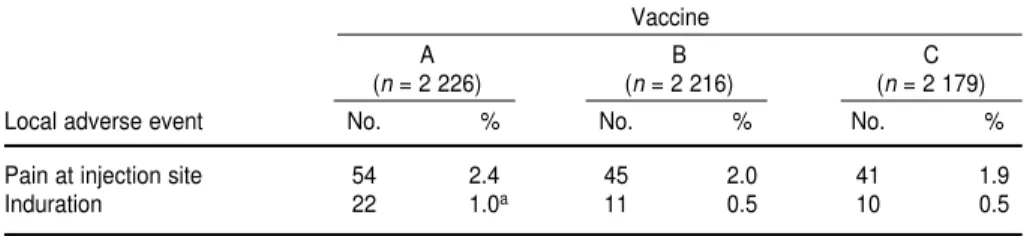
Of the children from the four groups presenting with an adverse event, 45% of them presented with only one sign or symptom. For the students who had been vaccinated, the most commonly reported local adverse events are shown in Table 2. Pain at the injection site, in most cases persist-ing for just one day, was the most fre-quently reported symptom, followed by induration.
As shown in Table 3, headache was the most common systemic adverse
event reported by the three vaccinated groups; it had a mean duration of one day. Fever was the second most com-monly reported systemic adverse event, persisting in most cases for one day, with all cases resolving within five days.
We compared the three vaccines in terms of the time interval between vac-cination and emergence of headache, fever, and increased parotid volume. We found that both fever and head-ache occurred within five days after vaccination.
The incidence of increased parotid volume with vaccine A was 2.3 times as high as with vaccine C and 5.7 times as high as with vaccine B. The peak inci-dence of increased parotid volume oc-curred between 15 and 19 days after immunization with vaccines A and C. As to vaccine B, that peak incidence oc-curred mostly between 5 and 9 days and 20 and 24 days after vaccination. A low incidence of skin rash was ob-served in the vaccinated groups. Eleven cases occurred in children receiving vaccine A, 9 with vaccine B, and 16 with vaccine C, with the rash lasting up to 6 days. The peak incidence of skin rash occurred 5 to 9 days after vaccination.
The incidence of lymphadenopathy reported after the use of vaccine A was
TABLE 2. Most frequent local adverse events reported over 30-day follow-up period after vaccination, in study evaluating the adverse reaction potential of three measles-mumps-rubella combination vaccines, Rio Grande do Sul, Brazil, 1996
Vaccine
A B C
(n= 2 226) (n= 2 216) (n= 2 179)
Local adverse event No. % No. % No. %
Pain at injection site 54 2.4 45 2.0 41 1.9
Induration 22 1.0a 11 0.5 10 0.5
a2test; P< 0.001 between vaccines A and B and between vaccines A and C.
TABLE 3. Main systemic adverse events reported after vaccination compared with the control group over a 30-day period, in study evalu-ating the adverse reaction potential of three measles-mumps-rubella combination vaccines, Rio Grande do Sul, Brazil, 1996
Vaccine Control
A B C group
(n= 2 226) (n= 2 216) (n= 2 179) (n= 3 521)
Adverse event No. % No. % No. % No. %
Headache 202 9.1 187 8.4 195 8.9 76 2.2
Fever 122 5.5a 105 4.7 92 4.2 52 1.5
Dizziness 29 1.3 36 1.6 28 1.3 10 0.3
Nausea 37 1.7a 26 1.2 38 1.7b 12 0.3
Vomiting 28 1.3 22 1.0 24 1.1 15 0.4
Cough 31 1.4a 18 0.8 22 1.0 14 0.4
Coryza 21 0.9 13 0.6 18 0.8 12 0.3
Conjunctivitis 5 0.2 2 0.1 6 0.3b 2 0.1
Joint manifestations 9 0.4 8 0.4 6 0.3 0 0
Skin rash 11 0.5 9 0.4 16 0.7 5 0.1
Lymphadenopathy 50 2.2a 16 0.7 22 1.0 9 0.3
Increased parotid volume 69 3.1a 12 0.5 29 1.3b 7 0.2
2.2 times as high as with vaccine C and 3.1 times as high as with vaccine B. The peak incidence of lymphadenopa-thy was observed 10 to 14 days after vaccination.
Table 4 presents the relative risks and corresponding 95% confidence in-tervals for lymphadenopathy and for increased parotid volume for the three vaccines.
During the 30-day follow-up period, joint reactions primarily included tran-sient arthralgia, with no episodes of arthritis. The episodes of joint mani-festations followed an irregular pat-tern, being most commonly reported with vaccine A. Just under two-thirds (65%) of the cases occurred in girls. The other systemic reactions observed in children during the follow-up pe-riod of this study are shown in Table 3. Six children required hospitaliza-tion, all of them from Porto Alegre. The primary cause for three hospital-izations (mesenteric adenitis, appen-dicitis, and bronchopneumonia) was not related to the vaccine. From the three cases of aseptic meningitis re-lated with mumps virus, case 1 (cine A) was associated with the vac-cine virus, case 2 (control) with the wild virus, and in case 3 (vaccine A), the in-vestigators concluded that the clinical and epidemiological data did not make it possible to define a single as-sociation, either with the vaccine virus or with the wild virus. Due to opera-tional problems, the isolation and analysis of nucleotide sequencing for virus identification could not be
per-formed. No severe reactions, such as anaphylactic shock or thrombocyto-penic purpura, occurred.
DISCUSSION
The rate of clinical events, including local and systemic reactions observed after the administration of three differ-ent MMR vaccines, was determined on the basis of strict monitoring of the children for 30 days following vac-cination and was compared with the frequency of adverse events in the con-trol group. When comparing the vacci-nated groups and the control group, we found that the frequency of clinical reactions was significantly higher among the vaccinees.
Vaccine A was found to induce more reactions than the other two vaccines. Vaccine A presented a statistically sig-nificant difference when compared with vaccine B concerning induration, nausea, cough, lymphadenopathy, and increased parotid volume. Vaccine A also presented a statistically signifi-cant difference when compared with vaccine C for induration, fever, lym-phadenopathy, and increased parotid volume.
Vaccine C was found to induce more reactions than vaccine B concerning nausea, conjunctivitis, and increased parotid volume.
Although we found statistically sig-nificant differences for fever, nausea, and cough when comparing the three different vaccines, the differences were
small. In contrast, with lymphadeno-pathy and increased parotid volume, we found moderate differences.
Headache was the most commonly reported manifestation among the three vaccinated groups, with no sig-nificant difference among them. How-ever, with fHow-ever, there was a signifi-cant difference in incidence between vaccine A (5.5%) and vaccine C (4.2%). The temporal pattern that we found with fever differed from what other re-searchers have found. In our study, the fever began and showed a higher incidence in the first 5 days follow-ing vaccination. In contrast, other researchers have found the fever oc-curring 5 to 15 days after vaccination (13–17).
Concerning joint manifestations, the only symptom that we observed among the vaccinated children was arthralgia (65% among females), with no case of arthritis. The incidence rates for arthralgia that we found (0.4% with vaccine A, 0.4% with vaccine B, and 0.3% with vaccine C) are consis-tent with data from other reports, which indicate a 0.5% incidence in children (18), and with a higher inci-dence among girls (2, 19, 20).
We observed a low incidence of skin rash in the three vaccinated groups: 0.5% with vaccine A, 0.4% with vaccine B, and 0.7% with vaccine C, with no significant difference among them. In comparison to the rates that we found, other studies have found higher rates, ranging from 5% to 15% (4, 13–15).
We believe that the pre-existence of immunity, particularly to measles, had a direct impact on the rates of post-immunization adverse events, such as with fever and rash, that we ob-served in the students (21). In our pre-immunization serologic evaluation we found that the immunity for measles, mumps, and rubella was 87%, 73%, and 56%, respectively. Several factors help explain the previous immunity: routine immunization against measles since 1973, a campaign for general im-munization against measles for chil-dren ranged 9 months to 14 years in 1992 (with coverage of 100% in Rio Grande do Sul), and an
epidemic-TABLE 4. Relative risk (RR) and 95% confidence interval (CI) for lymphadenopathy and in-creased parotid volume, in study evaluating the adverse reaction potential of three measles-mumps-rubella combination vaccines, Rio Grande do Sul, Brazil, 1996
Vaccines
A/B A/C C/B
Adverse event RR 95% CI RR 95% CI RR 95% CI
Lymphadenopathy 3.11 (1.78–5.45)a 2.22 (1.35–3.66)b 1.40 (0.74–2.66) Increased parotid volume 5.72 (3.11–10.54)a 2.33 (1.52–3.58)a 2.46 (1.26–4.80)c
endemic pattern of the three diseases in all of Brazil.
The episodes of lymphadenopathy and of increased parotid volume pre-sented larger variations in frequency among the three vaccines than was true for the other systemic adverse events.
The constituent mumps strains of the vaccines studied—Leningrad-Zagreb, Jeryl Lynn, and Urabe AM-9 —had incidence rates, respectively, of 3.1%, 0.5%, and 1.3% for increased parotid volume. Other researchers have described similar results (5, 8).
We found that vaccine A presented a significantly greater risk for develop-ing both lymphadenopathy and in-creased parotid volume, with the low-est risk being associated with vaccine B (Table 4).
Three cases of aseptic meningitis were detected among the children in the study, but only one case of vac-cine-related aseptic meningitis was identified, among the children receiv-ing vaccine A. This corresponds to one case among the 2 226 doses of this vac-cine delivered. Nevertheless, due to the limitation of our sample size, we
could not determine what the inci-dence of vaccine-associated aseptic meningitis would be in larger popula-tion groups. This event is commonly associated with the mumps strain (1–3, 5–7, 9). However, in the literature that we reviewed (8, 10), we found no pa-pers describing the occurrence of meningitis following the use of the Leningrad-Zagreb mumps strain, the constituent of vaccine A.
We found vaccine A to cause more reactions than did the two other vac-cines, especially in comparison to vaccine B. In addition, vaccine A pre-sented both a temporal and cause-and-effect association with one case of aseptic meningitis.
These results had not yet been dis-closed when, in 1997, an epidemic of measles occurred in Brazil. Some states had to conduct mass vaccination cam-paigns, and the states used two of the MMR vaccines that we had studied, vaccine A and vaccine C. Thousands of doses were applied in a short period of time. After the campaigns, there was a significant increase in post-vaccination adverse events, among them many cases of aseptic meningitis (22, 23). The
estimated risk of aseptic meningitis found associated with vaccine A in Rio Grande do Sul was 1 case per 3 390 applied doses (22). In the city of Sal-vador, Bahia, the risk associated with vaccine C was 1 case per 14 000 applied doses (23). These mass vaccination cam-paigns allowed rare adverse events to be quickly detected.
We believe that when public health authorities need to choose MMR vac-cines to use in national immunization programs, those officials must be aware of the safety and the efficacy of the various strains. This is especially true with mass vaccination strategies. We hope that our study has con-tributed information that will help public health authorities to make ap-propriate decisions.
Acknowledgments. In Brazil, we
thank the National Immunization Pro-gram, the National Health Founda-tion, and the Ministry of Health, which supported this research project. We also thank the three laboratories— Serum Institute of India, Merck-Sharp-Dohme, and the Institute Pasteur Merieux—that provided the vaccines.
1. United States of America, Centers for Dis-eases Control and Prevention. Recommenda-tions of the Advisory Committee on Immu-nization Practices (ACIP). Measles, mumps and rubella–vaccine use and strategies for elimination of measles, rubella and congenital rubella syndrome and control of mumps. MMWR 1998;47(RR-8):1–57.
2. Plotkin AS, Mortimer EA, eds. Vaccines. 2nd ed. Philadelphia: WB Saunders; 1994. 3. Patja A, Davidkin I, Kurki T, Kallio MJT, Valle
M, Peltola H. Serious adverse events after measles-mumps-rubella vaccination during a fourteen-year prospective follow-up. Pediatr Infect Dis J 2000;19(12):1127–1133.
4. Omoto TM. Vacina contra sarampo, caxumba e rubéola. Pediatria Moderna 1995;31(3):294– 308.
5. Miller E, Goldacre M, Pugh S, Colville A, Far-rington P, Flower A, et al. Risk of aseptic men-ingitis after measles, mumps and rubella vac-cine in UK children. Lancet 1993;341:979–982.
6. Sugiura A, Yamada A. Aseptic meningitis as a complication of mumps vaccination. Pediatr Infect Dis J 1991;10:209–213.
7. Fujinaga T, Motegi Y, Tamura H, Kuroume T. A prefecture-wide survey of mumps and rubella vaccine. Pediatr Infect Dis J 1991;10: 204–209.
8. Beck M, Welsz-Malecek R, Mesko-Prejac M, Radman V, Juzbasic M, Rajninger-Miholic M, et al. Mumps vaccine L-Zagreb, prepared in chick fibroblasts. I. Production and field trials. J Biol Stand 1989;17:85–90.
9. ˇCizman M, Mozetic M, Radescek-Rakar R, Pleterski-Rigler D, Susec-Michieli M. Aseptic meningitis after vaccination against measles and mumps. Pediatr Infect Dis J 1989;8:302– 308.
10. Bhargava I, Chhaparwal BC, Phadke MA, Irani SF, Chhaparwal D, Dhorje S. Immuno-genicity and reactoImmuno-genicity of indigenously produced MMR vaccine. Indian Pediatrics 1995;32:983–988.
11. Tesovic G, Begovac J, Bace A. Aseptic menin-gitis after measles, mumps and rubella vac-cine [letter]. Lancet 1993;341:1541.
12. de Quadros CA, Hersh BS, Nogueira AC, Car-rasco PA, da Silveira CM. Measles eradica-tion: experience in the Americas. Bull World Health Organ 1999;76:47–52.
13. Vesikari T, Heikkinen A, Terho A, D’Hondt E, Andre FE. Clinical trial of a new trivalent measles-mumps-rubella vaccine in young children. Am J Dis Child 1984;138:843–847. 14. Robertson CM, Bennett VJ, Jefferson N,
Mayon-White RT. Serological evaluation of measles, mumps and rubella vaccine. Arch Dis Child 1988;63:612–616.
15. Miller C, Miller E, Rowe K, Bowie, C, Judd M, Walker D. Surveillance of symptoms follow-ing MMR vaccine in children. The Practitioner 1989;233(8):69–73.
Yorkshire infants. Publ Health 1989;103:331– 335.
17. Peltola H, Heinonen OP. Frequency of true adverse reactions to measles-mumps-rubella vaccine. Lancet 1986;26:939–942.
18. Freeman TR, Stewart MA, Turner L. Illness af-ter measles-mumps-rubella vaccination. Can Med Assoc J 1993;149(11):1669–1674. 19. Peter G, ed. 1997 red book: report of the
Com-mittee on Infectious Diseases. 24th ed. Elk Grove Village, Illinois: American Academy of Pediatrics; 1997.
20. Benjamin CM, Chew GC, Silman AJ. Joint and limb symptoms in children after
immunisa-tion with measles, mumps, and rubella vac-cine. BMJ 1992;304:1075–1078.
21. Tischer A, Gerike E. Immune response after primary and re-vaccination with different combined vaccines against measles, mumps, rubella. Vaccine 2000;18:1382–1392. 22. da Silveira CM, Kmetzsch CI, Mohrdieck R,
Sperb AF, Prevots R. The risk of aseptic meningitis associated with the Leningrad-Zagreb mumps vaccine strain following mass vaccination with measles-mumps-rubella vaccine, Rio Grande do Sul, Brazil, 1997. Intern J of Epidemiol 2002;31(forth-coming).
23. Dourado I, Cunha S, Teixeira MG, Farrington P, Melo A, Lucena R, et al. Outbreak of asep-tic meningitis associated with mass vaccina-tion with a Urabe-containing measles-mumps-rubella vaccine. Am J Epidemiol 2000; 151(5): 524–530.
Manuscript received 11 February 2002. Revised manu-script accepted for publication on 15 July 2002.
Objetivos. Comparar la incidencia de acontecimientos adversos tras la adminis-tración de tres vacunas combinadas contra el sarampión, la parotiditis y la rubéola que ya están en el mercado.
Métodos. En 1996 se realizó un ensayo clínico aleatorizado, doblemente enmas-carado, en el que participaron 10 142 estudiantes de 6 a 12 años del estado de Rio Grande do Sul, Brasil. Las vacunas utilizadas contenían: A) las cepas Edmonston-Zagreb, Leningrado-Zagreb y RA 27/3A; B) las cepas Moraten, Jeryl Lynn y Wistar 27/3, y C) las cepas Schwartz, Urabe AM-9 y Wistar 27/3. La vacuna A se administró a 2 226 niños (21,9%), la B a 2 216 (21,8%), y la C a 2 179 (21,5%). El grupo de control lo formaron 3 521 niños (34,7%) no vacunados. Todos los participantes fueron obser-vados diariamente durante 30 días para detectar posibles manifestaciones clínicas. Resultados. Los acontecimientos adversos fueron más frecuentes en los niños vacu-nados que en el grupo de control (P< 0,01). El riesgo relativo (RR) de tumefacción parotídea con la vacuna A fue de 5,72 (intervalo de confianza del 95% [IC95]: 3,11 a 10,54) en comparación con la vacuna B, y de 2,33 (IC95: 1,52 a 3,58) en comparación con la vacuna C. La vacuna A también se asoció a un mayor riesgo de linfadenopatía que las vacunas B (RR = 3,11; IC95: 1,78 a 5,45) y C (RR = 2,22; IC95: 1,35 a 3,66). La vacuna C se asoció a un mayor riesgo de tumefacción parotídea que la vacuna B (RR = 2,46; IC95: 1,26 a 4,80). En los niños vacunados se detectaron tres casos de meningitis aséptica, pero solo uno, que recibió la vacuna A, se relacionó con la vac-una.
Conclusiones. Las tres vacunas estudiadas se asociaron a diferentes riesgos de acon-tecimientos adversos. La vacuna A causó más reacciones que las otras dos, en partic-ular más que la vacuna B. Además, la vacuna A presentó una asociación temporal y causal con un caso de meningitis aséptica. Este estudio aporta información que puede ser utilizada para elegir vacunas contra el sarampión, la parotiditis y la rubéola a base de cepas eficaces y seguras, especialmente para la vacunación en masa.
RESUMEN