Study of resuscitated in- and out-hospital
cardiorespiratory arrest patients undergoing
therapeutic hypothermia
Estudo de pacientes reanimados pós-parada cardiorrespiratória
intra e extra-hospitalar submetidos à hipotermia terapêutica
INTRODUCTION
Cardiorespiratory arrest (CRA) is the most frequent cause of global brain ischemia. Between 400,000 and 460,000 cases are seen every year in the USA.(1) Between 7 and 10% of the patients initially resuscitat-ed after out-of-hospital cardiac-cause CRA survive, and are dischargresuscitat-ed from the hospital with good neurological outcome(2) and 18% after in-hospital CRA.(3)
Return of spontaneous circulation (ROSC) following CRA leads to the post-cardiorespiratory arrest syndrome. Nevertheless the advances in therapies for patients surviving to a CRA event, in the last 50 years few changes in patients’ survival were seen. These patients mortality,
Cecilia Gómez Ravetti1, Tatiana
Oliveira Silva2, Anselmo Dornas
Moura3, Frederico Bruzzi de
Carvalho4
1. Master of Sciences, Physician of Intensive Care Unit - Hospital Mater Dei - Belo Horizonte (MG), Brazil. 2. Physician of Intensive Care Unit - Hospital Mater Dei, Belo Horizonte (MG), Brazil.
3. Physician of Intensive Care Unit - Hospital Mater Dei - Belo Horizonte (MG), Brazil.
4. Physician of Intensive Care Unit - Hospital Mater Dei - Belo Horizonte (MG), Brazil.
ABSTRACT
Objective: To determine the char-acteristics of patients undergoing stan-dard institutional protocol for man-agement of resuscitated patients after a cardiac arrest episode, including thera-peutic hypothermia.
Methods: his was a retrospective analysis of 26 consecutive patients ad-mitted following cardiac arrest, between January 2007 and November 2008.
Results: All cases underwent thera-peutic hypothermia. Average age was 63 years, and the patients were pre-dominantly male. Cardiac arrest event was out-of-hospital in 8 cases, in the emergency room in 3 cases, in the wards in 13 cases and in the operation room in 2 cases. he cardiac arrest rhythm was ventricular ibrillation in seven patients, asystolia in 11, pulse-less electrical activity in 5 cases, and was undetermined in 3 patients. he interval between the cardiac arrest and return of spontaneous circulation was
12 minutes (SD ± 5 min). he time to reach the target temperature was 5 ± 4 hours, the hypothermia time was 22 ± 6 hours and time to rewarming 9 ± 5.9 hours. Fourteen patients died in the intensive care unit, a 54% mor-tality, and three patients died during the in-hospital stay, a 66% in-hospi-tal morin-hospi-tality. here was statistically signiicant reduction in hemoglobin (p<0.001), leukocytes (p=0.001), platelets (p<0.001), lactate (p<0.001) and potassium (p=0.009), values and increased C reactive protein (p=0.001) and INR (p=0.004) after hypothermia.
Conclusions: he creation of a standard operative protocol for thera-peutic hypothermia in post cardiac ar-rest patients management resulted in a high use of therapeutic hypothermia. he clinical results of this protocol adapted from randomized studies are similar to the literature.
Keywords: Hypothermia; Heart arrest; Intensive care
Received from the Intensive Care Unit - Hospital Mater Dei - Belo Horizonte (MG), Brazil.
Submitted on July 20, 2009 Accepted on December 9, 2009
Author for correspondence:
Cecilia Gómez Ravetti Rua Sagitário 320, apt. 01 CEP: 30360-230 – Belo Horizonte (MG), Brazil.
Fones: (31) 3024-9413 - (31) 9959-6555
in an article published in 1953, was 50%,(4) and in 2006 the National Registry of Cardiopulmonary Re-suscitation, after analyzing 19,000 adults and 500 children, presented a 67 and 55% mortality, respec-tively.(4)
Post-CRA management may reduce early hemody-namic instability and multi-organ failure mortality, and late mortality for brain injury.(5) Most of post-CRA deaths are seen within the first 24 hours after ROCS.(6)
Post-cardiorespiratory arrest syndrome is character-ized by cardiovascular, neurological, respiratory, renal and metabolic systems impairment.(7) In two prospec-tive controlled randomized clinical trials performed in Australia(8) and in Europe(9), beneit was proven for hy-pothermia induction for 12 and 24 hours, respectively, in patients who remained in coma after ROCS. In these trials, published in 2002, hypothermia was compared to normothermia following CRA.
Based on this evidence, the International Liaison Committee on Resuscitation (ILCOR) included this therapy among its recommendations for post-cardiore-spiratory arrest patients, including patients with ROCS post-CRA out-of-hospital, for 12 to 24 hours, when the arrest rhythm was ventricular ibrillation (VF). Al-though there is no evidence so far, also included pa-tients with other arrest rhythms, and those occurring in-hospital.(10)
he mechanism how hypothermia is beneicial is not fully understood. In normal brains, the oxygen request is reduced by 6% for each 1ºC drop above 28ºC. It reduces reperfusion-related chemical reactions, such as oxygen free radicals production, excitatory amino-acids release, and calcium interchange leading to mitochon-drial damage and apoptosis.(10)
However, although hypothermia is a recommended therapy for this group of patients, it is not a fully used measure among us. In January and February 2007 it was prepared and issued a Standard Operational Pro-cedure (SOP) for guiding the management, increase treatment compliance and reduce the variability for this therapy use in the Hospital Mater Dei at Belo Horizonte, MG, Brazil. This study objective was to identify the results after the hypothermia protocol introduction in patients with cardiorespiratory arrest out of the intensive care unit (ICU). Additionally, it aimed to determine the issues influencing the hypo-thermia time, time to hypohypo-thermia, time to rewarm-ing, and laboratory results in patients undergoing therapeutic hypothermia.
METHODS
Aiming identify the epidemiology and outcomes of cardiorespiratory arrest patients management, we retrospectively analyzed all patients admitted post-CRA with any out-of-ICU rhythm, who remained in coma after ROSC and undergoing therapeutic hypo-thermia from January 2007 to November 2008 in the Hospital Mater Dei – Belo Horizonte (MG, Brazil) ICU.
The patients were managed according to the Unit adopted hypothermia protocol. For data collection, the Hospital Mater Dei – ICU database was used. This study was approved by the hospital’s Research Ethics Committee.
Protocol
The protocol complied with the POP-M-UTI-032 guidelines, discussed in January 2007 and published in February 2007.(11)
To prevent delay in the therapeutic start, the bed was previously prepared with a thermal cushion with esophageal temperature sensor. All patients un-derwent initial resuscitation aiming to aggressively correct hypotension, hypovolemia, hypoxemia, and hypoglycemia. Continued sedation with midazolam and fentalyl was started, and continued curarization with continued cisatracurium infusion or pancuroni-um bolus. Patients with an indication for coronary catheterization, were immediately submitted to this procedure.
The target temperature was 32 to 34ºC, reached with 30 mg/kg NaCl 0.9% or Ringer Lactate infu-sion at 4 to 8ºC,(12) ice applied to skin folds and use of the thermal cushion until the target temperature was reached. If the temperature was not reached, the cold intravenous infusion was repeated after 4 hours.
The patients were invasive arterial pressure moni-tored for hemodynamic control and serial blood tests collection (arterial blood gas, lactate, coagulogram, complete blood counts, ions). A central venous line was established for volume tests and vasopressors and inotropic agents administration, as necessary. Swan Ganz catheter monitorization was used at the inten-sivist physician discretion.
Trans-thoracic echocardiogram and laboratory tests review was performed for all patients. The tem-perature was maintained at the target for 12 to 24 hours.
cushion temperature + 0.5ºC per hour, until reach-ing 36ºC. Neuromuscular blockers were kept durreach-ing the rewarming and prophylactic antithermics for 48 hours.
Statistical analysis
Descriptive analysis was performed for all vari-ables. Continuous variables were expressed as mean ± standard deviation and median (minimum – maximum). Normality was checked with the Sha-piro-Wilk test. For comparison of the means, for independent and normal variables, the t Student test was used for independent samples. In case of non-normality, the medians were compared using the Mann-Whitney test. For pairwise comparison of more than two groups, the variance analysis model (ANOVA) for repeated measures was used in case of normality, and the Friedmann test in case of non-normality. To identify the differences detected in the ANOVA, a Tukey multiple comparisons test was used. In the Friedmann test, the Dunn test for mul-tiple comparisons was used. The significance level was 0.05.
Due to the small sample size, the variable “out-come” was recoded, becoming dichotomized: one of the categories as non-survivors and the other as sur-vivors.
The statistics softwares used for the analysis were GraphPad Prism 4 for Windows and SPSS 12.0 for Windows.
RESULTS
Twenty six patients admitted to the Hospital Ma-ter Dei ICU from January 2007 to November 2008 following a cardiorespiratory arrest (CRA) episode were analyzed. The patients were in average 63.0 ± 18 years old, median 64.5 (19-91) years. The male gender was predominant, accounting for 92.3% cas-es. The cardiorespiratory arrest was out-of-hospital in 8 cases, in the emergency department in 3 cases, and during in-hospital stay (out of ICU) in 13 cases, and in the surgery room in 2 cases. The heart rhythm was ventricular fibrillation in 7 patients, asystolia in 11, pulseless electrical activity (PEA) in 5 patients, and undetermined rhythm in 3 patients. The time between the cardiac arrest and return of spontane-ous circulation was, in average 12.0 ± 5.0 minutes. The time to the target temperature, from the admis-sion, averaged 5.0 ± 4.0 hours. Hypothermia time
averaged 22.0 ± 6.0 hours. Rewarming took 9.0 ± 5.9 hours. Admission lactate was average 6.0 ± 3.7. Blood glucose was averaged 133.0 ± 17.0 mg/dL (Ta-ble 1).
Table 1 – Site of cardiac arrest and the post-cardiac-arrest rhythm
N %
CRA site
Ward/Room 13 50
Surgery room 2 8
Out-of-hospital 8 31
Emergency dept. 3 12
Total 26 100
Arrest rhythm
PEA 5 19
Asystolia 11 42
VF 7 27
Unknown 3 12
Total 26 100
CRA – cardiorespiratory arrest; PEA - pulseless electric activity; VF – ventricular fibrillation.
The post-hypothermia outcomes are shown in table 2. Nine patients were discharged from the ICU, and from these, five were discharged from the hospital. Two were transferred to other institutions and two remain in-hospital. Fourteen patients died in the ICU, a 54% in-ICU mortality, three died during the stay in the ward, mounting 66% in-hos-pital mortality.
Table 2 – Outcome
Outcome N %
ICU/Hospital discharge 5 19
ICU Discharge/Transference 2 8
ICU Discharge/Ward 2 8
ICU Death 14 54
Out-of-ICU Death 3 12
Total 26 100
ICU – intensive care unit.
at the surgery room.
Analyzing the variable hours to hypothermia, hy-pothermia time and time to rewarming versus the dichotomized outcome, it was found a significant difference in outcomes for the median hours to hy-pothermia. Survivor patients had a longer median [9 (5-12)] than those who died (p=0.005) (Table 3). For hypothermia time and time to rewarming no sig-nificant difference was identified.
Regarding the hemodynamic variables, in average the patients used 0.47 ± 0.90 mcg/kg/min norepi-nephrine; during the out-of-hypothermia time this value was 0.33 ± 0.21 mcg/kg/min, while during hy-pothermia 0.47 ± 0.26 mcg/kg/min were required. Mean blood pressure during hypothermia was 87.0 ±4.3 mmHg, and out-of-hypothermia 83.0 ± 6.8 mmHg. The heart rate was 79.0 ± 5.0 bpm during hypothermia, and 87.0 ± 4.0 bpm out of this period. Mean cardiac output during hypothermia was 2.70 ± 0.44 L/min, while out of hypothermia it was 3.20 ± 0.66 L/min.
Only two patients required vasopressin (7.7%). In 15 patients (58%) dobutamine was used.
Pulmo-nary artery catheter monitoring was used in 14 pa-tients (54%).
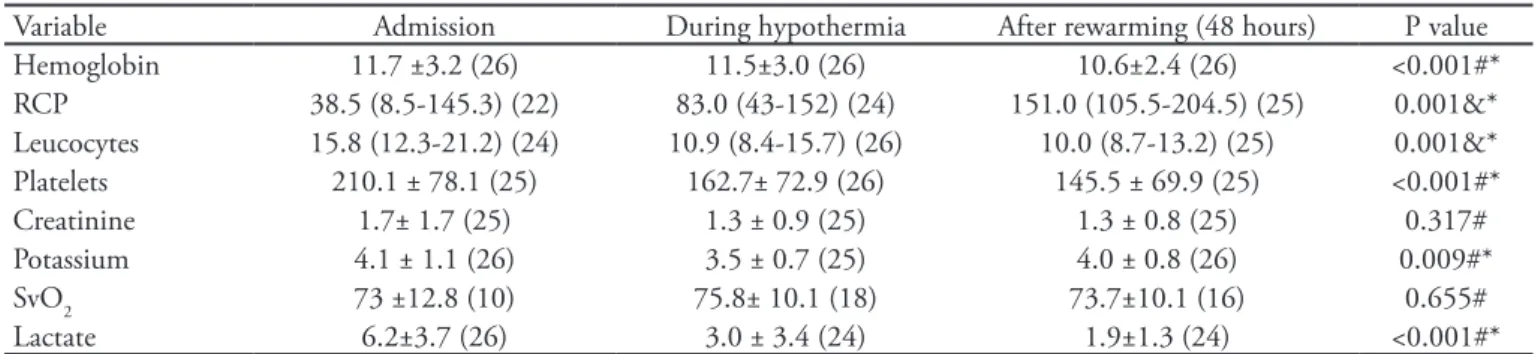
Mean blood glucose was 133 mg/dL (SD ± 17). Laboratory values were analyzed such as hemo-globin, leucocytes, platelets, reactive C protein, international normalized ratio (INR), creatinine, lactate, potassium, pH, bicarbonate and zero time SvO2 during hypothermia (24 hours) and by 48 hours to identify this treatment related changes. The table 4 shows the values found for each vari-able. A significant difference was found in the means versus time for the variables hemoglobin, C reactive protein, leucocytes, platelets, INR, potas-sium and lactate.
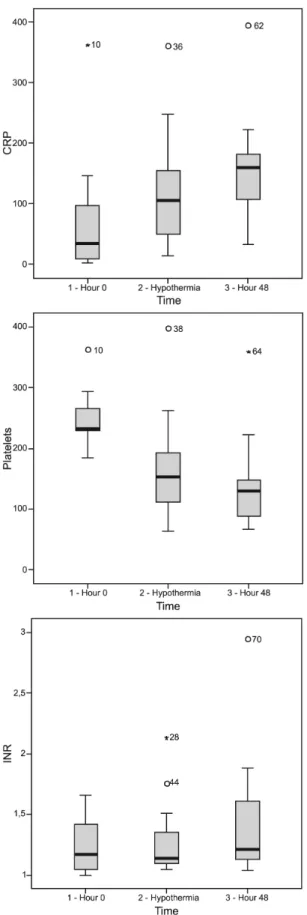
For the variables hemoglobin and leucocytes there as a clearly statistically significant drop af-ter hypothermia (p<0.001 and 0.001, respectively). For the reactive C protein variable, there was an increase after rewarming (p=0.001). A statistically significant drop in mean platelets (p<0.001), lactate (p<0.001) and potassium (p=0.009), and increased INR (p=0.004) were found. For better illustrating these differences, box-plots of these variables were prepared (Figure 1).
Table 3 – Hours to hypothermia, hypothermia time, and rewarming time versus outcome
Variable Outcome N Mean ± SD Median (IQ) Statistics Pvalue
Time from CRA/ hypothermia(hours)
Survivors 9 9 (5-12) 24.5* 0.005
Non-survivors 17 4 (0.5-6)
Hypothermia time(hours) Survivors 9 20.4 ± 2.9 -1.2** 0.235
Non-survivors 17 23.4 ± 6.9
Time to rewarming (hours)
Survivors 9 5 (4-12) 53.5* 0.291
Non-survivors 16 7.5 (6.0-14.7)
CRA – cardiorespiratory arrest; SD – standard deviation; IQ – minimum-maximum. *U Mann-Whitney statistics for medians comparisons due to non-parametrical distribution. **t Student test for means comparisons due to normal distribution.
Table 4 – Laboratory proile versus time: admission, during hypothermia and after rewarming
Variable Admission During hypothermia After rewarming (48 hours) P value
Hemoglobin 11.7 ±3.2 (26) 11.5±3.0 (26) 10.6±2.4 (26) <0.001#*
RCP 38.5 (8.5-145.3) (22) 83.0 (43-152) (24) 151.0 (105.5-204.5) (25) 0.001&*
Leucocytes 15.8 (12.3-21.2) (24) 10.9 (8.4-15.7) (26) 10.0 (8.7-13.2) (25) 0.001&*
Platelets 210.1 ± 78.1 (25) 162.7± 72.9 (26) 145.5 ± 69.9 (25) <0.001#*
Creatinine 1.7± 1.7 (25) 1.3 ± 0.9 (25) 1.3 ± 0.8 (25) 0.317#
Potassium 4.1 ± 1.1 (26) 3.5 ± 0.7 (25) 4.0 ± 0.8 (26) 0.009#*
SvO2 73 ±12.8 (10) 75.8± 10.1 (18) 73.7±10.1 (16) 0.655#
Lactate 6.2±3.7 (26) 3.0 ± 3.4 (24) 1.9±1.3 (24) <0.001#*
RCP – reactive C protein; SvO2 – venous oxygen saturation. Results expressed as mean ± standard deviation or median (min-max). In parenthesis, the number of patients in who the test was obtained. Friedman test or ANOVA.
DISCUSSION
CRA patients mortality remains very high.(1) In our series, the in-hospital mortality was 66%, coinciding with the figures by Nolan et al. in England where, after analyzing 28,958 cases for 10 years, the mortal-ity was 71.4%.(10) In Canada, in a multicenter trial by Keenan et al., also in ICUs, a 66.5% mortality was seen among 2,760 patients.(13) In the USA, analyzing 1992-2005patients above 65 years old, a in-hospital mortality of 81.7% was found, however with no sta-tistically significant difference during the study pe-riod.(13)
Regarding the site of the CRA event, although only two patients came from the surgical room, both were discharged from the hospital, showing a better recov-ery trend among these patients, coinciding with data showing 43.9% survival by Nolan et al.(15), 34.5% by Sprung et al.(16), and 38% by Girardi et al.(17) These improved results may perhaps be related to CRA cases in monitored sites having better outcomes.
Implementation of CRA patients treatment pro-tocols, as well as multidisciplinary approach, showed benefit for these patients’ outcomes.(18,19) In this series we found results compatible with the literature,(8,9) reaching some goals such as time to the target tem-perature (5 hours), hypothermia time (22 hours) and rewarming time (9 hours). Regarding the relationship between time to hypothermia and death, in this series, paradoxically, lower mortality was found among pa-tients taking longer to reach hypothermia (p=0.005), a result possibly attributable to the small sample size. However, additional studies are warranted to deter-mine the therapeutic strategy, as data from both works are not homogeneous, with an average 8 hours in the European study(9) and 2 hours in the Australian(8) to the target temperature.
Nevertheless these interesting results, it is impor-tant underlying several limitations in this study, as its retrospective design, limited number of patients and follow-up time, different CRA rhythms, which have intrinsically different results on mortality, and finally, different sites of the CRA event. All these features may significantly fade any signs eventually present in the analysis. Main complications in this therapy are infections, coagulopathies, arrhythmias and hyper-glycemia.(20) In this series, increased INR and reduced platelet counts were seen after hypothermia, however no bleeding complication was seen. No patient had
RCP = reactive C protein; INR = international normalized ratio.
blood transfusions during of after hypothermia (dada not shown). Regarding increased infection, statistically significant leucocytes and reactive C protein increases were found, however with no proven infection iden-tified after this treatment Regarding hemodynamic variables, there is no literature evidence for the appro-priate values in this patients’ group regarding mean blood pressure, central venous pressure, venous cen-tral saturation and clearance of lactate. Thus, values considered appropriate are those defined by the early goal-directed therapy.(21,22) In this series, an increased norepinephrine requirement during hypothermia was identified (0.47 mcg/kg/min versus 0.33 mcg/kg/ min), however with no harm to the mean blood pres-sure, heart rate, and a reduced heart output (3.2 and 2.7) as it was found by Bernard et al. in Australia.(8) Regarding lactate values, there was a clearance, with a statistically significant difference between admission and hypothermia and after rewarming times, evidenc-ing that the pre-established goals were reached.
Glucose control is controversial. Van den Berghe et al.(23) showed reduced mortality when blood glucose was strictly kept between 80 and 110 mg/L, however in recent papers, Oksanen et al.(24) and Losert et al.(25) benefit was found when there was a moderate con-trol between 100 and 144 mg/dL. In this study the mean blood glucose was 133 mg/dL, within the rec-ommended values.
This therapy use is simple and easily performed, as the target temperature goals can be reached with 4ºC solution infusion and skin folds ice.(12,26) The thermal cushion and neuromuscular blocker would, then, be adjuvants, offering increased stability for temperature control, however when missing, they are not a limita-tion for this technique.
CONCLUSION
A Standard Operational Procedure (SOP) for the treatment of cardiac arrest patients resulted in an elevated adhesion. The main topic of this protocol, the application of therapeutic hypothermia showed results compatible with the pertinent literature. The
apparent paradox of the relation of less time to obtain hypothermia and increased mortality needs to better addressed in a larger series. New reviews of the pro-tocol should be done periodically to adapt it to the current literature.
RESUMO
Objetivo: Conhecer as características dos pacientes sub-metidos a um protocolo operacional padrão institucional de atendimento a pacientes reanimados após episódio de parada cardiorrespiratória incluindo a aplicação de hipoter-mia terapêutica.
Métodos: Foram analisados retrospectivamente 26 pa-cientes consecutivos após episódio de parada cardiorrespi-ratória de janeiro de 2007 a novembro de 2008.
Resultados: Todos os casos foram submetidos a hipotermia terapêutica. Idade média de 63 anos, predominantemente do sexo masculino. O local da parada cardiorrespiratória foi extra-hospitalar em 8 casos, pronto socorro em 3, durante internação fora da unidade de terapia intensiva em 13 casos e o bloco ci-rúrgico em 2 casos. O ritmo de parada foi ibrilação ventricular em sete pacientes, assistolia em 11, atividade elétrica sem pulso em 5 casos e não foi determinado em 3 pacientes. O intervalo entre a parada e o retorno à circulação espontânea foi de 12 ± 5 minutos. O tempo requerido para alcançar a temperatura alvo foi de 5 ± 4 horas, o tempo de hipotermia foi de 22 ± 6 horas e para o reaquecimento usaram-se 9 ± 5,9 horas. Catorze pacientes evoluíram a óbito na unidade de terapia intensiva, re-presentando uma mortalidade de 54%, e três pacientes tiveram o mesmo desfecho durante a internação, determinando uma mortalidade intra-hospitalar de 66%. Houve redução estatisti-camente signiicativa dos valores de hemoglobina (p <0,001), leucócitos (p=0,001), plaquetas (p<0,001), lactato (p<0,001) e potássio (p=0,009), e aumento de proteína C reativa (p=0,001) e RNI (p=0,004) após aplicação de hipotermia.
Conclusões: A elaboração de protocolo operacional drão de hipotermia terapêutica para o tratamento de pa-cientes com parada cardiorrespiratória, utilizando-se das rotinas adaptadas de estudos randomizados, resultou em elevada aderência e seus resultados assemelham-se aos dados publicados na literatura.
Descritores: Hipotermia; Parada cardíaca; Cuidados intensivos
REFERENCES
1. Zheng ZJ, Croft JB, Giles WH, Mensah GA. Sudden car-Mensah GA. Sudden car-. Sudden car-Sudden car-diac death in the United States, 1989 to 1998. Circulation. 2001;104(18):2158-63.
2. Fredriksson M, Herlitz J, Nichol G. Variation in outco-me in studies of out-of-hospital cardiac arrest: a review of studies conforming to the Utstein guidelines. Am J Emerg Med. 2003;21(4):276-81.
W, Mancini ME, Nichol G, Lane-Truitt T, Potts J, Or-nato JP, Berg RA; National Registry of Cardiopulmonary Resuscitation Investigators. First documented rhythm and clinical outcome from in-hospital cardiac arrest among children and adults. JAMA. 2006;295(1):50-7.
4. Stephenson HE Jr, Reid LC, Hinton JW. Some common
denominators in 1200 cases of cardiac arrest. Ann Surg. 1953;137(5):731-44.
5. Safar P. Resuscitation from clinical death: pathophysio-logic limits and therapeutic potentials. Crit Care Med. 1988;16(10):923-41.
6. Laurent I, Monchi M, Chiche JD, Joly LM, Spaulding C,
Bourgeois B, et al. Reversible myocardial dysfunction in survivors of out-of-hospital cardiac arrest. J Am Coll Car-diol. 2002;40(12):2110-6.
7. Negovsky VA. Postresuscitation disease. Crit Care Med. 1988;16(10):942-6.
8. Bernard SA, Gray TW, Buist MD, Jones BM, Silvester W,
Gutteridge G, Smith K. Treatment of comatose survivors of out-of-hospital cardiac arrest with induced hypother-mia. N Engl J Med. 2002;346(8):557-63.
9. Hypothermia after Cardiac Arrest Study Group. Mild the-rapeutic hypothermia to improve the neurologic outcome after cardiac arrest. N Engl J Med. 2002;346(8):549-56. Erratum in: N Engl J Med 2002;346(22):1756.
10. Nolan JP, Morley PT, Vanden Hoek TL, Hickey RW, Klo-, Hickey RW, Klo-eck WG, Billi J, Böttiger BW, Morley PT, Nolan JP, Okada K, Reyes C, Shuster M, Steen PA, Weil MH, Wenzel V, Hickey RW, Carli P, Vanden Hoek TL, Atkins D; Interna-tional Liaison Committee on Resuscitation. herapeutic hypothermia after cardiac arrest: an advisory statement by the advanced life support task force of the Interna-tional Liaison Committee on Resuscitation. Circulation. 2003;108(1):118-21.
11. Protocolo Hipotermia Hospital Mater Dei. [citado 2007 Out 4]. Disponível em: <http://www.materdei.com.br/>. 12. Bernard S, Buist M, Monteiro O, Smith K. Induced hy-pothermia using large volume, ice-cold intravenous luid in comatose survivors of out-of-hospital cardiac arrest: a preliminary report. Resuscitation. 2003;56(1):9-13. 13. Keenan SP, Dodek P, Martin C, Priestap F, Norena M,
Wong H. Variation in length of intensive care unit stay after cardiac arrest: where you are is as important as who you are. Crit Care Med. 2007;35(3):836-41.
14. Ehlenbach WJ, Barnato AE, Curtis RJ, Kreuter W, Koep-sell TD, Deyo RA, Stapleton RD. Epidemiologic study of in-hospital cardiopulmonary resuscitation in the elderly. N Engl J Med. 2009;361(1):22-31.
15. Nolan JP, Laver SR, Welch CA, Harrison DA, Gupta V, Rowan K. Outcome following admission to UK intensive
care units after cardiac arrest: a secondary analysis of the ICNARC Case Mix Programme Database. Anaesthesia. 2007;62(12):1207-16.
16. Sprung J, Warner ME, Contreras MG, Schroeder DR, Bei-Schroeder DR, Bei-ghley CM, Wilson GA, Warner DO. Predictors of survival following cardiac arrest in patients undergoing noncardiac surgery: a study of 518,294 patients at a tertiary referral center. Anesthesiology. 2003;99(2):259-69.
17. Girardi LN, Barie PS. Improved survival after intraoperati-ve cardiac arrest in noncardiac surgical patients. Arch Surg. 1995;130(1):15-8; discussion 19.
18. Sunde K, Pytte M, Jacobsen D, Mangschau A, Jensen LP, Smedsrud C, et al. Implementation of a standardised tre-atment protocol for post resuscitation care after out-of-hospital cardiac arrest. Ressuscitation. 2007;73(1):29-39. 19. Oddo M, Schaller MD, Feihl F, Ribordy V, Liaudet L. From
evidence to clinical practice: efective implementation of therapeutic hypothermia to improve patient outcome after cardiac arrest. Crit Care Med. 2006;34(7):1865-73.20. Polderman KH. Application of therapeutic hypothermia in the intensive care unit. Opportunities and pitfalls of a promising treatment modality--Part 2: Practical aspects and side efects. Intensive Care Med. 2004;30(5):757-69. 21. Rivers E, Nguyen B, Havstad S, Ressler J, Muzzin A,
Kno-blich B, Peterson E, Tomlanovich M; Early Goal-Directed herapy Collaborative Group. Early goal-directed therapy in the treatment of severe sepsis and septic shock. N Engl J Med. 2001;345(19):1368-77.
22. Gaieski DF, Band RA, Abella BS, Neumar RW, Fuchs BD, Kolansky DM, et al. Early goal-directed hemodynamic optimization combined with therapeutic hypothermia in comatose survivors of out-of-hospital cardiac arrest. Resus-citation. 2009;80(4):418-24.
23. van den Berghe G, Wouters P, Weekers F, Verwaest C, Bruy-, Verwaest C, Bruy-ninckx F, Schetz M, et al. Intensive insulin therapy in the critically ill patients. N Engl J Med. 2001;345(19):1359-67.
24. Oksanen T, Skrifvars MB, Varpula T, Kuitunen A, Petti-, Kuitunen A, Petti-lä V, Nurmi J, Castrén M. Strict versus moderate glucose control after resuscitation from ventricular ibrillation. In-tensive Care Med. 2007;33(12):2093-100.
25. Losert H, Sterz F, Roine RO, Holzer M, Martens P, Cer-Holzer M, Martens P, Cer-chiari E, et al. Strict normoglycaemic blood glucose levels in the therapeutic management of patients within 12h after cardiac arrest might not be necessary. Resuscitation. 2008;76(2):214-20.