Stage of readiness to change of behavior in adolescents interested
in joining the Multiprofessional Obesity Treatment Program
Estágio de prontidão para mudança de comportamento de adolescentes interessados em ingressar no Programa Multiprofissional de Tratamento da Obesidade
Estadio de prontitud para cambio de comportamiento de adolescentes interesados en ingresar en el Programa Multiprofesional de Tratamiento de la Obesidad
Luzia Jaeger Hintze1, Glauco Barnez P. Cattai2, Danilo Fernandes da Silva1, Nelson Nardo Junior3
Instituição: Universidade Estadual de Maringá (UEM), Maringá, PR, Brasil 1Mestrando em Educação Física pela UEM; Integrante do Núcleo de Estudos Multiprofissional da Obesidade da UEM, Maringá, PR, Brasil
2Mestre em Ciências da Saúde pela UEM; Integrante do Núcleo de Estudos Multiprofissional da Obesidade da UEM, Maringá, PR, Brasil
3Doutor em Nutrição Humana Aplicada pela Universidade de São Paulo (USP); Professor do Departamento de Educação Física da UEM, Maringá, PR, Brasil
Endereço para correspondência: Luzia Jaeger Hintze
Avenida Colombo, 5.790, bloco M-05 – Jardim Universitário CEP 87020-900 – Maringá/SP
E-mail: [email protected]
Fonte financiadora: Fundação Araucária-Apoio ao Desenvolvimento Cien-tífico e Tecnológico do Paraná
Conflito de interesse: nada a declarar
Recebido em: 04/2/2011 Aprovado em: 17/8/2011 ABSTRACT
Objective: To access the stage of readiness to change (SRC) dietary and physical activity behavior in adolescents and verify the association between the variables gender, age, body mass index (BMI) classification and the SRC.
Methods: 145 adolescents aged from ten to 18 years in-terested in joining the Multiprofessional Obesity Treatment Program were evaluated. Assessments included, in addition to SRC, anthropometric parameters. For independent
analy-sis, Student’s t-test was applied and Mann-Whitney test was
applied to compare groups. The chi-square was used to verify possible associations between the variables of the study. A
p<0.05 value was was considered significant.
Results: About the feeding behavior (amount and portion size), there was an association between BMI classification and SRC. The older adolescents showed more advanced stages in relation to consuming fruits and vegetables, and physical activity. The same was shown in relation to routine physical activities.
Conclusions: There was an association between BMI classification and SRC regarding the amount and portion size, as well as between age and SRC related to fruits and vegetables consumption and physical activity. Experimental studies to verify the influence of SRC dietary and physical activity behaviors on the obesity treatment are needed.
Key-words: adolescent behavior; obesity; feeding behav-ior; motor activity.
RESUMO
Objetivo: Avaliar o estágio de prontidão para mudança do comportamento (EPMC) alimentar e de atividade física de adolescentes e verificar a associação entre as variáveis gê-nero, faixa etária e classificação do índice de massa corpórea (IMC) com o EPMC.
Métodos: Foram avaliados 145 adolescentes entre dez e 18 anos interessados em ingressar no Programa Mul-tiprofissional de Tratamento da Obesidade (PMTO). As avaliações incluíram, além dos EPMC, parâmetros antro-pométricos. A análise estatística envolveu a aplicação do
teste t de Student para amostras independentes e do teste
de Mann-Whitney na comparação entre os grupos. O teste
do qui-quadrado de tendência foi utilizado para verificar se houve ou não associação entre as variáveis do estudo, sendo significante p<0,05.
Conclusões: Há associação entre IMC e o EPMC relacio-nado ao comportamento alimentar (quantidade e tamanho das porções), do mesmo modo que entre a idade e o EPMC relacionado ao consumo de frutas e vegetais e prática habitual de atividade física. Recomenda-se a realização de estudos experimentais a fim de verificar se o EPMC tem poder predi-tivo em programas de intervenção destinados ao tratamento do excesso de peso.
Palavras-chave: comportamento do adolescente; obesi-dade; comportamento alimentar; atividade motora.
RESUMEN
Objetivo: Evaluar el estadio de prontitud para cambio del comportamiento (EPMC) alimentar y de actividad física de adolescentes y verificar la asociación entre las variables género, franja de edad y clasificación del índice de masa corporal (IMC) con los EPMC.
Métodos: Se evaluó a 145 adolescentes entre 10 y 18 años interesados en ingresar en el Programa Multiprofesional de Tratamiento de la Obesidad (PMTO). Las evaluaciones in-cluyeron, además de los EPMC, parámetros antropométricos. El análisis estadístico involucró la aplicación de la prueba
t de Student para muestras independientes y de la prueba
de Mann-Whitney en la comparación entre los grupos.La
prueba del chi cuadrado de tendencia fue utilizada para ve-rificar si hubo o no asociación entre las variables del estudio, siendo significante p<0,05.
Resultados: Respecto al comportamiento alimen-tar (cantidad y tamaño de las porciones), se verificó la asociación entre IMC y los EPMC. También se observó que los adolescentes mayores presentaron EPMC más avanzados respecto al consumo de frutas y verduras. Lo mismo se verificó respecto a la práctica habitual de actividad física.
Conclusiones: Hay asociación entre IMC y los EPMC re-lacionados al comportamiento alimentar (cantidad y tamaño de las porciones), del mismo modo que entre la edad y los EPMC relacionado al consumo de frutas y vegetales y práctica habitual de actividad física. Se recomienda la realización de estudios experimentales a fin de verificar si el EPMC tiene poder predictivo en programas de intervención destinados al tratamiento del exceso de peso.
Palabras clave: comportamiento del adolescente; obesi-dad; comportamiento alimentar; actividad motora.
Introduction
The increase in the prevalence of obesity in a large number of countries has driven investigators to consider it a world epidemic. According to Monteiro, Conde
e Popkin(1), obesity increased about 70% among men
and 63% among women from 1989 to 2003. Children and adolescents’ data are also alarming. The European countries with the largest prevalence of overweight and obesity in children and adolescents are Ireland (27.3%
among girls) and Spain (31.7% among boys)(2). In Brazil,
the amount of cases of children and adolescents’ obesity increased from 4.1% to 13.9% from 1970 to 1990, i.e.,
in a little over 20 years the amount tripled(3).
Although genetic factors determine a predisposition to overweight and obesity, dietary habits and physical activi-ties (PA) seem to interfere in a more signiicant way in the
development of this disorder(4). Programs aimed at changing
these behaviors are therefore important and strongly recom-mended therapeutic strategies, which may lessen the impact of the disorder among adolescents(5,6).
To implement this intervention it is necessary to
evalu-ate the stage of readiness to change (SRC) behavior(7), for
this information will help the staff and the subject to
identify improper habits which must be changed(8). SRC’s
model, also called transtheoretical model (TM), is applied
since the 1980s to ight smoking addiction(9) and has
been widely used in the evaluation of and/or intervention on risk behaviors, such as improper dietary habits(10,11)
and sedentarism(12,13). The advantage of TM is that in it
changes occur in stages, within a decisional balance and seeking a self-eficacy in the process of change, instead of considering that individuals are ready for action (change in behavior)(14).
The classiication of individuals in their respective SRC’s favors thus the distinction between those willing to change and those who have no intention to change their lifestyles. This classiication allows interventions to be more effective in changing dietary and PA practices(11,12). Because it is
easy to use and has a low cost, TM may be used by health
professionals both in research and in primary care(12). This
Method
An observational, cross-sectional study was conducted at Universidade Estadual de Maringá, Brazil. Obese adolescents interested in joining a PMTO promoted by the Multiprofessional Nucleus for the Study of Obesity (Núcleo de Estudos Multiproissional da Obesidade – NEMO) were included in the convenience sample. This program cares for adolescents of both sexes, aged from 10 to 18, and accepts new participants every beginning of semester, coinciding with the Brazilian school year. Data were, thus, collected in the beginning of each semester from 2008 on. Adolescents who were not obese according
to the cutoffs for age and gender deined by Cole et al(15)
and who did not participate in the SRCs and anthropo-metric assessment in the beginning of the intervention period were excluded from the analysis. Thus, the sample for this study was of 145 obese adolescents.
To assess the SRC dietary and PA behavior the stage of
change (SOC) questionnaire was applied, based on the TM
proposed by Sutton et al(10) and translated to the Brazilian
context by Cattai, Hintze e Nardo Junior(16), who followed
rigorously the international methodology for translation and cultural adaptation with a sample of obese adolescents. These authors concluded the instrument is appropriate for this population of obese adolescents, since it presented a good reliability and internal validity. The main advantages of using this instrument are that it can be self-administered and it contemplates SRCs, based on a group of items related
to the process of losing weight(10,16). The instrument is made
of 38 propositions distributed in four domains: size and amount of portions (9 propositions); amount of fat in the diet (11 propositions); fruit and vegetable consumption (9 propositions); and PA practice (9 propositions). The an-swers for each proposition are in a Likert scale, from 1 to 5: 1 – precontemplation. 2 – contemplation; 3 – preparation; 4 – action; 5 – maintenance. To obtain the SRCs of each of the four domains the mean score for each was obtained. To analyze the association the following classiication was used: 1 to 1.4 – precontemplation; 1.5 to 2.4 – contem-plation; 2.5 to 3.4 – preparation; 3.5 to 4.4 – action; 4.5 to 5 – maintenance.
Besides applying the questionnaire, information concern-ing gender, age and anthropometric data were collected. Weight assessment was performed with an electronic scale (Welmy) with a 300kg capacity and a 0.1kg precision. Height was measured with a stadiometer coupled to the
scale, with a precision of 0.1cm and capacity to measure up to 2m. These measurements were used to calculate the BMI
according to the equation BMI=weight (kg) / height2 (m).
The waist circumference (WC) and hip circumference (HC) were measured with an inextensible measuring tape (WISO). The perimeter of the lower abdominal region and the largest portion of the gluteal region were used as reference for the measurement of WC and HC, respectively. With these two anthropometric measurements were made the calculations of the waist/hip ratio (WHR). The anthropometric assessment followed the procedures previously standardized by Lohman, Roche, and Martorell(17).
The information regarding SRCs were gathered during the meetings performed to clarify to the adolescents’ guard-ians the procedures used by the multiprofessional staff during the intervention period. The anthropometric measurements were performed in the irst day of PMTO.
To analyze the data the 145 adolescents were divided in two groups through the mean value (50%) of the BMI of the sample itself. That made possible to differentiate those with a higher BMI from others. Adolescents were also divided in age groups, from 10 to 12 and from 13 to 18. Gender division was also used in the study. These stratiications were made to verify if there was an associa-tion between these variables and the SRCs for the four domains of the questionnaire.
The data were tabulated and organized in Excel 2007 for Windows spreadsheets, while the statistical treatments were performed with the program Statistical Package for the Social Sciences (SPSS), version 15.0. To assess the symmetry in data distribution the Kolmogorov-Smirnov test was used. Descriptive statistics used to characterize the sample in-volved measures of central tendency and dispersion (median
and interquartile range). The parametric Student’s t test for
independent samples and the nonparametric Mann-Whitney test were used to test the null hypothesis (that there was no signiicant difference between groups in demograph-ics). Comparisons between the distribution of adolescents in relation to the SRC and to the strata of gender, age and BMI classiication were performed using the chi-square test for trend. All analyzes adopted a signiicance level of 5% (p<0.05).
Results
Of the 145 adolescents who joined the program, 60 (41.4%) were boys. The median age was 13 years for both genders. The boys had the following anthropometric data expressed as median (interquartile range): BMI of 27.14 (7.71)kg/m², WC of 93.25 (15.18)cm, HC of 108 (12.05) cm and WHR of 0.86 (0.09), while girls had a BMI of 27.58 (8.60)kg/m², WC of 88 (12.5)cm, HC of 109 (14.7)
cm and WHR of 0.80 (0.08). The Student’s t test for
inde-pendent samples pointed towards a signiicant difference in the HC variable, while the Mann-Whitney U test showed differences in WHR.
Adolescents were categorized according to the 50% mark of the BMI (27.32kg/m²), calculated with the sample of obese adolescents itself. After applying the normality test, only the variables age and WHR were found as non-parametric. Differences were found in all of the anthropometric variables, except WHR. Adolescents with BMI>27.32 kg/m² (n=72)
presented higher values than the ones found in adolescents
with BMI≤27.32 kg/m² (n=73) for the variables weight (kg)
93.1 (14.4) versus 70.4 (17.8), height (cm) 1.63 (0.12) versus
1.58 (0.11), WC (cm) 95.5 (11.5) versus 84.2 (12.8), HC (cm)
114.5 (12.0) versus 103.0 (11.2) and age (years) 13 (3) versus
12 (2) – data expressed as median (interquartile range). When categorized according to age, adolescents from 13 to 18 years (n=83) had signiicantly higher values in all of the assessed variables when compared to adolescents from 10 to 12 (n=62). Differences in weight (kg) 85.7 (19.8)
versus.70.7 (21.5), height (cm) 1.68 (0.10) versus 1.54 (0.10),
BMI (kg/m²) 29.16 (7.36) versus 25.62 (7.11), CC (cm) 93.5
(13.3) versus 86.8 (14.2), CQ (cm) 111 (11) versus 103 (14)
and RCQ 0.82 (0.08) versus 0.85 (0.08) – data expressed as
median (interquartile range).
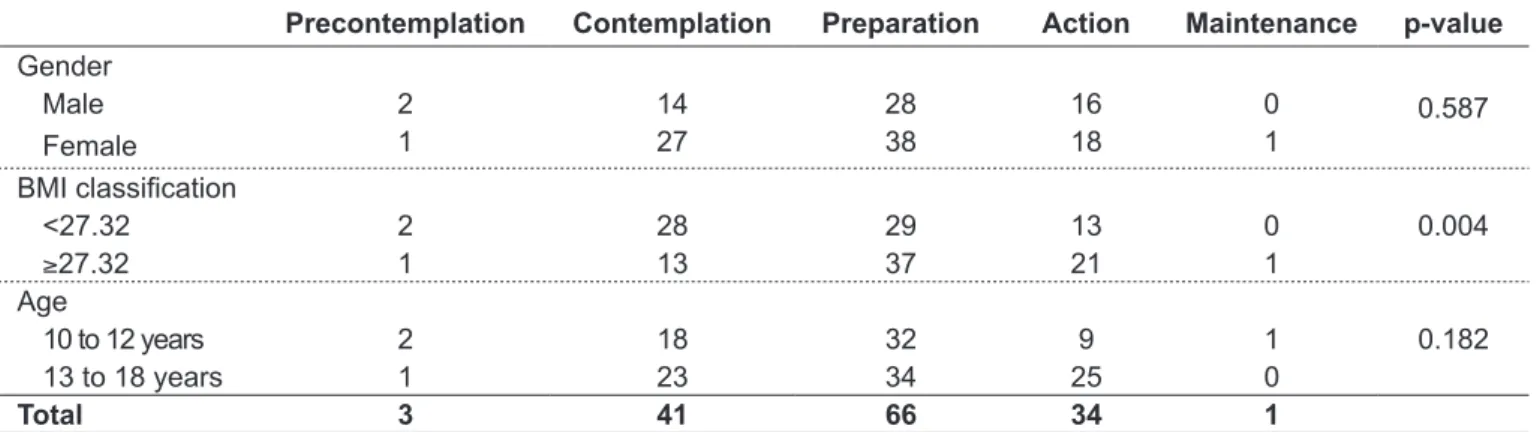
Tables 1 to 4 present results of the association between the four domains of the assessment questionnaire of SRC dietary and PA behavior and the variables gender, BMI classiication and age group. An association between BMI
Table 1 - Association between gender, body mass index classiication and age with the stage of readiness to change behavior related to the size and amount of portions
Precontemplation Contemplation Preparation Action Maintenance p-value
Gender
0.587
Male 2 14 28 16 0
Female 1 27 38 18 1
BMI classiication
0.004
<27.32 2 28 29 13 0
≥27.32 1 13 37 21 1
Age
0.182
10 to 12 years 2 18 32 9 1
13 to 18 years 1 23 34 25 0
Total 3 41 66 34 1
BMI: body mass index
Precontemplation Contemplation Preparation Action Maintenance p-value
Gender
0.550
Male 3 13 22 20 2
Female 6 18 34 25 2
BMI classiication
0.218
<27.32 4 20 26 21 1
≥27.32 5 11 30 24 3
Age
0.629
10 to 12 years 6 14 19 21 1
13 to 18 years 3 17 37 24 3
Total 9 31 56 45 4
Table 2 - Association between gender, body mass index classiication and age with the stage of readiness to change behavior related to the amount of fat in diet
Precontemplation Contemplation Preparation Action Maintenance p-value
Gender
0.525
Male 4 18 24 14 0
Female 1 32 42 10 0
BMI classiication
0.373
<27.32 1 30 31 10 0
≥27.32 4 20 35 14 0
Age
0.036
10 to 12 years 3 23 32 4 0
13 to 18 years 2 27 34 20 0
Total 5 50 66 24 0
Table 4 - Association between gender, body mass index classiication and age with the stage of readiness to change behavior related to physical activity practice
BMI: body mass index
Precontemplation Contemplation Preparation Action Maintenance p-value
Gender
0.834
Male 3 21 23 13 0
Female 0 20 47 8 0
BMI classiication
0.625
<27.32 0 28 36 8 0
≥27.32 3 23 34 13 0
Age
0.014
10 to 12 years 2 25 32 3 0
13 to 18 years 1 26 38 18 0
Total 3 51 70 21 0
Table 3 - Association between gender, body mass index classiication and age with the stage of readiness to change behavior related to fruit and vegetable consumption
BMI: body mass index
and SRC dietary and PA behavior was found in relation to the amount and size of portions ((Table 1). Table 2 presents the results of the SRC assessment in relation to the amount of fat in diet. In this case, no association was found to the other variables of this study (BMI clas-siication, age and gender). Older adolescents were more frequently in more advanced stages in relation to fruit and vegetable consumption (Table 3) and frequent PA practice (Table 4), when compared to younger adolescents.
Discussion
In comparing the anthropometric variables of boys and girls, no differences were found in age, height, weight, BMI and WC. Differences were only found in the variables HC, in which girls presented signiicantly higher values than boys, and WHR, in which boys had the higher values. These results are in accordance to the literature, which reports that boys present a higher accumulation of subcutaneous fat in
the torso than in the limbs. This leads to the increase of the
(WC) numerator(18,19); consequently, boys present higher
WHR values than girls.
Adolescents classified as above the 50% mark in BMI presented weight, height, WC and HC higher than the adolescents classified in the lower category. These results were expected, since the larger degree of overweight of these adolescents directly influences their bodily mass and fat amount in localized regions. Adolescents with a higher degree of overweight were also significantly older than adolescents in the other group, which rein-forces the differences found in the other anthropometric variables.
of weight, height and anthropometric variables, when com-pared to individuals in less advanced stages(19).
Changes in lifestyle are of great importance in the treat-ment of obesity. The adoption of healthy habits, such as decreasing the consumption of foods rich in sugars and fat, increasing fruit, vegetable and grain consumption, and adopting a more active lifestyle, are behaviors that should be adopted by those seeking a healthier life(7,20).
The association between the domain “size and number of servings” and the BMI classification may be linked to the fact that adolescents are joining a PMTO, having already realized the need to reduce the size and amount of portions they consume. Adolescents with higher levels of overweight appeared to be more aware of their problem and thus were more frequently in the stages “prepara-tion” and “ac“prepara-tion” than adolescents classified with lesser degrees of overweight, demonstrating concern about the amount and size of portions they consume. There was no association identified of this domain with the variables gender or age.
In a study with individuals who went to a primary health
care service in the United States, Wee, Davis and Phillips(21)
found a high percentage of overweight individuals in the stages “preparation”, “action” and “maintenance” in relation to weight loss. The authors reported that the knowledge that their high weight was a serious health risk was a fac-tor associated with these individuals’ higher scores of SRC behavior. Thus, over 50% of overweight subjects involved in that study were classiied in the stages “preparation” and “action”, while among those with a BMI below 25kg/m², less than 30% were in the same stages.
Fruit and vegetable consumption has been associated with lower energy consumption, lower intake of sugars
and fats(22), besides lower BMI and WC(23). Children and
adolescents often do not have very healthy eating habits, mainly due to the omission of breakfast, consumption of foods high in fat and sugar, and low consumption of
fruits, greens and vegetables(24).
In this study, the SRC behavior for fruit and vegetable consumption were associated with age of the participants. Older teenagers were in advanced stages with regard to fruit and vegetable consumption. National surveys with adolescents found an association of fruit and vegetable consumption with gender (boys consumed more fruits and vegetables), but not with age(11). In a study by Toral et al (11)
the majority of adolescents in the sample were in the irst and last stages (35 and 32% of the boys were at the stage of
pre-contemplation and maintenance, respectively, for fruit and vegetable consumption) .
In addition to proper nutrition, it is known that the usual practice of PA is an important contributor to both weight loss and its maintenance(7), proving to be a predictor of success in
the treatment of obesity(25). Thus, it is very important that
adolescents who want to lose weight are more advanced in the SRC behavior in relation to PA practice. In our study, there was an association between the SRC for the regular PA practice and the age of subjects. Older adolescents (13–17 years) were more advanced in their SRC when compared to the younger ones (11–12 years). On the other hand, a study conducted by
Kim(26) with adolescents aged 13 to 18 years found that those
of less age (13–15 years) had more advanced stages of readi-ness in relation to the practice of PA than adolescents from 16
to 18 years. The same was veriied by Bourdeaudhuij et al(27)
in older adolescents, who were in less advanced stages. On a national study, it was found that SRC of regular PA practice are less advanced as the school grade advances, i.e., the older
were in less advanced SRCs than the new(28). However, it is
noteworthy that these data refer to children with normal weight. No study was found in which this association was made with obese adolescents. These discrepancies probably are due to differences between the studied samples. In our study, the sample consisted of adolescents who were inter-ested in losing weight, and one could assume that these, even when older, were more willing to change habits to aid them to complete the process of weight loss, engaging in practices such as regular PA practice.
This study has some limitations. The diagnosis of SRC is not the only point that makes up the TM, although there is a focus in studies on assessing it(29). The factors
decisional balance (how to work with the pros and cons of changing habits), self-eficacy (conidence to change be-havior, even when going through dificulties) and change processes (experiences and behaviors that, when put into practice, assist in the passage from one stage to another) are also important, and together comprise the whole process of changing a risk behavior(30). However, in relation to
Given the results of this study, it is possible to argue that there is an association between the BMI classiication and the SRC related to the amount and size of portions. Additionally, age was associated with SRC related to fruit and vegetable consumption and PA practice. However, experimental design
studies should be carried out in order to check whether the SRC dietary and PA behavior at the beginning of an interven-tion inluence the results obtained in the treatment period. Moreover, the assessment of behavioral variables, such as food consumption and PA level should be included.
References
1. Monteiro CA, Conde WL, Popkin BM. Income-speciic trends in obesity in Brazil: 1975-2003. Am J Public Health 2007;97:1808-12.
2. World Health Organization Europe. The challenge of obesity in the WHO European Region and the strategies for response. Copenhagen: WHO; 2007.
3. Wang Y, Monteiro C, Popkin BM. Trends of obesity and underweight in older children and adolescents in the United States, Brazil, China, and Russia. Am J Clin Nutr 2002;75:971-7.
4. Waller K, Kaprio J, Kujala UM. Associations between long-term physical activity, waist circumference and weight gain: a 30-year longitudinal twin study. Int J Obes (Lond) 2008;32:353-61.
5. Scottish Intercollegiate Guidelines Network. Management of obesity: a national clinical guideline. Edinburgh: SIGH; 2010.
6. DH/HID/Obesity-Healthy Schools Programme. Obesity guidance for healthy schools co-ordinators and their partners. Waterloo Road: National Healthy Schools Programme; 2007.
7. Lau DC, Douketis JD, Morrison KM, Hramiak IM, Sharma AM, Ur E et al. 2006 Canadian clinical practice guidelines on the management and prevention of obesity in adults and children [summary]. CMAJ 2007;176 (Suppl 8):S1-13. 8. Garaulet M, Pérez de Heredia F. Behavioural therapy in the treatment of obesity
(I): new directions for clinical practice. Nutr Hosp 2009;24:629-39.
9. Prochaska JO, DiClemente CC. Stages and processes of self-change in smoking: toward an integrative model of change. J Consult Clin Psychol 1983;51:390-5.
10. Sutton K, Logue E, Jarjoura D, Baughman K, Smucker W, Capers C. Assessing dietary and exercise stage of change to optimize weight loss interventions. Obes Res 2003;11:641-52.
11. Toral N, Slater B, Cintra IP, Fisberg M. Adolescent eating behavior regarding fruit and vegetable intakes. Rev Nutr 2006;19:331-40.
12. Dumith SC, Domingues MR, Gigante DP. Stages of change toward physical activity: a review of literature. Rev Bras Cineantropom Desempenho Hum 2008;10:301-7.
13. Maddison R, Prapavessis H. Exercise behavior among New Zealand adolescents: a test of the transtheoretical model. Pediatric Exercise Science 2006;18:351-63.
14. Assis MA, Nahas MV. Motivational aspects in programs of nutritional behavior changes. Rev Nutr 1999;12:33-41.
15. Cole TJ, Bellizzi MC, Flegal KM, Dietz WH. Establishing a standard deinition for child overweight and obesity worldwide: international survey. BMJ 2000;320:1240-3.
16. Cattai GB, Hintze LJ, Nardo Junior N. Internal validation of the stage of change
questionnaire for alimentary and physical activity behaviors. Rev Paul Pediatr 2010;28:194-9.
17. Lohman TG, Roche AF, Martorell R, editors. Anthropometric standardization reference manual.Champaign: Human Kinetics; 1988.
18. Mariath AB, Grillo LP, Silva RO, Schmitz P, Campos IC, Medina JR et al. Obesity
and risk factors for the development of chronic non-transmissible diseases among consumers in a foodservice unit. Cad Saude Publica 2007;23:897-905. 19. Malina RM, Bouchard C, Bar-or O, editors. Crescimento, maturação e atividade
física. 2 ed. São Paulo: Phorte; 2009.
20. Melanson KJ, Angelopoulos TJ, Nguyen VT, Martini M, Zukley L, Lowndes J
et al. Consumption of whole-grain cereals during weight loss: effects on dietary
quality, dietary iber, magnesium, vitamin B-6, and obesity. J Am Diet Assoc 2006;106:1380-8.
21. Wee CC, Davis RB, Phillips RS. Stage of readiness to control weight and adopt weight control behaviors in primary care. J Gen Intern Med 2005;20:410-5. 22. Epstein LH, Gordy CC, Raynor HA, Beddome M, Kilanowski CK, Paluch R.
Increasing fruit and vegetable intake and decreasing fat and sugar intake in families at risk for childhood obesity. Obes Res 2001;9:171-8.
23. McNaughton SA, Mishra GD, Stephen AM, Wadsworth ME. Dietary patterns throughout adult life are associated with body mass index, waist circumference, blood pressure, and red cell folate. J Nutr 2007;137:99-105.
24. Andrade SC, Barros MB,Carandina L,Goldbaum M,Cesar CL,Fisberg RM. Dietary quality index and associated factors among adolescents of the state of Sao Paulo, Brazil. J Pediatr 2010;156:456-60.
25. Reinehr T, Brylak K, Alexy U, Kersting M, Andler W. Predictors to success in outpatient training in obese children and adolescents. Int J Obes Relat Metab Disord 2003;27:1087-92.
26. Kim YH. Korean adolescents’ exercise behavior and its relationship with psychological variables based on stages of change model. J Adolesc Health 2004;34:523-30.
27. Bourdeaudhuij I, Philippaerts R, Crombez G, Matton L, Wijndaele K, Balduck A et al. Stages of change for physical activity in a community sample of
adolescents. Health Educ Res 2005;20:357-66.
28. Souza GS, Duarte MF. Behavior change stages related to physical activity in adolescents. Rev Bras Med Esporte 2005;11:104-8.
29. Armitage CJ. Is there utility in the transtheoretical model? Br J Health Psychol 2009;14:195-210.