DOI: 10.1590/0104-1169.3126.2354
www.eerp.usp.br/rlae
Copyright © 2013 Revista Latino-Americana de Enfermagem
This is an Open Access article distributed under the terms of the Creative Commons Attribution Non-Commercial License (CC BY-NC).
This license lets others distribute, remix, tweak, and build upon your work non-commercially, and although their new works must also acknowledge you and be non-commercial, they don’t have to license their derivative works on the same terms.
Corresponding Author:
Laís Carvalho de Sá
Rua Senador Esmaragdo de Freitas, 1116 Bairro: Piçarra
CEP: 64017-200, Teresina, PI, Brasil E-mail: [email protected]
Laís Carvalho de Sá
2Telma Maria Evangelista de Araújo
3Rosane Harter Griep
4Viriato Campelo
5Claudete Ferreira de Souza Monteiro
31 Supported by Conselho Nacional de Desenvolvimento Científico e Tecnológico (CNPq), process # 402759/2010-9.
2 MSc, RN, Fundação Municipal de Saúde de Teresina, Teresina, PI, Brazil.
3 PhD, Adjunct Professor, Universidade Federal do Piauí, Teresina, PI, Brazil.
4 PhD, Researcher, Instituto Oswaldo Cruz, Fundação Oswaldo Cruz, Rio de Janeiro, RJ, Brazil.
5 PhD, Associate Professor, Universidade Federal do Piauí, Teresina, PI, Brazil.
Objective: to investigate the seroprevalence of hepatitis C in crack users in Piauí. Method:
seroepidemiological survey, undertaken in the Psycho-Social Care Centers for Drugs and Alcohol
(CAPS AD) in Piauí in the period December 2011 to May 2012. A questionnaire was administered
and blood samples were collected for serological research. Fisher’s exact test and the
Mann-Whitney test were used, with a level of significance of (p<0.05). Results: the prevalence of
Anti-HCV was 05 (1.4%) and 04 (1.1%) for the RNA-HCV. There was a statistically significant
association between hepatitis C (serological marker RNA-HCV) and age, being resident at home,
length of use of crack, interruption of the use of crack, and the habit of sharing the crack pipes.
Conclusion: the findings support the need to implement health policies aimed at crack users, due
to the accelerated process of physical and psychological deterioration to which these are subject.
Descriptors: Hepatitis C; Prevalence; Risk factors; Crack Cocaine.
Rev. Latino-Am. Enfermagem 2013 Nov.-Dec.;21(6):1195-202.
Introduction
The viral hepatites are a serious public health
problem. Although hepatitis C is universally distributed,
its prevalence differs depending on each region’s
socio-economic and cultural characteristics. It is interesting
to observe that some at-risk populations have higher
prevalences when compared to the population in general.
In this regard, the consumption of crack related to the
hepatitis C virus (HCV) has begun to awaken the interest of the world scientiic community, as the users present risk behaviors which may make them more susceptible
to infection.
In dependent use, the crack user faces problems
of organic, psychological, social and legal natures.
In relation to organic problems, the World Health
Organization (WHO) stresses particularly those which are infectious, such as Acquired Immunodeiciency Syndrome (AIDS), hepatitis B and C, and the infective
endocardites.
Although hepatitis C’s natural history has not
been well elucidated, the consensus is that the virus is
transmitted by parenteral exposure to blood, transfusion,
and medical and dental procedures, and that it may also
occur through tattooing and body piercing(1).
The dominant means of transmission of HCV in
the developed countries is the use of injectable drugs,
with the sharing of needles being the main risk factor.
Nevertheless, infection can also occur as a result of the
items used for preparing the drugs. The literature(2-5)
refers to the presence of RNA-HCV in body luids such as saliva, peripheral lymph nodes and semen. It is
worth noting that although the virus is found in low
titrations, this form of transmission must be considered.
Corroborating this understanding of the possibility of
other means of transmission, the Center for Disease
Control and Prevention (CDC) indicated, in an American
health report of 2012, that 45% of people with hepatitis
C did not report any known exposure risk(6).
Ratifying this, a study undertaken in Porto Alegre(7)
investigated the prevalence of sexually-transmitted diseases (STDs) in female crack users, inding a prevalence of 37% for Human Immunodeiciency Virus and 27.7% for HCV. The authors suggest that speciic habits may keep these patients at risk of transmission
of, and contagion with, infectious-contagious diseases,
given that the use of injections had a low frequency in
the sample.
In this regard, there are some questions: Is the
prevalence of hepatitis C higher among crack users than
in the general population? What are the risk factors for
hepatitis C presented by crack users?
In the light of the considerations raised, the
disease’s seriousness and the scarcity of Brazilian
studies associating the use of crack as a risk behavior
for acquiring hepatitis C, the present study is considered
to be relevant, as it will allow the obtaining of local/
regional epidemiological data on infection among crack
users, furthering the understanding of the risk factors,
as well as serving as support for the establishing of
policies and strategies for prevention.
Based on the above, this study aims to investigate
hepatitis C seroprevalence and associated factors among
crack users in the CAPS AD in Piauí (PI).
Methodology
This research was undertaken through a
seroepidemiological survey and is part of a wider research
program entitled “Hepatitis B and C seroprevalence in
crack users in the Piauí CAPS AD”.
It was carried out in the Brazilian state of Piauí in the
Psycho-Social Care Centers – Alcohol and Drugs (CAPS
AD) located in four municipalities; Teresina, Parnaíba,
Picos and Piripiri. The study’s source population was
made up of 2,971 crack users registered in the state’s
four CAPS AD. In the sample calculation, for the total of
353 participants, an acceptable error of 5% was taken into account, with a level of signiicance of 95%, and through proportional stratiication(8).
The inclusion criteria were to be a crack user
registered with the CAPS AD, and to accept to participate
in the research. The exclusion criteria were for the user
to be unable, at the time of data collection, to respond to
the questions of interest to the research, as well as the
absence of the express consent of the responsible party,
in the case of adolescent crack users.
Data collection was undertaken in the period
December 2011 – May 2012, and occurred in four
stages, namely:
-Administration of a questionnaire, with closed
and semi-open questions, which had been
previously tested so as to improve it, to test the performance of the ield researchers, and to promote familiarization.
-Observation of the mouth and nose so as to ascertain
the presence of blisters and/or lesions.
-Taking of a blood sample so as to research the crack
users’ serological situation for hepatitis C.
The serological markers were researched using
the ELISA immunoenzymatic assay described by the
Bioeasy® kit. The Bioeasy HCV ELISA Test is an indirect
qualitative solid phase immunoenzymatic assay for the
detection of the IgG antibody against HCV in human
serum or plasma.
The only way of knowing if the infection has passed
(spontaneous cure) or is current (acute or chronic) is to
carry out tests, by applying the qualitative polymerase
chain reaction (PCR), a molecular biology technique, so
as to directly detect the viral RNA (RNA-HCV). In this
way, in the cases of reagent reactions for the Anti-HCV,
the test for the RNA-HCV was undertaken automatically,
using the Roche®test.
The data was entered into, and then analyzed
using, the Statistical Package for the Social Sciences
(SPSS) software, version 19.0. Among the statistical
tests, the Mann-Whitney and Fisher tests were applied. The choice of test was based on the veriication of the non-normal distribution of the numerical variables. It is
important to emphasize that the means presented in the
tables of association with the Mann-Whitney test refer
to the descriptive analyses of the variables. Statistical signiicance was ixed at p≤0.05, with a conidence interval of 95%.
The research project was approved by the Research
Ethics Committee (REC) of the Federal University of
Piauí (CAAE: 0091.0.45.000-11), and the Terms of Free
and Informed Consent (TFIC) were presented to the
participants.
Results
Of the 353 crack users who participated in the study,
183 (51.8%) were aged between 20 and 30 years old,
with a mean age of 29.4, a minimum age of 15, and a
maximum age of 65. There was a predominance of the
male sex, with 297 (84.1%), and in relation to marital
situation, 242 (68.6%) were single/separated. In regard
to education, 165 (46.7%) had not completed junior high
school. The mean family income was R$1,668, this varying
between R$30 and R$20,000 (data not presented).
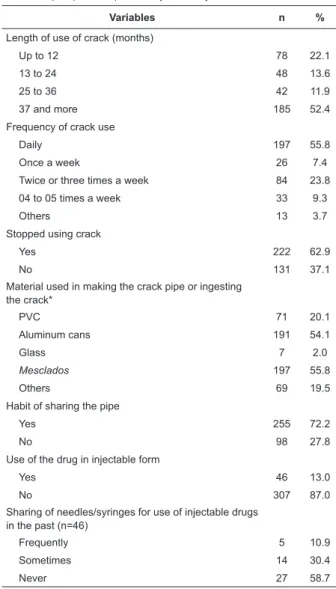
In relation to the pattern of crack consumption,
(Table 1), the majority of the users had used the drug for
a period longer than 37 months, with daily frequency. It
was observed that a small majority reported interrupting
the use of the substance after beginning treatment in
the CAPS AD. The materials used most for ingesting
the crack or making the crack pipes were: mesclados
(marijuana cigarettes containing rocks of crack) and
aluminum cans. A small proportion of the sample use
the drug in an injectable form.
Table 1 - Patterns of crack consumption and use of
the injectable form of the drug in the study’s sample.
Teresina, PI, Brazil, 2012 (N=353)
*Multiple response
Variables n %
Length of use of crack (months)
Up to 12 78 22.1
13 to 24 48 13.6
25 to 36 42 11.9
37 and more 185 52.4
Frequency of crack use
Daily 197 55.8
Once a week 26 7.4
Twice or three times a week 84 23.8
04 to 05 times a week 33 9.3
Others 13 3.7
Stopped using crack
Yes 222 62.9
No 131 37.1
Material used in making the crack pipe or ingesting the crack*
PVC 71 20.1
Aluminum cans 191 54.1
Glass 7 2.0
Mesclados 197 55.8
Others 69 19.5
Habit of sharing the pipe
Yes 255 72.2
No 98 27.8
Use of the drug in injectable form
Yes 46 13.0
No 307 87.0
Sharing of needles/syringes for use of injectable drugs in the past (n=46)
Frequently 5 10.9
Sometimes 14 30.4
Never 27 58.7
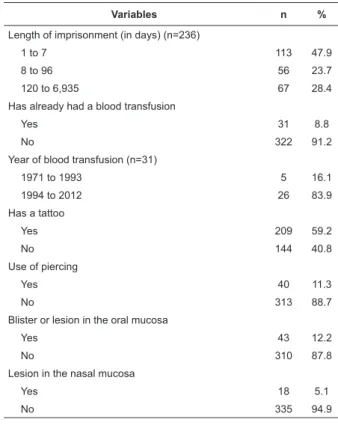
According to Table 2, a signiicant majority has sexual relations only with women, has a single partner,
and uses condoms frequently. A minority reported
having contracted a STD. Regarding other predictive
factors for HCV infection, there was a predominance
of a history of imprisonment and having a tattoo. A
minority had received blood transfusions, had body
piercings, and had blisters or lesions in the oral and
nasal mucosa.
In the researching of the serological markers for
hepatitis C (Table 3), 05 (1.4%) were positive for
Anti-HCV and 04 (1.1%) for the RNA-Anti-HCV.
In Table 4, there was a statistically-signiicant association between RNA-HCV and age (p=0.02), living
Rev. Latino-Am. Enfermagem 2013 Nov.-Dec.;21(6):1195-202.
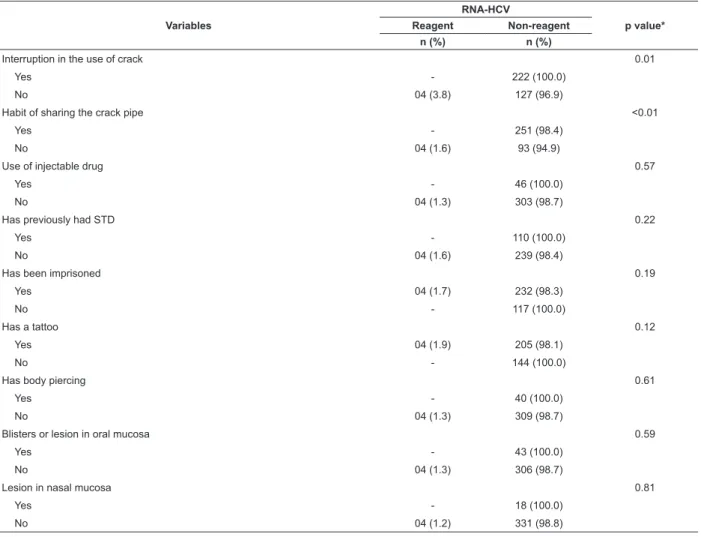
A statistically-signiicant association was observed between RNA-HCV and continuity of crack use (p=0.01)
and the sharing of the crack pipe (p<0.01). The other
variables tested did not present statistical association
(Table 5).
Table 2 - Predictive factors for infection with the hepatitis
C virus in the study’s sample. Teresina, PI, Brazil, 2012
(N=353)
Table 4 - Association between RNA-HCV and the variables: mean age, resident at home, family income, months of
crack use, number of partners in the previous six months and length of time spent imprisoned. Teresina, PI, Brazil,
2012 (N=353)
Table 2 - (continuation)
Table 3 - Distribution of the prevalence of serological
markers of hepatitis C in the study’s sample. Teresina,
PI, Brazil, 2012 (N=353)
Variables n %
Usually has sexual relations
Only with women 276 78.2
Only with men 42 11.9
With either sex 34 9.6
Has never had sexual relations 1 0.3
Number of sexual partners in the last 6 months (n=301)
One 143 40.5
2 to 5 106 30.0
6 and more 52 14.7
Has already had relations with a user of injectable drugs (n=352)
Yes 28 8.0
No 324 92.0
Uses Condoms (n=352)
Frequently 191 54.3
Sometimes 105 29.8
Never 56 15.9
Has already had a STD (n=352)
Yes 110 31.2
No 242 68.8
Has a history of imprisonment
Yes 236 66.9
No 117 33.1
(continue...)
(continue...)
Variables n %
Length of imprisonment (in days) (n=236)
1 to 7 113 47.9
8 to 96 56 23.7
120 to 6,935 67 28.4
Has already had a blood transfusion
Yes 31 8.8
No 322 91.2
Year of blood transfusion (n=31)
1971 to 1993 5 16.1
1994 to 2012 26 83.9
Has a tattoo
Yes 209 59.2
No 144 40.8
Use of piercing
Yes 40 11.3
No 313 88.7
Blister or lesion in the oral mucosa
Yes 43 12.2
No 310 87.8
Lesion in the nasal mucosa
Yes 18 5.1
No 335 94.9
Variables n %
Anti-HCV
Reagent 5 1.4
Non-reagent 348 98.6
RNA-HCV
Reagent 4 1.1
Non-reagent 349 98.9
RNA-HCV n Mean Standard Deviation p value*
Age 0.02
Reagent 4 40.2 8.2
Non-reagent 349 29.3 8.7
Resident at home <0.01
Reagent 4 1.0
Non-reagent 349 4.1 2.2
Family income (in Brazilian reais) 0.43
Reagent 4 916.5 589.0
Non-reagent 327 1677.6 1999.6
Months of crack use 0.01
Reagent 4 132.0 73.9
*p value was obtained through the Mann-Whitney test. The statistical signiicance was ixed at p≤0.05
Table 4 - (continuation)
Table 5 - Association between RNA-HCV and the variables: interruption of the use of crack, sharing of the crack pipe,
injectable drug, STD, imprisonment, tattooing, body piercing, blisters and lesions in the oral mucosa, and lesions in
the nasal mucosa. Teresina, PI, Brazil, 2012 (N=353)
*p value was obtained with Fisher’s exact test. Statistical signiicance was ixed at p≤0.05
RNA-HCV n Mean Standard Deviation p value*
Number of partners in the previous six months 0.53
Reagent 4 7.0 7.6
Non-reagent 349 3.3 6.4
Days imprisoned 0.15
Reagent 4 274.0 182.0
Non-reagent 230 215.9 715.2
Variables
RNA-HCV
p value*
Reagent Non-reagent
n (%) n (%)
Interruption in the use of crack 0.01
Yes - 222 (100.0)
No 04 (3.8) 127 (96.9)
Habit of sharing the crack pipe <0.01
Yes - 251 (98.4)
No 04 (1.6) 93 (94.9)
Use of injectable drug 0.57
Yes - 46 (100.0)
No 04 (1.3) 303 (98.7)
Has previously had STD 0.22
Yes - 110 (100.0)
No 04 (1.6) 239 (98.4)
Has been imprisoned 0.19
Yes 04 (1.7) 232 (98.3)
No - 117 (100.0)
Has a tattoo 0.12
Yes 04 (1.9) 205 (98.1)
No - 144 (100.0)
Has body piercing 0.61
Yes - 40 (100.0)
No 04 (1.3) 309 (98.7)
Blisters or lesion in oral mucosa 0.59
Yes - 43 (100.0)
No 04 (1.3) 306 (98.7)
Lesion in nasal mucosa 0.81
Yes - 18 (100.0)
No 04 (1.2) 331 (98.8)
Discussion
The socio-demographic characterization of the
sample produced a result similar to that ascertained in the irst investigation on crack consumption, carried out in São Paulo in 1994(9), which conirmed a preponderance
of men, younger than 30 years old, unemployed, with
little education, and from dysfunctional families.
Regarding the characteristics related to the pattern
of crack consumption, the observed was increasingly
heavy consumption at progressively shorter intervals,
explaining the fact that 37.1% of the crack users used
the drug even while being treated in the Piauí CAPS AD.
The tendency for increase in the need for crack was also
ascertained in a study(10) undertaken with drug users in
the city of Rio de Janeiro in the period 2007-2008.
In order to smoke a rock of crack, the crack users use
a type of pipe, and structures improvised from tin cans,
plastic or cardboard tubes, aluminum foil, hydraulic parts,
Rev. Latino-Am. Enfermagem 2013 Nov.-Dec.;21(6):1195-202.
the materials used for making artifacts for ingesting the
crack, among the users in the present study, a preference
for smoking mesclados was observed, followed by beer
and soft drink cans. The ‘mesclado’, a marijuana cigarette
with crack rocks mixed in with the marijuana, is a less harmful means of ingestion, as it reduces the issuring, and other, anxiogenic, effects of crack(11).
When they lack materials for making pipes, the
users consume the drug in aluminum cans which they often ind in the trash. In Brazil, this form of use has been well documented. In addition to the risk of the
presence of infectious agents in these cans found in
the gutter or trash, it should be emphasized that the
high level of aluminum in brain tissue causes changes in
cognitive and neurological function(12).
It is common for crack users to share pipes between themselves, a behavior veriied by the majority of this study’s population. In this way, those who smoke crack
have possibilities for infectious contamination(1,5).
In relation to the consumption of injectable drugs,
it was observed that this means was abandoned,
possibly due to the perception of risk involving this
practice and contagion with HIV, the infectious illness
which causes the most commotion worldwide. In spite
of the reduction in Injection Drug Users (IDUs), it is
estimated that 10 million people who inject drugs were
infected with HCV in 2011(1).
At the time of writing, the role of sexual behaviors
in the transmission of HCV remains controversial.
However, several authors have asserted some risk factors
for acquiring HCV, including biological factors (being
HIV-positive and having other sexually-transmissible
infections), rough sexual practices (anal sex, use of
sex toys), and having multiple sexual partners(13). In
relation to crack, it has been evidenced in studies that
less safe sexual practices are frequently associated
with this substance, examples being a large number of
sexual partners, unprotected sex, and sex in exchange
for drugs or money.
The non-use of condoms was reported by part of
the population studied. A higher frequency was found
by researchers in a separate study(14), in which 49.3% of
crack users reported that they rarely used them, in spite
of their being available for free in the health services. Due to the irregular use of condoms, the inding that there was a 31.2% incidence of STDs in the present
research is understandable. The use of psycho-active
substances can make drug addicts less aware of or
concerned about STDs(15). In one randomized study, the
prevalence of HCV antibodies was signiicantly (p≤0.001)
higher in the group of heterosexuals infected with
STDs than in the control group (without STDs); 5.3%
compared to 0.5%(16). One possible explanation is that as
some sexually-transmissible infections are ulcerative, the
presence of ulcers as a gateway may have facilitated the
contamination of the organism by HCV.
In relation to the problems which involve the Police or justice system, the study ascertained that a signiicant majority of crack users have previously had an episode
of imprisonment. This data is worrying given that the
rates of prevalence of HCV in prisons and other closed
institutions are higher than in the community. This
occurs due to the limited access to materials, and risk
practices that are undertaken, such as tattooing or body
piercing without sterilized instruments, homosexual
sexual practices, sexual attacks, and the sharing of
injectable and non-injectable drug paraphernalia. In one
study(17) undertaken in South America, in HCV
mono-infected persons were signiicantly more likely to have been imprisoned.
In the sample studied, 8.8% had received blood
transfusions. Following the introduction in 1993 of
Anti-HCV testing in the routine of health surveillance,
particularly in the bloodbanks, the rates of
post-transfusion hepatites have fallen increasingly lower,
making transfusions and transplants rare means of
transmission. However, there is still a risk of there being
cases of post-transfusional hepatites as a result of the
immunological window(6).
There was a predominance of tattooed crack users,
but only a small proportion had body piercing. Although
people with multiple tattoos and/or perforations have an
increased risk of HCV due to the absence of sterilization
processes, this association has been irregular among the
studies.
It is important to note that some cases –
approximately 15% – of hepatitis C are of unknown
origin in the general population. One hypothesis which
may explain infections with HCV among users of
non-injectable drugs was proposed by researchers of the
National Institutes of Health)(NIH) in the USA(18), who
identiied crack use as a risk factor for HCV among blood donors. They argued that the virus can be transmitted
by means of contaminated instruments.
This transmission occurs due to the existence of burns and blisters on the ingertips, mouth and nose, as a result of the heating-up of the pipes. The blood
from the oral and nasal lesions can be transferred via
the paraphernalia for consuming crack to the ulcerated
There are innumerable studies on the presence of
RNA-HCV in the saliva(2-5) but their results vary, relecting
the heterogeneity of the populations studied, and the
variety of detection techniques used. Nevertheless,
epidemiological studies suggest that the infectious
capacity of viral particles of HCV in the saliva is low. There
is no evidence that HCV is easily transmitted by kissing,
sneezing, coughing or sharing cups and plates(19).
In spite of the presence of blisters or lesions in the
oral and nasal mucosa in a proportion of the sample,
the prevalence found was of 1.4% for the Anti-HCV
and 1.1% for RNA-HCV. The prevalence of hepatitis C
among the crack users was similar to that estimated for
Brazil with 1% to 2%, as well as for the chronic cases of
hepatitis C which represent 1.5% of the population(20).
In relation to the Brazilian panorama, it is important
to stress that there is a shortage of information on HCV
among crack users. The result was below that found
among crack users in Bahía, with 2.4%(14) and similar to
that among adults in Criciúma, with 1.53%(21).
Comparing the prevalence rates around the world,
prevalences were observed which are higher than that
calculated in the population studied. One study(17)
estimated the prevalence of HCV in Buenos Aires
(Argentina) and Montevideo (Uruguay) at 8.8%. In
Mexico, the prevalence of hepatitis C among the users of
non-injectable drugs was 4.1%(22). Nevertheless, it was
lower than that found in Canada (0.8%)(23).
Regarding the association of hepatitis C with age, this inding was in accordance with other investigations of users of illicit drugs(10). A longer period of crack use
was statistically associated with RNA-HCV. This occurs
due to the cumulative effect of exposure to the risk of
infection by HCV.
In relation to the number of people who live at home,
it was ascertained that crack users who are positive
for hepatitis C lived alone. The Brazilian Association of
Psychiatry(24) states that positive relationships in the
family environment are always protective and provide
structure, reducing the individuals’ vulnerability for drug
consumption. The norms for social behaviors, including
risk practices, are developed in the relationships with
the primary sources of socialization: the family, the
school, and the friends in adolescence.
Regarding the continued use of crack, it was
evidenced that the fact that the users had not stopped
consuming the substance, even when in treatment,
suggests a greater association with hepatitis C, due to
the risk behaviors described above.
No association was found between the sharing
of equipment and HCV seroprevalence among
non-injectable drug users, in spite of the literature(25)
indicating that sharing crack-smoking equipment is
statistically-associated with HCV.
Conclusion
Regarding serological condition, 1.4% were positive
for Anti-HCV and 1.1% for RNA-HCV. In this way, in spite
of the risk behaviors (abusive consumption of crack,
sharing crack pipes, non-use of condoms, episodes of
imprisonment and being tattooed), the prevalence of
hepatitis C found for the crack users was similar to the
estimate found for the Brazilian population in general,
and below the worldwide estimate. The following
variables were statistically associated with RNA-HCV:
age, length of use of crack, living at home, cessation of
crack use, and the habit of not sharing the crack pipes.
It was ascertained that the repeated use of the
heated-up crack pipe can cause blisters and wounds, on the tongue, lips, face, nostrils and ingers. However, in this study it was not possible to afirm the hypothesis of the transmission of the virus through the sharing of the
paraphernalia used in crack consumption.
This study leads to the relection that, as hepatitis C normally follows an indolent course, the identiication of risk factors for infection is essential for the development
of effective early intervention strategies. It is relevant
to set up health education programs directed at crack
users concerning risk behaviors which expose them
to infectious diseases, such as hepatitis C, due to the
accelerated process of physical and psychological
deterioration to which they are subject.
The results of low prevalence of, and non-association
of, hepatitis C with the presence of blisters and lesions
in the oral and nasal mucosa may be attributed to the
study’s limitations. Information bias may have occurred,
given that the responses were self-declared. The
presence of false negatives, occasionally, is a problem.
The lack of a control group, the cross-sectional design
and relatively small sample may have made the analysis of the results dificult. For this reason, further research is necessary so as to deepen knowledge of the issue.
References
1. Nelson PK, Mathers BM, Cowie B, Hagan H,
Jarlais DD, Horyniak D, et al. Global epidemiology
of hepatitis B and hepatitis C in people who inject
drugs: results of systematic reviews. Lancet. 2011;
Rev. Latino-Am. Enfermagem 2013 Nov.-Dec.;21(6):1195-202.
Received: Jan. 31st 2013
Accepted: Aug. 21st 2013
2. Pekler VA, Robbins WA, Nyamathi A, Yashina TL, Leak
B, Robins TA. Use of versant TMA and bDNA 3.0 assays
to detect and quantify hepatitis C virus in semen. J Clin
Lab. 2003;17(6):264-70.
3. Ferreiro MC, Dios PD, Scully C. Transmission of
hepatitis C virus by saliva? Oral Dis. 2005;11(4):230-5.
4. Suzuki T, Omata K, Satoh T, Miyasaka T, Arai C,
Maeda M, et al. Quantitative detection of hepatitis
C virus (HCV) RNA in saliva and gingival crevicular
fluid of HCV-infected patients. J Clin Microbiol.
2005;43(9):4413-7.
5. Menezes GBL, Pereira FA, Duarte CAB, Carmo TMA,
Silva HP Filho, Zarife MA, et al . Hepatitis C virus
quantification in serum and saliva of HCV-infected
patients. Mem Inst Oswaldo Cruz. 2012;107(5):680-3.
6. Centers for Disease Control and Prevention (USA).
Recommendations for the Identification of Chronic
Hepatitis C Virus Infection Among Persons Born
During 1945–1965. MMWR Recomm Rep. 2012
Aug;61(RR-4):1-32. Erratum in: MMWR Recomm Rep.
2012 Nov 2;61(43):886.
7. Von Diemen L, De Boni R, Kessler F, Benzano
D, Pechansky F. Risk behaviors for HCV- and
HIV-seroprevalence among female crack users in Porto Alegre,
Brazil. Arch Womens Ment Health. 2010;13(3):185–91.
8. Callegari-jacques S. Bioestatística: princípios e
aplicações. Porto Alegre: Artmed; 2003.
9. Nappo AS, Galduróz JCF, Noto AR. Uso do “crack”
em São Paulo: fenômeno emergente? Rev ABP-APAL.
1994;16(2):75-83.
10. Vargens RW, Cruz MS, Santos MA. Comparison
between crack and other drugs abusers in a specialized
outpatient facility of a university hospital. Rev.
Latino-Am. Enfermagem. 2011;19(spe):804-12.
11. Oliveira LG, Nappo SA. Crack na cidade de São
Paulo: acessibilidade, estratégias de mercado e formas
de uso. Rev Psiquiatr Clín. 2008;35(6):212-8.
12. Pechansky F, Kessler FHP, Von Diemen L, Bumaguin
DB, Surratt HL, Inciardi JA. Brazilian female crack
users show elevated serum aluminum levels. Rev Bras
Psiquiatr. 2007;29(1):39-42.
13. Stall R, Wei C, Raymond HF, McFarland W. Do rates
of unprotected anal intercourse among HIV-positive
MSM present a risk for hepatitis C transmission? Sex
Transm Infect. 2011;87(5)439-41.
14. Nunes CLX, Andrade T, Galvão-Castro B, Bastos FI,
Reingold A. Assessing risk behaviors and prevalence of
sexually transmitted and blood-borne infections among
female crack cocaine users in Salvador-Bahia, Brazil.
Braz. J Infect Dis. 2007;11(6):561–6.
15. Bradshaw CS, Pierce LI, Tabrizi SN, Fairley CK,
Garland SM. Screening injecting drug users for sexually
transmitted infections and blood borne viruses using
street outreach and self collected sampling. Sex Transm
Infect. 2005;81(spe):53-8.
16. Petersen EE, Clemens R, Bock HL, Friese K, Hess
G. Hepatitis B and C in heterosexual patients with
various sexually transmitted diseases. Infection.
1992;20(3):128-31.
17. Caiaffa WT, Zocratto KF, Osimani ML, Martínez PL,
Radulich G, Latorre L, et al. Hepatitis C virus among
non-injecting cocaine users (NICUs) in South America: can
injectors be a bridge? Addiction. 2011;106(1):143–51.
18. Conry-Cantilena C, Van Raden M, Gibble J,
Melpolder J, Shakil AO, Viladomiu L, et al. Routes of
infection, viremia, and liver disease in blood donors
found to have hepatitis C virus infection. N Engl J Med.
1996;334(26):1691-6.
19. Zeremski M, Makeyeva J, Arasteh K, Des Jarlais DC,
Talal AH. Hepatitis C virus-specific immune responses in
noninjecting drug users. J Viral Hepat. 2012;9(8):554–9.
20. Ministério da Saúde (BR). Programa Nacional de
Prevenção e Controle da Hepatite Viral. Manual de
aconselhamento em hepatites virais. Brasília; 2005.
21. Fagundes GD, Bonazza V, Ceretta LB, Back AJ, Betiol
J. Detection of the hepatitis c virus in a population of
adults. Rev. Latino-Am. Enfermagem.
2008;16(3):396-400.
22. Campollo O, Roman S, Panduro A, Hernandez G,
Diaz-Barriga L, Balanzario MC, et al. Non-injection drug
use and hepatitis C among drug treatment clients in west
central Mexico. Drug Alcohol Dependence. 2012;123(1–
3):269–72.
23. Public Health Agency of Canada. Evaluation of the
hepatitis C prevention, support and research program
1999/2000-2005/2006. [Internet]. [acesso 13 out
2012].Canadá; 2009. Disponível em: http://
www.phac-aspc.gc.ca/publicat/2008/er-re-hepc/er-re-hepc1-eng.
php#ref..
24. Associação Brasileira de Psiquiatria. Conselho federal
de Medicina. Diretrizes para um modelo de assistência
integral em saúde mental no Brasil. Brasília; 2006. 58 p.
25. Macías J, Palacios RB, Claro E, Vargas J, Vergara
S, Mira JA, et al. High prevalence of hepatites C virus
infection among noninjecting drug users: association
with sharing the inhalation implements of crack. Liver