Original Article
Copyright © 2015 Revista Latino-Americana de Enfermagem This is an Open Access article distributed under the terms of the Creative Commons Attribution Non-Commercial License (CC BY-NC).
This license lets others distribute, remix, tweak, and build upon your work non-commercially, and although their new works must also acknowledge you and be non-commercial, they don’t have to license their derivative works on the same terms.
Corresponding Author: Silvia Portero de la Cruz
Universidad de Córdoba. Facultad de Enfermería Avda Menéndez Pidal, s/n
14071, Córdoba, España E-mail: [email protected]
1 Supported by Universidad de Córdoba, Córdoba, Spain.
2 MSc, Researcher, Departamento de Enfermería, Facultad de Enfermería, Universidad de Córdoba, Córdoba, Spain.
3 PhD, Professor, Facultad de Enfermería, Universidad de Córdoba, Córdoba, Spain.
Professional burnout, stress and job satisfaction of nursing staff at a
university hospital
1Silvia Portero de la Cruz
2Manuel Vaquero Abellán
3Objectives: to describe the social and work characteristics of the nursing staff at a tertiary hospital
in the Public Health Service of Andalucía, to assess the degree of professional professional
burnout and job satisfaction of those professionals and to study the possible relation between
the professional burnout variables and the stress and job satisfaction levels on the one hand and
social and employment variables on the other. Method: descriptive and cross-sectional study
in a sample of 258 baccalaureate and auxiliary nurses. As research instruments, an original
and specific questionnaire was used to collect social and employment variables, the Maslach
Burnout Inventory, the Nursing Stress Scale and the Font-Roja questionnaire. Descriptive,
inferential statistics and multivariate analysis were applied. Results: average scores were found
for professional stress and satisfaction, corresponding to 44,23 and 65,46 points, respectively.
As regards professional burnout, an average score was found on the emotional exhaustion
subscale; a high score for depersonalization and a low score for professional accomplishment.
Studies are needed to identify the scores on these subscales in health organizations and to
produce knowledge on their interrelations.
Descriptors: Burnout; Stress; Job Satisfaction; Occupational Health.
Rev. Latino-Am. Enfermagem 2015 May.-June;23(3):543-52
DOI: 10.1590/0104-1169.0284.2586
Introduction
As a consequences of the changes in the
organizations and of the current globalization processes,
the exposure to psychosocial factors in the professional
sphere has been more frequent and intense(1). When
these are adverse to the development of the professional
activity and the individual’s quality of life, they turn into
a higher level of stress for the professional(2).
In the last two decades, there has been a growing
concern with the effects of stress on the nursing
professionals(3), which represent the most numerous
group of health professionals who deliver care to patients
24 hours per day(4). According to the Occupational Health
and Safety Survey of the American Nurses Association
(ANA), the main concern for the nursing staff with
regard to health and safety in the work environment
is the acute or chronic effect of stress(5). The work
conditions in nursing imply the exposure to pain and death, interpersonal conlicts(6), lack of autonomy and
authority for decision making and the lack of deinition of the professional role, which produce a state of chronic
stress(7). The individual response to these situations
can be psychological, including symptoms like anxiety,
irritation and depression, or psychosomatic, involving
headaches, nausea and sleep problems, with possible
negative impacts for patient safety and for the quality
of care(8).
The prolonged exposure to professional stress is
associated with the professional burnout syndrome(9),
characterized by high levels of emotional exhaustion,
which refers to the decrease or loss of emotional
resources, the depersonalization or development of negative attitudes towards patients and, inally, the lack of personal accomplishments, which provokes trends
to assess one’s work negatively(10). The consequences
of professional burnout include mental fatigue, lack of
motivation(11), increased risk of cardiovascular diseases,
musculoskeletal problems(12), low output levels, low
productivity and absenteeism(13).
Current evidence reveals job satisfaction as a
predictor of the length of stay in a job, motivation and
job productivity. The level of job satisfaction among
nursing staff is dropping all over the world though(14).
The main sources of nursing dissatisfaction include lack
of staff, high care pressure and lack of professional
acknowledgement(15).
The objectives in this study were to describe the
social and employment characteristics of the nursing
staff at a tertiary hospital in the Public Health System
of Andalucía, to assess these professional’s degree
of work-related stress, professional burnout and job
satisfaction and to study the possible relation between
the professional burnout dimensions and the
work-related stress and job satisfaction levels with social and
employment variables.
Methods
An observational, descriptive and cross-sectional
study was undertaken at a tertiary hospital in the Public
Health System of Andalucía. The data were collected
between February and June 2014. The study subjects
were nurses or auxiliary nurses who worked at the
hospital, who had worked at the service where they
were active in care for more than one year and who were
active at the time of the data collection. Accepting an
alpha risk of 0.05, for an absolute precision level of 5%
in a bilateral contrast and an estimated prevalence of
professional burnout corresponding to 25%(16), a sample
of 258 subjects was determined, assuming a population
of 2242 subjects. The sample size was calculated in the
software Epidat version 4.0, departing from the least
advantageous prevalence. The researchers received data
on the total resources allocated to the nursing staff from
the nursing head of the hospital. The following exclusion
criteria were adopted: being a nursing student/auxiliary
nurse or being a professional in specialized educational
training.
The professionals were selected through random
cluster sampling. The clusters corresponded to the
services where the professionals worked. The hospital
consists of 45 services. Using tables with random igures, eight services were selected in function of the sample size and the total number of nurses and auxiliary
nurses working at the service. To foresee possible
losses, two additional services were selected. All nursing
professionals and auxiliary nurses from each of the
selected services were considered for the study.
The study received approval from the hospital’s
Institutional Review Board (protocol 227, reference
2491). A dossier was designed to collect information,
including an information letter in which the voluntary
and anonymous nature was highlighted, an explicit
request for cooperation which the professionals signed
and data to agree to participate in the study, an original and speciic form that collected social and employment variables, the Nursing Stress Scale (NSS)(17), the
Maslach Burnout Inventory (MBI)(18) and the Font-Roja
dossier to the professionals at the start of each work
shift (morning and afternoon). In addition, the service
supervisors received the number of dossiers needed
for the workers who were not present at the place of
work at the time of the distribution because they were
working night shifts. Completed dossiers were returned
directly to the researchers at the end of the shift or to
the service supervisors, for them to pass them on to the
researchers.
The social and employment variables, collected through an original and speciic questionnaire, were: sex (woman, man), age (years), professional category
(baccalaureate nurse, auxiliary nurse), marital status
(single, married, separated-divorced, widowed),
children (yes/no), relatives living at home (none, irst-degree relative, second-degree relative, both), complementary education (yes/no), professional
activity and/or complementary education beyond
work journey (yes/no), type of contract (statutory, undeined, hired), trainees in the previous month (yes/no), weekly work journey, number of patients
the professional is in charge of per day, professional
experience (years), time on the current job (years).
To measure the work-related stress in the nursing
staff, the NSS validated in Spain was used. This scale
consists of 34 items on potentially stressful situations.
The possible response categories for each of the items
are: never (0), sometimes (1), frequently (2), very
frequently (3). This scale has a factorial structure
and includes seven subscales: death and suffering (5 items), problems with doctors (5 items), insuficient preparation (6 items), lack of support (3 items),
problems with other nursing team members (5 items),
work burden (6 items) and uncertainty in treatment (4
items). The total score is equivalent to the simple sum
of the items in each subscale divided by the number of
items. Any mean score higher than 1 was considered
as a nursing stress factor. The global work-related
stress was obtained by adding up the scores of the 34
items, so that the global score ranges between 34 and
102 points(16). In this study, the internal consistency
of the global scale, represented by Cronbach’s alpha coeficient, corresponded to 0.87. To measure the degree of professional burnout, the Spanish version of the MBI was sued. This questionnaire consists of
22 items. The participants answer according to how
frequently they experience the feelings, ranging from
never (0) to few times per year or less (1), once per
month or less (2), few times per month (3), once per
week (4), few times per week (5), every day (6). No
valid cut-off points have been described in the literature
for the clinical level in order to measure the existence
of professional burnout and to be able to distinguish
the cases. Nevertheless, high scores for emotional
exhaustion and depersonalization and low scores for
professional accomplishment suggest the presence of
this syndrome. The sum of the scores determines three
dimensions of professional exhaustion: emotional
fatigue (9 items), depersonalization (5 items) and
personal accomplishment (8 items). To interpret the
scores obtained on the three scales, the following
cut-off points were used: for emotional exhaustion,
the scores range between 15 and 24 (<15 low, 15-24
medium and >24 high), for depersonalization between
4 and 9 (<4 low, 4-9 medium and >9 high) and, for
personal accomplishment, between 33 and 39 (<33
high, 33-39 medium and >39 low)(17). The Cronbach’s
alpha coeficient for the emotional exhaustion scale corresponded to 0.92, for depersonalization
to 0.83 and for personal accomplishment to 0.82.
Job satisfaction was measured using the Font-Roja questionnaire, validated for use in Spain. The
questionnaire consists of 24 items. The participants
answer according to the degree of agreement with
different situations related to their job environment.
The possible response categories for each of the items
are: strongly disagree (1), disagree (2), neither agree
nor disagree (3), agree (4), strongly agree (5). The
items are grouped in 9 factor that permit exploring
different dimensions that intervene in job satisfaction:
satisfaction with work (degree of satisfaction the
individual perceives conditioned by the job function,
4 items), work-related tension (degree of tension the
work causes in the subject and which is manifested
as fatigue, stress and professional burnout, 4
items), professional competency (extent to which
the individual believes (s)he is prepared to perform
daily work, 3 items), pressure at work (extent to
which the individual perceives the work as a burden,
2 items), professional promotion (extent to which
the worker believes (s)he can improve professionally
and in terms of professional acknowledgement, 3
items), interpersonal relationship with heads (degree
of satisfaction the social relationships with the heads
provoke in the individual, 2 items), interpersonal
relationship with peers (degree of satisfaction the
social relationships with the peers provoke in the
individual, 1 item), extrinsic characteristics of status
(extent to which the individual believes the work
in the organization and performance of the function,
2 items), and job monotony (extent to which the job
routine affects the subject, 2 items). The total score
corresponds to the simple sum of the items, divided
by the number of items. Score 3 was considered as
the median satisfaction level. The global or total
job satisfaction was calculated by adding up the
scores for the 24 items, ranging between 24 and
120 points(18). The internal consistency of the global
scale, represented by Cronbach’s alpha coeficient, corresponded to 0.83.
The qualitative variables were expressed
using absolute and percentage frequencies and the
quantitative variables though means and standard
errors. To compare the means between two independent groups, Student’s t-test was applied, after conirming the normal distribution of the variables.
For the comparison of means between more
than two independent groups, variance analysis
(ANOVA) was applied if the variables followed a normal
distribution or Kruskal-Wallis’ non-parametric test in
case of a non-normal distribution. For p-values < 0.05,
the two distinct groups were compared using Dunn’s
method, when Kruskal-Wallis non-parametric test
was applied or Tukey, Scheffé or Bonferroni’s method
for variance analysis in function of the equality or not
of the variances and sample size of the groups. To
correlate the variables, Pearson’s linear correlation coeficient was used, after proving the normal distribution of the variables. To estimate the variables
related to professional burnout, three multiple linear
regression models were developed, using the reverse
variable selection method. The dependent variables
were emotional exhaustion, depersonalization and
personal accomplishment. The independent variables
were age, sex, professional category, marital status
(recoded as: married-unmarried), children, relatives
living at home, professional activity and/or education
beyond work journey, type of contract, trainees under
professional’s responsibility in previous month, weekly
work journey, number of patients the professional is in
charge of per day, work experience, time on the current
job, global work-related stress level and global job
satisfaction level. Using Wald’s statistics, variables with p≥ 0.15 were eliminated from the model one by one. The Box-Tidwell test was used to assess the scale of
the continuing variables. Possible interactions among the variables were studied. Variables with signiicance superior to 0.05 were studied as possible confounding
factors, considering them as such if the percentage of
change of the coeficients was superior to 15%. To prove the normality of the residues, the Kolmogorov-Smirnov
test was applied. It was considered that there were no
collinearity problems among the independent variables if the variance inlation factor was lower or equal to 10. To diagnose extreme cases, the analysis of studentized
residuals was used. The adjusted determination coeficient R2 was used to assess the goodness of it.
P-values inferior to 0.05 were considered signiicant in all statistical tests.
For the statistical analysis, the software G-Stat
version 2 was used.
Results
In total, 258 properly completed dossiers
were received. In the study sample, 77.52% of the
professionals were women. The mean age was 49.21
(32 –65) years. 64.34% held a nursing degree. On
average, the professionals attended to 7.90±5.21
patients per day. 69.38% were married. In addition, 212
professionals had children. On average, the professionals
worked 36.18±6.98 hours per week. 73.26% lived with irst-degree relatives. The mean professional experience was 24.16±8.19 years. 72.09% of the professionals
worked on a statutory contract. The mean time on the
job was 10.43±8.39 years. 50.78% of the professionals
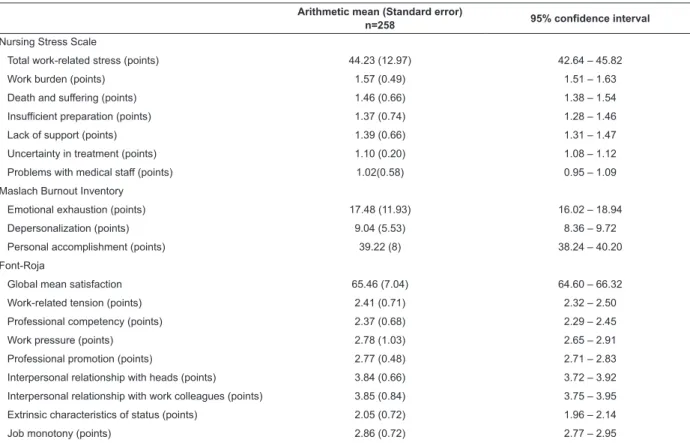
were in charge of trainees. As observed in Table 1,
the mean work-related stress score was 44.23±12.97,
ranging between 13 and 76 points. The minimum score
for emotional exhaustion was 0 and the maximum 49;
scores for depersonalization ranged between 0 and 25
points; and, for personal accomplishment, between 10
and 48 points. For the mean global satisfaction, the
minimum score was 51 points and the maximum 85.
The level of emotional exhaustion was 4.74 points
higher among professionals who did not supervise
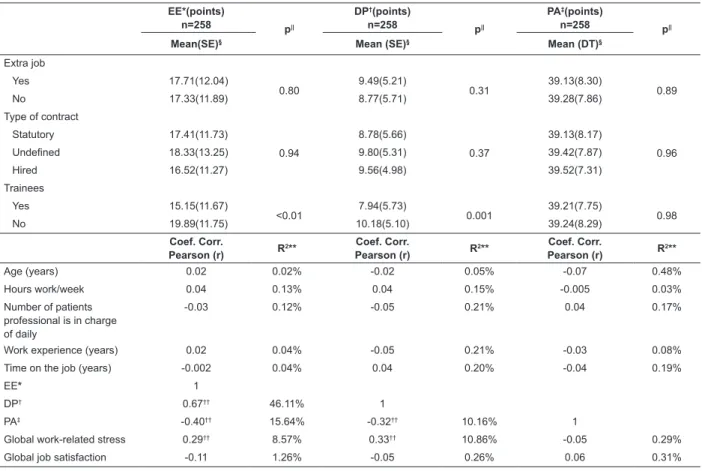
trainees when compared to supervisors (p<0.01). In the population, adopting a 95% conidence level, this score ranged between 1.87 and 7.61 points. As regards
personal accomplishment, the professionals who lived with irst-degree relatives obtained a mean score signiicantly higher by 9.83 points than professionals who lived with second-degree relatives. In the population, with a 95% conidence level, this score ranged between 3.92 and 15.74 points (Table 2).
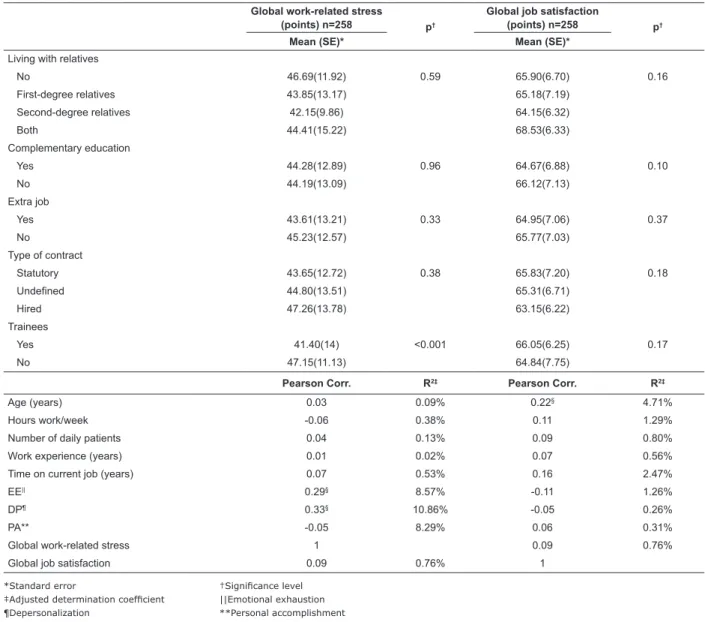
As regards the global job satisfaction, a positive and signiicant relation was found with the professionals’ age: for each additional year of age, the job satisfaction
Table 1 – Description of dimensions and/or subscales of the Nursing Stress Scale, Maslach Burnout Inventory and
Font-Roja questionnaire in nurses and auxiliary nurses. Andalucía, Spain, 2014
Arithmetic mean (Standard error)
n=258 95% confidence interval
Nursing Stress Scale
Total work-related stress (points) 44.23 (12.97) 42.64 – 45.82
Work burden (points) 1.57 (0.49) 1.51 – 1.63
Death and suffering (points) 1.46 (0.66) 1.38 – 1.54
Insufficient preparation (points) 1.37 (0.74) 1.28 – 1.46
Lack of support (points) 1.39 (0.66) 1.31 – 1.47
Uncertainty in treatment (points) 1.10 (0.20) 1.08 – 1.12
Problems with medical staff (points) 1.02(0.58) 0.95 – 1.09
Maslach Burnout Inventory
Emotional exhaustion (points) 17.48 (11.93) 16.02 – 18.94
Depersonalization (points) 9.04 (5.53) 8.36 – 9.72
Personal accomplishment (points) 39.22 (8) 38.24 – 40.20
Font-Roja
Global mean satisfaction 65.46 (7.04) 64.60 – 66.32
Work-related tension (points) 2.41 (0.71) 2.32 – 2.50
Professional competency (points) 2.37 (0.68) 2.29 – 2.45
Work pressure (points) 2.78 (1.03) 2.65 – 2.91
Professional promotion (points) 2.77 (0.48) 2.71 – 2.83
Interpersonal relationship with heads (points) 3.84 (0.66) 3.72 – 3.92
Interpersonal relationship with work colleagues (points) 3.85 (0.84) 3.75 – 3.95
Extrinsic characteristics of status (points) 2.05 (0.72) 1.96 – 2.14
Job monotony (points) 2.86 (0.72) 2.77 – 2.95
Table 2 – Association and correlation between professional burnout dimensions and social and employment variables
in nurses and/or auxiliary nurses. Andalucía, Spain, 2014 EE*(points)
n=258 p||
DP†(points)
n=258 p||
PA‡(points)
n=258 p||
Mean(SE)§ Mean (SE)§ Mean (DT)§
Sex
Man 18.24(12.25) 0.58 9.78(5.67) 0.25 39.34(7.90) 0.90
Woman 17.25(11.85) 8.83(5.48) 39.19(8.05)
Professional category
Nurse 16.92(11.74) 0.31 8.84(5.79) 0.42 39.43(7.72) 0.59
Auxiliary nurse 18.49(12.25) 9.41(5.03) 38.86(8.52)
Estado civil
Single 20.60(11.63) 0.08 11.83(4.29)a <0.001¶ 40.09(7.20) 0.14
Married 17.40(12.02) 9.17(5.36)a 39.59(7.96)
Separated 13.06(10.28) 6.39(5.85) 37.22(8.97)
Widowed 25.37(12.02) 6(6.82) 36.38(7.07)
Children
Yes 17.06(12.14) 0.24 8.86(5.70) 0.26 38.88(8.32) 0.13
No 19.37(10.83) 9.87(4.61) 40.83(6.19)
Living with relatives
No 19.62(11.41) 0.11 10.08(4.83) 0.24 40.10(6.13)b <0.01¶
First-degree relatives 16.79(11.94) 8.85(5.68) 39.68(7.95)b
Second-degree relatives 23.69(13.60) 10.54(5.53) 29.85(9.97)c
Both 15.41(10.41) 7.71(5.16) 39.35(6.80)
Complementary education
Yes 18.47(12.39) 0.22 9.07(5.73) 0.95 39.31(7.68) 0.87
No 16.63(11.49) 9.02(5.38) 39.15(8.30)
EE*(points)
n=258 p||
DP†(points)
n=258 p||
PA‡(points)
n=258 p||
Mean(SE)§ Mean (SE)§ Mean (DT)§
Extra job
Yes 17.71(12.04)
0.80 9.49(5.21) 0.31 39.13(8.30) 0.89
No 17.33(11.89) 8.77(5.71) 39.28(7.86)
Type of contract
Statutory 17.41(11.73)
0.94
8.78(5.66)
0.37
39.13(8.17)
0.96
Undefined 18.33(13.25) 9.80(5.31) 39.42(7.87)
Hired 16.52(11.27) 9.56(4.98) 39.52(7.31)
Trainees
Yes 15.15(11.67)
<0.01 7.94(5.73) 0.001 39.21(7.75) 0.98
No 19.89(11.75) 10.18(5.10) 39.24(8.29)
Coef. Corr.
Pearson (r) R
2** Coef. Corr.
Pearson (r) R
2** Coef. Corr.
Pearson (r) R 2**
Age (years) 0.02 0.02% -0.02 0.05% -0.07 0.48%
Hours work/week 0.04 0.13% 0.04 0.15% -0.005 0.03%
Number of patients professional is in charge of daily
-0.03 0.12% -0.05 0.21% 0.04 0.17%
Work experience (years) 0.02 0.04% -0.05 0.21% -0.03 0.08%
Time on the job (years) -0.002 0.04% 0.04 0.20% -0.04 0.19%
EE* 1
DP† 0.67†† 46.11% 1
PA‡ -0.40†† 15.64% -0.32†† 10.16% 1
Global work-related stress 0.29†† 8.57% 0.33†† 10.86% -0.05 0.29%
Global job satisfaction -0.11 1.26% -0.05 0.26% 0.06 0.31%
*Emotional exhaustion †Depersonalization ‡Personal accomplishment §Standard error
||p: Signiicance level
¶Signiicance obtained using the Kruskall-Wallis test and Dunn’s method for a posteriori comparisons: a= Signiicant difference from separated-divorced, b= Signiicant difference from second-degree relatives, c= Signiicant difference from irst and second-degree relatives.
**Adjusted determination coeficient
††p value < 0.001
Regression lines: emotional exhaustion =4.23+1.46xdepersonalization, emotional exhaustion =5.57+0.27xglobal work-related stress, emotional exhaustion =40.5-0.59xpersonal accomplishment, depersonalization=3.54+0.31x emotional exhaustion, depersonalization=2.83+0.14xglobal work-related stress, depersonalization=17.68-0.22xpersonal accomplishment, personal accomplishment=43.40-0.46xdepersonalization, personal
accomplishment=43.86-0.27x emotional exhaustion.
Table 3 – Association and correlation between global work-related stress level and global satisfaction level in nurses
and auxiliary nurses. Andalucía, Spain, 2014
Global work-related stress (points) n=258 p†
Global job satisfaction
(points) n=258 p†
Mean (SE)* Mean (SE)*
Sex
Man 44.86(14.01) 0.67 65.86(6.92) 0.08
Woman 44.04(12.68) 64.05(7.34)
Professional category
Nurse 42.50(13.52) 0.08 65.03(6.63) 0.19
Auxiliary nurse 47.35(11.32) 66.23(7.70)
Marital status
Single 50.03(9.63) 0.07 64.82(6.22) 0.85
Married 44.18(12.88) 65.65(7.28)
Separated 38.83(12.59) 64.86(6.69)
Widowed 44.25(19.88) 66.63(7.46)
Children
Yes 43.94(13.23) 0.45 65.47(7.17) 0.94
No 45.54(11.74) 65.39(6.47)
Tabela 2 - continuação
Global work-related stress (points) n=258 p†
Global job satisfaction
(points) n=258 p†
Mean (SE)* Mean (SE)*
Living with relatives
No 46.69(11.92) 0.59 65.90(6.70) 0.16
First-degree relatives 43.85(13.17) 65.18(7.19)
Second-degree relatives 42.15(9.86) 64.15(6.32)
Both 44.41(15.22) 68.53(6.33)
Complementary education
Yes 44.28(12.89) 0.96 64.67(6.88) 0.10
No 44.19(13.09) 66.12(7.13)
Extra job
Yes 43.61(13.21) 0.33 64.95(7.06) 0.37
No 45.23(12.57) 65.77(7.03)
Type of contract
Statutory 43.65(12.72) 0.38 65.83(7.20) 0.18
Undefined 44.80(13.51) 65.31(6.71)
Hired 47.26(13.78) 63.15(6.22)
Trainees
Yes 41.40(14) <0.001 66.05(6.25) 0.17
No 47.15(11.13) 64.84(7.75)
Pearson Corr. R2‡ Pearson Corr. R2‡
Age (years) 0.03 0.09% 0.22§ 4.71%
Hours work/week -0.06 0.38% 0.11 1.29%
Number of daily patients 0.04 0.13% 0.09 0.80%
Work experience (years) 0.01 0.02% 0.07 0.56%
Time on current job (years) 0.07 0.53% 0.16 2.47%
EE|| 0.29§ 8.57% -0.11 1.26%
DP¶ 0.33§ 10.86% -0.05 0.26%
PA** -0.05 8.29% 0.06 0.31%
Global work-related stress 1 0.09 0.76%
Global job satisfaction 0.09 0.76% 1
*Standard error †Signiicance level
‡Adjusted determination coeficient ||Emotional exhaustion
¶Depersonalization **Personal accomplishment
§p-value <0.01 Regression line: global job satisfaction=54.86+0.22xage.
Table 4 – Multiple linear regression model between burnout dimensions and social and employment characteristics of
nurses and auxiliary nurses. Andalucía, Spain, 2014
Dependent variable Independent variables Regression coefficients P*
EE† Global job satisfaction -0.22 0.03
Trainees
Global work stress = 30 points -6.84
Global work stress = 64 points 1.86 0.003
Global work stress = 98 points 10.56
DP‡ Trainees
Global work stress = 30 points -8.17
Global work stress = 64 points -7.30 0.002
Global work stress = 98 points -6.44
PA§ Living alone (reference) 1
First-degree relatives -0.43 0.76
Second-degree relatives -10.26 <0.001
Both -0.75 0.74
*Signiicance level †Emotional exhaustion ‡Depersonalization §Personal accomplishment
Adjusted determination coeficient for emotional exhaustion = 12.36%. F= 10.06 (p<0.001). Adjusted determination coeficient for depersonalization = 15%. F=16.11 (p<0.001). Adjusted determination coeficient for personal accomplishment = 6.27%. F = 6.73 (p<0.001.
The conditions of the multiple linear regression
models regarding normality of residuals, non collinearity
between independent variables and non-existence of
extreme values were complied with for the dimensions:
emotional exhaustion, depersonalization and personal
accomplishment. Like the rest of the variables, for
each additional point in the global job satisfaction, the
emotional exhaustion score dropped by 0.22 points
(Table 4).
Discussion
In this study, the sample was predominantly
female. The mean age was 49.21 years. In addition,
69.38% were married. These results were similar to
other studies in Spain(20-21) and abroad(6).
The mean scores on the professional burnout
dimensions situated the sample at a medium level
on the emotional exhaustion subscale; a high level
for depersonalization and a low level for personal
accomplishment. The comparison of the mean scores
for the professional burnout dimensions with other
studies(22-23) proves that the mean scores in this
study are similar for the emotional exhaustion and
depersonalization dimensions. As regards personal
accomplishment, the mean score was slightly higher in
this study.
A signiicant and positive relation was found between the professionals’ global stress level and
their emotional exhaustion and depersonalization. This
result is in line with the indings of another study(11).
Nevertheless, no signiicant relation was found between the global stress level and personal accomplishment.
In the adjusted analysis, the association between
emotional exhaustion and the global mean satisfaction
derives from the nursing professionals’ feeling of
emotional impact of their work and the work relations
established at the heart of the organization, reducing
their job satisfaction(23).
The mean score for depersonalization was
signiicantly higher among single and married than among separated or divorced professionals. The
relation between professional burnout dimensions
and the marital status is a frequent source of
discussion. While some researchers describe that
marriage hampers the presence of the syndrome in
health professionals (taking the form of a less cold
attitude towards the patients)(21), others consider that
marriage is not a variable that signiicantly affects the professional burnout dimensions, considering that the
social support received from the partner causes this
inluence(20).
As regards the personal accomplishment dimension
and adjusted by the other variables, professionals
who lived with second-degree professionals showed a
25-percent lower score for personal accomplishment
when compared to professionals who lived alone. The
professionals may not perceive suficient support from their relatives, which inluences the professional’s good performance.
The study limitations basically derive from the
cross-sectional design, which only permits the analysis
of associations between the variables, without the
possibility of establishing causal relationships. In
addition, the veracity factor in the professionals’
answers should be mentioned, considering that the use
of questionnaires tends to underestimate the degree
of work-related stress, professional burnout and job
dissatisfaction.
An action plan should be implemented in the hospital
management to control the levels of stress, professional
burnout and job satisfaction, enhancing the participation
and communication between the professionals and the
management.
Conclusions
The professionals reveal average levels of stress
and job satisfaction. The level of emotional exhaustion
is also average, that of depersonalization is high and
that of personal accomplishment low. The factors
related to the professional burnout dimensions are:
the level of global work-related stress, having trainees
under one’s supervision, living with relatives and the
mean global satisfaction level. The variables related
to the stress and job satisfaction level are supervising
trainees and age, respectively. Finally, training on
considered very important to strengthen optimism and
self-esteem.
Acknowledgements
To the board and nursing head of the hospital where
the study was developed for their cooperation.
References
1. Van Stolk C, Staetsky L, Hassan E, Woo C.
Management of psychosocial risks at work: An analysis
of the findings of the European Survey of Enterprises
on New and Emerging Risks. Luxembourg: Publications
Office of the European Union; 2012.
2. Gil-Monte P. Algunas razones para considerar los
riesgos psicosociales en el trabajo y sus consecuencias en
la salud pública. Rev Esp Salud Pública.
2009;83(2):169-73.
3. Laranjeira CA. The effects of perceived stress and
ways of coping in a sample of Portuguese health workers.
J Clin Nurs. 2011;21(11-12):1755–62.
4.Fore AM, Scull GL. A concept analysis of situational
awareness in nursing. J Adv Nurs. 2013;69(12):2613–21.
5. American Nurses Association. Health & Safety Survey
Report. Maryland: ANA;2011
6. França FM, Ferrari R, Ferrari DC, Alves ED. Burnout
and labour aspects in the nursing teams at two
medium-sized hospitals. Rev. Latino-Am. Enfermagem.
2012;20(5):961-70.
7. Garrosa E, Rainho C, Moreno-Jiménez B, Monteiro
MJ. The relationship between job stressors, hardy
personality, coping resources and burnout in a sample
of nurses: A correlational study at two time points. Int J
Nurs Stud. 2010;47(2):205-15.
8. Losa ME, Becerro de Bengoa R. Prevalence and
relationship between burnout, job satisfaction, stress,
and clinical manifestations in Spanish critical care
nurses. Dimens Crit Care Nurs. 2013;32(3):130-7.
9. Khamisa N, Peltzer K, Oldenburg B. Burnout in relation
to specific contributing factors and health outcomes
among nurses: A systematic review. Int J Environ Res
Public Health. 2013;10(6):2214-40.
10. Vargas C, Cañadas GA, Aguayo R, Fernández R,
De La Fuente EI. Which occupational risk factors are
associated with burnout in nursing? A meta-analytic
study. Int J Clin Health Psychology. 2014;14(1):28-38.
11. Wang S, Liu Y, Wang L. Nurse burnout: Personal and
environmental factors as predictors. Int J Nurs Pract.
2015;21(1):78-86. doi: 10.1111/ijn.12216.
12. Suñer-Soler R, Grau-Martín A, Font-Mayolas S, Gras
ME, Bertran C, Sullman MJ. Burnout and quality of life
among Spanish healthcare personnel. J Psychiatr Health
Nurs. 2012;20(4):305-13.
13. Chang Y, Chan HJ. Optimism and proactive coping in
relation to burnout among nurses. J Nurs Manag. 2013
Sep 24. doi: 10.1111/jonm.12148. [Epub ahead of print]
14. Caricati L, Sala RL, Marletta G, Pelosi G, Ampollini M,
Fabbri A et al. Work climate, work values and professional
commitment as predictors of job satisfaction in nurses.
J Nurs Manag. 2014 Nov;22(8):984-94. doi: 10.1111/
jonm.12079.
15. Lu H, Barriball KL, Zhang X, While AE. Job satisfaction
among hospital nurses revisited: A systematic review.
Int J Nurs Stud. 2012;49(8):1017-38.
16. Del Río O, Perezagua MC, Vidal B. El síndrome de
burnout en los enfermeros/as del hospital virgen de la
salud de Toledo. Rev Enferm Cardiol. 2003;28:24-9.
17. Escribà V, Más R, Cárdenas M, Pérez S. Validación
de la escala de estresores laborales en personal de
enfermería: «the nursing stress scale». Gac Sanit.
1999;13(3):191-200.
18. Maslach C, Jackson SE. Maslach Burnout Inventory.
En: Seisdedos N, editor. Manual del Inventario Burnout
de Maslach. Síndrome del “quemado” por estrés laboral
asistencial. Madrid: TEA Ediciones; 1997. p. 5-28.
19. Aranaz J, Mira J. Cuestionario Font Roja. Un
instrumento de medida de la satisfacción en el medio
hospitalario. Todo Hospital. 1988;52:63-6.
20. Albar MJ, Romero ME, González MD, Carbayo E,
García A, Gutiérrez I, et al. Apoyo social, características
sociodemográficas y burnout en enfermeras y auxiliares
de hospital. Enferm Clin. 2004;14(5):281-5.
21. Molina JM, Avalos F, Giménez I. Burnout en enfermería
de atención hospitalaria. Enferm Clin.
2005;15(5):275-82.
22. Ríos MI, Godoy C, Sánchez J. Síndrome de quemarse
psicológico en personal de enfermería. Anales Psicol.
2011;27(1):71-9.
23. Figueiredo H, Gau E, Gil P, García JA. Síndrome
de quemarse por el trabajo y satisfacción laboral
en profesionales de enfermería. Psicothema.
2012;24(2):271-6.