benzimidazole derivatives against
Sarcina lutea
Sanja O. Podunavac-Kuzmanović, Dragoljub D. Cvetković, Lidija R. Jevrić, Nataša U. Uzelac
University of Novi Sad, Faculty of Technology, Novi Sad, Serbia
Abstract
In the present study, a quantitative structure activity relationship (QSAR) has been carried out on a series of 2-methyl and 2-aminobenzimidazole derivatives to identify the lipophi-licity requirements for their inhibitory activity against bacteria Sarcina lutea. The tested compounds displayed in vitro antibacterial activity and minimum inhibitory concentration (MIC) was determined for all compounds. The partition coefficients of the studied com-pounds were measured by the shake flask method (log P) and by theoretical calculation (Clog P). The relationships between lipophilicity descriptors and antibacterial activities were investigated and the mathematical models have been developed as a calibration models for predicting the inhibitory activity of this class of compounds. The models were validated by the leave-one-out (LOO) technique as well as by the calculation of statistical parameters for the established models.Therefore, QSAR analysis reveals that the lipophilicity descrip-tor governs the inhibidescrip-tory activity of benzimidazoles studied against Sarcina lutea.
Keywords: benzimidazole, QSAR, lipophilicity, antibacterial activity,Sarcina lutea.
SCIENTIFIC PAPER
UDC 615.281:547.78:66
Hem. Ind.67 (1) 27–33 (2013)
doi: 10.2298/HEMIND120313054P
Available online at the Journal website: http://www.ache.org.rs/HI/
Benzimidazole derivatives continue to attract great interest due to the wide variety of interesting antimic-robial activities observed for this class of molecules. Se-veral thousands of benzimidazole analogs have been synthesized and screened for pharmacological activity. They are of wide interest because of their diverse biological activity and clinical applications. These hete-rocyclic systems have different activities as they can act as bacteriostats or bactericides, as well as fungicides [1–5] and they are present in numerous antiparasitic, antitumoral and antiviral drugs [6–7]. Also, some of them exhibit appreciable antiprotozoal activity [8]. They were confirmed to have a moderate in vitro anti-HIV activity [9]. The success with this group of molecules stimulated the search for new biologically active deri-vatives. Understanding the role of chemical structure on biological activity is very important. Predictions of biological and physicochemical properties of molecules based on their structures are the fundamental and most interesting objectives of chemistry.
A large number of research studies are needed to analyze the pharmacophore present in these com-pounds using the three-dimensional QSAR methods. The physicochemical properties predicted from struc-ture are helpful in the search for new molecules of similar or increased biological activity. The QSAR stu-dies enable the scientists to establish reliable
Correspondence: S.O. Podunavac-Kuzmanović, Department of Applied and Engineering Chemistry, Faculty of Technology, University of Novi Sad, Bulevar cara Lazara 1, 21000 Novi Sad, Serbia.
E-mail: [email protected] Paper received: 13 March, 2012 Paper accepted: 15 May, 2012
tative relationships, to derive a QSAR model and pre-dict the activity of novel molecules prior to their syn-thesis [10–13]. These studies reduce the trial and error element in the design of compounds by establishing mathematical relationships between physical, chemi-cal, biologichemi-cal, or environmental activities of interest and measurable or computable parameters such as physicochemical, electronic, topological, or stereoche-mistry. The 3D-QSAR methodology has been success-fully used to generate models for various chemothe-rapeutic agents.
Progress in the use of QSAR methods has shown the importance of the hydrophobic or lipophilic nature of drug molecules. The lipophilicity modifies the penetra-tion of bioactive molecules through the apolar cell membranes. This property is usually characterized by partition coefficient (log P), which is essentially deter-mined from distribution studies of the drug between an immiscible polar and non-polar solvent pair. This quan-titative descriptor of lipophilicity is one of the key de-terminants of pharmacokinetic properties. By knowing exact values of this parameter, it is possible to predict the inhibitory activity of the drugs.
EXPERIMENTAL
Chemical structures of the benzimidazoles tested in this study are presented in Table 1.
Table 1.Chemicalstructures of benzimidazoles examined
N N
R1
R2
Compound R1 R2
1 CH3 H
2 CH3 C6H5–CH2
3 CH3 4–CH3–C6H4–CH2
4 CH3 4–Cl–C6H4–CH2
5 CH3 C6H5–CO
6 CH3 4–CH3–C6H4–CO
7 CH3 4–Cl–C6H4–CO
8 NH2 H
9 NH2 C6H5–CH2
10 NH2 4–CH3–C6H4–CH2
11 NH2 4–Cl–C6H4–CH2
12 NH2 C6H5–CO
13 NH2 4–CH3–C6H4–CO
14 NH2 4–Cl–C6H4–CO
All the compounds except 1 and 8 were synthesized by a general procedure described by Vlaović [22]. 2-me-thylbenzimidazole (1) and 2-aminobenzimidazole (8) were of analytical reagent grade, commercially avail-able.
Procedure for experimental determination of antibacterial activity
All the benzimidazole derivatives were evaluated for their in vitro growth inhibitory activity against Gram-positive bacteria Sarcina lutea. Antibacterial activities of the compounds were tested by the disc-diffusion method under standard conditions using Mueller–Hinton agar medium as described by NCCLS [23]. The investigated isolate of bacteria was seeded in the tubes with nutrient broth (NB). A volume of 1 cm3 of seeded NB was taken and homogenized in tubes with 9 cm3 of melted (45 °C) nutrient agar (NA). The homogenous suspension was poured out in Petri dishes. The discs of filter paper (diameter 6 mm) were ranged on cool medium. After cooling on formed solid me-dium, 1×10⁻⁵ dm3 of the investigated compounds (γ = = 1000 µg/ml) were placed with a micropipette. After incubation for 24 h in a thermostat at 37 °C, inhibition (sterile) zone diameters (including disc) were measured (in mm). Each test was performed in triplicate.
Minimum inhibitory concentration (MIC) was ob-tained by the broth dilution method according to the guidelines established by the NCCLS standard M7-A5 [24]. The MIC of tested benzimidazoles is defined as the lowest concentration of the compound at which no growth of the strain was observed in a specified period of time and under specified experimental conditions. Stock solutions of the compounds were prepared in di-methylformamide (DMF), and dilutions were per-formed with distilled water. The inoculated plates were than incubated at 37 °C for 20–24 h. A control (DMF without test compound) was included for each of the organisms. There was no inhibitory activity in the wells containing only DMF. The MIC values of the benzimi-dazoles tested were obtained as µg/ml. For further QSAR analyses, the negative logarithms of molar MICs (pMIC) were used.
Molecular modeling and calculations of lipophilicity parameters
Molecular modeling studies were performed using CS Chem-Office Software version 7.0 (Cambridge software) running on a P-III processor [25]. All mole-cules were constructed by using Chem Draw Ultra 7.0 and saved as the template structures. For every com-pound, the template structure was suitably changed considering its structural features, copied to Chem 3D 7.0 to create a 3D model and, finally, the model was cleaned up and subjected to energy minimization using molecular mechanics (MM2). The minimization was executed until the root mean square (RMS) gradient value reached a value smaller than 0.1 kcal/mol⋅A. The Austin Model-1 (AM-1) method was used for re-opti-mization until the RMS gradient attained a value smaller than 0.0001 kcal/mol⋅A using MOPAC. The lowest energy structure was used for each molecule to cal-culate lipophilicity descriptors by using ChemDraw Ultra 7.0 (Table 2).
Procedure for experimental determination of log P
1:80 (V/V). All solutions were pipetted into glass vials; the n-octanol and stock solution were added with a microliter sxringe. The phases were shaken together on a mechanical shaker (Viggo, Sweden) for 30 min, cen-trifuged (Rotofix, Switzerland) at 2500 rpm for 20 min to afford complete phase separation, and n-octanol phase was removed. Absorbance of the buffer phase was measured using Shimadzu UV/VIS spectrophoto-meter (Japan) at λ = 252 nm. Values of log P were cal-culated as:
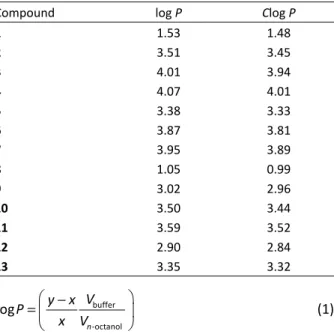
Table 2. Lipophilicity descriptors obtained experimentally (log P) and by theoretical calculation (Clog P)
Compound log P Clog P
1 1.53 1.48
2 3.51 3.45
3 4.01 3.94
4 4.07 4.01
5 3.38 3.33
6 3.87 3.81
7 3.95 3.89
8 1.05 0.99
9 3.02 2.96
10 3.50 3.44
11 3.59 3.52
12 2.90 2.84
13 3.35 3.32
buffer
-octanol log
n
V y x P
x V
−
=
(1)
where: P – partition coefficient; y – total mass of
benz-imidazole derivative (mg); X – mass of benzbenz-imidazole derivative in the buffer phase after partitioning (mg); Vbuffer – volume of phosphate buffer (cm
3
); Vn-octanol – volume of n-octanol (cm3). Each experimental log P value is the average of five determinations (Table 2). Statistical methods
The complete regression analysis was carried out by PASS 2005, GESS 2006, NCSS Statistical Software [26]. RESULTS AND DISCUSSION
The results of antibacterial studies of 14 benzimida-zole derivatives against Gram-positive bacteria Sarcina lutea are summarized in Table 3. As evident, all the compounds show noteworthy antibacterial activities against the tested bacteria. Consequently, the com-pounds with high value of pMIC (or low MIC) are the best antibacterial agents.
The antibacterial activity of the investigated benz-imidazoles was compared with the activity of well known commercial antibacterial agents (Ampicillin and Gentamicin) which were screened under similar con-ditions as reference drugs.
In an effort to determine the role of structural fea-tures, QSAR study was undertaken. A set of benzimi-dazoles consisting of fourteen molecules was used for model generation. The reference drugs were not in-cluded in model generation as they belong to a diffe-rent structural series. Inhibitory activity data (pMIC) were used as a dependent variable in the QSAR study.
The lipophilicity descriptors were used as indepen-dent variables and were correlated with inhibitory
acti-Table 3. Data of antibacterial activity obtained experimentally (pMICexp.) and by calculation (pMICpredict.)
Compound pMICexp. pMICpred. Residuals
Model 1 Model 2 Model 1 Model 2
1 4.635 4.510 4.525 0.125 0.110
2 4.435 4.527 4.529 –0.092 –0.094
3 3.488 3.439 3.590 0.049 –0.102
4 3.424 3.432 3.425 –0.008 –0.001
5 4.688 4.711 4.701 –0.023 –0.013
6 3.712 3.879 3.875 –0.167 –0.163
7 3.747 3.708 3.703 0.039 0.044
8 3.536 3.595 3.584 –0.059 –0.048
9 4.965 5.086 5.093 –0.121 –0.128
10 4.688 4.542 4.544 0.146 0.144
11 4.725 4.400 4.418 0.325 0.307
12 4.991 5.167 5.174 –0.176 –0.183
13 4.714 4.750 4.715 –0.036 –0.001
14 4.749 4.615 4.618 0.134 0.131
Ampicillin 4.446 – –
vity. The lipophilicity parameters tend to correlate with inhibitory activity, but in a more general case this rela-tionship is not linear. Therefore, a regression analysis was made resorting to both linear and quadratic. The statistical quality of the generated models is deter-mined by statistical measures: correlation coefficient, r, the standard error of estimation, s, and F-test (Fisher’s value) for statistical significance [27–29] (Table 4). The correlation coefficient is a relative measure of the fit by the regression equation. Correspondingly, it represents the part of variation in the observed data that is ex-plained by the regression. The correlation coefficient values closer to 1.0 represent the better fit of the re-gression. Standard deviation is measured by the error mean square, which expresses the variation of the re-siduals or the variation about the regression line. Thus, standard deviation is an absolute measure of the qua-lity of fit and should have a low value for the regression to be significant. The F-test reflects the ratio of the va-riance explained by the model and the vava-riance due to the error in regression. High values of the F-test indi-cate that the model is statistically significant.
It is observed that fitting equations improve when resorting to second order polynomials. In this ap-proach, two similar mathematical models were derived (Table 4). Both the models were derived using entire data set of compounds (n = 14) and no outliers were identified. It is noteworthy that the correlation between pMIC, and shake flask log P, as well as correlation between pMIC, and Clog P were equally significant. From the results, it can be concluded that theoretical calculated Clog P values can be used instead of log P values measured by the conventional shake-flask tech-nique. This is a rapid and reliable method to predict the antibacterial activity of this class of molecules.
However, there are three important components in any QSAR study: development of models, validation of models and utility of developed models. Validation is a crucial aspect of any QSAR analysis [30]. The statistical quality of the resulting models, as depicted in Table 4,
is determined by r, s and F [31–33].
For the testing the validity of the predictive power of selected models the LOO technique was used. The developed models were validated by the calculation of the following statistical parameters: PRESS, SSY, SPRESS,
r2CV and r2adj (Table 5).
These parameters were calculated from the follow-ing equations.
2 obs calc
( )
PRESS=
Y −Y (2)2 obs mean
( )
SSY=
Y −Y (3)PRESS
PRESS S
n
= (4)
2 CV 1
PRESS r
SSY
= − (5)
2 2
adj
1 1
1
n
r r
n p
−
= −
− −
(6)
where Yobs, Ycalc and Ymean are observed, calculated and mean values; n is the number of compounds; and p is the number of independent parameters.
PRESS is an acronym for prediction sum of squares. It is used to validate a regression model with regards to predictability. To calculate PRESS, each observation is individually omitted. The remaining n–1 observations are used to calculate a regression and estimate the value of the omitted observation. This is done n times, once for each observation. The difference between the actual Y value, Yobs, and the predicted Y, Ycalc, is called the prediction error. The sum of the squared prediction errors is the PRESS value. The smaller PRESS is, the better the predictability of the model. Its value being less than SSY points out that the model predicts better than chance and can be considered statistically signi-ficant. SSY are the sums of squares associated with the corresponding sources of variation. These values are in
Table 4. Statistical parameters of the best mathematical models for the prediction of antibacterial activity
Model Coefficient n r s F
1 Intercept 0.3514 14 0.9715 0.0233 92.2480
log P 3.8998
(log P)2 –0.7721
2 Intercept 0.5416 14 0.9728 0.0222 96.8987
Clog P 3.8451
(Clog P)2 –0.7795
Table 5. Cross-validation parameters
Model PRESS SSY PRESS/SSY SPRESS r
2
CV r
2 adj
1 0.4005 4.5605 0.0878 0.1691 0.9122 0.9335
terms of the dependent variable, Y.
The PRESS value above can be used to compute an r2CV statistic, called r2 cross validated, which reflects the prediction ability of the model. This is a good way to validate the prediction of a regression model without selecting another sample or splitting data. It is very possible to have a high r2 and a very low r2CV. When this occurs, it implies that the fitted model is data depen-dent. This r2CV ranges from below zero to above one. When outside the range of zero to one, it is truncated to stay within this range. Adjusted r-squared (r2adj) is an adjusted version of r2. The adjustment seeks to remove the distortion due to a small sample size.
In many cases r2CV and r2adj is taken as a proof of the high predictive ability of QSAR models. A high value of these statistical characteristic (> 0.5) is considered as a proof of the high predictive ability of the model. But, recent reports have proved the opposite [31]. Al-though, the low value of r2CV for the training set can in-deed serve as an indicator of a low predictive ability of a model, the opposite is not necessarily true. Indeed, the high r2CV does not imply automatically a high pre-dictive ability of the model. Thus, the high value of LOO r2CV is the necessary condition for a model to have a high predictive power, but it is not a sufficient condi-tion.
The only way to estimate the true predictive power of a model is to test its ability to predict accurately the biological activities of compounds.
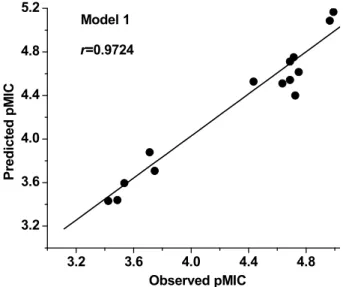
To confirm the predictive power of the models, the inhibitory activity of 14 molecules included in the study was calculated by the theoretical models (1) and (2). The data presented in Table 3 show that the observed and the estimated activities are very close to each other. It indicates the good predictability of the esta-blished models. Figure 1 shows the plots of linear reg-ression predicted versus experimental values of the antibacterial activity of benzimidazoles investigated. To investigate the existence of a systemic error in deve-loping the QSAR models, the residuals of predicted values of inhibitory activity were plotted against the experimental values in Figure 2. The propagation of the residuals on both sides of zero indicates that no sys-temic error exists in the development of regression mo-dels as suggested by Jalali-Heravi and Kyani [32]. It in-dicates that these models can be successfully applied to predict the antibacterial activity of this class of mole-cules.
Analysis of the results indicates that the antibac-terial activity exhibited by tested compounds is go-verned by the lipophilicity parameter, that is log P. It can be concluded that strong influence of the partition coefficient, log P, is important for the antibacterial activity and this parameter is usually related to phar-macological activity. This evidence was clearly
des-cribed in lipid theory advanced by Meyer and Overton [33,34]. According to this theory, log P is a measure of hydrophobicity which is important for the penetration and distribution of the drug, but also for the interaction of drug with receptors. The results of this study in-dicate that both shake flask log P and Clog P are equaly suitable for prediction of partition coefficient.
3.2 3.6 4.0 4.4 4.8
3.2 3.6 4.0 4.4 4.8 5.2
r=0.9724 Model 1
Observed pMIC
Predi
c
ted pM
IC
Figure 1. Relationship between pMIC values obtained experimentally and by calculation.
3.2 3.6 4.0 4.4 4.8
3.2 3.6 4.0 4.4 4.8 5.2
r=0.9728 Model 2
Observed pMIC
Predi
c
ted pM
IC
Figure 2. Relationship between the residual values and pMIC values obtained experimentally.
CONCLUSION
were developed for predicting the inhibitory activity of some benzimidazole derivatives. The validity of the mo-dels has been established by the determination of suit-able statistical parameters. The established models were used to predict inhibitory activity of the benzimi-dazoles investigated and close agreement between ex-perimental and predicted values was obtained. The low residual activity and high cross-validated r2 values (r2CV) observed indicated the predictive ability of the deve-loped QSAR models. It indicates that the antibacterial activity of series of 2-amino- and 2-methylbenzimida-zole derivatives can be successfully modeled using both shake flask log P and Clog P.
Acknowledgment
These results are part of the project No. 172012 and No. 172014 financially supported by the Ministry of Education, Science and Technological development of the Republic of Serbia, 2011-2014, and the project No. 114-451-2373/2011, financially supported by the Pro-vincial Secretariat for Science and Technological Deve-lopment of Vojvodina.
REFERENCES
[1] Z. Ates-Alagoz, S. Yildiz, E. Buyukbingol, Antimicrobial activities of some tetrahydronaphthalene-benzimida-zole derivatives, Chemotherapy 53 (2007) 110–113. [2] P.T.M. Nguyen, J.D. Baldeck, J. Olsson, R.E. Marquis,
Antimicrobial actions of benzimidazoles against oral streptococci, Oral Microbiol. Immunol. 20 (2005) 93–99. [3] G. Ayhan-Kilcigil, N. Altanlar, Synthesis and antifungal
properties of novel benzimidazole derivatives, Turk. J. Chem. 30 (2006) 223–228.
[4] H. Goker, M. Alp, S. Yildiz, Synthesis and Potent Anti-microbial activity of some novel N-(alkyl)-2-phenyl-1H -benzimidazole-5-carboxamidines, Molecules 10 (2000) 1377–1386.
[5] S.O. Podunavac-Kuzmanović, D.D. Cvetković, Anion ef-fect on antimicrobial activity of metal complexes with benzimidazole derivative, Chem. Ind. Chem. Eng. Q. 13
(2007) 68–71.
[6] M. Boiani, M. Gonzalez, Imidazole and benzimidazole derivatives as chemotherapeutic agents, Mini Rev. Med. Chem. 5 (2005) 409–415.
[7] L. Garuti, M. Roberti, C. Cermelli, Synthesis and antivirial activity of some N-benzenesulphonyl-benzemidazoles, Bioorg. Med. Chem. Lett. 9 (1999) 2525–2530.
[8] Z. Kazimierczuk, J.A. Upcroft, P. Upcroft, A. Gorska, B. Starosciak, A. Laudy, Synthesis, antiprotozoal and anti-bacterial activity of nitro- and halogeno- substituted benzimidazole derivatives, Acta Biochim. Polon. 49-1
(2002) 185–195.
[9] A. Akbay, I. Oren, O. Temiz-Arpaci, E. Aki-Sener, I. Yalcin, Synthesis and HIF-1 reverse transcriptase inhibitor acti-vity of some 2,5,6-substituted benzoxazole, benzimi-dazole, benzothiazole and oxazolo(4,5-b)pyridine deri-vatives, Arzneim.-Forcsh./Drug Res. 53 (2003) 266–271.
[10] D.R. Bevan, QSAR and Drug Design, Network Science,
http://www.netsci.org/Science/Compchem/fea-ture12.html (accessed Feb, 2013).
[11] QSAR, The Australian Computational Chemistry via the Internet Project, www.chem.swin.edu.au/modukes/ mod4/index.html (accessed Feb, 2013).
[12] C. Hansch, On the structure of medicinal chemistry, J. Med. Chem. 19 (1976) 1–6.
[13] A. Leo, C. Hansch, D. Elkins, Partition coefficients and their uses, Chem. Rev. 71 (1971) 525–616.
[14] S.O. Podunavac-Kuzmanović, D.D. Cvetković, Lipophili-city and antifungal activity of some 2-substituted benz-imidazole derivatives, Chem. Ind. Chem. Eng. Q. 17
(2011) 9–15.
[15] S.O. Podunavac-Kuzmanović, D.D. Cvetković, QSAR mo-deling of antibacterial activity of some benzimidazole derivatives, Chem. Ind. Chem. Eng. Q. 17 (2011) 33–38. [16] N.U. Perišić-Janjić, S.O. Podunavac-Kuzmanović, RPTLC
study of QSRR and QSAR for some benzimidazole deri-vatives, J. Planar Chromatogr. 21 (2008) 135–141. [17] N.U. Perišić-Janjić, S.O. Podunavac-Kuzmanović, J.S.
Ba-laž, Đ. Vlaović, Chromatographic behaviour and lipophi-licity of some benzimidazole derivatives, J. Planar Chro-matogr. 13 (2000) 123–129.
[18] S.O. Podunavac-Kuzmanović, D.D. Cvetković, D.J. Barna, The effect of lipophilicity on the antibacterial activity of some 1-benzylbenzimidazole derivatives, J. Serb. Chem. Soc. 73 (2008) 967–978.
[19] S.O. Podunavac-Kuzmanović, D.D. Cvetković, D.J. Barna, Correlations between the lipophilicity and the inhibitory activity of different substituted benzimidazoles, Chem. Ind. Chem. Eng. Q. 15 (2009) 125–130.
[20] S.O. Podunavac-Kuzmanović, D.D. Cvetković, D.J. Barna, QSAR Analysis of 2-Amino or 2-Methyl-1-Substituted Benzimidazoles Against Pseudomonas aeruginosa, Int. J. Mol. Sci. 10 (2009) 1670–1682.
[21] S.O. Podunavac-Kuzmanović, S.L. Markov, D.J. Barna, Relationship between the lipophilicity and antifungal activity of some benzimidazole derivatives, J. Theor. Comp. Chem. 6 (2007) 687–698.
[22] Đ. Vlaović, J. Čanadanović-Brunet, J. Balaž, I. Juranić, D. Đoković, K. Mackenzie, Synthesis, antibacterial, and antifungal activities of some new benzimidazoles, Biosci. Biotech. Biochem. 56 (1992) 199–206.
[23] National Committee for Clinical Laboratory Standards, NCCLS Approval Standard Document M2-A7, Vilanova, Pa, U.S.A., 2000.
[24] National Committee for Clinical Laboratory Standards, NCCLS Approval Standard Document M7-A5, Vilanova, Pa, U.S.A., 2000.
[25] CS. Chem. Office, Version 7.0, Cambridge Soft Corpo-ration, 100 Cambridge Park Drive, Cambridge, MA 02140-2317, U.S.A., 2001.
[26] NCSS Statistical Software, www.ncss.com (accessed Feb, 2013).
[27] G.W. Snedecor, W.G. Cochran, Statistical Methods, Oxford and IBH, New Delhi, 1967.
[29] M.V. Diudea, QSPR/QSAR Studies for Molecular Des-criptors, Nova Science, Huntingdon, New York, 2000. [30] J.G. Topliss, R.P. Edwards, Chance factors in studies of
quantitative structure-activity relationships, J. Med. Chem. 22 (1979) 1238–1244.
[31] A. Golbraikh, J. Tropsha, Beware of q2!, J. Mol. Graph. Mod. 20 (2002) 269–276.
[32] M. Jalali-Heravi, A. Kyani, Use of computer-assisted methods for the modeling of the retention time of a va-riety of volatile organic compounds: A PCA-MLR-ANN
Approach, J. Chem. Inf. Comput. Sci. 44 (2004) 1328– –1335.
[33] H.H. Meyer, Zur theorie der alkoholnarkose. Der einfluss wechseinder temperature angsstarke auf wirkungs-starke und theilungscoefficient der narcotica, Arch. Exp. Pathol. Pharmacol. 46 (1901) 338–346.
[34] C.E. Overton, Studies of narcosis and a contribution to general pharmacology, in: Studies of Narcosis, R.L. Lipnick, Ed., Chapman and Hall and the Wood Library and the Museum of Anaesthesiology, London, 1991.
IZVOD
PRIMENA QSAR MODELA U ANALIZI ANTIBAKTERIJSKE AKTIVNOSTI NEKIH DERIVATA BENZIMIDAZOLA PREMA Sarcina lutea
Sanja O. Podunavac-Kuzmanović, Dragoljub D. Cvetković, Lidija R. Jevrić, Nataša U. Uzelac Univerzitet u Novom Sadu, Tehnološki fakultet, Novi Sad, Srbija
(Naučni rad)
U ovom radu, urađena je analiza kvantitativne zavisnosti struktura-aktivnost (QSAR) u okviru serije derivata 2-metil i 2-aminobenzimidazola, da bi se utvrdio uticaj lipofilnosti molekula na njihovu inhibitornu aktivnost prema bakteriji Sar-cina lutea. Ispitivana jedinjenja in vitro pokazuju antibakterijsku aktivnost i za sva jedinjenja određena je minimalna inhibitorna koncentracija (MIC). Za ispitivana jedinjenja koeficijenti raspodele određeni su shake flask metodom (log P) i teoret-skim izračunavanjem (Clog P). Ispitane su zavisnosti između deskriptora
lipofil-nosti i antibakterijske aktivlipofil-nosti i razvijeni su matematički modeli za predviđanje inhibitorne aktivnosti ove grupe jedinjenja. Kvalitet modela potvrđen je LOO (leave-one-out) tehnikom, kao i izračunavanjem statističkih parametara za
postav-ljene modele.QSAR analiza pokazala je značajan uticaj lipofilnosti na inhibitornu aktivnost ispitivane serije benzimidazola prema Sarcina lutea.
Ključne reči: Benzimidazol • QSAR •