Braz Dent J 13(3) 2002
162 R.C. Albuquerque et al.
Effects of a 10% Carbamide Peroxide Bleaching
Agent on Rat Oral Epithelium Proliferation
Rodrigo de Castro ALBUQUERQUE1 Ricardo Santiago GOMEZ2 Rodrigo Aliprandi DUTRA1 Wallison Arthuso VASCONCELLOS1
Renato Santiago GOMEZ3 Marcus Vinícius GOMEZ4
1Department of Restorative Dentistry, School of Dentistry 2Department of Oral Surgery and Pathology, School of Dentistry
3Department of Surgery, School of Medicine 4Department of Pharmacology, Institute of Biological Sciences
Federal University of Minas Gerais, Belo Horizonte, MG, Brazil
The purpose of the present study was to evaluate the influence of short course topical application of carbamide peroxide on proliferating cell nuclear antigen (PCNA) immunohistochemical expression in the oral tongue mucosa of rats. Twelve male Wistar rats were submitted to topical application of 10% carbamide peroxide on one side of the dorsal tongue once a week for three consecutive weeks. Only distilled water was applied on the control side. The animals were killed on days 0, 10, and 20 after the last application. The tongue was fixed in buffered formalin for 24 h and embedded in paraffin. Tissue blocks (3 µm) were subjected to the biotin-streptavidin amplified system for identification of PCNA. The percentage of epithelial-positive basal cells in each side of the tongue mucosa was calculated. The results demonstrated that topical application of 10% carbamide peroxide increases PCNA immunohistochemical expression on the basal layer of the oral mucosa epithelium of rats on day 0 after treatment. In conclusion, short-course use of carbamide peroxide induces transient epithelial cell proliferation of the oral mucosa of rats.
Key Words: carbamide peroxide, immunocytochemistry, oral mucosa, proliferating cell nuclear antigen, carcinogenesis.
Correspondence: Dr. Ricardo Santiago Gomez, Departamento de Clínica, Patologia e Cirurgia, Faculdade de Odontologia, Universidade Federal de Minas Gerais, Avenida Antônio Carlos 6627, 31270-901 Belo Horizonte, MG, Brasil. Tel: +55-31-3499-2477. Fax: +55-31-3499-2472. E-mail: [email protected]
ISSN 0103-6440
INTRODUCTION
Bleaching of vital teeth is becoming a more commonly used treatment in the dental office. Some years ago, a technique for bleaching vital teeth involv-ing the topical application of 10% carbamide peroxide was introduced (1). Significant controversy has been generated regarding the risk of tissue damage from contact of the agent with the oral mucosa (2-7).
The proliferating cell nuclear antigen (PCNA), an auxiliary protein of DNA polymerase delta, is con-sidered to be related to cell proliferation (8). This protein has been shown to fluctuate during the cell cycle and to increase in late G1 and S phases. Some studies have proposed that PCNA
immunohistochemi-cal expression can be used to provide information regarding tumor differentiation, proliferation, and prog-nosis (9-11).
Concerns about the safety of the chronic use of carbamide peroxides on oral mucosa still exist in the literature (2-7). Although some studies have addressed the carcinogenic or cocarcinogenic activity of bleach-ing agents (7,12), the long protocol used by the authors to assess the results makes the extrapolation to at-home tooth bleaching treatments difficult. Therefore, the pur-pose of the present study was to evaluate oral epithelial cell proliferation in rats after short course application of 10% carbamide peroxide. The epithelial cell prolifera-tion index was estimated by the immunohistochemical expression of PCNA.
Braz Dent J 13(3) 2002 Effect of carbamide peroxide on rat oral epithelium proliferation 163
MATERIAL AND METHODS
Twelve male Wistar rats weighing 190 to 255 g were used in the experiments. The animals were al-lowed free access to standard pellet chow and water. At the time of the study there were no clinical signs of disease in any animal. The rats were anesthetized with an intraperitoneal injection mixture of ketamine (72 mg/kg body weight, Ketalar, Parke-Davis, Itapira, SP, Brazil) and xylazine (11 mg/kg body weight, Rompun, Bayer, São Paulo, SP, Brazil) as previously described (13). Intraperitoneal injections were given with animals in dorsal recumbence and they were allowed to recover on a 38 x 28 cm dry base pad in a warm draught-free room. About 200 mg of 10% carbamide peroxide (Opal-escence, Ultradent Products, South Jordan, UT, USA) was applied on one side of the dorsal tongue for 20 min. The tongue surface was washed with distilled water before and after this procedure. Only distilled water was applied on the control side. During the experiments no spread of the bleaching agent around the mouth was observed. The procedures were done once a week for three consecutive weeks. Groups of 4 animals were killed on days 0, 10, and 20 after the last treatment. Day 0 was immediately after the last treatment. The tongue was removed, cut sagitally, fixed in 10% buffered formalin for 24 h and embedded in paraffin.
Immunohistochemical Methods
Tissue blocks were cut at 3 µm and subjected to the biotin-streptavidin amplified system. To improve PCNA immunohistochemical expression, microwave
stimulation was carried out as described by Shi et al. (14). The sections were submitted to a microwave in a citrate buffer pre-treatment (pH 6.0, 10 mM) for 15 min. The samples were then immersed in 3% methanol-hydrogen peroxide solution for 10 min to block endogenous peroxidase activity, washed in tris-HCl buffer (pH 7.4) and incubated with anti-PCNA (Clone PC10, 1:3000 Sigma, St. Louis, MO, USA) in 5 mM tris-HCl buffer for 18 h at 4oC. After washing in tris-HCl buffer (pH 7.4), the sections were incubated at room temperature with 1) biotinylated swine anti-goat, mouse and rabbit immunoglobulin (DAKO, Carpinteria, CA, USA) diluted 1:150 in tris-HCl for 30 minutes; 2) washed with tris-HCl twice for 10 min; 3) incubated for 30 min with horseradish peroxidase-conjugated streptavidin (DAKO) prepared according to the manu-facturer instructions; 4) washed with tris-HCl; 5) incubated for 3 min with 0.01% diamine benzidine tetrahydrochloride (DAB) and 0.03% H2O2 in 5 mM tris-HCl buffer (pH 7.4); 6) rinsed in distilled H2O for 10 min and counterstained with Mayer’s hematoxylin. To avoid false positive results, a series of tissue sections were stained with omission of the pri-mary antibody or using adsorbed pripri-mary antibody with purified PCNA protein (25 ng PCNA per ml of anti-PCNA antibody diluted 1:3000 tris-HCl). Oral squa-mous cell carcinoma tissues were used as positive controls.
Cell Quantification and Statistical Analysis
The expression of PCNA was quantitatively ana-lyzed. Epithelial cells were considered to be positive if there was any staining of the nucleus, regardless of staining intensity. Six high-power microscopic fields (400X) were selected in each side of the dorsal tongue (experimental and control). Since PCNA is mainly expressed at the basal layer of the epithelium, it was calculated by the percentage of immunopositive basal cells. The total number of basal cells along the six microscopic fields and the number of basal cells stained were assessed. As the control and experimental speci-mens were obtained simultaneously from the tongue of the same animal and percentage does not conform to normal distribution, the Wilcoxon signed rank test was used for statistical analysis. The values were consid-ered significantly different when the p value was less than 0.05.
Braz Dent J 13(3) 2002
164 R.C. Albuquerque et al.
RESULTS
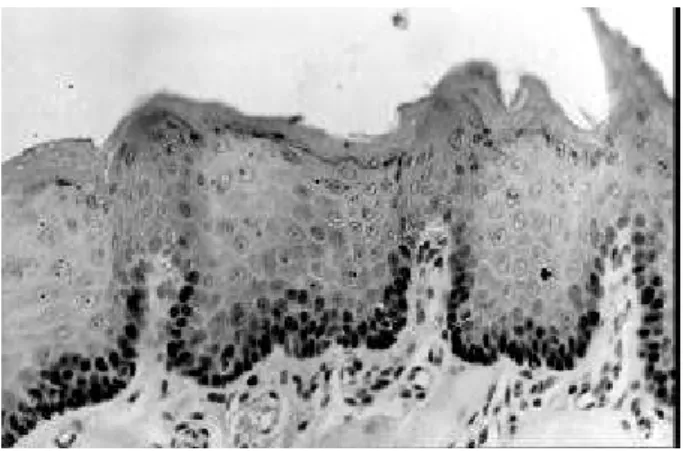
PCNA staining was mainly observed on the ba-sal layer of the tongue mucosa (Figure 1). The percentage of positive basal cells on the treated and on the non-treated side of the epithelium of the dorsal tongue on days 0, 10 and 20 is shown in Figure 2. The mean percentage of PCNA immunostaining on the side treated with carbamide peroxide was greater than on the con-trol side of the mucosa on day 0 after the last application (p=0.0053). On days 10 and 20, no difference was observed between the experimental and control side of the mucosa.
DISCUSSION
Although non-cycling cells may express PCNA immunoreactivity - possibly due to increased PCNA-mRNA stability induced by growth factor (15) - it is used as an indicator of cellular proliferation (9-11). Our results showed that topical application of carbamide peroxide increased transitorily PCNA expression on the basal layer of the oral mucosa epithelium of rats. This finding partly explains those reported by Weitzman et al. (16), who studied the effects of twice weekly topical application of 30% hydrogen peroxide and/or DMBA on the buccal epithelium of Syrian hamsters. They observed that the buccal mucosa of all animals treated with peroxide hydrogen alone showed hyper-keratosis and hyperplasia. Although no clinical evi-dence of mucosa alterations was detected in our study, the present data suggested increased epithelium turn-over induced by short-course application of carbamide peroxide.
The carcinogenic potentiality of bleaching agents is controversial. Hyperchromatic cells and mild dyspla-sia induced by bleaching agents is reported in the oral mucosa of experimental animals (16). On the other hand, additional studies did not confirm that hydrogen peroxide is carcinogenic or cocarcinogenic (12). In the present study, the carcinogenic activity of carbamide peroxide was not directly investigated. The short-course protocol of treatment did not induce any cytological atypia. Futhermore, increased PCNA expression in the experimental side of the mucosa was observed only on day 0. On days 10 and 20 after the last application, no difference was noted between the experimental and control groups (Figure 2). Probably in order for PCNA to be continuously expressed in the experimental side of the oral mucosa, continuous application of carba-mide peroxide would have to be carried out until the cells became completely autonomous.
It is well known that carcinogenesis is a multi-step process that involves chromosomal instability in transformed cells. Even considering relevant the transi-tory cellular proliferation induced by carbamide peroxide, this event constitutes only one of these mul-tiple steps. Since some chemical irritants might produce similar results, the present finding does not necessarily indicate tumor initiation. Futhermore, the hypothesis that topical use of carbamide peroxide could augment carcinogenesis associated with other carcinogens must be evaluated in additional studies using long-course application of this agent. Although there is no reliable specific marker for early carcinogenesis transforma-tion, it would be interesting in the future to evaluate the effects of carbamide peroxide on some oncogenes (MDM2) and tumor suppressor genes (p53, PTCH) regulation.
In conclusion, our findings show that short-course use of carbamide peroxide increases transitorily epithelial cell proliferation of rat oral mucosa. Further immunohistochemical and molecular investigations are necessary to elucidate the influence of bleaching agents on cell cycle regulation and cancer development.
ACKNOWLEDGMENTS
This study was supported by Conselho Nacional de Desenvolvimento Científico e Tecnológico (CNPq), Fundação de Amparo à Pesquisa do Estado de Minas Gerais (FAPEMIG) and PRONEX. Drs. R.S. Gomez
Figure 2. Mean percentage of PCNA immunopositive basal cells on the tongue mucosa at 0, 10 and 20 days after topical application of 10% carbamide peroxide once a week for 3 consecutive weeks. *p = 0.0053 (Wilcoxon signed rank test).
0 20 40 60 80 100
PCNA + Cells
0 10 20
Days
Experimental Control
Braz Dent J 13(3) 2002 Effect of carbamide peroxide on rat oral epithelium proliferation 165
and M.V. Gomez are research fellows of CNPq.
RESUMO
Albuquerque RC, Gomez RS, Dutra RA, Vasconcellos WA, Gomez RS, Gomez MV. Efeito do agente clareador contendo peróxido de carbamida a 10% na proliferação do epitélio oral de ratos. Braz Dent J 2002;13(3):162-165.
O propósito do presente estudo foi avaliar a influência da aplicação tópica de peróxido de carbamida na expressão imunohistoquímica do antígeno nuclear de proliferação celular (PCNA) na mucosa oral da língua de ratos. Doze ratos Wistar machos foram selecionados e submetidos a aplicação tópica de peróxido de carbamida a 10% sobre um lado do dorso da língua. O tratamento foi feito uma vez por semana por três semanas consecutivas. Água destilada foi aplicada no lado controle. Os animais foram sacrificados nos dias 0, 10, e 20 depois da última aplicação. A língua foi fixada em tampão de formalina por 24 horas e embebido em parafina. Cortes de tecido de 3 µm foram submetidos ao sistema de amplificação streptavidina-biotina para identificação do PCNA. A porcentagem de células basais epiteliais positivas em cada lado da mucosa da lingua foi calculada (experimental e controle). O resultado demonstrou que a aplicação tópica de peróxido de carbamida a 10% aumenta a expressão imunohistoquímica do PCNA na camada basal do epitélio da mucosa oral de ratos no dia 0 depois do tratamento. Concluiu-se que a uso em curto período de peróxido de carbamida a 10% induz proliferação celular epitelial transitória da mucosa oral de ratos.
Unitermos: peróxido de carbamida, imunohistoquímica, mucosa oral, antígeno nuclear de proliferação celular, carcinogênese.
REFERENCES
1. Haywood VB, Heymann HO. Nightguard vital bleaching. Quin-tessence Int 1989;20:173-176.
2. Woolverton CJ, Haywood VB, Heymann HO. Toxicity of two carbamide peroxide products used in nightguard vital bleaching. Am J Dent 1993;6:310-314.
3. Curtis JW, Dickinson GL, Downey MC. Assessing the effects of 10 percent carbamide peroxide on oral soft tissues. J Am Dent Assoc 1996;127:1218-1223.
4. Rosenstiel SF, Gagauff AG, Johnston WM. Randomized clinical trial of the efficacy and safety of a home bleaching procedure. Quintessence Int 1996;27:413-424.
5. Floyd RA. The effect of peroxides and free radicals on body tissues. J Am Dent Assoc 1997;128:37S-40S.
6. Ly Y. Tooth bleaching using peroxide-containing agents: Current status of safety issues. Compedium 1998;19:783-794.
7. Pieroli DA, Navarro, MFL, Consolaro A. Evaluation of the carci-nogenic potential of bleaching agents in a DMBA induction-model. Oral Med Pathol 2000;5:29-34.
8. Bravo R, Frank R, Blundell PA, MacDonald-Bravo H. Cyclin/ PCNA is the auxiliary protein of polymerase. Nature 1987;326:515-517.
9. Coltrera MD, Zarbo RJ, Sakr WA, Gown AM. Markers for dys-plasia of the upper aerodigestive tract. Suprabasal expression of PCNA, p53 and CK 19 in alcohol-fixed, embedded tissue. Am J Pathol 1992;141:817-825.
10. McCormick D, Hall PA. The complexities of proliferating cell nuclear antigen. Histopathol 1992;21:591-594.
11. Huang WYF, Coltrera M, Shubert M, Morton T, Truelov E. Histopathologic evaluation of proliferating cell nuclear antigen (PC10) in oral epithelial hyperplasias and premalignant lesions. Oral Surg Oral Med Oral Pathol 1994;78:748-754.
12. Marshall MV, Kuhn JO, Torrey CF. Hamster cheek pouch biossay of dentrifice containing hydrogen peroxide and baking soda. J Am Coll Toxicol 1996;15:45-61.
13. Smith W. Responses of laboratory animals to some injectable anaesthetics. Laboratory Animals 1993;27:30-39.
14. Shi SR, Cote RJ, Taylor CR. Antigen retrieval in immunohis-tochemistry: Past, present, and future. J Histochem Cytochem 1997;45:327-343.
15. Mighell A. PCNA and p53. Oral Oncol Eur J Cancer 1995;31B:403-404.
16. Weitzman AS, Weitberg AB, Stossel TP, Schwartz J, Shklar G. Effects of hydrogen peroxide on oral carcinogenesis in hamsters. J Periodontol 1986;57:685-688.